Colistin and Polymyxin B Dosage Regimens against
Acinetobacter
baumannii
: Differences in Activity and the Emergence of Resistance
Soon-Ee Cheah,aJian Li,aBrian T. Tsuji,bAlan Forrest,b,cJürgen B. Bulitta,a,dRoger L. Nationa
Drug Delivery, Disposition and Dynamics, Monash Institute of Pharmaceutical Sciences, Monash University (Parkville Campus), Parkville, Victoria, Australiaa; Laboratory of
Antimicrobial Pharmacodynamics, Department of Pharmacy Practice, University of Buffalo, Buffalo, New York, USAb; Division of Pharmacotherapy and Experimental
Therapeutics, University of North Carolina Eshelman School of Pharmacy, Chapel Hill, North Carolina, USAc; Center for Pharmacometrics and Systems Pharmacology,
Department of Pharmaceutics, College of Pharmacy, University of Florida, Orlando, Florida, USAd
Infections caused by multidrug-resistant
Acinetobacter baumannii
are a major public health problem, and polymyxins are often
the last line of therapy for recalcitrant infections by such isolates. The pharmacokinetics of the two clinically used polymyxins,
polymyxin B and colistin, differ considerably, since colistin is administered as an inactive prodrug that undergoes slow
conver-sion to colistin. However, the impact of these substantial pharmacokinetic differences on bacterial killing and resistance
emer-gence is poorly understood. We assessed clinically relevant polymyxin B and colistin dosage regimens against one reference and
three clinical
A. baumannii
strains in a dynamic one-compartment
in vitro
model. A new mechanism-based pharmacodynamic
model was developed to describe and predict the drug concentrations and viable counts of the total and resistant populations.
Rapid attainment of target concentrations was shown to be critical for polymyxin-induced bacterial killing. All polymyxin B
reg-imens achieved peak concentrations of at least 1 mg/liter within 1 h and caused
>4 log
10killing at 1 h. In contrast, the slow rise
of colistin concentrations to 3 mg/liter over 48 h resulted in markedly reduced bacterial killing. A significant (4 to 6 log
10CFU/
ml) amplification of resistant bacterial populations was common to all dosage regimens. The developed mechanism-based model
explained the observed bacterial killing, regrowth, and resistance. The model also implicated adaptive polymyxin resistance as a
key driver of bacterial regrowth and predicted the amplification of preexisting, highly polymyxin-resistant bacterial populations
following polymyxin treatment. Antibiotic combination therapies seem the most promising option for minimizing the
emer-gence of polymyxin resistance.
T
he rise of multidrug-resistant (MDR) Gram-negative
patho-gens, such as
Acinetobacter baumannii, presents a global threat
to public health (
1
,
2
). The number of antibiotics that remain
effective for the treatment of infections caused by these pathogens
continues to dwindle at an alarming rate, with few novel
alterna-tives in late-phase clinical development (
3
). This has driven a
re-surgence in the use of polymyxins to treat recalcitrant infections
that are resistant to most or all other currently available antibiotics
(
4
). The two clinically used polymyxins, colistin and polymyxin B,
differ substantially in clinical pharmacokinetics (PK) due to
dif-ferences in administered form. Although colistin and polymyxin B
have long been regarded as equivalent, clinical studies in critically
ill patients have revealed considerable differences in their PK (
5–
12
). Given the importance of polymyxins as last-line therapy,
de-veloping innovative dosage regimens for polymyxins will be
crit-ical to maintaining their efficacy against MDR pathogens.
Clinically, polymyxin B is administered in its active form
whereas colistin (polymyxin E) is administered as its inactive
pro-drug colistin methanesulfonate (CMS), which subsequently
un-dergoes slow conversion to colistin in patients (
13
). CMS is
elim-inated rapidly via the renal route in parallel with its gradual
conversion to colistin, and consequently a large proportion of
CMS is eliminated as CMS prior to conversion (
14
). Even when
CMS loading doses are used, the low rate of conversion from CMS
to colistin leads to delayed attainment of effective colistin
concen-trations (
8
). Conversely, administration of polymyxin B in its
ac-tive form allows target concentrations to be rapidly attained.
A clear association between the timely initiation of appropriate
antimicrobial therapy and patient survival has been established
for conditions such as ventilator-associated pneumonia and septic
shock (
15–17
). In light of this relationship, the differences in the
concentration-versus-time profiles of polymyxin B and colistin
may have a substantial impact on bacterial killing and clinical
outcomes. The differences in bacterial killing and the emergence
of resistance for polymyxin B and colistin during the initial stages
of polymyxin therapy with clinically relevant dosage regimens
have not been investigated.
The first aim of this study was to investigate, in
A. baumannii,
the effect of polymyxin concentration-versus-time profiles from
standard and innovative (e.g., front-loading or augmented
load-ing dose) dosage regimens on bacterial killload-ing and emergence of
resistance during the initial stages of polymyxin therapy. The
sec-ond aim was to quantitatively characterize and predict the impact
of polymyxin dosage regimens on antimicrobial activity and the
emergence of resistance by developing a novel, mechanism-based
mathematical model. To address these aims, experimental data
from a dynamic one-compartment
in vitro
infection model (IVM)
were integrated with pharmacokinetic/pharmacodynamic (PK/
Received6 December 2015 Returned for modification8 February 2016 Accepted5 April 2016
Accepted manuscript posted online11 April 2016
CitationCheah S-E, Li J, Tsuji BT, Forrest A, Bulitta JB, Nation RL. 2016. Colistin and polymyxin B dosage regimens againstAcinetobacter baumannii: differences in activity and the emergence of resistance. Antimicrob Agents Chemother 60:3921–3933.doi:10.1128/AAC.02927-15.
Address correspondence to Roger L. Nation, [email protected].
J.B.B. and R.L.N. are joint senior authors.
Copyright © 2016, American Society for Microbiology. All Rights Reserved.
PD) modeling, enabling the interrogation and prediction of
bac-terial killing and regrowth for clinically relevant polymyxin dosage
regimens.
MATERIALS AND METHODS
Bacterial strains and isolates.One reference strain and three previously reported (18–20) clinical isolates were examined in this study. These were
A. baumanniiATCC 19606 (MIC, 0.5 mg/liter), FADDI-AB008 (MIC, 0.5 mg/liter; described in reference19as isolate 8), FADDI-AB030 (MIC, 0.5 mg/liter; described in reference20as strain 248-01-C.248), and AB307-0294 (MIC, 1 mg/liter). The polymyxin B and colistin MIC values were identical for each of the strains.A. baumanniiATCC 19606 and FADDI-AB008 have previously been identified as being heteroresistant (19), con-sisting of predominantly polymyxin-susceptible bacteria but with a small subpopulation of polymyxin-resistant bacteria (21). Population analysis profiles (PAPs) forA. baumanniistrain AB307-0294 showed evidence of heteroresistance, while there was no evidence for heteroresistance in suscep-tible strain FADDI-AB030. InA. baumanniiATCC 19606, polymyxin resis-tance can occur via the modification of lipid A with phosphoethanolamine (22) or the loss of lipopolysaccharide (LPS) from the outer membrane (23). In the case of FADDI-AB008, only one mechanism of polymyxin resistance has been reported, namely, the loss of LPS from the outer membrane (23).
Comparison of clinically relevant colistin and polymyxin B dosage regimens.An IVM was used to simulate clinically relevant pharmacoki-netic profiles for polymyxin B and colistin. The experimental setup for the
IVM did not employ a filter and was identical to that used in previously published studies (24), except where described below. For each dosage regimen and bacterial strain, an elimination half-life (t1/2) of 11.6 h and an
average steady-state concentration (Css,avg) of 3 mg/liter were simulated in the IVM, guided by the results of previously published population PK studies in critically ill patients (5,8,9,25). Specifically, the elimination half-life was chosen to be within the range of values reported (9 to 13 h) for colistin formed from CMS and polymyxin B. Colistin and polymyxin B are approximately 50% bound in plasma of critically ill patients (9,26,
27). TheCss,avgof 3 mg/liter chosen for the studies in the IVM was selected
to represent the upper region of clinically achievable unbound concentra-tions of each of the polymyxins. For colistin, an unboundCss,avgof 3 mg/liter represents the accumulation of colistin observed by Garonzik et al. (5) for a patient with moderate renal impairment (creatinine clearance, ⬃50 ml/min/1.73 m2) receiving a daily maintenance CMS dose of⬃300
to 360 mg colistin base activity (CBA). A loading dose to more rapidly attain a concentration of 3 mg/liter was not included because 300 to 360 mg CBA is in the vicinity of the upper limit of the recommended loading dose (28). For polymyxin B, an unboundCss,avgof 3 mg/liter falls within
the 90th percentile for a patient receiving a maintenance dose of 3 mg/kg per day reported by Sandri et al. (9).
The dosage regimens examined in the IVM (Fig. 1) were as follows: the gradual accumulation of colistin with a half-life of 11.6 h, adapted from previously reported (8) concentration-time profiles predicted for the ini-tiation of therapy with CMS with no loading doses (regimen R1); poly-FIG 1Concentration-time profiles for colistin base (A) and polymyxin B base (B to D) of simulated (t1/2⫽11.6 h,Css,avg⫽3 mg/liter) clinically relevant
myxin B, 1-h infusion every 12 h with no loading dose (R2); regimen R2 with a loading dose to rapidly achieve the steady-state concentration (R3); and regimen R2 initiated with an augmented loading dose to achieve an initial peak concentration of 6 mg/liter polymyxin B base with a subse-quent decline to aCss,avgof 3 mg/liter (R4).
The volume and temperature of the central reservoir were 80 ml and 37°C, respectively, and cation-adjusted Mueller-Hinton broth was circu-lated at a rate of 4.8 ml/h to achieve an elimination half-life of 11.6 h. Viable counting was performed on drug-free and drug-containing (6.6 mg/liter polymyxin B base) plates at 0, 0.5, 1, 2, 4, 8, 11, 13, 23, 25, 26, 28, 47, 49, 50, 52, 71, 73, 74, 76, and 96 h. The PAPs were performed at 0, 23, 47, 71, and 96 h on polymyxin B-containing plates (1.7, 3.3, and 6.6 mg/liter polymyxin B base). Polymyxin B and colistin concentrations were measured using a previously described and validated liquid chroma-tography-tandem mass spectrometry assay (29).
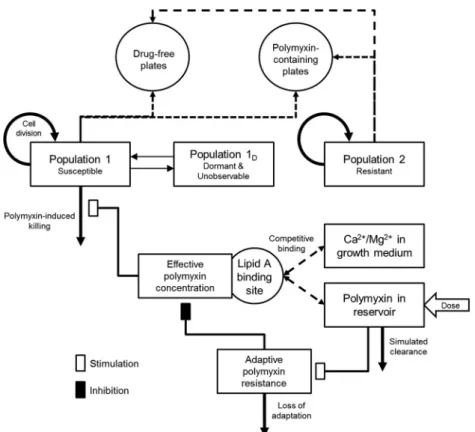
Mechanism-based modeling.A mathematical model was developed and fitted to the experimental data for each strain to correlate the time course of polymyxin concentrations with bacterial killing and the emer-gence of resistance (Fig. 2). The PK of polymyxin B or colistin in the IVM was described by a one-compartment model with first-order elimination. The mechanism-based PD model contained growth of multiple bacterial populations, polymyxin target site binding, bacterial killing, and adaptive polymyxin resistance (30,31).
Bacterial growth model.For eachA. baumanniistrain, bacterial cells were partitioned into 3 populations: polymyxin-susceptible (CFUS,
equa-tion 1), polymyxin-resistant (CFUR, equation 2), and dormant (i.e., non-replicating or extremely slowly non-replicating; PopD, equation 3) bacteria.
Replication of polymyxin-susceptible and -resistant bacteria was modeled as a first-order process, with separate growth rate constants for each pop-ulation. The total bacterial population for each strain was constrained by a logistic growth term that defined the maximum population size (32).
dCFUS
dt ⫽CFUS⫻
冋
kgrowth,S⫻冉
1⫺CFUtotal
CFUmax
冊
⫻共
1⫺Fcost
兲
⫺Killpolymyxin,eff⫺kSD⫺
CL
V
册
⫹kDS⫻PopD (1) dCFURdt ⫽CFUR⫻
冋
kgrowth,R ⫻冉
1⫺CFUtotal
CFUmax
冊
⫺CL
V
册
(2)dPopD
dt ⫽kSD⫻CFUS⫺
冉
kDS⫹CL
V
冊
⫻PopD (3)The parameters in these equations are explained in detail inTable 1
andFig. 2. The resistant population was assumed to be totally resistant, and therefore, equation 2 lacked a term for killing. Polymyxin-susceptible bacteria were allowed to transition, in both directions, into and out of a dormant state via a first-order process that rendered these cells both tol-erant to polymyxin-induced killing and also nonobservable by viable counting. The presence of viable but nonculturable bacterial cells has been documented previously (33,34); however, the impact of this phenome-non on polymyxin activity and the emergence of resistance has not been elucidated.
Polymyxin activity.A previously reported model was used to describe the binding of polymyxin to its initial bactericidal target, the lipid A moi-ety of LPS on the bacterial outer membrane (30). This model accounts for the competitive displacement of bound divalent cations (Fbound,cations;
Ca2⫹and Mg2⫹) from lipid A by polymyxins (equations 4 and 5). The
effective polymyxin concentration (Cpolymyxin,eff) was then calculated,
ac-counting for the occupancy of the lipid A binding site (Fpolymyxin,eff) and
the concentration of divalent cations in cation-adjusted Mueller-Hinton broth (equation 6). Bacterial killing by polymyxin (Killpolymyxin,eff) was
described by a Hill equation (equation 7) that is commonly used to de-scribe antimicrobial activity (35,36).
FIG 2Model structure of the developed mechanism-based model for polymyxin-mediated bacterial killing and the dynamics of constitutive and adaptive polymyxin resistance. The washout of bacteria from the IVM has not been included in this diagram for clarity.
Fbound,cations⫽
Ccations
Kdcations⫹Ccations⫹ Kdcations Kdpolymyxin⫻
Cpolymyxin
MWpolymyxin
(4)
Fpolymyxin,eff⫽
共
1⫺Fbound,cations兲
HillbindingEC50Hillbinding⫹
共
1⫺Fbound,cations兲
Hillbinding(5)
Cpolymyxin,eff⫽
Fpolymyxin,eff⫻Cpolymyxin
1⫹Radaptive
(6)
Killpolymyxin,eff⫽Killmax⫻
Cpolymyxin,effHillkilling
KillC50Hillkilling⫹Cpolymyxin,effHillkilling
(7) Polymyxin resistance.Resistance to polymyxins was characterized as either constitutive or adaptive. Constitutive polymyxin resistance was as-sumed to be complete (i.e., no bacterial killing). Therefore, the killing rate constant of the resistant population was zero. Adaptive resistance (also called tolerance) affected the polymyxin-susceptible bacterial population and reduced the effective polymyxin concentration (equation 6). In the model, adaptive resistance (Radaptive) was described in a previously re-ported (31) turnover model for adaptation (equations 8 and 9), account-ing for effective polymyxin concentration (Stim). The termSmax repre-sents the maximal fold reduction in the effective polymyxin concentration due to adaptive resistance. This approach is closely aligned with previous reports on the mechanism of adaptive polymyxin resistance, where lipid A modifications (with nonanionic moieties such as arabinose/phosphoe-thanolamine) lead to an attenuation of its electrostatic interaction with polymyxins (37,38). In two of the fourA. baumanniistrains (FADDI-AB008 and FADDI-AB030), the experimental data supported the inclu-sion of a fitness cost (Fcost) associated with adaptive polymyxin resistance that slowed the replication rate of the susceptible population, depending on the rate of adaptation (equation 10).
Stim⫽Smax⫻ Cpolymyxin
SC50⫹Cpolymyxin
(8)
Radaptive⫽kadapt⫻
共
Stim⫺Radaptive兲
(9)Fcost⫽Ginhib,max⫻ Radaptive
Smax
(10)
Observation model.The mathematical model outlined is premised on the number of colonies observed in standard viable counting on drug-free (CFUagar,drug-free) and drug-containing (CFUagar,drug-containing) plates
being representative of bacterial population dynamics. We had to develop a new observation model, since current PK/PD models could not explain the gradual emergence of antibiotic-resistant bacteria in the absence of killing. This novel model was implemented to capture the contribution of both constitutive and adaptive resistance to the number of colonies formed on polymyxin-containing (6.6 mg/liter) agar plates. In this model, the viable count on polymyxin-containing agar plates was equal to the sum of the polymyxin-resistant population and the modeled proportion of polymyxin-susceptible bacteria that remain viable following a 24-h exposure to polymyxin at 6.6 mg/liter in agar (equation 12). The rate of bacterial killing (equation 7) used to calculate the proportion of bacteria that remained viable during incubation was assumed to be the killing rate at the time of sampling, remaining unchanged during incubation.
CFUagar,drug-free⫽CFUS⫹CFUR (11)
CFUagar,drug-containing⫽CFUS⫻e⫺24⫻Killpolymyxin,eff,t⫹CFUR (12)
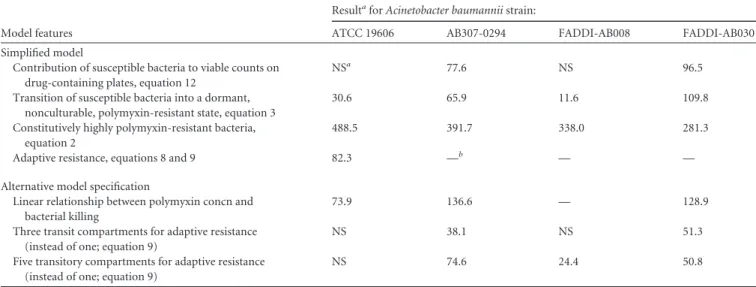
Parameter estimation, model qualification, and simulations.For eachA. baumanniistrain, PK/PD model parameters were simultaneously estimated in S-ADAPT (version 1.57) (39) using a Monte Carlo paramet-ric expectation maximization algorithm (i.e., importance sampling pmethod⫽4 in S-ADAPT). SADAPT-TRAN was used to facilitate mod-eling analysis (40,41). To assess the significance and overall contribution of each model component, alternate simplified models that lacked the respective model feature or parameter were fit to the experimental data. The change in the objective function (⫺2 log-likelihood) value was then used to determine the importance of the model component that was sim-plified.
The final model was then used to compare bacterial killing, bacterial regrowth, and the emergence of resistance associated with previously re-ported concentration-time profiles for colistin (8) and polymyxin B (9). For colistin, the unbound concentration-time profile used in the simula-tion mimicked that predicted by Plachouras et al. (8) following the ad-TABLE 1Population parameter estimates of the fitted models for each examinedA. baumanniistrain
Parameter (symbol and/or unit)
Mean (SE) forAcinetobacter baumanniistrain:
ATCC 19606 AB307-0294 FADDI-AB008 FADDI-AB030
Initial inoculum for CFUtotal(log10CFU/ml) 6.34 (3.14%) 6.14 (1.87%) 5.93 (4.14%) 6.17 (3.02%)
Initial inoculum for CFUR(log10CFU/ml) ⫺0.249 (95.2%) ⫺0.503 (34.6%) ⫺0.44 (73%) ⫺0.0466 (6.13%)
Maximal bacterial population (CFUmax, log10CFU/ml) 7.35 (1.04%) 8.05 (1.12%) 7.66 (1.07%) 7.82 (1.56%)
Mean turnover time CFUS(min) 75.2 (21.1%) 32 (10.7%) 35.2 (11.5%) 27.7 (10.2%)
Mean turnover time CFUR(min) 71.4 (12.3%) 81.0 (6.79%) 48.1 (9.58%) 313 (9.85%)
Transition rate constant to dormancy (kSD, h⫺
1) 0.00635 (70%) 0.0367 (42.9%) 0.00246 (44.5%) 0.000916 (102%)
Transition rate constant out of dormancy (kDS, h⫺
1) 3.19 (24.2%) 0.0332 (47.1%) 5.45 (38.9%) 7.05 (15.7%)
Hill coefficient for polymyxin binding to LPS (Hillbinding) 3.06 (16.2%) 4.13 (30.3%) 3.25 (68.2%) 4.83 (18.3%)
EC50
bfor polymyxin binding to LPS (EC
50) 0.0483 (8.25%) 0.0989 (9.76%) 0.0237 (19.7%) 0.0173 (7.17%)
Maximal polymyxin-induced killing rate constant (Killmax, h⫺
1) 100 (fixed) 100 (fixed) 100 (fixed) 100 (fixed)
Hill coefficient for polymyxin-induced killing (Hillkilling) 3.85 (20%) 2.79 (9.64%) 1.75 (13%) 19.5 (14.9%)
EC50for polymyxin-induced killing (KillC50, mg/liter) 0.521 (22.5%) 0.561 (22.3%) 0.693 (23.9%) 0.516 (13.1%)
Maximal fold reduction in the effective polymyxin concn due to adaptive resistance (Smax)
300 (fixed) 300 (fixed) 300 (fixed) 300 (fixed)
Adaptation rate constant (kadapt, h⫺
1) 7.20 (16.5%) 14.2 (12.9%) 8.09 (16.3%) 15.2 (10.5%)
Maximal fitness cost associated with resistance (Ginhib,max) NE
a NE 0.994 (9.43%) 0.991 (5.07%)
In vitromodel flow rate (CL, liters/h) 0.00434 (10.4%) 0.00506 (9.14%) 0.00585 (9.97%) 0.00476 (8.98%)
In vitromodel reservoir vol (V, liters) 0.111 (13.5%) 0.101 (13.6%) 0.119 (9.87%) 0.133 (17.6%)
aNE, not estimated: parameters were not included for estimation in the model, as the experimental data did not support the inclusion of this feature for these strains. b
ministration of a 12-MU CMS loading dose (⬃360 mg CBA) followed by 4.5 MU (⬃140 mg CBA) every 12 hours in a patient with normal creati-nine clearance. In the case of polymyxin B, the unbound concentration-time profile representative of the 50th percentile of Monte Carlo simula-tions reported by Sandri et al. (9) following a loading dose of 2 mg/kg of body weight (2-h infusion) and a daily maintenance dose of 1.25 mg/kg (1-h infusion) was used. The unbound concentrations for both polymyx-ins were calculated based upon 50% plasma protein binding (9,26,27). Model simulations were performed in Berkeley Madonna using the pop-ulation mean parameter estimates based on the experimental data for polymyxin-heteroresistantA. baumanniistrain AB307-0294.
RESULTS
The gradual accumulation of colistin arising from regimen R1
(
Fig. 1A
) resulted in little antibacterial activity against all the
ex-amined
A. baumannii
strains (
Fig. 3B
,
4B
,
5B
, and
6B
). Indeed,
overall the time course of CFU per milliliter for each strain was
similar to that for the corresponding growth control (panels A in
each of
Fig. 3
to
6
). The maximum observed bacterial killing of
⬃
1
log
10CFU/ml was achieved between 47 and 49 h after
commenc-ing treatment (
Fig. 6
), despite achieving colistin base
concentra-tions greater than 1 mg/liter (equivalent to 1.26 mg/liter colistin
sulfate) within 24 h. Further, amplification of polymyxin-resistant
bacterial populations was observed in the PAPS after
approxi-mately 48 h of colistin exposure in all examined strains. At the
conclusion of treatment, a significant proportion of the bacterial
population was polymyxin resistant. Analysis of the PAPs revealed
a modest difference (
⬍
3 log
10CFU/ml) between viable counts on
drug-free and 6.6-mg/liter polymyxin B plates for all
A. baumannii
strains except ATCC 19606, where the difference was
⬃
4 log
10CFU/ml.
FIG 3Observed data (points) and individual model fits (lines) for total viable bacteria (and thick solid line), resistant bacteria (Œand thick dashed line), and polymyxin concentrations (}, dotted line) for control (A), gradual rise of colistin (R1) (B), polymyxin B with no loading dose (R2) (C), a conventional loading dose (R3) (D), and augmented loading dose (R4) (E) againstA. baumanniistrain ATCC 19606.
In contrast, all three polymyxin B dosage regimens (
Fig. 1
)
displayed good initial antibacterial activity against the examined
A. baumannii
strains, achieving
⬎
4 log
10CFU/ml killing within 1
h of treatment initiation (panels C to E in each of
Fig. 3
to
6
).
However, bacterial regrowth was observed at 11 to 13 h after the
initiation of therapy. By 96 h, bacterial density was
⬎
7 log
10CFU/ml for all dosage regimens and strains examined. The
bacte-rial population following regrowth was polymyxin resistant, with
a
⬍
1-log
10CFU/ml difference in viable counts at 96 h between
drug-free and polymyxin B-containing (6.6 mg/liter) plates for all
strains except AB307-0294 (
Fig. 4
). Against
A. baumannii
strains
FADDI-AB008 and FADDI-AB030, administration of the
regi-men with an augregi-mented loading dose of polymyxin B (R4,
Fig. 5E
and
6E
) resulted in delayed and slow bacterial regrowth compared
to that observed with R2 (
Fig. 5C
and
6C
). The administration of
loading doses did not materially affect the regrowth of
A.
bauman-nii
strains ATCC 19606 and AB307-0294 (panels E versus C in
Fig.
3
and
4
).
The developed mechanism-based PK/PD model (
Fig. 2
)
de-scribed well the kinetics of bacterial killing and regrowth of
A.
baumannii
on antibiotic-free and antibiotic-containing agar
plates (
Table 1
;
Fig. 3
to
6
). To improve numerical stability during
the estimation, the maximal bacterial killing rate (Kill
max) was
fixed to 100 h
⫺1(equivalent to 11 log
10killing in 15 min) and the
maximal attenuation in killing (i.e., extent of adaptive resistance;
S
max) to 300. Model qualification demonstrated the significant
contribution (P
⬍
0.05) of each component to model fits, with the
objective function (
⫺
2 log likelihood) worsening with the
omis-sion of any individual component for at least 2 of 4 strains
(
Table 2
).
Examination of the modeled bacterial population dynamics
revealed that adaptive resistance was a primary mode of
poly-myxin resistance enabling bacterial regrowth during polypoly-myxin
treatment. The mechanism-based model also strongly implicated
the involvement of viable but nonculturable bacterial cells in
bac-terial regrowth during polymyxin treatment; deletion of this
model feature resulted in a substantial worsening in the objective
function (
Table 2
).
Simulations conducted using the model fitted for
A.
bauman-nii
AB307-0294 suggested that unbound colistin
concentration-time profiles achieved with the use of aggressive CMS loading
doses (
Fig. 7A
) would result in
⬃
3 log
10CFU/ml killing (
Fig. 7B
).
In contrast, the simulated polymyxin B dosage regimen (
Fig. 7C
)
resulted in more-rapid and
⬃
2-log
10CFU/ml-greater bacterial
killing than that obtained with the CMS dosage regimen (
Fig. 7D
).
Regrowth of polymyxin-resistant bacteria due to adaptive
resis-tance, as well as the amplification of constitutively
polymyxin-resistant subpopulations (
⬃
0.001% of total bacteria;
⬃
1,000-fold
amplification), was predicted within less than 24 h with both
dos-age regimens.
DISCUSSION
The resurgence in clinical usage of polymyxins and their
impor-tance as “last-line” therapeutic agents for the treatment of
infec-tions caused by MDR Gram-negative organisms necessitates
in-vestigations into the factors that influence polymyxin activity and
the development of resistance. Colistin and polymyxin B, the two
clinically used polymyxins, share similar
in vitro
activity but differ
substantially in the time course of concentrations achieved in the
hours, and potentially days, following initiation of therapy due to
FIG 5Observed data (points) and individual model fits (lines) for total viable bacteria (and thick solid line), resistant bacteria (Œand thick dashed line), and polymyxin concentrations (}, dotted line) for control (A), gradual rise of colistin (R1) (B), polymyxin B with no loading dose (R2) (C), a conventional loading dose (R3) (D), and augmented loading dose (R4) (E) againstA. baumanniistrain FADDI-AB008.their administered forms (
7
). In this report, we have employed a
dynamic
in vitro
PK/PD model and mathematical modeling to
explore the effects of differences in concentration-time profiles on
the activity of polymyxins and the development of polymyxin
re-sistance due to amplification of preexisting resistant mutants and
adaptive resistance (
42
,
43
). The developed mathematical model
implemented a new observation model that linked adaptive
resis-tance to colony formation on drug-containing plates, extending
the utility of previous models of adaptive resistance (
31
,
44
).
The one-compartment IVM was able to simulate clinically
rel-evant polymyxin B and colistin concentration-time profiles, as
seen in previously published studies (
5
,
8
,
9
). It should be noted
that the polymyxin concentrations investigated in the IVM were
in the region of the upper limits of unbound polymyxin
concen-trations seen in critically ill patients, to account for the previously
observed resilience of
A. baumannii
to treatment with colistin
(
45
). For colistin, an unbound
C
ss,avgof 3 mg/liter would be
pos-sible only in a patient with moderate renal function receiving
⬃
300 to 360 mg CBA each day; patients with higher renal function
achieve substantially lower concentrations (
5
). Of great concern
was our finding that the gradual rise in colistin concentrations to a
C
ss,avgof 3 mg/liter enabled the acquisition of polymyxin
differences in the magnitude of bacterial killing. Taken together,
these findings show the clear link between the rapid attainment of
therapeutic polymyxin concentrations and bacterial killing and
the alarming rate at which resistance to polymyxin develops.
In this study, polymyxin B loading doses (conventional and
augmented) were found to slow the rate of bacterial regrowth for
FADDI-AB030 (conventional and augmented loading doses) and
FADDI-AB008 (augmented loading dose only). A similarly clear
TABLE 2Model validation results, showing the change in⫺2 log likelihood associated with modifying and deleting model featuresModel features
ResultaforAcinetobacter baumanniistrain:
ATCC 19606 AB307-0294 FADDI-AB008 FADDI-AB030
Simplified model
Contribution of susceptible bacteria to viable counts on drug-containing plates, equation 12
NSa 77.6 NS 96.5
Transition of susceptible bacteria into a dormant, nonculturable, polymyxin-resistant state, equation 3
30.6 65.9 11.6 109.8
Constitutively highly polymyxin-resistant bacteria, equation 2
488.5 391.7 338.0 281.3
Adaptive resistance, equations 8 and 9 82.3 —b — —
Alternative model specification
Linear relationship between polymyxin concn and bacterial killing
73.9 136.6 — 128.9
Three transit compartments for adaptive resistance (instead of one; equation 9)
NS 38.1 NS 51.3
Five transitory compartments for adaptive resistance (instead of one; equation 9)
NS 74.6 24.4 50.8
a
NS, not significant: the data did not support inclusion of this feature in the model for the respective strain.
b—, feature lacking: the models that lacked this feature could not be robustly estimated for the respective strain(s), most likely since the simplified model provided very poor curve
fits. This strongly suggested that the respective model feature was beneficial and should be included.
FIG 7Model simulation results forA. baumanniistrain AB307-0294 (initial inoculum, 106CFU/ml) treated with unbound concentration-time profiles adapted
from population PK studies (8,9) of colistin following CMS administration in a patient with normal renal function (360 mg colistin base activity loading dose, 140 mg every 12 h maintenance dose) (A) and a polymyxin B dosage regimen representing the 50th percentile of critically ill patients receiving a 2-mg/kg polymyxin B loading dose, followed by 1.25 mg/kg every 12 h (C). The dynamics of initially susceptible (adaptive resistance) (solid line) and constitutively resistant (dashed line) bacterial populations are shown separately (B and D).
relationship between the use of loading doses and improved
sup-pression of bacterial regrowth was not seen in the remaining
A.
baumannii
strains, ATCC 19606 and AB307-0294. The
mechanis-tic basis of this observed slowing in the bacterial regrowth rate in
A. baumannii
when treated with polymyxin B loading doses
re-mains to be elucidated; however, it has been suggested that
het-eroresistance plays a significant role in determining the rate at
which antimicrobial resistance emerges (
21
).
Despite the growing body of clinical evidence surrounding the
beneficial effect of rapid attainment of therapeutic antibiotic
con-centrations (
15–17
) and the demonstration of superior activity of
polymyxin B loading doses
in vitro
against some strains in the
current study, the benefits of polymyxin B loading doses have not
been thoroughly investigated clinically. Clearly, the implications
of such dosage regimens on nephrotoxicity should be carefully
considered. The key drivers of polymyxin-induced nephrotoxicity
are the subject of continuing research (
46–49
), and findings from
those studies will be integral to the development of clinical
guide-lines for safe and effective polymyxin B dosing.
Current literature suggests that polymyxin resistance in
A.
baumannii
is driven by either the modification of the lipid A
moi-ety of LPS or the loss of LPS from the outer membrane (
22
,
23
,
37
,
50
). In other bacterial species, these changes to the bacterial outer
membrane arise due to preexisting mutations or adaptive
re-sponses to polymyxins (
38
). The dynamics between constitutively
polymyxin-resistant (mutants) and adaptively
polymyxin-resis-tant bacterial populations during polymyxin therapy have not
been previously investigated. In line with recently published
rec-ommendations (
51
), the new mechanism-based model described
in this report built upon prior work (
35
,
36
,
52
) on modeling
antimicrobial activity and incorporated both of these resistance
mechanisms, in addition to reversible dormancy. The model was
able to describe well the observed viable counts on both
antibiotic-free and antibiotic-containing agar plates (
Fig. 3
to
6
).
Analysis of the bacterial population dynamics as described by
the mechanism-based model pointed to adaptive resistance as a
key factor driving bacterial regrowth following treatment with
clinically relevant dosage regimens in the IVM. Further, dormant,
nonculturable bacterial cells were identified as a likely contributor
to bacterial regrowth following polymyxin treatment. Exclusion
of dormant cells from the model resulted in implausible
parame-ter estimates for bacparame-terial replication times (
⬍
15 min) to describe
the bacterial regrowth following polymyxin-induced bacterial
killing. Dormant and slow-growing bacterial cells have been
re-ported to be involved in penicillin resistance in
Escherichia coli
(
53
). Further investigations that enable direct observation of
bac-terial cells (e.g., single-cell microfluidic microscopy) will be
re-quired to examine this phenomenon in
A. baumannii
during
poly-myxin treatment.
The use of a CMS loading dose to hasten the attainment of
therapeutic colistin concentrations has been previously proposed
(
8
,
11
,
27
,
54
,
55
). It should be noted that the reported disposition
of formed colistin following CMS administration shows
substan-tial variance; a recent report on the disposition of CMS/colistin in
critically ill patients has described the rapid formation of colistin
following CMS administration (
55
). However, these findings are
contrary to previous reports from multiple investigators across
several continents (
5
,
8
,
27
,
56
). The reasons for the divergence in
results remain to be elucidated, and interbrand variability has
been hypothesized to be a key contributor (
55
). A
concentration-time profile representative of the more commonly reported
phar-macokinetics of CMS/colistin in patients with normal renal
func-tion was examined using the mechanism-based model fitted on
data from
A. baumannii
AB307-0294 (
Fig. 7
). Compared to a
polymyxin B dosage regimen with a loading dose as proposed by
Sandri et al. (
9
), the CMS regimen was slow to achieve polymyxin
concentrations of
⬎
1 mg/liter (cf.
⬃
4 h for CMS and 1 h for
polymyxin B).
Mathematical model simulations indicated that the CMS
reg-imen was likely to result in 2 log
10CFU/ml less bacterial killing
(i.e.,
⬃
3 log
10versus
⬃
5 log
10) compared to the polymyxin B
dosage regimen (
Fig. 7
). Model simulations for colistin and
myxin B also predicted the amplification of constitutively
poly-myxin-resistant bacteria, in line with the previously identified link
between the isolation of heteroresistant
A. baumannii
and prior
treatment with colistin in critically ill patients (
57
).
Heteroresis-tance in
A. baumannii
has been documented previously (
19
,
20
,
45
), and the clinical impact of these highly polymyxin-resistant
bacteria remains to be fully established. However, it seems highly
possible that these resistant mutants contribute to clinical failure
(
21
). Conclusive evidence of these phenomena will require
molec-ular confirmation of the modalities of polymyxin resistance
mechanisms. Although optimization of polymyxin monotherapy
remains as an important goal, a worrying trend in the
experimen-tal and simulation data was the regrowth of polymyxin-resistant
bacteria across all strains and dosage regimens, a finding common
to numerous previously published investigations into polymyxin
activity against Gram-negative pathogens
in vitro
(
45
,
58
,
59
).
These results suggest that simply optimizing polymyxin
mono-therapy is unlikely to be adequate to prevent the emergence of
resistance and that polymyxin combination therapies must be
explored as a strategy to combat multidrug resistance in
A.
baumannii.
A potential limitation of this study, and a key consideration, is
the lack of a functioning immune system in the applied dynamic
in
vitro
experimental model. Studies into granulocyte-mediated
bac-terial killing of
Pseudomonas aeruginosa
suggest that a reduction in
bacterial burden to
ⱕ
6 log
10CFU/ml is likely to prevent
satura-tion of bacterial killing by granulocytes and improve clinical
out-comes (
60
,
61
). The
in vitro
and
in silico
data from the present
study point to bacterial killing of
⬎
3 log
10CFU/ml for polymyxin
B dosage regimens with loading doses, suggesting that adequate
polymyxin dosage regimens will reduce the bacterial burden
suf-ficiently to prevent saturation of granulocyte-mediated killing.
Translation of these findings into treatment options for critically
ill patients with partially suppressed immune systems will require
further investigation and consideration of other clinical factors.
ther-apy against
A. baumannii
as well as the rational design of
synergistic combination therapies containing polymyxins.
ACKNOWLEDGMENTS
We declare that we have no conflict of interest.
FUNDING INFORMATION
This work was supported by the National Institute of Allergy and Infec-tious Diseases at the National Institutes of Health (award numbers R01AI079330 and R01AI111990 to R.L.N., J.L., B.T.T., A.F., and J.B.B. and R01AI098771 to J.L. and R.L.N.). J.L. is an Australian National Health and Medical Research Council (NHMRC) Senior Research Fellow. J.B.B. is the recipient of an NHMRC Career Development Fellowship (APP1084163). The content is solely the responsibility of the authors and does not necessarily represent the official views of the National Institute of Allergy and Infectious Diseases or the National Institutes of Health.
REFERENCES
1.Peleg AY, Seifert H, Paterson DL.2008. Acinetobacter baumannii: emer-gence of a successful pathogen. Clin Microbiol Rev21:538 –582.http://dx .doi.org/10.1128/CMR.00058-07.
2.Walker B, Barrett S, Polasky S, Galaz V, Folke C, Engstrom G, Acker-man F, Arrow K, Carpenter S, Chopra K, Daily G, Ehrlich P, Hughes T, Kautsky N, Levin S, Maler KG, Shogren J, Vincent J, Xepapadeas T, de Zeeuw A.2009. Environment. Looming global-scale failures and missing institutions. Science325:1345–1346.http://dx.doi.org/10.1126/science .1175325.
3.Infectious Diseases Society of America (IDSA), Spellberg B, Blaser M, Guidos RJ, Boucher HW, Bradley JS, Eisenstein BI, Gerding D, Lynfield R, Reller LB, Rex J, Schwartz D, Septimus E, Tenover FC, Gilbert DN. 2011. Combating antimicrobial resistance: policy recommendations to save lives. Clin Infect Dis52(Suppl 5):S397–S428.http://dx.doi.org/10 .1093/cid/cir153.
4.Bergen PJ, Landersdorfer CB, Lee HJ, Li J, Nation RL. 2012. ‘Old’ antibiotics for emerging multidrug-resistant bacteria. Curr Opin Infect Dis25:626 – 633.http://dx.doi.org/10.1097/QCO.0b013e328358afe5. 5.Garonzik SM, Li J, Thamlikitkul V, Paterson DL, Shoham S, Jacob J,
Silveira FP, Forrest A, Nation RL.2011. Population pharmacokinetics of colistin methanesulfonate and formed colistin in critically ill patients from a multicenter study provide dosing suggestions for various categories of patients. Antimicrob Agents Chemother55:3284 –3294.http://dx.doi.org /10.1128/AAC.01733-10.
6.Zavascki AP, Goldani LZ, Li J, Nation RL.2007. Polymyxin B for the treatment of multidrug-resistant pathogens: a critical review. J Antimi-crob Chemother60:1206 –1215.http://dx.doi.org/10.1093/jac/dkm357. 7.Nation RL, Velkov T, Li J.2014. Colistin and polymyxin B: peas in a pod,
or chalk and cheese? Clin Infect Dis59:88 –94.http://dx.doi.org/10.1093 /cid/ciu213.
8.Plachouras D, Karvanen M, Friberg LE, Papadomichelakis E, Antonia-dou A, Tsangaris I, Karaiskos I, Poulakou G, KontopiAntonia-dou F, Arma-ganidis A, Cars O, Giamarellou H.2009. Population pharmacokinetic analysis of colistin methanesulfonate and colistin after intravenous ad-ministration in critically ill patients with infections caused by gram-negative bacteria. Antimicrob Agents Chemother 53:3430 –3436. http: //dx.doi.org/10.1128/AAC.01361-08.
9.Sandri AM, Landersdorfer CB, Jacob J, Boniatti MM, Dalarosa MG, Falci DR, Behle TF, Bordinhao RC, Wang J, Forrest A, Nation RL, Li J, Zavascki AP.2013. Population pharmacokinetics of intravenous poly-myxin B in critically ill patients: implications for selection of dosage regi-mens. Clin Infect Dis57:524 –531.http://dx.doi.org/10.1093/cid/cit334. 10. Sandri AM, Landersdorfer CB, Jacob J, Boniatti MM, Dalarosa MG,
Falci DR, Behle TF, Saitovitch D, Wang J, Forrest A, Nation RL, Zavascki AP, Li J.2013. Pharmacokinetics of polymyxin B in patients on continuous venovenous haemodialysis. J Antimicrob Chemother68:674 – 677.http://dx.doi.org/10.1093/jac/dks437.
11. Karaiskos I, Friberg LE, Pontikis K, Ioannidis K, Tsagkari V, Galani L, Kostakou E, Baziaka F, Paskalis C, Koutsoukou A, Giamarellou H. 2015. Colistin population pharmacokinetics after application of a loading dose of 9 MU colistin methanesulfonate (CMS) in critically ill patients.
Antimicrob Agents Chemother59:7240 –7248.http://dx.doi.org/10.1128 /AAC.00554-15.
12. Karvanen M, Plachouras D, Friberg LE, Paramythiotou E, Papadomi-chelakis E, Karaiskos I, Tsangaris I, Armaganidis A, Cars O, Giamarel-lou H.2013. Colistin methanesulfonate and colistin pharmacokinetics in critically ill patients receiving continuous venovenous hemodiafiltration. Antimicrob Agents Chemother 57:668 – 671. http://dx.doi.org/10.1128 /AAC.00985-12.
13. Bergen PJ, Li J, Rayner CR, Nation RL.2006. Colistin methanesul-fonate is an inactive prodrug of colistin against Pseudomonas aerugi-nosa. Antimicrob Agents Chemother50:1953–1958.http://dx.doi.org /10.1128/AAC.00035-06.
14. Li J, Milne RW, Nation RL, Turnidge JD, Smeaton TC, Coulthard K. 2004. Pharmacokinetics of colistin methanesulphonate and colistin in rats following an intravenous dose of colistin methanesulphonate. J Antimi-crob Chemother53:837– 840.http://dx.doi.org/10.1093/jac/dkh167. 15. Kumar A, Roberts D, Wood KE, Light B, Parrillo JE, Sharma S,
Suppes R, Feinstein D, Zanotti S, Taiberg L, Gurka D, Kumar A, Cheang M.2006. Duration of hypotension before initiation of effec-tive antimicrobial therapy is the critical determinant of survival in human septic shock. Crit Care Med34:1589 –1596.http://dx.doi.org /10.1097/01.CCM.0000217961.75225.E9.
16. Kumar A, Ellis P, Arabi Y, Roberts D, Light B, Parrillo JE, Dodek P, Wood G, Kumar A, Simon D, Peters C, Ahsan M, Chateau D, Coop-erative Antimicrobial Therapy of Septic Shock Database Research Group.2009. Initiation of inappropriate antimicrobial therapy results in a fivefold reduction of survival in human septic shock. Chest136:1237– 1248.http://dx.doi.org/10.1378/chest.09-0087.
17. Luna CM, Aruj P, Niederman MS, Garzon J, Violi D, Prignoni A, Rios F, Baquero S, Gando S, Grupo Argentino de Estudio de la Neumonia Asociada al Respirador.2006. Appropriateness and delay to initiate ther-apy in ventilator-associated pneumonia. Eur Respir J27:158 –164.http: //dx.doi.org/10.1183/09031936.06.00049105.
18. Adams MD, Goglin K, Molyneaux N, Hujer KM, Lavender H, Jamison JJ, MacDonald IJ, Martin KM, Russo T, Campagnari AA, Hujer AM, Bonomo RA, Gill SR.2008. Comparative genome sequence analysis of multidrug-resistant Acinetobacter baumannii. J Bacteriol 190:8053– 8064.http://dx.doi.org/10.1128/JB.00834-08.
19. Li J, Rayner CR, Nation RL, Owen RJ, Spelman D, Tan KE, Liolios L. 2006. Heteroresistance to colistin in multidrug-resistant Acinetobacter baumannii. Antimicrob Agents Chemother50:2946 –2950.http://dx.doi .org/10.1128/AAC.00103-06.
20. Yau W, Owen RJ, Poudyal A, Bell JM, Turnidge JD, Yu HH, Nation RL, Li J.2009. Colistin hetero-resistance in multidrug-resistant Acinetobacter baumannii clinical isolates from the Western Pacific region in the SENTRY antimicrobial surveillance programme. J Infect58:138 –144.http://dx.doi.org /10.1016/j.jinf.2008.11.002.
21. El-Halfawy OM, Valvano MA.2015. Antimicrobial heteroresistance: an emerging field in need of clarity. Clin Microbiol Rev28:191–207.http://dx .doi.org/10.1128/CMR.00058-14.
22. Beceiro A, Llobet E, Aranda J, Bengoechea JA, Doumith M, Hornsey M, Dhanji H, Chart H, Bou G, Livermore DM, Woodford N.2011. Phos-phoethanolamine modification of lipid A in colistin-resistant variants of Acinetobacter baumannii mediated by the pmrAB two-component regu-latory system. Antimicrob Agents Chemother55:3370 –3379.http://dx .doi.org/10.1128/AAC.00079-11.
23. Moffatt JH, Harper M, Harrison P, Hale JD, Vinogradov E, Seemann T, Henry R, Crane B, Michael F, Cox AD, Adler B, Nation RL, Li J, Boyce JD.2010. Colistin resistance in Acinetobacter baumannii is mediated by complete loss of lipopolysaccharide production. Antimicrob Agents Che-mother54:4971– 4977.http://dx.doi.org/10.1128/AAC.00834-10. 24. Deris ZZ, Yu HH, Davis K, Soon RL, Jacob J, Ku CK, Poudyal A,
Bergen PJ, Tsuji BT, Bulitta JB, Forrest A, Paterson DL, Velkov T, Li J, Nation RL.2012. The combination of colistin and doripenem is synergis-tic against Klebsiella pneumoniae at multiple inocula and suppresses colis-tin resistance in an in vitro pharmacokinetic/pharmacodynamic model. Antimicrob Agents Chemother56:5103–5112.http://dx.doi.org/10.1128 /AAC.01064-12.
25. Zavascki AP, Goldani LZ, Cao G, Superti SV, Lutz L, Barth AL, Ramos F, Boniatti MM, Nation RL, Li J.2008. Pharmacokinetics of intravenous polymyxin B in critically ill patients. Clin Infect Dis47:1298 –1304.http: //dx.doi.org/10.1086/592577.
New pharmacokinetic/pharmacodynamic studies of systemically ad-ministered colistin against Pseudomonas aeruginosa and Acinetobac-ter baumannii in mouse thigh and lung infection models: smaller re-sponse in lung infection. J Antimicrob Chemotherhttp://dx.doi.org /10.1093/jac/dkv267.
27. Mohamed AF, Karaiskos I, Plachouras D, Karvanen M, Pontikis K, Jansson B, Papadomichelakis E, Antoniadou A, Giamarellou H, Armaganidis A, Cars O, Friberg LE.2012. Application of a loading dose of colistin methanesulfonate in critically ill patients: population pharmacokinetics, protein binding, and prediction of bacterial kill. Antimicrob Agents Chemother 56:4241– 4249. http://dx.doi.org/10 .1128/AAC.06426-11.
28. Directorate for the Quality of Medicines and HealthCare of the Council of Europe.2014. Monographs for colistimethate sodium and colistin sulfate, p 1960 –1962. European Pharmacopoeia 8.0. Directorate for the Quality of Medicines and HealthCare of the Council of Europe, Stras-bourg, France.
29. Cheah SE, Bulitta JB, Li J, Nation RL.2014. Development and validation of a liquid chromatography-mass spectrometry assay for polymyxin B in bacterial growth media. J Pharm Biomed Anal92:177–182.http://dx.doi .org/10.1016/j.jpba.2014.01.015.
30. Bulitta JB, Yang JC, Yohonn L, Ly NS, Brown SV, D’Hondt RE, Jusko WJ, Forrest A, Tsuji BT.2010. Attenuation of colistin bacteri-cidal activity by high inoculum of Pseudomonas aeruginosa character-ized by a new mechanism-based population pharmacodynamic model. Antimicrob Agents Chemother 54:2051–2062. http://dx.doi.org/10 .1128/AAC.00881-09.
31. Bulitta JB, Ly NS, Landersdorfer CB, Wanigaratne NA, Velkov T, Yadav R, Oliver A, Martin L, Shin BS, Forrest A, Tsuji BT.2015. Two mechanisms of killing of Pseudomonas aeruginosa by tobramycin as-sessed at multiple inocula via mechanism-based modeling. Antimicrob Agents Chemother 59:2315–2327. http://dx.doi.org/10.1128/AAC .04099-14.
32. Yano Y, Oguma T, Nagata H, Sasaki S.1998. Application of logistic growth model to pharmacodynamic analysis of in vitro bactericidal kinet-ics. J Pharm Sci87:1177–1183.http://dx.doi.org/10.1021/js9801337. 33. Oliver JD.2005. The viable but nonculturable state in bacteria. J
Micro-biol43:93–100.
34. Oliver JD.2010. Recent findings on the viable but nonculturable state in pathogenic bacteria. FEMS Microbiol Rev34:415– 425.http://dx.doi.org /10.1111/j.1574-6976.2009.00200.x.
35. Schuck EL, Dalhoff A, Stass H, Derendorf H.2005. Pharmacokinetic/ pharmacodynamic (PK/PD) evaluation of a once-daily treatment using ciprofloxacin in an extended-release dosage form. Infection33(Suppl 2): S22–S28.
36. Tam VH, Kabbara S, Vo G, Schilling AN, Coyle EA.2006. Comparative pharmacodynamics of gentamicin against Staphylococcus aureus and Pseudomonas aeruginosa. Antimicrob Agents Chemother50:2626 –2631.
http://dx.doi.org/10.1128/AAC.01165-05.
37. Arroyo LA, Herrera CM, Fernandez L, Hankins JV, Trent MS, Hancock RE.2011. The pmrCAB operon mediates polymyxin resistance in Acin-etobacter baumannii ATCC 17978 and clinical isolates through phos-phoethanolamine modification of lipid A. Antimicrob Agents Chemother 55:3743–3751.http://dx.doi.org/10.1128/AAC.00256-11.
38. Olaitan AO, Morand S, Rolain JM.2014. Mechanisms of polymyxin resistance: acquired and intrinsic resistance in bacteria. Front Microbiol 5:643.http://dx.doi.org/10.3389/fmicb.2014.00643.
39. Bauer RJ, Guzy S, Ng C.2007. A survey of population analysis methods and software for complex pharmacokinetic and pharmacodynamic mod-els with examples. AAPS J 9:E60 –E83. http://dx.doi.org/10.1208 /aapsj0901007.
40. Bulitta JB, Bingolbali A, Shin BS, Landersdorfer CB.2011. Development of a new pre- and post-processing tool (SADAPT-TRAN) for nonlinear mixed-effects modeling in S-ADAPT. AAPS J13:201–211.http://dx.doi .org/10.1208/s12248-011-9257-x.
41. Bulitta JB, Landersdorfer CB.2011. Performance and robustness of the Monte Carlo importance sampling algorithm using parallelized S-ADAPT for basic and complex mechanistic models. AAPS J13:212–226.http://dx .doi.org/10.1208/s12248-011-9258-9.
42. Bulitta JB, Landersdorfer CB, Forrest A, Brown SV, Neely MN, Tsuji BT, Louie A.2011. Relevance of pharmacokinetic and pharmacodynamic modeling to clinical care of critically ill patients. Curr Pharm Biotechnol 12:2044 –2061.http://dx.doi.org/10.2174/138920111798808428.
43. Nielsen EI, Friberg LE.2013. Pharmacokinetic-pharmacodynamic mod-eling of antibacterial drugs. Pharmacol Rev65:1053–1090.http://dx.doi .org/10.1124/pr.111.005769.
44. Mohamed AF, Nielsen EI, Cars O, Friberg LE.2012. Pharmacokinetic-pharmacodynamic model for gentamicin and its adaptive resistance with predictions of dosing schedules in newborn infants. Antimicrob Agents Chemother56:179 –188.http://dx.doi.org/10.1128/AAC.00694-11. 45. Tan CH, Li J, Nation RL.2007. Activity of colistin against heteroresistant
Acinetobacter baumannii and emergence of resistance in an in vitro phar-macokinetic/pharmacodynamic model. Antimicrob Agents Chemother 51:3413–3415.http://dx.doi.org/10.1128/AAC.01571-06.
46. Phe K, Lee Y, McDaneld PM, Prasad N, Yin T, Figueroa DA, Musick WL, Cottreau JM, Hu M, Tam VH. 2014. In vitro assessment and multicenter cohort study of comparative nephrotoxicity rates associated with colistimethate versus polymyxin B therapy. Antimicrob Agents Che-mother58:2740 –2746.http://dx.doi.org/10.1128/AAC.02476-13. 47. Azad MA, Finnin BA, Poudyal A, Davis K, Li J, Hill PA, Nation RL,
Velkov T, Li J.2013. Polymyxin B induces apoptosis in kidney proximal tubular cells. Antimicrob Agents Chemother57:4329 – 4335.http://dx.doi .org/10.1128/AAC.02587-12.
48. Akajagbor DS, Wilson SL, Shere-Wolfe KD, Dakum P, Charurat ME, Gilliam BL.2013. Higher incidence of acute kidney injury with intrave-nous colistimethate sodium compared with polymyxin B in critically ill patients at a tertiary care medical center. Clin Infect Dis57:1300 –1303.
http://dx.doi.org/10.1093/cid/cit453.
49. Abdelraouf K, Braggs KH, Yin T, Truong LD, Hu M, Tam VH.2012. Characterization of polymyxin B-induced nephrotoxicity: implications for dosing regimen design. Antimicrob Agents Chemother56:4625– 4629.
http://dx.doi.org/10.1128/AAC.00280-12.
50. Chin CY, Gregg KA, Napier BA, Ernst RK, Weiss DS.2015. A PmrB-regulated deacetylase required for lipid A modification and polymyxin resistance in Acinetobacter baumannii. Antimicrob Agents Chemother 59:7911–7914.http://dx.doi.org/10.1128/AAC.00515-15.
51. Jacobs M, Gregoire N, Couet W, Bulitta JB.2016. Distinguishing anti-microbial models with different resistance mechanisms via population pharmacodynamic modeling. PLoS Comput Biol12:e1004782.http://dx .doi.org/10.1371/journal.pcbi.1004782.
52. Gregoire N, Raherison S, Grignon C, Comets E, Marliat M, Ploy MC, Couet W. 2010. Semimechanistic pharmacokinetic-pharmacodynamic model with adaptation development for time-kill experiments of cipro-floxacin against Pseudomonas aeruginosa. Antimicrob Agents Che-mother54:2379 –2384.http://dx.doi.org/10.1128/AAC.01478-08. 53. Fridman O, Goldberg A, Ronin I, Shoresh N, Balaban NQ. 2014.
Optimization of lag time underlies antibiotic tolerance in evolved bac-terial populations. Nature 513:418 – 421. http://dx.doi.org/10.1038 /nature13469.
54. Dalfino L, Puntillo F, Mosca A, Monno R, Spada ML, Coppolecchia S, Miragliotta G, Bruno F, Brienza N.2012. High-dose, extended-interval colistin administration in critically ill patients: is this the right dosing strategy? A preliminary study. Clin Infect Dis54:1720 –1726.http://dx.doi .org/10.1093/cid/cis286.
55. Gregoire N, Mimoz O, Megarbane B, Comets E, Chatelier D, Lasocki S, Gauzit R, Balayn D, Gobin P, Marchand S, Couet W.2014. New colistin population pharmacokinetic data in critically ill patients suggesting an alternative loading dose rationale. Antimicrob Agents Chemother58: 7324 –7330.http://dx.doi.org/10.1128/AAC.03508-14.
56. Koomanachai P, Landersdorfer CB, Chen G, Lee HJ, Jitmuang A, Wasuwattakul S, Sritippayawan S, Li J, Nation RL, Thamlikitkul V. 2014. Pharmacokinetics of colistin methanesulfonate and formed colistin in end-stage renal disease patients receiving continuous ambulatory peri-toneal dialysis. Antimicrob Agents Chemother58:440 – 446.http://dx.doi .org/10.1128/AAC.01741-13.
57. Hawley JS, Murray CK, Jorgensen JH.2008. Colistin heteroresistance in acinetobacter and its association with previous colistin therapy. Antimi-crob Agents Chemother 52:351–352. http://dx.doi.org/10.1128 /AAC.00766-07.
58. Bergen PJ, Bulitta JB, Forrest A, Tsuji BT, Li J, Nation RL. 2010. Pharmacokinetic/pharmacodynamic investigation of colistin against Pseudomonas aeruginosa using an in vitro model. Antimicrob Agents Chemother54:3783–3789.http://dx.doi.org/10.1128/AAC.00903-09. 59. Bergen PJ, Li J, Nation RL, Turnidge JD, Coulthard K, Milne RW.
Pseu-domonas aeruginosa in an in vitro pharmacodynamic model. J Antimicrob Chemother 61:636 – 642.http://dx.doi.org/10.1093/jac /dkm511.
60. Drusano GL, Liu W, Fikes S, Cirz R, Robbins N, Kurhanewicz S, Rodriquez J, Brown D, Baluya D, Louie A.2014. Interaction of drug-and granulocyte-mediated killing of Pseudomonas aeruginosa in a murine
pneumonia model. J Infect Dis210:1319 –1324.http://dx.doi.org/10.1093 /infdis/jiu237.
61. Drusano GL, Vanscoy B, Liu W, Fikes S, Brown D, Louie A. 2011. Saturability of granulocyte kill of Pseudomonas aeruginosa in a murine model of pneumonia. Antimicrob Agents Chemother55:2693–2695.http: //dx.doi.org/10.1128/AAC.01687-10.