REGULATION OF GLUTAMATE TRANSPORTER 1 (GLT-1) GENE EXPRESSION BY COCAINE SELF-ADMINISTRATION AND WITHDRAWAL
Ronald Kim
A thesis submitted to the faculty of the University of North Carolina at Chapel Hill in partial fulfillment of the requirements for the degree of Master of Arts in the Department of Psychology
and Neuroscience (Behavioral and Integrative Neuroscience)
Chapel Hill 2017
Approved by:
Kathryn J. Reissner
Regina M. Carelli
ii ©2017 Ronald Kim
iii ABSTRACT
Ronald Kim: Regulation of Glutamate Transporter 1 (GLT-1) Gene Expression by Cocaine Self-Administration and Withdrawal
(Under the direction of Kathryn Reissner)
Downregulation of the astroglial glutamate transporter GLT-1 is observed in the nucleus
accumbens (NAc) following administration of multiple drugs of abuse. The decrease in GLT-1
protein expression following cocaine self-administration is dependent on both the amount of
cocaine self-administered and the length of withdrawal, with longer access to cocaine and longer
withdrawal periods leading to greater decreases in GLT-1 protein. However, the mechanism(s)
by which cocaine downregulates GLT-1 protein remains unknown. Further, it is unknown
whether NAc GLT-1 expression is affected by cocaine in female rats, as has been observed in
male rats. Here we used qRT-PCR to examine gene expression of GLT-1 splice isoforms
(GLT-1A, GLT-1B) in the NAc of male and female rats, and in the prelimbic cortex (PL) and
basolateral amygdala (BLA) of male rats, following two widely used models of cocaine
self-administration: the short-access (ShA) self-administration/extinction model, and the long-access
(LgA) self-administration/incubation model. While downregulation of GLT-1 protein is observed
following ShA cocaine self-administration and extinction, this model did not lead to a change in
GLT-1A or GLT-1B gene expression in any brain region examined. In contrast, LgA cocaine
self-administration and withdrawal significantly decreased GLT-1A gene expression in the NAc
and BLA, and significantly decreased GLT-1B gene expression in the PL. No change was
iv
withdrawal-induced decreases in GLT-1A mRNA. In addition, LgA cocaine self-administration
and withdrawal induced hypermethylation of the GLT-1 gene in the NAc, providing an
epigenetic mechanism for the observed decrease in GLT-1A mRNA. The decrease in GLT-1
gene expression in the NAc after LgA cocaine self-administration and withdrawal was not
observed in female rats, suggesting sex-specific effects on glutamate homeostasis of cocaine.
The brain region and isoform specific decreases in GLT-1 gene expression after LgA cocaine
self-administration and withdrawal, but not ShA and extinction, suggests multiple mechanisms
v
TABLE OF CONTENTS
LIST OF TABLES..………...…………...….…...……….vii
LIST OF FIGURES..………...…………...….…...………..viii
LIST OF ABREVIATIONS AND SYMBOLS..………...…...ix
CHAPTER 1: INTRODUCTION……….…………..….………….…...1
Glutamate homeostasis is disrupted after exposure to drugs of abuse……….1
Up-regulating GLT-1 expression in the NAc attenuates cocaine seeking.……...……...2
Hypotheses and Predictions………..………...……4
CHAPTER 2: METHODS AND MATERIALS……..………...………….…...………...6
Subjects……….…….…………..….………...6
Food Training…….……….…….…..………..…6
Surgery…….………..………….…….…..………..…7
Cocaine self-administration…….…..………..…7
Experiment 1a: Cocaine self-administration and withdrawal effects on GLT-1 gene expression in the NAc, PL, and BLA of male rats .……….…………...…8
Experiment 1b: LgA cocaine self-administration effects on NAc GLT-1 gene expression of male rats……….………...…………..9
Experiment 2: LgA cocaine self-administration and withdrawal effects on NAc GLT-1 gene methylation in male rats ….……...…..………..………9
Experiment 3: LgA cocaine self-administration and withdrawal effects on NAc GLT-1 gene expression in female rats………..…...…..10
vi
CHAPTER 3: RESULTS………..………..…….…………...…....…………...…12
Experiment 1a: Long access cocaine self-administration and withdrawal, but not short access cocaine self-administration and extinction, induces brain region and isoform specific
decreases in GLT-1 gene expression……….…...12
Experiment 1b: The decrease in GLT-1A in the NAc after LgA
cocaine self-administration requires withdrawal…….……...………...…..13
Experiment 2: The GLT-1 gene is hypermethylated in the NAc
after LgA cocaine and withdrawal……….…….…………..………14
Experiment 3: GLT-1 gene expression does not change in the NAc
of female rats after LgA cocaine self-administration and withdrawal...………14
CHAPTER 4: DISCUSSION……….………..……..………...….16
Genetic regulation of GLT-1 by cocaine depends on behavioral
paradigm, isoform, and brain region..………...……..……...……...….16
Genetic and post-transcriptional regulation of GLT-1……….………...….19
Downregulation of NAc GLT-1 mRNA by cocaine
is not observed in female rats……….20
Conclusions………...……….21
vii
LIST OF TABLES
Table 1 – Summary of Changes in GLT-1 Protein and mRNA by Cocaine
viii
LIST OF FIGURES
Figure 1 – Active lever presses and infusions received in male rats during short access self-administration and extinction,
or long access self-administration and withdrawal………23
Figure 2 – GLT-1A and GLT-1B gene expression in the NAc,
PL, and BLA of male rats after short access self-administration
and extinction, and long access self-administration and withdrawal…….………24
Figure 3 – GLT-1A and GLT-1B gene expression in the NAc
of male rats directly after long access self-administration……..…...……….…...25
Figure 4 – Methylation state of the GLT-1 gene in the NAc of male rats
after long access cocaine self-administration and withdrawal………...26
Figure 5 – GLT-1A and GLT-1B gene expression in the NAc
ix
LIST OF ABBREVIATIONS AND SYMBOLS
ANOVA Analysis of variance
BLA Basolateral amygdala
GLT-1 Glutamate Transporter 1
LgA Long access
MeDIP Methylated DNA immunoprecipitation
NAc Nucleus Accumbens
PFC Prefrontal Cortex
qRT-PCR Quantitative reverse transcription polymerase chain reaction
ShA Short access
VEH Vehicle
xCT Catalytic subunit of the cystine glutamate antiporter
* Significant difference relative to saline
1
CHAPTER 1: INTRODUCTION
Glutamate homeostasis is disrupted after exposure to drugs of abuse
Drug-induced adaptations in glutamatergic projections to the nucleus accumbens (NAc)
contribute significantly to drug seeking behaviors, including relapse following protracted
withdrawal (Cooper et al., 2017; Knackstedt and Kalivas, 2009; Quintero, 2013; Scofield et al.,
2016; van Huijstee and Mansvelder, 2014). In particular, glutamate homeostasis is impaired in
the NAc following exposure to multiple drug categories, including cocaine, heroin, nicotine, and
alcohol (reviewed in (Kalivas, 2009; Scofield et al., 2016)). Glutamate homeostasis refers to the
balance between synaptic and extra-synaptic glutamate levels, and a disruption in glutamate
homeostasis results in increased drug seeking following withdrawal (Kalivas, 2009; Scofield and
Kalivas, 2014). Elements of impaired glutamate homeostasis include decreased basal levels of
glutamate in the NAc (Baker et al., 2003), leading to decreased tone on inhibitory presynaptic
metabotropic glutamate receptors (mGluR 2/3), which in turn increases excitatory transmission
from the PFC to the NAc (Kalivas, 2009). This increase in glutamatergic transmission has been
observed following self-administration of nicotine, heroin, ethanol and cocaine, indicating that
disruptions in glutamate homeostasis may be a common consequence of drug intake (Gipson et
al., 2013; Kalivas, 2009; Shen et al., 2014). Moreover, pharmacological treatments that target
glutamate homeostasis have shown promise in reducing motivation to drug seeking in preclinical
animal models, as well as in human addicts (Knackstedt et al., 2010; LaRowe et al., 2013; LaRowe
2
Accordingly, maintaining glutamate homeostasis is critical in preventing relapse. This
maintenance is accomplished largely through the actions of the cystine-glutamate exchanger
(system xC-) and the glutamate transporter GLT-1. System xC- is largely responsible for
regulation of basal extracellular glutamate levels (Bridges et al., 2012) and exchanges one
molecule of cysteine uptake for one molecule of glutamate release (McBean, 2002). On the other
hand, GLT-1 is responsible for approximately 90% of synaptic glutamate uptake (Danbolt, 2001).
Both the catalytic subunit of xC- (xCT) and GLT-1 protein expression have been shown to be
down-regulated in the NAc after cocaine self-administration and withdrawal (Fischer-Smith et al.,
2012; Fischer et al., 2013; Knackstedt et al., 2010; Reissner et al., 2014; Reissner et al., 2015;
Trantham-Davidson et al., 2012). The decrease in xCT leads to decreased basal levels of glutamate
in the extra-synaptic space, which then leads to decreased input on to the pre-synaptic metabotropic
glutamate receptors, ultimately leading to increased synaptic levels (Kalivas, 2009; Scofield and
Kalivas, 2014). The decrease in GLT-1 expression leads to decreased uptake of synaptic glutamate
leading to increased synaptic levels. The magnitude of GLT-1 decrease is a function of both
duration of access and length of withdrawal from cocaine, with longer access to cocaine and longer
withdrawal periods leading to greater decreases in GLT-1 protein expression (Fischer-Smith et al.,
2012). This decrease in GLT-1 protein expression is not observed in brain areas such as the
prefrontal cortex and striatum (Knackstedt et al., 2010; Parikh et al., 2014; Reissner et al., 2014),
highlighting the important role of NAc GLT-1 expression in cocaine seeking behaviors.
Upregulating GLT-1 expression in the NAc attenuates cocaine seeking
Accordingly, restoration of glutamate homeostasis within the NAc may be critical in
3
glutamate homeostasis have shown promise in reducing motivation to seek drug in preclinical
animal models, as well as in human addicts (Knackstedt et al., 2010; LaRowe et al., 2013; LaRowe
et al., 2006; Reissner et al., 2014; Reissner et al., 2015; Zhou and Kalivas, 2008). For example, the
β-lactam antibiotic ceftriaxone, has been shown to increase xCT function and increase GLT-1
protein expression (Rothstein et al., 2005). Administration of ceftriaxone restores both xCT and
GLT-1 levels in rats that have undergone cocaine self-administration and furthermore,
significantly attenuates both cue and cocaine primed reinstatement (Knackstedt et al., 2010).
Similar decreases in cue and cocaine primed reinstatement have been shown with other drugs that
maintain glutamate homeostasis including N-acetylcysteine (Moussawi et al., 2011) and the glial
modulator propentofylline (Reissner et al., 2014). However, the ability of N-acetylcysteine and
propentofylline to decrease reinstatement to cocaine seeking has been shown to be dependent on
restored expression of GLT-1 (Reissner et al., 2014; Reissner et al., 2015). For example, when
GLT-1 expression was reduced using an antisense, the ability of both N-acetylcysteine and
propentofylline to attenuate reinstatement was blocked (Reissner et al., 2014; Reissner et al.,
2015). In comparison to animals administered a flipped control sequence, animals administered an
antisense to GLT-1 showed robust cocaine seeking during reinstatement (Reissner et al., 2014;
Reissner et al., 2015). Furthermore, when xCT expression was first reduced using an antisense,
the efficacy of N-acetylcysteine in attenuating cocaine seeking was still evident, as these animals
showed decreased cocaine seeking behavior during reinstatement tests (Reissner et al., 2015).
These results suggest up-regulation of GLT-1 and not xCT is the critical factor in the ability of
drug that maintain glutamate homeostasis such as N-acetylcysteine and propentofylline to
attenuate cocaine seeking. These results highlight a critical role for NAc GLT-1 expression in
4 Hypotheses and predictions
While a central role for GLT-1 in cellular dynamics that mediate cocaine seeking has been
established, the mechanism(s) responsible for the cocaine-induced downregulation of GLT-1
protein expression in the NAc remains unknown. To investigate whether the cocaine induced
decrease in GLT-1 protein is mediated by genetic mechanisms, this study investigated changes in
mRNA levels of two primary GLT-1 splice isoforms (GLT-1A and GLT-1B), following two
widely used models of rodent cocaine self-administration: the short-access self-administration and
extinction (ShA) paradigm, and the long-access and withdrawal (LgA) incubation model of
cocaine craving (Ahmed, 2012; Pickens et al., 2011; Roberts et al., 2007; Venniro et al., 2016). In
addition to the NAc, we investigated GLT-1A and GLT-1B mRNA levels in the prelimbic cortex
(PL) and basolateral amygdala (BLA), two regions with important innervations to the NAc.
Furthermore, despite robust sex differences in cocaine self-administration behavior, including
greater lever pressing during acquisition and greater drug seeking during reinstatement in female
rats (Feltenstein et al., 2011; Lacy et al., 2016; Lynch, 2008; Zlebnik et al., 2014), previous studies
have yet to examine whether elements of glutamate homeostasis are influenced by drug use in
female rats. Therefore, GLT-1 mRNA levels following LgA in female rats was also examined.
I hypothesized that decreased GLT-1 mRNA levels is the primary mechanism for the
observed decreases in GLT-1 NAc protein expression after both ShA and LgA cocaine
self-administration. Moreover, since a downregulation in GLT-1 protein expression is not found in
other brain areas after cocaine self-administration and withdrawal (Knackstedt et al, 2010; Parikh
et al, 2014; Reissner et al, 2014), I hypothesized that both models of cocaine self-administration
down-5
regulated in the NAc as hypothesized, it then becomes critical to examine which epigenetic
mechanisms may cause this downregulation. One possible mechanism is DNA methylation. DNA
methylation is characterized by the addition of a methyl group onto the 5’ end of cytosine
nucleotides (Robison and Nestler, 2011), and importantly, increased DNA methylation has been
shown to decrease gene transcription (Nestler, 2014). Therefore, I hypothesized that
hypermethylation of the GLT-1 gene in the NAc is one epigenetic mechanism that contributes to
the downregulation GLT-1 mRNA. Furthermore, since female rats show a greater behavioral
response to cocaine (Feltenstein et al., 2011; Lacy et al., 2016; Lynch, 2008; Zlebnik et al., 2014),
I hypothesized that female rats would show a decrease in NAc GLT-1 mRNA after LgA cocaine
6
CHAPTER 2: METHODS AND MATERIALS
Subjects
Male (200-225 g) and female (180-200 g) Sprague-Dawley rats were single-housed under
a reversed 12-hr light/dark cycle (lights off at 7 AM, lights on at 7 PM). Before the start of
experimental procedures all rats were fed ad libitum, kept under temperature controlled conditions
(68-70°), and had unlimited access to water throughout the experiment. The housing and treatment
of animals followed the “Guide for the Care and Use of Laboratory Rats” (Institute of Laboratory
Animal Resources on Life Sciences, National Research Council, 1996) and were approved by the
University of North Carolina Institutional Animal Care and Use Committee.
Food Training
To facilitate acquisition to lever pressing, all rats were first trained to lever press under an
FR1 schedule of food reinforcement (45 mg pellets; Purina, Richmond, IN). All food training and
subsequent self-administration procedures took place standard, sound attenuated operant
conditioning chambers (Med Associates, St. Albans, VT). All operant chambers were equipped
with two retractable levers and a food pellet dispenser. Twenty-four hours prior to food training,
all rats were food restricted. During the food training session, each lever press on the active lever
resulted in the delivery of one grain-based food pellet into the food hopper. Lever presses on
inactive lever had no programmed consequences. Food training sessions were at least 8 hours, or
7 Surgery
Prior to surgery, all rats were anesthetized with ketamine (100 mg/kg, i.m.) and xylazine
(7 mg/kg, i.m.). Chronic indwelling catheters were made in house and surgically implanted into
the right jugular vein for the administration of intravenous (i.v.) cocaine, as described previously
(Fuchs et al., 2006). The catheter ran subcutaneously and exited the back between the shoulder
blades where it was capped by sealed Tygon tubing. All rats were given at least 5 days of
post-operative recovery before the start of the experiment. Gentamicin (3 mg/kg) and heparinized saline
(30 units/kg) were administered i.v. for five days post operatively, as well as throughout all
self-administration procedures Patency of all catheters was tested periodically with propofol (1 mg/0.1
mL, IV) a short acting barbiturate that causes a rapid loss of muscle tone when administered i.v..
Cocaine self-administration
For the ShA administration paradigm, rats received two weeks of cocaine
self-administration (0.5 mg/kg/infusion, 2 h/day), followed by three weeks of extinction training.
Responding on the active lever during cocaine self-administration resulted in the delivery of
cocaine (0.2 mg/infusion), and was also accompanied by a tone and illumination of a stimulus light
above the active lever. A 20-sec time out period occurred after every infusion of cocaine in which
active lever pressing resulted in no programmed responses. Responding on the inactive lever
resulted in no programmed responses. Saline-administering rats received saline (0.9% NaCl), as
opposed to cocaine infusions. After 12 days of a minimum of 10 cocaine infusions received per
day, rats began extinction training where responding on either lever did not result in the delivery
of cocaine, nor the presentation of any audio or visual cues. In the LgA self-administration
self-8
administration, followed by 24 h or 45 days of withdrawal in the home cage. All other procedures
remained identical to the SA paradigm.
Experiment 1a. Cocaine self-administration and withdrawal effects on GLT-1 gene expression in the NAc, PL, and BLA of male rats
Twenty-four hours following the last extinction session for ShA rats, or 24 hours following
the last day of withdrawal for LgA rats, all rats were euthanized via rapid decapitation and tissue
samples were collected from the NAc and PL. The remaining brain samples were then flash frozen
in isopentane and stored at -80 °C. BLA samples were later collected from these samples on a
cryostat. All samples were stored in approximately 50 µl RNA later solution (Qiagen,
Germantown, MD) until processing for qRT-PCR.
Tissue samples from all male rats were stored in RNA later and processed by the UNC
Animal Clinical Chemistry and Gene Expression Laboratories as previously described (Kim et al,
2002; Jones et al, 2015). Briefly, tissue samples were homogenized in RNA lysis buffer and RNA
was isolated using the ABI prism 6700 automated nucleic acid work station (PE Biosystems, Foster
City, CA). qRT-PCR amplifications were performed in an ABI prism 7700 sequence detector (PE
Biosystems, Foster City, CA), with 10 µl RNA and 20 µl PCR reaction mixture per reaction. Each
qRT-PCR amplification was performed in duplicate under the following conditions: 30 min at
48 °C for the RT reaction, and 10 min at 94 °C, followed by 40 temperature cycles (15 s at 94 °C
and 1 min at 60 °C). GAPDH was used as an endogenous control (Scholpa et al, 2016), and the
following sequences were used to detect GLT-1 splice variants: GLT-1A Forward:
GGAAAGCAACTCTAATCAG/ATG, Reverse: CATTGGCCGCCAGAGTTAC, Probe:
FTCT/AATGCCGCACACAACTCTGTCGQ; GLT-1B Forward:
9
FTCT/AATGCCGCACACAACTCTGTCGQ; GAPDH Forward: AGGTCGGTGTGA
ACGGATTT, Reverse: GGCAACAATGTCCACTTTGT, Probe: FCGCCTGGTC/TACCAG
GGCTGCCQ (F = 5’ Fluorescein (FAM); Q = Quencher (TAMRA)).
Experiment 1b. LgA cocaine self-administration effects on NAc GLT-1 gene expression of male rats
In experiment 1b, rats were euthanized 24 hours following the last day of LgA cocaine or
saline self-administration. All other procedures remained identical to the procedures outlined for
experiment 1a.
Experiment 2.LgA cocaine self-administration and withdrawal effects on NAc GLT-1 gene methylation in male rats
Twenty-four hours following the last day withdrawal, NAc samples were isolated, frozen
on dry ice, and stored at -80 °C until processing. DNA from NAc samples were isolated using the
DNeasy Blood and Tissue Kit (Qiagen, Germantown, MD), and sonicated using the EpiShear
Probe Sonicator (Active Motif, Carlsbad, CA). The quantity and purity of DNA (A260/280 between
1.8-2.0) was verified using a spectrophotometer. Methylated DNA was immunoprecipitated using
an antibody against 5-methylcytosine (Active Motif, Carlsbad, CA). For both cocaine and saline
groups, 30 µl of input DNA was saved and used to generate qPCR standard curves with known
amounts of DNA. Methylated DNA was then amplified using SYBR green under the following
PCR conditions: reaction volume of 20 µl (7 µl DNA, 13 µl PCR reaction mixture), 1 cycle at 95
°C for 2 min, 45 temperature cycles (95 °C for 15 sec, 60 °C for 30 sec). The sequence of primers
used to amplify the GLT-1 gene was as follows- forward: ACAGCGTCTAAAGATGGGGGG,
10
Experiment 3. LgA cocaine self-administration and withdrawal effects on NAc GLT-1 gene expression in female rats
LgA cocaine self-administration and withdrawal procedures for female rats were identical
to procedures used in experiments 1 and 2. All female rats self-administered cocaine (0.75
mg/kg/infusion) or saline for 6 hours for 10 consecutive days, followed by 45 days of withdrawal
in the home cage.
Twenty-four hours following the last day of withdrawal, the NAc was isolated, dissected,
and stored in RNA later until processing. Tissue samples from all female rats were processed in
house. RNA was isolated and reverse transcribed using commercially available kits
(ThermoFisher Scientific, Waltham, MA). Each qRT-PCR amplification was performed in
duplicate, in a final volume of 20 µl (3 µl cDNA), using the Quantstudio 6 PCR system
(ThermoFisher Scientific, Waltham, MA) under the following conditions: hold for 2 min at
50 °C, hold for 2 min at 95 °C, followed by 40 temperature cycles (1 s at 95 °C and 20 sec at
60 °C). Primer sequences for GAPDH, GLT-1A and GLT-1B were identical to the sequences
used in experiment 1A.
Data analysis
All statistical analysis was conducted on the SigmaPlot 11.0 software. For all behavioral
measures, a two way repeated measures ANOVA was performed with drug (cocaine vs. saline)
and time (session administration session) set as factors. The dependent variable for behavioral
measures included active lever presses and the number of infusions received during
self-administration. Behavior data for all LgA animals were combined for statistical analysis. For
11
used as an endogenous control) in cocaine vs. saline groups. For GLT-1 gene methylation, the
amount of immunoprecipitated methylated GLT-1 was normalized to saline self-administering
animals and the fold change in GLT-1 methylation in cocaine self-administering animals was
assessed relative to the saline group. For both qRT-PCR and GLT-1 methylation a t-test was
12
CHAPTER 3: RESULTS
Experiment 1a: Long access cocaine self-administration and withdrawal, but not short access cocaine self-administration and extinction, induces brain region and isoform specific
decreases in GLT-1 gene expression
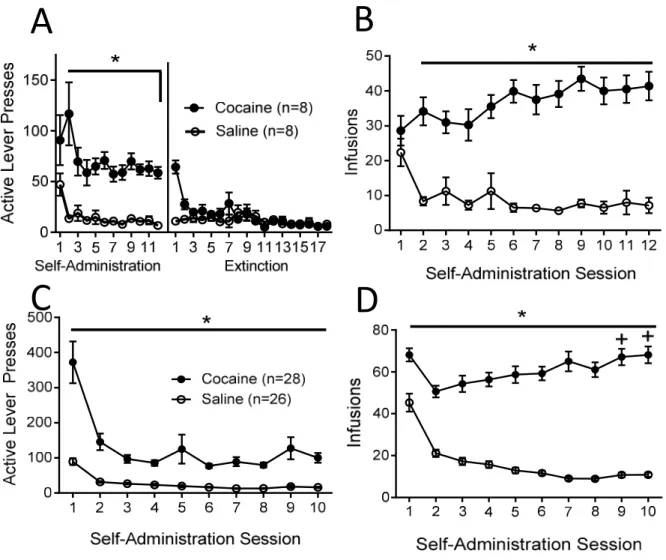
Behavioral profiles for all animals used in qPCR studies are shown following the ShA (Fig
1A, B) and LgA paradigms (Fig 1C, D). In the ShA paradigm, across all self-administration
sessions, cocaine self-administering rats showed a significantly greater number of both active lever
presses (F (1, 90) = 44.97, p < .001; Fig 1A) and infusions received (F (1, 90) = 64.82, p < .001;
Fig 1B) than saline self-administering animals. For both active lever presses and infusions in the
ShA paradigm, there was no main effect of time, and the interaction between drug and time was
not significant. Furthermore, no significant difference was found between cocaine and saline
groups in active lever presses throughout extinction sessions (F (1, 287) = 3.15, p = .098; Fig 1A).
In the LgA paradigm, across all self-administration sessions, cocaine self-administering
rats showed a significantly greater number of both active lever presses (F (1, 537) = 35.66, p < .001; Fig 1C) and infusions received (F (1, 537) = 166.94, p < .001; Fig 1D) than saline self-administering animals. For active lever presses (F (9, 537) = 21.21, p < .001; Fig 1C) and infusions
received (F (9, 537) = 25.06, p < .001; Fig 1D) the main effect of time was also significant. In
addition, the interaction between drug and time was significant for both active lever presses (F (9,
537) = 7.59, p < .001; Fig 1C) and infusions received (F (9, 537) = 20.75, p < .001; Fig 1D). Pairwise comparisons using the Holm-Sidak test showed no significant difference in the number
of infusions received across time in saline administering animals. However, cocaine
13
2, t = 6.44, p < 0.05; vs. day 3 t = 4.98, p < 0.05) and 10 (vs. day 2, t = 6.84, p < 0.05; vs. day 3 t
= 5.39, p < 0.05), indicating an escalation in self-administration.
To assess the regulation of GLT-1 gene expression by cocaine self-administration, levels
of GLT-1 mRNA splice isoforms were examined after ShA and extinction, as well as after LgA
and withdrawal. Although both models have been shown induce a downregulation in GLT-1
protein expression in the NAc (Fischer-Smith et al., 2012; Knackstedt et al., 2010), this finding
did not extend to GLT-1 mRNA. After ShA cocaine self-administration and extinction, no
significant differences were observed between cocaine and saline self-administering animals in
GLT-1A or GLT-1B mRNA levels in the NAc (Fig 2A, 2B). In contrast, LgA self-administration
and withdrawal led to significantly decreased GLT-1A (t (18) = 2.68, p < 0.05; Fig 2C) but not
GLT-1B mRNA levels (t (18) = -0.17, p = 0.86; Fig 2D) in the NAc of cocaine self-administering
rats.
In addition to GLT-1A and GLT-1B gene expression in the NAc, we examined GLT-1
gene expression in the PL and BLA, two brain regions with innervations to the NAc. Similar to
the NAc, ShA cocaine self-administration and extinction training did not result in any significant
changes in GLT-1A or GLT-1B gene expression in the PL or BLA (Fig 2A, 2B). In the PL, LgA
cocaine self-administration and withdrawal led to a non-significant trend toward a decrease in
GLT-1A levels (t (19) = 1.725, p = 0.101; Fig 2C), and a significant decrease in GLT-1B mRNA
levels (t (19) = 2.318, p < 0.05; Fig 2D). In the BLA, LgA cocaine self-administration and withdrawal significantly decreased GLT-1A (t (19) = 2.18, p < 0.05; Fig 2C) but not GLT-1B mRNA levels (t (19) = 1.58, p = 0.132; Fig 2D).
14
To further assess the decrease in GLT-1A mRNA levels after LgA cocaine
self-administration and withdrawal, we examined GLT-1A and GLT-1B gene expression in the NAc
of animals directly after the conclusion of LgA self-administration. In this case, measurements
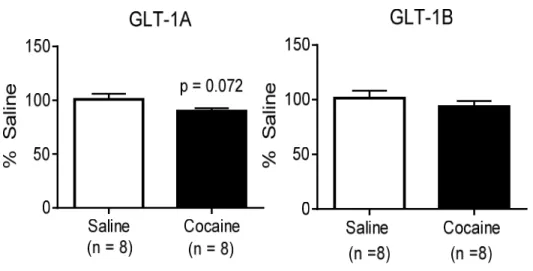
were taken 24 h after the last LgA session, as opposed to 45 days of withdrawal. Although LgA
cocaine self-administration led to a trend toward a marginal decrease in GLT-1A levels in the NAc,
this decrease was not statistically significant (p = 0.072; Fig 3A). Likewise, there was no
significant difference between cocaine and saline self-administering animals in GLT-1B mRNA
levels in the NAc directly after LgA self-administration (p = 0.38; Fig 3B).
Experiment 2: The GLT-1 gene is hypermethylated in the NAc after LgA cocaine and withdrawal
To examine a possible epigenetic mechanism for the observed decrease in GLT-1A mRNA
levels in the NAc after LgA cocaine and withdrawal, we next examined the methylation state of
the GLT-1 gene after LgA cocaine self-administration and withdrawal by methylated DNA
immunoprecipitation (MeDIP). In comparison to saline self-administering animals, LgA cocaine
self-administration and withdrawal induced a significant 2.75-fold increase in GLT-1 gene
methylation (t (15) = -2.379, p < 0.05; Fig 4).
Experiment 3: GLT-1 gene expression does not change in the NAc of female rats after LgA cocaine self-administration and withdrawal
To examine sex differences in the regulation of GLT-1 gene expression by LgA cocaine
self-administration and withdrawal, we assessed GLT-1 splice isoform mRNA levels in the NAc
of female rats. Behaviorally, compared to saline administering rats, throughout all
15
number of active lever presses (F (1, 199) = 85.90, p < .001; Fig 5A) and number of infusions received (F (1, 199) = 91.99, p < .001; Fig 5B). For active lever presses (F (9, 199) = 4.15, p <
.001; Fig 5A) and infusions received (F (9, 199) = 4.57, p < .001; Fig 5B), the main effect of time
was also significant, indicating escalation across time. The interaction between drug and time was
not significant for active lever presses, but the interaction was significant for infusions received (F
(9, 199) = 14.47, p < .001; Fig 5B).
Although male rats showed a significant decrease in GLT-1A mRNA after LgA cocaine
self-administration and withdrawal, this finding did not extend to female rats. In the NAc of female
rats, LgA cocaine self-administration and withdrawal did not result in any changes in GLT-1A
16
CHAPTER 4: DISCUSSION
Genetic regulation of GLT-1 by cocaine depends on behavioral paradigm, isoform, and brain region
Numerous studies have indicated that GLT-1 protein is downregulated in the NAc
following exposure to multiple drugs of abuse (Gipson et al., 2013; Knackstedt et al., 2009;
Knackstedt et al., 2010; Sari et al., 2013; Shen et al., 2014), and that restored expression of
GLT-1 is central to the mechanism for several candidate pharmacotherapies for relapse (Knackstedt et
al., 2010; Reissner et al., 2014; Reissner et al., 2015). However, the mechanism(s) responsible for
drug effects on GLT-1 protein levels is unknown. The results from this study show that GLT-1
gene expression after cocaine administration and withdrawal is dependent on
administration paradigm, as well as GLT-1 splice isoform and brain region. ShA cocaine
self-administration and extinction did not affect mRNA levels of either GLT-1 splice isoform in the
NAc, PL, or BLA, despite known effects on GLT-1 protein (Knackstedt et al., 2010). In contrast,
LgA cocaine self-administration and withdrawal significantly decreased GLT-1A gene expression
in the NAc and BLA. In the PL, a significant decrease was observed in GLT-1B, and a
non-significant trend was observed in GLT-1A mRNA. A summary of the changes in NAc GLT-1
protein and mRNA expression after cocaine self-administration in male rats is shown in Table 1.
The three main splice isoforms of GLT-1, which all vary in the C-terminus, are GLT-1A,
GLT-1B, and GLT-1C (Holmseth et al., 2009). GLT-1A is considered to be the dominant GLT-1
17
Meabon et al., 2012). 1B accounts for approximately 6% of 1 expression, while
GLT-1C accounts for roughly 1% (Holmseth et al., 2009). GLT-1A and GLT-1B are thus considered to
be the main isoforms of GLT-1 in the rat brain (Sullivan et al., 2004), and are the major focus of
this study. Although GLT-1A is more abundantly expressed in the rat brain, studies have shown
brain region specific differences in the expression of GLT-1 splice isoforms (Lehre et al., 1995;
Reye et al., 2002). For example, GLT-1A expression is more evident in parts of the pituitary gland
and external capsule, while GLT-1B is more highly expressed in parts of the cerebellar nuclei
(Reye et al., 2002). Moreover, the pattern of GLT-1 mRNA expression has been shown to differ
from protein expression of GLT-1 (Danbolt, 2001). Although GLT-1 protein expression is
primarily localized to astrocytes, GLT-1 mRNA expression has been found in both astrocytes and
neurons (Torp et al., 1994; Torp et al., 1997). In regions such as the CA3 region of the
hippocampus, although GLT-1 mRNA expression was present, GLT-1 protein expression was not
(Danbolt, 2001). The results from the present study suggest that LgA cocaine self-administration
and withdrawal may regulate GLT-1 gene expression differently based on isoform and brain
region. Therefore, it is likely that region-specific differences in mRNA expression of GLT-1 splice
isoforms contributed to the differential effects of LgA cocaine self-administration and withdrawal
on GLT-1A and GLT-1B gene expression in the NAc, PL, and BLA. The possibility exists that in
regions such as the NAc and BLA, GLT-1A may be the dominant isoform expressed and is
therefore downregulated by LgA cocaine self-administration and withdrawal, whereas GLT-1B is
not. The inverse may be true in regions such as the PL, where GLT-1B mRNA may be more
dominantly expressed and therefore downregulated by LgA cocaine self-administration and
withdrawal. It is also possible that more prolonged exposure and/or withdrawal than what was
18
In the NAc, ShA cocaine self-administration and extinction did not result in any changes
in GLT-1A or 1B mRNA levels, while LgA cocaine self-administration and withdrawal
significantly decreased GLT-1A but not GLT-1B mRNA levels. This result was somewhat
surprising since both models of cocaine self-administration downregulate GLT-1 protein levels in
the NAc (Fischer-Smith et al., 2012; Knackstedt et al., 2010; Reissner et al., 2015;
Trantham-Davidson et al., 2012), suggesting that post-transcriptional mechanisms may be responsible for
protein downregulation in this paradigm. Accordingly, we propose a dual model of GLT-1
regulation dependent on cocaine self-administration paradigm. The downregulation of GLT-1
protein in the NAc after ShA cocaine self-administration and extinction likely reflects changes in
GLT-1 protein trafficking or degradation (discussed in more detail below), whereas the decrease
in GLT-1 protein in the NAc after LgA and withdrawal engage changes in genetic regulation of
GLT-1.
Twenty-four hours after the last LgA cocaine self-administration session, we observed a
non-significant trend toward a minimal decrease in NAc GLT-1 mRNA levels, indicating that the
observed decrease in GLT-1A mRNA likely reflects neurochemical changes that occur in the NAc
during withdrawal from LgA cocaine administration. Withdrawal from LgA cocaine
self-administration leads to the “incubation of cocaine craving”, which is behaviorally characterized
by an increase in cocaine craving and cocaine seeking (Grimm et al., 2001; Pickens et al., 2011;
Tran-Nguyen et al., 1998). Furthermore, the incubation of cocaine craving is characterized by
neurochemical changes in the NAc not seen in other models of cocaine self-administration,
including an accumulation of calcium permeable AMPA receptors (Loweth et al., 2014; Wolf,
2016). This is consistent with the greater magnitude of GLT-1 protein downregulation observed
19
levels are decreased following LgA cocaine self-administration and withdrawal, this decrease in
GLT-1 mRNA likely reflects another neurochemical change in the NAc as a consequence of
withdrawal from LgA cocaine self-administration.
Genetic and post-transcriptional regulation of GLT-1
Numerous studies have shown that post-transcriptional mechanisms can lead to decreased
cell surface expression of GLT-1 protein. For example, in vitro studies using cell culture have shown that SUMOylation (Foran et al., 2014) and ubiquitination (García-Tardón et al., 2012;
Ibáñez et al., 2016; Martinez-Villarreal et al., 2012; Sheldon et al., 2008) can lead to internalization
and decreased cell surface expression of GLT-1. In addition, heat shock protein (Hsp90β) which
aids in the degradation of GLT-1 protein, is increased in reactive astrocytes of patients with
temporal lobe epilepsy, as well as in a mouse model of epilepsy (Sha et al., 2017). Preventing the
association between Hsp and GLT-1 with Hsp inhibitors has been shown to reduce the number of
seizures and further, prevent astrogliosis (Sha et al., 2017). Since GLT-1 gene expression was not
downregulated after ShA cocaine self-administration and extinction, it remains to be seen whether
these post-transcriptional mechanisms play a role in the downregulation of GLT-1 protein
expression after ShA cocaine self-administration and extinction.
The results from this study also show an increase in GLT-1 gene methylation in the NAc
following LgA cocaine self-administration and withdrawal, providing one epigenetic mechanism
for the observed decrease in GLT-1A mRNA. Increased DNA methylation leads to a decrease in
transcription via recruitment of methyl-CpG binding proteins which prevent the binding of
transcription factors, or by directly preventing the binding of transcription factors to DNA
20
methylation at shore regions of GLT-1 CpG islands, with higher methylation patterns observed in
the cerebellum vs. the cortex (Perisic et al., 2012). Other studies using cultured astrocytes from
the cerebellum have shown that inhibitors of DNA methyltransferase can increase GLT-1 gene
transcription (Zschocke et al., 2005). Furthermore, numerous studies have shown cocaine-induced
changes in DNA methylation patterns, including changes in gene expression of DNA
methyltransferase 3A and 3B in the NAc (Anier et al., 2010; LaPlant et al., 2010), as well as
hypermethylation at the protein phosphatase-1 (PP1c) promoter (Anier et al., 2010). Microarray
analysis used to examine the methylation state of various genes in the NAc after LgA cocaine
self-administration and withdrawal indicated a hypermethylation of genes related to glutamatergic
signaling (Massart et al., 2015). Similarly, in the medial prefrontal cortex of mice, prolonged
abstinence from cocaine self-administration altered DNA methylation patterns in 28 different
genomic locations (Baker-Andresen et al., 2015). The results from this present study add to these
findings and show that LgA cocaine self-administration and withdrawal results in the
hypermethylation of the GLT-1 gene in the NAc. Although there was only a decrease in GLT-1A
and not GLT-1B mRNA in the NAc following LgA cocaine self-administration and withdrawal,
hypermethylation of the GLT-1 gene in the NAc was still evident. This provides further evidence
in the NAc, GLT-1A is the dominant isoform.
Downregulation of NAc GLT-1 mRNA by cocaine is not observed in female rats
While effects of cocaine self-administration on glutamate homeostasis have been well
described in male rats, very little evidence is available regarding whether these effects also extend
to female rats. In the present study, LgA cocaine self-administration and withdrawal did not result
21
somewhat surprising, as female rats show robust lever pressing behavior during both acquisition
of self-administration and during reinstatement (Lacy et al., 2016; Zlebnik et al., 2014). It is then
possible that the estrous cycle may play a role in the regulation of GLT-1 gene expression.
Supporting this hypothesis, in primary cultures of astrocytes from the parietal cortex of patients
with Alzheimer’s disease (AD), estrogen administration was shown to reverse the downregulation
of GLT-1 observed in patients with AD (Liang et al., 2002). Future studies will be important in
order to determine the extent to which cocaine-induced disruptions in glutamate homeostasis is a
male-specific phenomenon, and if estrogen plays a role in the LgA cocaine self-administration and
withdrawal induced changes in GLT-1 gene expression.
Conclusions
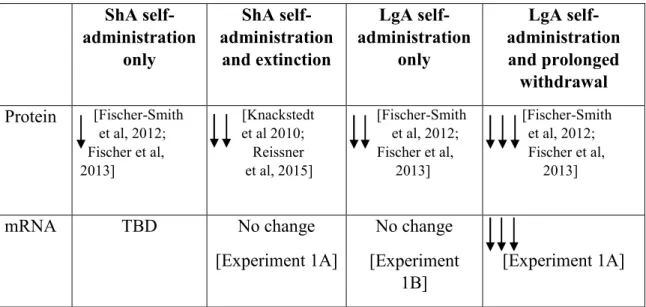
A summary of changes in GLT-1 protein and mRNA expression in male rats is shown in
Table 1, with the number of arrows indicating relative changes in expression. Previous studies
have shown decreases in NAc GLT-1 protein expression after ShA cocaine self-administration and
extinction (Knackstedt et al, 2010; Reissner et al, 2015), as well as after LgA cocaine
self-administration and withdrawal (Fischer-Smith et al, 2012; Fischer et al, 2013). The results from
this study show that in male rats, LgA cocaine self-administration and withdrawal, but not ShA
cocaine self-administration and extinction, decreases GLT-1 gene expression, indicating both
transcriptional and post-transcriptional mechanisms that contribute to the downregulation of
GLT-1 protein observed in these paradigms. This decrease is specific to GLT-GLT-1 splice isoform and brain
region, and requires a withdrawal period. Moreover, the decrease in GLT-1 mRNA in the NAc is
associated with a significant increase in methylation of the GLT-1 gene. Future studies will further
22
the NAc after ShA and extinction. Moreover, while our results show that hypermethylation of the
GLT-1 gene is one contributing mechanism responsible for the observed decreases in GLT-1
mRNA, other epigenetic mechanisms, such as histone modifications, may also play a role in the
regulation of GLT-1 gene transcription. Indeed, many studies have shown cocaine-induced
changes in histone modifications (Kennedy et al., 2013; Kumar et al., 2005; LaPlant and Nestler,
2011), and future studies can examine if histone modifications on the 1 gene influences
GLT-1 gene expression after LgA cocaine self-administration and withdrawal. Finally, future studies
can examine the epigenetic mechanism(s) leading to the changes in GLT-1 gene expression in the
PL and BLA of male rats, and can also assess if similar changes occur in female rats after LgA
23
Figure 1: Mean ± SEM active lever presses and number of infusions received during short access administration and extinction (A: active lever presses, B: infusions) and long access self-administration (C: active lever presses, D: infusions) *Significant difference between cocaine and saline administering rats (p < 0.05) +Significant difference between day 2 and day 3 of self-administration (p < 0.05)
A
D
C
24
Figure 2: Relative GLT-1A mRNA levels in the NAc, PL, and BLA after ShA and extinction (A), and LgA and withdrawal (C). Relative GLT-1B mRNA levels in the NAc, PL, and BLA after ShA and extinction (B), and LgA and withdrawal (D). ShA cocaine self-administration and extinction does not decrease GLT-1A or GLT-1B gene expression in any brain region. LgA cocaine self-administration and withdrawal significantly decreases GLT-1A gene expression in the NAc and BLA (C), and significantly decreases GLT-1B gene expression in the PL (D). *p < 0.05
A
B
25
26
27
Figure 5: Mean ± SEM active lever presses (A) and number of infusions (B) received during LgA administration in female rats. *Significant difference between cocaine and saline administering rats (p < 0.05) +Significant difference between day 1 and day 2 of self-administration (p < 0.05). No changes in GLT-1A (C) or GLT-1B (D) is found in the NAc of female rats after long access cocaine self-administration and withdrawal.
A
B
28
Table 1: Summary of Changes in NAc GLT-1 Protein and mRNA by Cocaine Experience in Male Rats. Relative amounts of change are indicated by one, two, or three arrows.
ShA self-administration only ShA self-administration and extinction LgA self-administration only LgA self-administration and prolonged withdrawal Protein [Fischer-Smith
et al, 2012; Fischer et al, 2013]
[Knackstedt et al 2010; Reissner et al, 2015]
[Fischer-Smith et al, 2012; Fischer et al, 2013]
[Fischer-Smith et al, 2012; Fischer et al, 2013]
mRNA TBD No change
29 REFERENCES
Ahmed, S. H., 2012. The science of making drug-addicted animals. Neuroscience 211, 107-125.
Anier, K., Malinovskaja, K., Aonurm-Helm, A., Zharkovsky, A., Kalda, A., 2010. DNA methylation regulates cocaine-induced behavioral sensitization in mice. Neuropsychopharmacology 35, 2450-2461.
Baker-Andresen, D., Zhao, Q., Li, X., Jupp, B., Chesworth, R., Lawrence, A. J., Bredy, T., 2015. Persistent variations in neuronal DNA methylation following cocaine self-administration and protracted abstinence in mice. Neuroepigenetics 4, 1-11.
Baker, D. A., McFarland, K., Lake, R. W., Shen, H., Tang, X. C., Toda, S., Kalivas, P. W., 2003. Neuroadaptations in cystine-glutamate exchange underlie cocaine relapse. Nat Neurosci 6, 743-749.
Bridges, R., Lutgen, V., Lobner, D., Baker, D. A., 2012. Thinking Outside the Cleft to Understand Synaptic Activity: Contribution of the Cystine-Glutamate Antiporter (System x(c)(−)) to Normal and Pathological Glutamatergic Signaling. Pharmacological Reviews 64, 780-802.
Cooper, S., Robison, A. J., Mazei-Robison, M. S., 2017. Reward Circuitry in Addiction. Neurotherapeutics, 1-11.
Danbolt, N. C., 2001. Glutamate uptake. Progress in Neurobiology 65, 1-105.
Feltenstein, M. W., Henderson, A. R., See, R. E., 2011. Enhancement of cue-induced reinstatement of cocaine-seeking in rats by yohimbine: sex differences and the role of the estrous cycle. Psychopharmacology 216, 53-62.
Fischer-Smith, K. D., Houston, A. C. W., Rebec, G. V., 2012. Differential effects of cocaine access and withdrawal on GLT1 expression in rat nucleus accumbens core and shell. Neuroscience 210, 333-339.
Fischer, K. D., Houston, A. C. W., Rebec, G. V., 2013. Role of the major glutamate transporter GLT1 in nucleus accumbens core vs. shell in cue-induced cocaine seeking behavior. J Neurosci 33, 9319-9327.
Foran, E., Rosenblum, L., Bogush, A., Pasinelli, P., Trotti, D., 2014. Sumoylation of the astroglial glutamate transporter EAAT2 governs its intracellular compartmentalization. Glia 62, 1241-1253.
30
Gipson, C. D., Reissner, K. J., Kupchik, Y. M., Smith, A. C. W., Stankeviciute, N., Hensley-Simon, M. E., Kalivas, P. W., 2013. Reinstatement of nicotine seeking is mediated by glutamatergic plasticity. Proceedings of the National Academy of Sciences 110, 9124-9129.
Grimm, J. W., Hope, B. T., Wise, R. A., Shaham, Y., 2001. Incubation of cocaine craving after withdrawal. Nature 412, 141-142.
Holmseth, S., Scott, H. A., Real, K., Lehre, K. P., Leergaard, T. B., Bjaalie, J. G., Danbolt, N. C., 2009. The concentrations and distributions of three C-terminal variants of the GLT1 (EAAT2; slc1a2) glutamate transporter protein in rat brain tissue suggest differential regulation. Neuroscience 162, 1055-1071.
Ibáñez, I., Díez-Guerra, F. J., Giménez, C., Zafra, F., 2016. Activity dependent internalization of the glutamate transporter GLT-1 mediated by β-arrestin 1 and ubiquitination. Neuropharmacology 107, 376-386.
Kalivas, P. W., 2009. The glutamate homeostasis hypothesis of addiction. Nat Rev Neurosci 10, 561-572.
Kennedy, P. J., Feng, J., Robison, A. J., Maze, I., Badimon, A., Mouzon, E., Chaudhury, D., Damez-Werno, D. M., Haggarty, S. J., Han, M. H., Bassel-Duby, R., Olson, E. N., Nestler, E. J., 2013. Class I HDAC inhibition blocks cocaine-induced plasticity by targeted changes in histone methylation. Nat Neurosci 16, 434-440.
Knackstedt, L. A., Kalivas, P. W., 2009. Glutamate and Reinstatement. Current opinion in pharmacology 9, 59-64.
Knackstedt, L. A., LaRowe, S., Mardikian, P., Malcolm, R., Upadhyaya, H., Hedden, S., Markou, A., Kalivas, P. W., 2009. The Role of Cystine-Glutamate Exchange in Nicotine Dependence in Rats and Humans. Biol Psychiatry 65, 841-845.
Knackstedt, L. A., Melendez, R. I., Kalivas, P. W., 2010. Ceftriaxone restores glutamate homeostasis and prevents relapse to cocaine-seeking. Biol Psychiatry 67, 81-84.
Kumar, A., Choi, K. H., Renthal, W., Tsankova, N. M., Theobald, D. E., Truong, H. T., Russo, S. J., Laplant, Q., Sasaki, T. S., Whistler, K. N., Neve, R. L., Self, D. W., Nestler, E. J., 2005. Chromatin remodeling is a key mechanism underlying cocaine-induced plasticity in striatum. Neuron 48, 303-314.
Lacy, R. T., Strickland, J. C., Feinstein, M. A., Robinson, A. M., Smith, M. A., 2016. The effects of sex, estrous cycle, and social contact on cocaine and heroin self-administration in rats. Psychopharmacology (Berl) 233, 3201-3210.
31
LaPlant, Q., Vialou, V., Covington, H. E., 3rd, Dumitriu, D., Feng, J., Warren, B. L., Maze, I., Dietz, D. M., Watts, E. L., Iniguez, S. D., Koo, J. W., Mouzon, E., Renthal, W., Hollis, F., Wang, H., Noonan, M. A., Ren, Y., Eisch, A. J., Bolanos, C. A., Kabbaj, M., Xiao, G., Neve, R. L., Hurd, Y. L., Oosting, R. S., Fan, G., Morrison, J. H., Nestler, E. J., 2010. Dnmt3a regulates emotional behavior and spine plasticity in the nucleus accumbens. Nat Neurosci 13, 1137-1143.
LaRowe, S. D., Kalivas, P. W., Nicholas, J. S., Randall, P. K., Mardikian, P. N., Malcolm, R. J., 2013. A Double-Blind Placebo-Controlled Trial of N-Acetylcysteine in the Treatment of Cocaine Dependence. The American journal on addictions / American Academy of Psychiatrists in Alcoholism and Addictions 22, 443-452.
LaRowe, S. D., Mardikian, P., Malcolm, R., Myrick, H., Kalivas, P., McFarland, K., Saladin, M., McRae, A., Brady, K., 2006. Safety and Tolerability of N-Acetylcysteine in Cocaine-Dependent Individuals. The American journal on addictions / American Academy of Psychiatrists in Alcoholism and Addictions 15, 105-110.
Lehre, K. P., Levy, L. M., Ottersen, O. P., Storm-Mathisen, J., Danbolt, N. C., 1995. Differential expression of two glial glutamate transporters in the rat brain: quantitative and immunocytochemical observations. J Neurosci 15, 1835-1853.
Liang, Z., Valla, J., Sefidvash-Hockley, S., Rogers, J., Li, R., 2002. Effects of estrogen treatment on glutamate uptake in cultured human astrocytes derived from cortex of Alzheimer's disease patients. J Neurochem 80, 807-814.
Loweth, J. A., Tseng, K. Y., Wolf, M. E., 2014. Adaptations in AMPA receptor transmission in the nucleus accumbens contributing to incubation of cocaine craving. Neuropharmacology 76, 10.1016/j.neuropharm.2013.1004.1061.
Lynch, W. J., 2008. Acquisition and maintenance of cocaine self-administration in adolescent rats: effects of sex and gonadal hormones. Psychopharmacology 197, 237-246.
Martinez-Villarreal, J., Garcia Tardon, N., Ibanez, I., Gimenez, C., Zafra, F., 2012. Cell surface turnover of the glutamate transporter GLT-1 is mediated by ubiquitination/deubiquitination. Glia 60, 1356-1365.
Massart, R., Barnea, R., Dikshtein, Y., Suderman, M., Meir, O., Hallett, M., Kennedy, P., Nestler, E. J., Szyf, M., Yadid, G., 2015. Role of DNA methylation in the nucleus accumbens in incubation of cocaine craving. J Neurosci 35, 8042-8058.
McBean, G. J., 2002. Cerebral cystine uptake: a tale of two transporters. Trends in Pharmacological Sciences 23, 299-302.
32
Moussawi, K., Zhou, W., Shen, H., Reichel, C. M., See, R. E., Carr, D. B., Kalivas, P. W., 2011. Reversing cocaine-induced synaptic potentiation provides enduring protection from relapse. Proc Natl Acad Sci U S A 108, 385-390.
Nestler, E. J., 2014. Epigenetic mechanisms of drug addiction. Neuropharmacology 76 Pt B, 259-268.
Parikh, V., Naughton, S. X., Shi, X., Kelley, L. K., Yegla, B., Tallarida, C. S., Rawls, S. M., Unterwald, E. M., 2014. Cocaine-induced neuroadaptations in the dorsal striatum: Glutamate dynamics and behavioral sensitization. Neurochemistry international 75, 54-65.
Perisic, T., Holsboer, F., Rein, T., Zschocke, J., 2012. The CpG island shore of the GLT-1 gene acts as a methylation-sensitive enhancer. Glia 60, 1345-1355.
Pickens, C. L., Airavaara, M., Theberge, F., Fanous, S., Hope, B. T., Shaham, Y., 2011. Neurobiology of the incubation of drug craving. Trends in neurosciences 34, 411-420.
Quintero, G. C., 2013. Role of nucleus accumbens glutamatergic plasticity in drug addiction. Neuropsychiatric Disease and Treatment 9, 1499-1512.
Reissner, K. J., Brown, R. M., Spencer, S., Tran, P. K., Thomas, C. A., Kalivas, P. W., 2014. Chronic Administration of the Methylxanthine Propentofylline Impairs Reinstatement to Cocaine by a GLT-1-Dependent Mechanism. Neuropsychopharmacology 39, 499-506.
Reissner, K. J., Gipson, C. D., Tran, P. K., Knackstedt, L. A., Scofield, M. D., Kalivas, P. W., 2015. Glutamate transporter GLT-1 mediates N-acetylcysteine inhibition of cocaine reinstatement. Addiction biology 20, 316-323.
Reye, P., Sullivan, R., Scott, H., Pow, D. V., 2002. Distribution of two splice variants of the glutamate transporter GLT-1 in rat brain and pituitary. Glia 38, 246-255.
Roberts, D. C. S., Morgan, D., Liu, Y., 2007. How to make a rat addicted to cocaine. Progress in neuro-psychopharmacology & biological psychiatry 31, 1614-1624.
Robison, A. J., Nestler, E. J., 2011. Transcriptional and epigenetic mechanisms of addiction. Nat Rev Neurosci 12, 623-637.
Rothstein, J. D., Patel, S., Regan, M. R., Haenggeli, C., Huang, Y. H., Bergles, D. E., Jin, L., Dykes Hoberg, M., Vidensky, S., Chung, D. S., Toan, S. V., Bruijn, L. I., Su, Z.-z., Gupta, P., Fisher, P. B., 2005. [beta]-Lactam antibiotics offer neuroprotection by increasing glutamate transporter expression. Nature 433, 73-77.
33
Scholpa NE, Briggs SB, Wagner JJ, Cummings BS. Cyclin-Dependent Kinase Inhibitor 1a (p21) Modulates Response to Cocaine and Motivated Behaviors. The Journal of Pharmacology and Experimental Therapeutics. 2016;357(1):56-65.
Scofield, M. D., Heinsbroek, J. A., Gipson, C. D., Kupchik, Y. M., Spencer, S., Smith, A. C. W., Roberts-Wolfe, D., Kalivas, P. W., 2016. The Nucleus Accumbens: Mechanisms of Addiction across Drug Classes Reflect the Importance of Glutamate Homeostasis. Pharmacological Reviews 68, 816-871.
Scofield, M. D., Kalivas, P. W., 2014. Astrocytic dysfunction and addiction: consequences of impaired glutamate homeostasis. Neuroscientist 20, 610-622.
Sha, L., Wang, X., Li, J., Shi, X., Wu, L., Shen, Y., Xu, Q., 2017. Pharmacologic inhibition of Hsp90 to prevent GLT-1 degradation as an effective therapy for epilepsy. The Journal of Experimental Medicine 214, 547-563.
Sheldon, A. L., Gonzalez, M. I., Krizman-Genda, E. N., Susarla, B. T., Robinson, M. B., 2008. Ubiquitination-mediated internalization and degradation of the astroglial glutamate transporter, GLT-1. Neurochem Int 53, 296-308.
Shen, H.-w., Scofield, M. D., Boger, H., Hensley, M., Kalivas, P. W., 2014. Synaptic Glutamate Spillover Due to Impaired Glutamate Uptake Mediates Heroin Relapse. The Journal of Neuroscience 34, 5649-5657.
Sullivan, R., Rauen, T., Fischer, F., Wiessner, M., Grewer, C., Bicho, A., Pow, D. V., 2004. Cloning, transport properties, and differential localization of two splice variants of GLT-1 in the rat CNS: implications for CNS glutamate homeostasis. Glia 45, 155-169.
Susarla, B. T., Robinson, M. B., 2008. Internalization and degradation of the glutamate transporter GLT-1 in response to phorbol ester. Neurochem Int 52, 709-722.
Torp, R., Danbolt, N. C., Babaie, E., Bjoras, M., Seeberg, E., Storm-Mathisen, J., Ottersen, O. P., 1994. Differential expression of two glial glutamate transporters in the rat brain: an in situ hybridization study. Eur J Neurosci 6, 936-942.
Torp, R., Hoover, F., Danbolt, N. C., Storm-Mathisen, J., Ottersen, O. P., 1997. Differential distribution of the glutamate transporters GLT1 and rEAAC1 in rat cerebral cortex and thalamus: an in situ hybridization analysis. Anatomy and Embryology 195, 317-326.
Tran-Nguyen, L. T. L., Fuchs, R. A., Coffey, G. P., Baker, D. A., Odell, L. E., Neisewander, J. L., 1998. Time-Dependent Changes in Cocaine-Seeking Behavior and Extracellular Dopamine Levels in the Amygdala during Cocaine Withdrawal. Neuropsychopharmacology 19, 48-59.
34
van Huijstee, A. N., Mansvelder, H. D., 2014. Glutamatergic synaptic plasticity in the mesocorticolimbic system in addiction. Frontiers in Cellular Neuroscience 8, 466.
Venniro, M., Caprioli, D., Shaham, Y., 2016. Chapter 2 - Animal models of drug relapse and craving: From drug priming-induced reinstatement to incubation of craving after voluntary abstinence. In: Hamed, E., Martin, P. P., (Eds), Progress in Brain Research. Elsevier, pp. 25-52.
Wolf, M. E., 2016. Synaptic mechanisms underlying persistent cocaine craving. Nat Rev Neurosci 17, 351-365.
Zhou, W., Kalivas, P. W., 2008. N-acetylcysteine reduces extinction responding and induces enduring reductions in cue- and heroin-induced drug-seeking. Biol Psychiatry 63, 338-340.
Zlebnik, N. E., Saykao, A. T., Carroll, M. E., 2014. Effects of combined exercise and progesterone treatments on cocaine seeking in male and female rats. Psychopharmacology 231, 3787-3798.