for zirconium-89-based radiopharmaceutical
development
†‡
Darpan N. Pandya,§*a
Nikunj Bhatt,§aHong Yuan,bCynthia S. Day,c
Brandie M. Ehrmann,dMarcus Wright,cUlrich Bierbachcand Thaddeus J. Wadas*a
We report our initial investigations into the use of tetraazamacrocycles as zirconium-89 chelators. We describe the synthesis and complete characterization of several Zr tetraazamacrocycle complexes, and definitively describe the first crystal structure of zirconium 1,4,7,10-tetraazacyclododecane-1,4,7,10-tetraacetic acid (Zr–DOTA) using single crystal X-ray diffraction analysis. After evaluating several radioactive analogs, we found that 89Zr–DOTA is superior to89Zr–DFO, the only89Zr-complex to be used clinically in 89Zr-radiopharmaceutical applications. Finally, we provide a rationale for the unanticipated and extraordinary stability of these complexes in vitro and in vivo. These results may inform the development of safer and more robust immuno-PET agents for precision medicine applications.
Introduction
Zirconium-89 (89Zr: (t1/2¼78.4 h,b+: 22.8%,Eb+max¼901 keV;
EC: 77%,Eg¼ 909 keV)) is a positron-emitting radionuclide
currently being tested in over 30 clinical trials involving
monoclonal antibodies (mAbs); its radioactive half-life
complements the biological half-life of a circulating antibody
in vivo.1 Standard practice within the radiopharmaceutical
industry requires89Zr to be attached to an antibody through desferrioxamine (DFO) or its analogs, which are derivatives of the iron chelator desferral, a growth-promoting agent secreted byStreptomyces pilosus.2,3Despite the widespread use of DFO
in89Zr-immuno-PET applications, the unsaturated
coordina-tion sphere of89Zr–DFO is believed to be responsible for its observed instability in preclinical animal models,4–6 and
signicant effort has been expended to develop improved
89Zr(IV)-chelators.7–21
Tetraazamacrocycles such as 1,4,7,10-tetraazacyclododecane-1,4,7,10-tetraacetic acid (DOTA) remain a largely unexplored class of ligands due to a perceived inability to form stable
89Zr-complexes.20,22–24 Although only anecdotal evidence has
appeared in the literature, instability is believed to arise from chelation by the four macrocycle nitrogen atoms and four oxygen atoms of the pendant arms rather than eight oxygen donors, which are believed to be preferred by the oxophilic89Zr4+ion.23 As a result, little is known regarding their Zr coordination
chemistry or use in 89Zr-radiopharmaceutical development.
Despite well-reasoned arguments to the contrary,20,22–24it seemed reasonable to posit that tetraazamacrocycles would be useful in
89Zr-radiopharmaceutical applications, since several Zr–cyclam
complexes have been described previously.25,26Additionally, we
reasoned that their use would be advantageous since (1) they demonstrate enhanced stability over acyclic ligands due to the macrocyclic effect; (2) various functional groups can be intro-duced into the macrocycle's backbone or pendant arms to modulate the ligand's stereo- and coordination chemistry; (3) bifunctional chelators derived from these ligands allow them to be conjugated to various peptides, proteins, and antibodies; and (4) they have been used successfully in a number of radiophar-maceutical applications and clinical trials.
Here we document our initial investigations into the use of tetraazamacrocycles as89Zr-chelators. We describe the synthesis
and complete characterization of Zr–DOTA, Zr–DOTAM, and
Zr–DOTP (Fig. 1), and describe the rst crystal structure of Zr–DOTA, which reveals a saturated coordination sphere around the Zr4+ion. Finally, we evaluate the radioactive analogsin vitro
andin vivo, and show that89Zr–DOTA demonstrates behaviour
aDepartment of Cancer Biology, Wake Forest School of Medicine, Winston-Salem, NC 27157, USA. E-mail: [email protected]; [email protected] bDepartment of Radiology, University of North Carolina at Chapel Hill, Chapel Hill, NC 27599, USA
c
Department of Chemistry, Wake Forest University, Winston-Salem, NC 27109, USA dDepartment of Chemistry, University of North Carolina at Chapel Hill, Chapel Hill, NC 27599, USA
†TJW, DNP and NB haveled patents relating to this work. All other authors declare no competingnancial interests exist.
‡Electronic supplementary information (ESI) available: Complete experimental details and supporting data. CCDC 1501174. For ESI and crystallographic data in CIF or other electronic format see DOI: 10.1039/c6sc04128k
§These authors contributed equally to this work.
Received 14th September 2016 Accepted 12th December 2016
DOI: 10.1039/c6sc04128k
www.rsc.org/chemicalscience
Open Access Article. Published on 13 December 2016. Downloaded on 23/03/2017 14:30:07.
This article is licensed under a
that is superior to89Zr–DFO. To the best of our knowledge, this is
therst report to evaluate tetraazamacrocycles as89Zr-chelators
and to provide a rationale for their exceptional and unpredicted
in vivobehaviour.
Experimental methods
Full experimental details are presented in the ESI.‡
Results and discussion
During initial syntheses of the nonradioactive complexes, we observed poor reactivity when the respective ligands were reacted with zirconium oxalate (Zr(ox)2), which demonstrates
poor solubility in a variety of solvents. Thus, we used either Zr(IV) acetylacetonate (Zr(AcAc)4) or ZrCl4as zirconium sources
with subsequent synthetic strategies modied from the litera-ture.11,16,27Accordingly, nonradioactive Zr–DOTA (Scheme S1‡),
Zr–DOTP (Scheme S2‡) and Zr–DOTAM (Scheme S3‡) were
prepared in excellent yields and all were fully characterized by HPLC, NMR spectroscopy, and HR-MS analyses (Fig. S1–S20‡). While single crystals of all complexes were obtained, only those of Zr–DOTA were suitable for single crystal X-ray diffraction analysis.
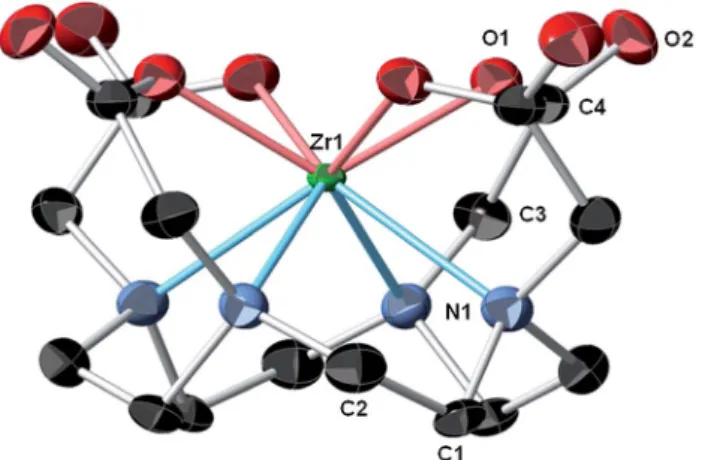
In our hands, single crystal X-ray diffraction of Zr–DOTA revealed 2 crystallographically-independent molecules in the
asymmetric unit with C4 symmetry. One of the Zr sites is
disordered (68%/32%) over 2 sites along the 4-fold axis. The ordered site at Zr1is depicted in Fig. 2 and complete
crystal-lographic parameters, data collection and renement infor-mation are included in the ESI.‡All four macrocycle nitrogen atoms and acetate pendant arms participate in Zr4+ion coor-dination to form an octa-coordinate complex, which may be the key to the relationship between the complex's structure
and its unanticipated in vivo behaviour (vide infra). The
Zr–DOTA complex exhibits a compressed, square
anti-pris-matic geometry. This is not unusual, since Zr tetraazamacro-cycle complexes exhibit varying geometries dictated by the additional ligands that occupy the coordination sites not occupied by the nitrogen atoms of the macrocycle.25,26,28The
perpendicular distance from the metal center to the plane described by the 4 acetate-containing pendant arms of the macrocycle is 1.004(3)A, and the perpendicular distance from˚
the metal center to the plane described by the 4 nitrogens of the macrocycle is 1.310(4)˚A. The DOTA ligand displays a low-symmetry saddle-like conformation similar to that of metal– dibenzotetramethytetraaza[14]annulene complexes described
by De Angelis and co-workers.29 This conformation is most
pronounced with metal complexes demonstrating d0electron
congurations, which lack crystal-eld stabilization.29 The
average Zr–ligand bond lengths and bond angles are
compa-rable to those observed in structurally characterized Zr complexes containing hydroxamate, phenoxyamine, salophen, or cyclam ligands.25,26,28,30–33
Aer completing synthesis and characterization of the refer-ence complexes, we attempted to radiolabel each ligand using
89Zr(ox)
2 and procedures established for preparation of
89Zr–DFO.5However, radiochemical yields were poor (Scheme S4
and Table S6‡). Thus, we used 89ZrCl
4 as a radioactive
precursor,5and observed that DOTA, DOTAM, and DOTP were
quantitatively radiolabeled within 45 minutes at 90C (Scheme S5‡). Optimized radiochemical synthesis conditions are pre-sented in Table S7.‡The radiochemical yield and purity of all
89Zr complexes were conrmed by radio-TLC (Fig. S25, S27 and
S29‡) or radio-HPLC (Fig. S26 and S28‡). The specic activity (As)
for each radiometal complex is in good agreement with theAsof
other89Zr-complexes reported in the literature.9,15The surprising differences in reactivity observed for89Zr(ox)2and89ZrCl4with
tetraazamacrocycles are most likely dictated by the89Zr species present in solution. Nonradioactive Zr(ox)2 is a highly stable
complex, even under highly acidic conditions and at very low molar concentrations.34Accordingly, the oxalate anion's ability to form a stable 89Zr-complex in aqueous media effectively
competes with the tetraazamacrocycle ligand, resulting in
reduced 89Zr-tetraazamacrocycle complex formation. On the
other hand, natural ZrCl4(like other highly charged, oxophilic
metal halides) readily undergoes aquation in solution to form hydroxo- and oxo-bridged species.35It is reasonable that89ZrCl
4
would demonstrate a similar behaviour.34Thus, in the absence
of an oxalate ligand,89Zr–tetraazamacrocycle complex formation Fig. 1 Structures of tetraazamacrocyclic ligands, desferral (DFO), and
their89Zr-complexes.
Fig. 2 Crystal structure of Zr–DOTA.‡Thermal ellipsoids are drawn at the 50% probability level; only one of the crystallographically-inde-pendent Zr centers is shown and a partial atomic labeling scheme is provided. The disordered Zr center, disordered solvent molecules, and hydrogen atoms are omitted for clarity.
Open Access Article. Published on 13 December 2016. Downloaded on 23/03/2017 14:30:07.
This article is licensed under a
metal ions aer 3 h incubation, with a 1000-fold excess of EDTA at pH 5. Based upon our EDTA challenge studies, the order of
89Zr-complex stability can be described as 89Zr–DOTA [
89Zr–DOTP >89Zr–DOTAM >89Zr–DFO (Table S8‡).
Tetraazamacrocycles can chelate numerous, biologically relevant metal cations, and this property can potentially create
a second mechanism for 89Zr4+ ion dissociation from its
chelatorin vivo.1 To assess the ability of the Zr complexes to resist demetallation by another metal cation, we performed metal competition studies, in which we mixed the radiometal complex with an excess concentration of metal salts in aqueous buffer. We observed no demetallation of 89Zr–DOTA over the
7 day experiment (Table S9‡). In contrast,89Zr–DFO remained
only 33.9% and 72.6% intact, respectively, when challenged with Fe3+ions or Ga3+ ions. The overall order of89Zr-complex stability based upon these studies mirrored our results in the EDTA challenge experiments, further demonstrating the robust stability of Zr–tetraazamacrocycle complexes.
We then evaluated the in vivo behaviour of 89Zr–DOTA,
89Zr–DOTP, and89Zr–DOTAM in acute biodistribution studies.
Results are shown in Tables S12–S14.‡ Mice receiving
89Zr–DOTAM retained elevated levels of radioactivity in liver and
spleen tissues, which was not excreted over the 72 h experiment.
In vitro,89Zr–DOTAM aggregated and precipitated out of solu-tion unless a low concentrasolu-tion of surfactant was included to stabilize the complex. While surfactant was used in the injec-tion formulainjec-tion for biodistribuinjec-tion studies, it is hypothesized that once in the blood stream, 89Zr–DOTAM aggregates with
serum proteins, which are deposited in these tissues during circulation. We could not identify the radioactive species, and thus we did not evaluate89Zr–DOTAM further.
Mice intravenously injected with 89Zr–DOTA retained
signicantly less radioactivity in their liver, kidney, and bone tissue compared to mice injected with89Zr–DOTP at 72 h post-injection (89Zr–DOTAvs.89Zr–DOTP: % ID per gSD,pvalue) (blood, 0.00030.001vs.0.00050.001, 0.39; liver, 0.021 0.002vs.0.0360.002, <0.0001; kidney, 0.0780.009vs.0.32 0.045, <0.0001; bone, 0.0250.009vs.2.630.12, <0.0001). Higher retention of 89Zr–DOTP was predicted by the in vitro
kinetic stability results, and may suggest transchelation to serum proteins or reduced stability in the presence of the lower pH environments that may exist in Kupffer cell lysosomes or the kidney.36,37Retention of radioactivity in bones of mice receiving
89Zr–DOTP may be caused by a number of factors,e.g.
residu-alization of89Zr transchelated by hydroxylapatite, or adsorption of the intact complex in the bone matrix due to the inuence of the four phosphate-containing pendant arms of the89Zr–DOTP complex. The latter phenomenon was observed with other
(89Zr–DOTA vs. 89Zr–DFO: % ID per g SD, pvalue) (blood, 0.00030.0008vs.0.00030.0005, 1.00; liver, 0.0210.002vs.
0.0660.009, <0.0001; kidney, 0.0780.009vs.0.690.098, <0.0001; bone, 0.025 0.009 vs. 0.079 0.014, <0.0001). Interestingly, while radioactivity retention in bone tissue of mice injected with89Zr–DFO increases over time, radioactivity retention in bone tissue of mice receiving89Zr–DOTA remained low, with no statistically signicant changes at any time point. One possible explanation for these observations may be the tetraazamacrocycle's ability to form an octa-coordinate complex with the89Zr4+ion. The saturated coordination sphere plus the
four hard oxygen donor groups are believed to produce a complex that remains resistant to chemical, biological, and physical factors that may destabilize a radiometal complexin vivo. However, it is unknown if resistance to these forces will be maintained when89Zr–DOTA is incorporated into an antibody conjugate. These studies are currently underway in our laboratory.
Normal mice were injected with 89Zr–DFO and 89Zr–DOTA and dynamic PET imaging done from 0–60 minutes, followed by static imaging at 2, 4, and 24 h aer injection. Both radiometal complexes exhibited a similar excretion prole based on the amount of radioactivity in the blood pool and the liver during
rst 60 minutes (Fig. 3, S38, and S39‡). Radioactivity in the kidney and bone was much lower in mice receiving89Zr–DOTA
compared to 89Zr–DFO, suggesting a better excretion prole
from these tissues (see Fig. 3 and S38‡). Both 89Zr–DFO and 89Zr–DOTA are excreted renally, with elevated levels of
radioac-tivity in the kidneys and bladder at early time points. However, by 4 h, nearly all the radioactivity was excreted from mice that received 89Zr–DOTA, and aer 24 h, radioactivity was barely above background levels. By contrast, more radioactivity accu-mulated in the kidneys of mice injected with89Zr–DFO at 4 h, and they were still visible in static images acquired aer 24 h. Results of region-of-interest analysis on the data acquired during the static imaging sessions further corroborate our bio-distribution studies, which suggest that thein vivobehavior of
89Zr–DOTA is superior to89Zr–DFO (Table S16‡). However, only
metabolism studies will provide denitive proof of the radioac-tive species retained or excreted. Accordingly, we are currently performing such studies to examine the fates of89Zr–oxalate, 89ZrCl
4,89Zr–DFO, and89Zr–DOTA in mouse tissues.
Based on these unexpected observations, we attempted to place our results in context by comparing them with published studies of other89Zr-chelators (Tables S17–S19‡). Variability in study designs or unreported data prevented direct comparisons among all ligand classes, but comparisons were made when possible.
Open Access Article. Published on 13 December 2016. Downloaded on 23/03/2017 14:30:07.
This article is licensed under a
In vitrodata suggest that89Zr–DOTA was more resistant to EDTA challenge than 89Zr–TAFC,39which was 97% intact aer
7 days exposure to 1000 fold EDTA (pH 7). Additionally, metal ion competition studies suggest that89Zr–DOTA was more resistant
to exogenous metal challenge than either 89Zr–HOPO or
89Zr–CP256.9,14 When exposed to Fe3+ ions, only 83% of the 89Zr–HOPO complex was still intact aer 7 days, and only 14% of
89Zr–CP256 remained intact aer 20 minutes. Finally, in vivo
biodistribution data were also examined at 24 h post-injection. Mice injected with89Zr-TAM-1, 89Zr-TAM-2, and89Zr-2,3-HOPO retained 26, 145, and 92 fold more radioactivity, respectively, in kidney tissue than mice injected with89Zr–DOTA.15,19In the same ligand series, mice injected with the corresponding radiometal chelates retained 2.6, 7.6 and 7.6 fold more radioactivity, respec-tively in bone tissue than did animals receiving89Zr–DOTA.15,19 Also, approximately 5 and 16 fold more radioactivity was observed in the bone tissue of animals injected with 89Zr–HOPO and 89Zr–L4, respectively.9,10This limited comparison ofin vitroandin vivo behaviour suggests that 89Zr–DOTA is the most stable
89Zr-complex reported to date, and its apparent resilience to
perturbationin vitroandin vivois remarkable and unexpected. Although the elevated temperature needed to synthesize89Zr tetraazamacrocycle complexes may be considered a limitation of this work, it should not prohibit exploration of these radio-metal chelates in immuno-PET applications, since various methods can be used to circumvent this temperature
require-ment and prepare useful 89Zr-radiopharmaceuticals.40–42
Furthermore, the use of89ZrCl4as a89Zr-source allows access to
ultra-stable89Zr-complexes, previously believed to be inacces-sible or unstable. The synthetic methodologies we describe here can facilitate systematic study of89Zr coordination chemistry
using inorganic chemistry, radiochemistry and molecular imaging techniques to elucidate how to create89 Zr-radiophar-maceuticals with excellent stabilityin vivo. While many ligands have been developed to chelate89Zr, a systematic study among ligand classes has not been described in the literature. Just as
a systematic study of tetraazamacrocycles beneted 64Cu
radiopharmaceutical development and led to the ultra-stable
cross-bridged chelators,43–46similar advances could be accom-plished based on systematic study of these 89
Zr-tetraazama-crocycle complexes. Finally, clinicians are increasingly using
89Zr–DFO–mAbs in dosimetry and therapeutic planning before
targeted systemic radiotherapy.47–51Since DOTA can effectively
chelate 89Zr and other therapeutic radionuclides,52–54 it is
plausible to imagine that one DOTA–mAb conjugate would be
needed to accomplish dosimetry and radiotherapy with89Zr and a therapeutic radionuclide, respectively. This approach may increase dosimetric accuracy, reduce regulatory burden, and minimize costs associated with cGMP-compliant radiophar-maceutical development, so that these precision medicine applications may be used more effectively in the future.
Conclusions
This report is therst to describe the structural characterization of Zr–DOTA using single-crystal X-ray diffraction and the use of tetraazamacrocycles as89Zr-chelators. In all studies,89Zr–DOTA
demonstrated superior in vivo behaviour compared to
89Zr–DFO, which is considered the“gold standard”in clinical
89Zr-radiopharmaceutical development. These results refute
current thinking regarding the use of tetraazamacrocycles as
89Zr-chelators, and may provide a way to enhance development
of radiolabeled agents for precision medicine applications.
Acknowledgements
The authors acknowledge support from Wake Forest University Health Sciences, a Commercialization Pathway Award from Wake Forest Innovations, Wake Forest Baptist Medical Center and the North Carolina Biotechnology Center (2016-BIG-6524). PET Imaging was provided by the Small Animal Imaging Core facility at the University of North Carolina Biomedical Research Imaging Center, which is supported by a Comprehensive Cancer Center grant (P30CA016086). High-resolution mass spectrometry was provided by the Mass Spectrometry Core Laboratory at the University of North Carolina at Chapel Hill. Fig. 3 PET maximum-intensity projection images comparing89Zr–DOTA and89Zr–DFO.89Zr–DOTA undergoes more efficient renal excretion than89Zr
–DFO. By 4 h post-injection, most activity associated with89Zr
–DOTA was excreted into the bladder; by 24 h post-injection, very little activity remained. Mice injected with89Zr
–DFO retained significantly more radioactivity in their kidneys at 4 h and 24 h post-injection.
Open Access Article. Published on 13 December 2016. Downloaded on 23/03/2017 14:30:07.
This article is licensed under a
Chem. Rev., 2010,110, 2858–2902.
2 Z. D. Liu and R. C. Hider,Med. Res. Rev., 2002,22, 26–64. 3 Z. D. Liu, R. Kayyali, R. C. Hider, J. B. Porter and
A. E. Theobald,J. Med. Chem., 2002,45, 631–639.
4 J. P. Holland, V. Divilov, N. H. Bander, P. M. Smith-Jones, S. M. Larson and J. S. Lewis,J. Nucl. Med., 2010,51, 1293–1300. 5 J. P. Holland, Y. Sheh and J. S. Lewis,Nucl. Med. Biol., 2009,
36, 729–739.
6 J. P. Holland and N. Vasdev,Dalton Trans., 2014,43, 9872– 9884.
7 E. W. Price and C. Orvig,Chem. Soc. Rev., 2014,43, 260–290. 8 M. A. Deri, S. Ponnala, P. Kozlowski, B. P. Burton-Pye, H. T. Cicek, C. Hu, J. S. Lewis and L. C. Francesconi,
Bioconjugate Chem., 2015,26, 2579–2591.
9 M. A. Deri, S. Ponnala, B. M. Zeglis, G. Pohl, J. J. Dannenberg, J. S. Lewis and L. C. Francesconi,J. Med. Chem., 2014,57, 4849–4860.
10 E. Boros, J. P. Holland, N. Kenton, N. Rotile and P. Caravan,
ChemPlusChem, 2016,81, 274–281.
11 F. Guerard, Y. S. Lee, R. Tripier, L. P. Szajek, J. R. Deschamps and M. W. Brechbiel,Chem. Commun., 2013,49, 1002–1004. 12 F. Guerard, Y.-S. Lee and M. W. Brechbiel,Chem.–Eur. J.,
2014,20, 5584–5591.
13 O. Jacobson, L. Zhu, G. Niu, I. D. Weiss, L. P. Szajek, Y. Ma, X. Sun, Y. Yan, D. O. Kiesewetter, S. Liu and X. Chen,Mol. Imaging Biol., 2011,13, 1224–1233.
14 M. T. Ma, L. K. Meszaros, B. M. Paterson, D. J. Berry, M. S. Cooper, Y. Ma, R. C. Hider and P. J. Blower, Dalton Trans., 2015,44, 4884–4900.
15 D. N. Pandya, S. Pailloux, D. Tatum, D. Magda and T. J. Wadas,Chem. Commun., 2015,51, 2301–2303.
16 M. Patra, A. Bauman, C. Mari, C. A. Fischer, O. Blacque, D. Haussinger, G. Gasser and T. L. Mindt,Chem. Commun., 2014,50, 11523–11525.
17 E. W. Price, B. M. Zeglis, J. S. Lewis, M. J. Adam and C. Orvig,
Dalton Trans., 2014,43, 119–131.
18 V. Radchenko, S. Busse and F. Roesch,Nucl. Med. Biol., 2014,
41, 721–727.
19 J. N. Tinianow, D. N. Pandya, S. L. Pailloux, A. Ogasawara, A. N. Vanderbilt, H. S. Gill, S.-P. Williams, T. J. Wadas, D. Magda and J. Marik,Theranostics, 2016,6, 511–521. 20 F. C. van de Watering, M. Rijpkema, L. Perk, U. Brinkmann,
W. J. Oyen and O. C. Boerman,BioMed Res. Int., 2014,2014, 203601.
21 D. J. Vugts, C. Klaver, C. Sewing, A. J. Poot, K. Adamzek, S. Huegli, C. Mari, G. W. Visser, I. E. Valverde, G. Gasser, T. L. Mindt and G. A. van Dongen,Eur. J. Nucl. Med. Mol. Imaging, 2016, DOI: 10.1007/s00259-016-3499-x.
and A. M. Martins,Dalton Trans., 2015,44, 1441–1455. 27 A. Rogers, E. Solari, C. Floriani, A. Chiesi-Villa and C. Rizzoli,
J. Chem. Soc., Dalton Trans., 1997, 2385–2386.
28 R. F. Munha, L. F. Veiros, M. T. Duarte, M. D. Fryzuk and A. M. Martins,Dalton Trans., 2009, 7494–7508.
29 S. Angelis, E. Solari, C. Floriani, A. Chiesi-Villa and C. Rizzoli,Inorg. Chem., 1992,31, 2520–2527.
30 P. Jewula, J.-C. Berthet, J.-C. Chambron, Y. Rousselin, P. Thuery and M. Meyer,Eur. J. Inorg. Chem., 2015, 1529–1541. 31 A. Li, H. Ma and J. Huang,Organometallics, 2013,32, 7460–
7469.
32 E. Solari, C. Maltese, F. Franceschi, C. Floriani, A. Chiesi-Villa and C. Rizzoli, J. Chem. Soc., Dalton Trans., 1997, 2903–2910.
33 C. Kato, A. Shinohara, K. Hayashi and K. Nomiya, Inorg.
Chem., 2006,45, 8108–8119.
34Chemical Thermodynamics of Compounds and Complexes of U, Np, Pu, Am, Tc, Se, Ni and Zr with Selected Organic Liquids, ed. M. Illemassene and J. Perrone, Elsevier Science, Amsterdam, 2005. 35 B. Galeffi, M. Simard and J. Wuest,Inorg. Chem., 1990,29,
951–954.
36 M. Bilzer, F. Roggel and A. Gerbes,Liver Int., 2006,26, 1175– 1186.
37 J. Blaine, M. Chonchol and M. Levi,Clin. J. Am. Soc. Nephrol., 2015,10, 1257–1272.
38 R. Ferdani, D. J. Stigers, A. L. Fiamengo, L. Wei, B. T. Li, J. A. Golen, A. L. Rheingold, G. R. Weisman, E. H. Wong and C. J. Anderson,Dalton Trans., 2012,41, 1938–1950. 39 C. Zhai, D. Summer, C. Rangger, G. M. Franssen,
P. Laverman, H. Haas, M. Petrik, R. Haubner and C. Decristoforo,Mol. Pharmaceutics, 2015,12, 2142–2150. 40 C. Perez-Medina, D. Abdel-Atti, Y. Zhang, V. A. Longo,
C. P. Irwin, T. Binderup, J. Ruiz-Cabello, Z. A. Fayad, J. S. Lewis, W. J. Mulder and T. Reiner,J. Nucl. Med., 2014,
55, 1706–1711.
41 B. M. Zeglis, C. B. Davis, R. Aggeler, H. C. Kang, A. Chen, B. J. Agnew and J. S. Lewis, Bioconjugate Chem., 2013,24, 1057–1067.
42 B. M. Zeglis, F. Emmetiere, N. Pillarsetty, R. Weissleder, J. S. Lewis and T. Reiner,ChemistryOpen, 2014,3, 48–53. 43 X. Shen, C. A. Boswell, E. H. Wong, G. R. Weisman,
C. J. Anderson and S. A. Tomellini, Biomed. Chromatogr., 2006,20, 37–47.
44 C. A. Boswell, P. McQuade, G. R. Weisman, E. H. Wong and C. J. Anderson,Nucl. Med. Biol., 2005,32, 29–38.
45 C. A. Boswell, X. Sun, W. Niu, G. R. Weisman, E. H. Wong, A. L. Rheingold and C. J. Anderson, J. Med. Chem., 2004,
47, 1465–1474.
Open Access Article. Published on 13 December 2016. Downloaded on 23/03/2017 14:30:07.
This article is licensed under a
46 X. Sun, M. Wuest, G. R. Weisman, E. H. Wong, D. P. Reed, C. A. Boswell, R. Motekaitis, A. E. Martell, M. J. Welch and C. J. Anderson,J. Med. Chem., 2002,45, 469–477.
47 C. G. England, E. B. Ehlerding, R. Hernandez, B. T. Rekoske, S. A. Graves, H. Sun, G. Liu, D. G. McNeel, T. E. Barnhart and W. Cai,J. Nucl. Med., 2016.
48 R. Laforest, S. E. Lapi, R. Oyama, R. Bose, A. Tabchy, B. V. Marquez-Nostra, J. Burkemper, B. D. Wright, J. Frye, S. Frye, B. A. Siegel and F. Dehdashti,Mol. Imaging Biol., 2016. 49 A. Natarajan and S. S. Gambhir,Mol. Imaging Biol., 2015,17,
539–547.
50 S. N. Rizvi, O. J. Visser, M. J. Vosjan, A. van Lingen, O. S. Hoekstra, J. M. Zijlstra, P. C. Huijgens, G. A. van
Dongen and M. Lubberink,Eur. J. Nucl. Med. Mol. Imaging, 2012,39, 512–520.
51 W. Beaino, J. R. Nedrow and C. J. Anderson, Mol.
Pharmaceutics, 2015,12, 1929–1938.
52 D. N. Pandya, R. Hantgan, M. M. Budzevich, N. D. Kock, D. L. Morse, I. Batista, A. Mintz, K. C. Li and T. J. Wadas,
Theranostics, 2016,6, 698–709.
53 C. Albertoni, B. Leoni, A. Rosi, V. D'Alessio, V. Carollo,
L. G. Spagnoli, C. van Echteld and R. De Santis, Cancer
Biother. Radiopharm., 2015,30, 291–298.
54 W. F. Maguire, M. R. McDevitt, P. M. Smith-Jones and D. A. Scheinberg,J. Nucl. Med., 2014,55, 1492–1498.
Open Access Article. Published on 13 December 2016. Downloaded on 23/03/2017 14:30:07.
This article is licensed under a