CHAMBER COMPETITIVENESS, POLITICAL POLARIZATION, AND THE BATTLE FOR LEGISLATIVE MAJORITY CONTROL
Jacob Forrest Harrison Smith
A dissertation submitted to the faculty at the University of North Carolina at Chapel Hill in partial fulfillment of the degree of Doctor of Philosophy in the Department of Political Science.
Chapel Hill 2018
ii © 2018
iii
ABSTRACT
Jacob Smith: Chamber Competitiveness, Polarization, and the Battle for Legislative Majority Control
(Under the direction of Jason Roberts)
iv
v
ACKNOWLEDGEMENTS
vi
In addition to the members of my dissertation committee, I also wish to acknowledge others who played an important role in my educational development before my time in graduate school. My parents supported my educational development from an early stage and made significant sacrifices so that I could attend Kenyon. Without their support, I would not have made it to this stage. My sister, Heidi, was always up for watching an episode of Psych during breaks and my brother, Joey, was always willing to supply a reality check from the perspective of the natural sciences.
My professors at Kenyon challenged me and gave me the preparation I needed to succeed in graduate school. Additionally, my time at Kenyon gave me a lifelong appreciation for the importance of a liberal arts education to promote better democratic citizenship. While there are countless professors at Kenyon who were positive forces in my life, there are several I would like to mention by name. John Elliott, my undergraduate advisor, gave me incredible feedback on my honors thesis, taught several excellent courses that have served as models for my own classes, and for reading my materials for graduate schools and job applications. Pam Camerra-Rowe and David Leibowitz taught some of my favorite political science classes as an
undergraduate. John Fortier was willing to let me enroll in a junior-level seminar as a first year and later hired me to work at Center for the Study of American Democracy in 2009 and the Bipartisan Policy Center during the summer of 2011. Outside of political science, Deborah Laycock, Judy Holdener, Jay Corrigan, Victor Rodriguez-Nunez, and Dane Heuchmer taught excellent courses that helped make my liberal arts education more complete.
vii
phone conversations about topics ranging from navigating the job market to making frequent jokes about Ed FitzGerald’s disaster of a campaign for Governor of Ohio in 2014. While 2016
viii
TABLE OF CONTENTS
LIST OF FIGURES ……….x
LIST OF TABLES ………...xiii
CHAPTER 1: INTRODUCTION ………1
Literature Review……….5
Plan of the Dissertation ………..12
CHAPTER 2: A THEORY OF CHAMBER COMPETITIVENESS, POLITICAL POLARIZATION, AND THE BATTLE FOR MAJORITY CONTROL OF LEGISLATURES ………..14
Prospective Candidates ………..17
Political Parties ………..24
Legislative Incumbents ………..29
In Summation ……….34
CHAPTER 3: CHAMBER COMPETITIVENESS, POLITICAL POLARIZATION, AND CANDIDATE DECISIONS TO RUN FOR OFFICE ………...35
Constructing a Measure of Competitiveness and Polarization ………...36
Chamber Competitiveness, Polarization, and Candidate Decisions to Run for Office ………….44
High Polarization, Low Competitiveness, and the Effect of Hardship on the Minority Party …..62
Discussion ………..66
CHAPTER 4: CHAMBER COMPETIVENESS, POLITICAL POLARIZATION, AND POLITICAL PARTIES ………..68
Political Party Engagement in Candidate Recruitment………..69
ix
Political Parties and Campaign Spending ………..87
Discussion ………..90
CHAPTER 5: CHAMBER COMPETITIVENESS, POLITICAL POLARIZATION, AND LEGISLATIVE INCUMBENTS………...………92
Minority Party Hardship and the Decision to Run for Reelection ……….94
Engagement in Party Fundraising Efforts ………104
Minority Party Hardship and Party Money………...120
Discussion. ………...126
CHAPTER 6: CONCLUSION ………128
APPENDIX ………..133
x
LIST OF FIGURES
Figure 3.1 - House Chamber Competitiveness (1872-2014) ……….40
Figure 3.2 - Senate Chamber Competitiveness (1914-2014) ……….40
Figure 3.3 - State Legislative Competitiveness (2012) ……….41
Figure 3.4 - State Legislative Competitiveness (2014) ………..41
Figure 3.5 - House Polarization (1872-2014) ………42
Figure 3.6 - Senate Polarization (1914-2014) ………43
Figure 3.7 - State Legislative Polarization (2012) ……….43
Figure 3.8 - State Legislative Polarization (2014) ……….44
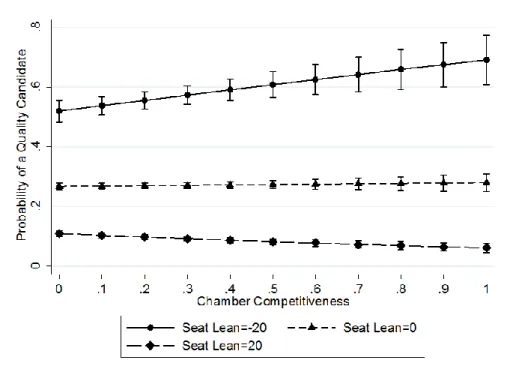
Figure 3.9 - Marginal Effects Plot for Chamber Competitiveness in the Post-World War II House (1946-2014) ………48
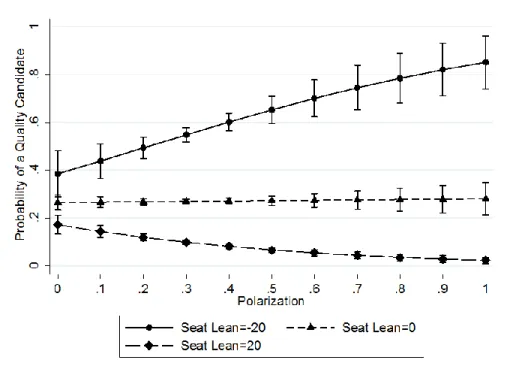
Figure 3.10 - Marginal Effects Plot for Polarization in the Post-World War II House (1946-2014) ………...49
Figure 3.11 - Marginal Effects Plot for Chamber Competitiveness in the Pre-World War II House (1872-1944) ………52
Figure 3.12 - Marginal Effects Plot for Polarization in the Pre-World War II House (1872-1944) ………53
Figure 3.13 - Marginal Effects Plot for Chamber Competitiveness in Senate (1914-2014) ……..56
Figure 3.14 - Marginal Effects Plot for Polarization in Senate (1914-2014) ……….57
Figure 3.15 - Marginal Effects Plot for Chamber Competitiveness in State Legislative Chambers in 2012 ………...59
Figure 3.16 - Marginal Effects Plot for Polarization in State Legislative Chambers in 2012 …...59
Figure 3.17 - Marginal Effects Plot for Chamber Competitiveness in State Legislative Chambers in 2014 ………...60
Figure 3.18 - Marginal Effects Plot for Polarization in State Legislative Chambers in 2014 …...60
xi
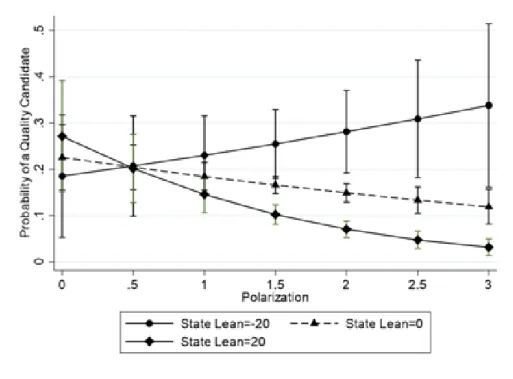
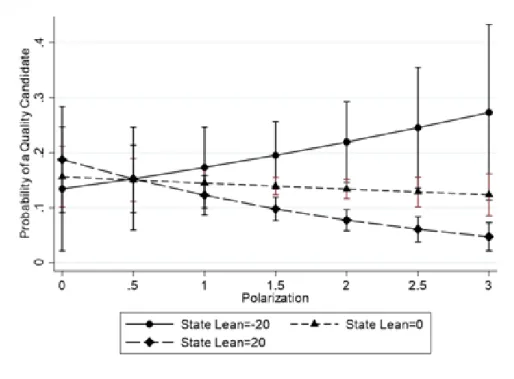
Figure 3.20 - Marginal Effects Plot of Minority Party Hardship on Quality Candidates
Running for Pre-War House (1872-1944) ……….…………65 Figure 3.21 - Marginal Effects Plot of Minority Party Hardship on Quality Candidates
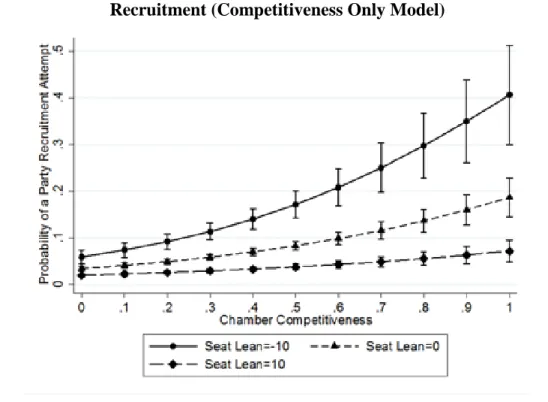
Running for U.S. Senate (1914-2014) ………..66 Figure 4.1 – Marginal Effects Plot of Chamber Competitiveness and Attempted Party
Recruitment (Competitiveness Only Model) ……….74 Figure 4.2 – Marginal Effects Plot of Competitiveness and Attempted Party Recruitment
(Full Model) ………...…………75 Figure 4.3 - Marginal Effects Plot of Polarization and Attempted Party Recruitment in the
House ………...76 Figure 4.4 - Marginal Effects Plot of Index Measure and Attempted Party Recruitment in the House……… ……….76 Figure 4.5 - Marginal Effects Plot of Chamber Competitiveness and Attempted Party
Recruitment in the Senate (Chamber Competitiveness Only) ………...78 Figure 4.6 - Marginal Effects Plot of Competitiveness and Attempted Party Recruitment in the Senate-Chamber (Full Model) ………..…...81 Figure 4.7 - Marginal Effects Plot of Polarization and Attempted Party Recruitment in the
Senate ……….82 Figure 4.8 - Marginal Effects Plot of Index Measure and Attempted Party Recruitment in the Senate ……….83 Figure 4.9 - Marginal Effects Plot of Hardship, Majority Party Status, and House
Recruitment Success ………...86 Figure 4.10 - Marginal Effects Plot of Hardship, Majority Party Status, and Senate
Recruitment Success ………...87 Figure 5.1 - Marginal Effects Plot of Minority Party Hardship on Retirement Decisions for Post-World War II House (1946-2014) ………...………..98 Figure 5.2 - Marginal Effects Plot of Minority Party Hardship on Quality Candidates
Running for Pre-World War II House (1872-1944) ……….……...102 Figure 5.3 - Marginal Effects Plot of Minority Party Hardship on Quality Candidates
xii
Rules (1872-1888) ……….……..104 Figure 5.5 - Marginal Effects of Chamber Competitiveness on Party Money in U.S. House
Elections (1990-2014) ………..108 Figure 5.6 - Marginal Effects of Polarization on Party Money in U.S. House Elections
(1990-2014) ……….……108 Figure 5.7 - Marginal Effects of Chamber Competitiveness on Party Money in U.S. Senate Elections (1990-2014) ………..113 Figure 5.8 - Marginal Effects of Polarization on Party Money in U.S. Senate Elections
(1990-2014)………..………113 Figure 5.9 - Marginal Effects of Chamber Competitiveness on Party Money in the 2012
State Legislative Elections ………...……114 Figure 5.10: Marginal Effects of Polarization on Party Money in the 2012 State Legislative Elections ………...114 Figure 5.11: Marginal Effects of Chamber Competitiveness on Party Money in the 2014
xiii
LIST OF TABLES
Table 2.1 - Four Scenarios of Chamber Competitiveness, Polarization, & Candidate Actions …24 Table 2.2 - Effect of Chamber Competitiveness and Polarization on Party Involvement and
Fundraising ………29
Table 2.3 - Four Broad Scenarios of Chamber Competitiveness, Polarization and Incumbent Behavior ……….34
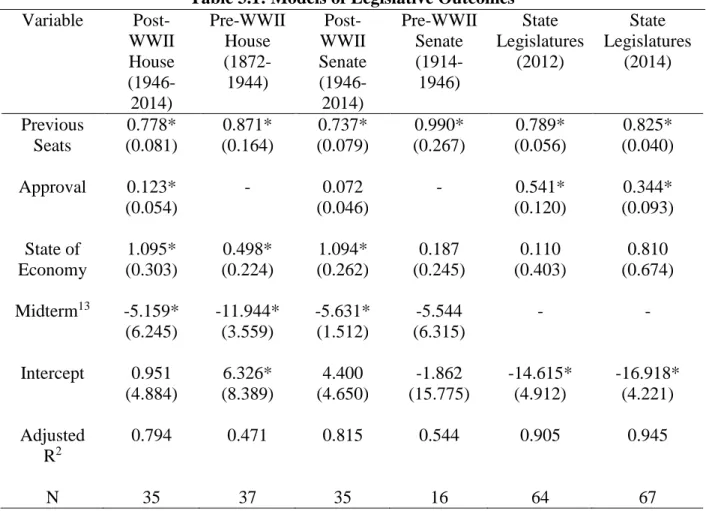
Table 3.1 - Models of Legislative Outcomes ……….38
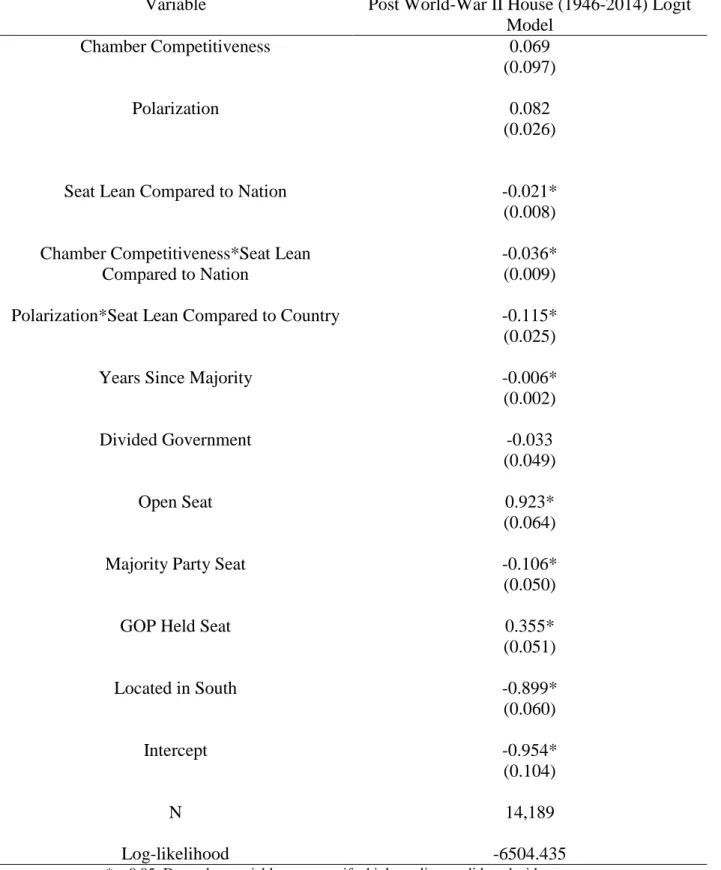
Table 3.2 – The Decision to Run for the Post-War U.S. House …..……..………46
Table 3.3 – The Decision to Run for the Pre-War U.S. House ……….……….51
Table 3.4 – The Decision to Run for the U.S. Senate ………54
Table 3.5 – The Decision to Run for State Legislatures ……….…...61
Table 3.6 - Minority Party Hardship and the Decision to Run for Office ...…...64
Table 4.1 – Determinants of House Party Committee Recruitment ……….……….72
Table 4.2 – Determinants of Senate Party Committee Recruitment ………..………79
Table 4.3 - Hardship, Majority Party Status, and Attempted Candidate Recruitment…………...85
Table 4.4 - Party Committee Spending ….……….………88
Table 5.1 - Minority Party Hardship and Incumbent’s Decision to Retire (Post- War) …………97
Table 5.2 - Minority Party Hardship and Incumbent’s Decision to Retire, Other Models ……..101
Table 5.3 - Incumbent Fundraising for Party Efforts ………...107
Table 5.4 - Senate and State Legislative Incumbent Fundraising for Party Efforts ………111
Table 5.5 - House Mixture Model Robustness Check ……….118
Table 5.6 - Senate and State Legislature Mixture Model Robustness Checks ………119
Table 5.7 - Minority Party Hardship and Party Fundraising Efforts ………...121
xiv
Appendix Table 3.1 - Post-World War II War House OLS Model Summary Statistics ……….133
Appendix Table 3.2 - Pre-War House OLS Model Summary Statistics………..133
Appendix Table 3.3 - Post-War Senate OLS Model Summary Statistics………133
Appendix Table 3.4 - Pre-War Senate OLS Model Summary Statistics ……….134
Appendix Table 3.5 - State Legislature 2012 OLS Model Summary Statistics ………..134
Appendix Table 3.6 - State Legislature 2014 OLS Model Summary Statistics ………..134
Appendix Table 3.7 - Post World-War II House Model Summary Statistics ………..135
Appendix Table 3.8 - Pre-World War II House Model Summary Statistics ………...136
Appendix Table 3.9 - Senate Model Summary Statistics ………137
Appendix Table 3.10 - 2012 State Legislative Model Summary Statistics ……….138
Appendix Table 3.11 - 2014 State Legislative Model Summary Statistics ……….139
Appendix Table 4.1 - House Candidate Recruitment Models Summary Statistics ……….140
Appendix Table 4.2 - Senate Candidate Recruitment Models Summary Statistics ……….141
Appendix Table 4.3 - House Campaign Finance Model Summary Statistics………..142
Appendix Table 4.4 - Senate Campaign Finance Model Summary Statistics ……….142
Appendix Table 4.5 - State Legislature Campaign Finance Model Summary Statistics ……….143
Appendix Table 5.1 - Post World-War II House Model Summary Statistics ………..144
Appendix Table 5.2 - Historic House Model Summary Statistics ………...145
Appendix Table 5.3 - Senate Model Summary Statistics ………146
Appendix Table 5.4 - U.S. House Incumbents and Party Money (1990-2014) ………...147
Appendix Table 5.5 - U.S. Senate Incumbents and Party Money (1990-2014) ………..148
Appendix Table 5.6 - State Legislative Incumbents and Party Money (2012) ………149
xv
CHAPTER 1: INTRODUCTION
On September 9, 2015, Senator Heidi Heitkamp (D-ND) announced that she was not running for the newly open North Dakota governorship in 2016, thus robbing Democrats of a strong recruit for the office, yet cheering national Democratic leaders at the same time (Pathé 2015). At first glance, it seems strange to assert that Democrats would be glad that their strongest possible recruit was passing on a winnable race, but that is the reaction that came from national Democrats, as Washington Post political reporter James Hohmann tweeted that “Washington Democrats are popping champagne to celebrate Heidi Heitkamp’s decision to stay in the Senate”
(Hohmann 2015). To understand why Democrats had this reaction, one should consider the political context surrounding Senator Heitkamp’s decision. After losing nine seats and their
Senate majority in 2014, Senate Democrats appeared to face a narrow but realistic path to winning a Senate majority in 2016, with seven Republican senators from states won by Barack Obama in 2012 up for reelection in 2016 (Shepard 2015). If Senator Heitkamp had decided to run for Governor of North Dakota, a recently passed law by the Republican-controlled state legislature would have required her replacement to be chosen by a special election in early 2017 (rather than by gubernatorial appointment), where Democrats would have faced an uphill battle to retain the seat in a Republican-leaning state like North Dakota (Nowatzki 2015). In other words, a decision from Heitkamp to run for governor would have made it more difficult for Democrats to win the Senate majority in 2016.
2
the majority leader as weak in the Senate due to the empowerment of the minority party through procedural rules such as the filibuster (for example see Binder and Smith 1997; but also see Den Hartog and Monroe 2011). However, Democrats’ reaction to Heitkamp staying in the Senate,
which makes it more likely they could reassume majority party status in 2017, suggests that holding the majority is important in an era of record polarization (Hare, Poole, and Rosenthal 2014). The importance of holding the Senate majority was made especially clear when Senate Republicans announced they would not hold hearings for any nominee that President Obama picked for the open seat on the Supreme Court (Everett and Thrush 2016).
While one might dismiss Heitkamp’s decision and the ensuing reaction as anecdotal, this
is not the first time something like this occurred in the early months of the 2016 election cycle. Earlier in 2015, Senators Claire McCaskill (D-MO) and Joe Manchin (D-WV) also announced that they would not run for open governorships in their respective states (Cheney 2015a &b). Similar to North Dakota, West Virginia’s legislature considered a bill that would have meant
Senator Manchin’s replacement would have been chosen in a special election were he elected governor and the veto-proof Republican majority in the Missouri legislature could pass a similar law if McCaskill had won the governorship (Cardosi 2015). Additionally, similar to Heitkamp’s decision not to run for governor, these decisions were hailed as good news for national
Democrats’ hope to win back the Senate majority (DeBonis 2015).
3
Democrats saw several of their incumbents in Republican-leaning seats opt to run for higher office in 2016 instead of seeking re-election, with Representatives Ann Kirkpatrick (D-AZ) and Patrick Murphy (D-FL) announcing their candidacies for the U.S. Senate in 2016 in the second quarter of 2015 (Cahn 2015b.). Given the options of potentially serving as part of a Senate majority, or (should they win reelection) continuing to be constantly outvoted as part of the minority in the House, these two legislators decided to run for the chamber where they seemed to have a higher probability of serving as part of the majority party.
In this dissertation, I examine chamber competitiveness, political polarization and how these two factors relate to the battle of majority control of political institutions. While the opening vignette of this introductory chapter is about the decision to run for office, I look at a number of decisions made by political actors including the decision to run, candidate recruitment from the perspective of political parties, incumbent retirement, and fundraising by legislative incumbents for the political party. Additionally, I consider decisions made by political actors in an array of legislative institutions in the United States, including the U.S. House, U.S. Senate, and state legislatures. Further seeking to expand the scope of inquiry, I analyze data from both the historical and modern U.S. House and U.S. Senate. Examining how chamber competitiveness and polarization affects a variety of decisions made by an assortment of political actors in a range of time periods has the potential to demonstrate the generalizability and robustness of the theory presented in this dissertation.
4
American politics. By illustrating how institution-level factors can affect the actions of individuals or parties, this study demonstrates the importance of context in the actions of political actors. This study is not the first to examine the importance of political context (for example see Shepsle 1989), but many previous studies examine the influence of political context on mass political behavior (for example see Wright 1977, Moore and Vanneman 2003, and Layman and Green 2006, among others). Candidates, parties, and legislators exhibit clear differences from the mass public, the focus of many studies of political behavior; at the same time, these political actors still engage in behavior that has the potential to be influenced by political context. By examining the role of chamber competitiveness and polarization in determining the behavior of potential candidates, parties, and incumbent legislators, this study begins the process of achieving a broader understanding of how contextual factors affect the behavior of an array of political actors.
5
Literature Review
Before presenting a theory of how competitiveness and polarization affect the behavior of political actors it is helpful to discuss previous literature pertaining to these factors and the political decision-making process.1 During the long periods of Democratic control of the U.S. Senate (1955-1981) and U.S. House (1955-1995), the widespread belief that majority control was not competitive affected the thoughts and actions of minority party Republicans (Connelly and Pitney 1994, Lee 2016). With Democrats being described as the “‘party of government’” Republicans struggled to recruit strong challengers and keep incumbents from leaving the House to advance their careers (Connelly and Pitney 1994, 12). Reflecting their unfavorable
circumstances, incumbent Republicans were not “hungry for a majority” and were generally unwilling to participate in party fundraising efforts (Ibid, 154). This all changed when Republicans, to the surprise of most of the country, took control of Congress in 1994.
Following the 1994 election as congressional majorities came to be viewed as being at stake in every election, Heberlig and Larson (2005, 2007, 2010, 2012), among others (also see Currinder 2003, Deering and Wahlbeck 2006, Green 2008), have demonstrated that numerous aspects of what it means to be a member of Congress have undergone substantial changes in recent years since the House majority became more competitive following the 1994 elections.2 Increasingly, safe-seat incumbents are expected to help the party raise money by redistributing campaign or leadership PAC funds to the party or directly to vulnerable members of their party. Heberlig and Larson (2012) find that advancement in the institution increasingly requires a commitment to raise money for the party. While other factors such as legislative loyalty and time
6
commitments to the party are also important, when majority control is at stake it is crucial for members who want to receive or remain in important leadership positions to financially contribute to those races that are likely to make a difference in the battle for majority control. Indeed, even when Congress is in session members are now expected to spend about four hours a day on the telephone engaged in “call time,” calling potential donors to raise money for their upcoming races if they hold a vulnerable seat or the overall party efforts if they hold a safe seat (Grimm and Siddiqui 2013). As the research discussed in this paragraph suggests, recent
research on the effect of chamber competitiveness generally tends to focus on financing majority control post-1994. The effect of chamber competitiveness on party fundraising is one of several phenomena to be studied in this dissertation. As such, this research serves as a starting point to examine how chamber competitiveness might affect how chamber competitiveness affects member and party fundraising, among an array of other behaviors, across various political time periods in an array of legislative bodies.
Also crucial to examining how chamber competitiveness affects the behavior of political actors is having a method to measure this phenomenon. In terms of measuring the level of competition for national legislative institutions, current literature on the U.S. House tends to use a dichotomous distinction where the majority is either at stake or non-competitive. In contrast, at the state level, a number of measures have been created to measure the level of party
7
legislative institutions, Holbrook and Van Dunk (1993) create a measure of legislative
competition based upon district-level electoral competition. These measures, irrespective of their particulars, demonstrate that competition does not necessarily have to be considered to be a dichotomous measure and serve as a guide in constructing my own measure of chamber competition that can be used to measure competitiveness across an array of legislative institutions over time and space.
While typically examined separately from chamber competitiveness, political polarization also has the potential to affect the behavior of political actors. Thus, discussing theories of party influence in Congress also provides an important foundation for the theory presented in the next chapter. Under the conditional party government (CPG) theory of party influence, party leadership only exerts influence over the caucus when policy differences exist between the parties and there is “widespread policy agreement” within a party (Rohde 1991, 91;
also see Aldrich and Rohde 2001, Smith and Gamm 2001, and Aldrich 2011). Although
Southern Democrats did not (for the most part) join with Republicans to pass items on their own agenda, these two groups often joined together to kill proposals supported by the majority of Democrats (Polsby 2004, 11).3 As political polarization increased, the party became more homogenous over the next several decades and Democratic victory on the floor became increasingly frequent (Rohde 2001, 159). Providing a different view of party influence in Congress, Cox and McCubbins (1993 and 2005) conceptualize congressional parties as acting like a cartel with the ability to control the agenda and thus determine what is voted on in Congress. In terms of negative agenda power—that is, preventing legislation that is strongly opposed from receiving a vote—Cox and McCubbins (2005, 28-29) note, even during the
8
20th century when there were a substantial number of conservative southern Democrats in Congress, there is little evidence of this group siding with Republicans to pass an agenda.
Indeed, the final majority party roll rate—that is, where a majority of the majority party is on the losing side of a bill that passes— during this time period closely approximates that in other periods (Cox and McCubbins 2005, 92-93).
Although the number of final passage majority party rolls has remained relatively constant over time, the number of final passage minority party rolls almost tripled from an average of 15.5 rolls per Congress (an average of 20.1 percent of all final passage votes per Congress or 16.8 percent of all votes in this time period) from 1951-1975 (82nd-93th Congress) to an average of 43.6 rolls (an average of 32.7 percent of final passage votes per Congress or 31.6 percent of all votes in this time period) from 1975-1999 (94th-105th Congress) based upon data presented by Cox and McCubbins (2005, 92-93).4 This increase in final passage minority party rolls as polarization between the parties increased and heterogeneity within the parties decreased shows that being in the minority became increasingly costly in the latter part of the 20th century. During this time period, the minority party was unable to advance their own agenda in the earlier time period, but they also did not face the frequent passage of legislation they objected to, which the higher roll rate in the later time period implies later became the case. Thus, as parties become increasingly distant from one another, not only does being in the majority confer benefits, but being in the minority seems to become costly as the other party pursues its own, far different agenda to the exclusion of the other party’s preferred policies. Furthermore, according to Lee
9
(2009), the recent rise in parties acting like teams has gone beyond ideological issues as parties have come to oppose one another even on non-ideological issues.
Even in an individualistic, consensus-based legislative institution like the U.S. Senate, polarization plays a role in the majority’s ability to achieve their desired policy goals. Den Hartog and Monroe (2011) posit that the majority party has more influence in the Senate because they pay lower agenda consideration costs to have their desired policy proposals considered due to a series of procedural advantages. Pearson (2008) also finds an increase in party loyalty in the Senate, both in terms of voting loyalty and fundraising for the party. Pearson notes that although Senate leaders have weaker mechanisms for party control than the House, they do have the potential to use committee assignments and chairmanships as a mechanism for inducing party discipline. Smith (2012 and 2014) has written about the development of what he refers to as the “Senate Syndrome,” a pattern of dysfunction in the modern Senate resulting from the collision of
increased partisanship and longstanding procedural rules. Senate Democrats were, however, able to use the so-called “nuclear option” so that a sixty vote threshold was no longer needed for Executive Branch appointees and non-Supreme Court judicial nominees, demonstrating the potential power of a unified majority to enact its will even in this traditionally individualistic and consensual chamber.
While Heberlig and Larson (2012) use theories of party government—especially Cox and McCubbins’s (1993 and 2005) party cartel model— to explain the rise of redistribution of
10
of polarization in an institution. Therefore, it follows naturally to consider not only the competitiveness of a chamber majority, but also the extent to which that legislative body is polarized when examining how institution-level factors have the potential to affect the decisions of political actors.
Scholars have developed formulas to examine how political actors make decisions, although these studies tend to focus on factors relating only to that particular political actor. As this study does not dispute the role of these considerations, but rather posits that additional, institution-level considerations also play a role in the decision-making process, previous studies on political decision-making serve as a crucial starting-point for my theory. In the classic formula given for political decision making given as R= p (B) – C +D, p relates to that political actor’s own prospects for success and B relates to the personal benefits he or she derives from achieving that goal (Riker and Ordeshook 1968). Black (1972) extends this formula to the
decision to run for office, focusing on the potential benefits, costs, and the probability of winning for individual candidates. Going a step further, Rohde (1979) examines progressive ambition— the desire to win a more a prominent elective office—among officeholders. While this theory adds the consideration not only of whether to run for office, but which office to run for, the central consideration for a political actors is whether he or she is likely to win elective office. Aldrich and Bianco (1992) also build off of Riker and Ordeshook’s formula, examining
prospective candidate’s decision to join a particular political party. As Aldrich and Bianco (1992, 105) note, at the center of this theory is “the assumption of (pure) office-seeking ambition.” Like previous studies, the focus of political actors’ decision-making process is the individual goal of
11
The same logic is present in a variety of studies of the behavior of political actors; famously, Mayhew (1974) posited that reelection was the proximate goal for members of
Congress. For Mayhew, running for Congress was an individual endeavor as Mayhew (1974, 27) declared that “no theoretical treatment of the United States Congress that posits parties as
analytic units will go very far.” Even past studies that include a role for parties still tend to focus
on the goal of winning as resulting in personal benefit for that member of Congress rather than the party as a whole. For example, Jacobson and Kernell (1983) examine how potential
candidates respond to national conditions such as the state of economy and presidential approval when making decisions on whether to run for office. While these factors relate to the popularity of a particular party at a given point in time, candidates from a particular party run because of how it affects their individual prospects of success and because they derive some sort of individual benefit from winning a seat in Congress. Written in the pre-1994 world, majority control is presupposed to remain with Democrats in congressional elections literature written in this time period.
12
when recruiting candidates to run for state legislature. Parties want to nominate the strongest possible candidate to run for office, but when this is not possible, these authors suggest that a party tries to recruit a “sacrificial lamb” so as to maintain a presence in the district, perhaps
setting them up for success in the future. Although these studies pay closer attention to the goals of the party than previous research, the focus is on that party’s prospects for winning an
individual seat, rather than their overall prospects for winning the majority in a particular election. These studies do, however, provide a good starting point for examining how chamber competitiveness and political polarization affect the battle for majority control of legislative institutions.
Plan of the Dissertation
In this dissertation I develop and test a theory of chamber competitiveness, polarization, and the decision-making process for political actors in legislative bodies at the national and state level in the United States. In the second chapter, I theorize that political actors take into account the extent to which a chamber is competitive and the ideological benefits of their party assuming majority status when making a range of politically-relevant decisions. In the third chapter, I test this theory’s expectations for candidates based on the expectation that high-quality potential
candidates are more likely to run for office when chamber competitiveness and polarization are high. For minority party potential candidates, however, the intersection of high levels of
13
high, but that high levels of polarization in the face of low competitiveness presents a challenge for the minority party in an institution. In the fifth chapter, I examine how chamber
competitiveness and polarization affect the decisions of incumbent legislators. Analogous to prospective candidates, I expect that legislators in highly polarized but uncompetitive legislatures who serve in the minority party are likely to view service in that legislature as unattractive and look for other opportunities for public service or may simply retire altogether. I also expect that increased levels of chamber competitiveness and polarization increases members’ willingness to contribute to party fundraising efforts. Finally, I conclude by placing the results of this
14
CHAPTER 2: A THEORY OF CHAMBER COMPETITIVENESS POLITICAL POLARIZATION, AND THE BATTLE FOR MAJORITY CONTROL OF
LEGISLATURES
A candidate’s decision to run or not run can benefit or undermine his or her party’s
standing in a particular district or state and ultimately, based on the overall outcome of the election, swing the direction of policymaking in one direction or the other. In the same vein, the decision of a political party about whether to get involved in a particular race and, after making this decision, the degree to which they are willing to invest resources, also has the potential to affect elections and the subsequent policy-making that takes place. Thus, an examination of political decision-making is one that is crucial to understanding the entirety of democratic government.
In this chapter, I put forward a modified theory of political decision-making, arguing that institution-level factors also have the potential to affect the behavior of political actors. I do not reject individual-level considerations that affect political decision making, but rather argue that there are additional factors that political actors take into account. Specifically, I posit that, in addition to their own probability of winning and the subsequent benefits of success, political actors may take into account the party’s probability and benefit of success (i.e. winning majority
control of a legislative chamber), which can be thought of in terms of the competitiveness of the chamber majority and the level of polarization in that legislative chamber. While other scholars (e.g. Jacobson and Kernell 1983, Jacobson 1989) have examined how national conditions affect the candidates’ decisions to run for office, their studies focus on candidate’s individual success
15
party’s prospects for majority control in a political institution as a factor in candidates’
decision-making processes (as well as those of parties and incumbent officeholders). Although these two outcomes relate to one another, they are not always the same as a party deep in the minority might have a good year for individual candidates even as they fall short of an overall majority (e.g. the Republican Party in an array of elections from 1954-1992). The theory presented in this dissertation applies to the contemporary U.S. Congress, but also extends to the pre-World War II U.S. House, the U.S. Senate (1914-2014), and state legislatures. One qualification of this theory is that the effect of chamber competitiveness and polarization may be slightly more modest in the context of the Senate because it is a more consensus-based body. Nevertheless, I expect to find a relationship between these variables and the behavior of political actors in the context of the Senate. As demonstrated by the failed nomination of Merrick Garland, majority party status still carries some importance in the context of the U.S. Senate.
A theory for how chamber competitiveness and polarization affect political actors can be built from the individual-focused theory of Riker and Ordeshook (1968). To review, in the formula R=p(B)-C+D, R represents the utility of a political action, p represents the probability of success, B represents the benefit of achieving a political outcome, C represents the costs of engaging in that action, and D represents considerations relating to civic duty. As discussed previously, these variables are specific to the political actor; in other words, p can be thought of as pindividual, B can be thought of as Bindividual, and C can be thought of as Cindividual. While not a crucial part of the theory presented here, D remains untouched for the sake of consistency. Given this formula, a political actor’s utility function can be conceptualized as u(c1, c2, π1, π2)= (π1*c1)
+ (π2*c2) where, c1 represents net benefits in a state of the world where the actor achieves his or
16
her goal, π1 represents the probability of achieving that goal, and π2 (equal to 1-π1) represents the
probability of not achieving that goal.
Building on this formula, I contend that an additional set of considerations related to the party that should be added to the Riker and Ordeshook formula to represent party-related considerations that political actors take into account when making political decisions. Specifically, I posit that a formula of political decision-making should also contain a p term related to the competitiveness of the chamber (pparty) and a B term related to the benefits of
serving in the majority (Bparty). Technically speaking, there should also be a C term related to the
costs to the party of a candidate running (Cparty). While the potential exists for a political actor to
take a specific action that has negative overall effects on the entire party (e.g. the potential candidacy of controversial Talk Show Host and former Cincinnati Mayor Jerry Springer for one of Ohio’s U.S. Senate seats in 2004), this kind of scenario is unlikely. Furthermore, even if such
negative effects take place, they would be hard to anticipate before taking such an action.5 The D term remains untouched. Thus, I present the revised formula R= pindividual.(Bindividual)-Cindividual +
pparty(Bparty)- Cparty + D, but, as the individual-related terms have already been examined in the literature, I focus on the party-related terms ppartyand Bparty. In terms of party-related factors, I posit that political actors have a utility function related to party success, which can be
represented as u(c1party, c2party, π1party, π2party)= (π1party*c1party) + (π2party*c2party), where c1party
represents net benefits in a state of the world where the candidate’s party wins the majority, c2party represents net benefits in a state of the world where the candidate’s party loses the
17
majority, π1party represents the probability of the party winning the majority, and π2party (equal to
1-π1party) represents the probability of the candidate’s party not winning the majority. This utility
function, combined with the previously-presented individual-based utility function, can be used to calculate the total utility (individual and party based) that a political actor receives from taking a particular action.
Prospective Candidates
Applying this theory to the specific context of legislative elections, I posit that high-quality potential candidates, in addition to considering their own benefits and probability of winning, also take into account the probability and benefit of their party winning the majority.6 In keeping with Fenno (1978), Rohde (1991), and Cox and McCubbins (1993 and 2005), I assume that potential officeholders have a broader set of goals than simply winning and
remaining in political office. This theory applies specifically to high-quality candidates because these individuals are likely to be recruited to run for winnable seats by the party (Maestas et al. 2006; Carsey and Berry 2014) and because, even apart from party recruitment efforts, these individuals are more likely to have a heightened sense of shared fate with their party than are other potential candidates. While sacrificial lamb candidates are (at best) given tacit approval to run by their party (and then promptly ignored), high-quality candidates are likely to be more connected and feel a heightened sense of investment in the success of their party.7 Furthermore, high-quality candidates with previous experience in elective office are likely to know that success or failure of their policy goals is strongly related to their party’s electoral outcomes. To
6 Note: I use Jacobson’s (1989) definition of high-quality candidates being those who have previously won political office in this dissertation. This definition has also been used in studies of the historic Congress (e.g. Carson and Roberts 2013) and more recent updates by Jacobson (2013).
18
an even greater degree under conditions of high polarization, this prior experience is likely to make these potential candidates acutely aware of the fact that the goal of “good public policy” [as Fenno (1978) puts it] relates to the overall electoral success of the party.
I theorize that a growth in chamber competition increases the likelihood that high-quality potential candidates will run for office because of the potential for any conceivably competitive seat to swing the majority from one party to another. While it may seem to be an overstatement to say that the majority may hinge on a single seat, numerous examples exist in history where legislative majorities have been decided based upon this scenario (e.g. U.S. Senate 2001-2003 and 2007-09, VA State Senate 2011-present, Colorado Senate 2015-17, among others). High-quality candidates are likely to be cognizant of this reality when running for a higher office; in some cases they may have served in a different legislative body where majority control was determined by a single seat or have friends or acquaintances who served in a legislature under these conditions. In addition, such individuals are likely to be among those with the highest levels of political knowledge; if a legislature has the potential to flip from one party to the other, these potential candidates are likely to know about it.
To have political knowledge is one thing, but to act on it is another. Based on the increased sense of shared fate these potential candidates have with their party, when given the opportunity to increase their party’s potential of winning majority control of a legislative body,
they may feel a sense of responsibility to run for a legislative seat, should their party have a credible chance of winning it in the next election. This is not to say that these potential
19
lose in the primary; indeed, Banks and Kiewiet (1989) show that these sorts of candidates
actually stand the best chance of winning by challenging a seemingly-safe incumbent and hoping for a break in the general election.
Furthermore, high-quality candidates are more likely to be recruited to run by their respective party (see Maestas et al. 2006 and Carsey and Berry 2014). While recruitment is not discussed specifically until later in this chapter, it relates directly back to a willingness to run for office. In other words, a high-quality candidate is more likely to be receptive to their party’s call to run for office under conditions of high chamber competitiveness than is a low-quality
candidate due to their existing linkages with the party. To use a counterexample, if a political party called a famous individual who previously had few connections to partisan politics but clearly identified with one of the parties, the fact that a particular legislative seat might swing majority control is unlikely to be a particularly potent motivator.8 In contrast, a prospective high-quality candidate (under the Jacobson 1989 definition) should care that a particular seat might determine majority control and thus is more likely to be receptive to party recruitment efforts. Political polarization has the potential to affect candidates’ decisions about whether to
run for office due to the heighted stakes of electoral outcomes for subsequent policymaking. Beyond a legislature simply being competitive or non-competitive, political polarization makes it especially worthwhile to have a legislative majority and costly to be consigned to the minority. Although being in the majority, regardless of polarization (Cox and McCubbins 1993 and 2005) provides for negative agenda control, conditions of high political polarization allow for positive agenda control. Drawing on data provided by Cox and McCubbins (2005, 92-93), the majority party final passage roll rate, where a majority of the majority party votes against a bill that
20
passes, varied little over the second half of the 20th century as polarization rose. In contrast, the minority party final passage roll rate, which measures the rate at which the majority of the minority party votes against a bill that passes, increased from 20.1 percent of all final passage votes from 1951-1974 to 32.7 percent of final passage votes between 1975 and 1999.Thus, as polarization rose over time, the passage of legislation increasingly became more of a zero-sum game where winning for the majority party meant losing for the minority party (see Lee 2016).
One potential criticism of this theory about the role of polarization is that conditions of divided government are often present in the United States. Based on this line of criticism, all that comes of divided government in recent years has been gridlock (but see Mayhew 1991); thus, why would a potential candidate be prompted to run for office based on the rise of polarization? The short periods of time in which unified government has been in place under conditions of high polarization provide an answer to that question. For example, under unified government during the George W. Bush Presidency, Republicans passed two rounds of tax cuts, CAFTA, and a prescription drug benefit, among other policies, with most Democrats voting in opposition. Similarly, during the two years of unified government during the Obama administration, the Affordable Care Act, the stimulus package, financial reform, the repeal of “Don’t Ask Don’t Tell,” and the Lilly Ledbetter Fair Pay Act all passed (and ultimately became law) over
21
other policies the majority of their party would have opposed. Thus, polarization serves as an impetus for high-quality potential candidates to run for office because of the increased stakes of making policy when their party enjoys unified control and blocking the policy goals of the other party by preventing that party from having unified control.
As with chamber competitiveness, however, increased polarization will not necessarily draw strong candidates to run for office in every legislative seat held by the other party that is up for election. As noted by Levendusky (2009), political polarization tends to lead to mass sorting, where liberal voters align with the Democratic Party and conservative voters align with the Republican Party. As a result, only those seats that are relatively balanced between the two parties are likely to feature high levels of electoral competition. Polarization, therefore, is likely to increase the likelihood that a high-quality potential candidate will run for office in relatively evenly divided seats, but is likely to have the opposite effect in seats that lean heavily toward one party or the other as high-quality potential candidates understand the long odds they face for wining that seat.
Consequently, stemming from this theory are the following hypotheses:
H1.1: As chamber competitiveness increases, the likelihood that a high-quality candidate will run for a potentially competitive seat held by the other party increases.
H1.2: As polarization increases, the likelihood that a high-quality candidate will run for a potentially competitive seat held by the other party increases.
22
the majority party. After almost forty years of his party serving in the minority, Representative Bill Gradison (R-OH) summed up life in the minority party by noting that “the sense of being in the minority is being left out” (Connelly and Pitney 1994, 5). For a high-quality potential
candidate, the knowledge that their party has poor prospects for winning the majority in the next election is likely to make running for office seem less desirable. Although the individual-level considerations put forth by Mayhew (1974, among others), may be enough for some high-quality potential candidates to run for office, the percentage of high-quality potential candidates who run is likely to be lower than under conditions of high chamber competitiveness. Returning to the formula presented earlier in this dissertation on candidate’s decision-making process in running for office, the potential for misery in a condition of high polarization and low competitiveness has the potential to increase the value of Cindividual, thus making potential candidates less likely to run for office.
While this theory relies on a characterization of members of Congress as a group up to this point, an individual basis exists in psychology for why one seeks to avoid situations where he or she is frequently on the losing side as is the case for minority party legislators in polarized legislative bodies. According to Robertson (2012), winning has positive effects on
neurotransmitters in the brain, particularly dopamine, which has been tied more broadly to individuals’ levels of motivation (e.g. see Wise 2004, Morita et al. 2013). Overall, Robertson
23
candidate is likely to be deterred from running for office when his or her party is consigned to minority party status under conditions of high polarization because of the emotional reaction he or she has to the likelihood of losing (e.g. being outvoted on bills, not getting to even vote on one’s own proposals) that is inherent to being in the minority under conditions of high
polarization. As a result, the minority party struggles to field high-quality candidates under such conditions.
Based on this consideration, I offer an additional hypothesis:
24
This theory of how chamber competitiveness and polarization affect decision-making in the context of potential candidates is also expressed in tabular format below:
Table 2.1: Four Scenarios of Chamber Competitiveness, Polarization, & Candidate Actions
Competitive Chamber Majority
Uncompetitive Chamber Majority
Polarized Chamber (1) Narrow, but predictable set of potentially competitive seats related to national competitiveness; high-quality candidate from out-party for that seat likely to run in competitive seats.
(e.g. Modern Senate; House 1994-2010)
(2) Narrow, but predictable set of potentially competitive seats related to national competitiveness; more seats are left on the table by minority party due to
persistent majority status for a party.
(e.g. Many modern state legislative bodies including NC)
Less Polarized Chamber (3)Wide range of potentially competitive seats but some left on the table due to less being at stake (policy-wise) based upon holding majority; largely candidate-centric. (e.g. House in late 1940s and early 1950s.)
(4)Wide range of potentially competitive seats, large percentage of potentially vulnerable incumbents left uncontested and fewer potentially competitive open seats feature high-quality candidates from both parties; completely candidate-centric. (e.g. 1970s House)
Political Parties
25
decision of whether to get involved with a specific electoral contest can be calculated using the formula R=p(B)-C+D, where R represents a party’s utility of getting involved in the fight for majority control, p represents the probability that their involvement will affect which party controls a legislative body, B represents the benefit of affecting the outcome of which party wins majority control, C represents the costs of involvement. As before, D is included to remain consistent with past research, but does not play a large role in this application of the theory. A party’s utility function utility function can be conceptualized as u(c1, c2, π1, π2)= (π1*c1) + (π2*c2) where, c1 represents net benefits in a state of the world where the party wins majority
control, c2 represents net benefits in a state of the world where the party does not win majority control, π1 represents the probability of winning majority control, and π2 (equal to 1-π1)
represents the probability of not winning majority control.
As with candidates, p and b can be thought of in terms of chamber competitiveness and polarization. Based on the levels of these factors, I theorize that a party becomes more or less likely to become engaged in the battle for majority control of a legislative body. By engagement in the battle for legislative majority control, I focus on two specific actions: party efforts to recruit candidates to run for office and party committee spending in legislative elections.
Beginning with party recruitment efforts, I posit that such engagement in legislative elections places specific burdens on the party, meaning that C (the cost of involvement) has a non-trivial value. Indeed, attempts to recruit party-backed candidates to run for office are often met with resistance among local activists who feel that their will is being usurped by party bosses. For example, Democratic Senatorial Campaign Committee (DSCC) Chair Chuck Schumer’s (D-NY) efforts to recruit candidates in 2006 met with opposition from local party
26
that party leaders were “disenfranchising the voters” and that it was “like the backrooms [were]
back, the smoke-filled rooms” (Thomma 2006).
A party is more likely to be willing to bear this cost of getting involved in races when their involvement has the potential to swing races that might be pivotal in determining which party controls the majority. Although dealing with party activists upset about the party meddling in a race, or members of Congress who do not want to spend hours every day on the phone raising money for their party is clearly unpleasant for party officials, these costs are well worth an increased chance of winning majority status in a legislative chamber. Additionally, party activists and members of Congress may be more likely to accept party involvement when a chamber majority is competitive. At the very least, party activists are unlikely to sit out an
election and not vote if a legislative majority may be determined by a seat or two. As a result, the value of C is likely to be lower when legislative majorities are more competitive, also making parties more likely to engage in the competition for majority control.
Political polarization also makes a party more willing to bear the costs of getting involved in a race because more is at stake based on the outcome of an election. As with individual
candidates, it is one thing to say that control of a majority is up for grabs, but another to say that it truly matters which party wins that majority. As with the theoretical framework for candidate decisions on running for office, I posit that benefits—and avoided costs— from majority control stem from the extent to which polarization exists in a chamber. There are benefits of majority control which exist even without high levels of polarization—nicer offices, chairmanships, and negative agenda control, to name a few—but especially in the absence of high levels of
27
majority control and downsides to minority party status are readily apparent to a party. Like prospective candidates, parties are aware of the accomplishments that their party has achieved under unified control, but are also aware of the policy goals achieved by the other party when they have unified control. Consequently, parties feel an impulse to engage under conditions of high polarization both based on a hope that they will be able to achieve their own policy goals, but also as a result of the fear of what would happen if the other party is able to win majority control under conditions of unified government. Additionally, as with chamber competitiveness, higher levels of polarization also may make party activists and incumbent officeholders alike more willing to bear the costs of party involvement in legislative elections. When a majority is both competitive and polarized, activists understand not only that a single seat or two may determine majority control, but that there are clear policy consequences—either positive or negative—that flow from which party has control of a chamber.
In terms of candidate recruitment, the following set of hypotheses for parties follow from the above theory:
H3.1: As chamber competitiveness increases, the likelihood that a party committee attempts to recruit a candidate for a potentially competitive seat increases.
H3.2: As chamber polarization increases, the likelihood that a party committee attempts to recruit a candidate for a potentially competitive seat increases.
The minority party, however, is likely to encounter resistance in recruitment when political polarization is high and chamber competitiveness is low. Critical to a party’s ability to
28
office. As noted previously, humans rationally avoid situations in which they constantly lose, creating an impediment for party’s trying to convince prospective candidates to run for office.
Seeing that a majority is out of reach, high-quality prospective candidates are more likely to rebuff party recruitment efforts under such conditions of prospective hardship.
Thus, I also hypothesize that:
H4: As the difference between chamber competitiveness and polarization (Polarization- Chamber Competitiveness) increases, the likelihood that a candidate recruited by the party committee for the minority party turns down the opportunity to run for that seat increases.
Party involvement in legislative elections also involves party campaign committees spending money to elect their preferred candidates. The amount of party spending during an election cycle is a function of donor giving to that party. I theorize that donor giving is likely to fluctuate based upon the level of chamber competitiveness and polarization of a legislative institution. As chamber competitiveness increases, parties are likely to be more receptive to party request for money due to the increased importance of their donation in determining which party holds the majority. At the same time, donors are also more likely to respond to party requests for donations under conditions of increased polarization because of the heighted policy stakes associated with majority control of that legislative institution.
Thus, given the assumption that real spending is a reflection of donor giving, the following hypotheses follow:
H5.1: As chamber competitiveness increases, the overall level of real spending by a party committee increases.
29
A table displaying this theory’s expectations of how political polarization and chamber competitiveness and political polarization are likely to affect political parties is below:
Table 2.2: Effect of Chamber Competitiveness and Polarization on Party Involvement and Fundraising
Competitive Chamber Majority
Uncompetitive Chamber Majority
Highly Polarized Chamber (1)Widespread party engagement, recruitment efforts in nationally
competitive seats that are not currently held. Party-based fundraising efforts should be widespread.
(e.g. Modern Senate; House 1996-2010)
(2) Same as scenario 1, except sometimes the minority party struggles to raise money/recruit
candidates due to perpetual minority status.
(e.g. Many modern state legislative bodies including NC)
Less Polarized Chamber (3)Less party involvement in recruitment; Fewer party-directed fundraising efforts due to less being at stake (policy-wise) in winning majority.
(e.g. Congress in late 1940s and early 1950s.)
(4) Smallest level of party-involvement in recruitment and directed fundraising efforts.
(e.g. 1970s House)
Legislative Incumbents
Chamber competitiveness and political polarization also have the potential to affect the decisions made by sitting office holders. As with my theory for high-quality prospective
candidates, I build off of the original Riker-Ordeshook (1968) utility function by including terms that relate only to individual considerations, as well as others that relate to broader, party-based calculations. Thus, as with prospective candidates, I present the formula for incumbent
officeholders R= pindividual.(Bindividual)-Cindividual + pparty(Bparty)- Cparty + D.9 As with prospective
30
candidates, I theorize that incumbent legislators have an additional utility function, beyond that for personal gains, related to the prospects of the party which can be represented by u(c1party, c2party, π1party, π2party)= (π1party*c1party) + (π2party*c2party), where c1party represents net benefits in a state of the world where the incumbent’s party wins the majority, c2party represents net benefits in a state of the world where the incumbent’s party loses the majority, π1party represents the
probability of the party winning the majority, and π2party (equal to 1-π1party) represents the probability of the incumbent’s party not winning the majority. This utility function, combined with the traditional individual utility function presented at the start of this chapter, can be used to calculate the total utility (individual plus party-based) that an incumbent receives from taking a particular action.
Similar to potential high-quality candidates’ decisions on whether to run, I posit that incumbent officeholders take chamber competitiveness and political polarization into account when they decide whether or not to seek reelection. The decision of whether to run for reelection or not is one of the most important that can be made by a legislator. Past research (e.g. Gelman and King 1990) has demonstrated that incumbents enjoy a built-in advantage over their
31
Incumbent legislators who have served in highly polarized, uncompetitive legislatures have experienced the misery of minority party status in that legislative body, which may prompt them to decide to leave that legislative body. As with prospective candidates, the effect of constantly losing makes seemingly perpetual service in a polarized legislative body as party of the minority party caucus to be miserable as members see their policy positions lose both in committee and on the floor. Indeed, in most cases, minority party legislators are often not even allowed to bring legislation to the floor for a vote. Drawing on Robertson’s (2012) finding that winning has positive health effects and losing has negative health effects, a rational actor such as an incumbent member of Congress should be more likely to retire under conditions of high polarization and low chamber competitiveness than they would be otherwise. This is not to say that all or even most members of Congress will retire under these circumstances, but for those members for whom the costs and benefits of continued service are already relatively balanced, service in a polarized, uncompetitive legislature may result in the costs of continued service outweighing the benefits. For example, when North Carolina State Senator Eleanor Kinnaird (D-23rd District) announced her retirement in the middle of her 9th term in the North Carolina State Senate in 2013, she cited her inability to get anything done and the fact that “17 years of [her] work [was being] dismantled” as the reason for her retirement (ABC11 2013). While Senator
Kinnaird moved from the state legislature to the private sector, in other situations legislators may retire from that legislative body, but decide to attempt to win a different political office. For example, these legislators may seek an executive office, such as governor, or a different
32
have decided to run for the U.S. Senate in 2016. As with prospective candidates, this pattern is least likely to be present among senators given the presence of the filibuster, giving the minority some say in the legislative process and is most likely to be present in state legislatures due to the wide array of non-competitive legislative bodies.
Reflecting these expectations is the following hypothesis:
H6: As the difference between polarization and chamber competitiveness (Polarization-Chamber Competitiveness) increases, the likelihood that member of the minority party retires increases.
In addition to deciding whether or not to seek reelection, incumbent officeholders also must consider whether or not to get involved in raising money for the party’s efforts to win
majority control of their respective legislative institution. All else equal, I assume that incumbent legislators view contributing to party fundraising efforts as an unpleasant task and will not engage in such efforts unless they have some sort of incentive to do so. I theorize that chamber competitiveness and polarization provide this incentive. Chamber competitiveness is likely to entice members to participate because of the potential for any seat to determine which party holds the majority. Taking into account the potential benefits that arise from being in the
majority, legislators are more willing to accept the unpleasantness of party fundraising efforts if they understand that their contributions could be vital in the party’s efforts to maintain or regain the majority. Additionally, increased political polarization should induce legislators to participate in party fundraising efforts due to the increased stakes associated with majority control. As polarization increases, members decide to put up with the misery associated with party
33
Based on the expectations presented in the above theory for how various factors affect an incumbent legislator’s willingness to participate in party fundraising efforts are the following
hypotheses:
H7.1: As chamber competitiveness increases, the level at which a member participates in party fundraising increases.
H7.2: As political polarization increases, the level at which a member participates in party fundraising increases.
Finally, minority party hardship is also likely to play a role in members’ willingness to
party fundraising efforts. Given the distaste that members feel towards party fundraising efforts, members are unlikely to engage in them if they feel they are a futile effort to win majority control, even when the stakes associated with majority control are high. Indeed, Connelly and Pitney (1994) noted that after decades of being in the minority party, Republicans were not “hungry for a majority” and that “other people’s campaigns [were] not their first priority” (Ibid,
154).
Thus, I also hypothesize:
34
Below, in tabular form, is the theory presented above for incumbent legislators:
Table 2.3: Four Broad Scenarios of Chamber Competitiveness, Polarization and Incumbent Behavior
Competitive Chamber Majority
Uncompetitive Chamber Majority
Polarized Chamber (1) Specific group of
incumbents (e.g. ideological extremists,
committee/chamber leaders) likely to engage in
fundraising efforts. (e.g. House 1994-2010)
(2) Higher than usual rate of retirement for minority party incumbents due to misery of serving in minority; also more difficultly for minority in getting minority legislators to contribute to party
fundraising efforts. (e.g. pre-1994 House) Less Polarized Chamber (3) Less of an impetus to
raise money for party than scenario 1, but also less of a reason for minority party incumbent to retire due to lack of polarization.
(e.g. House in late 1940s and early 1950s.)
(4) Lowest rate of fundraising. Lack of polarization means that holding office is still attractive for individual reasons, so lower retirement rate than scenario 2 for minority party incumbents. (e.g. 1970s House)
In Summation
In total, chamber competitiveness and political polarization have the potential to affect the behavior of a wide range of political actors. In the subsequent chapters, I will test the
35
CHAPTER 3: CHAMBER COMPETITIVENESS, POLITICAL POLARIZATION, AND CANDIDATE DECISIONS TO RUN FOR OFFICE,
Chamber competitiveness and polarization have the potential to affect a candidate’s
decision on whether to run for office. As presented in the previous chapter, I theorize that
increases in chamber competitiveness and polarization are associated with a higher probability of high-quality potential candidates running for theoretically winnable seats in an array of
legislative bodies. When legislative chambers are competitive, the knowledge that any marginal seat could make the difference in which party controls that chamber increases the probability that a quality candidate will run for that seat, while high polarization prompts quality candidates to run for office based on the knowledge of the high stakes (in terms of policy) of the election outcome for majority control of that legislative chamber. Finally, I also theorize that conditions of high polarization and low competitiveness create miserable conditions for the minority party in terms of passing favorable legislation and blocking unfavorable legislation, resulting in lower rates of quality candidates running for office.
36
competitiveness on minority party caucus decisions to run for a seat in a legislative body. Finally, I discuss the broader implications of these results and how they will be built upon in subsequent chapters.
Constructing a Measure of Competitiveness and Polarization
To construct the measure of chamber competitiveness used in this dissertation, I begin by constructing OLS models for each legislative chamber being examined that are similar to those commonly used to forecast congressional elections (e.g. Jacobson and Carson 2015). In their model of national congressional outcomes, Jacobson and Carson (2015, 187) include variables related to seat exposure, presidential approval, and the state of the economy to predict the
number of seats won or lost by the president’s party. Since a major focus of this dissertation is on
parties obtaining enough seats to win majority control of legislative bodies, the dependent variable for the model of post-World War II House (1946-2014) outcomes is the percentage of seats won by the president’s party in that year’s congressional election. I include independent
variables relating to each factor in the Jacobson and Carson model. To account for exposure, I include a measure of the number of seats held by the president’s party going into the election, the approval measure is taken from the first Gallup Poll after May 1 of the election year, and the economy measure is the change in real disposable income from the second quarter the year before the election to the second quarter of the election year.10 Finally, I also include a variable indicating whether it is a midterm election to account for the fact that the president’s party tends
to lose seats in midterm years (Campbell 1960).