SEEING AND STRENGTHENING LISTENING: NEW THEORETICAL AND METHODOLOGICAL DIRECTIONS FOR CRITICAL DISCOURSE ANALYSIS
Sarah Byrne Bausell
A dissertation submitted to the faculty at the University of North Carolina at Chapel Hill in partial fulfillment of the requirements for the degree of Doctor of Philosophy in the School of
Education.
Chapel Hill 2019
Approved by: Jocelyn Glazier Ashley Boyd
Michael Dominguez Brian Gibbs
© 2019
ABSTRACT
Sarah Byrne Bausell: Seeing and Strengthening Listening: New Theoretical and Methodological Directions for Critical Discourse Analysis
(Under the Direction of Jocelyn Glazier)
Critical Discourse Analysts (CDA) pay close attention to the ways that spoken, textual or physical features of discourse shape human experience. The penchant for speech is present in every stage of CDA work. For example, CDA scholars tend to cite elements from critical theories of discourse about voice, develop research questions designed to explicate text
properties and effects, and produce transcripts that are, more often than not, a sequential line of speaker interaction. Along these lines, the corpus of CDA literature works to answer the
question, how does discourse (speech/text) influence human condition? However rigorous, the field of Critical Discourse Analysis has failed to explicitly attend, methodologically or
theoretically, to the active role that listeners take on during interactions, instead focusing on how listeners are influenced and positioned via discourse in relation to speakers.
Set within classrooms, Critical Discourse Analyses offer compelling evidence that teachers are likely to reinforce oppressive beliefs and practices via their classroom talk. While the experience of listening has been explored across various fields, and even in the theories most commonly cited by Critical Discourse Analysts, the act of listening as it relates to power
ACKNOWLEDGMENTS
I’ve never written so much as a sentence on my own; this dissertation is certainly proof of that. This work emerged from countless conversations with friends, colleagues, professors, and family; it grew from generous feedback on early drafts; it is shored up by carefully curated reading recommendations; and it belongs to a lifetime of encouragement. It is made possible by Marion and Adam, and their students, who worked alongside me for a year to think about the role of listening in classroom discourse. Your commitment to teaching the humanities is astounding and I am grateful for your willingness to share your life’s work with me.
education, for being my writing and thinking partner, and for all of the truly generative
conversations that we’ve shared. I hope that you feel proud of this work as it is also yours—I am so proud to have been your student.
My inquiry into listening in the English classroom is rooted foremost in gifts afforded to me by my earliest teachers: Charlotte, Nura and Sharon—you are the writing teachers I knew I wanted to become. Whenever I sit down to draft, I imagine you three weird sisters as my immediate audience. In the same way, all of my writing belongs to the students who I have had the opportunity to teach—you know how I feel about you all!
I am so thankful for my friends at the Peabody School of Education friends: Beth
for all the porch-sitting and talking, for treating my ideas with seriousness, and for being a part of my children’s lives.
I have the most stunning group of long-time friends: Quinn Cartelli, Shenandoah Many, Melina Dale, Karin Heller, Kirsten James, Kate VanDis and Courtney Cook— I’m not sure how I lucked out into this level of love, but I would do anything to sustain it! Thank you for asking just the right amount of questions about my dissertation and for being more interested in other parts of my life. You are gorgeous people and I love being around you.
I hope that my family never reads this paragraph looking for evidence of how grateful I am for their support. I hope they feel it in tangible ways every day. I come from a long line of powerhouse women who have championed my ideas, beginning with my grandmothers, Nancy Meng Byrne and Camreon Fox. Nanny, you were a perfect treasure. I was made whole and safe because of your love and I miss you all the way through my bones. Cameron Fox, you are the reigning queen of bottle trees and wild summer adventures. You embody creativity, joy, and choice! I want to honor my aunties, Nell Gandy and Wendy Lea—Nellie Bird, thank you for your constant companionship, our long talks, and for loving me unconditionally. Wendy Lea, thank you for pulling me in and pulling me up, for listening to me so attentively, for the many rejuvenating girl’s trips, and for being a resolute leader.
There aren’t enough words of gratitude for my parents, Vicki and Peter Generelly, Bill and Debra Byrne, and Judy and Chuck Bausell. Mother, I loved watching you practice your sutures on pickled pigs’ feet in the kitchen when I was a little girl. I wanted to grow up to be just like you, committed to my work and unafraid of my power. Peter, thank you for being so
from you. Daddy, you have helped me understand that devotion and responsibility are one in the same. Thank you for always answering the phone and reminding me to take my time and to do my best. Debra, you are a powerhouse! I marvel in the joy that you have added to our family and I am so thankful that you are in my life. Chuck and Judy—you have loved me so well for so long and I am so proud to be your daughter-in-law. Thank you for always being there for us, for the long family dinners, and for sharing in our joy. Also, to my brothers Evan Byrne and Phinizy Generelly—you are fun, loving uncles and I thank you!
TABLE OF CONTENTS
LIST OF TABLES ... xiv
LIST OF FIGURES ... xv
CHAPTER ONE: INTRODUCTION TO THE STUDY ... 1
And We All Sat Up ... 1
Study Overview ... 7
Chapter Overview ... 9
CHAPTER TWO: THEORETICAL AND METHODOLOGICAL ORIENTATIONS OF CRITICAL DISCOURSE ANALYSIS ... 12
What’s that Sound? ... 12
Meanings of Discourse ... 13
Interdisciplinary Influences ... 15
Significance of Context... 16
Methodological Inventiveness ... 16
Using CDA... 17
CHAPTER THREE: THEORETICAL FRAMEWORK ... 19
Dialectical Theories of Listening ... 19
Listening and the Hero ... 20
Listening and Positioning ... 23
Reconciled Listening and Distinct Speech ... 24
Listening and Interpellation: Visual Dimensions of Listening ... 26
Leveraging Dialectical Theories of Listening for Classroom Discourse
Analyses ... 28
CHAPTER FOUR: REVIEW OF LITERATURE ... 32
Classroom Dialogue ... 32
Workshop Pedagogy: Adam Bisset ... 33
Tensions between Dialogic Pedagogy and Initiation, Response, Feedback (IRF): Marion Leventhal ... 35
Studying Classroom Discourse ... 37
Taking Stock of ‘Listening’ and ‘Listener’ in CDA Scholarship ... 38
Communities of Practice (CoP) ... 42
CHAPTER FIVE: METHODOLOGY ... 47
Research Design... 47
Participants ... 50
Recruitment ... 50
Data Collection ... 51
Data Sites ... 51
Tools for Data Collection ... 57
Data Sources ... 58
Approaches to Data Analysis ... 62
Seeing Listening ... 63
Analyzing Listening ... 65
Addressing Limitations of Study ... 72
CHAPTER SIX: CONTEXT ... 76
Participants in The Listening Collaborative ... 76
Researcher ... 76
Marion Leventhal ... 87
Leeville High School ... 90
Beyond Leeville ... 91
On Listening in the Now ... 95
Viral Listening, Louder than Words ... 96
Consequences of Listening as Dissent ... 97
Criminalizing Hearing ... 97
Listening Scale ... 98
CHAPTER SEVEN: SEEING LISTENING ... 100
What is the School Soundscape? ... 100
Leeville High School Soundscape ... 104
Why the School Soundscape Matters ... 114
What is the Listening Gesture? ... 116
Teacher Preoccupations with Listening Gestures ... 119
Policing of Listening Gestures ... 121
Why Listening Gestures Matter ... 127
What are Modalities of the Listening Gesture? ... 128
Listening Gestures Implicate Physical Space in Symbolic Ways ... 128
Listening Gestures Gain Momentum ... 133
Why Modalities of Listening Gesture Matter ... 136
What is a Listening Station? ... 137
Dialectics and Sustenance: Listening Stations ... 139
Why Listening Stations Matter ... 145
Listening Collaborative Sessions ... 150
Session 1: Identifying Tensions in Classroom Discourse and Inquiry ... 152
Session 2: Transcripts as Meeting Place and Mirror ... 158
Session 3: Trying Out CDA Methods ... 163
Session 4: Stripped Down Transcript and Pedagogical What-if’s... 168
Session 5: Tracing Listening Across Space and Time ... 174
Session 6: Transcript Play and Authentic Context Inquiry ... 179
Critical Listening/Reflection ... 182
Letting Silence In ... 183
Diversity of Interpretations: From Aversion to Anticipation ... 184
Remaking Our Practices ... 186
CHAPTER NINE: COLLABORATIVE ANALYSIS AND THE DEVELOPMENT OF A LISTENING TRANSCRIPT ... 189
Constructing the Listening Transcript ... 192
Transcript 1: Verbatim ... 194
Transcript 2: Verbatim Transcript Featuring Non-Ratified Participants ... 195
Transcript 3: Multi-Modal Transcript ... 198
Transcript 4: Parataxis, a Play on Side by Side ... 206
Transcribing as an Act of Listening ... 208
CHAPTER TEN: CONCLUDING THOUGHTS ... 211
Seeing and Strengthening Listening ... 211
Implications: CDA and Teacher Education ... 215
Attending to Researcher Reflexivity Through Semiotic Analysis ... 220
Writing Listening into Analyses ... 221
Committing to Interdisciplinary Work... 222
Sound Research ... 224
Concluding: Listening and Collectivity ... 225
APPENDIX A: TABLES OF STUDENTS ... 227
APPENDIX B: LISTENING COLLABORATIVE ... 231
APPENDIX C: TEACHER INTERVIEW GUIDE ... 232
APPENDIX D: ARTIFACTS ... 233
APPENDIX E: CODES ... 234
APPENDIX F: SHIFTS IN PARTICIPANT DISCOURSE INQUIRIES FOR ADAM ... 239
LIST OF TABLES
Table 1. Dialectical Theories of Listening ... 20
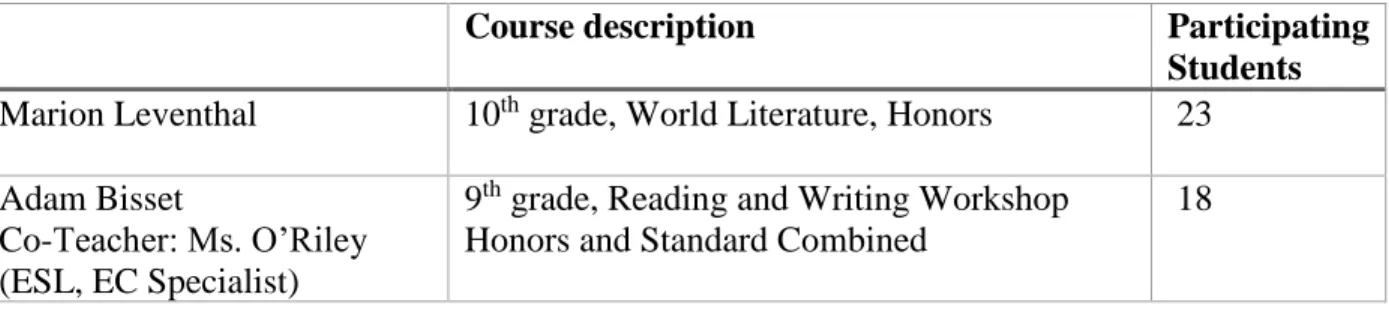
Table 2. Course Descriptions ... 51
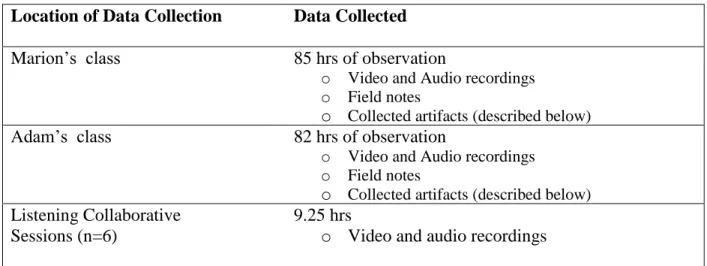
Table 3. Data Sites and Collection ... 52
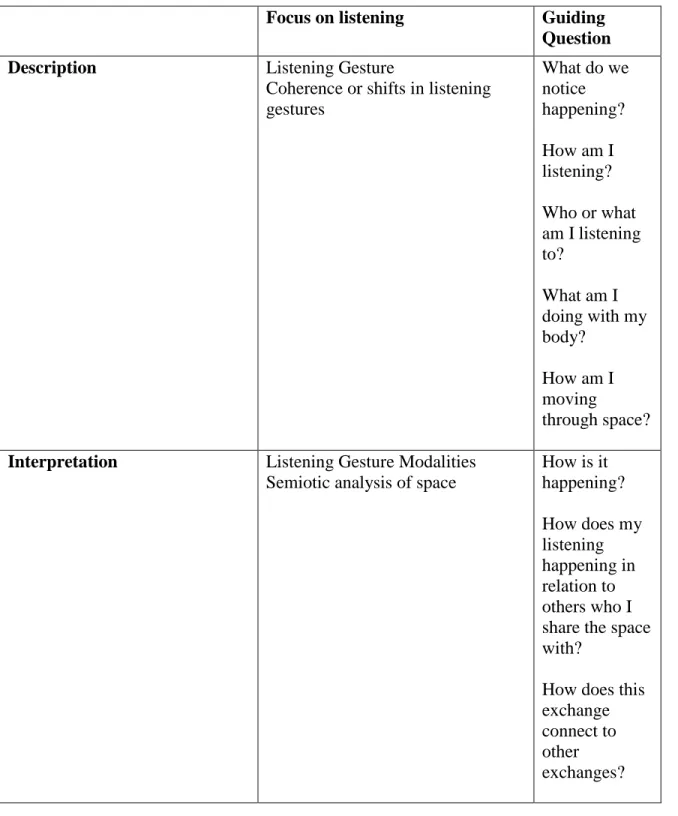
Table 4. Modified Stages of Critical Discourse Analysis (Fairclough, 1989) ... 56
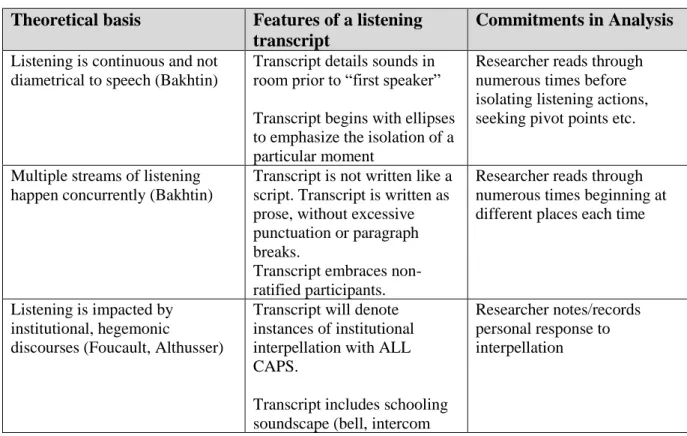
Table 5. Theoretical Commitments in Transcription ... 68
Table 6. Transcription Notation ... 193
LIST OF FIGURES
Figure 1. Timeline of Data Collection Across Sites ... 53
Figure 2. Gif Viral Listening ... 96
Figure 3. Meme, Listening as Dissent ... 97
Figure 4. Creative Insubordination ... 114
Figure 5. Adam’s Representation of Classroom Seminar ... 120
Figure 6. Classroom Layout ... 193
CHAPTER ONE: INTRODUCTION TO THE STUDY And We All Sat Up
Like it or not schools can be sinister places, and in them, classroom discourse the cruelest of corridors to walk through. Jamaica Kinkaid’s (1981) memoir, “On Seeing England for the First Time,” shows us how. Here, she traces what she calls her “personal erasure” to a particular lesson in primary school:
[w]hen my teacher had pinned this map up on the blackboard, she said, ‘This is England’—and she said it with authority, seriousness, and adoration, and we all sat up…We understood then—we were meant to understand then—that England was meant to be our source of myth and the source from which we got our sense of reality, our sense of what was meaningful, our sense of meaningless—and much about our own lives and much about the very idea of us headed that last list (p. 2).
Kincaid’s elegiac retrospective is not just about the supposition of living brown while in an English colony—but of the double supposition made possible by classroom discourse. Critical discourse scholars, many of whom take interest in power-laden exchanges between teacher and students like this one, analyze ways that domination functions via discourse. Set within
classrooms, Critical Discourse Analyses (CDA) offer compelling evidence that teachers, like the one that Kincaid describes, are likely to reinforce oppressive beliefs and practices via their classroom talk. Though designed to examine how power operates within discursive
communication. I move away from what has been an exclusive focus on verbal participation in classroom CDA research; however, my attention to listening should not be interpreted as a deemphasis of the value of verbal participation in classroom community. The process of sharing ideas is particularly essential to the humanities course, which by design work to provide
possibilities for “human beings [to be] bound to all other human beings by ties of recognition and concern” (Naussbaum, 2010, p. 10). Thus, my turn to listening through a critical discourse frame is in service to the belief that humanities classrooms ought to be spaces for the sharing of
multiple ideas and perspectives.
For critical discourse scholars, committed to understanding and disrupting such
classroom experiences, Kincaid’s phrase “we all sat up,” invites a new way to examine dialectics inscribed in classroom discourse. Her prose-poems, essays, and New Yorker articles over the years describe peer relationships earmarked by physical cruelty. Yet here, in the wake of their teacher’s discursive directions, Kincaid describes a shared listening: we all sat up. Her
description suggests an agentive, tangible quality of listening.
The cinematic framing (almost the entire film is shot between the walls of Marin’s classroom) emphasizes the estrangement between surrounding neighborhoods (and the personal lives of students) and the work of school. Within the classroom, Marin and his students are equally estranged. Students spend the bulk of the film trying to steer Marin to acknowledge their humanity; they resist lessons in using the formal subjunctive, they implore him to use names that reflect them, and they initiate (but don’t succeed) in a revolution when he calls two of them ‘skanks’. Meanwhile, Marin seems willfully oblivious to the on-going conversational theme, perturbed that he’s kept from his idea of good teaching. The nature of the everyday talk, and the amassed, missed opportunities to listen to his students, take on a particular narrative quality. Marin’s collegial conversations aren’t any more satisfying. Whether subject of a spontaneous hallway intervention, witness to casual faculty banter about “nice, nice, not so nice, very
naughty” students on a class roster, or participant in formal faculty meetings, Marin struggles to dialogue about his practice with other teachers. One gets the sense that Marin and his colleagues are, more often than not, avoiding the topic of teaching.
Jamaica Kincaid takes us into one moment in classroom discourse and shows us shared, agentive listening; Laurent Cantent takes us through a year’s worth of it. Within this film example, there is so much “we all sat up”, between teacher and students and for viewer as well, who bears witness to the tenuous discourse. I use these two examples to suggest a new focus on the role and significance of listening as discursive feature in the classroom dialectics.
But what is listening?
Following the 2018 American Educational Research symposium, Listening as an Ethical Engagement: Dialogues from Eastern and Western Traditions, discussant Sophie Haroutunian-Gordon wagged a finger between her notes and the line of expectant panelists, most of whom had been writing in conversation with her on the topic of listening for the past decade. “I’m just coming out with it,” she cried, “we still haven’t done it. It seems to me we still haven’t made any such argument about what listening is.” Haroutunian-Gordon’s instigation silenced the packed ballroom and elicited a murmur from the panelists. Though straightaway provocative, hers is a shared sentiment amongst scholars frustrated with the difficulty of nailing down listening.
Fleischman (1991), and many other philosophers, have made the argument that listening is an act toward perpetuity. Humans have “the need to be known, responded to, confirmed, appreciated, cared for, mirrored, recognized, identified”— the feeling of being listened to fulfills such desire (Felsichman, 1991, 120). For Buber, listening is the mediating experience between self in relation to other, or the I-You and the I-it. Buber (2003) and Levinas (1999) emphasized that listening involves a meeting between self and other, during which listener must “make space for other” (Buber, 2003, p. 26) and must yield in a position of passivity (Levinas, 1999b). It follows then that there is a great deal at stake as listener---namely, that in order to confirm other (i.e. speaker), listener must listen through (and sometimes despite) self. Such dialogical relations are both confrontational and confirming—listeners are rewarded the form of a greater sense of “attunement” with community. Listening is a “never not-done” process (Cohen, 2018), central to the human experience (Buber, 2003; Hyde, 1996; Levinas, 1999), and listening offers a return to self and community (Nancy, 2002).
Listening is good. Good for speaker, good for humanity, and good for society. Levin (1989), for instance, argued that “competence in listening could significantly improve the communicative infrastructures of the lifeworld that are necessary conditions for rational consensus, legitimation, equity, and justice” (p. 3). Similarly, McMaster (1995) argued that “listening would become more important as society places a higher value on diversity, connectedness, and interpersonal relationships as opposed to homogeneity, competition, and primacy of the individual” (Kagan, 2018, p. 107)1.
Jean Luc Nancy’s (2011) momentous mediation distinguishes listening from hearing through a close examination of self:
If “to hear” is to understand the sense (either in the so-called figurative sense, or in the so-called proper sense: to hear a siren, a bird, or a drum is already each tome to
understand at least the rough outline of a situation, a context if not a text), to listen is to be straining toward a possible meaning, and consequently one that is not immediately accessible (p. 18).
For Nancy, to listen requires a constant ‘strain.’ Such strain is a consequence of registrar (whatever it is, or whomever it is, one listens to) being outside of self. Other philosophers have bothered with descriptions of listening as a mediating place between self and other, but for Nancy, the experience of listening is central to the resonance of self-opening: “listening can and must appear to us not as a metaphor for access to self, but as the reality of this access” (p. 12). In other words, that we can listen, no matter how well, is a reminder of our humanity and a steady promise towards it. Music Theorist Brian Kane (2013) describes Nancy’s theory of listening as a moment that “holds open the threshold between sense and signification” (p. 439). Nancy
suggests that while listening occurs in a particular sonorous moment (across time and space) it also, peculiarly, resides through the opening of self in an “infinite sending and resending” (p. 439). Nancy, like Cohen, makes the argument that listening is never not done, evidenced in the ways that we return to a memory to re-listen to literal sounds, contexts, or ourselves within it. It would follow that any study into the experience of listening necessarily involves subject in relation to the experience.
Similarly, Hyde (1994) argued that listening continues long after the dimming of sound, and as a consequence listening, and thus listener, is not a “sometimes” activity or role, rather a continuous state of being:
his or her speaking. Rather each of us at every moment is always already listening in a particular way, listening from the ontological locus of our own particular set of values and concerns. Our way of being and our understanding of the world, given by these values and concerns, constitutes the listening that each of us always already is, the listening that determines the way the world occurs for us (p. 184).
Hyde and Nancy compel their respective reader to think of listening in highly agentic ways. For Hyde listening is a determinant in the “way the world occurs for us” (p. 184); for Nancy listening is to “enter into tension and to be on the lookout for a relation to self” (p. 12).
While the experience of listening has been explored from philosophical perspectives, and even in the social theories of discourse most commonly cited by Critical Discourse Analysts (to be explored in following chapter), the act of listening as it relates to power imbalances in the English classroom has not yet been analyzed. Here and there listening has been described over and over for its merits and its difficulties, yet remains inadequately defined—to return to Haroutunian-Gordon’s assertion: “We haven’t done it”.
The study I share here draws from extensive classroom and collegial discourse data to (1) establish listening as concrete, studiable feature of interaction, (2) explore ways that two English teachers engage in collaborative critical discourse analysis of records of practice using listening as a framework and, (3) offer a method of transcribing listening. Part research and part
professional development, the study is both an articulation of Kincaid’s description of listening as a physical feature of classroom discourse and a response to the patent absence of theorizing about listening in critical discourse studies.
Study Overview
This is a qualitative study, exercising Critical Discourse Analysis theories and methods, to explore features and functions of listening in the English classroom and in a related
spur a new course of investigation for the critical education discourse analyst: how do teachers come to listen in certain spaces and how does that listening shape others’ experiences? The specific research questions that guide the study are:
1. What is listening in the English Classroom? What shapes it? How does it shape? 2. How can CDA, and more specifically dialectical theories of listening, be used in
support of critical teacher reflection? 3. How can we transcribe listening?
Two qualitative research traditions inform the study: post-critical ethnography and critical discourse analysis. CDA, a field that combines theory with methods, extends linguistic analysis of discourse to examine the relationship between individual discursive practices and wider social, institutional, and political discourses. Ethnography allows for prolonged time making sense of a particular context, in this case the classroom discourse of Adam Bisset and Marian Leventhal, two secondary English teachers. In order to get a sense of listening in the English classroom, I conducted daily ethnographic classroom observations over the course of 11 weeks, collected video and audio recordings, and created transcripts, which were shared, along with field-notes and periodic memos, weekly with participants.
collected video and audio recordings of all CoP sessions and then created transcripts, which became additional source for our collaborative critical analysis.
Chapter Overview
In what follows, I provide an overview of theoretical and methodological orientations within the field of Critical Discourse Analysis. I emphasize CDA educational researchers’ motivation to disrupt hegemonic discursive practices and reimagine more humanistic practices. To demonstrate the field’s vibrancy and resolve to progress, I highlight key debates related to context and question whether CDA’s ambitious aim, to reimagine social structures via discourse inquiry, has been realized.
In Chapter 3 I take a close look at influential theories of social discourse through the lens of listening. Drawing from the work of Louis Althusser (1970), Mikhail Bakhtin (1975), Pierre Bourdieu (1991), and Michel Foucault (1966), I introduce dialectical theories of listening as a new theoretical framework which informs every aspect of the study, from transcription to analysis.
Chapter 4 includes a review of literature related to listening in schools at several levels: the classroom between teacher and students, and in Communities of Practice, between teacher and teacher. The chapter also takes stock of “listener and listening” in empirical analyses of classroom discourse.
In Chapter 5, I offer insight into my methods of study. I explore, in greater detail, the fit between Critical Discourse Analysis and post-critical ethnography, and make clear my approach to the studying listening as a material feature of discourse.
introduction to Marion and Adam, the two teachers who made this study possible. Because discourse is never new or neutral, I provide a description of Leeville High School, where they work, and situate that community within contemporary discourse and events. The chapter
concludes with a critical examination of listening in the public sphere, illustrating how a study of listening, like speech and text, “provides a finely articulated vehicle for differences in power in hierarchical social structures” (Wodak, 2011, p. 8).
Chapter 7 responds to the first research question: “what is listening?.” Drawing from ethnographic observations, classroom transcripts, and other artifacts, I locate listening within the larger school soundscape. Then, I provide a detailed exploration of listening gestures, teachers’ preoccupations with them, and ways that they feature in the larger trend of discourse policing. Having established listening gestures, I examine modalities of listening gestures including upholding of space and institutional discourses there within and gaining momentum. The chapter concludes with an analytic classroom portrait of the phenomenon I call listening stations. The chapter focuses on ‘seeing’ listening and raises questions regarding the accountability that this might inspire in educators and CDA scholars alike.
Chapter 8 examines the collaborative critical discourse work that Marion, Adam and I engaged in over the course of 8 months in our Community of Practice, the Listening
Chapter 9 extends the previous chapter’s discussion on Marion and Adam’s collaborative analysis, and shows how our engagement informed methodological approaches to transcribing and analyzing listening. I take the reader through several iterations of the ‘same’ classroom transcript, make clear the connections between dialectical theories of listening, and articulate the benefits of transcribing with an eye on listeners and listening.
CHAPTER TWO: THEORETICAL AND METHODOLOGICAL ORIENTATIONS OF CRITICAL DISCOURSE ANALYSIS
What’s that Sound?
Discourse Analysis is like taxidermy. As a child I walked into a darkened hall and saw a collection of starlings hanging above my head. Two hundred some birds strung in a scene of murmuration. Outside, there are reasons for this stunning coordination often likened to a noisy ballet—but here, in the Bern museum of Natural Science, muted birds were suspended into a long, stationary ribbon. My comparison, I hope, doesn’t denigrate either tradition; discourse analysis and taxidermy are both scientifically rigorous returns to that which mattered, stations on either the stuff of language: syntax, morphemes, etc. or the stuff of recently-deceased animals. Discourse analysis offers a detailed rendering of language, often highlighting the building blocks of particular moments, and requires its own form of forensic dissection—portions of the text are isolated, grammatical constructions noted, syllables counted, inflection graphed —scrupulous efforts to describe the inner workings of language and bring exchanges back to life.
However duteous, Discourse Analysis feels to me particularly and peculiarly insular. For example, the “living” discourse exchange has already happened at the time of analysis. The researcher is commonly absent (in participant form at least) from the original exchange. And finally, the analysis is often conducted for the benefit of a discrete audience and presented in a different genre (where the researcher sometimes fakes a disappearing act). It is fair to say that language, the center of the work, is dissociated from the wider context and, therefore, the
its own method, tools, and audiences, at its worst the taxidermized animal is “not beautifully remade; [but] awkwardly dead” (Kernot, 2018).
The Critical Discourse Analysis movement began as a challenge to the position that language alone is that which matters. It endeavored to be something else (not taxidermy) and do something else-- transform power structures. With inspiration from social theorists like Bakhtin (1975), Foucault (1966), Bourdieu (1991), and Althusser (1971), who explored dialectical relationship between language and social life, critical discourse analysts began concentrating on the manifestation of dominance and subordination through discourse. Critical discourse analysts are preoccupied by the ways in which language structures the social experiences of humans and use our studies to evoke social change. Because CDA extends beyond general descriptive reporting of language attributes towards critique and, even, challenge, scholars argue that the approach is in itself, a form of social action, a disruption of the legitimization of power structures via language. Thus, in many ways, Critical Discourse Analysis as a practice, is an attempt to “listen” to discourse in a way that allows for analytic and advocacy work. If there were a research paradigm jukebox, Critical Discourse Analysis (CDA) would be paired with Buffalo Springfield’s 1967 protest hit, “we better stop, hey, what's that sound, everybody look what's going down.”
Meanings of Discourse
Neo-Marxist critical theorists like Gramsci (1971) and Althusser (2006). They also rely on the work of sociolinguists like Halliday (1994) and Bernstein (2003) who emphasized the social
dimension of discourse. These theorists describe discourse as a blend of personal reflections and institutional language (Bakhtin, 1994; Habermas, 1987) and argued that it is shaped by the greater context and contrariwise shapes context (Bakhtin, 1994; Gramsci, 1971).
Discourse is understood as a system of representation (Foucault, 1971), a reflection and continuation of previous utterances (Bakhtin, 1981), a social event that designates meaning (Bakhtin, 1981; Bourdieu, 1991; Fairclough, 2013; Foucault, 1971), as signs of authority or wealth (Bourdieu, 1991), and as an interplay between macro and micro scripts (Fairclough, 1995). The driving belief in critical discourse studies is that discourse constitutes society and culture and vice versa (Wodak, 1997). Unlike, earlier linguistic models, heavy on formalism, these theories never separate discourse from the social context (Bakhtin, 1981; Bourdieu, 1991; Foucault, 1971).
To recapitulate: everything is discourse (and vice versa), and because discourse is the site where social identities are constructed, mediated and contested, paying attention to discourse is social change. In the words of Stuart Hall (1997) “nothing meaningful exists outside of
discourse” (p.44). The familiar refrain, discourse is the vehicle for ideology and critical
discourse analysis is “ideology work” (Wodak & Meyer, 2001), is reflected in questions such as: How do more powerful groups control public discourse and How are less powerful groups controlled via discourse?. Sometimes this scholarship, likened to “discourse analysis with an attitude” (Van Dijk, 1993), includes a focus on conflicts between discourses and issues of access (see, for example, Pecheux 1982). Other times, it involves an exploration into identity
exploration, CDA work is a devoted critique of constructed, singular, and therefore, hegemonic truths (Gramsci, 1971) and is aimed at “future imaginaries” (Rogers, 2005).
Interdisciplinary Influences
I opened this chapter by pointing out that linguistic discourse analysis only attends to the ‘what’ of language (Cameron, 2001; Fairclough, 1989) and then, I made a preemptive leap by introducing CDA as an approach that attends to language, power, and the relationship between the two. In fact, there were many iterations of discourse analysis and just as many contributions outside of the linguistics field that made the advent of CDA possible. Namely, linguistic models were ameliorated by interactional sociolinguistics (Cazden, John, & Hymes, 1972; Gumpez & Hymes, 1986), discursive psychology, narrative analysis (Labov, 1972), social semiotics (Halliday, 1994) conversational analysis (Have, 1999; Speier, 1973), and ethnographies of communication (Hymes, 1974). Rather than trying to establish clear and stable patterns in language, these approaches focused on interactional aspects of discourse and social relativism and introduced a seminal debate about what counts as context (Schegloff, 1997) through an expanded definition of discourse. For example, narrative analysis emphasized both speaker and listener, advancing the notion that meaning making is jointly constructed. Conversational Analysts became particularly interested in turn taking and conceptualized relinquishing the floor as power play. Likewise, an interactional sociolinguists approach to Discourse Analysis focused on communicative competence through expanded notions of communication (e.g., speech, body, and performance of self), and those advancing ethnographies of communication linked structure of languages with ways that speakers manipulate language in various settings or genres. For the latter, Hymes (1964) noted that this approach emphasized “primacy of speech over code;
so that one can not only generalize the particularities but particularize the generalities” (p. 11). It is from these theories, particularly their attentiveness towards interactions and positioning discourse as a symbolic guide to culture, that Critical Discourse Analysis evolved.
Significance of Context
Critical Discourse Analysts are obligated to a “widening of aperture” to account for wider context (Bourdieu, 1991). Gazdar (1979) famously argued that context is indispensable to
discourse research, yet, fundamentally remains indefinable. Indeed, a common critique of CDA analyses is that despite their commitment to uncovering context, that some studies are often decontextualized monuments to text/speech. Though CDA scholars have taken up various ambitious theories of context, there remains an uneven treatment of context in CDA analyses (Blommaert & Bulcaen, 2000). On one hand, context is often treated as “narration or
backgrounding material”; on the other hand, it is reduced to a finite set of “facts” (Bloomaert, 2001, p. 38). Both attitudes delimit the likelihood of uncovering the rich, dimensions of
discourse. Other critical discourse analysts have emphasized how internal contexts interact with external contexts. For the purpose of this study, I pull from Wodack and Meyer’s (2014)
argument for a “text-context theory,” in which they theorize local context models as “mental models that allow us to explain what is relevant to the social situation” (p. 109). Specifically, I set out to understand, describe, and explicate how listening gestures reflect and contribute to context.
Methodological Inventiveness
For example, Fairclough pulls from Halliday’s (1994) textual analysis, Gee pulls from Hymes (1974) and Labov (1972) sociolinguistics, textual analysis, and, even, literary criticism
(Chatman, 1978), and Souto-Manning pulls from Labov’s (1972) narrative analysis work. Depending upon the aim of the study, researchers may use linguistic tools elucidated in Labov’s approach (1997); for example, documenting structural units and clauses, constructing sentence diagrams, and analyzing syntax as a signal of the semantic logic. Or, one might attend to recurrent patterns (Tannen, 2007), note silences (Huckin, 2002) within the data, or return to Halliday’s (1985) grammatical resources (for example, see Janks, 1997).
CDA does not follow a unitary framework (van Dijk, 1993). While some CDA scholars (e.g., Rogers et. al, 2005) argue that standardization of a methodology contradicts the aim, others (e.g., Lewis, 2006; Fairclough & Wodack, 1997) point out that the habit of skepticism common amongst critical discourse scholars requires a systematic and rigorous attention to the “hows” of critical discourse analysis. Similarly, CDA scholars Lewis (2006) and Billig (1999) call for improvements in methodological precision and CDA critic Widdowson (1995) points out that CDA faces the danger of being “ideological orthodoxy [that] paradoxically exerts just the kind of discursive domination which it seeks to expose in other uses of language” (pp. 4). To the
frustration of many CDA scholars, there are too many instances in which researchers claim critical discourse analysis as a method without making their analysis transparent or linking the analysis with critical theories. Conversely, there are numerous examples of empirical work that critically examine discourse but do not claim the approach (see, for example, Penelope, 1991).
Using CDA
use—always discourse. CDA is an approach that helps researchers investigate the ways that social structures affect (and are affected by) various discourses and, in return, individuals. Therefore, researchers don’t do CDA to language, researchers use CDA to recover people from the language that entwines, encumbers, and occupies them (Lewis, 2005). Due to an imbalanced scrutiny on speech, CDA scholars have maintained a focus on product rather than process. This study is situated within my appreciation for these aims, and it is predicated on my appraisal that critical discourse scholars could do more to meet them.
CHAPTER THREE: THEORETICAL FRAMEWORK Dialectical Theories of Listening
As stated in the previous chapter, Bakhtin (1981), Foucault (1971), Bourdieu (1991) and Althusser’s (2006) respective theories of discourse are commonly used as frames from which to understand how ideology, and as a consequence, power operates through language. Interestingly, listening plays a significant role in each of these theories of discourse, yet has never been
explicitly addressed in empirical research. Across CDA research, the analytic focus remains overwhelmingly on speech, wherein these theories are leveraged to understand speaker’s effect on listener, with sporadic allusions to listener as necessary participant and sometimes co-constructor.
Table 1. Dialectical Theories of Listening
Listening and the Hero
Bakhtin (1981) used the word listener, but hoped that his reader would cease counting on a thing called the listener. Instead, he insisted on the experience of listening. According to Bakhtin listening is a stage of speech, not a diametric reversal of speech, but an element and feature of it (and vice versa). His work emphasized the experience of listening, by presenting listening/speaking as a dualism, inevitable to human experience, and rejecting listener as a fixed role, which he referred to as “a scientific fiction” (p. 23). To correct what he understood as scientific fictions, Bakhtin focused on complicating the previously accepted idea of speaker chain, “any understanding of live speech, a live utterance, is inherently responsive, although the degree of this activity varies extremely. All understanding is imbued with response and
necessarily elicits it in one form or another; the listener becomes the speaker and so on” (p. 5). For Bakhtin, listening/speaking is inevitable and constant.
Theorist Dialectical Listening Bakhtin Listening is continuous
Listening is not diametrical to speech
Multiple streams of listening happen concurrently
Construction of subject and hero happens within experience of listening Foucault Listening is impacted by institutional, hegemonic discourses
Listening returns a reconciled voice (e.g., madman) or a distinct voice
Listening is cumulative; previous listening experiences are present and influence present speech utterances
Bourdieu Listening involves evaluation and positioning Listening indexes power
Listening happens via the body
Listening responds to social space, especially built spaces Listening is an exchange
Althusser Listening is synonymous with interpellation or “being hailed” to a particular set of ideologies
Listening is encoded in the visual
In this way, and others, Bakhtin’s account of the ‘rhetorical moment’ was novel. For instance, Aristotle’s principal rhetorical question was related to speaker’s persuasion of listener; a perspective duly reflected in the Aristotelian rhetorical triangle, which focuses on three
interrelated elements of the rhetorical moment: the subject, the audience, and speaker persona. In contrast, Bakhtin’s question extended this immediate exchange and referenced the plurality of voices at any given time—sometimes called, “carnival of voices” (polyphony). Whereas
Aristotle examined the rhetorical moment in regards to message and saw persuasion of listener as paramount to communication, Bakhtin examined the moment with a curiosity of the various streams of contribution at any given time.
In regards to listening and the dialectic, the Bakhtinian concept that matters most to this study is that of the hero, or third-party, present in all exchanges. The Bakhtinian concept hero, emerged as a replacement for Aristotle’s subject. This replacement accentuated his thesis that everything is made possible (gains meaning) through language. According to Bakhtin, the hero is a genuine participant in any exchange, being shaped and influenced, and in turn shaping and influencing listening and speaking. Schuster (1985) explained, “the [Bakhtinian] hero also “speaks”; it too contains its own accumulation of values and terms…in essence, it has as much an identity as the speaker and listener” (Schuster, 1985, p. 596). Bakhtin’s “hero,” present in all communicative exchanges, complicates the experience of listening by demonstrating that
I opened Chapter One with a passage, in which author Jamaica Kincaid describes a particular moment of classroom listening: “We all Sat up.” I’d like now to return to this phrase and examine it through Bakhtin’s (1986) idea of a third party, the hero. In the case of Kincaid’s memoir, England (colonizer) is reaffirmed in the classroom space as the third-party hero. The scene obligates Kincaid and her peers to a collective, double supposition. Kincaid is listening to teacher, to the map, to herself, and to the other listeners who listen through their subject
positioning. The teacher’s verbal directions: “This is England” are like typeset on vellum paper, as Kincaid hears them in culmination with everyday childhood memories of colonization (e.g., the image on the box of her morning tea). When we study Kincaid’s passage, we indeed see the phenomenon of hero—and how it plays out in regards to power, and subject positioning within classroom discourse. However—as will be discussed in detail later in the section entitled “Listening stations” Kincaid also makes us aware of another hero in the exchange, that is the shared listening between students that punctuated the scene: “and we all sat up.”
Throughout The Dialogic Imagination, Bakhtin (1981) interchanges listening with understanding. His use of understanding is not, on its own, a novel substitution; after all, comprehension has long been linked with listening in scholarship. Bakhtin’s distinguishing moment is the connection he draws between listening/understanding and responsiveness. It is important not to mistake Bakhtin’s use of ‘activity’ with meaning making—Bakhtin describes listening as activity, meaning that it is an inherently responsive experience. He does not offer evaluations, address human agency, or even approach the idea of meaning making or
Listening and Positioning
Both Bakhtin and Bourdieu took aim at linguistic theories of language (e.g., Saussure and Chomsky). While Bakhtin helped problematize the common “graphic-schematic depictions of two partners in speech communication,” Bourdieu more confronted the way that interactionists neglected larger discourses. Bakhtin and Bourdieu expose the fiction of a singular, human interaction and, as such, both illustrate (though in different ways) how listening is an active, responsive experience. Bourdieu’s concept is not a replication of Bakhtin’s; Bourdieu extends Bakhtin’s concept of listening as a responsive experience through more charged verbs like “evaluated,” “appreciated”, “believed” and “obeyed” (p. 502). These evaluative phrases, which bespoke power and position, suggest that Bourdieu locates social positioning in the act of listening. The listener’s active response determines the subject and relationship between listener and other. Bourdieu’s main point, an enduring and salient feature of CDA scholarship, was that language, power, and politics are interwoven.
Bourdieu’s choice of diction is a powerful reflection of this perspective; words like agent, interlocutor, subject, legitimize, and authorize, all used to describe language exchanges,
Reconciled Listening and Distinct Speech
That Foucault (1971) was far more interested in studying discursive shifts in particular discourses over time than forming an argument about the nature of singular interactions should not diminish his theoretical contributions to listening. Within, for example, his work that concentrates on “the radical breaks, ruptures, and discontinuities [in discourses] between one period and another” (Hall, 1997), portraits of interactions—like those between doctor and patient in Madness and Civilization—are immensely valuable illustrations of listening.
On one hand, the illustrations reveal how the ‘subject’ is produced within discourse—a belief shared by Bakhtin (1981). On the other, they are mediations about the desirous and emotive dimensions evoked by and involved within the experience of listening. Specifically, the passage shared below, a review he offered of his work Madness and Civilization during the lecture Orders of Discourse (1970), connects practices of listening (or, in this case, practices of not listening) with the identity of madness:
It was through his words that one recognizes the madness of the madman but they were certainly the medium within which this division became active; they were neither heard nor remembered. No doctor before the end of the 18th century had ever thought of listening to the content – how it was said and why—of these words: and yet it was these, which signaled the difference between reason and madness. Whatever a madman said, it was taken for mere noise; he was credited with words only in a symbolic sense, in the theatre, in which he stepped forward, unarmed and reconciled, playing his role: that of masked truth (p. 22).
madness. It was also his suggestion that the misrecognition was an effect of legitimized habits of non-listening (e.g., the doctor “credited [him] with words only in a symbolic sense”). The fate of the madman’s speech, “neither heard nor remembered,” indicates permanence of this
misrecognition. Finally, Foucault helps us understand the madman’s response “playing his role: that of masked truth” as a response to the interminable misrecognition. In true Foucault fashion, it is impossible to point to the direction of power in this exchange—it is capillary and each figure actively adapts and submits to the rules of discourse (p. 10). The madman listens to the doctor’s habits of non-listening and within these discursive listening experiences their identities are reified. Thus, we learn from Foucault that listening plays a definite role in the construction of subject. Listener is “creditor” and “signifier.” He describes the misheard as “unarmed”,
“reconciled” and “masked”. We might choose to linger for a while with this fascinating choice of diction, “reconciled”, as a descriptor for the madman. What does Foucault mean? Foucault connects the concept of listening with the construction and perpetuation of roles; he probes prohibitions and restrictions of listening; he illustrates the temporal, interactional effects of listening—it creates a physical “hiatus”; but rather than insinuate “better” listening as a panacea, he confronts his reader with the disturbingly ambiguous “reconciled.”
place. Here, and elsewhere, Foucault gives us hope. Yes, Foucault tells us that listening between doctor and madman is interminably doomed. However, in contrast, a footnote in Orders of Discourse, an homage really, to his deceased professor, Jean Hyppolite, offers an alternative to reconciled listening:
I now know which voice it was I would have wished for, preceding me, supporting me, inviting me to speak and lodging within my own speech. I know now just was so awesome about beginning; for it was here, where I speak now, that I listened to that voice, and where its professor is no longer, to hear me speak (p. 30)
Foucault closed his discourse about discourse with a confession about intimacy between professor and student— a tribute to the relational, emotional, and temporal dimensions of listening/speaking. His suggestion is that past intimacy (made possible through reciprocal listening) influences present construction of the self. Or, in other words, having been listened to (ostensibly outside of the reconciled variety) provided Foucault the courage to face the fear of entering the “beginnings” of ordered discourse. This is a radical addendum to Bakhtin’s (1981) idea that discourse is living—that is, that the experience of listening and being listened to has both cumulative and collective implications. This reading of Foucault demonstrates a quality of time-traveling associated with the cumulative listening experience. In the case of Foucault and his professor this took the form of a nostalgic time-travel which returned courage and distinct speech.
Listening and Interpellation: Visual Dimensions of Listening
common sense of discourse (1994) are explanations of experiences in listening during which one does not detect ideology, or one imagines that he has consented to the ideology willingly.
I turn to Althusser’s well-known exemplar of a policeman calling out to a citizen on the street. This process, what he calls interpellation, signifies the moment a person is “hailed into being” (Althusser, 1971, p. 32). Typically, scholarship that draws on this theory emphasizes the verbal and semiotic elements of interpellation; that is, a verbal direction emerged from the policeman, who symbolizes a larger system, and consequently the subject is constructed by and positioned within that particular ideology. It has been a useful interpretation of the ways
discourse (specifically language and symbol) are disguised as innocuous carriers of ideology. My impulse is to return to Althusser’s oft-cited example and consider another lesser-discussed
implication. We learn from Althusser that response to voice is unavoidable. Listening, and therefore response, is imminent. Importantly, re-reading Althusser from the perspective of listening tells us that the experience is not consensual, rather an undeniably violent process in which one is on vulnerable edge of de-becoming, being subject to, interpellated into ideology.
This exercise of re-reading Althusser’s example helps draw an important connection between senses; in Althusser’s illustration, listening to the policeman’s voice happens alongside a visual recognition of other markers of police identity. Thus, listening is not singularly auditory, but rooted in the visual. Further, Althusser’s illustration of interpellation takes place in a public street, a detail which evokes questions about how actual or perceived audience influences listening experience, thus construction and orientation of subject. Althusser’s explication
Listening in the Body
Bourdieu (1991) was more explicitly interested in the role of place in discourse. This connection is most evident in his theory of linguistic sense of place, a temporal analogy that is of particular interest when considering what it means to be a listener. He extends his larger theory of language as an exchange of power by pointing out that one’s capacity for linguistic
competence is “a fundamental dimension of the sense of knowing the place which one occupies in the social space” (p. 508). According to Bourdieu, members of any linguistic exchange have a “sense” about their social place, formed, in part, from awareness about rules of exchange and expectations of the expressive style. The sense of place takes on influence from the sense of place of the other interlocutor. Thus, an element of listening is having an awareness of order based on social place within each exchange and social place, and expectations of expression (including listening) are discursively constructed. I read this to mean that listening, an integral component of linguistic sense of space, precedes the work of sharing language. Thus, listening— the position and eventual positioning work the listener engages in—is shaped by the physical and social space. For those of who work and learn within schools, this element of listening takes on a particular weight, for it suggests that the student and teachers are made into particular sorts of listeners as a result of their roles and the physical arrangement of schools.
by visual interpretations and takes influence from public or private space. Listening happens in flesh, across time and space. And finally, since listening is the site of sense making, it challenges our over-reliance on structural metaphors (like macro and micro) to understand the nature of discourse and power.
A move to articulate and, even, reconcile the dissonance between unleveraged theories of listening and methods is an important addition to the reconstructive CDA agenda (Luke, 2005). Noting many scholars limited experience with micro-analysis, Rogers and colleagues (2005) emphasized that “more analyses of the intricacies of talk, within a democratic framework, could offer descriptions, interpretations, and explanations of how agency, productive literate identities, and a sense of community are formed and sustained” (p. 384). Within this study, I attend to classroom microanalysis work with a reinvigorated commitment to understanding listening as part of the intricate discursive experience. I use this theoretical frame to initiate a timely course of investigation for the critical discourse analyst; how do teachers come to listen in certain spaces and how does our listening shape teachers’ own, students’ and their colleagues’
experiences? Throughout the study, I rely on the framework to inform transcription and analysis. While dialectical theories of listening are valuable maps of the relationship between listening and power, they are not concerned with particularities of any specific place or relationship. To ground these theories of listening within the site of this study, I draw from Goffman’s (1981) Participation Framework, which grants some specific vocabulary of listening in schools. I use Goffman’s vocabulary as a beginning tool to access and discuss listening; my analysis of listening, however, eclipses some of Goffman’s assumptions.
focused singularly on the production of message (coming from the speaker) and the reception of the message (arriving at the listener), to be a grossly insufficient model for understanding
interaction. I’d like to draw forth a few key limitations of the dyad model most applicable to this study. For one, it is described in terms of two interlocutors, facing one another, exchanging (via turns) utterances. This is simply too linear to accurately represent meaning making that occurs (i.e., listening) during communicative exchange. Secondly, the dyad does not account for context. In the case of classroom and collegial discourse, this would include multiple listeners (see, for instance Bakhtin) with various roles or obligations which might influence their meaning making, and external sounds that influence meaning making (see, for instance, Foucault,
Bourdieu and Althusser). Finally, the dyad illustrates only immediate listening and does not account for listening that continues beyond the immediate encounter. Humans are often engaged in replaying and dialoguing with a communicative exchange post the original encounter.
CHAPTER FOUR: REVIEW OF LITERATURE
What follows is a review of literature related to listening in school at several levels: in the classroom between teachers and students and then beyond classrooms, between teachers and teachers and teachers and researcher. I begin the chapter by discussing the significance of
dialogue in school. I then detail two examples of what classroom discourse looks like for the two teacher participants of the study (Marion and Adam). I describe how classroom it is typically researched, including an analysis of the treatment of listening and listener within critical discourse analyses. Finally, I shift to a review of literature related to talk between teachers by focusing on dialogue and dialogic inquiry in Communities of Practice.
Classroom Dialogue
Dialogue is a broad term, applied open-handedly to a variety of classroom interactions, regularly used to describe any manner of interactions involving more than one person, including teacher-led whole class discussions, one on one conferences, Socratic seminars, and small group discussions. Generally, dialogue is proxy to verbal interactions. In the case of this study,
al, 2002), language (Lee, 2006; Li & Walsh, 2011), and students’ (dis)abilities (Burns & Myhill, 2004) are or are not affirmed in the classroom and wider context.
The teachers in this study, Adam and Marion, bemoan the fact that certain subgroups dominate classroom dialogue and wanted to understand, with more acuity, their role in the practice of talking and listening within their classrooms. Simply put, Marion and Adam were not interested in classroom dialogue or investigations in listening from a learning perspective, rather a relational one. How they conceive of and organize dialogue within their classrooms is
important context to my inquiry into listening. In order to offer insight into the pedagogic, and relatedly dialogic structures of the classroom communities included in this study, I provide a brief review of literature related to each teacher’s espoused pedagogies2.
Workshop Pedagogy: Adam Bisset
Writing workshop teachers promote writing as a process. They aim to help learners develop as authentic, independent writers (Elbow,1993). As such, they use class time to practice writing routines and to develop rhythms for writing; they give students ultimate freedom over topics, genre and audience; and, they favor narrative feedback over grades, in what James Britton and his colleagues called a teacher-learner dialogue (Atwell, 1998; Britton, 1975; Calkins, 1994; Graves, 1983/2003; Murray, 2003). Typically, writing workshop teachers characterize their classes as forums of student agency. The forums, in which students write what they want, for the audience of their choice, and take active roles in the feedback process (e.g., grading), are
particularly unique in comparison with traditional modes of writing instruction (Elbow, 1993).
Advocates characterize writing workshop classrooms as vibrant, discursive communities (Dressman, 1993; Lensmire, 1994; Lewison & Heffernan, 2008; Mustav, 2007). Indeed, Adam Bisset, one of the teachers participating in this study, argued that peer-to-peer writing feedback, as well as the teacher-learner dialogue that takes place in his narrative feedback loops, positions his class as more dialogic than traditional whole class discussion courses which favor formulaic writing and dialogue. Like many other writing workshop teachers, Adam points out that the writing workshop makes more time for individual expression, and as a result, he is able to hear and understand each unique voice.
Whereas some scholars have highlighted many interrelated benefits of workshop pedagogy for learners, other scholars have problematized the assumption that an individualistic format necessarily values student “voice.” These critics assert that the expressivist (Snaza & Lensmire, 2006) and emergent (McCarthey, 2007) approaches to writing, disregard important cultural and political power dynamics that influence classroom interaction, a critique predicated on the observation that classroom environments are mediated by many social norms, many of which function to silence particular students, topics, and genres. Therefore, granting freedom of expression within a highly contested context such as the classroom, is not enough to elevate and honor student voice (Christianakis, 2010; Henkin, 1995; Lensmire, 1994; Rowe, Fitch, & Bass, 2001). Alternatively, they suggest that writing workshop teachers consider ways to engage learners in the work of considering multiple audiences and in regular practice of debate and critical dialogue (Snaza & Lensmire, 2006).
streams of feedback from diverse audience members. He described records of peer-to-peer interaction (e.g., google chats) as offering a distinct advantage, in so much that he could “pop in and hear how they are discussing the writing piece and process” (Field notes). Adam is not alone in his use of technologies to support writing workshop pedagogy. Applebee and Langer (2001) noted that the recent proliferation of social networking platforms, such as blackboard, wikis, and blogs, had an indelible effect on the logistics of dialogue within workshop approaches.
Unfortunately, their research also found that use of these technologies within the English
classroom appear to reinforce teacher centered discourse. Though beyond the scope of this study, Adam periodically checked in with me regarding student dialogue using these platforms. He wondered for instance, if students’ comments back and forth signaled authentic interaction or was illustrative of the formulaic dialogue designed to appease the teacher.
Tensions between Dialogic Pedagogy and Initiation, Response, Feedback (IRF): Marion Leventhal
According to Marion Leventhal, teacher participant of the study, students need classroom dialogue to practice disciplinary terms, play with content language, deliberate opposing views, and refine their literary interpretations (Field notes). Many literacy scholars would agree with her positive appraisal (Gee, 2008; Langer, 2010; Moje, 2007). Dialogic teaching provides learners ample time to engage in “learning talk.” Essentially students have the freedom to--- as James Britton and his colleagues called it “talk to learn”, as opposed to being expected to recite answers or keep mum. Dialogic teaching is meant to weave students’ own literacies and sense-making into participatory, open-ended dialogue. According to Alexander (2008) this process is reciprocal and cumulative. Students and teachers share their unique perspectives and experiences in
lines, advocates celebrate dialogic teaching because it mirrors the difficulties and rewards of participating in democratic society (Alexander, 2001; Applebee et al, 2003; Nystrand et al., 1997).
efficiency discourses, and other teacher and learner norms and question whether in light of these cultural influences dialogic pedagogy could ever bear similarly for all students in the class (see, for instance, Ellworth’s (1989) critique of dialogue) and, mirrors critiques of writer’s workshop emphasized earlier. Perhaps most germane to Marion’s class, research has demonstrated time and time again that marginalized leaners do not feel safe challenging the ideas of their peers and teachers (Fuentes & Hernandez, 2011; Pierce & Gillies, 2008).
Marion identified her classroom as dialogic, however she stressed her role as content and topic authority. While valuing talking-to-learn, she maintained her role as topic setter, text selector, and, relatedly took an active role in facilitating all dialogue. This included verbal and non-verbal feedback delivered to students who took on speaking roles and, then, instating a modicum of peer-to-peer discussion as a feature of that feedback. Plainly speaking, much of the dialogue in Marion’s class was arranged within the ubiquitous initiation-response-feedback (IRF) format (Viiri & Saari, 2006). While some scholars conceive of IRF, and relatedly IRE (initiation-response-evaluation), as antipodal to dialogic pedagogy, others, Marion included, argue that the pattern can evoke rigorous dialogue (Scott & Ametller, 2007; Scott et al., 2006), particularly when combined with alternative dialogic structures such as small group collaboration, common in Marion’s class.
Studying Classroom Discourse
Educational researchers have long been interested in classroom discourse from a
production of disciplines and social order. He argued that within schools, students and teachers take on and are limited by distinct voices, created in part by simulated demarcation between their roles (24). These two texts introduced an enduring vocabulary set for theorizing classroom discourse (e.g, speaking rights, pace, turn-taking, and bids). This vocabulary is prevalent across classroom discourse studies, no matter how discourse is theorized. For example, Lemke (1990) studied the frequency of cross-discussion; Erickson et al. (1996) examined the nature of active facilitation and Sawyer (2006) noted that unpredictable classroom conversations elicit creative participation on behalf of students. Despite these seemingly different vantage points, this scholarship overwhelmingly positions participation as speech.
Scholars taking on a soci-critical lens have worked more recently to analyze (and sometimes complicate) how listener is beholden (as victim or foe) to speaker. Au (1980) illustrated how teachers silence culturally significant ways of speaking, listening and sharing. Schultz (2003) noted patterns of silencing in classroom spaces including institutional silencing, silencing by others, silencing through exclusion or selection. And, with an agentic lens, San Pedro (2015) analyzed the ways that native students engage in purposeful critical silence as a venue of protection and protest. These investigations take a closer look at ‘participation’ and in doing so illuminate violence and resistance within classroom discourse.
Taking Stock of ‘Listening’ and ‘Listener’ in CDA Scholarship In her extensive review of Critical Discourse Analysis in Education, Rogers and
positive evaluation, I examined seven such studies included in her original review, through the lens of listening and listener (Baxter, 2002; Comber, 1997; Egan-Robertson, 1998; Gebhard, 2002; Hinchman & Peyton Young, 2001; Moje, 1997; Peace, 2003).
Most commonly this research set out to examine data in relation to what Cazden (1974) identified as the dominant speaking patterns in classroom discourse. Here, researchers equated democracy with equitable student participation in conversation. This is a significant detail, suggesting that participants should maintain ‘equal’ parts in conversations, an accomplishment measured via speech. Though the emphasis was universally about equal participation, the experience of listening is never explicitly addressed in any of these studies.
preceding comments or as “reluctant” or “indifferent” to the speaker chain (see, for example, Peace, 2003).
Several of these studies focused on student identity as speakers (for example, see Hinchman and Young, 2001; Moje, 1997). Using Gee's (1990) concept of (D)iscourse, these studies essentially collapse participant identity with frequency of participation in classroom conversations. These researchers foreground participation as speech and neglect the role that listening necessarily plays in dialogic interactions. For example, Hinchman and Young (2001) describe student perceptions of one another as good or bad “listeners” based on cumulative speech patterns. They do not ask participants about their own experiences as listeners or explore nuances or tensions between experiences. Additional studies have positioned listening as an act on behalf of group participation. For instance, Gebhard (2002) highlighted the ways that a second language learner was excluded in classroom dialogue, yet failed to interrogate
institutional behavioral mandates that dictate “listening behaviors” for students or intrapersonal dynamics that inform students’ sense of belonging or not-belonging, and thus might inform style of participation. Furthermore, the studies did not examine various ways of listening (possibilities of listening to self, contemplative discursively, listening to different aspects of the conversation simultaneously, critical listening, empathetic listening etc.) but rather offered a singular,
temporally bound, definition of listening (i.e., waiting to speak). This construction of listening held up even in the instances when researchers asked participants to recall their personal experiences in a past conversation (Hinchman and Young, 2001).
Reviewing these studies through the “lens” of listening reveals a troubling absence of
listener across CDA research. This vanishing corresponded with an overuse of “democratic” as