Antiretroviral Treatment of Adult HIV Infection
2008 Recommendations of the International
AIDS Society–USA Panel
Scott M. Hammer, MD Joseph J. Eron Jr, MD Peter Reiss, MD, PhD Robert T. Schooley, MD Melanie A. Thompson, MD Sharon Walmsley, MD Pedro Cahn, MD Margaret A. Fischl, MD Jose M. Gatell, MD, PhD Martin S. Hirsch, MD Donna M. Jacobsen, BS Julio S. G. Montaner, MD Douglas D. Richman, MD Patrick G. Yeni, MD Paul A. Volberding, MD
T
HE FIELD OF ANTIRETROVIRALtherapy continues to evolve rapidly, and, to maintain the highest possible standard of care, treatment guidelines must con-tinually be refined to assist the com-plex decision-making process. For a dis-ease that has been transformed from almost uniformly fatal to manageable over decades, the impact of treatment decisions is substantial. Treatment can provide durable virologic, immuno-logic, and clinical benefits while mini-mizing toxicities and drug resistance,
and potentially allow for a normal life span.
The rationale for the current up-date of the 2006 International AIDS
So-Context The availability of new antiretroviral drugs and formulations, including drugs in new classes, and recent data on treatment choices for antiretroviral-naive and -ex-perienced patients warrant an update of the International AIDS Society–USA guide-lines for the use of antiretroviral therapy in adult human immunodeficiency virus (HIV) infection.
Objectives To summarize new data in the field and to provide current recommen-dations for the antiretroviral management and laboratory monitoring of HIV infec-tion. This report provides guidelines in key areas of antiretroviral management: when to initiate therapy, choice of initial regimens, patient monitoring, when to change therapy, and how best to approach treatment options, including optimal use of recently ap-proved drugs (maraviroc, raltegravir, and etravirine) in treatment-experienced pa-tients.
Data Sources and Study Selection A 14-member panel with expertise in HIV research and clinical care was appointed. Data published or presented at selected sci-entific conferences since the last panel report (August 2006) through June 2008 were identified.
Data Extraction and Synthesis Data that changed the previous guidelines were reviewed by the panel (according to section). Guidelines were drafted by section writ-ing committees and were then reviewed and edited by the entire panel. Recommen-dations were made by panel consensus.
Conclusions New data and considerations support initiating therapy before CD4 cell count declines to less than 350/µL. In patients with 350 CD4 cells/µL or more, the decision to begin therapy should be individualized based on the presence of comor-bidities, risk factors for progression to AIDS and non-AIDS diseases, and patient readi-ness for treatment. In addition to the prior recommendation that a high plasma viral load (eg,⬎100 000 copies/mL) and rapidly declining CD4 cell count (⬎100/µL per year) should prompt treatment initiation, active hepatitis B or C virus coinfection, car-diovascular disease risk, and HIV-associated nephropathy increasingly prompt earlier therapy. The initial regimen must be individualized, particularly in the presence of co-morbid conditions, but usually will include efavirenz or a ritonavir-boosted protease inhibitor plus 2 nucleoside reverse transcriptase inhibitors (tenofovir/emtricitabine or abacavir/lamivudine). Treatment failure should be identified and managed promptly, with the goal of therapy, even in heavily pretreated patients, being an HIV-1 RNA level below assay detection limits.
JAMA. 2008;300(5):555-570
Author Affiliationsare listed at the end of this ar-ticle.
ciety–USA (IAS-USA) antiretroviral treatment recommendations1is based
on (1) the recent approval of 3 novel agents: maraviroc, a CC chemokine re-ceptor 5 (CCR5) antagonist; raltegra-vir, an integrase strand transfer inhibi-tor; and etravirine, a second-generation nonnucleoside reverse transcriptase in-hibitor (NNRTI); (2) new data that bet-ter inform the choice of drugs for ini-tial therapy and the management of treatment failure; and (3) new patho-genetic insights into the role of hu-man immunodeficiency virus (HIV) in disease processes previously consid-ered non–AIDS-related conditions.
These guidelines are built on the precept of pathogenesis- and evidence-based individualization of therapy in
highly resourced settings. Conse-quently, they are most applicable to developed and selected mid-level economies. However, the core prin-ciple underlying these guidelines, namely pathogenesis-directed therapy with regimens designed to achieve full virologic suppression with minimal toxicity and maximal simplicity, is applicable to the developing world. Progress with antiretroviral rollout in the developing world is encourag-ing,2but recent advances in the highly
resourced world need to be adapted and translated to the developing world to realize these benefits. Thus, these guidelines can be viewed in 2 contexts—providing direct, practical advice to caregivers in the developed world and serving as an advocacy tool to help close HIV treatment gaps between high and low socioeconomic settings.
METHODS
The volunteer panel was first convened by the IAS-USA in 19953to develop
evi-dence-based recommendations for an-tiretroviral therapy in adult HIV infec-tion in developed world settings.
After a planned partial rotation, the panel reconvened in February 2008. The panel met in person and electroni-cally to consider data produced since its 2006 report. A MEDLINE search was conducted (P.A.V.) to identify rel-evant studies. All manufacturers of ap-proved or expanded-access antiretro-viral drugs were contacted for published or publicly presented data pertaining to their product(s). Data on file, unpub-lished observations, personal commu-nications, and other such information was not considered except for public re-leases of data and safety monitoring board reports. Where recommenda-tions have not changed, reference to supporting evidence is available in the previous report.1Each panel member
was assigned to 1 or more writing teams, and section leaders ( J.J.E., P.R., R.T.S., M.A.T., and S.W.) prepared drafts as previously described.1
The quality and strength of the evi-dence were rated according to a scale
(BOX).1Clinical recommendations were
made by panel consensus.
WHEN TO START
ANTIRETROVIRAL THERAPY Established HIV-1 Infection
The primary goal of antiretroviral therapy is to increase disease-free sur-vival through maximal suppression of viral replication and preservation of im-munologic function. The optimal tim-ing of initiation of antiretroviral therapy depends on consideration of these ben-efits in balance with the risks of drug toxicity, potential emergence of viral re-sistance, and the understanding that HIV infection is a chronic disease re-quiring continuous therapy, usually over the course of decades.
Although the benefits of beginning antiretroviral therapy at CD4 cell counts above 200/µL are well documented, pre-vious recommendations were influ-enced by the perceived need to mini-mize drug toxicity and preserve therapeutic options for subsequent regi-mens.1Although these remain crucial
concerns, as treatment options have in-creased and the risks of untreated vi-remia are better appreciated, the risk-benefit ratio is shifting toward earlier treatment.
The substantial toxicity and inconve-nience of early regimens dampened en-thusiasm for starting therapy at higher CD4 cell counts. However, newer regi-mens are potent, durable, and less toxic.4-10Fixed-dose combinations with
long half-lives and ritonavir-boosted pro-tease inhibitors (PIs) have simplified regi-mens, improved pharmacokinetics and treatment response,11enhanced
adher-ence to therapy,12and slowed the
emer-gence of resistance.11,13,14
New data demonstrate the increased relative burden of non-AIDS diseases in HIV-infected persons and require their inclusion in the definition of HIV dis-ease progression.15-21Clinical trial and
ob-servational cohort data indicate that even at high CD4 cell counts, uncontrolled HIV replication and immune activation are strongly associated with the devel-opment of diseases not traditionally as-sociated with HIV infection, such as
non-Box. Strength of Recommendation and Quality of Evidence Rating Scale
Strength of Recommendation A: Strong evidence to support the recommendation
B: Moderate evidence to support the recommendation
C: Insufficient evidence to sup-port the recommendation Quality of Evidence
Ia: Evidence from 1 or more ran-domized, controlled clinical trials published in the peer-reviewed lit-erature
Ib: Evidence from 1 or more ran-domized, controlled clinical trials presented in abstract form at peer-reviewed scientific meetings IIa: Evidence from nonrandom-ized clinical trials or cohort or case-control studies published in the peer-reviewed literature IIb: Evidence from nonrandom-ized clinical trials or cohort or case-control studies presented in abstract form at peer-reviewed sci-entific meetings
AIDS cancers (including lung, anal, and head and neck cancers and Hodgkin lym-phoma)22-24and end-organ damage,
in-cluding cardiovascular,25hepatic,26and
renal27,28dysfunction. A large
multico-hort survival analysis among antiretro-viral-naive persons with CD4 cell counts of more than 350/µL demonstrated in-creased mortality even at high CD4 cell counts compared with the general popu-lation.29 The risk of developing non–
AIDS-defining cancers is higher when the CD4 cell count is less than 500/µL for 1 year or more.30Markers of
inflamma-tion (eg, interleukin 6) and coagulainflamma-tion (eg, D dimer) are strong predictors of mortality, even at higher CD4 cell counts, and are tightly correlated with plasma HIV-1 RNA levels.31-33In addition,
main-taining CD4 cell counts of more than 500/µL may result in a normal life ex-pectancy through the prevention of ir-reversible immune damage associated with prolonged immune activation.34
Although not designed to address the issue of when to initiate therapy, re-cent evidence from the Strategic Man-agement of Antiretroviral Therapy (SMART) trial supports the hypoth-esis that uncontrolled viral replication carries an increased risk of morbidity and mortality at all CD4 strata.35In this
trial, opportunistic diseases and death occurred at higher rates when therapy was interrupted than when therapy was continuous, even with CD4 cell counts of more than 350/µL. At high CD4 cell counts, these outcomes were associ-ated with HIV-1 RNA levels above 400 copies/mL. The risks of cardiovascu-lar, hepatic, and renal complications also were higher in the drug interrup-tion group than in the continuous vi-ral suppression group.36When therapy
was reinstituted, risk decreased but did not return to baseline.37In a subset of
patients who were antiretroviral-naive or not currently receiving therapy, those in the deferred therapy group had an increased rate of serious non-AIDS events compared with those in the im-mediate group who began treatment with CD4 cell counts of more than 350/ µL.38These results demonstrate a strong
relationship between uncontrolled HIV
replication and multiple non–AIDS-defining diseases that substantially affect both quality and length of life, even at CD4 cell counts of more than 350/µL. Treatment for all infected per-sons with HIV-related symptoms and for all asymptomatic HIV-infected per-sons with CD4 cell counts at or less than 200/µL has been a consistent recom-mendation.1Additionally,
longitudi-nal cohort studies and randomized clinical trials have shown that those who begin therapy with CD4 cell counts between 200/µL and 350/µL have lower rates of AIDS-defining diseases and death and are more likely to achieve maximal suppression of virus replica-tion and higher CD4 cell counts than those who begin therapy at lower CD4 cell levels.19,34,39-52Although not all
per-sons with higher CD4 cell counts are appropriate candidates for treatment, these data support the benefit of therapy, especially when other comor-bidities or risk factors for HIV disease progression exist. In particular, high vi-ral load (ie,⬎100 000 copies/mL), rapid CD4 cell count decline (⬎100/µL per year), hepatitis B or C virus (HBV or HCV) coinfection, HIV-associated ne-phropathy (HIVAN), and risk factors for non-AIDS diseases, particularly car-diovascular diseases, merit consider-ation of initiconsider-ation of therapy indepen-dent of CD4 cell counts.
Other benefits of antiretroviral therapy include decrease of mother-to-child HIV transmission53 and
poten-tial reduction of HIV transmission among adults.54Because antiretroviral
therapy can decrease HIV transmis-sion in the setting of couples with dis-cordant HIV status,55,56consideration
should be given to initiation of therapy in the HIV-seropositive partner but should not supplant traditional pre-vention methods. Risk reduction coun-seling should be a routine part of care and reinforced at each clinician-patient interaction.
Primary HIV-1 Infection
Although knowledge continues to evolve regarding the pathogenesis of primary HIV infection, no definitive
evi-dence has emerged that supports rou-tine initiation of antiretroviral therapy in primary HIV infection.
Recommendations
The patient’s readiness for treatment should always be assessed when con-sidering initiation of therapy. Therapy is recommended (TABLE1) for all pa-tients with symptomatic established HIV disease (rating A1a in the Box) af-ter appropriate counseling. For asymp-tomatic individuals, therapy should be initiated before the CD4 cell count de-creases to less than 350/µL (AIIa, AIIb). At present, there are no definitive ran-domized clinical trial data to define a specific CD4 cell count threshold of 350/µL or more for beginning therapy. Therefore, in this group, decisions should be based on comorbidities, risk of disease progression (including risk of non-AIDS diseases), and patient will-ingness and estimated ability to ad-here to long-term treatment. Rapid de-cline in CD4 cell count (ie,⬎100/µL per year), a plasma HIV-1 RNA level greater than 100 000 copies/mL, and risk factors for cardiovascular and other non-AIDS diseases are indicators that favor earlier therapy (AIIa, AIIb). Risk Table 1.Recommendations for Initiating Antiretroviral Therapy in Treatment-Naive Adults With Established HIV-1 Infectiona
Measure
Recommendation (Rating)
Symptomatic HIV disease
Antiretroviral therapy recommended (AIa) Asymptomatic HIV
disease
CD4 cell count ⬍350/µL
Antiretroviral therapy recommended (AIIa, AIIb)
CD4 cell count ⱖ350/µL
Antiretroviral therapy should be individualized (see “When to Start” section of text) (AIIa, AIIb)b
Abbreviation: HIV, human immunodeficiency virus.
aIn nonpregnant adults only. For all individuals, regardless
of whether they are receiving treatment, intensive coun-seling to prevent secondary transmission is recom-mended.
bConsiderations include high viral load (⬎100 000 HIV RNA
factors for cardiovascular disease, such as hypertension, hyperlipidemia, dia-betes, and tobacco use, should be ag-gressively managed in all patients. Al-though controlled clinical trials have not directly addressed whether earlier initiation of antiretroviral therapy might reduce cardiovascular or other non– AIDS-related disease risks, it is clear that the risk is higher when viral replica-tion is uncontrolled. Patient readi-ness, drug interactions, adherence chal-lenges, toxicities, and costs should be considered when determining whether to initiate therapy at higher CD4 cell counts, recognizing that treatment must be sustained. There is no upper CD4 cell limit for starting therapy when 1 or more of these considerations are present. An individual risk-benefit as-sessment is appropriate in such cir-cumstances. Clinicians should follow routine screening recommendations for malignancies, implementing earlier screening when risk factors warrant it. Because infected individuals continue to be identified at an advanced stage of disease, implementing routine volun-tary HIV testing and counseling using rapid testing technology is important for the earlier identification and treat-ment of HIV infection.
WHAT TO START
Recent Data: Choice of Initial Regimen
The initial selection of an antiretroviral regimen depends on the drug suscepti-bility of the individual patient’s HIV. Transmission of resistant variants in de-veloped countries ranges from 5% to 20%.57,58The selection is additionally
in-fluenced by factors like pill burden, fre-quency of dosing, anticipated tolerabil-ity, comorbid conditions, and short- and long-term adverse event profiles. Poten-tial for emergence of resistance during therapy and subsequent treatment op-tions may also affect the design of an ini-tial regimen.
PI vs NNRTI Comparisons.AIDS Clinical Trials Group (ACTG) study A5142 compared 3 initial regimens in 757 patients: efavirenz plus 2 nRTIs, rito-navir-boosted lopinavir (lopinavir/r) plus
2 nRTIs, and efavirenz plus lopinavir/r without nRTIs. Efavirenz plus 2 nRTIs led to a longer time to virologic failure and a lower rate of virologic failure than lopinavir/r plus 2 nRTIs (24% vs 37%, respectively).59Eighty-nine percent of
pa-tients initiating efavirenz plus 2 nRTIs had HIV RNA levels of less than 50 cop-ies/mL at 96 weeks compared with 77% of those initiating lopinavir/r plus 2 nRTIs. The CD4 cell count increases at 96 weeks were greater in patients tak-ing lopinavir/r plus 2 nRTIs than in those taking efavirenz plus 2 nRTIs (287/µL vs 230/µL, respectively). Grade 3 or 4 di-arrhea and triglyceride changes oc-curred more often in the group taking lopinavir/r plus 2 nRTIs, whereas lipase elevations of this severity were more common with efavirenz plus 2 nRTIs. In-creases in median total cholesterol, non– high-density lipoprotein cholesterol, and high-density lipoprotein cholesterol lev-els were similar in the 2 nRTI-contain-ing groups, whereas increases in triglyc-eride levels were lower with efavirenz plus 2 nRTIs.60Fat loss was most
pro-nounced when efavirenz was combined with stavudine or zidovudine. There is no evidence that efavirenz combined with nonthymidine nRTIs is associated with lipoatrophy.61
NNRTI-Based Regimens.The viro-logic response of regimens containing efavirenz plus 2 nRTIs is durable59,62,63
and consistent across viral load and CD4 cell count strata.64In a retrospective study
examining the activity of efavirenz plus 2 nRTIs across broad CD4 and HIV RNA strata, time to virologic failure did not dif-fer for patients with pretreatment viral loads above 300 000 RNA copies/mL and CD4 cell counts of less than 50/µL com-pared with all other patients.65
Al-though sample sizes were limited, pa-tients with baseline HIV RNA levels of more than 750 000 copies/mL had simi-lar treatment responses.
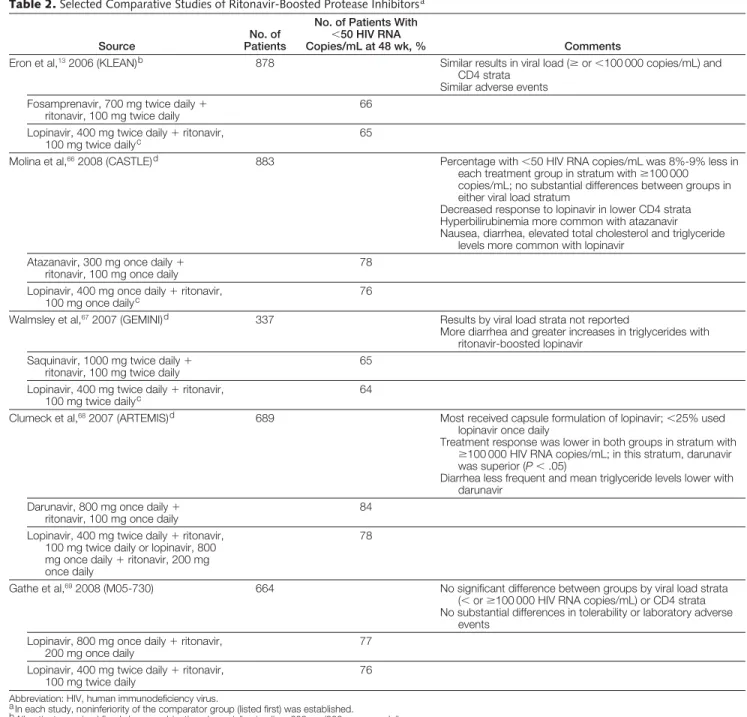
PI-Based Regimens (TABLE2).In an open-label, randomized study, fosam-prenavir/r twice daily was noninferior to lopinavir/r twice daily.13 Treatment
responses were similar for those with viral loads of at least vs less than 100 000 cop-ies/mL and across CD4 cell count strata.
Virologic failures were uncommon (6%-7%) and no major PI resistance– associated mutations were observed.
Atazanavir/r was also noninferior to lopinavir/r at 48 weeks in an open-label study. Fewer patients in either group achieved an HIV RNA level of less than 50 copies/mL if their baseline HIV RNA level was at least 100 000 copies/ mL. Patients with lower CD4 cell counts appeared to respond less well to lopi-navir/r. The percentage changes in total cholesterol and triglyceride (but not low- or high-density lipoprotein cho-lesterol) levels were greater in the lopi-navir/r group.66
Darunavir/r was compared with lopi-navir/r at 48 weeks in a randomized, open-label study.68Lopinavir/r could be
administered once (⬍25% of patients) or twice daily; only 2% initiated treat-ment with the tablet formulation of lopi-navir/r. The darunavir/r dose was 800 mg/ 100 mg once daily, not the currently approved dose of 600 mg/100 mg twice daily for treatment-experienced pa-tients. The difference between groups in response to less than 50 HIV-1 RNA cop-ies/mL at 48 weeks favoring the daruna-vir regimen met criteria for noninferior-ity but not for superiornoninferior-ity. In the HIV RNA stratum of 100 000 copies/mL or greater, the response in the darunavir/r group was superior to that in the lopi-navir/r group. Differences between the groups appeared to be driven by the re-sponse in patients who received lopina-vir/r once daily. No patients acquired ma-jor PI resistance mutations. Saquinavir/r was also noninferior to lopinavir/r in a randomized, open-label study.67
Use of the soft-gel formulation of lopinavir/r, which will soon no longer be available, complicates the interpre-tation of the aforementioned studies. A randomized, open-label study com-pared once-daily vs twice-daily lopina-vir/r combined with tenofovir and em-tricitabine.69An 8-week comparative
comparative study of lopinavir/r and da-runavir/r, and no substantial differ-ences in treatment responses were seen between HIV RNA strata (⬍100 000 andⱖ100 000 copies/mL). There were no differences in tolerability or ad-verse events.
In a smaller randomized study, there were fewer virologic failures and less
re-sistance emergence with atazanavir/r (300 mg/100 mg once daily) than with unboosted atazanavir (400 mg once daily), both combined with 2 nRTIs. Differences in the median changes in lipids were small.70
Since the previous guidelines, once-daily fosamprenavir, 1400 mg, with rito-navir, 100 mg, was approved for use in
treatment-naive patients, although com-parative data are limited. A small ran-domized trial comparing fosamprena-vir/r with atazanafosamprena-vir/r once daily, both with fixed-dose combination tenofovir/ emtricitabine, found no substantial dif-ferences between the groups.71
Dual nRTI Components.Dual nRTIs remain the backbone of most initial
Table 2.Selected Comparative Studies of Ritonavir-Boosted Protease Inhibitorsa
Source
No. of Patients
No. of Patients With ⬍50 HIV RNA
Copies/mL at 48 wk, % Comments
Eron et al,132006 (KLEAN)b 878 Similar results in viral load (ⱖor⬍100 000 copies/mL) and
CD4 strata Similar adverse events
Fosamprenavir, 700 mg twice daily⫹ ritonavir, 100 mg twice daily
66
Lopinavir, 400 mg twice daily⫹ritonavir,
100 mg twice dailyc 65
Molina et al,662008 (CASTLE)d 883 Percentage with⬍50 HIV RNA copies/mL was 8%-9% less in
each treatment group in stratum withⱖ100 000 copies/mL; no substantial differences between groups in either viral load stratum
Decreased response to lopinavir in lower CD4 strata Hyperbilirubinemia more common with atazanavir Nausea, diarrhea, elevated total cholesterol and triglyceride
levels more common with lopinavir Atazanavir, 300 mg once daily⫹
ritonavir, 100 mg once daily
78
Lopinavir, 400 mg once daily⫹ritonavir,
100 mg once dailyc 76
Walmsley et al,672007 (GEMINI)d 337 Results by viral load strata not reported
More diarrhea and greater increases in triglycerides with ritonavir-boosted lopinavir
Saquinavir, 1000 mg twice daily⫹ ritonavir, 100 mg twice daily
65
Lopinavir, 400 mg twice daily⫹ritonavir, 100 mg twice dailyc
64
Clumeck et al,682007 (ARTEMIS)d 689 Most received capsule formulation of lopinavir;⬍25% used
lopinavir once daily
Treatment response was lower in both groups in stratum with ⱖ100 000 HIV RNA copies/mL; in this stratum, darunavir was superior (P⬍.05)
Diarrhea less frequent and mean triglyceride levels lower with darunavir
Darunavir, 800 mg once daily⫹ ritonavir, 100 mg once daily
84
Lopinavir, 400 mg twice daily⫹ritonavir, 100 mg twice daily or lopinavir, 800 mg once daily⫹ritonavir, 200 mg once daily
78
Gathe et al,692008 (M05-730) 664 No significant difference between groups by viral load strata
(⬍orⱖ100 000 HIV RNA copies/mL) or CD4 strata No substantial differences in tolerability or laboratory adverse
events Lopinavir, 800 mg once daily⫹ritonavir,
200 mg once daily
77
Lopinavir, 400 mg twice daily⫹ritonavir, 100 mg twice daily
76
Abbreviation: HIV, human immunodeficiency virus.
aIn each study, noninferiority of the comparator group (listed first) was established.
bAll patients received fixed-dose combination abacavir/lamivudine, 600 mg/300 mg once daily. cCapsule formulation of lopinavir/ritonavir.
regimens. Extensive data support in-clusion of lamivudine or emtricita-bine as 1 of the 2 nRTIs. Tenofovir/ emtricitabine and abacavir/lamivudine are taken once daily. Long-term data for tenofovir/emtricitabine support its use in initial therapy,61-63although
indi-viduals with underlying renal dysfunc-tion or requiring other nephrotoxic agents may be at increased risk of re-nal toxicity. Modest decreases in bone density have been observed,63and
hy-pophosphatemia can occur.72The
long-term impact of tenofovir on bone me-tabolism, phosphate meme-tabolism,73and
renal function needs further evalua-tion. Tenofovir, emtricitabine, and efa-virenz are coformulated in a single pill taken once daily.
Abacavir/lamivudine is currently being compared with tenofovir/emtricitabine in a randomized, blinded, 96-week clini-cal trial of 688 treatment-naive pa-tients.10Both dual-nRTI combinations are
paired with once-daily lopinavir/r. At the 48-week primary end-point analysis, 68% of patients receiving abacavir/lamivu-dine and 67% of those receiving tenofo-vir/emtricitabine had HIV RNA levels of less than 50 copies/mL. In the stratum with screening viral loads of 100 000 cop-ies/mL or greater, 63% and 65% of pa-tients had HIV RNA levels below 50 cop-ies/mL in the abacavir and tenofovir groups, respectively; confirmed viro-logic failure occurred in 12% and 11%, respectively, of the patients over 48 weeks. Median changes in triglyceride and low-density lipoprotein cholesterol levels were greater in the abacavir group. In contrast with these results, the on-going ACTG A5202 study of approxi-mately 1800 treatment-naive patients comparing the same 2 dual-nRTI binations, in conjunction with a com-parison of efavirenz with atazanavir/r, was modified when a data and safety moni-toring board interim review noted a higher rate of virologic failure in pa-tients with screening viral loads of 100 000 copies/mL or higher in the aba-cavir/lamivudine group than in the te-nofovir/emtricitabine group. The esti-mated hazard ratio for cumulative virologic failure in this stratum was 2.33
(95% confidence interval [CI], 1.46-3.72;P= .0003) (http://www.aactg.org /news_results.asp).
A large, collaborative cohort study in-vestigated the association of nRTI use with subsequent myocardial infarc-tion.74,75After controlling for
numer-ous factors, an increased risk of myo-cardial infarction associated with recent abacavir or didanosine use (relative rates, 1.90 [95% CI, 1.47-2.45] and 1.49 [95% CI, 1.14-1.95], respectively) was demonstrated. Cumulative exposure was not predictive, and those who had not taken abacavir or didanosine for 6 months or more did not have an in-creased risk. The overall absolute risk was small but was greatest in those at highest risk of myocardial infarction, based on traditional cardiovascular risk factors. Although an association has been demonstrated in this study, cau-sation is not established.
Other Initial Combinations. The ACTG A5142 study included an nRTI-sparing group of efavirenz, 600 mg once d a i l y, w i t h l o p i n a v i r, 5 3 3 m g / ritonavir, 133 mg, twice daily59that had
a time to virologic failure similar to efa-virenz plus 2 nRTIs in the overall analy-sis, although in the stratum of 100 000 HIV RNA copies/mL or greater, the time to virologic failure was shorter. Limb-fat increase was greatest in the efavirenz/ lopinavir/r group, laboratory toxicity was more common (predominantly be-cause of rises in triglyceride levels), and emergence of resistance was more fre-quent than in the 2 nRTI groups.
Initial PI monotherapy has also been evaluated in a small, randomized, open-label study comparing lopinavir/r alone with lopinavir/r plus zidovudine and la-mivudine in patients with baseline vi-ral loads below 100 000 copies/mL.76
Fewer patients receiving PI mono-therapy achieved HIV RNA levels be-low the limit of detection, and a greater number receiving PI monotherapy had emergence of PI resistance mutations, suggesting that this approach should currently be considered suboptimal.
In another randomized, open-label study of 114 patients, 4 nRTIs (zido-vudine, lami(zido-vudine, abacavir, and
te-nofovir) had similar antiretroviral ac-tivity as efavirenz plus zidovudine and lamivudine; 68% and 67% had HIV RNA levels of less than 50 copies/mL at 48 weeks, respectively.77
N e w D r u g C l a s s e s i n I n i t i a l Therapy. Raltegravir, an integrase strand transfer inhibitor,78was
ap-proved in 2007 for use in highly treat-ment-experienced patients.79,80It was
compared with efavirenz in treatment-naive patients in a randomized, par-tially blinded trial in which patients re-ceived 1 of 4 doses of raltegravir (100, 200, 400, or 600 mg twice daily) or efa-virenz, each combined with tenofovir and lamivudine. At 48 weeks, the pro-portions of individuals who had an HIV RNA level of less than 50 copies/mL were similar among the 5 groups, rang-ing from 83% to 88%.81Phase 3
stud-ies comparing raltegravir, 400 mg twice daily, with efavirenz once daily, each paired with 2 nRTIs, are under way.
Maraviroc, a CCR5 antagonist ap-proved in 2007 for use in treatment-experienced patients, has antiretrovi-ral activity only in patients with HIV-1 variants that exclusively use the CCR5 coreceptor (termed R5 viruses). Mara-viroc was compared with efavirenz, each combined with zidovudine/lamivu-dine, in a randomized, double-blind, phase 3 study in treatment-naive pa-tients with R5 virus.82At 48 weeks,
69.3% and 65.3% of patients achieved a viral load of less than 50 copies/mL in the efavirenz and the maraviroc groups, respectively; the prespecified criterion for noninferiority was not met.
Recommendations
resistance should be guided by resis-tance test results (BIIa, BIIb). Nevira-pine is an alternative to efavirenz when an NNRTI-based regimen is desired and the CD4 cell count is less than 250/µL and 400/µL in women and men, respec-tively (AIa).
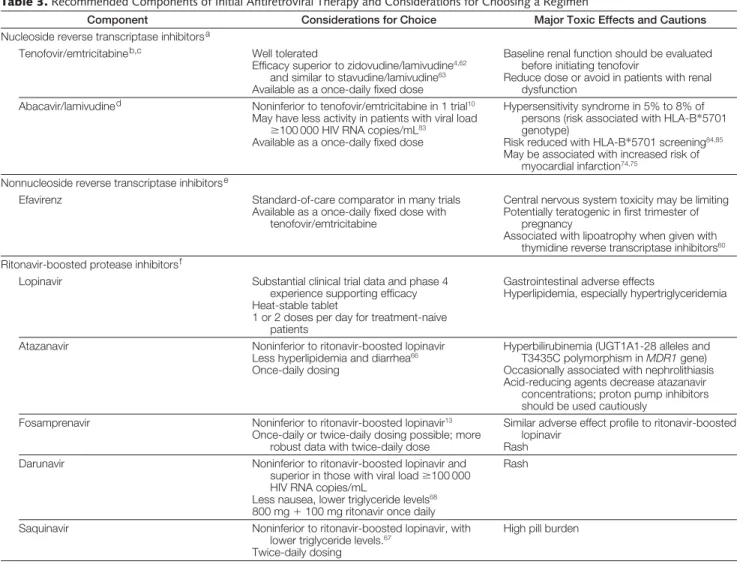
Of the ritonavir-boosted PIs, recom-mended components include lopina-vir/r (AIa), atazanalopina-vir/r (AIb), fosam-prenavir/r (AIa), darunavir/r (AIb), or saquinavir/r (AIb). Choice of PI/r is in-fluenced by factors such as frequency
of dosing, pill number, coformula-tion, need for refrigeracoformula-tion, adverse effect profile, concomitant medica-tions, comorbid illnesses, presence of primary drug resistance, and cost.
Lopinavir/r has been the most ex-tensively studied ritonavir-boosted PI and served as the comparator for most clinical trials of other ritonavir-boosted PIs. It is the only coformu-lated boosted PI option, and the com-bination tablet does not require refrigeration. It may be given once (BIa,
AIb) or twice (AIa, AIb) daily in treat-ment-naive patients, may be the most likely to cause diarrhea, and may have the greatest negative effect on triglyc-eride levels.
Once-daily ritonavir-boosted atazana-vir (AIb) has similar activity to lopina-vir/r, with fewer gastrointestinal ad-verse effects, a more favorable lipid profile, and a lower pill burden.66
Coad-ministration with acid-reducing agents must be done cautiously.86,87
Fosampre-navir/r may be given twice daily (AIa)13
Table 3.Recommended Components of Initial Antiretroviral Therapy and Considerations for Choosing a Regimen
Component Considerations for Choice Major Toxic Effects and Cautions
Nucleoside reverse transcriptase inhibitorsa
Tenofovir/emtricitabineb,c Well tolerated
Efficacy superior to zidovudine/lamivudine4,62
and similar to stavudine/lamivudine63
Available as a once-daily fixed dose
Baseline renal function should be evaluated before initiating tenofovir
Reduce dose or avoid in patients with renal dysfunction
Abacavir/lamivudined Noninferior to tenofovir/emtricitabine in 1 trial10
May have less activity in patients with viral load ⱖ100 000 HIV RNA copies/mL83
Available as a once-daily fixed dose
Hypersensitivity syndrome in 5% to 8% of persons (risk associated with HLA-B*5701 genotype)
Risk reduced with HLA-B*5701 screening84,85
May be associated with increased risk of myocardial infarction74,75
Nonnucleoside reverse transcriptase inhibitorse
Efavirenz Standard-of-care comparator in many trials Available as a once-daily fixed dose with
tenofovir/emtricitabine
Central nervous system toxicity may be limiting Potentially teratogenic in first trimester of
pregnancy
Associated with lipoatrophy when given with thymidine reverse transcriptase inhibitors60
Ritonavir-boosted protease inhibitorsf
Lopinavir Substantial clinical trial data and phase 4 experience supporting efficacy Heat-stable tablet
1 or 2 doses per day for treatment-naive patients
Gastrointestinal adverse effects
Hyperlipidemia, especially hypertriglyceridemia
Atazanavir Noninferior to ritonavir-boosted lopinavir Less hyperlipidemia and diarrhea66
Once-daily dosing
Hyperbilirubinemia (UGT1A1-28 alleles and T3435C polymorphism inMDR1gene) Occasionally associated with nephrolithiasis Acid-reducing agents decrease atazanavir
concentrations; proton pump inhibitors should be used cautiously
Fosamprenavir Noninferior to ritonavir-boosted lopinavir13
Once-daily or twice-daily dosing possible; more robust data with twice-daily dose
Similar adverse effect profile to ritonavir-boosted lopinavir
Rash
Darunavir Noninferior to ritonavir-boosted lopinavir and superior in those with viral loadⱖ100 000 HIV RNA copies/mL
Less nausea, lower triglyceride levels68
800 mg⫹100 mg ritonavir once daily
Rash
Saquinavir Noninferior to ritonavir-boosted lopinavir, with lower triglyceride levels.67
Twice-daily dosing
High pill burden
Abbreviation: HIV, human immunodeficiency virus.
aZidovudine/lamivudine is considered an alternative (see “When to Start” section of text).
bA baseline urinalysis and estimation of creatinine clearance or glomerular filtration rate for assessment of renal function are recommended.27All patients receiving tenofovir should
be observed for development of renal dysfunction.
cOr lamivudine. dOr emtricitabine.
eNevirapine (in women with⬍250 CD4 cells/µL and men with⬍400 CD4 cells/µL) is considered an alternative (see “What to Start” section of text).
fSubstantial clinical trial data exist for ritonavir-boosted lopinavir as initial antiretroviral therapy, including data on long-term outcomes. Each of the other ritonavir-boosted protease
or once daily with either 200 or 100 mg of ritonavir (BIa). With twice-daily dos-ing, the adverse effect profile and lipid effects are similar to lopinavir/r.13
Twice-daily saquinavir/r (AIb) was also nonin-ferior to twice-daily lopinavir/r,67with
less diarrhea and more favorable triglyc-eride changes.
Once-daily darunavir/r (AIb) is also well tolerated, with similar activity to lopinavir/r.68At present, the
formula-tion of darunavir studied in the phase 3 trial is not available. Using daruna-vir/r in initial therapy must be bal-anced against its proven efficacy in pa-tients with multidrug-resistant virus. Debate exists whether darunavir should b e u s e d i n p a t i e n t s w i t h d r u g -susceptible virus or should be re-served for patients with primary or ac-quired drug resistance.88-91
Unboosted PIs are not recom-mended. However, consideration of their use arises in highly selected cir-cumstances; eg, in individuals who are not candidates for NNRTI-based therapy or who have intolerance or con-traindications to ritonavir. Atazana-vir, fosamprenaAtazana-vir, and, in some cases, nelfinavir are candidates to consider, but a non-PI–, non-NNRTI–based regi-men such as raltegravir plus 2 nRTIs is another alternative, pending results of phase 3 studies.
Recommended nRTIs in the initial regimen are the fixed-dose combina-tions tenofovir/emtricitabine (AIa) or abacavir/lamivudine (AIa). Data lished or presented since the 2006 pub-lication of these guidelines continue to support the efficacy and safety of teno-fovir/emtricitabine. The recently re-ported association of abacavir with an increased risk of myocardial infarc-tion should be considered in patients with known or high risk of cardiovas-cular disease. The diminished viro-logic efficacy of abacavir/lamivudine compared with tenofovir/emtricita-bine (each in combination with efavi-renz or atazanavir/ritonavir) in pa-tients with viral loads of more than 100 000 copies/mL reported in 1 ran-domized study should also be consid-ered. The data are as yet insufficient,
however, to remove abacavir as a rec-ommended nRTI component of initial therapy.
Zidovudine/lamivudine twice daily is an alternative dual-nRTI component (AIa), although the gastrointestinal and central nervous system adverse effects and associations with lipoatrophy and anemia make this choice less desirable. The quadruple nRTI combination of abacavir/lamivudine/zidovudine/ tenofovir (BIIa)77may be considered in
special circumstances, such as coad-ministration with tuberculosis therapy or when comorbid conditions man-date treatment with other medica-tions that have substantial drug inter-a c t i o n s w i t h N N R T I s inter-a n d P I s . Lopinavir/r plus efavirenz (AIa)59also
may be considered to avoid nRTI use, although lipid abnormalities are com-mon. Currently, initial therapy with raltegravir should be considered only in highly selected circumstances (BIa). Use of maraviroc (CIb) or PI/r mono-therapy (CIa) for initial mono-therapy is not currently recommended.
PATIENT MONITORING Considerations
Recommendations for the initial workup of newly diagnosed HIV-infected persons have not changed sub-stantially except that baseline geno-typic testing for resistance should be performed in all treatment-naive pa-tients regardless of estimated duration of infection.92Baseline and periodic
CD4 cell counts and plasma HIV-1 RNA measurements guide timing of initial therapy. Presence of HBV or HCV in-fection, evidence of HIVAN, or cardio-vascular risk may also influence therapy initiation and regimen and, therefore, should be assessed.
Monitoring Treatment Response
Effective therapy should generally re-sult in at least a 10-fold (1.0 log10)
de-crease in HIV-1 RNA copies/mL in the first month and suppression to less than 50 copies/mL by 24 weeks, depending on pretreatment viral load.1Once HIV-1
RNA suppression is confirmed, it should be assessed at regular intervals
(eg, every 3 or 4 months).1Isolated
epi-sodes of low-level viremia (“blips”) are not predictive of subsequent virologic failure, but consistent elevations to more than 50 copies/mL meet a strict definition of virologic failure. Con-firmed viral load rebound should prompt a careful evaluation of regi-men tolerability, drug-drug interac-tions, and patient adherence. CD4 cell counts should generally be assessed in concert with viral load. Once CD4 cell counts are consistently at least 350/ µL, however, less frequent monitor-ing of CD4 cell count (ie, every 6 months) is reasonable if the viral load remains suppressed.
Resistance Testing
Updated IAS-USA guidelines for the use of antiretroviral drug resistance test-ing have been published.92 For
treat-ment failure with HIV-1 RNA levels of more than 500 to 1000 copies/mL, re-sistance testing is essential and should be performed while the patient is tak-ing the failtak-ing regimen.92
Tropism
Human immunodeficiency virus 1 re-quires a second receptor, either CCR5 or CX chemokine receptor 4 (CXCR4), to enter CD4 cells. Virus may exclu-sively use either CCR5 (R5 virus) or CXCR4 (X4 virus) or may use both re-ceptors (dual-tropic). Human immu-nodeficiency virus 1 variants within an infected individual may be R5 only, X4 only, or a mixture of R5, X4, and dual-tropic variants (so-called dual-/mixed-tropic populations). Most transmitted variants are R5, and R5 virus predomi-nates early in the course of infection. The CCR5 antagonist maraviroc inhib-its R5 virus and can provide added rologic activity in patients with R5 vi-rus93; it has little or no activity in
patients with dual-/mixed- or X4-tropic virus.94Thus, assessment of
tro-pism prior to use of maraviroc is es-sential.92,95
Monitoring for Treatment Toxicity
treat-ment, it is important to realize that car-diovascular, hepatic, and renal compli-cations may not only reflect drug toxicity but may also be associated with uncontrolled HIV replication.36-39
Ap-propriate clinical and laboratory as-sessment of relevant comorbid condi-tions should be performed before initiating treatment and during follow-up. For example, cardiovascular dis-ease risks should be assessed by avail-able algorithms. The Framingham risk algorithm may be the most appropri-ate, although it can underestimate car-diovascular disease risk in the setting of HIV infection.96Guidelines for the
prevention and management of meta-bolic complications in HIV infection are available.97
Assessment of renal function should be made before initiation and during use of tenofovir, allowing avoidance, dose modification, or timely substitution of the drug when appropriate.27
HLA-B*5701 Screening
The Prospective Randomized Evalua-tion of DNA Screening in a Clinical Trial (PREDICT) study demonstrated the clinical value of prospective HLA-B*5701 screening to identify patients at risk of abacavir-associated hypersen-sitivity reaction (HSR).84Those
screen-ing negative for HLA-B*5701 rarely de-velop immunologically confirmed abacavir HSR; approximately 50% of HLA-B*5701–positive patients de-velop immunologically confirmed HSR when given abacavir. Thus, HLA-B*5701–positive patients should not re-ceive abacavir. When a patient screens negative for HLA-B*5701, this should not replace careful follow-up because clinically diagnosed forms of abacavir HSR may still occur in such patients, albeit infrequently.
Therapeutic Drug Monitoring
The clinical role of therapeutic drug monitoring remains controversial, and no definitive data have emerged since the last edition of the guidelines on which to base a clear-cut recommen-dation.98-100 When available with
as-says performed by a quality-assured
laboratory,101therapeutic drug
moni-toring of PIs and NNRTIs may be se-lectively useful in pregnant wom-en,102,103children,104,105and patients with
renal or liver failure106-108; to
poten-tially minimize overexposure and ad-verse effects108-110; when managing
po-tential drug-drug interactions99; or in
virologic failure in the absence of re-sistance when adherence is thought to be excellent.
Recommendations
The goal of antiretroviral therapy is to reduce and maintain a plasma HIV-1 RNA level of less than 50 copies/mL, regardless of previous treatment expe-rience. Plasma HIV-1 RNA levels should be monitored frequently when treat-ment is initiated or changed for viro-logic failure (eg, at 2, 4, 8, and every 4 weeks thereafter) (AIIa) until it reaches levels below the assay detection lim-its, and regularly thereafter (eg, 3-4 times per year [BIII]). Once the viral load is suppressed for an extended pe-riod and CD4 cell counts are stable at 350/µL or more, twice-yearly CD4 cell counts are reasonable (CIII).
Baseline genotypic testing for resis-tance should be performed in all treat-ment-naive patients (AIIa and, in cases of confirmed virologic failure, AIa). Re-sistance testing should also be consid-ered after a new regimen is introduced if the trajectory of HIV-1 RNA reduc-tion is not optimal, as archived muta-tions may emerge (AII). Appropriate as-sessment of comorbid conditions and monitoring for toxicity should be per-formed before initiating treatment and during follow-up (eg, for hyperlipid-emia, cardiovascular risk, renal func-tion, and hepatic transaminases) and may be partly dependent on the regimen. When possible, patients should be screened for the HLA-B*5701 haplo-type if being considered for abacavir (AIa); those screening positive should not receive the drug (AIa). Those screening negative can generally take abacavir, but because rare cases of abacavir HSR may occur in such patients, clinical vigi-lance for suspected abacavir HSR re-mains appropriate (AIa).
Assessment of viral tropism is rec-ommended prior to use of maraviroc (AIb). Therapeutic drug monitoring for PIs and first-generation NNRTIs is not recommended as part of routine care (CIII).
WHEN TO CHANGE AND WHAT TO CHANGE Changing for Reasons of Toxicity or Convenience
The principles for modifying a regimen successful in suppressing HIV have not changed.1Single-agent switches to
de-crease toxicity, avoid adverse drug in-teractions, or improve convenience and adherence are possible provided the po-tency of the regimen is maintained and subsequent drug interactions are man-aged appropriately.111-115Switching to PI/r
monotherapy is not recommended, given the increased rates of low-level vire-mia,116unless other options are not
avail-able (BI). Caution must be taken in switching to nevirapine in women with CD4 cell counts of more than 250/µL and in men with CD4 cell counts of more than 400/µL, although studies have sug-gested that the risks of hypersensitivity and hepatotoxicity are lower than have been reported in antiretroviral-naive in-dividuals who start nevirapine with simi-lar CD4 cell counts (BII).117,118Changes
because of toxicity should not be made prematurely, as many early drug-related adverse effects subside with time. However, persistent adverse effects may compromise adherence and lead to re-sistance.
Recommendations.Replacing single agents to reduce toxicity or drug inter-actions or to improve convenience and adherence is acceptable provided the regimen potency is maintained and sub-sequent adverse drug interactions are avoided (AIIa). Prior treatment his-tory and results of prior resistance test-ing should be reviewed. Close moni-toring of HIV-1 RNA level after such a switch can help ensure that virologic suppression is maintained.
Changing for Virologic Failure
ma-jority of patients with virologic fail-ure, even those with multidrug-resistant HIV.89,90,93,119-123
The selection of a new regimen should take into consideration history of drug exposure, current and prior ge-notypic or phege-notypic resistance pat-terns, tolerability, other prescribed drugs with interaction potential, and reasons for failure and should include expert advice when possible. At least 2 (and ideally 3) fully active drugs should be included, and using drugs from at least 1 new class should be consid-ered.
First-Line Failure of NNRTI-Based Regimens.There is no advantage to maintaining an NNRTI to which resis-tance has emerged. The failure of an agent should be recognized early and discontinued so that additional muta-tions to the NNRTI and dual-nRTI com-ponents do not emerge to compro-mise other compounds in the class.
First-line NNRTI failures are typi-cally treated with 2 active nRTIs plus a PI/r. If such a regimen cannot be con-structed, including etravirine or an agent in a new class, such as raltegra-vir or mararaltegra-viroc (if raltegra-virus is pure R5), can be considered if adequately sup-ported by other active drugs in the regi-men. Although etravirine retains activ-ity in the setting of fewer than 3 NNRTI mutations and does not appear to be af-fected by K103N,124it will need to be
supported by at least 1 fully active nRTI and a PI/r. Etravirine with 2 nRTIs alone is not recommended [BI].
First-Line Failure of PI/r Regimens.
As with NNRTI-based regimens, fail-ure should be detected early and mu-tations identified. For many patients, resistance to the PI may not have emerged, allowing the same drug or an-other PI/r to be used next. For virus with some degree of PI resistance, a PI/r with activity against resistant strains, such as lopinavir/r, darunavir/r, or ti-pranavir/r, should be considered. In this setting, darunavir/r is likely to be more active than lopinavir/r88and may be
more tolerable than tipranavir/r. If not previously used, an NNRTI may be in-cluded, provided that drug
interac-tions are considered. Whenever pos-sible, 2 fully active nRTIs should be included. If the combined potency is uncertain, including an agent from a new class, such as an integrase strand transfer inhibitor or a CCR5 antago-nist (if R5 virus can be confirmed by tropism assay), should be considered. With virologic failure of either an NNRTI- or a PI/r-based initial regi-men, decisions should be individual-ized with respect to the number of new drugs and new drug classes used in the replacement combination. For early fail-ures, strategic sequencing of PIs should be considered. For example, for a vi-rus that is fully susceptible to all PIs, there is no virologic advantage to using darunavir/r or tipranavir/r over lopina-vir/r or atazanalopina-vir/r.125
Recommendations.Virologic fail-ure with an initial NNRTI- or PI-based regimen should be treated early with at least 2, and ideally 3, fully active drugs. For NNRTI failures, the new combina-tion should include, if possible, an agent from a new class (AIa), most com-monly a PI/r. With NNRTI failure, etra-virine may be a useful component of a new regimen if there are fewer than 3 NNRTI-associated mutations, but it must be supported by a potent combi-nation of other drugs that should in-clude a PI/r (AIa). Depending on the drug resistance profile and options available, inclusion of an agent from an-other new drug class (raltegravir, an in-tegrase inhibitor, or maraviroc, a CCR5 antagonist) should be considered (BIII).
Multidrug (Including PI and NNRTI) Resistance
In this setting, 3 active drugs, includ-ing new classes of agents whenever possible, should be used. Individuals with treatment failure and multidrug-resistant virus usually benefit from a PI/r with activity against resistant s t r a i n s , s u c h a s d a r u n a v i r / r o r tipranavir/r.90,119 Etravirine can be
paired with darunavir/r but not tipranavir/r126 and may be of value
depending on the number of NNRTI mutations. One or more drugs drawn f r o m n e w e r c l a s s e s s h o u l d b e
included, such as raltegravir or mara-viroc (if R5 virus is confirmed).93,122,123
Enfuvirtide may be of value despite the inconvenience of subcutaneous injection and the associated injection site reactions.127There is no
convinc-ing evidence for the use of 2 PI/rs (double PI boosting).128There is no
new information on the role of con-tinuing lamivudine (or emtricitabine) to maintain the M184V mutation to modulate viral fitness.
Recently Approved Agents Particularly Useful in
Multidrug-Experienced Patients Raltegravir.Patients with triple class– resistant HIV were randomized to re-ceive raltegravir, 400 mg twice daily, or placebo in addition to optimized back-ground therapy in 2 phase 3 trials (TABLE4).122,123 Human
immunodefi-ciency virus 1 RNA levels of less than 50 copies/mL occurred in 65% of pa-tients taking raltegravir and in 31% in the control groups. Virologic re-sponses were greater in the subgroup of patients with lower baseline HIV-1 RNA levels, higher baseline CD4 cell counts, and who had more active agents in the optimized background therapy. There were non–statistically signifi-cantly increased numbers of cancers in patients randomized to receive active drug (relative risk at 48 weeks, 1.5; 95% CI, 0.5-6.3). It is unclear whether this imbalance is drug related or reflects an-ticipated complications in an ad-vanced patient population. Raltegra-vir resistance remains under study but appears to involve a minimum of 2 mu-tations along 1 of 2 pathways of the in-tegrase enzyme (Q148H/K/R or N155H).129Raltegravir is a potent agent
for patients with multidrug resis-tance, but given its relatively low ge-netic barrier to resistance, it needs to be supported by other agents.
Maraviroc. Maraviroc was evalu-ated in triple class–experienced pa-tients with R5 virus in 2 phase 3 stud-ies (Table 4).93The mean HIV-1 RNA
change from baseline in the placebo group was −0.78 log10copies/mL
once-daily maraviroc and −1.84 log10
copies/mL with twice-daily maravi-roc. Maraviroc has not been associ-ated with an increased incidence of ma-lignancy, but the question has been raised with another investigational drug in this class, vicriviroc, so careful phase 4 follow-up is ongoing. Resistance to maraviroc typically occurs through emergence of X4 or dual-/mixed-tropic virus preexistent in the viral population; a second mechanism in-volves mutations developing in gp120 of HIV-1 that permit the virus to use the CCR5 receptor in the presence of bound maraviroc.
Etravirine.Etravirine was evalu-ated in treatment-experienced tients in 2 parallel trials in which pa-tients received etravirine, 200 mg twice daily, or matching placebo with
daruna-vir/r and optimized background therapy.120,121,130At 48 weeks, 65% of
pa-tients randomized to etravirine, com-pared with 39% to 40% randomized to placebo, had HIV-1 RNA levels of less than 50 copies/mL. More active agents in the optimized background therapy produced greater response rates. The presence of 3 or more NNRTI muta-tions was associated with a poor viro-logic response.124Most data for this
agent have been derived from the trials in which it was combined with daruna-vir/r and other active agents, so its use in other combinations needs to be con-sidered cautiously.
Recommendations.The treatment goal of suppression of HIV-1 RNA to less than 50 copies/mL in treatment-experienced patients, introduced in the last report,1has been strengthened by
recent advances (AIa). Regimens should include at least 2, and ideally 3, fully active agents (AIa), and at least 1 new class should be included (AIa). Expert advice should guide therapy for pa-tients with multidrug resistance (BIII). Ritonavir-boosted PIs with activity against resistant viruses (darunavir/r or tipranavir/r) often are the foundations of a new regimen. Adding raltegravir provides a potent agent from a new class. Raltegravir has a relatively low ge-netic barrier to resistance and, thus, needs to be protected by the addition of other agents to prevent virologic breakthrough (AIa).
Etravirine can be an important ad-junct to a new regimen if no or only 1 or 2 NNRTI-associated resistance mu-tations are present (AIa), and it must be supported by a potent backbone (eg,
Table 4.Selected Trials of Newly Available Drugs in Antiretroviral-Experienced Patients
Class and Drug
Pivotal Trials in Multidrug-Resistant
Patients Entry Criteria Randomization Outcomes Comments
Integrase inhibitor: raltegravir
BENCHMRK-1 (n = 352)122
BENCHMRK-2 (n = 351)123
Multidrug resistance HIV RNA⬎1000
copies/mL Any CD4 cell count
Optimized background therapy⫹ raltegravir or placebo (2:1 ratio)
HIV RNA⬍50 copies/mL at week 48: 60%-65% (raltegravir) vs 31%-34% (control) CD4 cell counts
increased 98-120/µL (raltegravir) vs 40-49/µL (control)
Most frequent adverse events gastrointestinal; not increased vs placebo Relative risk of
malignancy increased vs placebo; significance uncertain
CCR5 antagonist: maraviroc
Motivate-1 (n = 601)93
Motivate-2 (n = 475)93
Multidrug resistance R5-tropic
HIV RNA⬎5000 copies/mL Any CD4 cell count
Optimized background therapy⫹ placebo or maraviroc once daily or maraviroc twice daily (1:2:2 ratio)
HIV RNA⬍50 copies/mL at week 48: 45.5% (maraviroc, once daily) and 43.2% (maraviroc, twice daily) vs 16.7% (control) CD4 cell counts
increased 116/µL (maraviroc, once daily) and 124/µL (maraviroc, twice daily) vs 61/µL (control)
Need to perform tropism assay prior to use No increase in
malignancy Most common
adverse events: diarrhea, nausea, fatigue, and headache; similar to placebo
NNRTI: etravirine DUET-1 (n = 612)120
DUET-2 (n = 489)121
HIV RNA⬎5000 copies/mL ⱖ1 NNRTI mutation ⱖ3 PI mutations Any CD4 cell count
Ritonavir-boosted darunavir⫹ optimized background therapy⫹ etravirine or placebo
HIV RNA⬍50 copies/mL at week 48: 60%-61% (etravirine) vs 39%-41% (control) CD4 cell counts
increased 94-103/µL (etravirine) vs 72-74/µL (control)
Fully active only if fewer than 3 resistance-associated mutations; activity not compromised by isolated K103N mutation Most data are based
on combined use with darunavir
a boosted PI such as darunavir/r). Etra-virine should not be used with tiprana-vir/r because of drug-drug interac-tions (AII).
For individuals with R5 virus, ma-raviroc can provide another active agent from a new class (AIa). Tropism should be assessed when contemplating the use of maraviroc (AIa). Concerns about the limited sensitivity of the tropism as-says in excluding the presence of X4 vi-rus are being addressed by the devel-opment and availability of more sensitive assays. Maraviroc is espe-cially important to consider if the PI/r component of the regimen is compro-mised by PI resistance.
Despite its inconvenience, enfu-virtide remains an important agent for persons with multidrug-resistant vi-rus, especially those with greater com-promise of the PI component.
The nRTIs are often included in new regimens for highly treatment-experienced patients but typically pro-vide only partial, adjunctive activity, given the frequent presence of drug class cross-resistance as a result of prior drug exposure. Their use as adjuncts is recommended in situations where re-sidual antiretroviral activity is thought to be present and tolerance is good (BIa).
ANTIRETROVIRAL THERAPY IN SPECIAL POPULATIONS In at least 3 circumstances, special con-sideration should be given to initia-tion of therapy.
HIV-Infected Persons With
or at Risk of Specific Opportunistic Diseases and Coinfections
The presence of coinfections, or a high risk of certain opportunistic diseases, can provide a strong rationale for ear-lier initiation of therapy. Liver disease a s s o c i a t e d w i t h H B V a n d H C V progresses more rapidly in HIV-1– coinfected populations than in those in-fected with HBV or HCV alone. Liver disease progression is slower in HIV/ HCV-coinfected patients receiving ef-fective antiretroviral therapy.131Therapy
for HCV (eg, peginterferon alfa plus
ribavirin) is limited by toxicity, adher-ence challenges, and limited efficacy, particularly with HCV genotype 1 and 4 infection. Therefore, initiation of an-tiretroviral therapy, regardless of CD4 cell count in those coinfected with HCV genotypes 1 and 4, in those with geno-types 2 or 3 who do not tolerate therapy, or in persons who do not clear virus de-spite a course of anti-HCV therapy might substantially reduce the rate of progression of liver disease.
In HBV coinfection, treatment for HIV should be considered at any CD4 cell count. A number of HIV drugs (te-nofovir, emtricitabine, lamivudine) also are appropriate for HBV therapy and can be used in initial HIV regimens for HBV-coinfected patients.
The timing of antiretroviral therapy in those presenting with HIV-1 tion and an acute opportunistic infec-tion was recently examined.132In
HIV-1–infected persons presenting with a subset of treatable opportunistic infec-tions, 6-month morbidity and mortal-ity were reduced in those in whom an-tiretroviral therapy was initiated closer to the time of presentation than in those in whom therapy was delayed. This study excluded patients with tubercu-losis; thus, the optimal approach to starting antiretroviral therapy in those with immunologically advanced HIV in-fection and tuberculosis remains an area of active investigation.
HIV-Associated Nephropathy
Abnormal kidney function is found in up to 30% of HIV-infected per-sons.133,134Proteinuric renal disease is
more common in persons of African de-scent and persons with diabetes, hy-pertension, HCV infection, family his-tory of kidney disease, CD4 cell count of less than 200/µL, or HIV-1 RNA level of more than 4000 copies/mL.27,133
An-tiretroviral therapy can improve renal function in HIVAN and may slow, if not stop, its progression.135-137
Observa-tional studies suggest that antiretrovi-ral therapy may prevent HIVAN, as its prevalence has decreased in the era of highly active therapy.136Uncontrolled
viral replication is associated with the
development of non-AIDS diseases, and renal disease is more prevalent in un-treated HIV infection.27,35,36
Pregnant Women
Antiretroviral therapy for pregnant women with detectable HIV-1 RNA is indicated to improve the health of the mother and to prevent transmission of HIV-1 to the fetus or infant. Antiretro-viral therapy should not be deferred in women in their first trimester of preg-nancy if they are candidates for therapy, irrespective of pregnancy status. Com-plete recommendations for antiretro-viral treatment during pregnancy should be used to guide therapy.53
Recommendations
Human immunodeficiency virus infec-tion treatment may be considered at any CD4 cell count for persons coinfected with HCV genotypes 1a, 1b, or 4 to slow the progression of liver disease (AIIa, AIIb). Therapy should also be consid-ered for those with HCV genotypes 2 or 3 who do not clear virus with therapy or who cannot tolerate HCV treat-ment (AIIa, AIIb).
Active HBV coinfection should prompt consideration of initiation of an-tiretroviral therapy, irrespective of CD4 cell count, since earlier therapy might reduce the rate of liver disease progres-sion (AIIa). Early antiretroviral therapy with at least 2 agents that are active against HBV will likely have a benefi-cial impact on liver disease and re-duce the rate of evolution of drug-resistant HBV variants. Tenofovir and either emtricitabine or lamivudine are preferred for initial treatment of HBV in coinfection. The activity of ente-cavir against HIV has not yet been con-firmed in clinical trials; therefore, it should not be substituted for an active nRTI for the treatment of HIV.138
Persons with HIVAN should begin antiretroviral therapy (AIIa, AIIb) as soon as renal disease is diagnosed.27
(renal tubular disorders) are used, re-nal function should be monitored closely.
CONCLUSIONS
The 21 years since zidovudine was ap-proved for the treatment of HIV infec-tion have witnessed remarkable ad-vances in the understanding of disease pathogenesis, translation of that knowl-edge into practical therapeutics, con-tinued discovery of complications or disease states associated with HIV or its treatment that increase the complex-ity of management, and a dynamic drug development process that has led to the current availability of more than 30 in-dividual drugs and fixed-dose combi-nations to treat HIV infection.
Despite these advances, disease man-agement remains challenged by toxici-ties, maintenance of adherence, clini-cal manifestations related to both the drugs and the HIV infection itself, and the threat of drug resistance. Sustain-ability and expansion of the progress achieved will depend on maintaining a robust drug development pipeline and the ability to deliver effective therapy and monitoring tools to the world’s af-fected populations. With creativity and political will, the progress and indi-vidualized approach to antiretroviral therapy evident in the developed world can be adapted to the public health ap-proach in the developing world, where 90% of the world’s HIV-infected popu-lation lives.
Author Affiliations:Columbia University College of Physicians and Surgeons, New York, New York (Dr Hammer); University of North Carolina at Chapel Hill (Dr Eron); Academic Medical Center, University of Amsterdam, Amsterdam, the Netherlands (Dr Reiss); University of California San Diego, La Jolla (Dr Schooley); AIDS Research Consortium of Atlanta, Atlanta, Georgia (Dr Thompson); University of Toronto, Toronto, Ontario, Canada (Dr Walmsley); Hospital Juan Fernandez/University of Buenos Aires Medical School and Fundacion Huesped, Buenos Aires, Argentina (Dr Cahn); University of Miami, Miami, Florida (Dr Fischl); University of Barcelona, Barcelona, Spain (Dr Gatell); Harvard Medical School, Boston, Massachusetts (Dr Hirsch); International AIDS Society–USA (Ms Jacobsen) and University of California San Francisco and San Francisco Veterans Affairs Medical Center (Dr Volberding), San Fran-cisco; University of British Columbia, Vancouver, Brit-ish Columbia, Canada (Dr Montaner); University of California San Diego and Veterans Affairs San Diego Healthcare System, San Diego (Dr Richman); and Hoˆpital Bichat-Claude Bernard and Xavier Bichat Medical School, Paris, France (Dr Yeni).
Author Contributions:Study concept and design:
Hammer, Eron, Reiss, Schooley, Thompson, Walmsley, Cahn, Fischl, Gatell, Hirsch, Jacobsen, Montaner, Richman, Yeni, Volberding.
Acquisition of data:Hammer, Eron, Schooley, Volberding.
Analysis and interpretation of data:Hammer, Eron, Reiss, Schooley, Thompson, Cahn, Gatell, Hirsch, Montaner, Richman, Yeni, Volberding.
Drafting of the manuscript:Hammer, Eron, Reiss, Schooley, Thompson, Walmsley, Cahn, Fischl, Gatell, Hirsch, Jacobsen, Richman, Yeni, Volberding.
Critical revision of the manuscript for important in-tellectual content:Hammer, Eron, Reiss, Schooley, Thompson, Walmsley, Cahn, Gatell, Hirsch, Montaner, Richman, Yeni, Volberding.
Obtained funding:Jacobsen.
Administrative, technical, or material support:
Hammer, Schooley, Jacobsen, Yeni.
Study supervision:Hammer, Eron, Cahn, Gatell, Hirsch, Jacobsen, Montaner, Volberding.
Financial Disclosures:Dr Hammer reports that he has served as a scientific advisor to Boehringer Ingel-heim, Bristol-Myers Squibb, Merck, Pfizer, Progen-ics, Schering, Shire, TaiMed BiologProgen-ics, and Tibotec-Virco; has received a clinical trial research contract from Merck; and has served on a data and safety monitor-ing board for Bristol-Myers Squibb. Dr Eron reports that he was the principal investigator on research grants to University of North Carolina from Boehringer In-gelheim, GlaxoSmithKline, Merck, and Panacos; has served as a consultant to Avexa, Bristol-Myers Squibb, GlaxoSmithKline, Merck, Monogram, Panacos, Pfizer, Tibotec, and Tobira; and was on the speakers’ bu-reaus for or received honorarium from Bristol-Myers Squibb, Merck, Roche, and Tibotec. Dr Reiss reports that he has served on advisory boards and/or speak-ers’ bureaus for and/or received research grants from Boehringer Ingelheim, Bristol-Myers Squibb, Gilead Sci-ence, GlaxoSmithKline, Hoffmann, LaRoche, Merck, Pfizer, Theratechnologies, and Tibotec. Dr Schooley reports that he has served as a consultant to Achillion, Anadys, Ardea, Gilead, GlaxoSmithKline, ImQuest, In-hibitex, Koronis, Merck, Monogram, Myriad, Pfizer, TaiMed, Tanox, Tibotec, Tobira, and Vertex; has re-ceived grant support from Merck and Chimerix; and has had stock options for Achillion and Monogram. Dr Thompson reports that she has received research grants for AIDS Research Consortium of Atlanta from Abbott, Avexa, Boehringer Ingelheim, Bristol-Myers Squibb, GlaxoSmithKline, Gilead, Koronis, Merck, Pa-nacos, Pfizer, Progenics, Roche, Serono, TaiMed, Ther-atechnologies, and Tibotec; has spoken at events spon-sored by GlaxoSmithKline and Serono; and has served as a consultant to or was on the scientific advisory boards for GlaxoSmithKline, Gilead, Panacos, Pfizer, Progenics, Serono, and Tibotec. Dr Walmsley reports that she has served on advisory boards and/or speak-ers bureaus for Abbott, Bristol-Myspeak-ers Squibb, Boe-hringer Ingelheim, Gilead Sciences, GlaxoSmithKline, Merck, Pfizer, Roche, and Tibotec. Dr Cahn reports that he has received fees for consultancy, speaking en-gagements, scientific advisory board membership, and/or research grants from Abbott, Avexa, Boe-h r i n g e r I n g e l Boe-h e i m , B r i s t o l - M y e r s S q u i b b , GlaxoSmithKline, Hoffmann LaRoche, Merck, Pfizer, Pharmasset, Schering-Plough, and Tibotec. Dr Fischl reports that she has received research grants from Ab-b o t t L a Ab-b o r a t o r i e s , B r i s t o l - M y e r s S q u i Ab-b Ab-b , GlaxoSmithKline, Merck, Progenics Pharmaceuticals, and Cytheris and has served on advisory boards for Merck and Progenics Pharmaceuticals. Dr Gatell re-ports that he has received honoraria for speaking or participating in advisory boards or research grants from Abbott, Boehringer Ingelheim, Bristol-Myers Squibb, Gilead, GlaxoSmithKline, Idenix, Janssen, MSD, Pfizer, Roche, Tibotec, and Tobira. Dr Hirsch reports that he has served on data safety monitoring boards for Merck
and TaiMed Biologics. Dr Montaner reports that he has received grants from, served an advisor to, or spo-ken at events sponsored by Abbott, Argos Therapeu-tics, Bioject Inc, Boehringer Ingelheim, Bristol-Myers Squibb, Gilead Sciences, GlaxoSmithKline, Hoff-mann-La Roche, Janssen-Ortho, Merck Frosst, Pana-cos, Pfizer, Schering, Serono Inc, TheraTechnologies, Tibotec, and Trimeris. Dr Richman reports that he has served as a consultant to Anadys Pharmaceuticals, Biota, Bristol-Myers Squibb, Boehringer Ingelheim, Gi-lead Sciences, Idenix, Koronis Pharmaceuticals, Merck, Monogram Biosciences, Pfizer, Roche, and Tobira. Dr Yeni reports that he has received grants and research support from Bristol-Myers Squibb, GlaxoSmithKline, Merck, Roche, and Tibotec and has served as a con-s u l t a n t t o B r i con-s t o l - M y e r con-s S q u i b b , G i l e a d , GlaxoSmithKline, Merck, and Tibotec. Dr Volberding reports that he has served on scientific advisory boards for Bristol-Myers Squibb, Gilead, Merck, Pfizer, and Schering; has participated as a member of an end-point adjudication committee of Schering for an on-going clinical trial; has provided expert testimony in a lawsuit against Abbott Laboratories; and has re-ceived an unrestricted educational grant from GlaxoSmithKline-Italy. The IAS-USA has received grants for selected continuing medical education activities that are pooled (ie, no single company supports any single effort) from Abbott Laboratories, Boehringer Ingel-heim, Bristol-Myers Squibb, Gilead Sciences, GlaxoSmithKline, Merck, Pfizer, Roche, and Tibotec. No other disclosures were reported.
Funding/Support:This work was funded by the IAS-USA. Panel members serve in volunteer capacities (ie, are not compensated). No private sector or govern-ment funding contributed to this work.
Role of the Sponsor:The IAS-USA determined the need for updated recommendations, selected the panel members, and provided administrative oversight and financial support.
Additional Contributions:We thank Brian G. Gaz-zard, MD, FRCP, Chelsea and Westminster Hospital, London, England; Michael S. Saag, MD, University of Alabama at Birmingham; Mauro Schechter, MD, PhD, Universidade Federal do Rio de Janeiro, Rio de Ja-neiro, Brazil; and Charles C. J. Carpenter, MD, Brown University School of Medicine, Providence, Rhode Is-land; for helpful comments; and Michelle Tayag, BS, who was compensated as an employee of the IAS-USA, for administrative support.
REFERENCES
1.Hammer SM, Saag MS, Schechter M, et al. Treat-ment for adult HIV infection: 2006 recommenda-tions of the International AIDS Society–USA panel.
JAMA. 2006;296(7):827-843.
2.Braitstein P, Brinkhof MW, Dabis F, et al. Mortal-ity of HIV-1-infected patients in the first year of an-tiretroviral therapy: comparison between low-income and high-low-income countries.Lancet. 2006; 367(9513):817-824.
3.Carpenter CCJ, Fischl MA, Hammer SM, et al. An-tiretroviral therapy for HIV infection in 1996: recom-mendations of an international panel.JAMA. 1996; 276(2):146-154.
4.Gallant JE, DeJesus E, Arribas JR, et al. Tenofovir DF, emtricitabine, and efavirenz vs zidovudine, lam-ivudine, and efavirenz for HIV.N Engl J Med. 2006; 354(3):251-260.
5.Dube´ MP, Komarow L, Mulligan K, et al. Long-term body fat outcomes in antiretroviral-naive par-ticipants randomized to nelfinavir or efavirenz or both plus dual nucleosides: dual x-ray absorptiometry re-sults from A5005s, a substudy of Adult Clinical Trials Group 384.J Acquir Immune Defic Syndr. 2007; 45(5):508-514.