The Use of a Mechanism-Based Model
(MBM) to Better Characterize the
Pharmacology of Combination Colistin
(COL) and Ceftazidime/Avibactam (CZA)
Across Five Carbapenem-resistant
Klebsiella pneumoniae Strains
By
Joseph Piscitelli
Honors Thesis
UNC Eshelman School of Pharmacy
University of North Carolina at Chapel Hill
2/10/2020
Approved:
The Use of a Mechanism-Based Model (MBM) to Better Characterize the Pharmacology of Combination Colistin (COL) and Ceftazidime/Avibactam (CZA) Across Five Carbapenem-resistant
Klebsiella pneumoniae Strains
Joseph Piscitelli1, Hongqiang Qiu1, Courtney Lutebach2, Rajnikant Sharma1, Estefany Garcia1, Patrick Hanafin1, David van Duin2, Gauri G. Rao1
1UNC Eshelman School of Pharmacy, University of North Carolina, Chapel Hill, NC, 2UNC School of Medicine, University of North Carolina, Chapel Hill, NC,
Journal: Antimicrobial Agents and Chemotherapy or Clinical Microbiology and Infection Words Count: 4145
Abstract
Introduction: Carbapenem-resistant Klebsiella pneumoniae are resistant to multiple classes of antibiotics and often necessitating the need for combination therapy to ensure adequate sustained killing activity and prevent the emergence of resistance. Previous in vitro studies have shown that the combination of colistin (COL) and ceftazidime/avibactam (CZA) resulted in sustained activity against
Klebsiella pneumoniae.
Methods: Five Klebsiella pneumoniae clinical isolates were utilized. (COL MIC: 32mg/L; CZA MIC: 0.5-2mg/L). COL (0.5, 1, 2, 4, 8, 16mg/L) and CZA (16/4, 32/8, 64/16, 128/32mg/L) were evaluated alone and in combination (COL 0.5, 1, 2, 4mg/L and CZA 16/4, 32/8, 64/16 mg/L) against an initial inoculum of ~106 CFU/mL over 24 hours. Model development was conducted using a pooled approach with
maximum likelihood estimation in ADAPT-5 and S-ADAPT-TRAN.
Results: The mechanism-based model (MBM) characterized both drugs as exerting their
pharmacological effect on the death rate of the bacteria. The MBM was able to capture the reduction in bacterial burden and rapid regrowth well (R2 = 0.974). The model precision was fair as characterized by parameter coefficient of variation.
Introduction:
Increasing spread of carbapenem resistance amongst Klebsiella pneumoniae is a worrisome, growing trend that is narrowing therapeutic options in clinic1,2, making blood stream infections (BSI) increasingly challenging to treat. BSIs in themselves are already associated with high mortality3, and substantial long-term morbidity with no significant improvements despite attempts to optimize treatment4. Sepsis is a
serious consequence of untreated or inadequately managed BSIs, in which the host’s inflammatory
immune response causes life-threatening damage to the host’s organs and tissue5. Post-sepsis survivors experience a sharp increase in proportion of days spent in a clinical institution relative to days spent at home6, highlighting an apparent compromise in quality of life as a prominent survivorship issue. Presently, effective treatment of BSIs continues to be an obstacle in the clinic.
In 2017, The World Health Organization ranked carbapenem-resistant (CRE) and 3rd generation cephalosporin-resistant Enterobacteriacae, including Klebsiella pneumoniae, at the top of their global priority list, citing that urgent research is required into development of new antibiotics for these resistant species7. Given the mounting resistance to newer antimicrobial agents, older antibiotics such as polymyxins are making a comeback. However, many of these agents have well-defined toxicities and side-effects that preclude intensive use in clinic8. While this pressure has borne fruit in the form of a novel class of beta-lactamase inhibitors such as avibactam and relebactam, a distinct lack of novel therapeutic agents in drug development pipeline remains a pervasive issue9. Given the challenging circumstances and in the interests of cost, clinicians have unsurprisingly turned towards using existing agents in combination to restore their antimicrobial activity, and improve therapeutic outcomes in patients with CRE infections. Previous in vitro studies demonstrated the success of ceftazidime-avibactam (CZA) and colistin (COL) in monotherapy10.
It is important to develop better mathematical models, metrics/pharmacodynamic analysis, and study designs to determine if combination therapy is efficacious and apply those results to clinical context. Mechanism-based modeling (MBM) can be useful in this because it takes into account the pharmacology of the drugs being used and this can help to better explain the effects that are being seen. Mechanism-based modeling can also be used to optimize combination regimens for antibiotic agents to better understand how two drugs work together to achieve a maximum killing effect11. By applying pharmacodynamic (PD) modeling approaches to in vitro data, we can better understand how the combination of drugs work together and translate the results to useful dosing strategies in human patients. Developing a successful PD model can lead to other forms of optimization such as running simulations or using an in vitro dynamic model.
Methods: Bacterial strains
Five clinical BSI isolates of Klebsiella pneumoniae– culture ID 3138, 3135, 2873, 3207, 3173 were selected based on their clinical treatment group and minimum inhibitory concentration (MIC) profile from a total of 36 carbapenem-resistant isolates obtained from The Consortium on Resistance Against Carbapenems in Klebsiella and Other Enterobacteriacae (CRACKLE) study. Isolates were selected from each treatment category: colistin monotherapy, ceftazidime-avibactam monotherapy, and combination colistin and ceftazidime-avibactam. These isolates were also previously studied by van Duin et al. (2017)10.
Medium and antibiotics
Fresh stock solutions of all antibiotics were prepared in sterile water prior to each experiment and sterilized by filtration with a 0.22 µm filter (Olympus Plastics, Genesee Scientific) for susceptibility testing and in vitro static time-kill studies. Mueller-Hinton broth (BBL, Becton Dickinson, lot number 8045582) supplemented with calcium (25 mg/L) and magnesium (12.5 mg/L) (SMHB) was used for susceptibility testing and in vitro static time-kill studies. Luria-Bertani (LB) broth (Difco, Becton Dickinson, lot number 4339957) similarly supplemented with calcium and magnesium (SLB) as above was used in bacterial culture for growth curve, and vesicle isolation, and purification processes. Avibactam (Advanced ChemBlocks Inc, lot number 10499), Ceftazidime hydrate (Sigma, lot number 035M4897V), and Colistin sulfate salt (Sigma, SLBK0713V) were used for in vitro static time-kill assays. Susceptibility testing
The MIC for the five clinical Klebsiella pneumoniae isolates with, ceftazidime-avibactam and colistin, were determined by broth microdilution in duplicates according to Clinical and Laboratory Standards Institute (CLSI) guidelines using cation-adjusted Mueller-Hinton broth (CAMHB). Broth microdilution was performed in 96-well polystyrene round bottom microwell plates (Thermo Fisher Scientific). Mueller-Hinton agar (BBL, Becton Dickinson, lot number 8024807) was used for the agar dilution method. Susceptibility breakpoints for all antibiotics was guided by the British Society for Antimicrobial Chemotherapy (BSAC).
In vitro static time-kill studies
Static-concentration time-kill (SCTK) experiments were performed over 24 h to evaluate
Samples were obtained at 0, 1, 2, 4, 6, 8, and 24 hours, subject to dilutions with sterile saline as necessary. Viable bacterial counts were determined by plating 50 µL of each sample on drug-free Mueller-Hinton agar (BBL, Becton Dickinson, lot number 8024807) plates using an automatic WASP2 spiral plater (Microbiology International). Plates were incubated for 24 h at 37°C before colony counts were determined using ProtoCOL SR (Symbiosis). The colony count in log10CFU/mL was plotted as a function of time for all tested drug regimens for each clinical isolate.
Pharmacodynamic Model Development:
The log10-transformed counts of CFU in response to concentrations of colistin and
ceftazidime/avibactam were characterized by fitting candidate PD models. The PD model was derived by fitting smooth curves through the time-kill experimental data, resulting in the computation of model parameter values which summarize and characterize the observed experimental data and which are more amenable to hypothesis testing. PD models explored included one where the drug effect for either or both drugs was hypothesized to inhibit bacterial replication and where the drug effect enhanced the rate of bacterial killing. Models with two, three, or four preexisting bacterial populations were
considered. Model development was conducted using a pooled approach with maximum likelihood estimation using ADAPT-514 and S-ADAPT-TRAN15. The differential equation solver used was LSODA and the function minimization was carried out using Nelder Mead Simplex. Model discrimination was accomplished using the rule of parsimony and the Akaike Information criteria (AIC) values, goodness of fit plots, parameter estimates and their coefficient of variation (CV%).
Mechanism-based Model:
This mechanism-based PD model of SCTK data was developed to quantitatively characterize the bacterial killing and regrowth for both colistin and ceftazidime/avibactam alone and in combination against Klebsiellapneumoniae. The total bacteria concentration was the difference between a saturable capacity-limited bacterial replication process and the rate of bacterial death due to natural elimination (elimination of bacteria in the absence of drug) (Kd; hour-1), the first-order bacterial elimination rate constant. The rate of bacterial replication described as the maximal velocity of bacterial growth [VGmax expressed as CFU/mL per hour] was parameterized as the maximum bacterial population size
(CFUmax) and the median effect, (CFUm; CFU/mL), the bacterial density that results in half maximal rate of bacterial growth:
VGMAX = KD*(CFUM+CFUMAX)
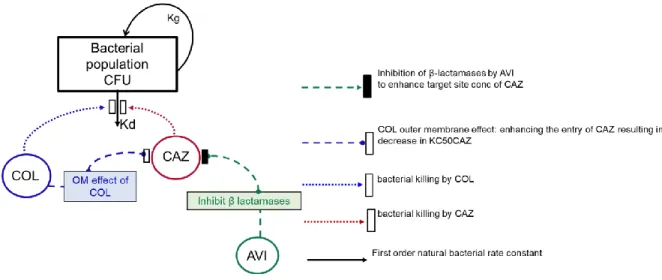
We modeled monotherapy time-kill data for each antibiotic and the final estimates were used to inform the development of the model for the combination therapy. For the combination therapy, evaluated two significant interactions: (i) Outer membrane effect: colistin causes disruption of the outer membrane of the gram-negative bacteria that enhances the penetration of ceftazidime into the bacterial cell. (ii) Protective effect: avibactam provides effective protection provided against hydrolysis
outer membrane by colistin.16 The avibactam beta-lactamase effect was incorporated into the model based on its activity against known Ambler class A (ESBL and KPC), C (AmpC), D (OXA-48) enzymes.17
outer_membrane_effect_COL = 1-(IMAX_COL*COL**H_COL/(IC50_COL**H_COL+COL**H_CH)) beta_lactamase_effect_AVI = 1-((IMAX_AVI*AVI**H_AVI)/(AVI**H_AVI+IC50_AVI**H_AVI)) COL_Effect_R = (EMAX_COL*COL**H_COL)/(EC50_CR**H_COL+COL**H_COL)
COL_Effect_S = (EMAX_COL*COL**H_COL)/(EC50_CS**H_COL+CST**H_COL)
The effect of ceftazidime was modeled to increase the natural elimination of bacteria, Kd, by a Hill-function. Kmax is the maximal fractional increase in Kd, the value of Kmax will result in a proportional
increase in Kd. Hill’s constant, H, influences the shape of the effect curve i.e. as the value of H increases the slope of the PD function becomes steeper.
Bacterial Killing of ceftazidime/avibactam=
VGmax*(bacterial load)/(CFUM+CFUTOT))-Kd*(bacterial load)*(1+(((EMAX_CAZ*CAZ**H_CAZ)/
(outer_membrane_effect_COL*beta_lactamase_effect_AVI*EC50_CAZ**H_CAZ+CAZ**H_CAZ))+COL_ef fect_R))
Neither this equation nor any other considered that assumed a homogenous drug sensitivity throughout
the inoculum was able to fit the experimental data. Therefore, we employed a “mixture model” in which
Figure 1. MBM schematic depicting the shift in CAZ KC50 through COL
disruption of the outer bacterial membrane, and through the β-lactamase effect of AVI
Results:
Static Time-Kill Results:
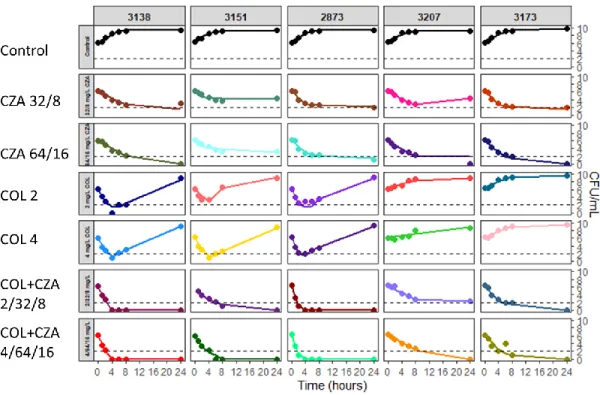
For colistin monotherapy many of the strains demonstrated early bacterial killing, especially at some of the higher concentrations such as 8 mg/L and 16mg/L. However, around the 4 to 6-hour time point, bacterial regrowth began to set in that was similar to the control data at 24 hours. All of the strains showed resistance to colistin even though many of the MICs were determined to be less than 0.5 mg/L. The ceftazidime/avibactam monotherapy showed faster and more sustained killing than the colistin monotherapy group. Many of the strains had 2-3 log-reduction by the 4 to 6-hour time points and had no regrowth at all. Regrowth for the ceftazidime/avibactam time kills were seen with MICs greater than 2mg/L and usually in lower concentrations such as the 16/4 mg/L groups. The most drastic killing effect was seen with the combination of colistin and ceftazidime/avibactam. Log-reduction of 3-4 was seen by almost all of the strains, with extended killing below the limit of quantification (BLQ) out to 24 hours. Regrowth was uncommon, but when it did occur, it happened between the 8 to 24-hour time points and, similarly to the monotherapy SCTK studies, were mainly with lower concentrations of drug. MICs above 1-2 mg/L were more likely to have regrowth at the 24-hour time points.
Although there is a similar killing effect between the ceftazidime/avibactam monotherapy treatment and the combination treatment, it is important to highlight that the differences are significant (Figure 2). At the 24-hour time point for the ceftazidime/avibactam monotherapy, there are still bacterial loads thar are above the BLQ line (dotted). Additionally, there is a more significant log-reduction in bacterial load when using the combination therapy. To achieve higher rates of treatment success, it is important to elicit a killing effect that is quick and has a long duration. In this study, the combination of colistin and ceftazidime/avibactam was able to accomplish this through its ability to decrease bacterial load below the limit of quantification at a rapid rate, and sustain the killing for 24 hours.
AVI- avibactam CAZ- ceftazidime COL- colistin
Mechanism-Based Modeling:
A mechanism-based PD model of SCTK data was developed to quantitatively characterize the bacterial killing and regrowth for both colistin and ceftazidime/avibactam alone and in combination against K. pneumoniae. Using a bacterial growth model, monotherapy time-kill data for each antibiotic and the final estimates were used to inform the development of the model for the combination therapy (Table 1).
Our main focus was to identify the effect of combination therapy on bacterial growth. We found that when given together, bacterial killing is drastically increased and sustained with most concentrations through 8 hours. When resistance was seen, it did not manifest until the 24-hour time point. The MBM was able to capture the reduction in bacterial burden and bacterial regrowth well for all 5 strains (Mean R2 =0.974, standard deviation= ±0.02), as shown in Figure 2. The coefficient of determination for the strains ranged from 0.92-0.99, showing that the model fits were all very good and there was a less than 10% variance between each of the models.
Figure 2. Time course of bacterial density in response to static concentrations of colistin, ceftazidime/ avibactam, and colistin in combination with ceftazidime/avibactam at concentrations used for human treatment. The solid lines (–) represent the model fits and the dots (•) represent the observed
Parameter Parameter Description Final Estimate (Median [Range])
CV%
(Median [Range]) Kmax,COL (h-1) Maximum killing rate
constant of COL
16.1 [9.72-18.6] 3.90 [2.38-11.9]
Kmax,CAZ (h-1) Maximum killing rate constant of CZA
9.84 [5.29-10.8] 4.04 [3.35-8.01]
KC50,COL(S) (mg/L) COL concentration resulting in 50% of KMAX,COL in the susceptible subpopulation
1.18 [0.10-150] 12.7 [4.95-15.3]
KC50,COL(R) (mg/L) COL concentration resulting in 50% of KMAX,COL in the resistant subpopulation
565 [58.2-2090] 7.53 [3.71-8.03]
KC50,CAZ(S) (mg/L) CAZ concentration resulting in 50% of KMAX,CAZ in the susceptible subpopulation
0.69 [0.28-6.93] 12.1 [4.73-26.6]
KC50,CAZ(R) (mg/L) CAZ concentration resulting in 50% of KMAX,CAZ in the resistant subpopulation
163 [60.4-373] 6.54 [4.08-12.2]
Imax,AVI (h-1) Maximum fractional decrease of KC50,CAZ by AVI
β-lactamase killing effect
0.58 [0.22-0.66] 46.7 [20.8-127]
IC50,AVI (mg/L) AVI concentration causing 50% of Imax,AVI
0.12 [0.04-0.32] 9.77 [3.94-29.9]
Imax,COL,OM (h-1) Maximum fractional decrease of KC50,CAZ by COL via outer membrane disruption
0.44 [0.15-0.75] 50.8 [10.3-195]
IC50,COL,OM (mg/L) COL concentration causing 50% of Imax.COL,SYN
0.64 [0.16-1.75] 12.8 [4.09-27.1]
LogMF_RS Log10 mutation frequency of sub population resistant to COL
-5.56 [-6.87- -3.72] 1.05 [0.60-4.49]
LogMF_SR Log10 mutation frequency of sub population resistant to CAZ
-3.88 [-4.32- -1.71] 3.32 [0.92-5.85]
LogCFU0 (log10 CFU/ml)
Initial Inoculum 6.15 [5.87-6.25] 0.87 [0.61-1.11]
LogCFUm CFU at which the rate of replication is 50% of maximum growth velocity
8.81 [8.39-9.18] 0.37 [0.29-1.38]
LogCFUmax (log10 CFU/ml)
Maximum carrying capacity
9.49 [9.20-9.63] 0.29 [0.24-1.07]
Table 1. Model Parameter estimates and CV (%) are reported
Discussion:
Overall, the mechanism-based model was able to predict the bacterial time kill data well. With some of the isolates, the MIC value did not correlate to how we initially thought the bacterial time course would appear. For instance, strain 3151 had a MIC of 0.5 mg/L for colistin and 1.0 mg/L for
ceftazidime/avibactam which made us think that both drugs would have an excellent killing effect.
However, this wasn’t the case. There was major regrowth for the colistin alone concentrations, and the
ceftazidime/avibactam monotherapy treatment wasn’t able to drop the bacterial load below the limit of
quantification. When just relying on MIC to predict bacterial sensitivity, other factors may be missed leading to inappropriate dosing. Modeling the killing effect can help to better understand characteristics of each strain and to better dose patients accordingly.
The precision on the final estimates for the MBM were very good for the Kmax and KC50 values. Even the higher range values were below 50% showing that each of the five strains had excellent precision. With both monotherapy and combination therapy data available, there was much more information the model could use to better predict the killing effect of colistin and ceftazidime/avibactam.
Precision was still good for the parameters involved with avibactam’s effect (Imax,AVI, IC50,AVI) on
ceftazidime as well. However, one reason the precision is not better is that there was no data available with the killing effect of ceftazidime without avibactam. Because of this, it was much harder to gauge the effect that avibactam had on the ceftazidime killing. Avibactam inhibits the beta-lactamase
properties of the Klebsiella bacteria which have a devastating effect on ceftazidime if it is given without avibactam. Understanding the killing effects that ceftazidime has by itself would allow us to quantify how much more bacterial killing is there is when avibactam is added.
The maximum fractional decrease of KC50,CAZ by COL via outer membrane disruption (Imax,COL,OM ) was also difficult to describe with this model and also had a higher CV% with some of the strains. One thought for why this occurred, is due to the lack of killing effect that colistin has on some of the strains, especially those that have a higher MIC. If colistin is not able to elicit its killing mechanism of breaking open the
bacterial cell membrane, then it also isn’t increasing the killing of ceftazidime either. In higher MIC strains, colistin isn’t having barely any effect and thus it is almost as if it is removing the parameters involved with the outer membrane effect as a whole. In some strains we can quantify the effect and some strains we cannot, leading to decreased precision.
this drug can be crucial for better understanding its pharmacology and use in combination with other antibiotics.
One limitation to this study is not having multiple time points at each concentration. For each bacterial strain there is only one-time point per concentration used. If there is an outlier or any major error in any of the time points, we would not know. We can make guesses about whether that time point it correct or not, but without additional data at each time point, we have to accept that it is the actual data point in the model. Additionally, the lower limit of quantification for the assay involved in this study was a LogCFU of 2. There were many data points at 6, 8, or 24 hours that were BLQ. Because there is some ambiguity about the actual bacterial load at those time points, it contributes to the error of our model. Future directions for this study would be first to try and incorporate the pharmacokinetics of
ceftazidime/avibactam and colistin into the model. Evaluating in silico pharmacodynamic activity in response to clinically relevant exposures for these antibiotics would improve our predicting ability to determine what doses should be used to treat infected patients. Additionally, incorporating patient specific clinical data, or bacterial strain genomics would also be helpful in painting a full picture of the system we are treating. Adding in age, immune function, or bacterial mutations would allow for better predicting of outcomes or dosing options. Another future study could be to look at how our model would work in tissue infections. This model was built off of data from blood stream infections, but measuring its utility in tissue infections would be a great test. Finally, after developing the model further, we could compare outcomes of model dosing versus package insert dosing to gauge how well this model would work for treating actual patients.
References
1. Munoz-Price LS, Poirel L, Bonomo RA, et al. Clinical epidemiology of the global expansion of Klebsiella pneumoniae carbapenemases. Lancet Infect Dis. 2013;13(9):785-796. doi:10.1016/S1473-3099(13)70190-7
2. Bush K. Alarming β-lactamase-mediated resistance in multidrug-resistant Enterobacteriaceae. Curr Opin Microbiol. 2010;13(5):558-564. doi:10.1016/j.mib.2010.09.006
3. Martinez RM, Wolk DM. Bloodstream Infections. In: Diagnostic Microbiology of the
Immunocompromised Host, Second Edition. Vol 4. American Society of Microbiology; 2016:653-689. doi:10.1128/microbiolspec.DMIH2-0031-2016
4. Iwashyna TJ, Cooke CR, Wunsch H, Kahn JM. Population burden of long-term survivorship after severe sepsis in older Americans. J Am Geriatr Soc. 2012;60(6):1070-1077.
doi:10.1111/j.1532-5415.2012.03989.x
5. Stevenson M, Pandor A, James MM-S, et al. Background and definition of the decision problem. 2016. https://www.ncbi.nlm.nih.gov/books/NBK368614/. Accessed January 19, 2019.
6. Prescott HC, Langa KM, Liu V, Escobar GJ, Iwashyna TJ. Increased 1-Year Healthcare Use in Survivors of Severe Sepsis. Am J Respir Crit Care Med. 2014;190(1):62-69. doi:10.1164/rccm.201403-0471OC
7. Tacconelli E, Carrara E, Savoldi A, Kattula D, Burkert F. Global Priority List of Antibiotic-Resistent Bacteria to Guide Research, Discovery and Development of New Antibiotics.; 2017.
https://www.who.int/medicines/publications/WHO-PPL-Short_Summary_25Feb-ET_NM_WHO.pdf?ua=1. Accessed January 19, 2019.
8. Neuner EA, Yeh J-Y, Hall GS, et al. Treatment and outcomes in carbapenem-resistant Klebsiella pneumoniae bloodstream infections. Diagn Microbiol Infect Dis. 2011;69(4):357-362.
doi:10.1016/j.diagmicrobio.2010.10.013
9. Boucher HW, Talbot GH, Benjamin DK, et al. 10 x ’20 Progress--Development of New Drugs Active Against Gram-Negative Bacilli: An Update From the Infectious Diseases Society of America. Clin Infect Dis. 2013;56(12):1685-1694. doi:10.1093/cid/cit152
10. van Duin D, Lok JJ, Earley M, et al. Colistin Versus Ceftazidime-Avibactam in the Treatment of Infections Due to Carbapenem-Resistant Enterobacteriaceae. Clin Infect Dis. 2017;66(2):163-171. doi:10.1093/cid/cix783
11. Rao G, Li J, Garonzik S, Nation R, Forrest A. Assessment and modelling of antibacterial combination regimens. Clinical Microbiology and Infection. 2018;24(7):689-696.
doi:10.1016/j.cmi.2017.12.004.
12. Allergan G. AVYCAZ Highlights of Prescribing Information.; 2018.
14. D’Argenio, D.Z., A. Schumitzky and X. Wang. ADAPT 5 User’s Guide:
Pharmacokinetic/Pharmacodynamic Systems Analysis Software. Biomedical Simulations Resource, Los Angeles, 2009.
15. Bulitta JB, Bingolbali A, Shin BS, Landersdorfer CB. 2011. Development of a new pre- and post-processing tool (SADAPT-TRAN) for nonlinear mixed-effects modeling in S-ADAPT. AAPS J 13:201–211. 16. Schindler M, Osborn MJ. Interaction of divalent cations and polymyxin B with
lipopolysaccharide. Biochemistry 1979;18:4425-30.
17. Aszodi J, Fromentin C, Lampilas M, et al. Aventis Pharma SA, assignee Heterocyclic compounds
which are active as inhibitors of β-lactamases, 2003. 2003 Jan 27; International Patent number PCT/FR2003/000243.
Report Addendum: Acknowledgements:
I would like to recognize Patrick Hanafin and the rest of the Rao lab for their teachings. I would also like to thank Julie Dumond and Craig Lee for their assistance with the RASP program and for helping to direct it. Lastly, I would like to thank Alan Forrest for introducing me to these modeling concepts.
Funding Support
“The authors have no funding support to disclose”
Conflicts of Interest
“The authors have no conflicts of interest to disclose”
Dissemination Plan
This work was accepted by the American Conference on Pharmacometrics. The Conference was held on October 20-23 2019.