A Systematic Classification of Migration of
Legacy Application to Cloud Services
Raghavan P1, Chandra Shekar RK2, Shiva Murthy G3
1
Research Scholar, VTU,2Assistant Professor, Practice School Division, Birla Institute of Technology & Science, Pilani, Bangalore Center ,3Associate Professor, VTU Centre for PG Studies,
Bangalore, India
Abstract
“Cloud computing” enables the computing resources and computing services to be available for purchase on demand. By adopting cloud services, organizations can migrate and deploy their software applications on cloud resources. The benefits like elasticity, flexibility and expenditure reduction attract many enterprises to consider the migration of their applications to the Cloud. This migration brings in many complex organizational and technical challenges; among them is the lack of mature processes, methods and techniques during legacy application migration. This survey gives a systematic survey that consolidates various research conducted on migration approaches, frameworks, tools and decision support methods. The survey also presents a systematic classification of legacy application migration to cloud platform and then, analyze and evaluates and presents critical review of different migration classifications.
It emphasizes the need of support for migration to cloud in the form of innovative frameworks, tools and Decision support methods which confirms correctness and completeness of cloud migration.
Keywords — Cloud Computing, Legacy application
Migration, Migration to Cloud, Classification of Migration to Cloud, Migration Classification.
I. INTRODUCTION
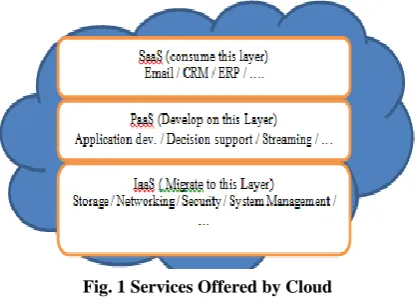
The abstraction of cloud services it offers can be classified into three categories. Software-as-a-Service (SaaS), Platform-as-a-Software-as-a-Service (PaaS) and Infrastructure-as-a-Service (IaaS).This categorization can be viewed as layered services offered by cloud. The figure1 briefs the purpose of each service Layer.
The ever increasing need for storage, data processing, elastic and unbounded scale of computing infrastructure has created great need for shifting the data and computing operations to the cloud [1]. Cloud computing is a cost efficient model for service provision[2]. The adoption of cloud computing is gaining momentum because most of the services provided by the cloud are low cost and readily available. The pay- as-you- go structure of the cloud is particularly suited to Small and Medium
Fig. 1 Services Offered by Cloud
Enterprise (SME) who has little or no resources for IT services [3]. The growing trend of cloud computing has led many organizations and even individuals moving their computing operations, data, and/or commissioning their e-services to the cloud[4], [5].
Moving the on-premise application (or few components of the application) to the cloud platform is called migration of legacy application to cloud[1], [5] . There are several parameters that attract the migration of the legacy application to cloud; few of the major parameters are – Scaling the application for addressing the growing traffic, without investing in new hardware [5], [6], expanding and provisioning the extra capacity only when it‘s needed [5], [6], the costs of resource over-provisioning and the risks of under-provisioning are associated with cloud providers [5] [7]. Hence, Elasticity is one of the important economic benefits of cloud computing [2] [7]. Cloud providers own the responsibility of operational and maintenance which reduces the cost for the same [5] [8]. There are several other advantages and benefits of application migration to cloud, they are, ease of manageability, increased reliability, increased performance, increased security, increased flexibility, no need to invest early in hardware, reduced complexity, service consolidation. All the above advantages potentially reduce the cost of application maintenance[9].
A. Decision to Migrate
IaaS— the application should be migrated to. The application type influences the choice of cloud service for the migration.
B. Organization of this Paper
In the 2nd section of this paper we discuss general migration methodology, then in the 3rd section we have discussed about the high level classification of migration – Hot and Cold migration methods and continue our discussion of migration by considering Hot migration which is the complicated process and needs a proper framework for migration in the 4th section we have presented the various literatures that discuss different approaches for migration based on these approaches analysis we have tried to classify the migration process in the 5th section based on the above detailed survey and analysis we have identified few open issues of migration that is presented in the 6th section. Finally in section 7th concluded the discussion with identifying a need for a novel framework for migration to cloud.
II. GENERICMIGRATIONPROCESS Cloud migration is a process of migration activities carried to support an end-to-end cloud migration. Any application migration is done in phases and each phase has detailed steps to be followed [6]: Phase 1: Evaluate your existing environment - this phase has steps to audit the IT, Application dependency mapping and the Customer Experience analysis, Phase 2: Plan & Design your new environment - this phase has steps to identify suitable cloud-based providers, assess potential customer service, Plan & Design, the final Phase 3: Migrate and verify the new environment – this phase has steps to Migrate services, Verify services and Monitor services.
III.GENERICCLOUDMIGRATION Migration can be done in two ways namely Hot Migration: Migrating the application to cloud during the application run (live migration) and second way of migration is cold Migration, here the migration to cloud is performed after bringing down the on-premise application and migrating the application offline to cloud.
A. Hot Migration
This is the transfer of the Operating System (OS) and the application(s) from a physical machine to another machine (here in this context its virtual machine in cloud) without suspending or stopping OS operations or applications. This migration method is suited for less sensitive servers that have more static content. This method works by creating a snapshot of the application and then copying that snapshot to the newly created Virtual Machine. Any files that are open at the time of the snapshot may not have their data committed which will result in a crash-consistent state for your destination VM. Any subsequent
changes to any files after the snapshot is taken will not be copied as well. Any open files or any message passing may get disturbed during this type of migration that has to be taken care.
B. Cold Migration
In this type of transfer, we suspends OS and application(s) of the physical machines and later the transfer begins. Here we can move all the files and also database with less hiccups. This type of migration gives the best chance of success because OS is not running hence no data is corrupted since there are no open files during the transfer. This migration may be the best option for data sensitive servers like database and email servers.
In practice Hot migration is common process for migration and also has several challenges in it compared to cold migration. Finally when the question arises for strategies associated with the application migration we end up with similar strategies for both hot and cold migrations. In [10]authors have proposed a generic methodology to migrate legacy system to cloud platform. They are: - representation of the legacy application
- redesign the architecture model with identified services
- model driven architecture (MDA) transformation - web service generation
- invocation of legacy functionalities
- selection of a suitable cloud computing platform, - provision of cloud web service to the end users
These steps improve the productivity and effectiveness of migration.
Rebuild on PaaS and replace with software as service[13]. Revise for IaaS or PaaS[13]. Migration to SaaS is not considered as application migration but is dealt as replacement of the existing application with a SaaS[14]. Applications that are based on standard application server software such as JavaEE or .net platforms can be migrated and rebuilt[14]. Deploying the application on the cloud service providers servers‘ Migration to IaaS‘[14]. By detailed analysis of advantages and disadvantages there is a proposal of three familiar and common approaches for migrating legacy applications to the cloud services namely Iaas, PaaS and SaaS[15].
The result of analysis done on various research work proposed on Migration to Cloud are: Sanjeev kumar Yadav et al.,[10], The Phased manner approach is a better approach while moving towards cloud. The authors do not specify any technical parameters for migration and also parameters like correctness, completeness and post-migration performance and its evaluation are not discussed. Muhammad Aufeef Chauhan et al.,[16], Authors discuss the migration to cloud in specific to Hackystat system, AWS and Google App Engine platforms and the general challenges associated with other applications and general cloud platforms are not presented. Ganesh Olekar et al., [9], has presented the advantage of application migration to cloud and strategies that can be implemented for migration of legacy application. Authors also mentions challenges faced while migrating legacy application to cloud. Pooyan Jamshidi et al.,[17], Author‘s reviews that there is a need for a migration framework, which is non-existence as off now and also reveals that due to lack of frameworks, people do not have trust in migration. This review shows a lack of tool support to automate migration tasks an also it identifies needs for architectural adaptation and self-adaptive cloud-enabled systems. Stavros Stavru et al.,[18], The Authors have discussed only partial way to use agile methodology and have not provided the complete agile method to support the legacy systems to cloud migration. Doaa M. Shawky et al., [19],The limitations of this research is the lack of consideration of performance issues such as reliability and availability and also the scenarios when database components are to be migrated are to be considered. Mohammad Hajjat et al.,[20], Although the proposed approach has several positive parameters they have a limitation as concluded by the authors that there is threat of consistency in data extraction and data selection and also threat of biased data synthesis and biased results. B. C. Tak et al.,[21], The Authors have discussed extensively on Feasibility study, Decision of providers, Decision of sub-systems, Decision of services, but the complete study is under a controlled environment, hence the discussion here is limited to the cases considered in the paper and cannot be taken for a generalized migration. P. V.
Beserra et al.,[13], The discussion is on Decision of providers, Migration strategies but for an Example application hence results cannot be generalized. Dunhui Yu, et al.,[14], The Authors discuss on Architecture extraction, Code Modification, Migration strategies for a complete migration of application, the support provided is not complete and is limited for a case study.
V. CLASSIFICATIONOFMIGRATION Most of the approaches discussed in many other research papers are similar to the strategies given in the above survey.
After the survey and analysis, abstractly we can map the migration approaches mentioned above to specific migration types. Through this mapping existing migration approaches to the identified migration types, the migration types can be better understood and compared explicitly. Any method (Hot or Cold migration) will have the following migration types –Replace, migrate and cloudify and migrate the software stack.
Replace: opting for the available cloud solution for the legacy application and replacing the legacy application with the cloud offering.
Migrate and Cloudify: A migration of the application takes place and here cloudification requires additional adaptive actions to address possible incompatibilities.
Migrate the software stack: migration of the software application stack to the Cloud. Here the application is encapsulated in VMs and ran on the Cloud.
A. Partial and Complete migrations
Each Migration type mentioned above has a bifurcation of Partial and complete migration. Partial migration means one or more components / layers of application is migrated and complete migration is migration of all the components / layers of an application.
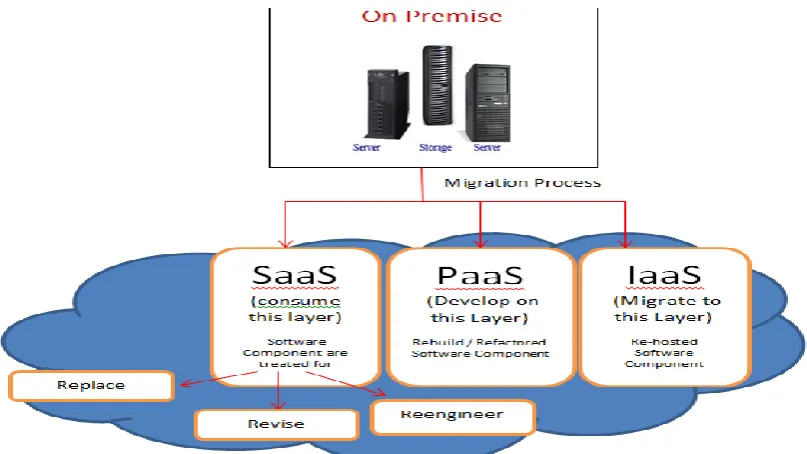
As shown in the figure 2 below, we have classified the migration to cloud into three basic strategies based on the detailed analysis and comparison: migration to IaaS, migration to PaaS and migration to SaaS. This classification of migration approaches realizes fundamental migrations that can cover all migration cases.
1) Migration to IaaS:
Fig. 2Generic View of Classification of Migration to Cloud
capabilities of the application, transitive risk post migration, and framework constraints. Migration to SaaS can be further classified into three sub migrations namely ‗replacing the existing application‘ with the application provided by SaaS provider here migration effort will be minimal, second sub strategy is ‗revising the existing application‘ with some business logic of the cloud service and the adaption to the legacy system based on SaaS provider services and the third sub migration strategy ‗reengineering the existing application‘ based on SaaS provider, this migration is challenging, and may require reverse engineering, structure redesign, service generation, and many other process.
When there is no time to reengineer the applications for a cloud, IaaS is the best choice for moving applications to the cloud[22]. Usually migration to IaaS involves migration of a full IT infrastructure. The motivating factors for migration to IaaS are – cost (usually migration costs are neglected and only reduction in operational costs are considered), time it saves for maintenance and other issues, adding flexibility to existing application, improves the impact, loose / win strategy like, what type of profits and loses might occur in the business, IaaS is a hosting service provided by the cloud service provider, this includes routing, network, amount of data communication, dynamic resource allocation, provision for any special hardware devices and storage. The hardware platform to run the application and store applications is provided by the IaaS provider this also includes the administrative services to manage the Infrastructure by the client. IaaS providers provide all the above services to the client by adopting virtual Machines(VM) in cloud hosting environment. Client need to load all the software to run their applications on cloud. There are
few factors to be considered before migrating legacy system to IaaS such as meaningful prerequisites, financial and legal issues, culture shift, and few more parameters other than technology alone. These conditions should be satisfied for migration of legacy system to cloud[23]. In [24] certain suggestions are provided for the organizations before migrating their applications to cloud. There are many risks associated post migration like increased dependency on the cloud service provider, reducing quality of service, integrity issues and few more. A general migration guideline is discussed in [25]. In [26]– [28]various parameters like cost, service, security, and so on are to be considered before migration is discussed.
2) Generic Methodology in migration to IaaS:
Usually migration to IaaS is based on best-practice selected where ever possible. IaaS migration can be viewed as below: Assessment and Planning, the assessment stage of migration includes - deciding speedy and easy way to migrate and determining the success measures, preparing charts of loses / profits, and assessing the best practices and their cases. Migration strategy: The functional scope of the application in the cloud context is defined at this stage. Migrating and optimization: This stage is based on experience in migration projects like previous projects and best-practices.
3) Migration to PaaS:
migrating to PaaS are – sales, marketing at right time, cost, as the hosting of application is outsourced no need to manageinfrastructure by a large extent that saves cost and time.
It is almost impossible for a PaaS service provider to provide complete technology coverage, hence we can expect classification within PaaS Services like User experience PaaS, Application PaaS, Database and many others. Each of these PaaS models will have their own migration use case. PaaS service providers usually will provide combinations of these models based on the market requirements and providers business considerations. One of the major things neglected during migration to PaaS is the need of skill change post migration.
4) Generic Methodology in Migration to PaaS:
Usually migration to PaaS is based on best-practice for the specific platform. PaaS migration can be viewed as below: Assessment and Planning: Post migration development using a PaaS environment requires a number of major changes regarding the architecture design and software development approach. Migration Strategy: State fullness and statelessness describe whether an application component is designed to remember or keep track of one or more preceding events in a given sequence of interactions with another internal or external application component or a device or a user. Migrating development, deployment and optimization:
[28] has discussed few checklist for application migration to PaaS, that includes database, programming languages, restrictions and limitations of the service provider (PaaS) and also mentioned checklist for required hardware, software, data and incompatibility issues of database migration are discussed.
5) Migration to SaaS:
In SaaS, application(s) will be delivered as service and also the associated data will be centrally hosted on the cloud. Clients of SaaS access the SaaS services using a thin client like browsers/…, This service model has many advantages over the traditional software model. The motivational factors for migrating to SaaS are – The recurring revenue stream, Easy maintenance and application update, Lower cost of service delivery. These are a positive mileage for both application provider and consumer. These positives are attracting a big number of organizations to adopt SaaS solutions irrespective of the size of the organization. Generic methodology in migration to SaaS The migration strategy is through replacing legacy system by SaaS. This migration does not refer to reengineering the legacy system. The major and most of the time only work needs to
be done is to migrate on-premise data to the cloud database.
VI. OPENISSUES
In the course of detailed survey and analysis of migration to cloud we have identified few open issues that are to be addressed. Few of them are mentioned here.
A. Software Licensing
The terms of commercial software licenses are typically more restrictive, and may not allow deployment in a cloud environment. Moreover, many software vendors do not offer support for their products used in a cloud environment[15], [22].
B. Performance
The further the point where data resides from the point where it has to get to, the longer it takes to get there. Decisions must be made as to what data resides where, whether the business logic is best held with the data and what tools – such as caching, packet shaping and other WAN acceleration technologies are needed to ensure users get a fully responsive experience[15].
C. Location of the Cloud
Apart from functional and non-functional aspects to be taken into consideration when migration of Database layer happens there are also jurisdictional issues such as compliance. The laws and regulations to be applied depend on the residence of the Cloud service provider company[20].
D. Component Migration
After the parts to be migrated have been identified, the challenge of extracting the components without side effects onto other components arises. Adapting the parts moved to the Cloud to be based on Cloud offerings is another major research challenge. Current products and research are focused on the migration of components provided in standardized formats. However, a holistic approach which takes into consideration all layers and components of composite enterprise applications is required[20].
E. Cloud Portability:
F. Software Engineering Challenges:
Some identified software engineering challenges are related to establishing the context and understanding the technologies and business models, while others are related to the modernization step of legacy applications (software architecture as well as data) and testing the solutions. New quality requirements such as scalability and storage become important in the migration and the service users should be able to project their requirements regarding these[29].
Finally a number of questions therefore arise: what part(s) of the application to migrate? How to adapt the application to operate in this mixed environment? Would, at the end of the day, migrating the whole application be a more efficient (in terms of a cost/benefit analysis) solution?
VII. CONCLUSION
In the current scenario, migration to the cloud raises a wide range of questions. There are no common procedures for migrations and tool support is often not sufficient and also many times not available. Usually migration is conducted by migration experts on their own experience and some basic tools to facilitate the process. As discussed and defined we need to identify commonalities in the migration process in different context, using the cloud IaaS/PaaS/SaaS layers as the primary differentiation factor. There is need for suitable architecture design for the cloud, but also considers the effects in terms of changed business models. There is need for a migration pattern catalogue that can be used as a template real situation. The design of the migration pattern would be more specific than the migration processes.. As discussed there are many migration parameters to be considered for designing the migration pattern.
We need to determine common migration processes and decompose them into operational level activities in order to overcome the inherent complexities involved with the migration to a Cloud platform. We need to extract common migration process activities for the layer-specific processes and discuss commonalities, differences and open issues. Most of the current approaches are often limited to specific cloud environments and many times do not provide automated support for the alignment with a cloud platform. We have an opportunity design a platform neutral migration framework.
REFERENCES
[1] S. Zardari and R. Bahsoon, ―Cloud Adoption: A Goal-oriented Requirements Engineering Approach,‖ in Proceedings of the 2Nd International Workshop on Software Engineering for Cloud Computing, New York, NY, USA, 2011, pp. 29–35.
[2] ―IBM_Perspective_on_Cloud_Computing.pdf.‖ [Online]. Available:
ftp://ftp.software.ibm.com/software/tivoli/brochures/IBM_P erspective_on_Cloud_Computing.pdf.
[3] S. Biggs and S. Vidalis, ―Cloud Computing: The impact on digital forensic investigations,‖ in 2009 International Conference for Internet Technology and Secured Transactions, (ICITST), 2009, pp. 1–6.
[4] M. Miller, Cloud computing: Web-based applications that change the way you work and collaborate online. Que publishing, 2008.
[5] G. Conway and E. Curry, ―Managing Cloud Computing-A Life Cycle Approach,‖ in CLOSER, 2012, pp. 198–207. [6] J. Varia, ―Migrating your existing applications to the aws
cloud,‖ Phase-Driven Approach Cloud Migr., 2010. [7] M. Armbrust et al., ―A View of Cloud Computing,‖
Commun ACM, vol. 53, no. 4, pp. 50–58, Apr. 2010. [8] H. R. Motahari-Nezhad, B. Stephenson, and S. Singhal,
―Outsourcing business to cloud computing services: Opportunities and challenges,‖ IEEE Internet Comput., vol. 10, no. 4, pp. 1–17, 2009.
[9] G. Olekar and V. Sreekumar, ―Cloud Computing: Migration from Traditional Systems to the Cloud,‖ Int. J. Adv. Res. Comput. Eng. Technol. IJARCET, vol. 2, no. 3, pp. 1128– 1131, 2013.
[10] Sanjeev Kumar Yadav, Dr. AkhilKhare, ―Legacy Applications Migration Process to Cloud– an approach
Framework.‖ [Online]. Available:
http://www.ijctee.org/files/VOLUME4ISSUE1/IJCTEE_01 14_06.pdf.
[11] T. Laszewski and P. Nauduri, Migrating to the cloud: Oracle client/server modernization. Elsevier, 2011.
[12] P. Mell and T. Grance, ―The NIST definition of cloud computing,‖ Natl. Inst. Stand. Technol., vol. 53, no. 6, p. 50, 2009.
[13] P. V. Beserra, A. Camara, R. Ximenes, A. B. Albuquerque, and N. C. Mendonça, ―Cloudstep: A step-by-step decision process to support legacy application migration to the cloud,‖ in Maintenance and Evolution of Service-Oriented and Cloud-Based Systems (MESOCA), 2012 IEEE 6th International Workshop on the, 2012, pp. 7–16.
[14] D. Yu et al., ―A practical architecture of cloudification of legacy applications,‖ in Services (services), 2011 ieee world congress on, 2011, pp. 17–24.
[15] ―HyperStratus-WhitePaper.cdr -
hyperstratus_whitepaper_aws_case_study_lessonopoly1.pdf
.‖ [Online]. Available:
https://virtualizationandstorage.files.wordpress.com/2015/0 3/hyperstratus_whitepaper_aws_case_study_lessonopoly1.p df.
[16] M. A. Chauhan and M. A. Babar, ―Towards process support for migrating applications to cloud computing,‖ in Cloud and Service Computing (CSC), 2012 International Conference on, 2012, pp. 80–87.
[17] P. Jamshidi, A. Ahmad, and C. Pahl, ―Cloud migration research: a systematic review,‖ IEEE Trans. Cloud Comput., vol. 1, no. 2, pp. 142–157, 2013.
[18] S. Stavru, I. Krasteva, and S. Ilieva, ―Challenges for migrating to the service cloud paradigm: An agile perspective,‖ in Web Information Systems Engineering– WISE 2011 and 2012 Workshops, 2013, pp. 77–91. [19] D. M. Shawky, ―A cost-effective approach for hybrid
migration to the cloud,‖ Int. J. Comput. Inf. Technol., vol. 2, no. 1, pp. 57–63, 2013.
[20] M. Hajjat et al., ―Cloudward bound: planning for beneficial migration of enterprise applications to the cloud,‖ in ACM SIGCOMM Computer Communication Review, 2010, vol. 40, pp. 243–254.
[21] B.-C. Tak, B. Urgaonkar, and A. Sivasubramaniam, ―To Move or Not to Move: The Economics of Cloud Computing,‖ in HotCloud, 2011.
[22] V. Andrikopoulos, T. Binz, F. Leymann, and S. Strauch, ―How to adapt applications for the cloud environment,‖ Computing, vol. 95, no. 6, pp. 493–535, 2013.
[23] ―Legacy 2 Cloud Migrating legacy applications to the
https://cloudbestpractices.files.wordpress.com/2011/07/lega cy2cloud1.pdf.
[24] A. Van Lamsweerde, ―Goal-oriented requirements engineering: A guided tour,‖ in Requirements Engineering, 2001. Proceedings. Fifth IEEE International Symposium on, 2001, pp. 249–262.
[25] Shrikant D. Bhopale, ―Cloud Migration Benefits and Its Challenges Issue.‖ [Online]. Available:
http://www.iosrjournals.org/iosr-jce/papers/sicete-volume1/8.pdf.
[26] ―Moving from Legacy Systems to Cloud Computing.‖
[Online]. Available:
http://mybusiness.tataindicombroadband.com/pdf/legacy_to _cloud_whitepaper.pdf.
[27] H. Patel and R. Patel, ―Cloud Analyst: An Insight of Service Broker Policy,‖ Int. J. Adv. Res. Comput. Commun. Eng., vol. 4, no. 1, pp. 122–127, 2015.
[28] A. Regalado, ―Who coined ‗cloud computing,‘‖ Technol. Rev., vol. 31, 2011.