Research Article
PARTIAL MOLAL VOLUME AND PARTIAL MOLAL ISENTROPIC COMPRESSIBILITY OF
L-ISOLEUCINE IN AQUEOUS K2SO4, KNO3
AND KCL SOLUTIONS AT THE TEMPERATURES
(303.15, 308.15, 313.15, 318.15 AND 323.15 K)
RIFFAT BASHARAT
Department of Chemistry, Govt. Degree College Sopore, J&K, India. Email: [email protected]
Received: 2 Nov 2011, Revised and Accepted: 24 Dec 2011
ABSTRACT
The apparent molal volume (v) and apparent molal isentropic compressibility (k) of amino acid; L-isoleucine in aqueous solutions of 0.5M K2SO4,1M KNO3and 1.5M KCl have been calculated at several temperatures by using density and isentropic compressibility values. These
parameters values have been used to derive the apparent molal volume at infinite dilution i.e. partial molal volume, (0v ) and apparent molal
isentropic compressibility at infinite dilution i.e. partial molal compressibility, (0k ) for amino acid in the said aqueous solution of electrolytes. The
observed 0
v values for the studied amino acid in aqueous electrolyte medium have been found to be larger in magnitude than those of
corresponding values in water. The negative values with few positive apparent isentropic compressibility values have been found in all the system under investigation. The negative apparent isentropic compressibility values indicate that the water molecules around the amino acid molecules are less compressible than the water molecules in the bulk solvent. This behavior has been discussed in terms of electrostatic forces operative between zwitter-ions and ions of solutions.
Keywords: L-isoleucine; K2SO4; KNO3; KCl; Partial molal volume; Partial molal compressibility
INTRODUCTION
Thermodynamic properties of amino acid-water-electrolyte systems have been extensively studied in order to obtain a better understanding of the behavior of intra-molecular and intermolecular associations, complex formation and related structural changes in liquid systems. Volumetric studies in particular have largely been undertaken in order to probe molecular interactions in solutions 1-3.
There have been many studies on the amino acid–water-salt systems, the volumetric studies have been recognized as a quantity that is sensitive to structural changes occurring in solutions. A number of studies have been made for the determination of partial molal volumes of amino acids in aqueous electrolytes 4-14. The study of these
interactions provide important information about physiological systems and showed that the presence of an electrolyte drastically affects the behavior of amino acids in solutions which can be used for their separation and purification. The study of volumetric properties of solutes have proved to be of great importance in understanding the intermolecular/interionic interactions in solutions and has been found to be sensitive to the degree and nature of solute salvation 15-18. In
continuation of my previous work,19I recorded in the present work
the measurements of apparent molal volume (v) and apparent molal isentropic compressibility (k), and their corresponding partial molal volume (0v ) and partial molal isentropic compressibility (0k ) of ternary systems (L-isoleucine + K2SO4 + water, L-isoleucine + KNO3 +
water, L-isoleucine + KCl + water).
MATERIALS AND METHODS Experimental Details
The amino acid: L-isoleucine used in this work is obtained from SRL (India). The salts: potassium sulphate, potassium nitrate and potassium chloride were purchased from E. Merck (India). All the chemicals were of≥99% purity. The amino acid wasdried at ~110o
and kept in vacuum desiccator over P2O5for several hours before use.
The salts were recrystallized twice in triply distilled water, dried in a vacuum oven and then kept over P2O5in a vacuum desiccator at room
temperature for a minimum of 24 hours before use. All the solutions were made by weight using a balance having a resolution of ±0.1 mg. Stock solutions of 0.5M concentration of K2SO4, 1M KNO3and 1.5M KCl
were prepared in triply distilled water and were used as solvents for
the preparation of solutions. The specific conductivity of the water used was less than 18 10-6 -1cm-1. Solutions of amino acid of
different molal concentration were prepared in aqueous solutions of 0.5M K2SO4, 1M KNO3 and 1.5M KCl. An ultrasonic interferometer
based on variable-path principle was used for the measurement of speed of sound at a frequency of 4 MHz in the temperature range: 303.15 – 323.15 K by a method described elsewhere 20. An average of
10 readings was taken as a final value of ultrasound velocity. Water from ultra-thermostat (Type U-10) was circulated through the brass jacket surrounding the cell and the quartz crystal. The jacket was well insulated and the temperature of the solution under study was maintained to an accuracy of 0.01o. The instrument was calibrated
with the triply distilled water. The speed of sound values of water at different temperatures were taken from literature for calibration purpose21. The densities of solutions were measured by pyknometer
using a method described elsewhere 20. The densities of pure water at
various required temperatures were taken from literature for calibration purpose 22. Thermostated water/paraffin bath was
maintained at a desired temperature (0.01o) for about 30 minutes
prior to recording of readings at each temperature of study. Average of close readings was recorded at each temperature.
The accuracies in measurements of the speed of sound and density were ascertained by comparing the measured values of these parameters for water with the corresponding literature values at different temperatures. For instance, the measured values of the speed of sound of water were found to be 1519.9 and 1536.4 ms-1, at 308.15
and 318.15 K, respectively (corresponding literature values23are:
1519.808, 1536.409 ms-1); the experimental values of density of water
were 0.9942, 0.9903 and 0.9879 g.cm-1at 308.15, 318.15 and 323.15K,
respectively (corresponding literature values22 are: 0.994032,
0.990213, 0.988036 g.cm-1). The uncertainties in speed of sound and
density measurements were found to be within 0.2 m/s and 0.0001 gm/cm3, respectively.
RESULTS AND DISCUSSION
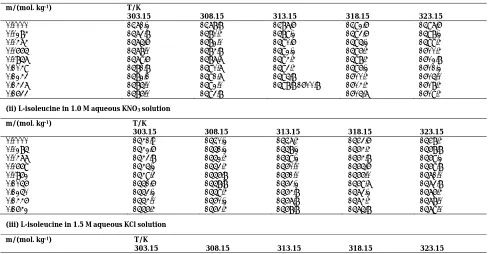
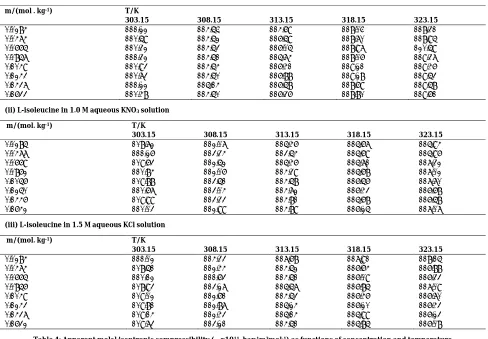
The data of the measured density (ρ) and speed of sound (u) of ternary systems (amino acid + salt + water): L-isoleucine in the three solvents: 0.5M K2SO4, 1M KNO3and 1.5M KCl solutions as functions of amino
acid concentration and temperature (303.15, 308.15, 313.15, 318.15 and 323.15 K) is given in Table 1 and 2.
Table 1: Density values (/10-3kg. m-3) as functions of concentration and temperature.
(i) L-isoleucine in 0.5 M aqueous K2SO4solution
m/(mol. kg-1) T/K
303.15 308.15 313.15 318.15 323.15
0.0000 0.0284 0.0474 0.0665 0.0857 0.1049 0.1243 0.1437 0.1633 1.0593 1.0597 1.0600 1.0603 1.0605 1.0608 1.0611 1.0613 1.0617 1.0579 1.0582 1.0584 1.0586 1.0588 1.0590 1.0592 1.0593 1.0596 1.0561 1.0564 1.0565 1.0567 1.0569 1.0570 1.0571 1.0573 1.0575 1.0542 1.0544 1.0545 1.0546 1.0547 1.0548 1.0549 1.0551 1.0552 1.0519 1.0521 1.0522 1.0523 1.0524 1.0525 1.0526 1.0527 1.0528
(ii) L-isoleucine in 1.0 M aqueous KNO3solution
m/(mol. kg-1) T/K
303.15 308.15 313.15 318.15 323.15
0.0000 0.0285 0.0477 0.0669 0.0862 0.1056 0.1250 0.1446 0.1642 1.0529 1.0534 1.0536 1.0540 1.0542 1.0546 1.0548 1.0552 1.0555 1.0511 1.0515 1.0517 1.0520 1.0523 1.0524 1.0527 1.0529 1.0532 1.0490 1.0493 1.0496 1.0497 1.0500 1.0502 1.0504 1.0506 1.0508 1.0467 1.0470 1.0472 1.0474 1.0476 1.0477 1.0479 1.0482 1.0483 1.0442 1.0445 1.0447 1.0448 1.0450 1.0451 1.0454 1.0456 1.0457
(iii) L-isoleucine in 1.5 M aqueous KCl solution
m/(mol. kg-1) T/K
303.15 308.15 313.15 318.15 323.15
0.0000 0.0285 0.0474 0.0665 0.0856 0.1049 0.1243 0.1437 0.1632 1.0614 1.0618 1.0622 1.0624 1.0628 1.0631 1.0633 1.0637 1.0639 1.0597 1.0600 1.0603 1.0606 1.0607 1.0610 1.0612 1.0615 1.0616 1.0578 1.0580 1.0583 1.0585 1.0586 1.0589 1.0590 1.0592 1.0595 1.0556 1.0558 1.0560 1.0562 1.0563 1.0565 1.0567 1.0569 1.0571 1.0533 1.0535 1.0537 1.0539 1.0540 1.0542 1.0544 1.0546 1.0548
Table 2: Ultrasonic velocity values (u/m. s-1) as functions of concentration and temperature
(i)L-isoleucine in 0.5 M aqueous K2SO4solution
m/(mol. kg-1) T/K
303.15 308.15 313.15 318.15 323.15
0.0000 0.0284 0.0474 0.0665 0.0857 0.1049 0.1243 0.1437 0.1633 1571.2 1573.8 1575.6 1578.0 1579.6 1581.8 1582.1 1585.0 1586.0 1578.8 1580.4 1582.0 1584.8 1587.7 1590.7 1591.7 1592.0 1593.8 1587.6 1589.2 1590.6 1592.2 1594.4 1593.4 1595.8 1598.8 1600.8 1592.6 1593.6 1595.2 1596.4 1598.4 1596.2 1600.4 1604.4 1605.7 1597.6 1598.2 1599.4 1600.4 1602.8 1601.2 1605.0 1608.4 1609.4
(ii) L-isoleucine in 1.0 M aqueous KNO3solution
m/(mol. kg-1) T/K
303.15 308.15 313.15 318.15 323.15
0.0000 0.0285 0.0477 0.0669 0.0862 0.1056 0.1250 0.1446 0.1642 1541.8 1542.6 1543.8 1545.2 1549.3 1551.6 1553.2 1554.0 1556.4 1550.2 1551.2 1552.4 1553.4 1556.8 1558.8 1559.4 1560.2 1563.4 1557.4 1558.2 1559.2 1560.0 1561.0 1563.2 1564.8 1567.8 1568.8 1563.6 1564.4 1564.8 1565.6 1566.0 1569.7 1573.2 1574.4 1575.8 1568.4 1568.8 1569.2 1569.8 1571.0 1573.8 1576.4 1578.0 1579.0
(iii) L-isoleucine in 1.5 M aqueous KCl solution
m/(mol. kg-1) T/K
0.0000 0.0284 0.0474 0.0665 0.0856 0.1049 0.1243 0.1437 0.1632
1584.0 1585.9 1586.2 1587.2 1588.8 1592.1 1593.3 1596.0 1598.4
1590.5 1591.5 1592.0 1593.2 1595.2 1598.5 1600.0 1600.8 1603.2
1595.8 1596.0 1596.4 1597.4 1599.4 1602.6 1604.6 1606.8 1608.2
1601.6 1602.4 1603.0 1604.4 1605.2 1606.0 1608.0 1612.0 1614.0
1606.2 1607.0 1607.8 1608.4 1609.2 1610.4 1613.5 1615.8 1618.0
Using the data of density (ρ) andspeed of sound (u), the apparent molal volume, v and apparent molal isentropic compressibility, have been calculated using the following relations:
v= (M/) – {1000 (-o)/mo [1]
k= [{1000 (κs-κo)}/mo] + κsv [2]
Where M denotes the molar mass, m is the molality and ρ and ρo
are the densities of solution and that of the solvent, respectively. The respective values of κs and κo denote the isentropic
compressibilities of solution and solvent that can be related to the density (ρ) of the solution and the speed of sound (u) according to the relation
КS=1/ρu2 [3]
The measured experimental data are correlated using the following linear functions:
v= ov + Svm [4]
k= ok + Skm [5]
Where ov and ok are infinite dilution apparent molal volume and apparent molal isentropic compressibility of the said solutions. Sv
and Sk are the slopes of the lines obtained from fitting Eqs. (4) and
(5) to the experimental data.
The apparent molal volume, v and apparent molal isentropic compressibility, k of amino acid solution with different electrolyte concentrations that are presented in Table-3 and 4
Table 3: Apparent molal volume (vx106, m3mol-1) as functions of concentration and temperature
(i) L-isoleucine in 0.5M aqueous K2SO4solution
m/(mol . kg-1) T/K
303.15 308.15 313.15 318.15 323.15
0.0284 0.0474 0.0665 0.0857 0.1049 0.1243 0.1437 0.1633
111.22 110.59 110.32 111.32 110.93 110.73 111.22 110.48
114.55 114.52 114.53 114.51 114.54 114.50 115.14 114.50
114.69 116.59 116.05 115.74 116.41 116.88 116.58 116.36
118.06 118.70 118.97 118.06 119.21 119.28 118.69 118.80
118.31 118.95 120.59 119.37 119.46 119.53 119.58 119.61
(ii) L-isoleucine in 1.0 M aqueous KNO3solution
m/(mol. kg-1) T/K
303.15 308.15 313.15 318.15 323.15
0.0285 0.0477 0.0669 0.0862 0.1056 0.1250 0.1446 0.1642
108.72 111.26 109.63 110.84 109.88 110.67 109.99 110.03
112.07 113.34 112.52 112.06 113.51 113.04 113.33 112.99
115.46 113.54 115.46 114.39 114.58 114.72 114.81 114.89
115.67 115.69 115.71 115.68 116.56 116.43 115.68 116.25
115.94 115.96 117.32 117.02 117.70 116.68 116.58 117.07
(iii) L-isoleucine in 1.5 M aqueous KCl solution
m/(mol. kg-1) T/K
303.15 308.15 313.15 318.15 323.15
0.0284 0.0474 0.0665 0.0856 0.1049 0.1243 0.1437 0.1632
111.02 108.51 110.12 108.93 109.02 109.81 109.14 109.73
114.33 112.44 111.63 113.27 112.61 112.87 112.43 113.21
117.68 114.52 114.51 115.57 114.53 115.24 115.14 114.51
117.91 116.64 116.09 116.85 116.46 116.20 115.99 115.85
118.15 116.88 116.33 117.09 116.70 116.43 116.23 116.08
Table 4: Apparent molal isentropic compressibility (kx1011, bar-1m3mol-1) as functions of concentration and temperature
(i) L-isoleucine in 0.5 M aqueous K2SO4solution
m/(mol. kg-1) T/K
0.0284 0.0474 0.0665 0.0857 0.1049 0.1243 0.1437 0.1633
-4.41 -5.46 -9.98 -7.38 -8.95 -3.16 -6.48 -4.61
14.19 9.10 -1.21 -17.89 -1.07 -0.24 -1.54 0.70
14.21 16.29 9.44 4.63 15.88 11.40 5.81 4.32
26.04 17.73 16.89 11.48 27.21 14.52 5.45 6.33
32.29 25.26 24.62 15.43 27.20 16.00 9.09 13.06
(ii) L-isoleucine in 1.0 M aqueous KNO3solution
m/(mol. kg-1) T/K
303.15 308.15 313.15 318.15 323.15
0.0285 0.0477 0.0669 0.0862 0.1056 0.1250 0.1446 0.1642
23.28 18.43 12.73 -4.10 -7.71 -6.28 -3.51 -5.70
22.27 17.85 16.35 2.02 0.77 4.20 6.54 0.83
28.10 21.88 22.82 20.56 14.34 12.37 6.30 7.53
34.74 29.38 27.09 28.05 14.37 5.19 5.58 6.17
34.69 33.36 32.43 27.76 18.25 11.34 10.09 11.31
(iii) L-isoleucine in 1.5 M aqueous KCl solution
m/(mol. kg-1) T/K
303.15 308.15 313.15 318.15 323.15
0.0284 0.0474 0.0665 0.0856 0.1049 0.1243 0.1437 0.1632
6.54 14.29 14.71 10.27 0.89 2.41 -1.85 -3.51
21.92 22.71 18.38 13.41 3.41 3.69 5.50 3.38
38.23 33.39 28.34 21.17 10.33 8.21 5.59 5.36
28.85 27.30 21.36 21.93 21.66 17.25 7.96 6.26
28.83 25.44 25.31 25.00 22.51 14.23 10.44 7.93
[
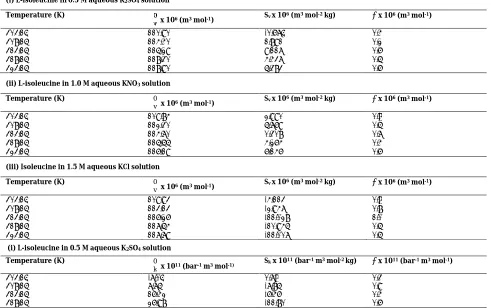
The values of the infinite dilution apparent molal volume and isentropic compressibility of L-isoleucine in K2SO4, KNO3, and KCl solutions are
presented in Table 5.
Table 5: The infinite dilution apparent molal volume and isentropic compressibility at different temperatures
(i) L-isoleucine in 0.5 M aqueous K2SO4solution
Temperature (K)
x 106(m3mol-1) Sv x 106(m3mol-2kg) x 106(m3mol-1)
303.15 308.15 313.15 318.15 323.15
110.90 114.40 115.29 118.30 118.90
-0.675 1.891 9.117 4.437 5.383
0.4 0.2 0.6 0.5 0.6
(ii) L-isoleucine in 1.0 M aqueous KNO3solution
Temperature (K)
0v x 106(m3mol-1) Sv x 106(m3mol-2kg) x 106(m3mol-1)
303.15 308.15 313.15 318.15 323.15
109.84 112.30 114.70 115.55 116.19
2.990 5.769 0.308 4.264 6.146
0.8 0.5 0.7 0.4 0.6
(iii) Isoleucine in 1.5 M aqueous KCl solution
Temperature (K) 0
v x 106(m3mol-1)
Sv x 106(m3mol-2kg) x 106(m3mol-1)
303.15 308.15 313.15 318.15 323.15
109.93 113.13 116.26 117.54 117.79
-4.113 -2.947 -11.028 -10.945 -11.007
0.8 0.8 1.0 0.5 0.5
(i) L-isoleucine in 0.5 M aqueous K2SO4solution Temperature (K)
0k x 1011(bar-1m3mol-1) Skx 1011(bar-1m3mol-2 kg) x 1011(bar-1m3mol-1)
303.15 308.15 313.15 318.15
-7.05 7.75 16.42 26.98
0.78 -7.85 -6.46 -11.80
323.15 33.91 -14.18 0.5
(ii) L-isoleucine in 1.0 M aqueous KNO3solution Temperature (K)
0k x 1011(bar-1m3mol-1) Skx 1011(bar-1m3mol-2 kg) x 1011(bar-1m3mol-1)
303.15 308.15 313.15 318.15 323.15
25.37 23.25 32.05 42.33 43.22
-22.88 -14.98 -15.94 -24.46 -21.67
0.7 0.5 0.2 0.4 0.4
(iii) L-isoleucine in 1.5 M aqueous KCl solution Temperature (K)
0k x 1011(bar-1m3mol-1) Skx 1011(bar-1m3mol-2 kg) x 1011(bar-1m3mol-1)
303.15 308.15 313.15 318.15 323.15
17.14 27.47 44.80 34.87 35.15
-12.22 -16.67 -27.20 -16.55 -15.91
0.5 0.4 0.5 0.3 0.3
These properties are important because at infinite dilution the interactions between the amino acid molecules are negligible and these properties solely reflect the interactions between the amino acid molecules and the mixed solvent.
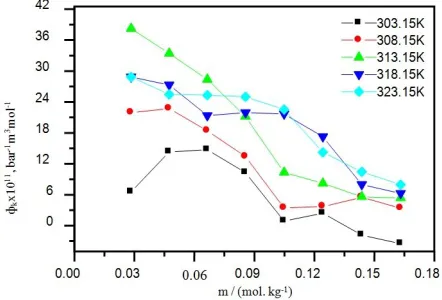
Fig. 1-2: Depict the experimental results of the effect of the L-isoleucine concentrations on their apparent molar volumes and isentropic compressibilities in KCl solution
Fig. 1: Plots of apparent molal volume versus concentration of L-isoleucine in 1.5M aqueous KCl solution. At 303.15 K, 308.15 K, 313.15 K, 313.15 K, 318.15 K, 323.15 K
Fig. 2: Plots of apparent molal isentropic compressibility versus concentration of L-isoleucine in 1.5M aqueous KCl solution. At 303.15 K, 308.15 K, 313.15 K, 313.15 K, 318.15 K, 323.15 K
The solid lines are the results of the correlation obtained from Eqs. (4) and (5) with the parameters listed in table 5. The plots of v with solute concentration exhibit apparently linear behavior as can be seen from the figures. An examination of the table 5 reveals that the partial molal volume and partial molal isentropic compressibility values of the said amino acid in aqueous electrolyte solutions at each temperature are higher than the corresponding values in aqueous
may be attributed to volume expansion of hydrated zwitter-ions of amino acid. It is noteworthy that the ov values in L-isoleucine-aqueous K2SO4, KNO3, and KCl solutions have been found to be
107.54, 106.31, and 107.39, respectively at 298.15 K while in aqueous medium it is found to be 105.80 cm3/mol 24. Franks et al.25
have shown that the partial molal volume of a non-electrolyte is a combination of two factors, viz., the intrinsic volume of solute and the volume changes due to its interactions with solvent. The intrinsic volume has been considered to be made up of two types of contributions 26, 27
Vintrinsic= Vvw+ Vvoid [6]
Where Vvwis Van der Waals volume 28, 29, and Vvoidis the volume
associated with the voids or empty spaces present therein30.
Shahidi et al.27have modified the above equation in order
to evaluate the contribution of a solute molecule towards its partial molal volume as,
0
v = Vw+ Vvoid– n s [7]
Wheresis the shrinkage in volume produced by the interactions of hydrogen bonding groups present in the solute with water molecules and n is the potential number of hydrogen bonding sites in the molecule. For electrolytes and zwitter-ionic solutes, the shrinkage is caused by electrostriction and therefore the 0v of an amino acid can be evaluated by employing the relation,
0
v = Vvw+ Vvoid– Vshrinkage . [8]
It may be assumed that Vvwand Vvoidhave the same magnitude in
water and in mixed solvent for the same class of compounds 26.
The slope, Svis a measure of solute-solute interactions. The values
have been found to be positive for all the systems under investigation. The positive values of Svindicate the stronger zwitter-ion-zwitter-ion
and ion-ion interactions than those of apolar-apolar interactions. It has been observed that the apparent isentropic compressibility values for the said amino acid are negative in all aqueous electrolyte solutions. The values show irregular trend of variations with temperature as well as with concentration. The negative k values exhibit strong interactions between the solute and solvent. The ion-zwitter-ion interactions seem stronger than ion-hydrophobic interactions in
systems under investigation. The ok values are positive of smaller magnitude. These values apparently indicate a larger ordering effect of the solute molecules on those of the solvent. The values of Skare found
to be negative, which suggest the presence of essentially weak solute-solute interactions.
CONCLUSION
Finally an examination of the above computed parameters reveals that there is a significant increase in the values of ρ andu with successive increase in the concentration of amino acids and such values gives a better understanding of solute and
solute-solvent intermolecular/ interionic interactions. The partial molal volume and partial molal isentropic compressibility values of the said amino acid in aqueous electrolyte solutions at each temperature are higher than the corresponding values in aqueous medium. At infinite dilution the interactions between the amino acid molecules are negligible and these properties solely reflect the interactions between the amino acid molecules and the mixed solvent.
REFERENCES
1. J. A. Nevines and T. M. Letcher, J. Chem. Thermodyn. 7, 1083 (2003).
2. M. S. Lampreias, F. A. Dias, and A. F. S. S. Mendonca, Phys. Chem. Chem. Phys. 5, 4869 (2003).
3. G. Douheret, M. I. Davis, J. C. R. Reis, I. J. Fjellanger, M. B. Vaage, and H. Hoiland, Phys. Chem. Chem. Phys. 4, 6034 (2002). 4. K. B. Belibagli and E. Ayranci, J. Solution Chem. 19, 867
(1990).
5. R. K. Wadi and R. K. Goyal, J. Solution Chem. 21, 163 (1992). 6. J. Wang, Z. Yan, K. Zhuo and J. Lu, Biophys. Chem. 80, 179
(1999).
7. S. K. Singh and N. Kishore, J. Solution Chem. 32,117 (2003). 8. T. Ogawa, K. Mizutani and M. Yasuda, Bull. Chem. Soc. Jpn. 57,
2064 (1984).
9. D. Kumar, Can. J. Chem. 77, 1288 (1999).
10. T. S. Banipal, D. Kaur and P. K. Banipal, J. Chem. Eng. Data 49, 1236 (2004).
11. B. S. Lark, P. Patyar, T. S. Banipal and N. Kishore, J. Chem. Eng. Data 49,553 (2004).
12. M. Natarajan, R. K. Wadi and H. C. Gaur, J. Chem. Eng. Data 35, 87 (1990).
13. D. Kumar, J. Indian Chem. Soc. 74, 610 (1997).
14. S. Thirumaran and K. Job Sabu, Journal of Applied Sciences 11, 3258 (2011).
15. F. J. Millero, A. L. Surdo and C. Shin, J. Phys. Chem. 82, 784 (1978).
16. S. Cabani, G. Conti, E. Matteoli and M.R. Tine, J. Chem. Soc. Faraday Trans. I 77, 2377 (1981).
17. H. Hoiland, J. Solution Chem. 9, 857 (1980).
18. J. V. Leyendekkers, J. Chem. Soc. Faraday Trans. I 84, 397 (1988). 19. Riyazuddeen and R. Basharat, J. Chem Thermodyn.38, 1684
(2006).
20. S. Islam and B. N. Waris, Thermchim. Acta 165,424 (2004). 21. Del Grosso and C. W. Mader, J. Acoust. Soc. Am. 52, 1442
(1972).
22. Kell, J. Chem. Eng. Data 20, 97 (1975).
23. P. Sarvazyan, D. P. Kharakoz and P. Hemmas, J. Phys. Chem. 83, 1796 (1979).
24. K. Mishra and J. C. Ahluwalia, J. Phys. Chem. 88, 86 (1984). 25. F. Franks, M. A. Quickenden, D. S. Reid and I. D. Watson, Trans.
Faraday Soc.66, 582 (1970).
26. S. Terasaewa, H. Itsuki and Arakawa, J. Phys. Chem. 79, 2345 (1975).
27. F. Shahidi, P. G. Farrell and J. T. Edwards, J. Solution Chem.5, 807 (1976).
28. Bondi, J. Phys. Chem. 68, 441 (1964).
29. Bondi in “Physical Properties of Molecular Crystals, Liquids and Glasses”, New York, (1968), c.14