S T U D Y P R O T O C O L
Open Access
A comparison of the effects of oral vs.
intravenous hydration on subclinical acute
kidney injury in living kidney donors: a
protocol of a randomised controlled trial
Shona Mackinnon
1,2*, Emma Aitken
1, Ryan Ghita
1and Marc Clancy
1Abstract
Background:Optimal treatment for established renal failure is living donor kidney transplantation. However this pathway exposes healthy individuals to significant reduction in nephron mass via major surgical procedure. Laparoscopic donor nephrectomy is now the most common method for live donor transplantation, reducing both donor post-operative pain and recovery time. However this procedure exposes kidneys to additional
haemodynamic stresses. It has been suggested that donor hydration—particularly the use of preoperative intravenous fluids—may counteract these stresses, reducing subclinical acute kidney injury and ultimately improving long-term renal function. This may be important in both preservation of donor renal function and recipient graft longevity.
Methods/Design:A prospective single-centre single-blinded randomized controlled trial will be carried out to determine the effects of donor preoperative intravenous fluids. The primary outcome is donor subclinical acute kidney injury (defined as plasma NGAL, >153 ng/ml) on day 1 postoperatively. Secondary outcomes include intraoperative haemodynamics, recipient subclinical acute kidney injury, perioperative complications and donor sleep quality.
Donors will be randomised into two groups: the intervention group will receive active pre-hydration consisting of three litres of intravenous Hartmann’s solution between midnight and 8 am before morning kidney donation, while the control group will not receive this. Both groups will receive unlimited oral fluids until midnight, as is routine. Plasma NGAL will be measured at pre-specified perioperative time points, intraoperative haemodynamic data will be collected using non-invasive cardiac output monitoring and clinical notes will be used to obtain demographic and clinical data. The researcher will be blinded to the donor fluid hydration status. Blinded statistical analysis will be performed on an intention-to-treat basis. A prospective power calculation estimates a required sample size of 86 patients.
Discussion:This study will provide important data, as there is currently little evidence about the use of donor preoperative fluids in laparoscopic nephrectomy. It is hoped that the results obtained will guide future clinical practice.
(Continued on next page)
* Correspondence:[email protected]
1Department of Renal Transplantation, Queen Elizabeth University Hospital, 1345 Govan Road, Glasgow G51 4TF, UK
2College of Medical, Veterinary and Life Sciences, Wolfson Medical School Building, University of Glasgow, University Avenue, Glasgow G12 8QQ, UK
(Continued from previous page)
Trial registration:This study has been approved by the West of Scotland Research Ethics Committee 3 (reference no. 14/WS/1160, 27 January 2015) and is registered with the International Standard Randomised Controlled Trial Number Register (reference no. ISRCTN10199225, 20 April 2015).
Keywords:Acute kidney injury, Hemodynamics, Kidney transplantation, Laparoscopy, Lipocalins, Living donors, Nephrectomy
Background
Chronic Kidney Disease and Renal Transplant
Chronic kidney disease (CKD) has an estimated prevalence of 8.5% in the UK adult population [1]. A small but signifi-cant proportion of patients develop end stage renal disease (ESRD) [2]—irreversibly reduced renal function where renal replacement therapy, either dialysis or transplant, is required for survival [3–5]. Currently around 4800 patients in Scotland are on some form of renal replacement therapy, with over 50% of these patients having received a renal transplant [6].
Renal transplantation is associated with increased life expectancy and quality of life compared to dialysis and so should be considered in all patients with ESRD [7, 8]. However, there is an intense kidney shortage (the average UK renal transplant waiting time for a cadaveric kidney is 3–4 years [9]). Almost 300 people die in the UK each year while waiting for a kidney transplant, and many more are removed from the waiting list, having become too ill for a transplant [10]. Therefore, everything possible must be done to maximise renal transplant benefit, particularly the benefit of living donation which is associated with super-ior graft and patient survival [11].
The price of better recipient outcomes with living kidney donation is some associated additional donor risk [12]. Earlier studies suggested that kidney donation does not affect mortality [13] but a recent prospective observational study by Mjøen et al. [14], comparing kidney donors with carefully matched controls and longer follow-up periods found kidney donation to be associated with a 30% increase in the relative risk of all-cause mortality over a long follow up period (more than 20 years). Furthermore, Muzaale et al. [15] estimated the lifetime risk of ESRD to be 0.9% in liv-ing kidney donors, compared with 0.14% in healthy non-donors. Ethically everything possible must be done to pre-serve renal function in this group, who are undertaking these risks for no personal health benefit.
Pneumoperitoneum, Renal Perfusion and Subclinical Acute Kidney Injury
First carried out in 1995, laparoscopic nephrectomy is now widespread and has resulted in increasing live donor transplantation [16]. Despite reducing post-operative pain and speeding up recovery, the tech-nique exposes the kidney to theoretical additional
haemodynamic stresses of extremes of posture for op-timal access and pneumoperitoneum [17].
The effect of increased intra-abdominal pressure is well characterized in abdominal compartment syndro-me—organ dysfunction secondary to intra-abdominal hypertension, defined as≥12 mm Hg [18]. Pneumoperi-toneum usually uses pressures of between 12–15 mmHg. The kidneys are particularly sensitive to haemodynamic changes [19]. Studies have shown a decrease in renal blood flow and renal function associated with pneumo-peritoneum, though as renal function returns to normal afterwards this phenomenon has been deemed of “ un-certain clinical significance” [20, 21]. Indeed a recent Cochrane review found no difference in kidney function in open vs laparoscopic nephrectomy at 1 year [22].
This may reflect the fact that the kidneys have a large reserve, with approximately 50% of renal parenchyma compromise needed to see changes in eGFR. Therefore, even if renal damage has taken place, it may not be de-tectable by these functional measures. There is a new and emerging concept of subclinical acute kidney injur-y—injury not detected by functional criteria, but through measurement of biomarkers associated with tubular necrosis [23].
NGAL as a Biomarker of Subclinical Acute Kidney Injury NGAL is a small 25 kDa protein of the lipocalin family, and was first identified by transcriptome analysis of the murine model, investigating the early induction of gene expression after renal ischaemia. Its expression was found to be upregulated in tubular cells after ischaemic injury [24]. NGAL levels have been shown to increase in both blood and urine in response to subclinical acute kidney injury [23, 25].
There has been wide variation in reports of the diag-nostic accuracy of NGAL, including variation in the specificities reported. This may be in part as a result of the different populations studied. NGAL is also pro-duced by activated neutrophils and therefore may be raised in infection or inflammation [24, 25]. Plasma NGAL levels have been shown to be raised in septic ICU patients without acute kidney injury, and therefore plasma NGAL should be used with caution in this popu-lation [27]. As our popupopu-lation of interest is healthy, stud-ies looking at populations outside a critical care setting are likely to be more generalizable to our population.
Other studies, using the point of care Triage® NGAL Device, have demonstrated superior diagnostic accur-acies. For example, 2-h plasma NGAL measurement of 120 children who underwent cardiopulmonary by-pass obtained AUC of 0.96 and the same AKI threshold of 150 ng/ml yielded a sensitivity 0.84 and specificity of 0.94 [28]. Several other studies have also confirmed the usefulness of these bedside NGAL assays in the clinical setting [29]. Therefore, conclusions drawn from previous studies support the diagnostic accuracy of this method.
In the living donor population, Yoon et al. demon-strated that perioperative plasma NGAL in living donors correlates with 6 month donor eGFR. This correlation was found to be strongest using plasma NGAL at 1 week post-operatively, but a correlation was found at all time points [30].
Pilot Data
Pilot data obtained at our study centre involving 20 do-nors indicate that hand-assisted laparoscopic nephrec-tomy is associated with significant subclinical acute kidney injury, defined as plasma NGAL >153 ng/ml, and that preoperative fluids may reduce the incidence of this. In a non-randomised pilot series, where fluids were ad-ministered as per surgeon preference, there was found to be an incidence of subclinical acute kidney injury of approximately 50% in patients receiving <1000 ml of intravenous fluids compared with a 20% incidence in those receiving >2500 ml of intravenous fluids. An in-verse correlation between increase in NGAL and post donation eGFR at 6 weeks was also demonstrated [31].
The risk of subclinical acute kidney injury has been demonstrated by Hasse et al. who analysed pooled data from ten prospective observational studies, in-volving over 2000 patients with cardiorenal syndrome type 1. Subclinical acute kidney injury detected by NGAL was found to increase the risk of adverse out-comes, such as need for renal replacement therapy, hospital mortality, and duration of hospital stay, even in the absence of a diagnostically significant increase in serum creatinine [32].
Any decrease in subclinical acute kidney injury is therefore likely to be beneficial. In the long term, it may result in a small increase in GFR, which may be benefi-cial for the remaining donor function, and reduced haemodynamic stress on the donated kidney may poten-tially result in greater longevity of the allograft. There-fore optimisation of perioperative fluid management is likely to have a protective role.
Fluids in Transplant Optimization
There is some controversy surrounding perioperative fluid administration, and optimal fluid balance. The risks of restrictive fluid administration include inadequate organ perfusion and post-operative nausea, whereas lib-eral fluid use may increase the risk of prolonged post-operative ileus, poor wound healing and the potential for fluid overload leading to heart failure [33, 34].
There have been variable findings in this field, with some studies demonstrating benefit from liberal fluid ad-ministration [35–37], and others demonstrating either deleterious effects or no difference in outcome [38]. There is some suggestion that in “low-risk” patients undergoing mild to moderate surgery, a high-volume fluid strategy is superior [39].
Our donor study population is a very healthy one, and all perioperative complications will be closely monitored for and reported.
Potential mechanisms behind attenuation of subclin-ical acute kidney injury using preoperative fluids are that optimal hydration results in increased renal venous and arteriolar filling, preventing collapse and congestion. Also, increased inferior vena cava pressure may prevent reduced venous return during pneumoperitoneum, maintaining cardiac output. These mechanisms may also reduce vasoconstriction caused by activation of the renin-angiotensin-aldosterone system [40].
We have chosen to use Hartmann’s solution (com-pound sodium lactate) preoperatively. This contains the following electrolyte concentrations: Na+131 mmol/L, K
+
5 mmol/L, HCO3− 29 mmol/L, Cl− 111 mmol/L and
Ca2 2 mmol/L [41]. Although there is some concern about the possibility of chloride increasing the incidence of AKI, Hartmann’s solution is considered to be a chloride-restrictive intravenous fluid [42].
As discussed, existing studies used functional criteria, such as serum creatinine, which detect only damage ex-tensive enough to cause immediate functional changes, and any subtle effects present may be masked by the overwhelming effect of nephrectomy and subsequent compensatory renal hypertrophy (CRH). There is there-fore currently a lack of evidence about preoperative fluids in laparoscopic nephrectomy, and significant vari-ation in clinical practice. This study aims to address this.
Methods
Study Aims and Hypothesis
This study hypothesis is that the use of preoperative intravenous Hartmann’s solution will result in a decrease in donor subclinical acute kidney injury, defined as plasma NGAL >153 ng/ml.
The primary aim of this study is to determine whether preoperative intravenous fluids result in a decrease in donor subclinical acute kidney injury. The secondary aims include investigating the effects of fluids on various donor and recipient clinical and biochemical outcomes, listed below.
Study Design
This study proposes that donors will be randomised to one of two groups: one group will receive active pre-hydration with three litres of intravenous Hartmann’s solution between midnight and 8 am before morning do-nation with unlimited oral fluid as desired, while the other group will receive just unlimited oral fluids until midnight.
Primary Outcome
The primary outcome will be the incidence of donor acute kidney injury (as defined by plasma NGAL >153 ng/ml) on day 1 post-operatively.
Secondary Outcomes
Day 1 change in donor plasma NGAL from baseline
Donor renal function (serum creatinine and eGFR)
day 1–4, week 6 and 1 year, as is standard procedure
Donor BNP changes
Recipient change in plasma NGAL from baseline
Recipient serum creatinine and eGFR at 6 weeks and
1 year
Delayed graft function (DGF)—defined as use of
dialysis in the first week postoperatively
1 year graft and patient survival in recipient
Donor intraoperative haemodynamics, including
blood pressure, heart rate, stroke volume index, cardiac index and systemic vascular resistance index (collected from non-invasive cardiac output
monitor).
NGAL levels in blood obtained from renal vein
during retrieval and implantation surgery
Donor and recipient perioperative mortality
Donor perioperative fluid balance
Donor fluid boluses and response to fluid challenge.
Donor and recipient perioperative complications
(including cardiorespiratory complications, time to first bowel motion, infective complications, length of hospital stay, readmission)
Donor sleep quality, assessed using the Richards–
Campbell Sleep Questionnaire [45]
Inclusion criteria
Adult patients aged >18 years of age. undergoing live
donor hand-assisted laparoscopic nephrectomy eligible to participate
Consent to participate given
English-speaking or appropriate translation facilities
to allow for consent to be valid
Laparoscopic nephrectomy taking place at the study
site
Transplant taking place between dates of the trial.
Exclusion criteria
Patients undergoing open nephrectomy
Patient unable or unwilling to consent
Power Calculation to Determine Sample Size
Based on the observational pilot data discussed above, which demonstrated a 50% incidence of day 1 subclinical acute kidney injury in patients receiving <1000 ml of intravenous fluids and a 20% incidence of acute kidney injury (AKI) in patients receiving >2500 ml of intraven-ous fluids, we anticipate that 39 patients would be re-quired in each arm to detect a similar magnitude of difference with 80% power and a significance level of 0.05. Allowing for 10% attrition, we intend to recruit a total of 86 patients.
Patient Recruitment and Consent
Patients who fit the stated inclusion and exclusion cri-teria will be identified at the time of allocation of a date for surgery. The recruitment process will involve ap-proaching potential participants prior to surgery, and obtaining written consent upon hospital admission [Fig. 1].
Randomisation and study groups
envelopes. Allocation to treatment arms will be per-formed by a member of the research team on the day prior to surgery, after the patient has provided valid written consent.
Blinding
This sort of intervention means that blinding of patients and clinicians is not feasible. Therefore a single-blind approach is being used, where the researcher will be blinded to the fluid hydration status of the patient at the time of data collection.
Intervention Group
The evening prior to surgery (day-1), between midnight and 8 am, patients in the intervention group will receive three litres of IV Hartmann’s solution. Patients in this group will also be admitted on the evening prior to sur-gery (day −1) but will not be given intravenous fluids. Both will receive unrestricted oral fluids in line with the European Society of Anaesthesiology perioperative fast-ing guidelines and will be encouraged to drink freely. It will be ensured that both groups have ready and equal access to unrestricted oral fluids, and any oral and intra-venous fluid intake will be recorded via routine fluid charts.
Pre-operative management
All patients will be admitted on the afternoon prior to surgery as is routine practice and receive entirely stand-ard care in all ways other than the different pre-surgical fluid regimes indicated in this protocol.
Intra-operative management
All patients will receive standard anaesthetic care and monitoring. Additionally, in order to obtain key haemo-dynamic measurements, such as cardiac index (CI), sys-temic vascular resistance index (SVRI) and stroke volume index (SVI) measurements, the use of a non-invasive cardiac output monitor will be required. The NICCOMO™ bioimpedance system (Medis, Germany) will be used—a novel and totally non-invasive monitor which employs impedance cardiography to measure car-diac output. It does so by measuring electrical signals produced by changes in the volume and velocity of the blood in the thoracic aorta. This NICCOMO system is complemented by another device—the CNAP™ Monitor 500 (CNSystems, Austria). The CNAP Monitor employs the volume-clamp method of Penaz to measure non-invasive arterial blood pressure continuously via two small inflatable cuffs applied to the fingers of one hand. The cardiac output monitor will be attached to the
Identification of a donor undergoing laparoscopic nephrectomy who fits the stated inclusion and exclusion criteria.
A letter sent to the patients, explaining the purpose of the study and containing the relevant Participant Information Sheet (PIS).
Personal communication of study details by a member of the research team prior to admission for surgery plus provision of PIS.
On admission for surgery, a member of the research team will review the details of the study with the patient and what participation would involve.
The Participant Information Sheets will be reviewed and discussed with the patients.
After the patients have had sufficient time to consider participation in the study, a member of the research team will ensure they understand what the study involves and answer any questions, allowing extra time for questions if needed.
If the patients consent to participate in the study, this will be documented using the Donor and Recipient consent forms respectively.
patient shortly after the induction of anaesthesia and will remain in situ throughout the surgical procedure. It will be removed at the end of the operation before the pa-tient is transferred to the recovery room. The anaesthe-tist will be blinded to the results of the cardiac output monitor.
The cardiovascular response to a single 500 ml fluid challenge will be assessed following the induction to an-aesthesia. Cardiovascular parameters with be recorded, then a“stat” 500 ml fluid challenge will be administered and cardiovascular parameters recorded again. Again, the anaesthetist will be blinded to the results of this challenge.
Additionally a single 5 ml sample of venous blood will be obtained from the donor renal vein immediately after retrieval and immediately after implantation to assess the immediate impact on biomarkers of AKI.
Postoperative management
After surgery, patients will be taken to the recovery room and monitored according to standard hospital pol-icy before return to the transplant ward for post-operative care.
Patients will receive their normal medications prior to surgery unless otherwise directed by the anaesthetist.
Criteria for discontinuation
Every effort will be made to retain patients in the trial and to minimise withdrawals. Patients with capacity to consent may request to be withdrawn from this study at any time. If the patient develops a severe or life-threatening condition and loses capacity, continued consent will be presumed unless it is deemed that con-tinuation of the trial will result in an adverse outcome for the patient. This is because follow-up of patients who have complications is particularly important for this trial, as it is examining the effect that preoperative intra-venous fluid has on these.
In patients who do withdraw from the study, reasons for withdrawal will be documented. All data accumu-lated up to the time of withdrawal will be retained and included in subsequent statistical analyses.
Study Centre
The study will be conducted solely within the West of Scotland Renal Transplant Unit. Follow-up will be under-taken in out-patient clinics throughout NHS Greater Glasgow and Clyde by the Renal Transplantation Team.
Data Collection
Data will be obtained from the ward observation and fluid charts, anaesthetic record, recovery room observa-tion chart, laboratory and bedside blood test results, in-traoperative data collection and clinical review in the
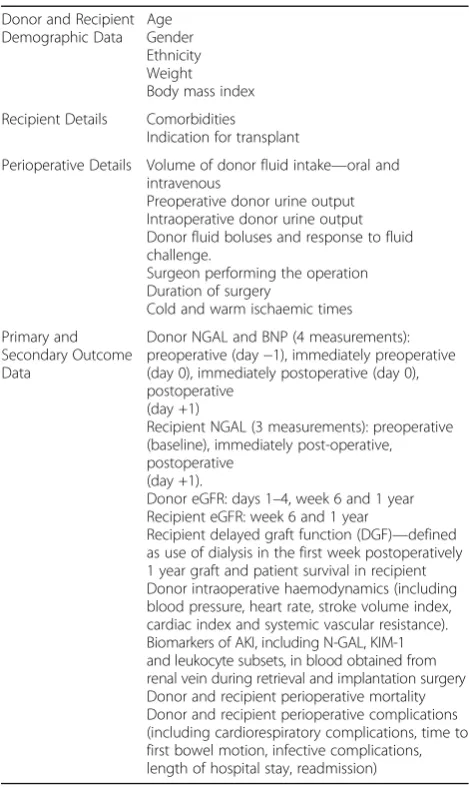
post-operative period. To avoid any bias, the outcome assessor will be blinded to the fluid hydration that the patient received. The data that will be collected includes demographic data, patient details, perioperative details and primary and secondary outcome data [Table 1].
Data Management
Data will be entered on a patient-by-patient basis into a computerised password-protected database on a com-puter within the Department of Renal Transplantation by an investigator blinded to the study group allocation. Patients will be identified by their study number only. After data analysis has been performed, it will be com-bined with the randomisation code and the nature of each patient’s perioperative fluid regimen will be re-vealed. This will be performed in accordance with the Data Protection Act. A case report file will be created for each patient. These will be archived in a locked facil-ity and kept for a period of 3 years.
Table 1Data to be collected
Donor and Recipient Demographic Data
Age Gender Ethnicity Weight Body mass index Recipient Details Comorbidities
Indication for transplant
Perioperative Details Volume of donor fluid intake—oral and intravenous
Preoperative donor urine output Intraoperative donor urine output Donor fluid boluses and response to fluid challenge.
Surgeon performing the operation Duration of surgery
Cold and warm ischaemic times Primary and
Secondary Outcome Data
Donor NGAL and BNP (4 measurements): preoperative (day−1), immediately preoperative (day 0), immediately postoperative (day 0), postoperative
(day +1)
Recipient NGAL (3 measurements): preoperative (baseline), immediately post-operative, postoperative
(day +1).
Donor eGFR: days 1–4, week 6 and 1 year Recipient eGFR: week 6 and 1 year
Statistical Analysis
Descriptive statistics will be used to describe continuous variables. Results for continuous variables will be re-ported as mean (+/− standard deviation) or median (interquartile range). The primary outcome, proportion of patients in each group with subclinical acute kidney injury, will be compared using a chi-square test and 95% confidence intervals for the difference in proportions.
If the data for continuous variables follow a Normal distribution, the variables will be compared using a Student’st-test. If data are found to not be Normally dis-tributed, a Mann WhitneyU-test will be used. Analysis will be performed on an intention-to-treat basis.
Study reporting will be in accordance with the CON-SORT guidelines.
Discussion
As there is currently relatively little data about preopera-tive fluid use in laparoscopic donor nephrectomy, it is hoped that this study will provide important clinical information. Prior to this study, trials looking at pre-operative fluids have shown a beneficial effect on intra-operative haemodynamics. In this study, plasma NGAL will be used to determine whether this effect translates to a reduction in subclinical acute kidney injury, which may be of benefit for both the donor and the recipient.
In terms of the volume of intravenous fluid adminis-tration, Mertens zur Borg et al. based the volume of fluid administered on ideal body weight [44]. Though this is a useful approach in terms of monitoring the rela-tive effects of fluid on patient physiology, it was decided that in this study a pragmatic approach to this would be the most feasible option. As approximately 3 L of intra-venous fluid has been administered preoperatively previ-ously, it was decided that this volume would be used. This is useful both in terms of facilitating adherence to the protocol and in terms of potential future clinical utility, as it would be more easily reproduced in future clinical practice, should any clinical benefit be found.
It is hoped that, whatever the findings of the study, the results will be of real clinical relevance. If preoperative intravenous fluids are found to be of benefit, then this could lead to their widespread use in clinical practice. If, however, no difference is found between the groups, then live donors may not need be admitted to hospital until the morning of the surgery which would mean greater patient convenience and reduced costs.
Abbreviations
AKI:Acute kidney injury; CI: Cardiac index; CKD: Chronic kidney disease; CRH: Compensatory renal hypertrophy; DGF: Delayed graft function; eGFR: Estimated glomerular filtration rate; ESRD: End stage renal disease; IAH: Intra-abdominal hypertension; NGAL: Neutrophil-gelatinase associated lipocalin; SVI: Stroke volume index; SVRI: Systemic vascular resistance index
Acknowledgements
We are grateful to David Young, University of Strathclyde, for his statistical advice and Julie Glen and Loraine Lawson, the renal transplant co-ordinators.
Availability of data and materials
Not applicable.
Authors’contributions
SM wrote this manuscript. MC devised the concept and is responsible for oversight of the trial. SM and EA wrote original protocol. SM and RG are responsible for the day-to-day running of the trial. All authors have read, approved and contributed to the final manuscript.
Competing interests
The authors do not declare any competing interests.
Consent for publication
Not applicable.
Ethics approval and consent to participate
This is a prospective, single-centre, single-blinded, randomized controlled trial. This study has been approved by the West of Scotland Research Ethics Committee 3 (reference no. 14/WS/1160, 27 January 2015) and is registered with the International Standard Randomised Controlled Trial Number Register (reference no. ISRCTN10199225, 20 April 2015). This study will be performed in keeping with the requirements of the Declaration of Helsinki.
Received: 5 November 2015 Accepted: 11 January 2017
References
1. Stevens PE, O’Donoghue DJ, de Lusignan S, et al. Chronic kidney disease management in the United Kingdom: NEOERICA project. Kidney Int. 2007;72(1):92–9. 2. Levey AS, and Coresh J. Chronic kidney disease. Lancet. 2012; doi:10.1016/
S0140-6736(11)60178-5.
3. Scottish Intercollegiate Guidelines Network (SIGN). Diagnosis and management of chronic kidney disease. 2008.
4. Moss AH, Ganjoo J, Sharma S, et al. Utility of the“surprise”question to identify dialysis patients with high mortality. Clin J Am Soc Nephrol. 2008; doi:10.2215/CJN.00940208.
5. Thiruchelvam PT, Willicombe M, Hakim N, et al. Renal transplantation. BMJ. 2011; doi: 10.1136/bmj.d7300.
6. NHS Scottish Renal Association .Scottish Renal Registry Report. 2014. http:// www.srr.scot.nhs.uk/Publications/docs/scottish-renal-registry-report-2014-web.pdf?3. Accessed 19 Oct 2015.
7. National Institute of Health and Clinical Excellence (NICE). Chronic Kidney Disease: Early identification and management of chronic kidney disease in adults in primary and secondary care. 2008.
8. Karam G, Kälble T, Alcaraz A, Aki F T, Budde K, Humke U et al. Guidelines on Renal Transplantation. Eur Assoc Urol. 2014. Available from: https://uroweb. org/wp-content/uploads/27-Renal-Transplant_LRV2-May-13th-2014.pdf. Accessed 12 Jan 2017.
9. Kidney Research UK. Kidney Transplantation. 2013. https://www.kidneyresearchuk. org/health-information/kidney-transplantation. Accessed 12 Jan 2017. 10. Wheldon A. Kidney transplant waiting list falls, but many families still saying
no to donation. Kidney Research UK. 2016. Available from: https://www. kidneyresearchuk.org/news/kidney-transplant-waiting-list-falls-but-many-families-still-saying-no-to-donation. Accessed 12 Jan 2017.
11. Lohdi S, and Meir-Kersche HU. Kidney allograft survival: the long and short of it. Nephrol Dial Transplant. 2011; doi:10.1093/ndt/gfq730.
12. Matas AJ, Payne WD, Sutherland DER, et al. 2,500 living donor kidney transplants: a single-center experience. Ann Surg. 2001;234(2):149–64. 13. Hartmann A, et al. The risk of living kidney donation. Nephrol Dial
Transplant. 2003; doi: 10.1093/ndt/gfg069.
14. Mjøen G, Hallan S, and Hartmann A. Long-term risks for kidney donors. Kidney Int. 2014; doi:10.1038/ki.2013.460.
15. Muzaale AD, Massie AB, Wang MC, et al. Risk of end-stage renal disease following live kidney donation. J Am Med Assoc. 2014;311:579e86. doi:10. 1001/jama.2013.285141.
17. Grabowski J, and Talamini A. Physiological effects of pneumoperitoneum. J Gastrointestinal Surg. 2009; doi:10.1007/s11605-008-0662-0.
18. Matthew D, et al. Abdominal compartment syndrome and acute kidney injury due to excessive auto–positive end-expiratory pressure. Am J Kidney Dis. 2012; doi:10.1053/j.ajkd.2012.06.030.
19. Aitken E, et al. Observational study of intra-abdominal pressure monitoring in acute pancreatitis. Surgery. 2014;155(5):910–8.
20. Demyttenaere S, Feldman LS, and Fried GM. Effect of pneumoperitoneum on renal perfusion and function: A systematic review. Surg Endosc. 2007; doi: 10.1007/s00464-006-0250-x.
21. Hazebroek EJ, Gommers D, Schreve MA, et al. Impact of intraoperative donor management on short-term renal function after laparoscopic donor nephrectomy. Ann Surg. 2002;236(1):127–32.
22. Wilson CH, Sanni A, Rix DA, and Soomro NA. Laparoscopic versus open nephrectomy for live kidney donors. Cochrane Database Syst Rev. 2011; doi: 10.1002/14651858.CD006124.pub2.
23. Bolignano D, Donato V, Coppolino G, et al. Neutrophil-gelatinase associated lipocalin (N-GAL) as a marker of kidney damage. Am J Kidney Dis. 2008;52:595.
24. Mishra J, Ma Q, Prada A, et al. Identification of neutrophil gelatinase-associated lipocalin as a novel early urinary biomarker for ischemic renal injury. J Am Soc Nephrol. 2003;14(10):2534–43.
25. Schmidt-Ott KM. Neutrophil gelatinase-associated lipocalin as a biomarker of acute kidney injury––where do we stand today? Nephrol Dial Transplant. 2011;26(3):762–4.
26. Triage CardioRenal Panel Product Insert, Alere, San Diego, 2014. Available from: https://sdmctrlprod.biosite.com/mc/main/mastercontrol/vault/view_pdf.cfm?ui= 011617095217&infocardID=A78B0C920AB8404CFD. Accessed 16 Jan 2017. 27. Aydoğdu M, Gürsel G, Sancak B, et al. The use of plasma and urine Neutrophil
Gelatinase Associated Lipocalin (NGAL) and cystatin C in early diagnosis of septic acute kidney injury in critically ill patients. Dis Markers. 2013;34(4):237–46. 28. Dent CL, Ma Q, Dastrala S, et al. Plasma neutrophil gelatinase-associated lipocalin
predicts acute kidney injury, morbidity and mortality after pediatric cardiac surgery: a prospective uncontrolled cohort study. Crit Care. 2007;11(6):R127. 29. Devarajan P. Neutrophil gelatinase-associated lipocalin: a promising biomarker
for human acute kidney injury. Biomark Med. 2010; doi: 10.2217/bmm.10.12. 30. Yoon YE, Cho Y, Kim SY, et al. Plasma neutrophil gelatinase-associated
lipoprotein in living kidney donors. Transplant Proc. 2016;48(3):738–41. doi:10.1016/j.transproceed.2015.12.094.
31. Aitken E, et al. Neutrophil-gelatinase associated lipocalin (N-GAL) to assess perioperative acute kidney injury in hand-assisted laparoscopic donor nephrectomy: A pilot study. BANTAO. (In Press).
32. Haase M, Devarajan P, Haase-Fielitz A, et al. The outcome of Neutrophil Gelatinase-Associated Lipocalin (NGAL)-positive subclinical acute kidney injury: a multicenter pooled analysis of prospective studies. J Am Coll Cardiol. 2011;57(17):1752–61.
33. Holte K, Sharrock NE, Kehlet H. Pathophysiology and clinical implications of perioperative fluid excess. Br J Anaesth. 2002;89(4):622–32.
34. Bamboat ZM, Bordeianou L. Perioperative management and anesthesia. Clin Colon Rectal Surg. 2009;22(1):28–33.
35. Maharaj CH, Kallam SR, Malik A, et al. Preoperative intravenous fluid therapy decreases postoperative nausea and pain in high risk patients. Anesth Analg. 2005;100:675–82.
36. Lambert KG, Wakim JH, Lambert NE. Preoperative fluid bolus and reduction of postoperative nausea and vomiting in patients undergoing laparoscopic gynecologic surgery. AANA J. 2009;77:110–4.
37. Holte K, Klarskov B, Christensen DS, et al. Liberal versus restrictive fluid administration to improve recovery after laparoscopic cholecystectomy: a randomized, double-blind study. Ann Surg. 2004;240(5):892–9. 38. Bundgaard-Nielsen M, Secher NH, Kehlet H.‘Liberal’vs.‘restrictive’
perioperative fluid therapy–a critical assessment of the evidence. Acta Anaesthesiol Scand. 2009;53:843.
39. Doherty M, Buggy DJ. Intraoperative fluids: how much is too much? Br J Anaesth. 2012;109(1):69–79.
40. Norbert L. The prevention of acute kidney injury: an in-depth narrative review Part 1: volume resuscitation and avoidance of drug- and nephrotoxin-induced AKI. Clin Kidney J. 2008; doi: 10.1093/ndtplus/sfn162. 41. British National Formularly. 9.2 Fluids and electrolytes. National Institute for
Health and Care Excellence. Available from: https://www.evidence.nhs.uk/ formulary/bnf/current/9-nutrition-and-blood/92-fluids-and-electrolytes. Accessed 12 Jan 2017.
42. Yunos NM, Bellomo R, Hegarty C, et al. Association between a chloride-liberal vs chloride-restrictive intravenous fluid administration strategy and kidney injury in critically ill adults. JAMA. 2012;308(15):1566–72. doi:10.1001/ jama.2012.13356.
43. Bergman S, Feldman LS, Carli F, et al. Intraoperative fluid management in laparoscopic live-donor nephrectomy: challenging the dogma. Surg Endosc. 2004;18(11):1625–30.
44. Mertens zur Borg IR, Di Biase M, Verbrugge S, Ijzermans JN, and Gommers G. Comparison of three perioperative fluid regimes for laparoscopic donor nephrectomy. A prospective randomized dose-finding study. 2008; doi: 10.1007/s00464-007-9391-9.
45. Richards KC, O’Sullivan PS, Phillips RL. Measurement of sleep in critically ill patients. J Nurs Meas. 2000;8(2):131–44.
• We accept pre-submission inquiries
• Our selector tool helps you to find the most relevant journal • We provide round the clock customer support
• Convenient online submission • Thorough peer review
• Inclusion in PubMed and all major indexing services • Maximum visibility for your research
Submit your manuscript at www.biomedcentral.com/submit