tripleC 15(2): 816-847, 2017 http://www.triple-c.at
Information as Work and as Value
Marcos Dantas
Universidade Federal do Rio de Janeiro, Brazil, [email protected],
www.marcosdantas.pro.br
Abstract: This article suggests an approach to Marx's capital valorisation theory supported by a dialectical information theory as developed by physicians, biologists and also communication theorists during the second half of the 20th century. It suggests that it is possible to link the basic concepts of information, as science has established them, to Marx's basic concepts of capital. Based on this foundation, this article also tries to explain how capital, in its development, has evolved to discharge redundant or repetitive jobs but has become increasingly dependent on random or creative ones. Because of this circumstance, in its present stage, the capitalist production process creates value in many concrete forms of semiotic information. Because information cannot be reduced to the status of a commodity, as the theory explains, capitalist states and corporations are improving and hardening intellectual property laws in order to appropriate the information value created by “creative” or “artistic” work.
Keywords: Value, information, negentropy, communication, capital, Marx, random work, redundant labour, informational rents.
Acknowledgement: The author is grateful to the critical comments and suggestions of the reviewers, the help and support of Denise Moura and Gabriela Raulino, and the contribution by the editors for the quality of the final text.
History itself is a real part of natural history of nature developing into man. Natural science will in time incorporate into itself the science of man, just as the science of man will incorporate into itself natural science: there will be one science. (Marx 1844)
In a work originally published in 1950, Norbert Wiener, the ‘father’ of Cybernetics, may have been the first to warn that “information” could not be reduced to a commodity, even while admitting that to be its destiny in capitalist society (Wiener 1950). In another pioneering work, economist Kenneth Arrow equally demonstrated the difficulties that would arise from the reduction of “information” to a commodity, claiming that it should be treated as a “public resource” (Arrow 1977/1962). Both Wiener and Arrow were anticipating the new and serious institutional and political problems linked to the appropriation of the value of ‘information’ and ‘knowledge’ that may be in the core of the contradictions of capitalism this century. They also anticipated a great theoretical challenge, since economic theories, both classical and neoclassical, excluded ‘information’ and ‘knowledge’ from their formulations, or rather considered them as presupposed elements.
Knowledge certainly has use value [...] but it doesn’t have a cost value that can be used as a reference to determine the exchange value and that works as marginal cost (neoclassic theory) as well as reproduction cost (Marxist theory). Indeed, the production cost of knowledge is highly uncertain and, above all, is radically different from its reproduction cost. Once the first unit has been produced, the cost to reproduce other units tend to zero (if the knowledge is codified) [....] The exchange value of a commodity which reproduction cost is null inevitably tends to zero (2000, 89-90).
In order to understand the logic that operates behind this accumulation regime, which I will call information-capital, we need to rethink the place of concrete work in political economy. Marx realised that if human work results, on one hand, in fatigue that needs to be tackled by means of good nutrition, hours of sleep, and leisure time; on the other hand, it also results in creation, in modification of the matter or the environment, in something different from what existed before work was started. During the same working time, the worker’s physical and mental wear occur
alongside some alteration of reality to which they have incorporated their idea or project. In Marx’s elaboration, as will be discussed in detail later on, during the same working time there is an exchange between the worker and his or her object: one's loss, expressed by his or her fatigue, allows another's gain, expressed by the transformation performed. There is also an equivalent gain that corresponds to that loss: the salary. The transformation of the object also corresponds to many other losses, such as rubbish, energy consumption, and so on. This type of exchange, being constitutive of life, is inherent to the relation of every living being with the nature around it.
In the time of Marx, one of the poles of this exchange was already well-known by science, thanks to the studies of Carnot, Clausius and Maxwell that formalised it through the Laws of Thermodynamics and the concept of entropy: the measure of the natural tendency of every organised system towards heat dissipation, disorganisation and loss of capacity to provide work. The other pole only began to be studied and understood better in the 20th century, especially after the Second World War:
information, or a process that, under certain conditions and limits, allows a system to
recover part of the dissipated heat, sustain a certain degree of relative order and thus retain its capacity of providing work.
The first section of this article exposes information theory’s basic aspects – mainly those aspects that are significant to the Marxian political economy debate. The second section deals with Wiener’s or Arrow’s warnings, but now from the perspective of Marx’s Value Theory, enlightened by information theory. Doing this, the article argues that the basic Marxian categories are closely linked to information theory. For instance, as we will see, the distinction Marx made between “living labour” and “dead labour” is quite similar to the distinction between “information” and “negentropy” as formulated by Brillouin (1988) and Atlan (1992).
After these two first theoretical items, the final two sections discuss some aspects of the capitalist information society we live in.
1. Information and Work
Information is an energy modulation that causes something different in a given system and produces within that system some kind of oriented action, if there is an agent in it that is able and interested in capturing and processing the senses or significations of that modulation. Therefore, the information is not ‘in’ the object, neither is it in the agent. It is found in the interaction, in the relation established by physicochemical phenomena between agents driven by their purposes, and the forms that are highlighted in the environment and duration of the action.
This brief statement aims to summarise and synthesise the investigations and formulations of a broad range of authors whose theories and demonstrations, including convergences and divergences, could not be detailed in the space of an article (Atlan 1992; Bateson 1987; Brillouin 1988; Escarpit 1991; Moles 1978; Monod 1976; Von Foerster 1980; Shannon 1948; Singh 1982; Vieira Pinto 2005; Wiener 1950; Wilden 2001; Dantas 1996; 1999; 2001).
We know that any transformation in a system results from the thermally differentiated subsystems that coexist and interact inside it. As established in the Laws of Thermodynamics, there is an inescapable trend of transferring heat from the hotter to the colder subsystems, up to a point where the thermal conditions of the entire system are equalised. The entropy rate will indicate the degree of indifferentiation/disorder or equilibrium of a system in relation to a previous degree of higher differentiation/order, or to a later degree of even higher disorder and equilibrium.
Therefore, if a system is not in thermal equilibrium, it will undergo spontaneous
and inexorable chemical or physical transformations. Since these transformations imply the action of parts of the system on other parts, they produce physical and/or chemical work.
However, if parts of the system manage to spontaneously perform a certain amount of work, it is because they retain, at a given initial moment, some capacity to do so. Brillouin (1988) coined the term negentropy, referring to the capacity to perform or provide work: the opposite or negative of entropy. There must be negentropy in order to obtain information:
negentropy. Monod (1976) demonstrates that this is how enzymes work, thus clarifying the thermodynamic paradox of life. Every living being performs negentropic
or informational work: processing and selecting energy modulations that allow them
to identify and capture, within the environment, sources to recover the negentropy that was thermodynamically dissipated. However, as we well know, this work demands ‘spending’ energy. The limit of this expenditure is given thermodynamically: the recovered negentropy can’t be higher than that dissipated in the negentropic work itself (if that were possible, the Laws of Thermodynamics would be revoked). At most, under exceptional conditions the negentropic gain and loss will be equalised. In other words: the gain of negentropy, on one side, is generally ‘paid off’ by a gain of entropy on the other. Hence, the negentropic efficiency of informational work can be measured by the formula:
where N is negentropy and S, entropy.
The problem of every negentropic organism is to extract optimal efficiency from its action. Its ‘opponent’, so to speak, is time: the more time the organism consumes in its negentropic work, the more time it grants to entropy. Its goal, therefore, should be to obtain the maximum possible negentropic efficiency in the shortest time. To ‘save
time’, every organism, through its senses (including the human being with its senses and technological prostheses), is able to cut out a pattern of events distinguished from the background of the environment, through which it realises or differentiates
the events that will guide its action. Hence, as highlighted by Bateson, information will be “any difference which makes a difference in some later event” (Bateson 1987, 381).
This pattern of events constitutes a code: a set of forms, noticeable in space and time that offers an agent a certain degree of predictability as to the events that can be perceived through this set of forms. Every code also contains an equally finite set of rules which an agent can use in order to give those events sense, orientations, and meanings. All information is necessarily codified – or it does not constitute information.
A code requires some repeatability and hence predictability in order to be initially recognised. This repeatability is called redundancy, and it allows the agent to establish the degrees of differentiation that are needed for the extraction of meanings or significations contained in the event transmitted through the code. That is, the redundancy allows somebody facing a message with some missing items “able to guess at the missing items with better than random success” (Ibid., 419).
Adopting the principle of logical types by Russell and Whitehead, Anthony Wilden (2001) understands that the apparently shapeless background pattern of the manifestations of light, sound, odour, heat, cold and so on, in which any agent is immersed and to which it doesn’t and can’t pay permanent attention, constitutes the total class of variety (the set of all possible eventualities, or Redundancy = 0), in which the agent, in its conditions and purposes, can identify and cut the codes that guide its actions. This second level or logical class of still potential significations is called noise by Wilden. Unlike Shannon, Wilden considers noise not as an excluded third party, but as a mediation that is necessary to the production of significant information (along Henry Atlan’s line of thought).1 Contained in this second great
1 In the work that is considered to be the foundation of information theory, Claude Shannon
level, the logical class of information is where the agent performs, on the codes, the choices that will concretely guide its negentropic work (Figure 1).
Figure 1: A logical typology of the information process (based on Wilden 2001)
1.1. Organisation from Noise
Living beings and, above all, human beings, have the inherent ability to adapt and change in response to environmental circumstances, as they are oriented by and may act upon the relation they establish between the informational differences and redundancies that they can capture and process. Atlan (1992), taking Heinz von Foerster as a starting point, developed the principle of organisation from “noise”
based on this relation. The organism acts or reacts to different events in its environment (expected or unexpected) because its negentropy can only be sustained in a non-equilibrium stable state by its information-oriented actions in the environment.
Random events, therefore, can have negative or positive effects, depending on how they affect the agent. The meanings of this ambiguity depend on the position and purposes of the agent in the system. Under certain conditions, random events are essential for the negentropy of the agent. Under others, they will just barely be tolerated. Under still others, they will have to be controlled, corrected and even repressed. In any case, once processed, these events will have broadened the agents’ memory or knowledge about the environment in which they act, and their own resources for action. The unexpected event, the ‘noise’, will then have contributed to improve organisation. That is why, in the case of a factory or any other economic and productive organisation, an ‘error’, ‘failure’, or ‘defect’, whether mechanical or human, ends up contributing to improve the organisation as a whole through changes in routines, improvements in maintenance or training, some alteration in the project (if applicable) and, always, adding experience and knowledge for workers, technicians, engineers and other working instances.
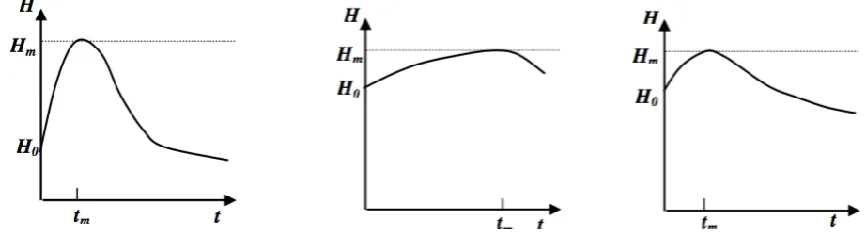
This process of improvement by an organism or system due to random events can go on for a variable amount of time, up to a limit that is mainly determined by its own conditions and structural possibilities. From that point of maximum growth, all the information available in this system and in its relations with the environment or with
other systems is revealed. Consequently the effects of the Second Law will start to be felt more strongly and the system will enter an irreversible process of ageing and death. A large set of functional and structural conditions, varying from organism type to organism type, from environment to environment, from system to system, or from company to company describe different evolution curves over time (Figure 2).
Figure 2: Some possible evolutionary curves of different organisms (based on Atlan 1992)
So, for example, in nature, the genetic code of an animal species would consist in some original (structural) redundancy that would define the possibilities of birth, growth, learning, survival, ageing and, finally, death for any individual of that species. During its lifetime, the organism has countless opportunities to act negentropically along the curve Ht in Figure 2. Each action, especially in the growth phase, incorporates physical, motor, perceptive and other resources. These make the negentropic efficiency of the next action even more efficient. In other words, the organism experiences physical and memory growth up to a point beyond which its basic structure will allow it to do nothing more than keep a relentless and unsuccessful fight against ageing and death. The upward curve is replaced by a downward curve: which is to say, its maximum negentropy will eventually give way to universal entropy.
In this process, the organism gains information by registering redundancies in its nervous and muscular systems, and then, through memory, reducing those redundancies as it resorts to them at each new negentropic action. Memory contains senses or ‘signifieds’, incorporated into the code under the conditions and circumstances of each action. These signifieds enrich and, perhaps, slowly modify the code. In any living being, even if the memory of the species is genetically transmitted and capable of improvement in a biologically selective process, the direct memory of an individual is lost with the death of that individual. Only the human species, thanks mainly to articulated language, developed this particular ability to transmit individual memories to contemporaries and descendants. In human species and in the work performed by human beings, memory acquires, therefore, the form of
knowledge: social, historical and cultural heritage for each and every one of us.
Knowledge results from the interaction between individuals with their personal and social past, and also with their projects for the future.
human information, since it is oriented by knowledge, processes signs. And human informational work will be by nature semiotic work, involving an immeasurable range of connotative and pragmatic possibilities. As Umberto Eco says, “producing signs implies work, whether these signs are words or commodities” (1981, 170; translated).
1.2. Information Value
Along its evolutionary curve, any living organisation permanently relates the
unexpected to the known, the random to the redundant. Redundancy converts
pre-identified messages into messages whose only utility is to immediately point out routes for the pursuit of what is new. When redundancy doesn’t give this orientation,
action tends to stop, but the spontaneous consumption of negentropy is not detained: or it may proceed even though the non-spontaneous consumption of negentropy continues. For example, in a factory, if a worker needs to watch a working machine for hours, paying attention to its clocks, gauges, and the noises it emits (which only the experienced worker knows well), he does so solely to capture random events (errors, unexpected and undesirable behaviour changes), not predictable ones. Redundancy is only useful because it can point to some original information, if it occurs. Therefore, it allows the worker to focus on the search for meaning to events whose origins or causes he initially ignores. That search will be semiotic work: a process in which senses, nerves and muscles, but, above all, the mind, are used in the association of signifiers to signifieds, given a context and its codes (Dantas 2001; 2007). That is why, recovering some of Marx’s key categories, the value of “concrete living labour” will express itself in those moments in which the machine work reveals or produces a random event; not when it operates ‘flawlessly’.
Negentropic work permanently moves within this dialectic between novelty and redundancy. It is activated by the different, new, original event. The more meanings or signifieds it extracts from an original event, in the shortest amount of time, the higher its efficiency. It is possible, both in the natural world and in the human social world, that novelty doesn’t reveal its meaning easily, considering the agent’s objectives. In such cases, the effort of searching and processing will become time-consuming and tiring; uncertainty will grow, and this can, in extremes, lead to disaster.2 However, in most cases, memory, knowledge and experience quickly help to identify and correct the causes of a problem.
Assigning semiotic signifieds to the original event implies reducing ignorance or processing uncertainties in relation to the environment, or parts of the environment (Atlan 1992). By definition, this is negentropic work of uncertain or random nature. Once all the possible signifieds of the event are extracted, the resulting action, whose objectives and purposes are now already given, will mainly imply entropic consumption of matter and energy. However, this work expenditure will still be necessary to achieve the negentropic purpose of the organism, which it can hardly evade. This expenditure will have, in general, the form of some communication: in any productive environment, the worker or employee communicates the problem to their boss or, depending on the case, communicates directly with the machine they work with, aiming to correct it through control instruments. Every time this is done
2 For example, consider air disasters. Nowadays, most of the time a disaster derives from a
totally unexpected situation, whether through the training of the pilots or the onboard computers, so the pilots have no time to identify the origin and dimension of an anomaly. It is a case of R→ 0, in which the negentropic efficiency of the pilots’ efforts to find a solution
they move muscles, nerves and neurons (Dantas 2001; 2007).
In the natural world, any living organism communicates its ‘intentions’ to other living organisms, originating persecutions, escapes, and so on. Any communication originates from a difference (information), but materialises in redundancy. As Bateson says, “the raison d'être of communication is the creation of redundancy” (1987, 133). Therefore, once the signified of a new event is obtained, random work is necessarily followed by redundant work. They are two moments of the same process: two moments that can either occur imperceptibly or indifferently for the agent, or in a way that is clearly perceptible or distinguishable by the agent. When I think and immediately type my thoughts onto a computer keyboard, I perform random and redundant work almost simultaneously. In an industrial organisation, if a worker spends hours watching the machine work without the need to intervene because everything is happening ‘normally’, they perform redundant work, until some unexpected event also calls for their semiotic competence to perform random work: identifying the problem, modifying commands on the machine, communicating the difficulty to other instances, and so on.
Since the resolution of a problem or the processing of random information enables any organisation (whether an individual or a capitalist company) to move forward along the Ht curves in Figure 2, each point of these curves will express that moment in which the meanings or signifieds that could be extracted from information will already have been extracted, giving rise to the redundant work of communicating them through pertinent means. Therefore, any point in curve Ht has to correspond to
an originality curve that expresses a new event perceived at that point, and its
growing repetition over time, as formulated by Moles (1978). We suggest that informational work is performed in the vicinity of point O, on the curve Ht (Figure 3). There will be a degree of uncertainty beyond which the processing of information doesn’t offer the agent any orientation3, and there will be a degree of redundancy beyond which time starts to become highly entropic, as it consumes the negentropy available in the whole system. In short, for each point Oa,b,... n, there will be a maximum desirable Ha,b,...,n, or information that can be treated at that point at a processing time that has to be a minimum value of ta,b,...,n. Thus, any ta',b',...,n' > ta,b,...,n will tend to be redundant in the face of the action already performed. This relation, as we suggest, will attribute a value to information relative to the agents in interaction with the environment (Dantas 1996; 1999; 2001).
Figure 3: The value of information work
1.3. Some Epistemological and Theoretical Comments
Abraham Moles wrote that the “growing awareness of the material nature of information is very recent” and has developed thanks to information theory (1978, 271; translated). Until recently, the ideal aspects of the interpersonal relation seemed to be so evident that nobody was able to realise the material side of information. Moles adds that for Plato, Bacon or Spinoza, “the material aspect of the writing was no more than an ancillary contingency of which we must free the thought” (Ibid.).
We can go beyond Moles: we can say that this idealistic way to think about information started to change after Saussure's (1969/1916) definition of the sign as a dual unity of mind concept (signified) with its material support (significant) and Peirce's (1977/1931-1934) definition of the sign itself as a triad unit of its material qualities (qualisign and sinsign) and the rules that relate them (legisign).
All human relations are expressed and carried out by signs produced by the human body in action: affection, love, hate, taste, desire, dreams, projects, victory, defeat, etc.; matter expresses all human relations. It is the transformation of matter – sound and light frequencies, chemical molecules – through which we can talk, listen, draw and see images, smell and so on. From an information theory perspective as well as from a Marxian point of view, there is no “immaterial work” or “immaterial economy”. People who use these odd categories, as Gorz (2003), seem to go back to that old idealistic pre-Marxian way of thinking.
define “information” and also “knowledge” but, despite information theory, he didn't see any reason to “improve” the arbitrary and operational definitions by Daniel Bell and Marc Porat: “information is data that is being organized and communicated”. This positivist definition that turns information into a thing (“data”) is simply tailored to
reduce it to a commodity. But as mentioned above, even Kenneth Arrow realises that the commodification of information is hard to achieve.
“Information is not property but form of the movement of matter”, the Brazilian Marxist philosopher Alvaro Vieira Pinto wrote in his posthumously published opus
magnum (2005, 379; translated). Heinz von Foerster also argues:
Since we think we know what information is, we believe we can compress it, process it, chop it up. We believe information can even be stored and then, later on, retrieved: witness the library, which is commonly regarded as an information storage and retrieval system. In this, however, we are mistaken. A library may store books, microfiches, documents, films, slides and catalogues, but it cannot store information. One can turn a library upside down: no information will come out. The only way one can obtain information from the library is to look at those books, microfiches, documents, slides, etc. One might as well speak of a garage as a storage and retrieval system for transportation. In both instances a potential vehicle (for transportation or for information) is confused with the thing it does only when someone makes it do it. Someone has to do it. It does not do anything (von Foerster 1980, 19; emphasis in original).
We can say the same nowadays about electronically stored data. In short: the relation between information and work is symbiotic. There is no living work without information, or information outside living work – outside the agent in action. Information is not a “thing”, it is movement. It is not an “entity”, it is a relation.
2. From Industrial Capital to Information-Capital
The exposition done so far will allow us to shed new light on the relation between use
value and exchange value in Marx’s theory. In a passage of Capital, Marx affirms:
A machine which does not serve the purposes of labour, is useless. In addition, it falls prey to the destructive influence of natural forces. Iron rusts and wood rots. Yarn with which we neither weave nor knit, is cotton wasted.
Living labour must seize upon these things and rouse them from their death-sleep, change them from mere
possible use-values into real and effective ones. Bathed
individual consumption, or as means of production for some new labour-process. If then, on the one hand, finished products are not only results, but also necessary conditions, of the labour-process, on the other hand, their assumption into that process, their contact with living labour, is the sole means by which they can be made to retain their character of use-values, and be utilized (Marx 1996/1867, 130; my emphasis).
After all our previous exposition, it is hard not to admit that in this passage we can perceive that same relation between information and negentropy described by the fields of contemporary physics and biology. Machines and materials are preserved work (Marx also says “past labour” or “dead labour”) that tend towards entropic degradation. But they can recover their previous capacity of providing work to a certain extent (even if it is modified; and because it is modified), thanks to the information introduced into them by an external agent: living work or labour. The utility of this work or labour – its use value– resides precisely within this competence, or knowledge, to give form to (or, to in-form) the “dead work” (physicochemical entropic work): to give it new shapes needed for its social utility.4
There is no commodity without the utility that is preserved or added by, as Marx writes, the:
[...] subjective factor of the process, with labour-power in action. While the labourer, by virtue of his labour being of a specialised kind that has a special object, preserves and transfers to the product the value of the
4 A fairly famous footnote introduced by Engels in the first chapter of Marx's Capital stresses
means of production, he at the same time, by the mere act of working, creates each instant an additional or new
value [...] This value is the surplus, of the total value of the
product, over the portion of its value that is due to the means of production. It is the only original bit of value formed during this process, the only portion of the value of
the product created by this process. Of course, we do not
forget that this new value only replaces the money advanced by the capitalist in the purchase of the labour-power, and spent by the labourer on the necessaries of life (Marx 1996/1867, 146; my emphasis)
In short, in our terms, information (semiotically processed by useful living work) adds new value to past “dead” work. This increase of value doesn’t derive from any “capitalist exploitation”: it is intrinsic to the relation between useful work and its object. Any medieval artisan, for example, would have increased value when he transformed raw materials into new useful objects serving his customer. The function of capital is to expand this capacity of living work to the most, in all possible dimensions, in order to add a new value (on the condition of new utility) to the products of past work. Thus work, under capital conditions, adds surplus value to the products, now commodities. However, whatever the dimensions and practices of exploitation of work by capital, in every minute or every second of the work process, value is being added to past work, due to the transformations it goes through under the useful ‘subjective’ action of living work.
The value that concrete living work adds to materials and means of work submitted to its action is the information it processes and incorporates into them. This is the real essence of “useful labour” (in Marx's terms), this “natural gift” of the worker (and of every human being) that, among other things, allows capital to obtain “surplus value” from materials that otherwise would tend entropically towards wear and dissolution. The use value of the workforce does not consist in its eventual capacity of transforming and employing energy in the work process, but in its capacity of capturing, organising, registering and communicating semiotic information in it. Hence, concrete or useful work, having informational nature, will have value depending on the degrees of randomness and redundancy that it processes and communicates at a given time, along productive activities.
2.1. Abstract Labour and Negentropy of the Worker
As we know, the measure of the value of commodities won’t initially be a function of
processed, registered and communicated information, but of the (social) time of
equal, or abstract, or simple labour, socially incorporated into it. If we abstract the useful nature of work, “all labour is, speaking physiologically, an expenditure of human labour-power” (Marx 1996/1867, 33), expenditure that can be understood as dissipation of the worker’s negentropy as he or she informs and gets informed in the environment (or in the workplace). The need to recover this specific negentropy through the means of subsistence acquired by the salary will provide the measure of the value of the workforce itself. From the point of view of classic political economy, that value (which corresponds to the increasing entropy of the labour organism along the working shift) will serve as an equalisation measure for exchanges.
necessary – are based on the basic non-equilibrium between the negentropy given by the information that is processed and communicated by the worker and the entropy of his body while he is providing labour. They are “two entirely different magnitudes”, Marx wrote (1996/1867, 135). One is measured by N, the other is measured by S. Thus, capital is presented to us as a system far from equilibrium – a “dissipative structure”, as Prigogine and Stengers (1988) would say – that will keep itself in this condition as long as it can feed on negative entropy up to the limit of the restrictions imposed by natural resources and, no less importantly, on the possibilities of continuing to have living (creative) work in sufficient qualitative and quantitative dimensions to sustain the production and consumption of its increasingly elevated negentropic requirements. Marx was a pioneer in describing a system far from equilibrium at a time of the absolute predominance of the equilibrium and reversibility paradigms of Newtonian Physics.
Marx does not once ignore the close relation between the qualitative value and quantitative value of commodities and workforce. But during his time he could consider that the knowledge, abilities, and skills of the workers, and even scientific knowledge widespread through society, had no cost to capital. He notes in many passages of Capital that these elements comprise a “gift of Nature” of the workforce
that, fortunately, the capitalist could acquire in exchange for the mere cost of the worker’s subsistence. At that time, industrial productive processes were performed empirically, almost exclusively in workshops that employed workforce with relatively high degrees of knowledge, including mathematics, about production processes and techniques (Landes 1994; Hobsbawm 1997; Samuel 1992): the capitalist bought (as he has always bought) this knowledge (the qualitative use value of the workforce), while paying only the cost of its negentropic recovery (the quantitative measure of the value). Capitalism has always been cognitive.
The capitalist organisation of the productive process aimed, as Marx understood, to absorb the knowledge contained in human work: but it couldn’t do so without employing and providing for the worker’s body, holder of its memory and mind, reduced to labour. To take hold of the knowledge of work as labour, capital:
i) imposes that the worker’s body should keep working as long as possible (for
instance, by instituting working shifts of 10 hours, 12 hours, or more);
ii) reduces its replacement costs by lowering the price of essential goods or increasing productivity;
or iii) absorbs innovations born from the work process and generated by the
workers themselves, innovations that increment the efficiency of labour by time unit. Marx called the first dimension of surplus value absolute surplus value. He put together the other two under the same label of relative surplus value. But a careful reading, especially of Chapter XV of CapitalVolume 1, shows that Marx made a clear qualitative distinction between these two dimensions of surplus value. The third dimension can be named intensified surplus value.
These three dimensions of surplus value seem to act in a contradictory way upon one another. The barrier to the endless expansion of capitalism, or the source of its crises and impasses, resides in its permanent need to employ the body of the worker in the process of informing matter – this constitutes its structural redundancy that, once destroyed, would ensure its collapse.
on the other hand, free time becomes necessary to consumption and extended reproduction. Likewise, lower costs are no longer imposed for basic livelihood items, which, in Marx’s time, weren’t much more than essential food items, basic clothing and basic accommodation with scarce furniture. The ‘subsistence’ of the average worker, in advanced welfare state capitalism, usually includes a mortgage for a house, a car, vacation trips with the family and all the electronic gadgets that capitalist industry is capable of inventing and producing. To acquire all that, salaries need to be situated above the minimum ‘consumption’ level. That is, two out of three dimensions of surplus value wouldn’t affect, in normal conditions, the process of valorisation. They can be considered neutral constants.
The intensification of work efficiency per unit of time has become the determinant relation in the production of surplus value. The decisive factor was the so-called ‘second industrial revolution’ in the early 20th century. This was arguably about replicating work time, as the real estate industry does by building (vertically) tens of housing units in the same area of land. In advanced industrial production, in the same time unit, the scientific and technical social knowledge incorporated into work processes – and even for each individual worker – can be replicated thousands of times from the same initial model. So, the entropic time of the worker, individually and collectively, is detached from the time of the machine. But their use value, individually and collectively – or their negentropic time – is still essential to valorisation, not as time that adds labour, but the opposite, as time that saves labour. That is, use value is considered as a capacity to process semiotic information and produce knowledge that minimises the interruptions of production at redundant times, or gets ahead of them, if possible, through product and process innovations at random times (Dantas 2001; 2007).
Living work or labour – since the ‘second industrial revolution’ – transforms little or almost no matter directly. Most matter transformation is executed by machine systems; that is, by fixed capital. Living work or labour, seen in a collective and combined way, but also individually, deals with semiotic interactions with machines through panels, clocks, gauges, buttons, handles and also sensory organs. It captures and processes semiotic information, based on individual or social knowledge, on industrial collective codes and general goals of the company (Dantas 2001; 2007; Burawoy 1979; Dejours 1995; Duarte and Feitosa 1998; Lucas 1974; Naville 1963; Rasmussen 1986; Zarifian 1996). Its use value is not directly related to the matter being transformed, but to the significant codes of techno-science learned at the company, at formal and technical education, and in social life. Therefore its field of work is communication: with the machine, with the colleagues, with other instances of the company.
capitalist firm, tends politically and ideologically to much more complacent positions towards capital than those that shop floor workers and other hierarchically inferior employees had been willing to accept.5 The economic and social division between random work and redundant labour inside capitalism gained socially empirical and politically evident existence from the early days of Fordism.
But it may be said that Marx had already perceived this development would be the historical evolution of capitalism, in the essence of its contradictions.
Since with the development of the real subsumption of labour under capital or the specifically capitalist mode of production it is not the individual worker but rather a socially combined labour capacity that is more and more the real executor of the labour process as a whole, and since the different labour capacities which cooperate together to form the productive machine as a whole contribute in very different ways to the direct process by which the commodity, or, more appropriate here, the product, is formed, one working more with his hands, another more with his brain, one as a manager, engineer, or technician, etc., another as an overlooker, the third directly as a manual worker, or even a mere assistant, more and more of the functions of labour capacity are included under the direct concept of productive labour, and their repositories under the concept of productive workers, workers directly exploited by capital and altogether subordinated to its valorisation and production process. If one considers the total worker constituting the workshop, his combined activity is directly realized
materialiter in a total product which is at the same time a
total quantity of commodities and in this connection it is a matter of complete indifference whether the function of the individual worker, who is only a constituent element of this total worker, stands close to direct manual labour or is far away from it. But then: The activity of this total labour capacity is its direct productive consumption by capital, i.e. it is capital’s process of self-valorisation, the direct production of surplus value, and therefore — a point we shall develop further later on — the direct conversion of surplus value into capital (Marx 1864; emphasis in original).
Marx saw during his lifetime how “intellectual” tasks were being absorbed in the industrial process of production and reduced to labour in the form of the production of commodities or, more precisely, capital. But, of course, he couldn't see the actual
5 In his classic work The White Collars (1951), C. Wright Mills provides an accurate cultural
path this development would take; namely, since the early stages of Fordism, the rise of a new caste of relatively well-paid workers, dedicated to creative and pleasant jobs. But as Marx clearly saw, these jobs produce capital directly. The next section shows how this development has progressed up to the present day.
2.2. The Value of Time in Marx
In the first section of Capital, Volume 2, Marx presents his well-known formula:
M – C ... P ... C' – M'
This formula tells us that the monetary form of capital (M) is employed by the capitalist on the acquisition of commodities (C) that are introduced in production (P), from which they emerge transformed in new valued merchandise (C') that will be sold and transformed into surplus money (M'). This expanded money, however, will need to return to the capitalist's hands, not only to put the profit in his own pockets, but also to buy again the necessary commodities (including workforce) to restart the cycle and keep it moving (M' M). The suspension points before and after P indicate that, during production, circulation is “interrupted” (Marx 1997/1885). The whole process, going through all its “metamorphosis”, is denominated “industrial-capital cycle” (Ibid., 29).
All the effort of capital has always been aimed at reducing the time it takes to carry out the total cycle. However, it subsequently faces several barriers, as Marx notes. On the production (P) cycle, for example, material transformation will always require some amount of time, depending on the nature of the materials to be transformed and the available equipment and technologies. In transformation, every process is interrupted by this waiting time, longer or shorter, during which the worker, individually and collectively, has nothing to do but wait for nature to follow its course (supposing no ‘noise’ occurs). General scientific and technological work will do everything possible to reduce this time. The value of this general work (of scientists, engineers, technicians and also factory workers), which aims to solve the problems presented by the time barrier of production and compress that time to an irreducible minimum, is found precisely within the socially useful information it is able to process and communicate.
In circulation, capital faces the barriers of what Marx designated “spatial moments” and “temporal moments”. In order to generate value, both commodities and money need to travel distances that, in Marx’s time, could take months. Ignoring many other factors that can affect realisation (circumstantial crisis, wars, etc.), physical space will always constitute an inescapable barrier. Overcoming it has required, since the early days of modern capitalism, large investments in various means of transportation and communication.
This is why, as one can read in Capital Volume 2, the “transportation industry” –
responsible for commodity circulation – constitutes “a separate sphere of investment of productive capital”. However, “its distinguishing feature is that it appears as a continuation of a process of production within the process of circulation and for the process of circulation” (Marx 1997/1885, 88). This transportation industry is presented to us as a subsector of the larger communication industry:
the communication industry, whether engaged in transportation proper, of goods and passengers, or in the mere transmission of communications, letters, telegrams, etc., is economically important (Marx 1997/1885, 30; my emphasis)
The “communication industry” – though Marx deals almost exclusively with the transportation area – generates value because its ‘useful effect’ is to allow the consumption of the commodity, moving it from one place to another. This useful effect is the movement itself, and this effect is consumed in the act of performing it. Therefore, the capital cycle here obeys the following particular formula:
M – C ... P – M'
The transportation company advances monetary capital (M) to buy commodities (C), to which it adds value (M') without producing a new commodity (that is, without the transformation P... C'), apart from the act of moving them from where they are produced to where they will be consumed.
This last formula reveals another essential aspect to the discussion we are proposing: that it is not alien to Marx’s theory that there is production of value (and accumulation) without production of a commodity, without material transformation. Value is always associated with utility, and this is not necessarily contained in the results of direct material transformation. The labour of moving materials or, as we will see further, any other work or labour that results in saving time, can also be a source of valorisation; therefore, productive work or labour, even if it isn’t specifically factory
labour.
The cycle of valorisation and accumulation is only complete after the commodity has reached its consumer and the money has returned to the hands of the producer. The useful effect – hence the value – of transportation increases with the decrease of circulation time. This time gets into contradiction with production time (P) and, therefore, all the subsequent development of capitalism is determined not just by the need to increase the productivity and intensity of labour (living and dead), but also, in
the same dimensions, by this other need to accelerate circulation, thus decreasing
movement times for commodities and money. Therefore, notes Marx, synthesising these dynamics in a phrase: the more widely capital expands around the world, the more it will need “to annihilate this space with time, i.e. to reduce to a minimum the time spent in motion from one place to another” (1973, 464).
Still in circulation, there is another time element whose equal interference in the valorisation of capital didn’t escape Marx’s perception: the time spent negotiating and administrating, which, at that point in history, directly consumed the labour of the capitalist in person. Marx designated this time as “temporal moments” of circulation:
Suppose the act of making the transition from commodity to money is fixed by contract, then this still requires time – calculating, weighing, measuring. The abbreviation of this moment is likewise development of productive force. However, this is time still conceived only as an external
condition for the transition from the state of money into that of commodity; the transition itself is presupposed; the question is the time which elapses during this
Quite different is the time which generally passes before the commodity makes its transition into money; or the time during which it remains a commodity, only a potential but not a real value. This is pure loss. (Marx 1973, 459)
“Calculating, weighing, measuring” – this is obviously not material transformation labour. Nor is its ‘useful effect’ movement from a place to another in space. We can affirm that its ‘useful effect’ is information that, as for locomotion, will be value without being a commodity. In Marx, it is clear that this work-time fits in the concept of circulation and, therefore, the reduction of this time will also imply development of productive forces. It won’t be unreasonable to admit, by analogy, that its general formula will be:
M – C ... I – M'
This formula tells us that the investor acquires means of production6 and work or labour capacity (C), not to employ in some material transformation or movement (or they might do it just as an auxiliary), but to use in the activities of perceiving, processing, registering and communicating information, thus giving rise to valorisation (M'). For this valorisation, material transformation or movement is secondary (though these always occur, because materials and human beings wear out). So, the possibilities which both living and dead means can offer to process uncertainty and communicate redundancy in the shortest time are essential.
2.3. Informational Work
Detached from immediate material transformation (due to more than secular mechanisation, automation and automatisation of productive processes), living labour such as Marx knew it has evolved, becoming increasingly a combined process of semiotic and informational mental work that articulates itself through its random and redundant moments. That is, on one hand, work is not individual, but collective, combined, interactive. Each worker, whether a scientist or a shop floor worker, is no more than a link in a total system that is not contained in the limits of the individual firm, but includes the set of capital units that contribute differently, sharing work with one another, to the total production of valuable knowledge and marketable use values. This is just as Marx had predicted in his unpublished (until the 1960s) papers. This combined body, general social production7 constitutes an evolved stage of intensified surplus value production, where on the one hand living work is dedicated to activities such as research, investigation, study, analysis and decision-making in science, technology, financial management and other areas related to the development and evolution of products and processes. This is mainly random work. On the other hand, living work is also dedicated to activities such as supervision, control, observation, direction or corrections of ‘dead’ (entropic) work that will aim to materialise the work of removing uncertainties. These tasks are predominantly
redundant, although necessary to carry out the fixation of redundant information on
6 These means of production could constitute, in current days, computers and other
information technologies, telecommunication resources, all kinds of office supplies and equipment, the means to produce and record audiovisual spectacles and other fixed capital necessary to process and communicate information in its different social or cultural forms: R&D, design and marketing, consulting on economics and other services, artists or cultural spectacles, also management and other office activities inside firms, and so on.
7 By general social production, we understand the current historical stage (capitalist) in which
the appropriate material supports for its intended utility.
A worker (an artist, an athlete, an engineer, a teacher or a shop floor worker) may individually perform both random and redundant work. However, socially and economically, certain activities or certain investments are by nature more random, and others more redundant. Scientific research, the development of a brand, providing consultancy, or artistic performance are types of work with a high randomness rate. From them, a model, a prototype, a report, or an audio and video matrix – some unique piece – will be extracted and then, depending on the case, will
be replicated to be distributed. The production of this mould – to call all of them by
the same name – is a kind of work with a relatively high degree of uncertainty, work which is subject to trial and error, difficult to control over time. It’s a creative activity
par excellence, totally dependent on the abilities and competences of concrete useful
work. The mould created by this work is the central pillar of reproduction of supports within the same time unity: be it in physicochemical industries reproducing a specific team design thousands of times, or in cultural industries recording a cast performance (Dantas 2001; 2007). Of course, for each industry, even for each piece, no matter the production process, there will be many different kinds of moulds, in shape, weight, materials and so on.
If the mould condenses in itself all information processed and all knowledge produced, the communication of this knowledge, especially its commercialisation, will require some particular means of transportation – a physicochemical support – linking social and economic agents, capital units and, last but not least, consumers. Fixing the processed information on that support, or replicating the mould, may still require a good amount of redundant living labour. The intensified magnitude of this labour by product unit will usually depend on the materials and dimensions of the supports: they can be thousands of music CDs, or pairs of tennis shoes from a famous brand, or a single huge bulk carrier ship, or just a few units of a large commercial jet, or a gigantic hydroelectric dam. The more material they contain, the longer it takes for their stages of physical and chemical transformations, the more relatively redundant labour the communication will demand, such as typing, final designs, assembly of components or pieces, operating machines and equipment, or watching control panels. As with the other phenomena related to circulation and communication, as long as these movements are not concluded, the informational product will not be ready for use.
‘Reducing time’ – this time of redundant labour – has been a crucial issue for
capital since at least the time of Taylor and Ford. For this purpose, capital has been investing in the development and use of several technologies in transporting material and communicating information, aiming to reduce material transformation time to be as short as possible. To achieve this, since the last decades of the twentieth century, capital has made use of modern digital technologies, not to mention all the technology that industrial capitalism was able to generate and improve since the first industrial revolution.
the first half of the 19th century. These tasks also integrate the “total labour capacity” (Marx 1864), but because they are carried out by over-exploited workers in peripheral ‘sweat shops’, some analysts – ignoring the real information working value of the
total process – see in its particular and secondary segment a kind of capitalist return
to earlier times of widespread absolute surplus value production.8 But capital is developing a new machine generation empowered by artificial intelligence (the ‘Internet of things’) and the extraordinary capacity to reproduce things (3D printing) that promise to finally replace the remaining demand for the kind of living labour that has very low semiotic competency. Political establishment leaders and organic intellectuals are saying that we are experiencing the beginning of the ‘fourth industrial revolution’. Could this development bring about capital's old dream of accumulation without living labour?
Because of its intensive development of fixed capital discharging redundant living labour, capitalism, in its new informational phase, has become a mode of production that excludes a large contingent of the population from production processes and usufruct of wealth. This population segment is no longer even seen as the “industrial reserve army”. The social and ethical consequences of this exclusion are present, visible to everyone.
2.4. The Cycle of Productive Communication
As the evolution of capitalism reduced circulation and turnover times and expanded the dimensions of semiotic informational work, it would end up resizing quantitatively and qualitatively, in general social production, the information valorisation cycle – which, as we saw, was perceived but not elaborated on by Marx: at his time, exclusively semiotic work was carried out by the individual businessman and a few assistants, helped by paper and dip pen.
In the cycle:
8 An example: in A Companion to Marx's Capital Volume II, Harvey (2013, 102) quotes a
M – C ... I – M'
Entropic (‘dead’) work and living work or labour will perform different functions, precisely because the goal is not to transform or move matter and turn it into a new use value. Basically, as we have shown above, the materials are there simply to be
used as instruments and equipment by living work or labour.
Considering the investment of capital in information valorisation; that is, in the times of random and redundant processing, money (M) is advanced to recruit living work in the production of living activity (Boutang 2001) of collecting, processing, registering and communicating semiotic information (I). Hence, obtaining surplus money (M') will be a function of the processed relation randomness/redundancy, that is, of the value of information as discussed above in Section 1.2.:
M – I – M'
On the other hand, since information can’t be detached from a physicochemical communication support, capital, when ruling informational work, will need to assign
entropic material work to it: instruments, equipment, machines or other materials, to generate and register the desired knowledge. Thus there will be a factory cycle of production, in which raw materials, machines and energy are acquired by an investor, to be consumed in the production of physicochemical supports for use in processing and communicating information. Our language has become accustomed to calling such values ‘commodities’:
C – P – C'
The time of this cycle tends towards a minimum but it finds its lowest limit in the irreducible barriers of the physical and chemical conditions of the materials in transformation or movement. Particularly after the development of informatics and microelectronics, this cycle became automated to extreme levels, such that it must now function in a continuous cycle, dependent on living work or labour for supervision to ensure it is not interrupted.
In the information processing cycle, time tends to an acceptable maximum for random work on the axis of uncertainty; and to a minimum, if possible to the limit of zero, on the axis of redundant labour. In scientific research or technological development, error is presupposed during activity. In order to produce a movie scene, there are several rehearsals. Until you obtain the desired model of a garment or a vehicle, many designs and tests must be done. However, once you obtain the knowledge, the film or the final model of the product, all subsequent communication will widely use digital means and global computer networks. Because of these technologies, in the last two or three decades many stages of redundant labour and the huge Fordist-era amounts of workers could be eliminated, or made more “flexible”, as Harvey (1996) suggests. This reduction results in a total cycle of
productive communication, in which valorisation and accumulation are no longer
M – I – M'
C – P – C'
This rupture of the whole circulation cycle time was probably first perceived and studied by early researchers in the field of political economy of communication. Zallo (1988) calls it “no unit of work process” because the conception of an artist’s work – no matter if it is produced by an artist (e.g. a writer) or a collective (e.g. a movie cast) – is a separate procedure from its factory/physicochemical reproduction. Huet goes further:
In the current control state of the artistic use value production process, work is still insufficiently reducible to abstract labour [that] makes possible to submit its product change to the value law [...] In fact its use value is that of a unique product (Huet et al. 1988, 99).
This is the definition of any artistic product, even in the age of its technical reproducibility: uniqueness. The artistic use value is intrinsically linked to the performance and empathy of the artistic workers. Even if the product is recorded, its use value remains work in action: the artist’s presentation and the action he produces
in its readers, listeners, and viewers (emotions, desires, feelings and so on). Today, this model of work process, first developed in those typical cultural industries, has become dominant in all industries that are in the most advanced frontiers of present-day capitalist accumulation patterns. This is simply due to the fact that “aesthetic production is integrated to the general commodity production” as Jameson (2006, 30) states so effectively. The determinant capital valorisation process is supported by ‘creative’ work – work that is, as all artistic work, hardly reducible to abstract labour.
On the other hand, at the end stage of any industrial total process, the value of a piece of any physicochemical information support can be negligible. For example, the factory production of a CD can cost less than a dollar per disc. The manufacture of a pair of jeans from Benetton or Diesel can cost around 20 dollars. But in the shops, the CD will be sold for 17 dollars and the jeans for USD 300 dollars or more (Witt 2015; Lima 2005). How can this be explained? The industrial value of these physicochemical supports is very low per unit because of the very high amount of fixed capital in the entirety of its supply chain (C – P – C') and the very low value of remaining redundant living labour in assembling or tailoring or packaging the final product unit. However, the final sale price of a product unit is so high because it has to cover the value of relative high cost of random living work, plus uncertainty time in R&D and design, fixed capital investments, marketing costs and, last but not least, monopoly prices due to intellectual property. This last issue will be discussed in the next subsection.
or labour doesn’t aim to transform any commodity. Living work or labour uses
physicochemical supports (equipment, tools, facilities etc.) to process and communicate information. The use of these physicochemical supports can happen in creative, rich activities, like those performed by engineers or artists in their projects or performances; or in repetitive, poor activities, like those that require routine movements of merely joining pieces, carried out in many garment factories. Therefore, at any instance of work, the material used there arrives totally or almost totally transformed by entropic (‘dead’) work systems.
These entropic work systems are fixed capital in Marx's terms. Whether big machines, means of transportation, telecommunication cables and satellites, office computers, or the software and algorithms embedded in them, these are frozen redundant information that has been previously randomly processed and registered by living work in R&D labs, engineering departments, design and marketing offices and so on. Therefore, C can develop into C', not because it contains surplus labour (living, simple and material), but because of the information value embedded therein, suppressing many other turnover times of production, circulation and communication.
Capital cannot discharge itself from productive living work, the source at least of intensified surplus value. But as Marx said:
the more the metamorphoses of circulation of a certain capital are only ideal, i.e., the more the time of circulation is equal to zero, or approaches zero, the more does capital function, the more does its productivity and the self-expansion of its value increase (Marx 1997/1885, 73).
Because of this increase, capital is evolving to discharge its “ideal metamorphosis” from the physicochemical production of information supports. Nowadays, in the cycle of productive communication, circulation will not be necessarily ‘interrupted’ during production. The return of added money may occur without material production even happening, for example, in patent or brand licensing. Increasingly, the consumer first transfers money instantly from their account to the vendor’s, through automatic debit or online shopping, then receives the commodity in a few seconds (if it is a product that is downloaded online), or in a few days if it’s a physicochemical object that will be delivered by traditional post. In other words, the advanced capital can return to the investor before the complete circulation cycle of the physicochemical commodity is ended. The extraordinary capacity that capital has reached to value information exclusively through almost annulling the time of communication, thereby automating the times of circulation and turnover in relation to those of production, will be the base of “informationalisation” (Castells 1998) or “financialisation” of the economy (Chesnais 1996).
2.5. Realisation and Appropriation of Value
As a consequence of what was discussed in the first part of the present article, the value of an informational product for the person who acquires it – whether it is a software package, a music CD or a branded pair of tennis shoes – lies in the action