AND JUDGMENT ACCURACY TO REVEAL THE CUES BEHIND TEACHERS’ EXPECTATIONS
by M. Brady Webb
A dissertation
submitted in partial fulfillment of the requirements for the degree of Doctor of Education in Curriculum and Instruction
Boise State University
DEFENSE COMMITTEE AND FINAL READING APPROVALS
of the dissertation submitted by
M. Brady Webb
Dissertation Title: Exploring the Correlation Between Teachers’ Mindset and Judgment Accuracy to Reveal the Cues Behind Teachers’ Expectations
Date of Final Oral Examination: 28 April 2015
The following individuals read and discussed the dissertation submitted by student M. Brady Webb, and they evaluated her presentation and response to questions during the final oral examination. They found that the student passed the final oral examination. Jonathan Brendefur, Ph.D. Chair, Supervisory Committee
Keith W. Thiede, Ph.D. Member, Supervisory Committee Michele Carney, Ph.D. Member, Supervisory Committee Jennifer L. Snow, Ph.D. Member, Supervisory Committee
iv
v
I would like to thank the amazing people who guided and influenced me along the way to making this doctoral goal a reality. I would not be writing this page without you.
To my committee members, I sincerely appreciate your invaluable contributions to and feedback on my dissertation. Your different perspectives contributed to a much richer dissertation, as well as conversations! Dr. Brendefur, thank you. As my advisor and chair, you knew how and when to push me, and you added so much depth to my knowledge as a student and educator. Your help revising and improving my work
vi
transcripts that lie at the heart of this dissertation. Dr. Carney, you have always been the voice of reason and taught me the importance of knowing one’s strengths. Your questions and wise insight give me a richer understanding of the topic at hand. Thank you for always being there for support and clarification. You ask the best questions!
I would also like to express my sincerest gratitude for the other Boise State professors (in addition to my committee members I had as professors!) that I learned from and with. You made my doctoral experience richer and of higher quality. Being in your classes truly shaped me and this dissertation. Thank you Dr. Johnson, Dr. Peralta, Dr. Dismuke, Dr. Rodriguez, and vicariously Dr. Gabbard! And to Dr. Stewart, I will forever be in awe of your patience and kindness. My doctoral career was drastically improved because of working with you. You embody collaboration, respect, mentoring, and professionalism. I sincerely thank you.
I’ve heard it said that the doctoral program doesn’t have a cohort, per say. But to that I say you’re wrong because my cohort was with me every step of the way. Angie, your brilliance, humor, and consistency kept me above water; and you pulled me out when I fell through the ice! Thank you so much. To Lenny, Petya, Liesl, Kelli, Belma, Scott, and Ann—our meetings, emails, texts, and bursts of inspiration will forever be the anchor points. To Tatia, Mike, Brad, Jan, I thank you for your friendships, sharp wit, creative minds, and inspiring conversations. So to my cohort, I say I am forever grateful for you.
vii
spent away from you culminate here in this dissertation. Making you proud kept (and will always keep) me going. Mae and Gus, thank you for being so brave and understanding during this journey. I hope seeing your mom on her doctoral path serves as a positive role model rather than a reason for therapy! Craig, you kept our team strong and our children so grounded. You truly did every thing to make this happen. Thank you for being
SuperDad! Without you, I don’t know how I would have finished my doctorate, let alone stay upright and forge ahead. Thank you so much for being my compass. You are
viii
Teaching is about constantly evaluating one’s students to best situate them for learning and future progress. Based on such evaluations, the academic expectations teachers hold for their students influence their instructional practice and are mediators of student achievement. Forming accurate expectations of students’ ability and accurate predictions of performance is instrumental to effectively improving instruction and advancing student learning. Therefore, when teachers form inaccurate expectations of student academic performance, students can suffer academically and personally. When teachers’ judgments of student learning are based on accurate information reflecting students and their learning, students can benefit academically and personally. Yet, little research exists that specifically examines teachers’ mindsets, and its influence on the cues teachers use to judge student learning. The research questions for this study are: Is there a relationship between a teacher’s judgment accuracy and mindset? What are the cues that fixed and growth mindset teachers use to make their judgment of students’ learning and academic performance? Does the teacher’s mindset influence this cue-usage? The purpose of this study is two-fold: the first quantitative study examines the correlation between teachers’ mindset (growth or fixed) and their ability to accurately judge students’ academic performance; the second qualitative study explores the cues that teachers with a fixed or a growth mindset use to judge their students’ learning and
ix
actually know their students, leading to practical implications in teacher education, teaching, and teacher-student interactions.
x
DEDICATION ... iv
ACKNOWLEDGEMENTS ... v
ABSTRACT ... viii
LIST OF TABLES ... xvi
LIST OF FIGURES ... xvii
CHAPTER 1: INTRODUCTION TO THE STUDY ... 1
Background of the Problem ... 1
Problem Statement ... 4
Purpose of the Study ... 5
Research Questions ... 6
Nature of the Study ... 7
Theoretical Framework ... 9
Expectancy Effect Theory ... 10
Expectancy Mediation Theory ... 12
Expectancy Confirmation Theory ... 15
Implicit Theories ... 17
Definition of Terms... 17
Assumptions and Limitations ... 18
xi
CHAPTER 2: LITERATURE REVIEW OF TEACHER EXPECTATIONS ... 22
Introduction ... 22
Why Do Teachers’ Expectations Matter? ... 23
Overview of the Teacher Expectation Literature ... 25
Teacher Expectation Research - Phase One... 26
Overview of the Need for Proof: Process-Product Model ... 26
Teacher Expectations Defined, Conceptualized, and Theorized ... 26
Demonstrating the Expectancy Effect in the Classroom ... 27
Experimental Study: Pygmalion in the Classroom ... 28
Setting the Stage ... 29
Findings... 30
Historical Impact ... 31
Criticism ... 32
Inspiring Further Research ... 34
Need For a New Paradigm ... 36
Summary of the Need for Proof: Process-Product Model ... 37
Teacher Expectation Research - Phase Two ... 38
Overview of Expectancy Mediation ... 38
Teacher Expectations Defined, Conceptualized, and Theorized ... 39
Experimental Study ... 42
Findings... 42
xii
Need for a New Paradigm ... 47
Summary of Expectancy Mediation... 48
Teacher Expectation Research - Phase Three ... 49
Overview of the Need for an Inclusive Paradigm ... 50
Teacher Behavior Conceptualized Further ... 50
Further Research on Inclusive Paradigm ... 53
The Importance of Accuracy of Expectations ... 53
Summary of the Inclusive Model of Expectancy Mediation ... 55
Teacher Expectation Research - Phase Four ... 57
Overview of the Era of Sociocognitive Constructs... 57
Teacher Expectations Defined, Conceptualized, and Theorized ... 58
Implicit Theories ... 59
Is Pygmalion Still In the Classroom Today? ... 69
Summary of the Era of Socio-Cognitive Constructs... 72
Teacher Expectation Research - Phase Five ... 73
Teacher Expectations as Reform ... 73
Professional Development Policy ... 74
Conclusion ... 77
CHAPTER 3: STUDY 1 METHOD ... 79
Setting ... 79
Participants ... 80
xiii
Teachers’ Judgment Accuracy ... 82
Mindset ... 83
Data Collection Procedure and Time Line ... 85
Threats to Internal Validity ... 86
Data Analysis ... 86
Ethical Considerations ... 86
CHAPTER 4: STUDY 1 RESULTS AND DISCUSSION ... 87
Teachers’ Judgment Accuracy ... 87
Mindset ... 88
Correlational Analyses ... 89
CHAPTER 5: STUDY 2 METHOD ... 92
Setting ... 92
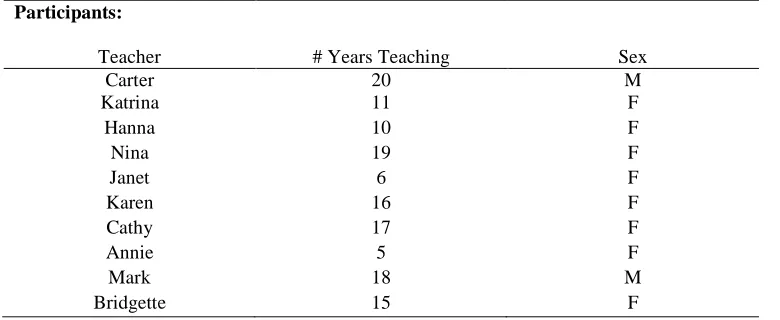
Participants ... 92
Research Design and Approach ... 94
Measures ... 96
Data Collection Procedure and Time Line ... 97
Threats to Internal Validity ... 98
Data Analysis ... 99
Ethical Considerations ... 100
Summary ... 100
CHAPTER 6: STUDY 2 RESULTS... 102
xiv
Further Analysis of the Cues Teachers Reported Using ... 114
Data Analysis ... 117
Cues Influenced by Mindset ... 117
Growth Mindset ... 119
Fixed Mindset ... 120
A Tale of Two Teachers ... 121
Judgment Accuracy Influenced by Mindset ... 122
Summary ... 123
CHAPTER 7: DISCUSSION AND CONCLUSION ... 125
Interpretations of the Studies’ Findings ... 127
Study 1 ... 127
Study 2 ... 127
Study 1 and 2 combined ... 128
Implications... 132
Limitations and Assumptions of the Study ... 136
Recommendations for Future Research ... 137
Conclusion ... 138
REFERENCES ... 140
APPENDIX A ... 149
ITML Test of Mathematical Skills and Concepts: Grade 2 ... 149
APPENDIX B ... 152
xv
Mindset Survey ... 155
APPENDIX D ... 157
Interview Protocol ... 157
APPENDIX E ... 161
xvi
Table 4.1 Mean Judgment Accuracy Computed Across Teachers ... 87
Table 4.2 Mean Mindset Computed Across Teachers... 89
Table 4.3 Correlation between Judgment Accuracy and Mindset Computed
Across Teachers ... 89
Table 5.1 Teachers’ Demographics ... 94
Table 6.1 Initial List of Cues Teachers Reported Using to Predict Student
Performance ... 103
Table 6.2 Cues Reported by Each Teacher During the Interviews ... 113
Table 6.3 Final List of Cues Teachers Reported Using to Predict Student
Performance ... 116
Table 6.4 Teachers’ Mindsets ... 118
Table 6.5 Teachers’ 2015 Mindsets and Judgment Accuracy on Math Skills ... 122
xvii
Figure 1. Graphic representation of study’s purpose. ... 6
Figure 2. Graphic representation of Study 1 and Study 2. ... 7
Figure 3. Graphic representation of Phase 1: the process-product model
of teacher expectancy effects theory. ... 38
Figure 4. Graphic representation of Phase 2: Expectancy Mediation Model
and Theory. ... 49
Figure 5. Graphic representation of Phase 3: an Inclusive Model for Expectancy
Mediation. ... 56
Figure 6. Graphic depicting the Social- Cognitive Model and Processes
of a Fixed Mindset. ... 65
Figure 7. Graphic depicting the Social- Cognitive Model and Processes of a
Growth Mindset ... 66
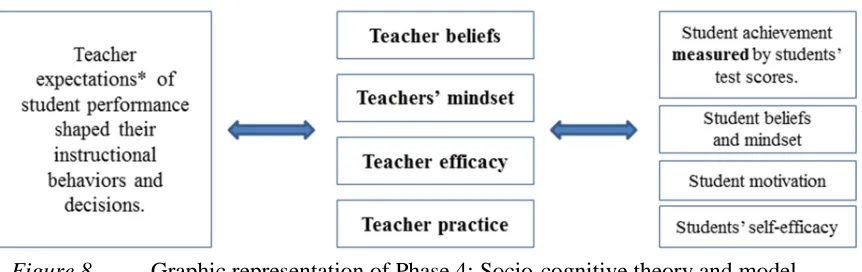
Figure 8. Graphic representation of Phase 4: Socio-cognitive theory and model. ... 73
Figure 9. Graphic representation of Phase 5: Education reform and effective
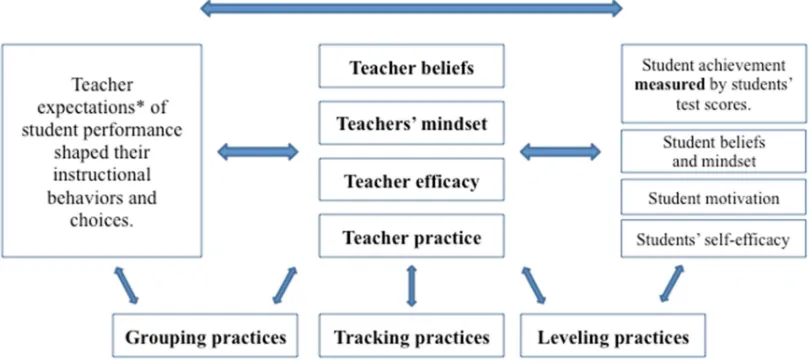
instruction. ... 76
Figure 10. Graphic representation of study’s purpose. ... 118
Figure 11. Graphic describing what the main tenets of this study are from the
CHAPTER 1: INTRODUCTION TO THE STUDY
Background of the Problem
Over the past five decades, teacher expectations have been widely studied in social science, education psychology, sociology, teacher education and policy, and cognitive psychology. The academic expectations teachers hold for their students influence instructional practice and are mediators of student achievement (Brophy & Good, 1970, 1974; Good, 1987; Rubie-Davies, 2006, 2007, 2014; Bandura, 2001; Babad, 1998). Similarly, teachers’ expectations can significantly influence teacher behavior, student achievement, students’ confidence, self-worth, efficacy, motivation, and overall academic experience (Rosenthal & Jacobson, 1968; Brophy & Good, 1970, 1974; Borko, Cone, Russo, & Shavelson, 1979; Good, 1987; Brophy, 1983, 1985, 1998; Jussim, 1986; Hoge & Coladarci, 1989; Jussim & Eccles, 1992; Babad, 1998; Bandura, 2001; Rubie-Davies, 2006, 2007, 2009, 2014; Weinstein, 2002; Rubie-Rubie-Davies, Peterson, Sibley, & Rosenthal, 2015).
student motivation, foster confidence and self-efficacy, and promote academic achievement because teachers exposed higher expectation students to more learning opportunities and more effective pedagogy.
Therefore, it matters a great deal what teachers base their expectations on. If unfounded or invalid, low or high expectations could allow teachers to ignore, stereotype, or generalize students. Inaccurate expectations can lead to erroneous monitoring of student learning, the perpetuation of deficit modeling, and misguided differentiation of instruction. Ultimately, the appropriateness and academic relevance of what teachers base their academic expectations on—regardless of whether high or low—determine the accuracy of expectations. The cues behind the expectation determine the accuracy of expectations and their subsequent effects.
For example, a teacher might place a student or group of students in the lowest achievement group because she continues to expect them to perform below grade-level simply because of their race, behavior, or their reading score on last year’s standardized test. Because of these low expectations based on inaccurate, outdated, and/or
academically irrelevant qualities, the students could then be exposed to fewer learning opportunities and receive inadequate instruction. Their learning could therefore be inaccurately monitored. In contrast, a teacher may place a student in the highest
Conversely, teacher expectations—whether high or low—can encourage and promote student learning if accurately based on authentic knowledge of the students and their learning, as garnered through ongoing and meaningful forms of assessment, progress monitoring, and building rapport. For example, when a teacher forms accurate but lower expectations because she recognizes that a student struggles in class with a particular task or skill, this teacher can then provide additional instruction and support to help this student learn and increase his achievement. When expectations are based on academically relevant and current cues, teachers can leverage their expectations as tools for fostering growth and establishing realistic, higher expectations (Brophy & Good, 1974; Babad, 1993; Dweck, 2006). Making strategic and meaningful adjustments to their instruction hinges upon teachers accurately judging and monitoring their students’ learning. When teachers astutely differentiate between students who understand the content and lesson and those who do not, their academic expectations beget pedagogical practices tailored to help struggling students and challenge proficient students.
Ultimately, the veracity and academic relevance of what teachers base their academic expectations on—regardless of whether high or low—is the antecedent to the accuracy of expectations and judgments of student learning and performance. As stated earlier, the accuracy of teacher expectations trumps all. The cues (the reasons, the bases) teachers use to form their expectations influence their accuracy. The accuracy and
thereby validity of teachers’ expectations of students’ academic achievement is extremely important because of the vast number of decisions teachers make daily about their
After examining the teacher expectation research, it is clear that additional research needs to explore precisely what teachers base their expectations on, and
consequently its accuracy. When forming expectations and judging student performance, why does one teacher use academically relevant cues and another teacher use
academically irrelevant cues? Perhaps teachers’ mindsets influence the cues teachers use to make their academic expectations, and this in turn could affect the accuracy of their expectations. Little research exists that specifically examines the mindsets behind teacher expectations, and whether or not a particular mindset is more conducive to forming accurate expectations because of the specific cues used to form expectations.
Problem Statement
Monitoring accuracy is crucial for effective teaching and academic achievement (Brophy & Good, 1970, 1974; Jussim, 1986; Jussim, Madon, & Chatman, 1994; Good & Brophy, 2003; Rubie-Davies, 2014; Weinstein, 2002). A teacher should form and hold accurate expectations of student learning because in turn these expectations directly and indirectly affect her instruction, which in turn affects student learning (Carpenter, Fennema, Peterson, & Carey, 1988; Südkamp, Kaiser, & Möller, 2012; Demaray & Elliot, 1998). This cycle of cause-and-effect continues, whether the teacher is conscious or not of the academic accuracy and relevance of her expectations. Therefore, the cues teachers use to form their expectations directly and/or indirectly affect their monitoring accuracy. Yet, little research has examined what cues a teacher intentionally or
Purpose of the Study
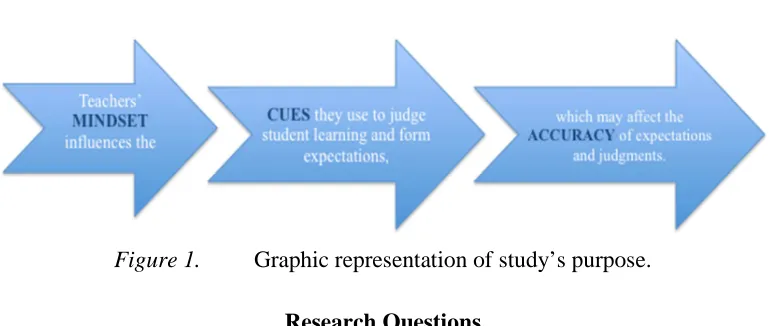
The purpose of this mixed-methods study was two-fold. The first quantitative study (Study 1) examined whether a correlation existed between teachers’ mindset (growth or fixed) and their ability to accurately predict students’ academic performance on a mathematics skills and concepts assessment. The follow-up qualitative study (Study 2) investigated the cues teachers use to judge student learning and examined whether fixed and growth mindsets use different cues. Data from Study 1 were used to select the teachers who were interviewed in Study 2. Five teachers who were above average on judgment accuracy and above average growth mindset, and five teachers who were below average on judgment accuracy and above average on fixed mindset were interviewed. The researcher was blind to the teachers’ mindsets before and during the interviews, and was not informed of them until after preliminary analysis of the data had been completed.
Figure 1. Graphic representation of study’s purpose.
Research Questions
The following research question was examined in Study 1: Is there a relationship between a teacher’s judgment accuracy and mindset? This study included two groups: teachers who have been identified as having either a growth or a fixed mindset, as measured and categorized by the Mindset Survey (Appendix C and described in detail in Chapter 3: Methodology). This study entailed the variable of teachers’ accuracy of predicting their students’ academic performance on math assessments. More specifically, teachers’ judgment accuracy was operationalized by computing the intra-individual correlation (Helmke & Schrader, 1987) between students’ predicted score and their actual performance on the tests of mathematical skills and concepts. These two variables were then analyzed using a bivariate correlation research design.
To address the subsequent qualitative purpose of this research study, the
status. Whereas growth mindset teachers were hypothesized to be more accurate in their predictions, basing their predictions of students’ academic performance on accurate and/or academically relevant factors, such as students’ cumulative folders and academic records of performance, current grades, and the teacher’s knowledge of student learning.
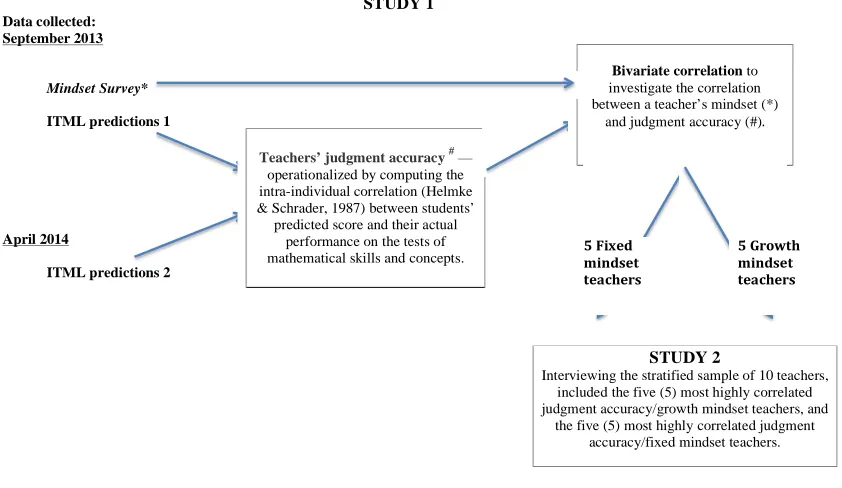
Figure 2. Graphic representation of Study 1 and Study 2.
Nature of the Study
As seen in Figure 1 above, this mixed-methods study used a bivariate correlation analysis for Study 1 to investigate the existence of a correlation between teachers’ judgment accuracy and their mindsets and qualitative semi-structured interviews for Study 2.
One variable in this study was teachers who have been identified as either having a growth mindset—when the teacher believes that learning and students’ intelligence are malleable and could therefore be developed and improved over time through effort and
STUDY 1 Data collected:
September 2013
Mindset Survey*
ITML predictions 1
April 2014
ITML predictions 2
Teachers’ judgment accuracy # — operationalized by computing the intra-individual correlation (Helmke & Schrader, 1987) between students’ predicted score and their actual
performance on the tests of mathematical skills and concepts.
Bivariate correlation to
investigate the correlation between a teacher’s mindset (*)
and judgment accuracy (#).
STUDY 2
Interviewing the stratified sample of 10 teachers, included the five (5) most highly correlated judgment accuracy/growth mindset teachers, and
the five (5) most highly correlated judgment accuracy/fixed mindset teachers.
by tackling challenges; or having a fixed mindset— when the teacher believes students’ intelligence does not change because it is innate, and therefore challenges are avoided for fear of being judged (Dweck, 1991, 2006, 2013; Dweck & Leggett, 1988; Dweck & Elliott, 1983; Elliott &Dweck, 1988; Dweck, Chiu, & Hong, 1995; Hong, Chiu, Dweck, Lin, & Wan, 1999).
After these teachers were identified and categorized as having a fixed or growth mindset, as measured by the Mindset Survey, this study focused on the data revealing the accuracy of teacher predictions of their students’ performance on both a mathematics skills and concepts assessment, administered at the start and end of the 2013/2014 school year. This variable of teachers’ judgment accuracy was operationalized by computing the intra-individual correlation (Helmke & Schrader, 1987) between students’ predicted score and their actual performance on the tests of mathematical skills and concepts. In this sense, expectation is synonymous with judgment in the sense that the teachers are stating their expectations of how their students will perform on a math assessment at the
beginning and end of one school year.
The population of interest for this study was elementary teachers (Kindergarten – 5th grade). The data obtained for Study 1 came from a sample of 90 teachers from two school districts, one in a suburban area and another in an urban area, both in the
and the five (5) most highly fixed mindset teachers. A more detailed description of the study’s methodology can be found in Chapters 3 and 5.
Theoretical Framework
Several theories pertaining to teacher expectations and mindsets inform this study. The expectancy effect theory, and more specifically teacher expectancy effect theory (Rosenthal & Jacobson, 1968; Brophy & Good, 1970, 1974) provides a theoretical framework for the acknowledgment of the direct and indirect influential powers that teacher expectations have on student’s academic achievement. Expectancy mediation theory (Brophy & Good, 1970, 1974) further supports this study for its demonstration of how differential treatment, varying learning time, and overall inconsistent behavior directly affects learning and the overall learning environment, therefore widening the gap between low and high achieving students.
Expectancy confirmation theory (Jussim, 1986; Jussim, Smith, Madon, & Palumbo, 1998) also informed this study by further supporting the significance of the accuracy of the teacher’s expectations and judgments. Within the framework of
expectancy confirmation theory, accuracy pertains to the level of the teacher’s expertise and ability to evaluate students based on evidence such as grades, test scores, ongoing formative assessments, and teachers’ knowledge of students (Jussim, 1986; Jussim et al., 1998).
framework supports this study’s categorization and comparison of the two levels of teacher mindset—fixed and growth.
Expectancy Effect Theory
This study is informed by expectancy effect theory, more specifically the teacher expectancy theory that teacher expectations can directly and indirectly influence student achievement (Brophy & Good, 1970, 1974). This framework drew much of its empirical findings and theories from psychology (Weinstein, 2002). It focused on demonstrating the actual existence of expectancy effect (Brophy & Good, 1970), and the construct of
expectancy itself (Bandura, 2001). Students’ voices and roles were left out of this
teacher-centered linear equation because the main source of evidence about the existence of expectancy processes only favored teacher expectations of performance as measured by students’ achievement scores. In this original research, teacher expectations were impersonally framed in the quantifiable input-output business-like model. The goal of this empirically driven research was to “define relationships between what teachers do in the classroom (the process of teaching) and what happens to their students (the products of learning)” (Fang, 1996).
was “founded on behavioristic principles, centered on an input-output model… human behavior was shaped and controlled automatically and mechanically by environmental stimuli” (p. 2).
This behavioral paradigm centered more specifically on the concept of self-fulfilling prophecy, the driving force behind this initial research on teacher expectations. Surprisingly, this concept was first coined and defined by the sociologist, Robert K. Merton, in 1948. Merton drew from “the dean of American sociologists, W. I. Thomas’s theorem basic to the social sciences stating that ‘If men define situations as real, they are real in their consequences’” (Merton, 1948, p. 193). A self-fulfilling prophecy is “a false definition of the situation evoking a new behavior which makes the original false
conception come true” (Merton, 1948, p. 195, italics in original). Merton also constructed the model through which this self-fulfilling prophecy manifests: first the beliefs about a situation, then the behaviors that bring about a confirming response, and then the confirming response itself. The hypothesis that teacher expectations can function as self-fulfilling prophecies was the ignition behind this initial stage of research on expectations expectancy effects (Brophy, 1998).
Such overreliance on experimental and correlational studies also tarnished this prolific amount of research with the absence of independent measures of teacher expectations because teachers were “simply assumed to adopt the expectation-inducing information provided by the experimenter” (Mitman & Snow, 1985, p. 115). This body of work did not capture the “social process” that education is because it reduced it to
variations in IQ scores, which “merely give indications of potential, not of process” (Rist, 1970, p. 417, italics in original).
It was time for the next strand of research and a departure from the quantitative process-product model of research that narrowly defined teacher expectations as perceptions about students’ performance and aptitude, impersonally operationalized by students’ test scores or IQ. This next strand of research took place concurrently with its process-product model just described, but their tenets, approach, and application differed greatly. It was time to move away from the backdrop of the laboratory and into the more ecologically valid context of the classroom, where expectancy effects could be tested for in the natural expectations of a teacher instead of in experimentally induced expectations of teachers (Brophy, 1983; Dusek, 1975; Weinstein, 2002).
Expectancy Mediation Theory
Brophy and Good’s work ignited a wave of research in 1970, which called for more meaning behind behavior mediation of teachers’ differential expectations. Research was called for to demonstrate how such differential treatment, varying learning time, and overall inconsistent behavior directly affected learning and the overall learning
Good, 1970). Their seminal paper entitled “Teachers’ Communication of Differential Expectations for Children’s Classroom Performance: Some Behavioral Data” did so by providing the research field with an explicit observational tool that elucidated and operationalized self-fulfilling prophecies “as outcomes of observable sequences of behavior” (Brophy & Good, 1970, p. 365). Researchers, teacher educators, and administrators could now study and actually code the dyadic interactions between classroom teachers and each individual student. Their initial study and use of the observational tool was the first naturalistic studies of teacher interaction with high- and low-achieving students in the classroom, following Rosenthal and Jacobson’s (1968) Pygmalion in the Classroom study (Good, 1987).
Good and Brophy’s (1970) teacher-child dyadic interactions model provided a coding system of six steps for how the teacher expectation communication process might work in a classroom. This model for observational work addressed all dyadic contacts between the teacher and the individual student. Therefore, the teacher-child dyad became the unit of analysis, rather than the whole class as a group, making this observational tool especially sensitive to and precise for the study of communication of differential teacher expectations (Good & Brophy, 1970). These researchers firmly believed the
observational system had to analyze the teacher-student interaction in order to capture the true behavioral mediation of teacher expectancy effect, because “teachers do treat
children differently” (Good & Brophy, 1970, p. 132).
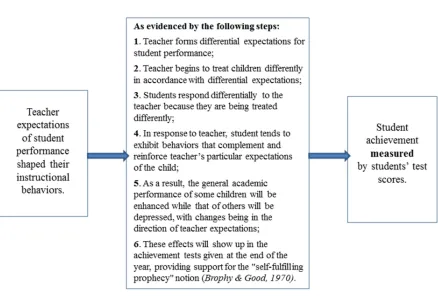
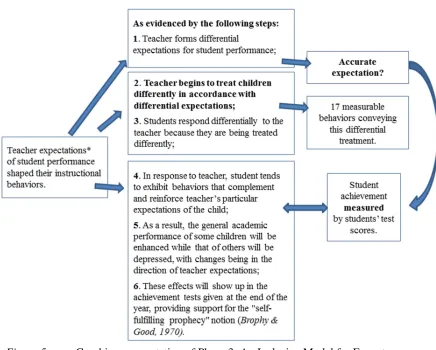
performance; (b) The teacher then begins to treat children differently in accordance with the teacher’s differential expectations; (c) The children respond differentially to the teacher because they are being treated differently by the teacher; (d) In responding to the teacher, each child tends to exhibit behavior which complements and reinforces the teacher’s particular expectations for the student; (e) As a result, the general academic performance of some children will be enhanced while that of others will be depressed, with changes being in the direction of teacher expectations; (f) These effects will show up in the achievement tests given at the end of the year, providing support for the "self-fulfilling prophecy" notion (p. 365-366).
Greatly influential to this field of research, this new research tool could quantify components of the expectancy effect from more of a personal stance in that the teacher behavior communicating expectancy effects was measured rather than the product of student IQ or test score. The impact on students as individuals was now taken into consideration—an element largely ignored in previous research models. This tool also brought to light the behavior evidence of expectancy effect in the more ecologically valid context of the classroom, where expectancy effects could now be tested for in the
naturally-occurring expectations of a teacher, instead of in the experimentally-induced expectations of teachers as before (Brophy & Good, 1970, 1974; Brophy, 1985; Weinstein, 2002).
This intense review of the mediation research further zoomed in on Step 2 of the “Brophy-Good model,” allowing for further delineation of exactly how teachers behave differently towards various students based on their already-formed differential
seventeen behaviors that indicate teachers’ differential treatment towards their high- and low-expectancy students (Brophy, 1983, 1985; Good, 1987). With numerous studies cited under each of the 17 behaviors, examples included differential treatment such as, teachers giving less “wait time” for their low students to answer; supplying low achievers with the answers or calling on a different student rather than rephrasing or repeating the question; seating high achievers closer to the teacher and low achievers farther away; demanding less from low achievers; providing less feedback to low achievers; interacting more privately with low achievers and more publicly with high achievers (Brophy, 1983, 1985; Good, 1987).
Overall, this specification of such discrete behavior was of enormous significance for teacher education (Weinstein, 2002). Especially in light of Brophy’s (1983) claim that a teacher’s differential treatment of students as a whole class may be more widespread and a “more powerful mediator of self-fulfilling prophecy effect on student achievement” than differential treatment of an individual student (p. 309).
Expectancy Confirmation Theory
of her students (Jussim, 1986; Jussim et al., 1998). Called impression accuracy, it describes the extent to which teachers’ expectations parallel the students’ actual characteristics or achievement (Jussim, 1986; Jussim et al., 1998). In this case, the accuracy of a teacher’s expectation is derived from the teacher’s strength of knowing her students (Jussim, 1986).
Accuracy of a teacher’s expectation also signifies a reasonable alternate
explanation to a self-fulfilling prophecy or bias as evidence that students actually confirm teacher’s expectations. Jussim (1986) described predictive accuracy as the extent to which the teachers’ expectations predict but do not cause student achievement. The accuracy and thereby validity of teachers’ expectations of students’ academic
achievement is extremely important because of the vast number of decisions teachers make daily about their students based on their academic performance (Demaray & Elliot, 1998). Similarly, given the important implications of teacher judgment, the question of their accuracy is critical. “Accurate assessment of students’ performance is a necessary condition for teachers to be able to adapt their instructional practices, to make fair placement decisions, and to support the development of an appropriate academic self-concept” (Sudkämp et al., 2012, p. 744).
subjective reality influences teacher evaluations of student achievement; another
important reason accuracy plays an important role when analyzing teacher expectations. Implicit Theories
An individual’s self-conception about basic beliefs such as intelligence are what Dweck and colleague’s prolific research identify as the implicit theories—the incremental and entity theories (Dweck, 1991, 2006, 2013; Dweck & Elliott, 1983; Dweck &
Leggett, 1988; Elliott & Dweck, 1988; Dweck et al., 1995; Hong et al., 1999). This theoretical framework supports this study’s categorization and comparison of the two levels of teacher mindset—fixed and growth. If you have a growth mindset (and prescribe to the incremental theory), a person believes that learning and fundamental attributes such as intelligence are malleable and can be developed with effort, motivation, and effective education and self-instruction. On the contrary, if you have a fixed mindset (and prescribe to the entity theory), a person believes that learning and fundamental attributes such as ones intelligence are simply fixed and do not change. Intelligence is seen as innate and constant; therefore, effort is futile and actually is an indication of lower ability. As a result, those with fixed mindsets tend to avoid challenges and situations that may be seen as potentially causing setbacks.
Definition of Terms
Teacher expectations: teacher expectations have been defined as everything from
Rubie-Davies, 2007, 2014). For this study, “(t)eacher expectations are inferences that teachers make about present and future academic achievement and general classroom behavior of students” (Brophy, 1998, p. ix).
Growth mindset: when a person believes that learning and ones intelligence are
malleable and could therefore be developed over time (Dweck, 1975, 1986, 1991, 2006, 2008, 2013, 2015; Dweck & Elliott, 1983; Dweck & Leggett, 1988; Elliott & Dweck, 1988; Dweck et al., 1995; Hong et al., 1999).
Fixed mindset: when a person believes that learning and ones intelligence do not
change because they are innate and constant (Dweck, 1975, 1986, 1991, 2006, 2008, 2013, 2015; Dweck & Elliott, 1983; Dweck & Leggett, 1988; Elliott & Dweck, 1988; Dweck et al., 1995; Hong et al., 1999).
Judgment accuracy: operationally defined and measured through the relative
standing of two sets of data, the teachers’ predictions and the students’ performances; accuracy as the agreement between teachers’ item-by-item predictions on the (test) and students’ actual item-by-item performance (Demaray & Elliot, 1998). In this study, teachers’ judgment accuracy was further operationalized as the intra-individual
correlation (Helmke & Schrader, 1987) between students’ predicted score and their actual performance, as computed across the students in each classroom on the tests of
mathematical skills and concepts.
Assumptions and Limitations
The assumption for Study 1 is that the teacher participants completed their
reflection.
Using a stratified, convenience sampling for Study 2 could pose a limitation and thereby restrict the generalizability of the results to other school districts and to other populations of teachers and students.
Significance of the Study
This study will contribute to the research base of teacher expectations and judgment accuracy concerning the importance of the cues teachers use to judge their students’ learning. As teachers’ judgment accuracy informs their teaching practice, which in turn affects student learning (Thiede et al., 2015), it is important to better understand the factors that affect monitoring accuracy—like cue use and mindset. Forming
expectations and monitoring student learning based on current and academically relevant information for each student is especially important in today’s classrooms. In light of the growing diversity in the population of every classroom, the diversity in students’ learning styles, and the diversity in both teachers’ and students’ backgrounds, accurate
expectations need to foster greater academic achievement and stronger accountability from both teacher and students. Revealing the cues that improve teachers’ judgment accuracy is especially significant for students for whom teachers have perpetually low expectations.
teaching could have a new dimension if a correlation exists between teachers’ mindset and their ability to accurately predict students’ achievement. Developing a better understanding of the factors that affect teachers’ judgment accuracy could inform the development of interventions to improve judgment accuracy, which could in turn improve student achievement.
A teacher’s deliberate reflection on her expectations and the cues behind them could be part of the solution to deficit modeling and inequities in the school system. Teachers who can accurately assess their students’ thinking, learning styles, strengths, and weaknesses have an overall stronger knowledge of their students, which in turn improves the teacher’s instruction and student learning (Carpenter et al., 1988).
Summary
Little research exists that specifically examines teachers’ mindsets that guide their expectations. Is a particular mindset, growth or fixed, more conducive to accurate
expectations and thereby judgments of students’ academic performance? If teachers form expectations arbitrarily or invalidly for any number of reasons, biases, or judgments, the students suffer academically and personally. It is a problem in education today if students are not acknowledged for the individuals that they are. Conversely, it is a blessing in the classroom when teacher expectations of student performance are based on accurate and academically relevant information.
CHAPTER 2: LITERATURE REVIEW OF TEACHER EXPECTATIONS
Introduction
On a warm, fall evening in September, elementary teachers from all over the area gathered for a professional development meeting on mathematical instruction. Teachers seemed refreshed after the summer, and pleased to start the new school year. Grade levels collaborated on mathematical strategies their students could use to solve particular
problems. Teachers shared their thoughts on students’ misconceptions and problem solving skills. They shared activities and instructional practices that have been effective in their classrooms, and they brainstormed on ways to apply the professional
development to their instruction and to meet their individual students’ needs. This positive collaboration and optimism was abruptly interrupted by one
At that moment, I realized the magnitude of the influence that teacher expectations and teacher perceptions of their students have on education. If teachers stereotype and judge their students based on characteristics out of students’ control, they have set a tone and expectation of underachievement. This sets off an endless ripple effect. I became fascinated with the workings of teacher’s minds, and how expectations form and can govern educator’s instructional practice and interactions.
Similarly, when teachers predict that certain students will receive a low grade simply because of their race, ethnic background, family income, and/or the grade they received on last year’s achievement for example, students’ have an unfair burden of proof to bear. I witnessed this dismal situation when looking at data from over one hundred elementary teachers. At the beginning of the school year, they were asked to make predictions of their students’ performance in mathematical skill and concepts. Teachers were asked to score from 0 to 5, as to how many correct answers each of their students would get. I noticed that several teachers predicted zeros for half of their students and then also assigned some 2’s and 3’s, and only a few 4’s and 5’s. The students receiving the 0’s were almost unanimously Hispanic last names, and when asked about a few of the other students receiving zeros, a few teachers attributed their predicted score to the students’ low socioeconomic status. Conversely, students receiving 4’s and 5’s were simply, “good kids.”
Why Do Teachers’ Expectations Matter?
Teacher expectations are a major factor behind these realities. Who a teacher is naturally affects how a teacher teaches. This paper will look specifically at teacher expectations and the literature behind it, how expectations were defined, conceptualized, theorized, and operationalized.
The expectations teachers hold for their students can directly and indirectly influence both the teacher’s instructional practice and the students’ academic
experiences. Expectations carry a lot of influential power, whether these expectations are high or low, and whether these expectations are accurately or inaccurately based on a number of criteria. How a teacher expects students to perform academically impacts the outcome of student performance. Teachers can form expectations at the whole-class level, where they do not have expectations specifically for each individual student, but rather for their entire class as a whole. Teachers can also form expectations at the individual-student level, where they can pinpoint and articulate their expectations that they hold specifically and uniquely for each individual student.
Overview of the Teacher Expectation Literature
Over the past five decades, teacher expectations have been under the microscopes of social science, education psychology, quantitative and qualitative methodology, sociology, ethnography, teacher education and policy, and more recently cognitive psychology. The academic expectations that a teacher holds for her students carry a lot of influential power both in her instructional practice and as a mediator of student
achievement (Brophy & Good, 1970, 1974; Good & Brophy, 2003; Rubie-Davies, 2014; Weinstein, 2002). The research grew from the need to acknowledge the existence of teacher expectations (especially for differential groups of students) as measured by their impact on student achievement. This need for proof of expectancy effects evolved into research that focused on the teachers themselves, and how they communicated their expectations as mediators in the expectancy process. Then a new paradigm shift occurred with the exploration of teacher expectations’ social-cognitive underpinnings, to better explain the complex findings of this complicated realm (Pajares, 1992; Bandura, 2001; Babad, 1998).
This shift from analyzing the existence of teacher expectations, to its
Teacher Expectation Research - Phase One
The first wave of landmark research studies on teacher expectations came during the mid-1960s, as a result of the field of education’s acknowledgment of the influential powers that teacher expectations have on student’s academic achievement. This
movement drew much of its empirical findings and theories from psychology (Weinstein, 2002), and it focused on demonstrating the actual existence of expectancy effect (Brophy & Good, 1970), and the construct of expectancy itself (Bandura, 2001).
Overview of the Need for Proof: Process-Product Model
The goal of this empirically driven research was to “define relationships between what teachers do in the classroom – the process of teaching – and what happens to their students – the products of learning” (Fang, 1996). In this original research context, teacher expectations were impersonally framed in the quantifiable process-product, input-output model. Students’ voices and roles were left out of this teacher-centered linear equation, because the main source of evidence about the very existence of expectancy processes only favored teacher expectations of performance as measured by students’ achievement scores.
Teacher Expectations Defined, Conceptualized, and Theorized
teachers and students undoubtedly left a clinical residue. Bandura (2001) states this early psychological theorizing of expectancy was “founded on behavioristic principles,
centered on an input-output model… human behavior was shaped and controlled automatically and mechanically by environmental stimuli” (p. 2).
This behavioral paradigm centered more specifically on the concept of self-fulfilling prophecy, the driving force behind this initial research on teacher expectations. Surprisingly, this concept was first coined and defined by the sociologist, Robert K. Merton, in 1948. Merton drew from “the dean of American sociologists, W. I. Thomas’s theorem basic to the social sciences stating that ‘If men define situations as real, they are real in their consequences’” (Merton, 1948, p. 193). The self-fulfilling prophecy is “a
false definition of the situation evoking a new behavior, which makes the original false
conception come true” (Merton, 1948, p. 195, italics in original). Merton also constructed the model through which this self-fulfilling prophecy manifests: first the beliefs about a situation, then the behaviors that bring about a confirming response, and then the confirming response itself. The hypothesis that teacher expectations can function as self-fulfilling prophecies was the ignition behind this initial stage of research on expectancy effects (Brophy, 1998).
Demonstrating the Expectancy Effect in the Classroom
Twenty years later, the existence of Merton’s concept of self-fulfilling prophecy was tested in the classroom by the iconic and controversial Pygmalion in the Classroom study by Robert Rosenthal and Lenore Jacobson (1968). This principal-teacher
advanced research design for its time, this study was a randomized experiment in a natural setting (school). Modeled after experiments performed with animals in and outside of laboratories, Pygmalion in the Classroom challenged the possibility that the
experimenter expectancy effect exists in the classroom.
When the experimenter sees what he expects to see, this is the experimenter
expectancy effect, the unconscious experimenter bias, and also called the interpersonal
expectancy effect (Rosenthal & Jacobson, 1968; Brophy & Good, 1970, 1974; Rosenthal,
1997; Babad, 1998). “The unintentional expectations that…teachers…bring to
the…classrooms – can wield significant influence on individuals” (Rosenthal, 1997, p. 1). Rosenthal and Jacobson wondered “about the beliefs created in schools – teachers, when they are told a child is educable but slow, deserving but disadvantaged” (Rosenthal & Jacobson, 1968, p. 44). Was the expectancy effect at play in the classroom?
Experimental Study: Pygmalion in the Classroom
To find out the answer to their question, Rosenthal and Jacobson (1968) tested the hypothesis that in any random classroom, a correlation exists between teachers’
expectations and their students’ achievement. They designed the Oak School Experiment “specifically to test the proposition that within a given classroom those children from whom the teacher expected greater intellectual growth would show such greater growth” (Rosenthal and Jacobson, 1968, p. 61), and counter opposing themes and findings of their day, where “children defined as disadvantaged are expected by their teachers to be unable to learn” (p. 53). Because of this deficit-model thinking so embedded in the culture of this school (and arguably in many schools then and now), their study aimed at
Classroom sought evidence for whether or not a teacher’s expectations (high, in this case)
made any difference in either the teacher’s evaluation of her students or in their actual performance. Rosenthal and Jacobson wanted to verify whether a teachers’ high
expectations of students’ academic performance actually led to the students performing better academically.
Setting the Stage
At the low-class community “Oak School,” twenty percent of the elementary students were chosen from a table of random numbers to be the test group. To establish this group, Rosenthal and Jacobson pretested all of the students at “Oak School” with the (fictitious) “Harvard Test of Inflected Acquisition” IQ test at the end of the summer of 1964. Entirely unrelated to the actual test scores, the top 20 percent scorers were randomly chosen for this experiment and their names were distributed to their new teachers. Eighteen teachers and their classrooms were studied: one teacher from grade levels first through sixth grade, and one teacher at these grade levels from the three tracks, fast, medium, and slow. (Rosenthal noted that students at “Oak School” were grouped and tracked like this, according to ability based on reading performance, with a disproportionate number of Mexican students and students from low-income families in the low group.)
to academically bloom; all based on the IQ test given and scored independently by Rosenthal and Jacobson (1968, p. 66).
Teachers were not allowed to discuss this phenomenon with any of their students (including those labeled as academic spurters) or with the academic spurters’ parents. Because these students were chosen completely at random, what is most fascinating about this study is that “(t)he difference between the children earmarked for intellectual growth and the undesignated control children was in the mind of the teacher” (p. 70). It was up to the teachers to implement the “program of intellectual change” that this experiment set out to test.
Findings
approval. Rosenthal and Jacobson came back and re-tested all the students two years later to test reliability of their findings.
Historical Impact
This study “created an intense storm, which still reverberates in educational circles, and opened a vast research domain focusing on teacher expectancies” (Babad, 1998, p. 184). The Pygmalion study demonstrated the existence of self-fulfilling prophecy in the positive direction in the classroom setting. This was evidenced by the differentiation of the teachers’ expectations (and subsequent preferential treatment and instruction) regarding the intellectual performance of these allegedly ‘special’ children, which actually led to measurable changes in the intellectual performance of these students selected completely at random without any relation to their actual test results.
Yet even more shocking was the discovery that the teachers unfavorably judged the students not expected to make gains in their IQ (those students in the control group) (Rosenthal & Jacobson, 1968; Rosenthal, 1997). This led to the classification of the negative implication of self-fulfilling prophecies: the “Golem” effect where the teacher’s negative expectations may actually harm low achievers and minimize their performance below their intellectual potential (Rosenthal & Jacobsen, 1968; Babad, Inbar, &
Rosenthal, 1982; Rosenthal, 1997; Babad, 1998). Because this study only manipulated
positive expectations, it did not even approach the empirical question of the effects of
negative expectations (Jussim et al., 1998). “Apparently there were hazards to
Oak School Experiment and the subsequent book, Pygmalion in the Classroom:
Teacher Expectation and Pupils’ Intellectual Development, have indelibly left their
marks on educational psychology, the research on teacher expectations, and education as a whole. This study brought to light the need for more empirical evidence of the equality of educational opportunities by strongly demonstrating that teacher expectations had a self-fulfilling expectancy effect on students’ intelligence, and by showing the existence of teachers’ differential behavior associated with high and low expectations. For decades now, the term Pygmalion effect is widely used synonymously with self-fulfilling
prophecy in the positive direction, demonstrating the importance of this experiment and book.
This study fit Merton’s model from 1948 perfectly of how the self-fulfilling prophecy comes to fruition: first the beliefs about a situation (teachers were told some of their students were particularly bright, a false expectation rendered through the use of psychological tests), then the behaviors that bring about a confirming response (teachers change their behavior to better support these allegedly academically talented students), and then the confirming response itself (some of these particular students’ achievement scores rose).
Criticism
whereas their impact on achievement they saw as more probably. When Rosenthal and Jacobson re-tested two years later, the results did not show long-term evidence of this experimental manipulation, other than the students who were in fifth grade during the year of the experiment (Elashoff & Snow, 1971, as cited by Weinstein, 2002). The validity of the IQ test was also scrutinized, and administration of the same test was questioned (see Thorndike, 1968; Jensen, 1969; Elashoff & Snow, 1971).
Heavy criticism fell on Rosenthal and other researchers who set out to replicate this study to find further evidence that induced teaching expectations influence student academic performance. When these replication experiments never recreated similar achievement gains in any students, Brophy (1983) astutely credited this inability for replication to the teachers’ newly gained awareness of “phony information” brought on by the Pygmalion study, rendering the replication experiments less credible (p. 632).
Babad (1978) defends the harsh criticism this study received when he said “this study may or may not have been premature and overgeneralized, but the intensity and emotional tone of the attacks was grossly exaggerated, indicating, in my opinion, some underlying problems and biases on the part of psychologist” (p. 388). Yet in the same review, Babad also wittingly sheds light on the flipside of the teacher expectancy effect and self-fulfilling prophecy when expectations are negative (the Golem effect, as described earlier). Clearly the existence of the expectancy effect has been demonstrated for those students slated to intellectually bloom due to implanted positive expectations. But everyday influences work in the opposite direction, where “people are
Thus far, the case has been made that expectations in general, and teacher expectations in particular, are educationally relevant. In spite of later criticism, the
Pygmalion study elucidated the impact teacher expectations can have on student
achievement. I highlight this study because it serves as the benchmark study of teacher expectancy effects and continues to be ubiquitously cited.
Inspiring Further Research
To assimilate the influential magnitude of self-fulfilling prophecies, Rosenthal and Rubin (1978) developed and ran a meta-analysis of 345 experimental studies on self-fulfilling prophecies, which they also referred to now as interpersonal expectancy effect. Similar to experimenter effect explained earlier with the Pygmalion study, interpersonal expectancy effect looked at how the expectations held by teachers, therapists, and employers for their students, clients, and workers might also come to serve as
interpersonal self-fulfilling prophecies (Rosenthal & Rubin, 1978). These studies under analysis were performed across multiple settings, some laboratory and some “everyday life situations” (p. 377), including schools and therapist offices.
They categorized these studies under eight domains of research, such as studies on effects of sensory restriction under the domain of laboratory interviews; latency of word association under the domain of reaction time; and IQ test scores, verbal
.55), psychophysical judgments (d = 1.05), and everyday situations (d = .88). (As per Fields (2014), the effect size is a standardized measure of the magnitude of observed effects, as measured by the difference between the means of the two comparison group divided by the within-group standard deviation.)
They concluded that after examining the results of these 345 studies of
interpersonal self-fulfilling prophecies, some clear conclusions emerged. “The reality of this phenomenon is beyond doubt and the mean effect size is not trivial… the estimated grand mean effect size over eight different areas of research was 0.70” (Rosenthal & Rubin, 1978, p. 385).
Yet with only about one-third of these studies successfully showing the existence of self-fulfilling prophecy, critics claimed the phenomenon did not exist; while
proponents took the glass-half-full stance claiming this was evidence of self-fulfilling prophecy because, if only chance differences were occurring, replications would only succeed about 5 percent of the time (Jussim et al., 1998). All the while, this study served as the development of the meta-analysis statistical technique, which is now widely used to summarize the results of multiply studies (Rosenthal & Rubin, 1978; Harris & Rosenthal, 1985).
from the expectations teacher form organically from observing and interacting with their students (Dusek, 1975). In the classroom setting, Dusek (1975) concluded that there was much more widespread evidence suggesting expectancy effects in the ordinary classroom rather than bias expectancy induced by an experiment. This next strand of research followed Dusek’s advice and looked at naturally occurring expectations and their effects in the classroom. This distinction between falsely formed and naturally formed
expectations was an important turning point in the expectation research (Jussim et al., 1998).
Need For a New Paradigm
Similar to the criticism of the Pygmalion study’s overgeneralization of the
expectancy effect, this extensive research demonstrating the existence of this effect came under fire for its repetitiveness and overenthusiasm for proof. The prolific amount of research that had surfaced was criticized for being “limited to statistical procedures” and thereby “inadequately represents a body of research by placing undue emphasis on the mere existence of the expectancy effect, to the apparent exclusion of its meaning and significance… in the absence of theoretical statements tying together research explaining the phenomenon” (Adair, 1978, p. 386).
variations in IQ scores, which “merely give indications of potential, not of process” (Rist, 1970, p. 417, italics in original).
It was time for the next strand of research and a departure from the quantitative process-product model of research that narrowly defined teacher expectations as perceptions about students’ performance and aptitude, impersonally operationalized by students’ test scores or IQ. This next strand of research took place concurrently with its process-product model just described, but their tenets, approach, and application differed greatly. It was time to move away from the backdrop of the laboratory and into the more ecologically valid context of the classroom, where expectancy effects could be tested for in the natural expectations of a teacher instead of in experimentally induced expectations of teachers (Brophy, 1983; Dusek, 1975; Weinstein, 2002).
Summary of the Need for Proof: Process-Product Model
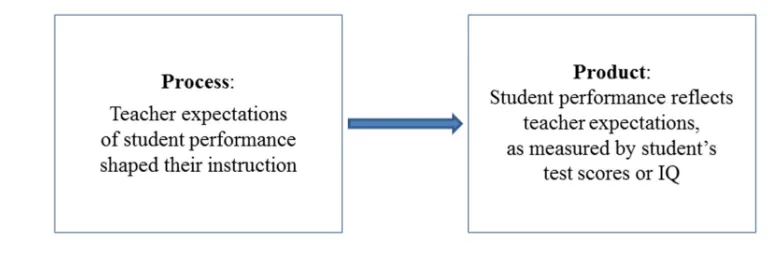
In summary, this first phase of expectation research focused on demonstrating the existence of the teacher expectancy effect through a process-product model (Figure 1). The process of teaching led to a change in the product of student achievement, thereby demonstrating expectancy effects. Teacher expectations were defined as teacher perceptions about students’ performance and aptitude, and thereby quantified and
effects, and the next wave of research aimed at looking deeper into the reasons behind teacher expectancy effects.
Figure 3. Graphic representation of Phase 1: The process-product model of teacher
expectancy effects theory.
In this research model, teacher expectations were defined as teacher perceptions about students’ performance and aptitude, and thereby quantified and operationalized by test scores (Rosenthal & Jacobson, 1968; Brophy & Good, 1970; Brophy, 1983).
Teacher Expectation Research - Phase Two
With the existence of teacher expectancy effect clearly demonstrated, a new path in research set out to fill in the holes left empty by the empirically driven research on self-fulfilling prophecy. Echoing the criticism of Pygmalion study and the process-product approach to expectancy research, this next phase held teacher behavior in their classroom setting as their main focus (Brophy & Good, 1970, 1974).
Overview of Expectancy Mediation
Researchers now explored the concept of expectancy mediation—how a teacher actually communicates her expectations—looking for the intervening processes
centered on looking for data on the causal mechanisms at work with teacher expectation effects, which was merely mentioned in Rosenthal and others’ work (Brophy, 1983).
Brushing the surface and without investigating causal connection, Rosenthal and Jacobson’s Pygmalion study (1968) documented how teachers differentiated their behavior based on expectations in four areas: socioemotional climate (smiling,
friendliness, for example), input (actual distance of the student’s seat from the teacher, time given to complete problems, and assignment differentiation), output (calling on students, accuracy and length of feedback, wait time for students’ response to the teacher’s question), and affective feedback (amount of criticism or encouragement, pity or anger directed at perceived low performers). But now it was time to conceptualize the behaviors that communicate the expectancy effects (Good & Brophy, 1970).
Teacher Expectations Defined, Conceptualized, and Theorized
This conceptualization began when Brophy and Good quantified teachers’
behavioral analysis in 1970, igniting a long-lasting wave of research. Teacher expectation was still defined as the teacher’s perception of student performance, but this next phase of research explored the actual process of how the teacher expectation communication might work in a classroom in six steps. Included in this process of expectancy mediation, teacher’s differential treatment, varying learning time, and overall inconsistent behavior on the part of the teacher communicated such perceptions. Their seminal paper entitled
Teachers’ Communication of Differential Expectations for Children’s Classroom
Performance: Some Behavioral Data did so by providing the research field with an
Researchers, teacher educators, and administrators could now study and actually code the dyadic interactions between classroom teachers and each individual student. Their initial study and use of the observational tool was the first naturalistic study of teacher interaction with high- and low-achieving students in the classroom, following Rosenthal and Jacobsen’s (1968) Pygmalion in the Classroom (Good, 1987).
Good and Brophy’s (1970) teacher-child dyadic interactions model provided a coding system of six steps for how the teacher expectation communication process might work in a classroom. This model for observational work addressed all dyadic contacts between the teacher and the individual student. Therefore, the teacher-child dyad became the unit of analysis, rather than the whole class as a group, making this observational tool especially sensitive to and precise for the study of communication of differential teacher expectations. Good and Brophy firmly believed the observational system had to analyze the teacher-student interaction in order to capture the true behavioral mediation of teacher expectancy effect, because “teachers do treat children differently” (p. 132).
teacher expectations; (f) These effects will show up in the achievement tests given at the end of the year, providing support for the "self-fulfilling prophecy" notion (p. 365-366).
Greatly influential to this field of research, this new research tool could quantify components of the expectancy effect from more of a personal stance in that the teacher behavior communicating expectancy effects was measured rather than the product of a test score. The impact on students as individuals was now taken into consideration, an element largely ignored in previous research models. This tool also brought to light the behavior evidence of expectancy effect in the more ecologically valid context of the classroom, where expectancy effects could now be tested for in the naturally-occurring expectations of a teacher, instead of in the experimentally-induced expectations of teachers as before (Brophy & Good, 1970, 1974; Brophy, 1985; Weinstein, 2002).
With its six steps, Good and Brophy’s (1970) teacher-child dyadic interactions model further outlined and more explicitly detailed Merton’s (1948) original model of how the self-fulfilling prophecy manifests. First, the teacher forms differential
expectations for student performance, then that teacher treats students differently in accordance with the teacher’s differential expectations, the students react differentially to the teacher because the teacher is treating them differently, then in response to the
teacher, each student tends to behave in ways that compliment and reinforce the teacher’s specific expectation for the student. This results in the general academic performance of certain students being enhanced, while that of other students will be lowered, with
Experimental Study
Using classroom interaction analysis and their new teacher-child dyadic
interactions model (Good & Brophy, 1970) as their observation instrument, Brophy and
Good (1970) observed the dyadic interactions between students and teachers in four first grade classrooms, in a small Texas school district, serving rural and lower-class
population, as well as a large military base nearby. The ethnic composition was representative of the general population of the area with 75% Anglo-American, 15% Mexican-American, and 10% Afro-American. More specifically, Brophy and Good observed the dyadic interactions targeting the six highest and six lowest students, both boys and girls, as rank-ordered by their teacher according to “achievement… vague instructions to encourage the teachers to use complex, subjective criteria in making their judgments” (p. 366).
This initial study focused on the second step of their model, where “given
differential teacher expectations, how are they communicated to the children in ways that would tend to cause the children to produce reciprocal behavior?” (p. 366). Teachers were not told their behavior was being observed, instead that the study was focused on the classroom behavior of the children at different levels of achievement.
Findings
Using their observation instrument, they were able to code and analyze the sequence of interaction patterns, discerning between teacher-initiated and student-initiated behaviors, in addition to capturing the different types of teacher behavior