R E S E A R C H A R T I C L E
Open Access
Pre-cooling for endurance exercise performance
in the heat: a systematic review
Paul R Jones
1,2, Christian Barton
1, Dylan Morrissey
1, Nicola Maffulli
1*and Stephanie Hemmings
1Abstract
Background:Endurance exercise capacity diminishes under hot environmental conditions. Time to exhaustion can be increased by lowering body temperature prior to exercise (pre-cooling). This systematic literature review synthesizes the current findings of the effects of pre-cooling on endurance exercise performance, providing guidance for clinical practice and further research.
Methods:The MEDLINE, EMBASE, CINAHL, Web of Science and SPORTDiscus databases were searched in May 2012
for studies evaluating the effectiveness of pre-cooling to enhance endurance exercise performance in hot environmental conditions (≥28°C). Studies involving participants with increased susceptibility to heat strain, cooling during or between bouts of exercise, and protocols where aerobic endurance was not the principle performance outcome were excluded. Potential publications were assessed by two independent reviewers for inclusion and quality. Means and standard deviations of exercise performance variables were extracted or sought from original authors to enable effect size calculations.
Results:In all, 13 studies were identified. The majority of studies contained low participant numbers and/or absence of sample size calculations. Six studies used cold water immersion, four crushed ice ingestion and three cooling garments. The remaining study utilized mixed methods. Large heterogeneity in methodological design and exercise protocols was identified. Effect size calculations indicated moderate evidence that cold water immersion effectively improved endurance performance, and limited evidence that ice slurry ingestion improved performance. Cooling garments were ineffective. Most studies failed to document or report adverse events. Low participant numbers in each study limited the statistical power of certain reported trends and lack of blinding could potentially have introduced either participant or researcher bias in some studies.
Conclusions:Current evidence indicates cold water immersion may be the most effective method of pre-cooling to improve endurance performance in hot conditions, although practicality must be considered. Ice slurry ingestion appears to be the most promising practical alternative. Interestingly, cooling garments appear of limited efficacy, despite their frequent use. Mechanisms behind effective pre-cooling remain uncertain, and optimal protocols have yet to be established. Future research should focus on standardizing exercise performance protocols, recruiting larger participant numbers to enable direct comparisons of effectiveness and practicality for each method, and ensuring potential adverse events are evaluated.
Keywords:Pacing, thermoregulation, internal cooling, cooling garment, cold water immersion, ice slurry ingestion
* Correspondence: [email protected]
1Centre for Sports and Exercise Medicine, William Harvey Research Institute, Bart’s and the London School of Medicine and Dentistry, Queen Mary University of London, Mile End Hospital, Bancroft Road, London E1 4DG, UK Full list of author information is available at the end of the article
Joneset al.BMC Medicine2012,10:166
http://www.biomedcentral.com/1741-7015/10/166
Background
Endurance exercise capacity has been reported to be diminished when exercising in hot environmental condi-tions, compared with normal and cold conditions [1-3]. A recent review evaluated the data of six International Association of Athletics Federations (IAAF) Gold Labeled Road Marathon races from 2001 to 2010 to determine which environmental factors have the largest impact on race performance [4]. The authors reported a median optimum environmental temperature of 6.2°C for men and 6.8°C for women. There was a consistent slowing of 0.03% for every 1°C increase in temperature above optimum and average performance decreases of -17.7% and -12.4% for men and women at +20°C above optimum. The authors concluded that temperature is the main environmental factor influencing marathon performance. Hot environmental temperatures also limit cycling performance. Peiffer and Abbiss [3] investigated cyclists performing a 40 km time trial in a heat chamber at different environmental temperatures. The authors reported a significantly lower mean power output for the participants at 37°C compared to at 17°C, 22°C and 27°C. A separate study reported that higher environ-mental temperatures reduce the time taken to reach volitional fatigue when cycling at a fixed intensity (70% maximal aerobic capacity (VO2max)). Mean time to
volitional fatigue decreased by 30 minutes between trials performed at 21°C (81.2 min) and 31°C (51.6 min) [1]. Although not all endurance events follow a linear model of performance decline with increasing environmental temperature [5], it is apparent that hot environmental temperatures above an optimum impair endurance exer-cise performance.
Understanding the physiological basis as to why the capacity to perform endurance exercise is reduced in hot (≥28°C) environments is needed to develop interventions that may improve performance. It was previously postu-lated that exhaustion in hot conditions was a result of cir-culatory failure (a reduction in cardiac output and muscle blood flow) diminishing the drive for further exercise [6]. However, Nielsenet al.[7] found evidence to challenge this. In this study athletes exercised at 60% VO2max until
exhaustion for 9 to 12 days in 40°C heat. The authors reported that exhaustion coincided with a core tempera-ture of 39.7 ± 0.15°C. With acclimation, the athletes took progressively longer to reach this core temperature. No reduction in cardiac output was found at exhaustion and the authors concluded that high core temperature rather than circulatory failure was the limiting factor. However, thermoregulation and cardiovascular functioning are not separate entities and a number of physiological adapta-tions occurred with acclimation, such as earlier onset of the sweating response and improved cardiovascular effi-ciency, reducing cardiovascular strain and slowing the rate
of rise of core body temperature, which likely contributed to the lower core body temperature at a given point of exercise reported in this study [7]. Another proposed hypothesis was that fatigue may arise from decreased sub-strate availability given that there is an observed increase in the rate of muscle glycogen utilization, and therefore depletion, when exercising in the heat, though this seems unlikely [3,8]. Febbraioet al.[8] reported that carbohy-drate ingestion during cycling at 70% VO2max in 33°C
heat produced no ergogenic effect compared to a sweet placebo, nor did the athletes’blood glucose fall below rest-ing levels durrest-ing the trial. They concluded that fatigue was related to thermoregulatory factors as opposed to decreased substrate availability.
Current hypotheses propose that the critical limiting factor for exercise performance in the heat is an ele-vated core body temperature, at which an athlete will have to reduce their exercise intensity or risk heat-related injury [9]. It is thought that pre-cooling in hot environments will improve endurance exercise perfor-mance by lowering an athlete’s preliminary core body temperature, thereby increasing the margin between the initial core temperature and temperatures at which ath-letic performance is affected. A lower core body tem-perature at a given point of exercise has a similar effect to that which occurs with acclimation [7] and enables athletes to exercise at higher intensities during self-paced exercise (or for a longer duration during constant pace exercise). A consistent core temperature at volun-tary fatigue has also been observed across fitness groups [10]. The higher environmental heat load in hot condi-tions augments the rate of rise in core body tempera-ture, reducing the time taken for an athlete to reach their limiting temperature [11].
The hypothesized link between increased core tem-perature and reduced endurance exercise performance has led to the proposal and evaluation of a number of cooling methods prior to sports participation (that is, pre-cooling). It is thought that pre-cooling in hot envir-onments will improve endurance exercise performance by lowering an athlete’s preliminary core body tempera-ture and increasing the margin between the initial core temperature and critical limiting core temperature at which athletic performance declines [12]. An athlete would therefore have a lower core body temperature at a given point of exercise, similar to the effect that occurs with acclimation reported in the Nielsen et al. study [7], enabling athletes to exercise harder for longer. Early pre-cooling studies evaluated the effectiveness of methods such as cold water baths and cooling fans, with positive outcomes for endurance exercise performance reported [13,14]. However, clinical application of these methods is made difficult by the need for transportation and/or installation of equipment and facilities needed.
Joneset al.BMC Medicine2012,10:166
http://www.biomedcentral.com/1741-7015/10/166
The potential of pre-cooling to improve sporting per-formance led scientists at the Australian Institute of Sport (AIS) to develop a cooling jacket for in-competition athletes, constructed from neoprene and designed to be packed with ice, prior to the Atlanta Games 1996, as a more practical and convenient alternative to the cold water baths and cooling fans used in laboratory studies. Of the 43 surveyed after Atlanta, all athletes felt that the jackets made a positive contribution to their performance at the Games [15]. Since this practical innovation, other novel pre-cooling strategies have been proposed and investigated, such as ice slurry ingestion [16-19].
Pre-cooling: theoretical mechanism of action
Different pre-cooling interventions are proposed to act via different mechanisms to reduce core body tempera-ture and thus cool the body prior to exercise.
Cold water immersion
When immersed in water of an ambient temperature below the human thermoneutral zone in water (33 to 34°C), the human body will attempt to maintain its core temperature by reducing skin blood flow (tion) [20]. Below this thermoneutral zone, vasoconstric-tion in isolavasoconstric-tion is not sufficient to maintain core temperature, so metabolic heat production is increased. However, if the cold stimulus is of a sufficiently low temperature and applied for long enough, heat loss will exceed heat production, causing a reduction in core temperature and increasing heat storage capacity [21]. Ice slurry ingestion
The phase change of solid ice (H2O) to liquid water
requires a large transfer of heat energy into the system, known as the‘enthalpy of fusion (melting)’of ice. Merrick et al.[22] reported that cold modalities that undergo phase change caused lower skin surface and intramuscular temperatures than modalities that do not undergo phase change. Therefore, when ice slurry is ingested, heat energy is transferred into the slurry mix from the surrounding tis-sues, rather than stored in the body, reducing the core temperature. A study investigating intravenous cooling in swine reported that ice slurry (-1°C to 0°C) cooled brain temperature more rapidly and effectively than chilled sal-ine (0°C to 1°C) [23], which suggests that ice slurry may potentially be effective as a pre-exercise pre-cooling modality.
Cooling garment
Cooling garments primarily reduce skin temperature. Common strategies include wearing a vest that covers the torso with pockets for ice packs (ice vest) [24-26], or wearing a waist-length polyester blend shell with sleeves and a hood that has a phase change material sewn in (cooling jacket) [17,27]. Kay et al. [28] sug-gested that lowering skin temperature without a conco-mitant reduction in core body temperature prior to
exercise, increasing the thermal gradient between core and skin, afforded participants a lower core tempera-ture during exercise due to increased core to skin heat loss.
Although there is a significant body of work regarding pre-cooling and its effects on athletic performance, the literature concerning pre-cooling for endurance exercise performance has yet to be reviewed systematically and it is yet to be established which pre-cooling modality or mechanism of body cooling is the most effective. Two reviews provide comprehensive descriptions of pre-cool-ing and its application to sports performance [29,30]. However, neither combined available data to systemati-cally analyze or compare different pre-cooling strategies. The conclusions drawn are therefore more open to bias than those of a systematic review and comparisons of methods subjective. Furthermore, both reviews were published before more recent pre-cooling strategies such as ice slurry ingestion had been investigated and reported on. Therefore, a more up-to-date evidence-based review, less open to bias is warranted.
Recently, Ranalliet al.[31], evaluating the effect of body cooling on aerobic and anaerobic exercise perfor-mance, concluded that pre-cooling conferred limited benefit to intermittent or anaerobic exercise perfor-mance. For the ‘aerobic’ section of the review, they included nine studies, yet only two of these studies evalu-ated cooling prior to exercise (pre-cooling). Considering practical limitations to cooling during competition for many sports, and the number of additional studies evalu-ating the effects of pre-cooling on endurance exercise performance in the literature, a systematic review of all studies where participants were cooled prior to exercise is required. Therefore, the aims of this systematic review were to (i) summarize the effectiveness of different pre-cooling procedures to improve endurance exercise per-formance by comparing, critiquing and combining results from each study; (ii) enable evidence-based decisions on appropriate pre-cooling athlete management to be made; and (iii) provide guidance for future research evaluating the efficacy of pre-cooling strategies which aim to enhance endurance exercise performance.
Methods
Inclusion and exclusion criteria
Repeated measures crossover studies and randomized controlled trials comparing a pre-cooling method(s) to control or no intervention in healthy adults were consid-ered for inclusion. The pre-cooling method could be any that cooled a participant prior to commencing an endur-ance exercise protocol or event. A measure of aerobic endurance was required to be one of the outcome mea-sures in each study. The ambient environmental tem-perature during the performance trials had to be at or
Joneset al.BMC Medicine2012,10:166
http://www.biomedcentral.com/1741-7015/10/166
above the human thermoneutral zone of environmental temperatures (≥28°C) [32,33].
Unpublished studies, case series studies, non-peer-reviewed publications, studies not involving humans, reviews, letters, opinion articles, articles and abstracts not in English were excluded. Studies that included par-ticipants with pathological conditions known to increase susceptibility to heat strain, such as spinal cord injury [34], were also excluded, as were studies that attempted to cool participants during exercise, those that used intermittent or team-based sport exercise protocols or protocols that primarily stressed the anaerobic energy pathway. Unpublished research was not sought. Although this may potentially lead to publication bias [35], it was deemed impractical to identify all unpub-lished work on pre-cooling and endurance exercise per-formance from all authors and institutions around the world.
Search strategy
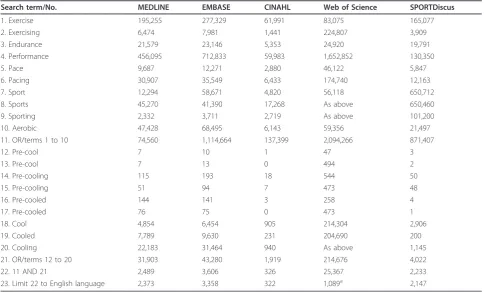
The following databases were searched in May 2012 (week 4): MEDLINE (Ovid Web, 1948 to 2012 and Medline In-process and Other Non-Indexed Citations), EMBASE (1974 to 2012), CINAHL (1981 to 2012), Web of Science (1899 to 2012) and SPORTDiscus. Key terms
used in the search strategy and results of the search are shown in Table 1. Reference lists and lists of citing arti-cles were searched to ensure that no relevant studies had been missed by the search strategy. No additional papers were identified.
Review process
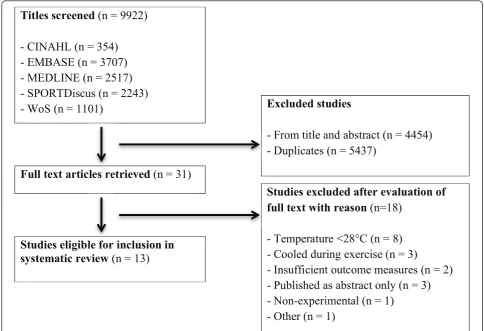
All titles and abstracts were downloaded into EndNote X4 (Thomson Reuters, Philadelphia, PA, USA) giving a set of 9922 citations. The set was crossreferenced and any duplicates were deleted, leaving a total of 4454 cita-tions. Each title and abstract were evaluated for potential inclusion by two independent reviewers (PRJ and CB) using a checklist developed from the inclusion/exclusion criteria outlined above. If insufficient information was contained in the title and abstract to make a decision on a study, it was retained until the full text could be obtained for evaluation. Any disagreements regarding studies were resolved by a consensus meeting between the two reviewers, and a third reviewer (DM) was avail-able if necessary.
Methodological quality assessment
Quality assessment was performed using the Physiother-apy Evidence Database (PEDro) Scale, which is a valid
Table 1 Search strategy and results from each included database
Search term/No. MEDLINE EMBASE CINAHL Web of Science SPORTDiscus
1. Exercise 195,255 277,329 61,991 83,075 165,077
2. Exercising 6,474 7,981 1,441 224,807 3,909
3. Endurance 21,579 23,146 5,353 24,920 19,791
4. Performance 456,095 712,833 59,983 1,652,852 130,350
5. Pace 9,687 12,271 2,880 46,122 5,847
6. Pacing 30,907 35,549 6,433 174,740 12,163
7. Sport 12,294 58,671 4,820 56,118 650,712
8. Sports 45,270 41,390 17,268 As above 650,460
9. Sporting 2,332 3,711 2,719 As above 101,200
10. Aerobic 47,428 68,495 6,143 59,356 21,497
11. OR/terms 1 to 10 74,560 1,114,664 137,399 2,094,266 871,407
12. Pre-cool 7 10 1 47 3
13. Pre-cool 7 13 0 494 2
14. Pre-cooling 115 193 18 544 50
15. Pre-cooling 51 94 7 473 48
16. Pre-cooled 144 141 3 258 4
17. Pre-cooled 76 75 0 473 1
18. Cool 4,854 6,454 905 214,304 2,906
19. Cooled 7,789 9,630 231 204,690 200
20. Cooling 22,183 31,464 940 As above 1,145
21. OR/terms 12 to 20 31,903 43,280 1,919 214,676 4,022
22. 11 AND 21 2,489 3,606 326 25,367 2,233
23. Limit 22 to English language 2,373 3,358 322 1,089a 2,147
a
Search also refined by appropriate categories: sports science; physiology; public, environmental and occupational health; cardiac cardiovascular systems, respiratory system.
Joneset al.BMC Medicine2012,10:166
http://www.biomedcentral.com/1741-7015/10/166
measure of the methodological quality of clinical trials [36]. Each study is rated according to ten separate cri-teria on the PEDro scale that assess a study’s internal validity and statistical reporting, then totaled to give a score out of 10. An additional criterion,‘sample size cal-culation’, was included in the quality assessment as the authors felt it to be an important component of study methodology. This criterion did not contribute to the PEDro score. Two reviewers (PRJ and CB) applied the PEDro scale to each included study independently, and any scoring discrepancies were resolved through a con-sensus meeting, with a third reviewer (DM) available if necessary. Studies were considered high quality if PEDro scores were greater than 6, and low quality if 6 and below.
Statistical analysis and data synthesis
Means and standard deviations for all continuous data were extracted and effect sizes (Cohen’s d) (with 95% CIs) calculated to allow comparison between the results of each study. Data were pooled using RevMan for Mac version 5.1.2 (The Nordic Cochrane Centre, Copenhagen, Denmark). If inadequate data were available from original studies to complete effect size calculations, attempts were made via email to contact the study’s corresponding author for the required data. The presence of publication bias was determined by evaluating funnel plot asymmetry graphically [37,38].
Definitions for ‘levels of evidence’ were guided by recommendations made by van Tulder et al. [39] and are as given below:
‘Strong evidence’= consistent findings among multiple high quality randomized controlled trials.
‘Moderate evidence’= consistent findings among mul-tiple low quality randomized controlled trials and/or non-randomized controlled trials, or one high quality randomized controlled trial.
‘Limited evidence’ = findings from one low quality randomized or non-randomized controlled trial.
‘Conflicting evidence’= inconsistent findings among multiple trials.
Results
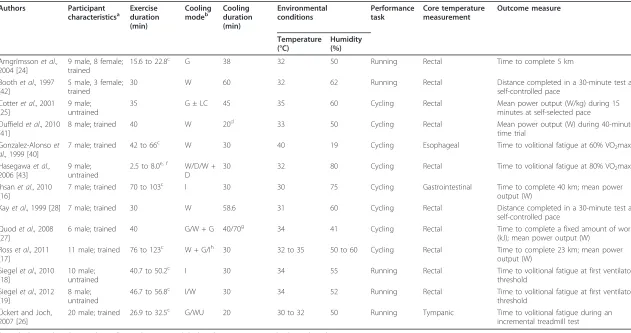
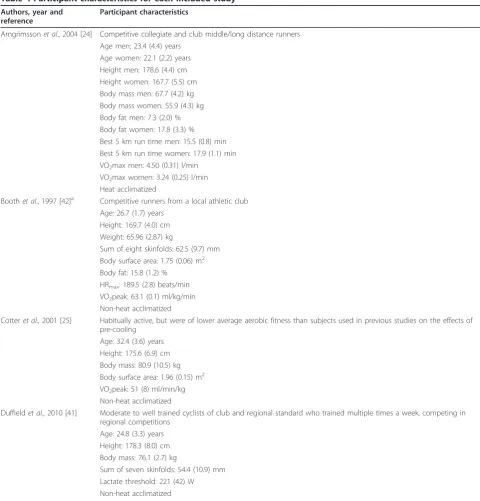
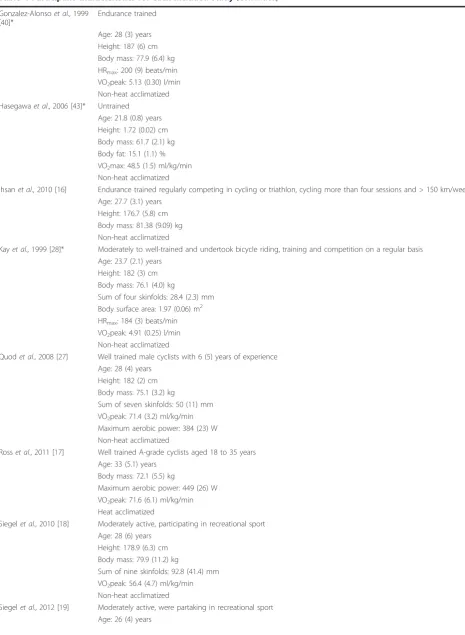
Following the search, 13 studies were deemed appropri-ate for inclusion (Figure 1). Table 2 shows the partici-pant characteristics and investigation protocol for each included study.
Quality assessment of included studies
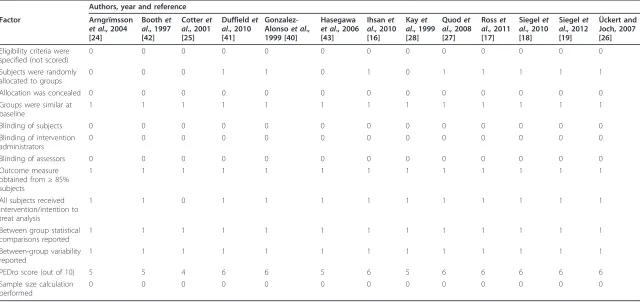
Of the 13 studies included in the review, 8 studies attained a PEDro score of 6/10 [16-19,26,27,40,41], 4 attained a score of 5/10 [24,25,42,43], and 1 study received a score of 4/10 (Table 3) [25]. Sample size
calculations were not performed by any of the reviewed studies.
Additional data and publication bias
Corresponding authors of two additional studies eligible for review were contacted via email to request additional data necessary for inclusion in the review [44,45]. The required data had not been supplied at the time of going to press. A symmetrical funnel plot indicated the absence of publication bias [37,38].
Effectiveness of different pre-cooling modalities
Cold water immersion
Six studies evaluated the effectiveness of cold water immersion in enhancing endurance exercise perfor-mance compared to a control condition (see Figure 2) [19,28,40-43]. Performance measures evaluated included time to volitional fatigue exercising at a fixed exercise intensity [19,40,43], distance completed in a 30-minute self-controlled exercise test [28,42], and mean power output (MPO) over a 40-minute cycling time trial [41]. Three studies showed improved performance compared to a control condition (d = 2.01, 1.41 and 1.48 respec-tively) [19,40,43]. Consistent with significant findings, the remaining three studies showed a trend for cold water immersion to improve performance, though this was not statistically significant (d = 0.61, 0.42 and 0.74 respectively) [28,41,42]. Therefore, moderate evidence is indicated for the effectiveness of cold water immersion to improve endurance exercise performance in hot environments.
Ice slurry ingestion
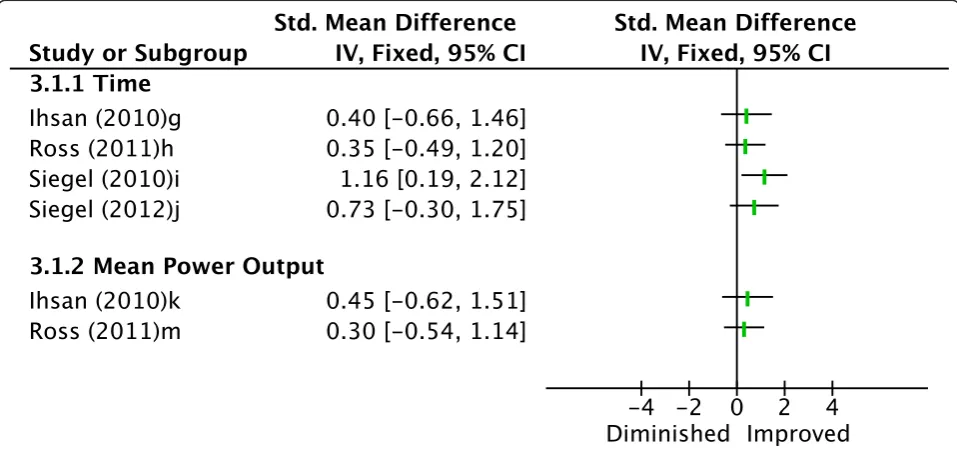
Four studies evaluated the effectiveness of ingesting an ice slurry beverage in enhancing endurance exercise per-formance compared to a control condition (see Figure 3) [16-19]. The control condition was consumption of a volume of water equal to that of the ingested ice slurry in each study. Performance measures evaluated included time taken to cycle a set distance and MPO [16,17], and time to volitional fatigue at a fixed exercise intensity [18,19]. One study showed a statistically significant per-formance improvement in the pre-cooling condition (d = 1.16) [18]. All three remaining studies reported a trend towards improved performance in the pre-cooling condi-tion for both time taken and MPO [16,17,19]. Therefore, limited evidence is indicated for the effectiveness of ice slurry ingestion to improve endurance exercise perfor-mance in hot environments.
Cooling garment
Three studies evaluated the effectiveness of a cooling gar-ment in enhancing endurance exercise performance com-pared to a control condition (see Figure 4) [24,26,27]. Two studies [24,26] used an ice vest as their cooling
Joneset al.BMC Medicine2012,10:166
http://www.biomedcentral.com/1741-7015/10/166
garment, and the other used a cooling jacket covering the torso, arms, and head with a hood [27]. Performance measures evaluated included time taken to complete a 5 km run [24], time to volitional fatigue on an incremen-tal treadmill test [26], and time taken to complete a fixed amount of work (kJ) and MPO while cycling [27]. There were no significant improvements in performance for any of the parameters measured, indicating moderate evi-dence that cooling garments are an ineffective pre-cool-ing intervention.
Mixed cooling methods
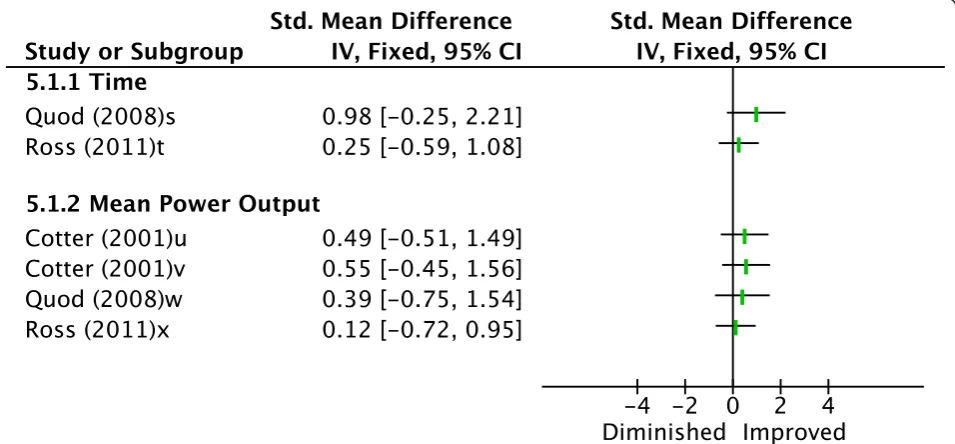
Three studies evaluated the effectiveness of combined pre-cooling methods to a control condition (see Figure 5) [17,25,27]. Two studies pre-cooled athletes using cold water immersion followed by wearing a cooling jacket (torso, sleeves and hood) [17,27]. Performance measures evaluated in both studies were time taken to cycle a set distance and MPO. Although not statistically significant, Quodet al.[27] showed a trend towards the pre-cooling condition improving performance (d = 0.98, 0.39 for time taken and MPO respectively). Rosset al.[17] found no improvement. Cotteret al.[25] used two different, mixed
methods pre-cooling procedures in their study. Subjects were cooled with an ice vest and cold air while their thighs were either kept warm or cooled using water-perfused cuffs. The performance measure evaluated was MPO. Both of these pre-cooling interventions showed a trend to performance improvement in the pre-cooled conditions (d = 0.49 and 0.55 in leg cooling and leg warming, respectively).
Comparison of pre-cooling methods
One study evaluated the effectiveness of ice slurry inges-tion in enhancing endurance exercise performance com-pared to cold water immersion (see Figure 6) [19]. There was no statistically significant difference between the two pre-cooling methods (d = 0.54), though there was a trend to cold water immersion being more effective. There is limited evidence that ice slurry ingestion is as effective at improving endurance exercise performance as cold water immersion.
Discussion
The aim of the present systematic review was to summar-ize the effectiveness of different pre-cooling techniques to
Titles screened
(n = 9922)
- CINAHL (n = 354)
- EMBASE (n = 3707)
- MEDLINE (n = 2517)
- SPORTDiscus (n = 2243)
- WoS (n = 1101)
Full text articles retrieved
(n = 31)
Studies eligible for inclusion in
systematic review
(n = 13)
Studies excluded after evaluation of
full text with reason
(n=18)
- Temperature <28°C (n = 8)
- Cooled during exercise (n = 3)
- Insufficient outcome measures (n = 2)
- Published as abstract only (n = 3)
- Non-experimental (n = 1)
- Other (n = 1)
Excluded studies
- From title and abstract (n = 4454)
- Duplicates (n = 5437)
cles re
le for
-fu
Figure 1QUOROM (for‘Quality of Reporting of Meta-analyses’using standards developed by the QUOROM group) flow diagram, summarizing study selection for inclusion.
Joneset al.BMC Medicine2012,10:166
http://www.biomedcentral.com/1741-7015/10/166
Table 2 Investigation protocol for each included study.
Authors Participant
characteristicsa Exerciseduration
(min)
Cooling
modeb Coolingduration
(min)
Environmental conditions
Performance task
Core temperature measurement
Outcome measure
Temperature (°C)
Humidity (%)
Arngrïmssonet al., 2004 [24]
9 male, 8 female; trained
15.6 to 22.8c G 38 32 50 Running Rectal Time to complete 5 km
Boothet al., 1997 [42]
5 male, 3 female; trained
30 W 60 32 62 Running Rectal Distance completed in a 30-minute test at
self-controlled pace Cotteret al., 2001
[25]
9 male; untrained
35 G ± LC 45 35 60 Cycling Rectal Mean power output (W/kg) during 15
minutes at self-selected pace Duffieldet al., 2010
[41]
8 male; trained 40 W 20d 33 50 Cycling Rectal Mean power output (W) during 40-minute
time trial
Gonzalez-Alonsoet
al., 1999 [40]
7 male; trained 42 to 66c W 30 40 19 Cycling Esophageal Time to volitional fatigue at 60% VO
2max
Hasegawaet al., 2006 [43]
9 male; untrained
2.5 to 8.0e, f W/D/W +
D
30 32 80 Cycling Rectal Time to volitional fatigue at 80% VO2max
Ihsanet al., 2010 [16]
7 male; trained 70 to 103c I 30 30 75 Cycling Gastrointestinal Time to complete 40 km; mean power
output (W)
Kayet al., 1999 [28] 7 male; trained 30 W 58.6 31 60 Cycling Rectal Distance completed in a 30-minute test at self-controlled pace
Quodet al., 2008 [27]
6 male; trained 40 G/W + G 40/70g 34 41 Cycling Rectal Time to complete a fixed amount of work
(kJ); mean power output (W) Rosset al., 2011
[17]
11 male; trained 76 to 123c W + G/Ih 30 32 to 35 50 to 60 Cycling Rectal Time to complete 23 km; mean power
output (W) Siegelet al., 2010
[18]
10 male; untrained
40.7 to 50.2c I 30 34 55 Running Rectal Time to volitional fatigue at first ventilatory
threshold Siegelet al., 2012
[19]
8 male; untrained
46.7 to 56.8c I/W 30 34 52 Running Rectal Time to volitional fatigue at first ventilatory
threshold Ückert and Joch,
2007 [26]
20 male; trained 26.9 to 32.5c G/WU 20 30 to 32 50 Running Tympanic Time to volitional fatigue during an
incremental treadmill test
a
Described as moderately trained to well trained in sports with high endurance components by the study authors.
b
W = cold water immersion, G = cooling garment, D = cool water drink, WU = warm-up, I = ice slurry ingestion, LC = leg cooling.
c
Mean group time.
d
Cooling was maintained during subsequent warm-up by application of cool gel packs to hamstrings and quadriceps.
e
Preceded by 10 minutes at 50% and 30 minutes at 70% VO2max. f
Preceded by 60 minutes at 60% VO2max. g
30 minutes cold water immersion, followed by 40 minutes wearing a cooling garment.
h
While applying iced towels. VO2max = maximal aerobic capacity.
Jones
et
al
.
BMC
Medicine
2012,
10
:166
http://ww
w.biomedcen
tral.com/1741
-7015/10/166
Page
7
of
Table 3 Physiotherapy Evidence Database (PEDro) scale scores for each study
Authors, year and reference
Factor Arngrïmsson
et al., 2004 [24]
Boothet al., 1997 [42]
Cotteret al., 2001 [25]
Duffieldet al., 2010 [41]
Gonzalez-Alonsoet al., 1999 [40]
Hasegawa
et al., 2006 [43]
Ihsanet al., 2010 [16]
Kayet al., 1999 [28]
Quodet al., 2008 [27]
Rosset al., 2011 [17]
Siegelet al., 2010 [18]
Siegelet al., 2012 [19]
Ückert and Joch, 2007 [26]
Eligibility criteria were specified (not scored)
0 0 0 0 0 0 0 0 0 0 0 0 0
Subjects were randomly allocated to groups
0 0 0 1 1 0 1 0 1 1 1 1 1
Allocation was concealed 0 0 0 0 0 0 0 0 0 0 0 0 0
Groups were similar at baseline
1 1 1 1 1 1 1 1 1 1 1 1 1
Blinding of subjects 0 0 0 0 0 0 0 0 0 0 0 0 0
Blinding of intervention administrators
0 0 0 0 0 0 0 0 0 0 0 0 0
Blinding of assessors 0 0 0 0 0 0 0 0 0 0 0 0 0
Outcome measure
obtained from≥85%
subjects
1 1 1 1 1 1 1 1 1 1 1 1 1
All subjects received intervention/intention to treat analysis
1 1 0 1 1 1 1 1 1 1 1 1 1
Between group statistical comparisons reported
1 1 1 1 1 1 1 1 1 1 1 1 1
Between-group variability reported
1 1 1 1 1 1 1 1 1 1 1 1 1
PEDro score (out of 10) 5 5 4 6 6 5 6 5 6 6 6 6 6
Sample size calculation performed
0 0 0 0 0 0 0 0 0 0 0 0 0
Jones
et
al
.
BMC
Medicine
2012,
10
:166
http://ww
w.biomedcen
tral.com/1741
-7015/10/166
Page
8
of
improve endurance exercise performance in hot (≥28°C) environmental conditions. A total of 13 studies contained sufficient data to complete effect size calculations [16-19,24-28,40-43]. Of the three individual pre-cooling methods identified, cold water immersion was the most effective, with moderate evidence supporting its ability to
improve endurance exercise performance compared to control conditions. Additionally, limited evidence indicates that ingesting ice slurry prior to competition is also effec-tive, and potentially a more practical alternative to cold water immersion. Wearing a cooling garment prior to endurance exercise is of limited benefit to subsequent Figure 2Effect sizes (Cohen’s d) for cold water immersion versus control. Graph represents effect of intervention on exercise performance. a
Time to volitional fatigue running at 60% VO2max. b
Time to volitional fatigue cycling at 80% VO2max. c
Time to volitional fatigue at first ventilatory threshold.dDistance run in 30 minutes at self-controlled pace.eDistance cycled in 30 minutes at self-controlled pace.fMean power output during 40-minute cycling time trial.
Figure 3Effect sizes (Cohen’s d) for ice slurry ingestion versus control. Graph represents effect of intervention on exercise performance. gTime to cycle 40 km.hTime to cycle 23 km.iTime to volitional fatigue at first ventilatory threshold.jTime to volitional fatigue at first ventilatory threshold.kMean power output cycling 40 km.mMean power output cycling 23 km.
Joneset al.BMC Medicine2012,10:166
http://www.biomedcentral.com/1741-7015/10/166
endurance exercise performance. Of the combined pre-cooling procedures that improved performance, the most effective protocol involved a period of cold water immersion.
Quality
Each included study used a repeated measures crossover design. However, methodological quality was varied with
PEDro scores ranging from 4/10 to 6/10, indicating no high quality randomized controlled trials evaluating the effectiveness of pre-cooling to improve endurance exer-cise performance in the heat. Some studies did not ran-domize participant allocation, possibly introducing allocation bias [24,25,28,42,43]. All except four studies [18,19,25,43] used participants who were moderately to well trained (Table 4) in sports with high endurance Figure 4Effect sizes (Cohen’s d) for cooling garment versus control. Graph represents effect of intervention on exercise performance.nTime to run 5 km.pTime to cycle a fixed amount of work.qTime to volitional fatigue during an incremental treadmill run.rMean power output for duration of cycling time trial.
Figure 5Effect sizes (Cohen’s d) for various mixed cooling methods versus control. Graph represents effect of intervention on exercise performance.sTime to cycle a fixed amount of work (cold water immersion + cooling garment).tTime to cycle 23 km (cold water immersion + cooling garment).uMean power output during 15-minute cycling time trial (cold air + cooling garment + leg cooling).vMean power output during 15-minute cycling time trial (cold air + cooling garment + leg warming).wMean power output for duration of cycling time trial (cold water immersion + cooling garment).xMean power output cycling 23 km (cold water immersion + cooling garment).
Joneset al.BMC Medicine2012,10:166
http://www.biomedcentral.com/1741-7015/10/166
Figure 6Effect sizes (Cohen’s d) for ice slurry ingestion versus cold water immersion. Graph represents effect of intervention on exercise performance.yTime to volitional fatigue at first ventilatory threshold.
Table 4 Participant characteristics for each included study
Authors, year and reference
Participant characteristics
Arngrïmssonet al., 2004 [24] Competitive collegiate and club middle/long distance runners Age men: 23.4 (4.4) years
Age women: 22.1 (2.2) years Height men: 178.6 (4.4) cm Height women: 167.7 (5.5) cm Body mass men: 67.7 (4.2) kg Body mass women: 55.9 (4.3) kg Body fat men: 7.3 (2.0) % Body fat women: 17.8 (3.3) % Best 5 km run time men: 15.5 (0.8) min Best 5 km run time women: 17.9 (1.1) min VO2max men: 4.50 (0.31) l/min
VO2max women: 3.24 (0.25) l/min Heat acclimatized
Boothet al., 1997 [42]a Competitive runners from a local athletic club Age: 26.7 (1.7) years
Height: 169.7 (4.0) cm Weight: 65.96 (2.87) kg
Sum of eight skinfolds: 62.5 (9.7) mm Body surface area: 1.75 (0.06) m2 Body fat: 15.8 (1.2) %
HRmax: 189.5 (2.8) beats/min VO2peak: 63.1 (0.1) ml/kg/min Non-heat acclimatized
Cotteret al., 2001 [25] Habitually active, but were of lower average aerobic fitness than subjects used in previous studies on the effects of pre-cooling
Age: 32.4 (3.6) years Height: 175.6 (6.9) cm Body mass: 80.9 (10.5) kg Body surface area: 1.96 (0.15) m2 VO2peak: 51 (8) ml/min/kg Non-heat acclimatized
Duffieldet al., 2010 [41] Moderate to well trained cyclists of club and regional standard who trained multiple times a week, competing in regional competitions
Age: 24.8 (3.3) years Height: 178.3 (8.0) cm Body mass: 76.1 (2.7) kg
Sum of seven skinfolds: 54.4 (10.9) mm Lactate threshold: 221 (42) W Non-heat acclimatized
Joneset al.BMC Medicine2012,10:166
http://www.biomedcentral.com/1741-7015/10/166
Table 4 Participant characteristics for each included study(Continued)
Gonzalez-Alonsoet al., 1999 [40]*
Endurance trained
Age: 28 (3) years Height: 187 (6) cm Body mass: 77.9 (6.4) kg HRmax: 200 (9) beats/min VO2peak: 5.13 (0.30) l/min Non-heat acclimatized Hasegawaet al., 2006 [43]* Untrained
Age: 21.8 (0.8) years Height: 1.72 (0.02) cm Body mass: 61.7 (2.1) kg Body fat: 15.1 (1.1) % VO2max: 48.5 (1.5) ml/kg/min Non-heat acclimatized
Ihsanet al., 2010 [16] Endurance trained regularly competing in cycling or triathlon, cycling more than four sessions and > 150 km/week Age: 27.7 (3.1) years
Height: 176.7 (5.8) cm Body mass: 81.38 (9.09) kg Non-heat acclimatized
Kayet al., 1999 [28]* Moderately to well-trained and undertook bicycle riding, training and competition on a regular basis Age: 23.7 (2.1) years
Height: 182 (3) cm Body mass: 76.1 (4.0) kg
Sum of four skinfolds: 28.4 (2.3) mm Body surface area: 1.97 (0.06) m2 HRmax: 184 (3) beats/min VO2peak: 4.91 (0.25) l/min Non-heat acclimatized
Quodet al., 2008 [27] Well trained male cyclists with 6 (5) years of experience Age: 28 (4) years
Height: 182 (2) cm Body mass: 75.1 (3.2) kg
Sum of seven skinfolds: 50 (11) mm VO2peak: 71.4 (3.2) ml/kg/min Maximum aerobic power: 384 (23) W Non-heat acclimatized
Rosset al., 2011 [17] Well trained A-grade cyclists aged 18 to 35 years Age: 33 (5.1) years
Body mass: 72.1 (5.5) kg
Maximum aerobic power: 449 (26) W VO2peak: 71.6 (6.1) ml/kg/min Heat acclimatized
Siegelet al., 2010 [18] Moderately active, participating in recreational sport Age: 28 (6) years
Height: 178.9 (6.3) cm Body mass: 79.9 (11.2) kg
Sum of nine skinfolds: 92.8 (41.4) mm VO2peak: 56.4 (4.7) ml/kg/min Non-heat acclimatized
Siegelet al., 2012 [19] Moderately active, were partaking in recreational sport Age: 26 (4) years
Joneset al.BMC Medicine2012,10:166
http://www.biomedcentral.com/1741-7015/10/166
components (cycling, triathlon and distance running), and within that only cycling and running exercise proto-cols were used, limiting the applicability of the findings to the broader, less well trained population. Lack of parti-cipant, investigator and outcome assessor blinding was consistent across all studies, likely due to practical diffi-culties. Consequently, some results could have been unintentionally biased, either by observer bias, such as encouraging participants in the pre-cooled group, or a placebo effect.
Participant numbers in each study were low, ranging from 6 [27] to 20 [26], limiting the validity of conclusions that can be drawn from the results. None of the reviewed studies performed sample size calculations, and therefore certain data trends could not be substantiated due to inadequate statistical power. There was a high level of methodological heterogeneity between studies, including: exercise performance protocol, pre-cooling duration, exercise duration and outcome measure, making compar-ison of studies and recommendations for enhancing sporting performance difficult. This was further com-pounded by the absence of comparisons between the three main individual pre-cooling maneuvers (cold water immersion, cooling garment and ice slurry ingestion) in all but one study [19]. Therefore, the relative efficacy and practicality of one pre-cooling method to another could not be made. In one study, subjects exercised at 60% VO2max for 60 minutes followed by an effort at 80%
VO2max to volitional fatigue [43]. However, mean
per-formance time ± standard error were only reported for the short effort at 80% VO2max to fatigue. This is likely
to have inflated the effect size compared to other studies.
Cold water immersion
Moderate evidence currently exists to support the use of cold water immersion as a pre-cooling intervention to improve endurance exercise performance in the heat. Three studies showed a significant performance improvement in
the pre-cooled compared to control condition [19,40,43], with the remaining three studies showing a positive trend to improved performance [28,41,42]. In each of the immersion studies there was a significant reduction in core tempera-ture compared to control at some point during the exercise protocol. Additionally, the rate of heat storage was greater in three of the four studies that reported this variable [19,28,42], conferring a greater margin for metabolic load during exercise in the pre-cooling condition. Gonzalez-Alonsoet al.[40] reported that rate of heat storage was equal between both conditions. However, as the pre-cooled group commenced exercise with a core temperature 1.5°C lower than the control condition, their total heat storage capacity was greater. Although not conclusive evidence of a precise mechanism, it seems that pre-cooling using cold water immersion could possibly improve performance by reducing core temperature prior to exercise, or blunting the rate of rise in core temperature during exercise, increasing heat storage capacity and enabling athletes to perform at a greater relative intensity or for a greater duration [29].
Despite a more rapid reduction in core temperature with water immersion compared with traditional cold air exposure [46], the required length of pre-cooling remains significant (30 to 60 minutes) [29,30]. Marino and Booth [21], in one of the first studies investigating the potential use of pre-cooling via cold water immer-sion prior to endurance exercise, reduced core tempera-ture by gradually reducing the temperatempera-ture of the immersion bath over a 60-minute period. This was to avoid the potentially detrimental cold stress responses that had previously been seen with cold air exposure, such as shivering [29]. Such a regimented technique, which also precludes a concomitant warm-up, is limited in its practicality in an elite sports setting immediately prior to athletic competition, in addition to other logisti-cal issues such as expense, transportation of equipment, and access to such a large volume of water and electri-city in the field.
Table 4 Participant characteristics for each included study(Continued)
Height: 179.9 (6.7) cm Body mass: 78.1 (5.9) kg
Sum of nine skinfolds: 87.3 (22.5) mm VO2peak: 54.2 (2.5) ml/kg/min Non-heat acclimatized
Ückert and Joch, 2007 [26] Regularly practiced types of sport with high endurance and strength components at a high level for example, soccer, athletics
Age: 25.6 (3.5) years Height: 183.4 (7.6) cm Weight: 77.9 (9.5) kg Non-heat acclimatized
All values are mean (± SD). a
Values in brackets are ± (SE).
HR = heart rate; VO2max = maximal aerobic capacity; VO2peak = peak oxygen uptake.
Joneset al.BMC Medicine2012,10:166
http://www.biomedcentral.com/1741-7015/10/166
Ice slurry ingestion
Limited evidence currently exists to support the use of ice slurry as a pre-cooling intervention to improve endurance exercise performance in the heat. One study [18] showed a significant performance improvement in the ice slurry ingestion pre-cooled compared to the con-trol condition and the three remaining studies showed a positive trend to improved performance [16,17,19]. Each study reported that core temperature was significantly lower in the pre-cooling condition than control after the cooling intervention and prior to the start of the exer-cise task, increasing heat storage capacity. Alternatively, the participants’lower core body temperatures prior to exercise may have enabled them to select a faster pacing strategy by influencing central regulation of exercise intensity [47].
Two studies [18,19] reported that the pre-cooled group exhibited a significantly higher core temperature at exhaustion. The authors suggest that this could be due to the generation of higher metabolic heat loads as a result of either a direct cooling effect on the brain, or an effect on core temperature afferent nerves [48], altering perception of effort and increasing time to exhaustion. Increased core temperature above normal tolerable limits is an important safety consideration and may be detrimental to athlete health, increasing the risk of heat-related illness, and is something that requires attention in future studies.
Ice slurry ingestion offers a number of practical bene-fits over cold water immersion, as it is not subject to the same logistical restrictions. The ice slurry can be pro-duced using a commercially available machine or simply freezing and part-thawing sports drinks prior to the event, and transporting them in a cool box. This is parti-cularly useful at events where there is no provision for electrical equipment, or where transportation is an issue. Pre-cooling athletes in this way is quick and simple. The amount of ice slurry required to achieve effective cooling is low and similar in volume to pre-exercise fluid hydra-tion protocols, ranging from 6.8 g/kg [16] to 14 g/kg [17] of body mass. In each reviewed study, the volume of ice slurry was administered over a 30-minute period at a standardized rate that ranged from 5 [18,19] to 15 min-utes [17]. Although not yet investigated, there is the potential that ice slurry ingestion could enable athletes to warm-up during cooling, making it much more time effi-cient than cold water immersion. In addition to providing a greater cooling effect than cold water alone [23], a much smaller volume is required to produce this response, reducing the potential for detrimental effects that the ingestion of large volumes of fluid may have. As well as cooling athletes, the ice slurry can be used to hydrate athletes too so that combined fluid and slurry ingestion is not necessary.
Cooling garments
None of the studies showed a significant improvement of wearing a cooling garment on subsequent exercise per-formance [24,26,27]. This likely resulted from the lack of effect on core body temperature. In two studies [26,27], despite the pre-cooling groups having significantly lower skin temperatures while wearing the cooling garment, core temperature was not significantly lower at any time point during either pre-cooling or subsequent exercise. Arngrïmssonet al.[24] reported significantly lower rectal temperatures in the pre-cooling group for the last 18 minutes of the warm-up and first 3.2 km of the running exercise task compared to the control group. However, this effect was not strong enough to have caused a signifi-cant improvement in performance and may have resulted from the high rectal temperatures, and therefore reduced heat storage capacity, at the start of the performance task in both the cooling garment (38.0°C) and control group (38.2°C) compared to all other studies that reported rectal temperature at the onset of the exercise task [18,19,25,27,28,41-43].
Kayet al.[28] suggested a reduction in core body tem-perature achieved through lowering skin temtem-perature, effecting heat loss from core to skin. This is the mechan-ism by which cooling garments are believed to act to cool athletes prior to exercise. However, cooling in Kayet al.’s [28] study was achieved via whole-body cold water immersion, which likely provided a greater cooling sti-mulus than cooling garments, especially at peripheral areas of the body. This could explain why cooling gar-ments were found to have little effect on core body tem-perature in the present study. One study reported than the application of a cooling garment reduced skin blood flow across the body by stimulating vasoconstriction, pre-venting efficient heat transfer between the skin and the cooling garment. Core body temperature of subjects remained unaltered, likely from the redistribution of blood to the core [44]. If the hypothesis that a critical core temperature limits exercise performance in the heat is correct, then, by failing to reduce core body tempera-ture cooling garments were unable to improve endurance exercise performance.
Mixed methods
Some studies combined more than one pre-cooling inter-vention to cool participants prior to the exercise compo-nent of the trial. Two studies immersed subjects in cold water, followed by a period wearing a cooling garment [17,27]. Quodet al.[27] reported a significant decrease in core body temperature prior to exercise, likely as a result of an‘afterdrop’effect [49]; that is, a continued fall in core temperature after the initial hypothermic exposure, as opposed to any further cooling effect of the garment.
Joneset al.BMC Medicine2012,10:166
http://www.biomedcentral.com/1741-7015/10/166
Indeed, the same study reported that wearing the cooling garment alone failed to reduce core temperature com-pared to control. Exercise performance was significantly better than control and cooling garment conditions. Con-versely, Rosset al.[17] reported that, despite a signifi-cantly lower core body temperature after cooling and throughout warm-up compared to controls, there was no improvement in performance. The authors suggest that the larger cooling response in the combined condition may have led the athletes to select poorer pacing strate-gies. An alternative explanation could be that the cold water immersion protocol used may have been too abrupt compared to that used in other studies [21], and may therefore have elicited a cold stress response that was det-rimental to performance, similar to that reported for cold air exposure [29].
A combination of cold air and a cooling garment, with or without thigh cooling, showed trends to improved performance in both conditions compared to control in one study [25]. Both pre-cooling groups had a lower core temperature after pre-cooling, and power output was significantly greater compared to controls during the 15-minute performance trial. There was no differ-ence in power output between the two cooling condi-tions. It is difficult to determine whether the cooling garment conferred any additional benefits than have been shown to be conferred by cold air cooling alone [12,13,50]. In practice, cold air cooling has a number of logistical limitations including equipment transport and cost, the significant time required to adequately cool athletes, and a noted cold stress response that can impair exercise performance [29].
Limitations and future research
There is a high level of heterogeneity in study design examining the effectiveness of pre-cooling strategies, and optimal cooling protocols have yet to be estab-lished. Variables such as cooling duration and time between pre-cooling and commencing exercise are likely to exert considerable influence on study out-comes and require greater attention. Once repeatable pre-cooling protocols have been identified for each individual modality, then more reliable comparisons of effectiveness can be made between modalities. One study directly compared ice slurry ingestion to cold water immersion and found it to be similarly effective at improving performance (Figure 6) [19]. As poten-tially the cheaper, more practical strategy, this result is encouraging and warrants further investigation of ice slurry ingestion in the field. Additionally, following Quod et al.’s study [27], it would be instructive to determine whether the combination of a cooling gar-ment following cold water immersion confers any addi-tional benefit compared to immersion only.
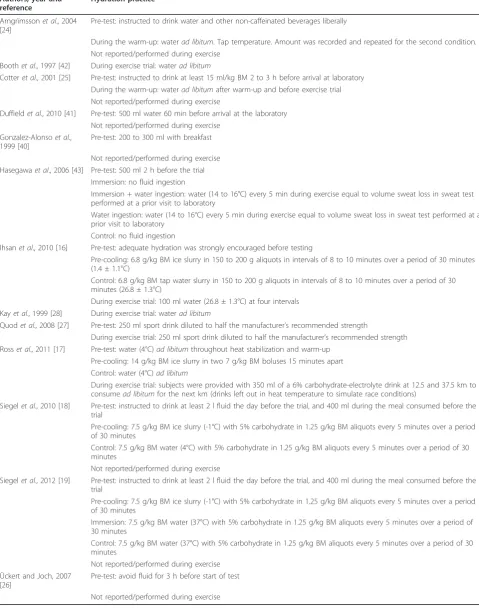
Hydration strategies employed, and reporting of these strategies was inconsistent (Table 5). Water ingestion, especially cool water, may lower core body temperature via a similar mechanism as ice slurry ingestion. Poten-tially, if control participants were permitted to drink cool water either before or throughout the exercise trial this may confound the effectiveness of the pre-cooling strategy. However, this is a difficult variable to control for and depends on the comparison being made. For example, studies investigating ice slurry ingestion used water ingestion of an equal volume as the control condition to determine that any improve-ments in performance were a result of the pre-cooling effect of ice slurry ingestion as opposed to the ergo-genic effect of adequate hydration [51]. Interestingly, Siegel et al. found a greater effect of ice slurry inges-tion on performance when compared to controls drink-ing cool fluid (4°C) [18] than when compared to controls drinking warmer fluid (37°C) [19], which sug-gests that cool water ingestion may not blunt the effec-tiveness of pre-cooling as much as expected. However, more consistent hydration protocols will enable greater analysis of this relationship. Hasegawa et al. [43] reported that continuous cool water ingestion during exercise following cold water immersion significantly improved performance compared to cold water immer-sion alone and negated the rise in core body tempera-ture towards the end of the performance protocol. The authors attributed this to increased evaporative sweat loss, sweat efficiency and decreased heat strain in the continuous water ingestion group. This finding sug-gests that the benefits of pre-cooling may be augmen-ted by maintaining hydration during exercise. Ice slurry ingestion acts to pre-cool athletes and could also be used to maintain cooling and hydration during exer-cise. Therefore, a comparison of combined cold water immersion and water beverage with continuous ice slurry ingestion is warranted.
The level of fitness of participants varied across stu-dies as did the consistency of reporting of fitness and experience of endurance exercise (Table 4). It is difficult, therefore, to determine whether more experienced or less experienced athletes would benefit more from pre-cooling. Furthermore, those who are less experienced are likely to be less accurate when anticipating a required pacing strategy to complete a given exercise trial [47]. By lowering core body temperature using exo-genous means, participants may perceive their level of exertion to be lower than their body’s thermal load should dictate, that is, a discrepancy between their per-ceived and actual homeostatic state, which could cause them to develop heat illness due to the masking of ther-mal strain. This is acknowledged in the two studies that reported participants to have an elevated core body
Joneset al.BMC Medicine2012,10:166
http://www.biomedcentral.com/1741-7015/10/166
Table 5 Hydration practices for each included study
Authors, year and reference
Hydration practice
Arngrïmssonet al., 2004 [24]
Pre-test: instructed to drink water and other non-caffeinated beverages liberally
During the warm-up: waterad libitum. Tap temperature. Amount was recorded and repeated for the second condition. Not reported/performed during exercise
Boothet al., 1997 [42] During exercise trial: waterad libitum
Cotteret al., 2001 [25] Pre-test: instructed to drink at least 15 ml/kg BM 2 to 3 h before arrival at laboratory During the warm-up: waterad libitumafter warm-up and before exercise trial Not reported/performed during exercise
Duffieldet al., 2010 [41] Pre-test: 500 ml water 60 min before arrival at the laboratory Not reported/performed during exercise
Gonzalez-Alonsoet al., 1999 [40]
Pre-test: 200 to 300 ml with breakfast
Not reported/performed during exercise Hasegawaet al., 2006 [43] Pre-test: 500 ml 2 h before the trial
Immersion: no fluid ingestion
Immersion + water ingestion: water (14 to 16°C) every 5 min during exercise equal to volume sweat loss in sweat test performed at a prior visit to laboratory
Water ingestion: water (14 to 16°C) every 5 min during exercise equal to volume sweat loss in sweat test performed at a prior visit to laboratory
Control: no fluid ingestion
Ihsanet al., 2010 [16] Pre-test: adequate hydration was strongly encouraged before testing
Pre-cooling: 6.8 g/kg BM ice slurry in 150 to 200 g aliquots in intervals of 8 to 10 minutes over a period of 30 minutes (1.4 ± 1.1°C)
Control: 6.8 g/kg BM tap water slurry in 150 to 200 g aliquots in intervals of 8 to 10 minutes over a period of 30 minutes (26.8 ± 1.3°C)
During exercise trial: 100 ml water (26.8 ± 1.3°C) at four intervals Kayet al., 1999 [28] During exercise trial: waterad libitum
Quodet al., 2008 [27] Pre-test: 250 ml sport drink diluted to half the manufacturer’s recommended strength
During exercise trial: 250 ml sport drink diluted to half the manufacturer’s recommended strength Rosset al., 2011 [17] Pre-test: water (4°C)ad libitumthroughout heat stabilization and warm-up
Pre-cooling: 14 g/kg BM ice slurry in two 7 g/kg BM boluses 15 minutes apart Control: water (4°C)ad libitum
During exercise trial: subjects were provided with 350 ml of a 6% carbohydrate-electrolyte drink at 12.5 and 37.5 km to consumead libitumfor the next km (drinks left out in heat temperature to simulate race conditions)
Siegelet al., 2010 [18] Pre-test: instructed to drink at least 2 l fluid the day before the trial, and 400 ml during the meal consumed before the trial
Pre-cooling: 7.5 g/kg BM ice slurry (-1°C) with 5% carbohydrate in 1.25 g/kg BM aliquots every 5 minutes over a period of 30 minutes
Control: 7.5 g/kg BM water (4°C) with 5% carbohydrate in 1.25 g/kg BM aliquots every 5 minutes over a period of 30 minutes
Not reported/performed during exercise
Siegelet al., 2012 [19] Pre-test: instructed to drink at least 2 l fluid the day before the trial, and 400 ml during the meal consumed before the trial
Pre-cooling: 7.5 g/kg BM ice slurry (-1°C) with 5% carbohydrate in 1.25 g/kg BM aliquots every 5 minutes over a period of 30 minutes
Immersion: 7.5 g/kg BM water (37°C) with 5% carbohydrate in 1.25 g/kg BM aliquots every 5 minutes over a period of 30 minutes
Control: 7.5 g/kg BM water (37°C) with 5% carbohydrate in 1.25 g/kg BM aliquots every 5 minutes over a period of 30 minutes
Not reported/performed during exercise Ückert and Joch, 2007
[26]
Pre-test: avoid fluid for 3 h before start of test
Not reported/performed during exercise
BM = body mass.
Joneset al.BMC Medicine2012,10:166
http://www.biomedcentral.com/1741-7015/10/166
temperature at volitional fatigue [18,19]. Notably, these studies used untrained participants so it is possible that more experienced athletes may be better attuned to their physiological limits and hence less at risk of heat illness, but this is speculative and warrants further investigation before ice slurry ingestion can be recommended.
Given the lack of blinding of participants and researchers in the reviewed studies, a placebo effect can-not be excluded from having influenced results. Future studies should consider introducing a separate, placebo-controlled group, and participant and assessor blinding to improve methodological validity. The placebo-control could, for example, use menthol to provide a cooling sensation for participants without causing an actual change in temperature [52].
Each study included in this review was limited by low participant numbers. It was therefore difficult to deter-mine whether certain reported trends or lack thereof were the result of the studies being underpowered. A priori power calculations should be performed to increase the statistical significance of any trends reported in the results. Study participants were predominantly male, therefore the findings of this review may not be applicable to females, especially because certain anthro-pometric and hormonal differences, including stage of the menstrual cycle [53] and body composition [54], can affect thermoregulation under heat stress. It should be acknowledged that the majority were performed with the intention of applying the findings to highly trained ath-letes, and that recruiting large numbers of such compli-ant volunteers is difficult. However, the inclusion of larger sample sizes and inclusion of similar proportions of female and male participants in future research will allow both improved external validity for broader popula-tions and between sex comparisons to be made.
Laboratory studies grant assessors strict control of cer-tain variables, such as the environmental conditions under which exercise is performed, which is necessary with preliminary studies to establish intervention effi-cacy and optimal protocols. However, future studies of pre-cooling should focus on real-world testing to deter-mine whether the promising laboratory findings trans-late to tangible performance gains in the field. This is also important to evaluate the practicality of each method of pre-cooling during competition.
There was also a lack of safety or adverse event reporting. It remains unknown what effect increased heat storage capacity may have on other bodily systems other than those directly involved in thermoregulation. Therefore, until these can be elucidated, it would be prudent for future research to include consideration of athlete safety, as this will be of primary concern to
coaches and athletes alike, given the physiologically stressful environment in which they will be competing.
Practicality and recommendations
Although consistently the most effective method of pre-cooling and enhancing endurance exercise performance in the heat, cold water immersion has limited practical-ity in sporting settings due to expense, transportation issues, difficulty accessing large volumes of water and time required to achieve a reduction in core body tem-perature. Ice slurry ingestion is a relatively cheap and much more practical alternative to whole body immer-sion and effectively lowers core body temperature, approaching the improvements in performance seen with immersion. Additionally, there is currently limited evidence from one study that indicates the effectiveness of ice slurry ingestion and cold water immersion are comparable [19]. However, safety concerns raised by two studies that reported a raised core body tempera-ture at volitional fatigue need to be addressed before its use can be recommended for competing athletes. Cool-ing garments failed to improve endurance exercise per-formance and therefore are of limited use in this regard.
Conclusions
This systematic review suggests that pre-cooling proce-dures can improve endurance exercise performance in the heat, with the likely mechanism being reduced core body temperature prior to exercise, and subsequently increased heat storage capacity. Cold water immersion is the most effective method of pre-cooling, with moderate evidence to support its effectiveness. However, its limited practicality in many sporting settings must be considered. Ice slurry ingestion has shown good initial results, with limited evidence supporting its effectiveness, and may provide a more practical pre-performance option. How-ever, larger studies with consistent protocols and further investigation of potential safety issues associated with altered levels of perceived exertion are required before its use can be recommended. Cooling garments appear of limited efficacy, but this finding may be the result of sub-optimal cooling protocols or inadequate study power. To date, most studies have focused on whether pre-cooling improves performance compared to no intervention, with only one study directly comparing individual modalities. Therefore, recommending one method over another to coaches and athletes is difficult. Further comparative research is required before best practice recommenda-tions can be made.
Authors’contributions
PRJ conceived the review topic. All authors assisted with the review design. PRJ and CB completed searching, quality assessment and data analysis. All
Joneset al.BMC Medicine2012,10:166
http://www.biomedcentral.com/1741-7015/10/166
authors contributed to interpretation of results, editing of the manuscript and approved the final manuscript
Competing interests
The authors declare that they have no competing interests.
Author details
1Centre for Sports and Exercise Medicine, William Harvey Research Institute, Bart’s and the London School of Medicine and Dentistry, Queen Mary University of London, Mile End Hospital, Bancroft Road, London E1 4DG, UK. 2King’s College London School of Medicine and Dentistry, King’s College London, Guy’s Campus, London SE1 9UL, UK.
Received: 5 March 2012 Accepted: 18 December 2012 Published: 18 December 2012
References
1. Galloway SD, Maughan RJ:Effects of ambient temperature on the capacity to perform prolonged cycle exercise in man.Med Sci Sports Exerc1997,29:1240-1249.
2. MacDougall JD, Reddan WG, Layton CR, Dempsey JA:Effects of metabolic hyperthermia on performance during heavy prolonged exercise.J Appl Physiol1974,36:538-544.
3. Peiffer JJ, Abbiss CR:Influence of environmental temperature on 40 km cycling time-trial performance.Int J Sports Physiol Perform2011,6:208-220. 4. El Helou N, Tafflet M, Berthelot G, Tolaini J, Marc A, Guillaume M,
Hausswirth C, Toussaint JF:Impact of environmental parameters on marathon running performance.PLoS One2012,7:e37407. 5. McCann DJ, Adams WC:Wet bulb globe temperature index and
performance in competitive distance runners.Med Sci Sports Exerc1997,
29:955-961.
6. Brück K, Olschewski H:Body temperature related factors diminishing the drive to exercise.Can J Physiol Pharmacol1987,65:1274-1280.
7. Nielsen B, Hales JR, Strange S, Christensen NJ, Warberg J, Saltin B:Human circulatory and thermoregulatory adaptations with heat acclimation and exercise in a hot, dry environment.J Physiol1993,460:467-485. 8. Febbraio MA, Murton P, Selig SE, Clark SA, Lambert DL, Angus DJ, Carey MF:
Effect of CHO ingestion on exercise metabolism and performance in different ambient temperatures.Med Sci Sports Exerc1996,28:1380-1387. 9. Maughan RJ:Distance running in hot environments: a thermal challenge
to the elite runner.Scand J Med Sci Sports2010,20:95-102. 10. Sawka MN, Young AJ, Latzka WA, Neufer PD, Quigley MD, Pandolf KB:
Human tolerance to heat strain during exercise: influence of hydration.
J Appl Physiol1992,73:368-375.
11. Abbiss CR, Burnett K, Nosaka AK, Green JP, Foster JK, Laursen PB:Effect of hot versus cold climates on power output, muscle activation, and perceived fatigue during a dynamic 100-km cycling trial.J Sports Sci 2010,28:117-125.
12. Lee DT, Haymes EM:Exercise duration and thermoregulatory responses after whole body precooling.J Appl Physiol1995,79:1971-1976. 13. Hessemer V, Langusch D, Brück LK, Bödeker RH, Breidenbach T:Effect of
slightly lowered body temperatures on endurance performance in humans.J Appl Physiol1984,57:1731-1737.
14. Olschewski H, Brück K:Thermoregulatory, cardiovascular, and muscular factors related to exercise after precooling.J Appl Physiol1988,64:803-811. 15. Martin DT, Hahn AG, Ryan-Tanner R, Yates K, Lee H, Smith JA:Ice jackets
are cool.Sportscience1998,2: [http://sportsci.org/jour/9804/dtm.html]. 16. Ihsan M, Landers G, Brearley M, Peeling P:Beneficial effects of ice
ingestion as a precooling strategy on 40-km cycling time-trial performance.Int J Sports Physiol Perform2010,5:140-151.
17. Ross ML, Garvican LA, Jeacocke NA, Laursen PB, Abbiss CR, Martin DT, Burke LM:Novel precooling strategy enhances time trial cycling in the heat.Med Sci Sports Exerc2011,43:123-133.
18. Siegel R, Maté J, Brearley MB, Watson G, Nosaka K, Laursen PB:Ice slurry ingestion increases core temperature capacity and running time in the heat.Med Sci Sports Exerc2010,42:717-725.
19. Siegel R, Maté J, Watson G, Nosaka K, Laursen PB:Pre-cooling with ice slurry ingestion leads to similar run times to exhaustion in the heat as cold water immersion.J Sports Sci2012,30:155-165.
20. Burton AC, Bazett HC:A study of the average temperature of the tissues, of the exchanges of heat and vasomotor responses in man by means of a bath calorimeter.Am J Physiol1936,117:36-54.
21. Marino F, Booth J:Whole body cooling by immersion in water at moderate temperatures.J Sci Med Sport1998,1:73-82.
22. Merrick MA, Jutte LS, Smith ME:Cold modalities with different thermodynamic properties produce different surface and intramuscular temperatures.J Athl Train2003,38:28-33.
23. Vanden Hoek TL, Kasza KE, Beiser DG, Abella BS, Franklin JE, Oras JJ, Alvarado JP, Anderson T, Son H, Wardrip CL, Zhao D, Wang H, Becker LB:
Induced hypothermia by central venous infusion: saline ice slurry versus chilled saline.Crit Care Med2004,32:S425-431.
24. Arngrïmsson SA, Petitt DS, Stueck MG, Jorgensen DK, Cureton KJ:Cooling vest worn during active warm-up improves 5-km run performance in the heat.J Appl Physiol2004,96:1867-1874.
25. Cotter JD, Sleivert GG, Roberts WS, Febbraio MA:Effect of pre-cooling, with and without thigh cooling, on strain and endurance exercise performance in the heat.Comp Biochem Physiol A Mol Integr Physiol2001,
128:667-677.
26. Uckert S, Joch W:Effects of warm-up and precooling on endurance performance in the heat.Br J Sports Med2007,41:380-384. 27. Quod MJ, Martin DT, Laursen PB, Gardner AS, Halson SL, Marino FE,
Tate MP, Mainwaring DE, Gore CJ, Hahn AG:Practical precooling: effect on cycling time trial performance in warm conditions.J Sports Sci2008,
26:1477-1487.
28. Kay D, Taaffe DR, Marino FE:Whole-body pre-cooling and heat storage during self-paced cycling performance in warm humid conditions.J Sports Sci1999,17:937-944.
29. Marino FE:Methods, advantages, and limitations of body cooling for exercise performance.Br J Sports Med2002,36:89-94.
30. Quod MJ, Martin DT, Laursen PB:Cooling athletes before competition in the heat: comparison of techniques and practical considerations.Sports Med2006,36:671-682.
31. Ranalli GF, Demartini JK, Casa DJ, McDermott BP, Armstrong LE, Maresh CM:
Effect of body cooling on subsequent aerobic and anaerobic exercise performance: a systematic review.J Strength Cond Res2010,24:3488-3496. 32. Cabanac M, Massonnet B:Thermoregulatory responses as a function of
core temperature in humans.J Physiol1977,265:587-596. 33. Tyler C, Sunderland C:The effect of ambient temperature on the
reliability of a preloaded treadmill time-trial.Int J Sports Med2008,
29:812-816.
34. Price MJ:Thermoregulation during exercise in individuals with spinal cord injuries.Sports Med2006,36:863-879.
35. Maher CG, Sherrington C, Elkins M, Herbert RD, Moseley AM:Challenges for evidence-based physical therapy: accessing and interpreting high-quality evidence on therapy.Phys Ther2004,84:644-654.
36. de Morton NA:The PEDro scale is a valid measure of the methodological quality of clinical trials: a demographic study.Aust J Physiother2009,
55:129-133.
37. Sedgwick P:Meta-analysis: funnel plots.BMJ2011,343:d5372. 38. Sterne JA, Egger M, Smith GD:Systematic reviews in health care:
investigating and dealing with publication and other biases in meta-analysis.BMJ2001,323:101-105.
39. van Tulder M, Furlan A, Bombardier C, Bouter L, Editorial Board of the Cochrane Collaboration Back Review Group:Updated method guidelines for systematic reviews in the cochrane collaboration back review group.
Spine (Phila Pa 1976)2003,28:1290-1299.
40. González-Alonso J, Teller C, Andersen SL, Jensen FB, Hyldig T, Nielsen B:
Influence of body temperature on the development of fatigue during prolonged exercise in the heat.J Appl Physiol1999,86:1032-1039. 41. Duffield R, Green R, Castle P, Maxwell N:Precooling can prevent the
reduction of self-paced exercise intensity in the heat.Med Sci Sports Exerc 2010,42:577-584.
42. Booth J, Marino F, Ward JJ:Improved running performance in hot humid conditions following whole body precooling.Med Sci Sports Exerc1997,
29:943-949.
43. Hasegawa H, Takatori T, Komura T, Yamasaki M:Combined effects of pre-cooling and water ingestion on thermoregulation and physical capacity during exercise in a hot environment.J Sports Sci2006,24:3-9.
Joneset al.BMC Medicine2012,10:166
http://www.biomedcentral.com/1741-7015/10/166