R E S E A R C H
Open Access
Soluble amyloid precursor protein: a novel
proliferation factor of adult progenitor cells of
ectodermal and mesodermal origin
Michael P Demars
1, Amelia Bartholomew
2, Zuzana Strakova
3and Orly Lazarov
1*Abstract
Introduction:Soluble amyloid precursor proteina(sAPPa) is a proteolyte of APP cleavage bya-secretase. The significance of the cleavage and the physiological role of sAPPaare unknown. A crystal structure of a region of the amino terminal of sAPPareveals a domain that is similar to cysteine-rich growth factors. While a previous study implicates sAPPain the regulation of neural progenitor cell proliferation in the subventricular zone of adult mice, the ubiquitous expression of APP suggests that its role as a growth factor might be broader.
Methods:sAPPaanda-secretase activities were determined in neural progenitor cells (NPCs), mesenchymal stem cells (MSC) and human decidua parietalis placenta stem cells (hdPSC). Inhibition ofa-secretase was achieved by treatment with the matrixmetalloproteinase inhibitor GM6001, and proliferation was determined using clonogenic and immunocytochemical analysis of cell-lineage markers. Recovery of proliferation was achieved by
supplementing GM6001-treated cells with recombinant soluble APPa. Expression of APP and its cellular localization in the subventricular zone was determined by Western blot and immunohistochemical analyses of APP wild type and knockout tissue. Alterations in pERK and pAKT expression as a function of soluble APPaproduction and activity in NPCs were determined by Western blot analysis.
Results:Here we show that sAPPais a proliferation factor of adult NPCs, MSCs and hdpPSC. Inhibition of a -secretase activity reduces proliferation of these stem cell populations in a dose-dependent manner. Stem cell proliferation can be recovered by the addition of sAPPain a dose-dependent manner, but not of media depleted of sAPPa. Importantly, sAPPa operates independently of the prominent proliferation factors epidermal growth factor (EGF) and basic fibroblast growth factor (bFGF), but in association with ERK signaling and MAP-kinase signaling pathways. Levels of sAPPaand putative a-secretase, ADAM10, are particularly high in the subventricular zone of adult mice, suggesting a role for sAPPain regulation of NPCs in this microenvironment.
Conclusions:These results determine a physiological function for sAPPaand identify a new proliferation factor of progenitor cells of ectodermal and mesodermal origin. Further, our studies elucidate a potential pathway for sAPPa signaling through MAP kinase activation.
Introduction
Amyloid precursor proteins (APPs) comprise a family of evolutionarily conserved single-pass type I transmem-brane glycoproteins of an unknown physiological func-tion. In mammals, that family includes APP and amyloid precursor-like protein 1 and 2 (APLP1 and
APLP2) (reviewed in [1]). Mutations in APP cause
familial Alzheimer’s disease (reviewed in [1]). APP
undergoes extensive enzymatic processing, producing both intracellular and extracellular metabolites (reviewed in [2]). In its non-amyloidogenic pathway, APP is cleaved mostly on the plasma membrane by an enzy-matic activity termed thea-secretase [3,4]. a-Secretase
cleaves APP between Lys16 and Leu17 of the Abregion,
resulting in the release of a soluble fragment (sAPPa) to the extracellular lumen and the retention of a mem-brane-tethered carboxyl-terminus fragment that under-goes further proteolysis (reviewed in [5]). The identity * Correspondence: [email protected]
1
Department of Anatomy and Cell Biology, The University of Illinois at Chicago, 808 S Wood St. Rm. 572 Chicago, IL 60612, USA
Full list of author information is available at the end of the article
of a-secretase is not fully elucidated. Several enzymes-including members of the ADAM (a disintegrin and metalloproteinase) family ADAM10 [6], ADAM17 (TACE) [6-9], and ADAM9 as well as aspartyl protease beta-site APP-cleaving enzyme 2 (BACE2) [10]-are known to havea-secretase activity. Like APP, APLP2 is a substrate of ADAM10 and 17 [11]. Both ADAM10 and 17 are implicated in development-regulated notch signaling by ectodomain shedding of Notch ligands Delta and Jagged [12]. ADAM10 was recently suggested to be the maina-secretase in the brain [13].
sAPPa has been shown to exhibit neurotrophic and
proliferative properties in fibroblasts [14], thyroid epithelial cells [15], and embryonic stem cells [16]. A crystal structure of a region of the amino terminal of sAPPaalso reveals a domain that is similar to cysteine-rich growth factors, suggesting that sAPPamay act as a potential ligand for growth factor receptors [17]. Indeed, epidermal growth factor (EGF)-responsive neural pro-genitor cells (NPCs) in the subventricular zone (SVZ) have been shown to have binding sites for sAPP [18]. Deficiency of the sortilin-related receptor with type-A repeats (SORLA) results in enhancement of sAPP pro-duction, extracellular signal-regulated kinase (ERK) sti-mulation, and increased proliferation and survival of NPCs in both the SVZ and subgranular layer of the den-tate gyrus (SGL) [19]. Taken together, these results sug-gest that APP may act as a growth factor in promoting cellular proliferation. However, there has been no fol-low-up to these studies. It is not clear what populations
of NPCs sAPPaacts upon, whether it is a stand-alone
factor or a co-factor, or whether it regulates non-neural adult stem cell populations.
Here, we show that the production of sAPPaby a
-secretase processing of APP is an important event for the promotion of proliferation in a wide range of stem cell populations. We show, specifically, that sAPPa reg-ulates the proliferation of NPCs, mesenchymal stem cells (MSCs), and Human decidua parietalis placenta
stem cells (hdpPSCs). Importantly, sAPPa is a
stand-alone proliferation factor, exerting its proliferative effect in an EGF- and basic fibroblast growth factor
(bFGF)-independent manner. In the brain, levels of sAPPa are
particularly high in the SVZ. In addition, we show that,
in NPCs, sAPPa function is associated with the ERK
signaling pathway. These results suggest that sAPPa is an essential proliferation factor for neural and non-neural adult stem cells. These observations further pro-vide a functional significance for the abundance of APP.
Materials and methods
Primary neurosphere culture
Two-month-old C57/Bl6 wild-type mice were eutha-nized and their brains were removed and placed into
sterile Dulbecco’s modified Eagle’s medium/F12
(DMEM/F12). A coronal slice (approximately 1 mm) was dissected starting 1 to 2 mm posterior to the olfac-tory bulb. The region occupying the lateral wall and anterior horn of the lateral ventricles was removed with the aid of a dissecting microscope and diced with a ster-ile scalpel. Neurosphere culture was prepared as pre-viously described [20]. Briefly, tissue pieces were
collected in a mixture of Papain and DNase in Earl’s
balanced salt solution and incubated at 37°C for 40 min-utes. Then, tissue pieces were pelleted by centrifugation and dissociated to a single-cell suspension, and cells were plated in complete medium-water, DMEM/F12 (Gibco, now part of Invitrogen Corporation, Carlsbad, CA, USA), glucose (Sigma-Aldrich, St. Louis, MO,
USA), NaHCO3 Aldrich), HEPES
(Sigma-Aldrich), L-glutamine (Invitrogen Corporation), penicil-lin/streptomycin (Invitrogen Corporation), putrescine (9.6μg/mL; Sigma-Aldrich), apotransferrin (0.1 mg/mL; Sigma-Aldrich), insulin (0.025 mg/mL; Roche, Indiana-polis, IN, USA), selenium (5.2 ng/mL; Sigma-Aldrich), progesterone (6.3 ng/mL; Sigma-Aldrich), bovine serum albumin (BSA) (2 mg/mL; Sigma-Aldrich), heparin (4
μg/mL; Sigma-Aldrich), EGF (20 ng/mL; PeproTech,
Rocky Hill, NJ, USA), and bFGF (10 ng/mL; Pepro-Tech)-and passaged after 10 days.
Isolation of mesenchymal stem cells
After euthanasia, the bone marrow contents of the femurs and tibia of donor Balb/C mice were flushed
through a 40-μm filter (Becton, Dickinson and
Com-pany, Franklin Lakes, NJ, USA) into a 50-mL tube (Corning, Corning, NY, USA) containing MSC media:
40% alpha-modified Eagle’s medium (Invitrogen
Cor-poration, Rockville, MD, USA), 40% F-12 nutrient mix-ture (Invitrogen Corporation), 10% fetal bovine serum (Valley Biomedical, Winchester, VA, USA), and 1% anti-biotic-antimycotic solution (Invitrogen Corporation). Bone marrow cells were plated at a density of 20 × 106
per 9.6 cm2 in MSC media at 37°C in 5% CO2 as
Human decidua parietalis placenta stem cells
All studies were approved by the Institutional Review Board of the University of Illinois. hdpPSCs were iso-lated from the decidua parietalis dissected from placen-tal membranes after normal vaginal delivery at term, as previously described in detail [22]. Human placenta tis-sue was obtained from the Human Female Reproductive
Tissue bank in the Center for Women’s Health and
Reproduction at the University of Illinois at Chicago. Cells were cultured in RPMI-1640 medium supplemen-ted with 10% heat-inactivasupplemen-ted and charcoal-stripped fetal bovine serum, 0.1 mM sodium pyruvate, and 1% penicillin/streptomycin. At confluence, cells were trypsi-nized, propagated, and used for experiments in passage numbers three to five.
Recombinant sAPP
sAPPa(Sigma-Aldrich) was used at 10 nM
concentra-tions unless otherwise indicated (dissolved in phos-phate-buffered saline, or PBS).
Conditioned media
Neurosphere media was conditioned by plating 3 × 10⁵
NPCs in each well of a 12-well plate in 500μL of com-plete media. After 1 hour, media was removed and spun at 1,000gfor 10 minutes to remove any cells or debris. For depletion of sAPP, conditioned media was pre-cleared with protein A-agarose beads (Pierce, Rockford, IL, USA) and then incubated overnight at 4°C with 22C11 antibodies against the N-terminus of APP or IgG antibodies (Millipore Corporation, Billerica, MA, USA) as a control. Protein A-agarose beads were added for 30 minutes, the mixture was spun at 4,000 revolutions per minute (rpm) for 3 minutes, and the supernatant was used as depleted media. Regular conditioned media was subjected to the same process without antibody incuba-tion as a control. All media was filtered through a 0.22-mm filter prior to addition.
Detection of sAPP
For the detection of soluble APP from brain lysates, protein was extracted in immunoprecipitation buffer containing 150 mM NaCl, 50 mM Tris-Cl, 5 mM ethy-lenediaminetetraacetic acid (EDTA), 1% Triton-X 100, 0.5% sodium deoxycholate, protease inhibitor cocktail,
and 250μM phenylmethylsulfonyl fluoride (PMSF). To
remove full-length APP, protein samples were immuno-depleted by using 369 antibodies against the C-terminus of APP (a gift from Sangram S Sisodia, The University of Chicago). Briefly, samples were precleared with 50μL of immobilized protein A-agarose beads (Pierce) at 4°C for 30 minutes. Samples were centrifuged at 4,000 rpm for 3 minutes, and the pellet was discarded. To the
supernatant, 5 μL of 369 antibody was added and
incubated overnight at 4°C. The next morning, 50 μL of immobilized protein A was again added for 30 minutes at 4°C and spun at 4,000 rpm for 3 minutes. The pellet contains the full-length APP-369 antibody complex, and the supernatant was probed for sAPP by using 22C11 antibodies raised against the N-terminus of APP (Milli-pore Corporation).
Neurosphere formation (clonogenic) assay
Briefly, neurospheres were singly dissociated by mechanical dissociation and plated at 1,000 cells per well onto 96-well plates. For matrix-metalloproteinase (MMP) inhibitor experiments, cells were then treated with the indicated molar concentration of GM6001 or GM6001 negative control (Millipore Corporation) and the indicated molar concentrations of sAPP or
condi-tioned media. If not otherwise indicated, 1 μM
GM6001 and negative control inactive inhibitor (NC) were used. Cells were treated every 72 hours for 10 days. After 10 days in culture, neurospheres were counted under an inverted light microscope, and the average neurosphere diameter was calculated from 25 randomly assigned squares of the grid by using a Zeiss AX10 microscope (Carl Zeiss Ltd., Hertfordshire, UK) and StereoInvestigator software (MBF Bioscience, Will-iston, VT, USA). After sphere size determination, cells were singly dissociated with a p200 pipette and counted with a hemocytometer. The remaining cells were placed onto Matrigel-coated chamber slides for 30 minutes and then fixed in 4% paraformaldehyde for 30 minutes for immunocytochemistry. Briefly, cells were washed four times in Tris-buffered saline (TBS) and then placed into blocking solution (5% normal donkey serum, 0.25% Triton-X 100 in TBS) for 30 minutes at room temperature. Next, cells were incu-bated in primary antibodies-mouse anti-nestin (1:100; Millipore Corporation) and goat anti-Sox2 (1:200; Santa Cruz Biotechnology, Inc., Santa Cruz, CA, USA)-in TBS contaUSA)-inUSA)-ing 0.25% Triton-X 100 for 1 hour at room temperature. After primary antibodies, cells were again incubated in blocking solution for 30 minutes at room temperature before secondary antibody incuba-tion-anti-goat cy5 (1:250; Jackson ImmunoResearch Laboratories, Inc., West Grove, PA, USA) and anti-mouse cy3 (1:500; Jackson ImmunoResearch Labora-tories, Inc.)-in TBS with 0.25% Triton-X 100 for 30 minutes at room temperature in the dark. Cells were then washed four times in TBS and incubated for 5
minutes with DAPI (4’-6-diamidino-2-phenylindole)
Mesenchymal and placental cell proliferation experiments
MSC or hdPSC were trypsinized for 5 to 10 minutes with 0.05% trypsin, collected after trypsin inactivation, and spun at 500g for 5 minutes. Pellets were then disso-ciated and plated at 1,000 cells per well in 96-well plates. Cells were then treated with the indicated molar concentration of GM6001 or GM6001 negative control (Millipore Corporation) and the indicated molar concen-trations of sAPP. After 3 days in culture, cells were tryp-sinized for 5 to 10 minutes, spun, and counted with a hemocytometer.
Brain tissue for biochemistry and immunohistochemistry
Experiments using animals were performed according to guidelines of the National Institutes of Health and the University of Illinois at Chicago Institutional Animal
Care and Use Committee. TheAPP knockout [APP(-/-)]
model has been described previously [23,24]. Briefly, the authors generated the mice through homologous recom-bination in embryonic stem cells. Mice heterozygous for
APP expression were cross-mated and APP(+/+) (APP
wild-type), APP(+/-), and APP(-/-) resulted from this breeding. Our colony is maintained via group housing (fewer than five mice per cage) in a barrier facility under a 14:10 light/dark cycle with free access to food and water. Animal care and procedures were conducted according to the National Institutes of Health Guide for the Care and Use of Laboratory Animals[25].
Brain tissue processing
For in vivoimmunohistochemical staining, male APP (+/+) mice from 3 to 5 months old were used. All mice were anesthetized with a mixture of ketamine and xyla-zine and transcardially perfused with 100 mL of ice-cold PBS. The brains were then removed and halved in the sagittal plane. The left half was immediately placed into 4% paraformaldehyde on ice. From the right half of the brain, the following regions were dissected for biochem-ical analysis and immediately placed into Eppendorf tubes on dry ice: SVZ, hippocampus, olfactory bulb, frontal cortex, and cerebellum.
Immunohistochemistry
Left hemibrains from PBS-perfused mice were post-fixed in 4% paraformaldehyde for 3 days and stored in 30% sucrose at 4°C. Hemibrains were sectioned sagittally at
50μm by using a microtome and placed into
cryopre-servent (47.6% PBS, 28.57% ethylene glycol, and 25% glycerin vol/vol). Sections were blocked by using a solu-tion containing 0.25% vol/vol Triton-X 100 (Sigma-Aldrich) and 5% vol/vol Normal Donkey Serum (Jackson ImmunoResearch Laboratories, Inc.) in TBS. The follow-ing antibodies were used: Dlx-2 (1:200; Millipore Cor-poration), nestin (1:100; Millipore CorCor-poration), Sox2
(1:100; Santa Cruz Biotechnology, Inc.), ADAM10 (1:200; Millipore Corporation), and APP (22C11; Milli-pore Corporation and A8717; Sigma-Aldrich). Floating sections were incubated in primary antibodies for 72 hours at 4°C before continuing with blocking, biotin conjugation (Jackson ImmunoResearch Laboratories, Inc.), and secondary antibody incubation (cy2 Streptavi-din, anti-mouse cy3, anti-goat cy5, and anti-rabbit cy5; Jackson ImmunoResearch Laboratories, Inc.).
Western blotting
Protein extraction from brain tissue was performed in lysis buffer containing 1X TNE, 50 mM Tris, 150 mM NaCl, 5 mM EDTA, protease inhibitor cocktail (Sigma-Aldrich), and 100 mM PMSF. Quantification of protein was performed by using the bicinchoninic acid (BCA) method (Pierce), and equal amounts of protein were subjected to direct immunoblotting. For the extraction of protein from neurosphere, mesenchymal, and Human decidua parietalis placenta stem cells cultures, a lysis buffer containing 150 mM NaCl, 50 mM Tris-Cl, 5 mM EDTA, 1% Triton-X 100, 0.5% sodium deoxycholate, protease inhibitor cocktail, and 250μM PMSF was used. For quantification, at least three cultures were used.
Erk and Akt signaling
To assay phosphorylation of Erk and Akt, neurospheres were singly dissociated and plated at 5 × 10⁵ cells per well in a six-well plate in Earle’s balanced salt solution
(Sigma-Aldrich) and treated immediately with 1 μM
GM6001 or GM6001 negative control. After 1-hour incubation at 37°C, one of the GM6001-treated groups was subsequently treated with 10 nM recombinant sAPPa(Sigma-Aldrich) for 15 minutes before all groups were lysed in ROLB buffer: 10 mM HEPES, pH 7.4,
0.5% Triton X-100, 80 mM b-glycerophosphate, 50 mM
Results
sAPParescues proliferation of neural progenitor cells after treatment with a matrix-metalloproteinase and ADAM inhibitor
To examine the role of sAPPa in NPC proliferation and
the significance ofa-secretase cleavage of APP in this process, NPCs isolated from the SVZ of adult mice were treated with GM6001, a potent broad-spectrum hydro-xamic acid-based inhibitor of MMPs and ADAMs which has been shown to decrease levels of sAPP and sAPLP2 [11]. First, using Western blot analysis, we confirmed that levels of sAPP are reduced in the conditioned media of NPCs treated with GM6001 (Figure 1a, b). Next, we singly dissociated NPCs and treated them with either inactive inhibitor (NC) or GM6001 or with
GM6001 and sAPPa in a neurosphere formation assay.
We observed that treatment of neurosphere culture with GM6001 significantly reduced proliferation of NPCs in a dose-dependent manner (Figure 1c). Inhibition of NPC proliferation could be rescued by the addition of recom-binant sAPPa(Figure 1c), suggesting that sAPPais suf-ficient for the induction of NPC proliferation. To further characterize the effect of sAPPaon NPC prolif-eration, we repeated the clonogenic assay, treated singly dissociated NPCs with NC or GM6001 or with GM6001
and sAPPa, and determined the number of
neuro-spheres generated, their diameter, and the total number of NPCs (Figure 1d-f). We observed that, after treatment with GM6001, there were significant reductions in the diameter of neurospheres (Figure 1e) and the total num-ber of NPCs observed in the cultures (Figure 1d) but not a significant reduction in the number of clones (Fig-ure 1f), suggesting that treatment with GM6001 affects NPC proliferation without affecting clone formation capability. Likewise, treatment of neurosphere cultures
with GM6001 and sAPPa significantly rescued impaired
neurosphere diameter and total number of NPCs with-out affecting the number of neurospheres (Figure 1d-f). To determine whether recovery of NPC proliferation by
sAPPaoccurs in a dose-dependent manner, sAPPawas
added to neurosphere culture at a concentration range
of 100 pM to 100 nM. sAPParecovered NPC
prolifera-tion after GM6001 treatment in a concentraprolifera-tion as low as 100 pM. Rescue of NPC proliferation increased as a
function of sAPPa dose and was maximal at 10 nM
(Figure 1g). Taken together, these data suggest thata -secretase cleavage of APP is an important event in NPC
cell cycle control and that sAPPa regulates NPC
proliferation.
To determine the subpopulation of NPCs affected by GM6001 inhibition and recovered by sAPPa, singly dis-sociated NPCs treated with GM6001 or GM6001 +
sAPPawere allowed to form neurospheres in a
clono-genic assay as before and then immunolabeled with
antibodies raised against nestin, an intermediate filament protein expressed in stem and progenitor cells [26], and Sox2, a transcription factor expressed in neural stem cells (NSCs) and NPCs of the adult brain [27]. We show that the number of nestin+Sox2+cells was significantly reduced after treatment with GM6001, and their num-ber was fully recovered after addition of sAPPa (Figure 2a-c, 2e, f), suggesting that sAPPaaffects the prolifera-tion of both NSCs and NPCs. Thus, we proceeded to
examine whether sAPPa affects self-renewal of NSCs
(Figure 2d). For this purpose, secondary neurospheres were singly dissociated and cultured at one cell per well in 96-well plates, and the number of cells that generated tertiary neurospheres was quantified. We show that treatment of cells with GM6001 significantly reduced the number of generated neurospheres but that the addition of sAPPasignificantly enhanced the number of neurspheres generated (Figure 2d), suggesting that
sAPPa regulates both NSC self-renewal and NPC
proliferation.
sAPParegulates neural progenitor cell proliferation in an EGF- and bFGF-independent manner
To address whether sAPPais a stand-alone proliferation factor or its proliferative effect depends on other growth factors, we first compared the ability of
NPC-condi-tioned media containing sAPPa to rescue NPC
prolif-eration with that of conditioned media depleted of
sAPPa. We observed that conditioned media containing
sAPPasuccessfully rescued NPC proliferation but that
conditioned media depleted of sAPPa failed to do so
(Figure 3a). Next, we excluded proliferation factors (namely, EGF and bFGF) from the proliferation medium of NPCs and examined the rate of proliferation of cells by measuring clone formation and size (Figure 3b). As expected, neurosphere proliferation was reduced without EGF and bFGF. Interestingly, treatment of these neuro-spheres with GM6001 further reduced the extent of pro-liferation, suggesting that factors aside from EGF and bFGF regulate neurosphere proliferation (Figure 3b).
Importantly, the addition of soluble APPa recovered
GM6001-induced deficits in proliferation even without
EGF and bFGF, suggesting that sAPPaoperates
inde-pendently of EGF and bFGF (Figure 3b). To determine whether sAPPaoperates synergistically to these growth factors in regulation of neurosphere proliferation, we
quantified the effect of sAPPa in medium devoid of
EGF/bFGF and supplemented with GM6001 as well as the effect of EGF/bFGF in a medium supplemented with GM6001 and compared the effect on neurosphere meter with the effect of EGF/bFGF on neurosphere dia-meter in medium supplemented with the negative control for GM6001. We observed that the additive
supplemented with GM6001 and the effect of EGF/ bFGF in a medium supplemented with GM is greater than the effect of EGF/bFGF in medium supplemented with the negative control for GM, suggesting a synergis-tic effect of sAPPa, EGF, and bFGF (Figure 3b).
sAPParegulates the proliferation of adult stem cells of non-neural origin
As APP is ubiquitously expressed and was shown to act upon fibroblasts and thyroid epithelial cells [14,15], we examined whether it regulates adult stem cells of
non-Figure 1Soluble amyloid precursor protein alpha (sAPPa) ameliorates matrix-metalloproteinase inhibitor-induced proliferation deficits in neural progenitor cells (NPCs).(a)Western blot analysis shows that levels of secreted sAPP are dramatically reduced in NPCs after treatment with matrix-metalloproteinase inhibitor GM6001 (GM) when compared with NPCs treated with an inactive inhibitor (NC). Actin from cell lysate was used as a control for protein load.(b)Optical density of expression intensity of sAPP normalized to actin.(c)NPC proliferation as assayed by a clonogenic assay. Total number of NPCs after 10 days in culture is reduced by GM6001 in a dose-dependent manner. Red diamond indicates 1
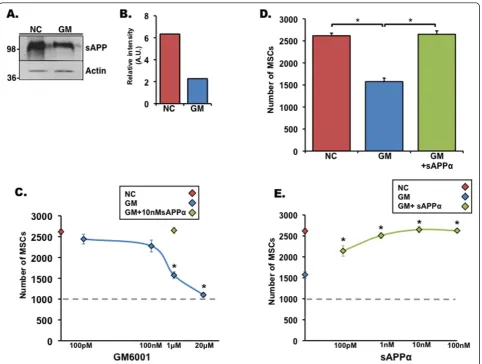
neural origin. Thus, we first tested whether reduced proliferation after inhibition of MMPs and ADAMs was cell-autonomous to NPCs or applied to other stem cell types. For this purpose, we examined the extent of pro-liferation of MSCs after GM6001 treatment. As in NPCs, GM6001 treatment reduced secreted levels of sAPPa(Figure 4a, b) and significantly reduced prolifera-tion of MSCs (Figure 4c) in a dose-dependent manner, suggesting that MMP family members may play an important role in the proliferation of MSCs. The
addi-tion of recombinant sAPPasignificantly recovered MSC
proliferation (Figure 4c, d). Like in the NPCs, 100 pM of sAPPawas sufficient to significantly rescue MSC pro-liferation and enhance their propro-liferation in a dose-dependent manner (Figure 4e). Taken together, these
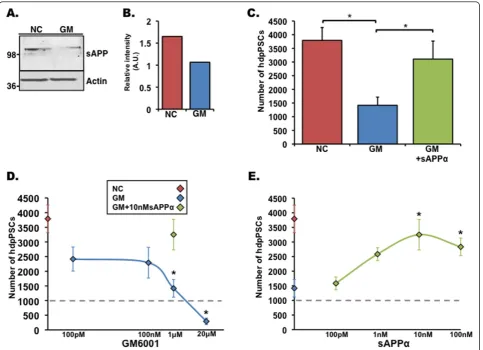
results suggest that APP is expressed in MSCs and pro-cessed by a-secretase activity to yield sAPPa that in turn regulates the proliferation of MSCs. Next, we inves-tigated the effect of a-secretase inhibition and sAPPa on the proliferative activity of hdpPSCs. The effect of GM6001 on hdpPSCs was similar to the one observed with NPCs and MSCs (Figure 5). Treatment with
GM6001 significantly reduced levels of secreted sAPPa
concomitantly with hdpPSC proliferation (Figure 5a-c), and this deficit was ameliorated by the addition of
recombinant sAPPain a dose-dependent manner
(Fig-ure 5c-e). Taken together, these results suggest that sAPPais an essential proliferation factor of a variety of adult stem cells of different origins and provides a func-tional significance for the abundance of APP.
High levels of sAPP are expressed in the subventricular zone of adult mice
To establish that sAPPa plays a role in proliferation of NPCs in vivo, we examined expression levels of
full-length APP and sAPPa in the SVZ, SGL, and a
non-neurogenic region (cerebellum) of APP(-/-) and APP
(+/+) mice. For this purpose, we used antibodies
recognizing the N◯-terminus of APP (22C11), thus
recognizing both full-length APP and sAPPa. We show
that levels of 22C11 are comparable in the SGL and cerebellum with a trend of increased expression in the SVZ (Figure 6a). To examine whether this trend is a
result of increased levels of sAPPa specifically, we
immunodepleted full-length APP from the protein extract by using antibodies recognizing the
carboxyl-terminus of APP, thus not capturing sAPPa. We
observed that levels of sAPPa were particularly high in
the SVZ of bothAPP(+/+) andAPP(+/-) (Figure 6b-d).
These results support our notion that sAPPa plays a
major role in the SVZ.
To determine whether the NSC and NPC populations
that express APP resemble those observed in vitro in
neurosphere culture, we double-stained brain sections of adult mice with antibodies raised against APP, Sox2, nestin, and Dlx-2, the last of which is a homeobox pro-tein expressed in transit-amplifying C cells of the adult SVZ [28]. APP expression colocalized with all three
markers, suggesting that APP is expressed in NSCs and transit-amplifying NPCs in the adult SVZ (Figure 6e).
ADAM10 is expressed in the subventricular zone and hippocampus of adult mice
To examine whether high levels of sAPPain the SVZ
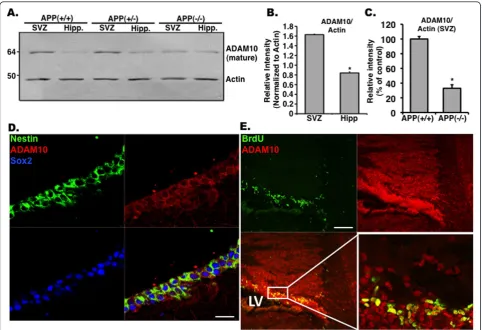
reflect levels ofa-secretase in this region, we examined expression of ADAM10, recently shown to be a criticala -secretase during brain development [13]. We show that levels of ADAM10 are significantly higher in the SVZ compared with the SGL (Figure 7a, b). In support of a
cor-relation between levels of sAPPaand ADAM10 is the
observation that ADAM10 levels are lower in the SVZ of APP(-/-) compared with APP(+/+) (Figure 7a, c). To examine whether ADAM10 is expressed in the same neu-rogenic populations as APP, we immunostained brain sec-tions with antibodies raised against ADAM10, nestin, Sox2, and BrdU 24 hours after a single dose. We observed that ADAM10 colocalizes with all three markers, suggest-ing that, like APP, ADAM10 is expressed in NSCs and transit-amplifying NPCs in the adult SVZ (Figure 7d, e).
sAPP regulates extracellular signal-regulated kinase activity
The mitogen-activated protein (MAP) kinase pathway plays an important role in the proliferation of NPCs derived from the adult SVZ [29]. Treatment with sAPP
has been shown to stimulate ERK signaling in PC-12 cells [30], and SORLA-deficient mice showing enhanced APP cleavage to sAPP and Abdisplay increased neurogenesis and ERK signaling in hippocampal neurons [19]. There-fore, we tested whether inhibition of MMP activity, decreasing sAPPaproduction, would result in deficient ERK signaling. For this purpose, NPCs were treated with GM6001 as before and placed into Hank’s balanced salt solution for 1 hour to remove any presence of exogenous growth factor signaling. Western blot analysis reveals that pERK is reduced approximately 25% in NPCs treated with GM6001 (Figure 8a, b). To examine whether this
reduc-tion can be recovered by addireduc-tion of sAPPa, we added
recombinant sAPPaprior to lysing the cells. Recombinant sAPPawas able to reverse the deficits in ERK phosphory-lation caused by GM6001 treatment (Figure 8a, b). To test whether this effect was specific to ERK, we examined another integral proliferation pathway known to respond to sAPPa[31], protein kinase B (Akt). Phosphorylation of Akt did not change significantly from negative control in any of the groups tested (Figure 8c, d), suggesting that sAPPais associated specifically with ERK signaling.
Discussion
During the last two decades, there has been much inter-est in unraveling the physiological role of APP, its
metabolites, and the physiological significance of its multiple metabolic pathways. Here, we show that sAPPa, a product of APP cleavage by a-secretase, is a proliferation factor of NPCs in the adult brain, MSCs, and hdpPSCs. This suggests an important role for sAPPa as a proliferation factor of different stem cell populations in the adult. The diversity of stem cells that respond to sAPPaas a proliferation factor leads us to suggest that sAPPaexerts its effect on a wide range of stem cell populations. NPCs used in this study were derived from the adult mouse brain. MSCs were isolated from the bone marrow of adult mice, and hdpPSCs were isolated from the decidua parietalis dissected from placental membranes. All stem cell populations have
self-renewal capability. Whereas NPCs are capable of differentiating into neurons or glia only, MSCs exhibit multilineage potential into many mesodermal cell types and possibly into endodermal and ectodermal cells as well (reviewed in [32]). hdpPSCs are of human fetal ori-gin and are thought to exhibit multilineage potential [33].
These results provide functional significance for the fact that APP is ubiquitously expressed and is highly conserved in evolution (reviewed in [34]). We show that sAPPais a potent factor that can recover proliferation of these stem cell populations after treatment with an MMP inhibitor. The importance of our observations is supported by studies reporting that the expression of
sAPPa can rescue behavioral and physiological deficits
ofAPPknockout mice, such as growth and brain weight
deficits, agenesis of the corpus callosum, and impaired spatial learning associated with impaired long-term potentiation, suggesting that sAPPais sufficient for the execution of APP function compromised in its absence [35,36].
APLP1 and APLP2 have substantial homology to APP, both within the ectodomain and particularly within the cytoplasmic tail [37]. Support for functional redundancy between APLP2 and APP/APLP1 comes from studies of combined knockouts [38]. Cleavage of APLP1 and
APLP2 bya-secretase yields sAPLPaof unknown
func-tion, which may play a role similar to that of sAPPa in NPC and other stem cell populations. As we cannot
exclude a potential functional redundancy between
sAPPa and sAPLP2a, we avoid a potential
compensa-tory effect of sAPLPain the present study by using the GM6001 MMP inhibitor that inhibits APLP1,2 cleavage by a-secretase as well. Expression levels of sAPPa were particularly high in the SVZ. That may suggest that NPC proliferation is differentially regulated in the two neurogenic microenvironments in the adult brain [39]
(and that sAPPa plays an important role in the SVZ
specifically) or simply reflect the fact that the neuro-genic population is larger in the SVZ. Expression levels of thea-secretase, ADAM10, are significantly higher in the SVZ compared with the dentate gyrus or to the SVZ of APP(-/-), suggesting a correlation between a
-secre-tase and sAPPa in the neurogenic regions. Like in the
case of sAPPa, the higher level of ADAM10 expression in the SVZ may be a reflection of the greater population of NSCs and NPCs residing in the SVZ. While GM6001
inhibited a-secretase activity in NPCs, MSCs, and
hdpPSCs, we cannot exclude the possibility that the
identity of the dominant a-secretase in each one of
these stem cell populations is different, representing a different member of the ADAM family, each of which is differentially expressed in a tissue- or niche-specific manner.
Finally, we provide an insight into the mechanism by which sAPPaexerts its proliferative effect in NPCs. We show that it acts in an EGF- and bFGF-independent manner. It has been suggested that, because of the pre-sence of a heparin-binding domain adjacent to the puta-tive growth factor domain in APP [40] and the presence of sAPP-binding sites on EGF-responsive NPCs [18], signaling of sAPP may involve other factors (such as
EGF) which also can interact with heparin. Our results
suggest that any interaction of sAPPaand EGF or bFGF
is not necessary for the proliferation-related functions of
the molecule. Furthermore, we show that sAPPa
signal-ing is associated with ERK/MAP kinase signalsignal-ing. Increased phosphorylation of ERK is indicative of signal-ing through the MAP kinase pathway. In NPCs, ERK signaling is crucial for carbachol-induced increases in DNA synthesis [41], inhibiting MAP kinase signaling decreases BrdU incorporation after heparin-binding EGF activation [42], and MEK 1 and 2 inhibitor, U0126, inhi-bits proliferation after hypoxia/reoxygenation [43]. All of these factors point to ERK/MAP kinase as a critical pathway in the proliferation of NPCs. Another critical pathway involved in proliferation of NPCs, Akt [41-44], was not activated by sAPPain vitro. Previous investiga-tions using pharmaceutical inhibitors of either the ERK/ MAP kinase pathway or the Akt/PI3-K pathway suggest
that PI3-K inhibition results in both self-renewal deficits and proliferation decline whereas MAP-kinase inhibition affected proliferation only [45].
Conclusions
In summary, we provide evidence that, by signaling through MAP kinase pathways, the evolutionarily con-served sAPPa regulates the proliferation of adult stem cells originating from different germ layers. Future
stu-dies should determine whether a reduction ina
-secre-tase activity or in sAPPa production or in both
contributes to the aging of these stem cell populations.
Abbreviations
ADAM: a disintegrin and metalloproteinase; APP: amyloid precursor protein; BCA: bicinchoninic acid; bFGF: basic fibroblast growth factor; BSA: bovine serum albumin; DMEM/F12: Dulbecco’s modified Eagle’s medium/F12; EDTA:
ethylenediaminetetraacetic acid; EGF: epidermal growth factor; ERK: extracellular signal-regulated kinase; hdpPSC: Human decidua parietalis placenta stem cells; MAP: mitogen-activated protein; MMP: matrix-metalloproteinase; MSC: mesenchymal stem cell; NC: negative control inactive inhibitor; NPC: neural progenitor cell; NSC: neural stem cell; PBS: phosphate-buffered saline; PMSF: phenylmethylsulfonyl fluoride; rpm: revolutions per minute; sAPPα: soluble amyloid precursor protein alpha; SGL: subgranular layer of the dentate gyrus; SORLA: sortilin-related receptor with type-A repeats; SVZ: subventricular zone; TBS: Tris-buffered saline.
Acknowledgements
This study was supported by NIA AG033570 (OL), an Alzheimer’s Association Young Investigator Award (OL), an Illinois Department of Public Health ADRF award (OL), and the Brain Research Foundation (OL).
Author details
1Department of Anatomy and Cell Biology, The University of Illinois at
Chicago, 808 S Wood St. Rm. 572 Chicago, IL 60612, USA.2Department of
Surgery, The University of Illinois at Chicago, 840 S Wood St. Suite 402 Chicago, IL 60612, USA.3Department of Obstetrics and Gynecology College
of Medicine, The University of Illinois at Chicago, 1801 W. Taylor Street, Chicago, IL 60612, USA.
Authors’contributions
MPD carried out experiments and data analysis and participated in manuscript writing.
AB and ZS each collaborated on experiments and participated in experimental design and manuscript writing. OL oversaw studies and participated in study design, data analysis, and manuscript writing. All authors read and approved the final manuscript.
Competing interests
The authors declare that they have no competing interests.
Received: 1 July 2011 Accepted: 30 August 2011 Published: 30 August 2011
References
1. Thinakaran G, Koo EH:Amyloid precursor protein trafficking, processing, and function.J Biol Chem2008,283:29615-29619.
2. Small SA, Gandy S:Sorting through the cell biology of Alzheimer’s disease: intracellular pathways to pathogenesis.Neuron2006,52:15-31. 3. Sisodia SS:Beta-amyloid precursor protein cleavage by a
membrane-bound protease.Proc Natl Acad Sci USA1992,89:6075-6079. 4. Sisodia SS, Koo EH, Hoffman PN, Perry G, Price DL:Identification and
transport of full-length amyloid precursor proteins in rat peripheral nervous system.J Neurosci1993,13:3136-3142.
5. De Strooper B:Alzheimer’s disease. Closing in on gamma-secretase.
Nature2000,405:627-629.
6. Lammich S, Kojro E, Postina R, Gilbert S, Pfeiffer R, Jasionowski M, Haass C, Fahrenholz F:Constitutive and regulated alpha-secretase cleavage of Alzheimer’s amyloid precursor protein by a disintegrin metalloprotease.
Proc Natl Acad Sci USA1999,96:3922-3927.
7. Asai M, Hattori C, Szabo B, Sasagawa N, Maruyama K, Tanuma S, Ishiura S:
Putative function of ADAM9, ADAM10, and ADAM17 as APP alpha-secretase.Biochem Biophys Res Commun2003,301:231-235.
8. Buxbaum JD, Liu KN, Luo Y, Slack JL, Stocking KL, Peschon JJ, Johnson RS, Castner BJ, Cerretti DP, Black RA:Evidence that tumor necrosis factor alpha converting enzyme is involved in regulated alpha-secretase cleavage of the Alzheimer amyloid protein precursor.J Biol Chem1998,
273:27765-27767.
9. Postina R, Schroeder A, Dewachter I, Bohl J, Schmitt U, Kojro E, Prinzen C, Endres K, Hiemke C, Blessing M, Flamez P, Dequenne A, Godaux E, van Leuven F, Fahrenholz F:A disintegrin-metalloproteinase prevents amyloid plaque formation and hippocampal defects in an Alzheimer disease mouse model.J Clin Invest2004,113:1456-1464.
10. Yan R, Munzner JB, Shuck ME, Bienkowski MJ:BACE2 functions as an alternative alpha-secretase in cells.J Biol Chem2001,276:34019-34027. 11. Endres K, Postina R, Schroeder A, Mueller U, Fahrenholz F:Shedding of the
amyloid precursor protein-like protein APLP2 by disintegrin-metalloproteinases.FEBS J2005,272:5808-5820.
12. LaVoie MJ, Selkoe DJ:The Notch ligands, Jagged and Delta, are sequentially processed by alpha-secretase and presenilin/gamma-secretase and release signaling fragments.J Biol Chem2003,
278:34427-34437.
13. Jorissen E, Prox J, Bernreuther C, Weber S, Schwanbeck R, Serneels L, Snellinx A, Craessaerts K, Thathiah A, Tesseur I, Bartsch U, Weskamp G, Blobel CP, Glatzel M, De Strooper B, Saftig P:The disintegrin/ metalloproteinase ADAM10 is essential for the establishment of the brain cortex.J Neurosci2010,30:4833-4844.
14. Saitoh T, Sundsmo M, Roch JM, Kimura N, Cole G, Schubert D, Oltersdorf T, Schenk DB:Secreted form of amyloid beta protein precursor is involved in the growth regulation of fibroblasts.Cell1989,58:615-622.
15. Pietrzik CU, Hoffmann J, Stober K, Chen CY, Bauer C, Otero DA, Roch JM, Herzog V:From differentiation to proliferation: the secretory amyloid precursor protein as a local mediator of growth in thyroid epithelial cells.Proc Natl Acad Sci USA1998,95:1770-1775.
16. Ohsawa I, Takamura C, Morimoto T, Ishiguro M, Kohsaka S:Amino-terminal region of secreted form of amyloid precursor protein stimulates proliferation of neural stem cells.Eur J Neurosci1999,11:1907-1913. 17. Rossjohn J, Cappai R, Feil SC, Henry A, McKinstry WJ, Galatis D, Hesse L,
Multhaup G, Beyreuther K, Masters CL, Parker MW:Crystal structure of the N-terminal, growth factor-like domain of Alzheimer amyloid precursor protein.Nat Struct Biol1999,6:327-331.
18. Caille I, Allinquant B, Dupont E, Bouillot C, Langer A, Muller U, Prochiantz A:
Soluble form of amyloid precursor protein regulates proliferation of progenitors in the adult subventricular zone.Development2004,
131:2173-2181.
19. Rohe M, Carlo AS, Breyhan H, Sporbert A, Militz D, Schmidt V, Wozny C, Harmeier A, Erdmann B, Bales KR, Wolf S, Kempermann G, Paul SM, Schmitz D, Bayer TA, Willnow TE, Andersen OM:Sortilin-related receptor with A-type repeats (SORLA) affects the amyloid precursor protein-dependent stimulation of ERK signaling and adult neurogenesis.J Biol Chem2008,283:14826-14834.
20. Demars M, Hu YS, Gadadhar A, Lazarov O:Impaired neurogenesis is an early event in the etiology of familial Alzheimer’s disease in transgenic mice.J Neurosci Res2010,88:2103-2117.
21. Polchert D, Sobinsky J, Douglas G, Kidd M, Moadsiri A, Reina E, Genrich K, Mehrotra S, Setty S, Smith B, Bartholomew A:IFN-gamma activation of mesenchymal stem cells for treatment and prevention of graft versus host disease.Eur J Immunol2008,38:1745-1755.
22. Strakova Z, Livak M, Krezalek M, Ihnatovych I:Multipotent properties of myofibroblast cells derived from human placenta.Cell Tissue Res2008,
332:479-488.
23. Zheng H, Jiang M, Trumbauer ME, Hopkins R, Sirinathsinghji DJ, Stevens KA, Conner MW, Slunt HH, Sisodia SS, Chen HY, Van der Ploeg LH:Mice deficient for the amyloid precursor protein gene.Ann N Y Acad Sci1996,
777:421-426.
24. Zheng H, Jiang M, Trumbauer ME, Sirinathsinghji DJ, Hopkins R, Smith DW, Heavens RP, Dawson GR, Boyce S, Conner MW, Stevens KA, Slunt HH, Sisoda SS, Chen HY, Van der Ploeg LH:beta-Amyloid precursor protein-deficient mice show reactive gliosis and decreased locomotor activity.
Cell1995,81:525-531.
25. National Institutes of Health Guide for the Care and Use of Laboratory Animals [http://grants.nih.gov/grants/olaw/Guide-for-the-Care-and-use-of-laboratory-animals.pdf].
26. Bazán E, Alonso FJ, Redondo C, López-Toledano MA, Alfaro JM, Reimers D, Herranz AS, Paíno CL, Serrano AB, Cobacho N, Caso E, Lobo MV:In vitro and in vivo characterization of neural stem cells.Histol Histopathol2004,
19:1261-1275.
27. Alvarez-Buylla A, Garcia-Verdugo JM:Neurogenesis in adult subventricular zone.J Neurosci2002,22:629-634.
28. Doetsch F, Petreanu L, Caille I, Garcia-Verdugo JM, Alvarez-Buylla A:EGF converts transit-amplifying neurogenic precursors in the adult brain into multipotent stem cells.Neuron2002,36:1021-1034.
29. Learish RD, Bruss MD, Haak-Frendscho M:Inhibition of mitogen-activated protein kinase kinase blocks proliferation of neural progenitor cells.Brain Res Dev Brain Res2000,122:97-109.
30. Greenberg SM, Kosik KS:Secreted beta-APP stimulates MAP kinase and phosphorylation of tau in neurons.Neurobiol Aging1995,16:403-407, discussion 407-408.
31. Wehner S, Siemes C, Kirfel G, Herzog V:Cytoprotective function of sAppalpha in human keratinocytes.Eur J Cell Biol2004,83:701-708. 32. Kuhn NZ, Tuan RS:Regulation of stemness and stem cell niche of
mesenchymal stem cells: implications in tumorigenesis and metastasis.J Cell Physiol2010,222:268-277.
33. Ilancheran S, Michalska A, Peh G, Wallace EM, Pera M, Manuelpillai U:Stem cells derived from human fetal membranes display multilineage differentiation potential.Biol Reprod2007,77:577-588.
34. Selkoe DJ:Alzheimer’s disease: genes, proteins, and therapy.Physiol Rev 2001,81:741-766.
35. Muller U, Cristina N, Li ZW, Wolfer DP, Lipp HP, Rulicke T, Brandner S, Aguzzi A, Weissmann C:Behavioral and anatomical deficits in mice homozygous for a modified beta-amyloid precursor protein gene.Cell 1994,79:755-765.
36. Ring S, Weyer SW, Kilian SB, Waldron E, Pietrzik CU, Filippov MA, Herms J, Buchholz C, Eckman CB, Korte M, Wolfer DP, Müller UC:The secreted beta-amyloid precursor protein ectodomain APPs alpha is sufficient to rescue the anatomical, behavioral, and electrophysiological abnormalities of APP-deficient mice.J Neurosci2007,27:7817-7826.
37. Slunt HH, Thinakaran G, Von Koch C, Lo AC, Tanzi RE, Sisodia SS:Expression of a ubiquitous, cross-reactive homologue of the mouse beta-amyloid precursor protein (APP).J Biol Chem1994,269:2637-2644.
Müller U:Mice with combined gene knock-outs reveal essential and partially redundant functions of amyloid precursor protein family members.J Neurosci2000,20:7951-7963.
39. Suh H, Deng W, Gage FH:Signaling in adult neurogenesis.Annu Rev Cell Dev Biol2009,25:253-275.
40. Corrigan F, Pham CL, Vink R, Blumbergs PC, Masters CL, van den Heuvel C, Cappai R:The neuroprotective domains of the amyloid precursor protein, in traumatic brain injury, are located in the two growth factor domains.Brain Res2011,1378:137-143.
41. Li BS, Ma W, Zhang L, Barker JL, Stenger DA, Pant HC:Activation of phosphatidylinositol-3 kinase (PI-3K) and extracellular regulated kinases (Erk1/2) is involved in muscarinic receptor-mediated DNA synthesis in neural progenitor cells.J Neurosci2001,21:1569-1579.
42. Jin K, Mao XO, Del Rio Guerra G, Jin L, Greenberg DA:Heparin-binding epidermal growth factor-like growth factor stimulates cell proliferation in cerebral cortical cultures through phosphatidylinositol 3’-kinase and mitogen-activated protein kinase.J Neurosci Res2005,81:497-505. 43. Sung SM, Jung DS, Kwon CH, Park JY, Kang SK, Kim YK:Hypoxia/
reoxygenation stimulates proliferation through PKC-dependent activation of ERK and Akt in mouse neural progenitor cells.Neurochem Res2007,32:1932-1939.
44. Wang L, Gang Zhang Z, Lan Zhang R, Chopp M:Activation of the PI3-K/ Akt pathway mediates cGMP enhanced-neurogenesis in the adult progenitor cells derived from the subventricular zone.J Cereb Blood Flow Metab2005,25:1150-1158.
45. Torroglosa A, Murillo-Carretero M, Romero-Grimaldi C, Matarredona ER, Campos-Caro A, Estrada C:Nitric oxide decreases subventricular zone stem cell proliferation by inhibition of epidermal growth factor receptor and phosphoinositide-3-kinase/Akt pathway.Stem Cells2007,25:88-97. doi:10.1186/scrt77
Cite this article as:Demarset al.:Soluble amyloid precursor protein: a novel proliferation factor of adult progenitor cells of ectodermal and
mesodermal origin.Stem Cell Research & Therapy20112:36.
Submit your next manuscript to BioMed Central and take full advantage of:
• Convenient online submission
• Thorough peer review
• No space constraints or color figure charges
• Immediate publication on acceptance
• Inclusion in PubMed, CAS, Scopus and Google Scholar
• Research which is freely available for redistribution