A Comparison Study of Curriculum between
TESOL in the United Kingdom and TCSOL in
China
Yong Wu
Zhejiang Yuexiu University of Foreign Languages, China
Yuqi Qiu
Zhejiang University of Science and Technology, China
Fonny Dameaty Hutagalung University of Malaya, Malaysia
Callum McNeill-Keay
Zhejiang Yuexiu University of Foreign Languages, China
Abstract—this research analyses 10 universities from the United Kingdom and China respectively to make a comparison between TESOL and TCSOL curriculum. Based on the analysis, the compulsory courses, and optional courses, some similarities and differences have been analyzed. By referring to the curriculum of TESOL, some suggestions have been put forward. This research aims to inject broader approaches to the study of Master of Teaching Chinese to Speakers of Other Language (TCSOL), which would result in an enhanced understanding and enlargement of the subject matter, provide new thinking direction, promote the development of TCSOL, and reduce the possible confusion on the future development.
Index Terms—TCSOL, TESOL, curriculum, comparison
I. INTRODUCTION
Teaching English to Speakers of Other Language (TESOL) has over 70 years of history; which can be seen to have been founded after the completion of the Second World War, with the establishment of an English college at the University of Michigan. With the rapid economic development and technological strength of British and American, English is frequently used, and the demand for English teachers grows with changing. To meet this demand, more and more universities recruit the Postgraduate students in the TESOL in the U.K. As the origin of English, the U.K. set up the TESOL as major earlier than other countries. Until now, there are more than 50 colleges, universities have TESOL, and the related majors in the U.K.
TESOL is mainly to study and explore how to carry out English teaching, to get the theoretical methods of English teaching, and to enhance the overall level of English teaching through the practice of theory. Universities in the U.K. are developing with their TESOL curriculum based on the analysis of the students' situation and employment rate. Through these analyses, it can make more supplements to the contents of TESOL major, so that make TESOL become more international and meet the market demand. However, with the alteration of educational intuitions becoming more focused on the aspects of international education, has allowed for TESOL to become widely accepted within Western countries such as the UK, US, Australia, New Zealand and many others. Students can obtain the certificate related to TESOL upon graduation.
In recent years, with the rapid development of China’s economy and the steady improvement of national strength, more and more people begin to learn Chinese in the world. In 1985, Teaching Chinese to Speakers of other languages (TCSOL) for undergraduate students was established. Until 2007, the master's degree in TCSOL was established. Subsequently, more than 20 universities within China began to establish doctoral degrees successively. The establishment of these degrees at different levels has made an irreplaceable contribution for TESOL to internationalisation. However, some Chinese scholars still have varying degrees of “anxiety and uneasy” about the vision and mission of TCSOL, curriculum setting, development directions, and other essential issues of TCSOL (Ning, 2018).
ten universities in the United States and five universities in the United Kingdom. However, both countries have something in common, which puts "English teaching theory and practice" courses in the most critical position, followed by "Second Language Teaching Theory" and "English Language" courses (Wen, 2019). Add as Tian and Teng (2018) pointed out that the curriculum system of TESOL in the United Kingdom is divided into two categories, which are regular courses and special courses by analyzing 12 universities of TESOL. In addition suggest putting forward the emphasis on the development of special programs for the Master of TCSOL in China. It is necessary to expand setting the optional courses, focus on the intersection and penetration of knowledge; respect the individual differences of learners, and Increase the flexibility of student choice, with due consideration given to courses in research methods, linguistics, international topics, etc. This evidence has been able to provide a strong value for the curriculum within educational settings in China.
Zhang (2012) referred to the TECOL curriculum and proposed some suggestions. Similarly, Zhang (2015) found that TCSOL needs to have a high requirement and standard and should diversify the course setting and strong learning and managing system, and clear version and mission to meet the learners' needs. Su (2012) emphasized that the assessment of TESOL is diversified, not limited to the examination. TESOL focused on the difficult tasks of self-learning and comprehensive analysis; motivate learners’ metacognitive and cognitive strategies. Tian and Teng (2018) gave a detailed analysis of core courses, elective courses and specialized courses in the TESOL in the United Kingdom. They also made an overview of the required courses, optional courses, and practical courses in the U.S. It is concluded that the TESOL for Master Program in the United Kingdom has in-depth characteristics, and the TESOL for master Program in the United States is practical and personalized.
Chen (2008) clarified that the master's degree of TCSOL is not only an emerging discipline but also a cross-disciplinary discipline, as well as an open and international discipline. Zhou (2015) pointed out that the training mode determines the training direction of the master of TCSOL, and curriculum setting plays an essential role in the training mode.
Cao and Qin (2017) indicated that the TCSOL curriculum for master students usually has problems that emphasize the cultivation of teaching skills and neglect the teaching of language knowledge. In their research suggested that the content of TCSOL curriculum should meet the training objectives of the TCSOL, adhere to the principle of combining theory with practice, the combination of knowledge transfer and skill training, and optimize the current curriculum setting for TCSOL. Liu and Pan (2018) proposed that TCSOL should pay more attention to curriculum to achieve teaching achievement. Although these experts all emphasize the importance of the curriculum, however, they have put forward different opinions on the TCSOL curriculum.
Compare to the TESOL, it is a short development history for TCSOL of master students. However, as a similar major, there must be some universal or standard courses in the course setting. Therefore, this study mainly studies the following issues:
1. Is there any difference between TESOL major in the U.K. and TSCOL in China in terms of compulsory courses? 2. Is there any difference between TESOL major in the U.K. and TSCOL in China in terms of optional courses?
II. METHODOLOGY
A. Participants
This study is a comparison of the curriculum of TESOL in the U.K. and TCSOL in China. Ten representative universities in the U.K. were selected for analysis, which are the University of Edinburgh, the University of Leeds, University College London, University of Surrey, University of Bath, the University of Exeter, Oxford Brooks University, Lancaster University, University of Leicester, and the University of Sheffield. The selected Chinese universities are Peking University, Beijing Language and Culture University, Renmin University of China, Northeast Normal University, Communication University of China, Liaoning University, Dalian University of Foreign Languages, Zhejiang Normal University, Zhejiang University of Science and Technology, Guangdong University of Foreign Studies. All of these Chinese universities offer master’s degrees in teaching Chinese to speakers of other languages.
B. Data Collection and Procedures
Firstly, the curriculum data from the website of British universities are got, after the network search and investigation, the researcher had a general understanding of TESOL of 10 universities in the U.K. Nonetheless it has been pointed out by scholars showing that the majority of literature materials about the curriculum setting of TCSOL in the U.K. and TESOL in China for master's degree students were collected based on some databases. Finally, the collected data are sorted out, compared and studied.
C. Data Analysis
The Comparison of Compulsory Courses between TESOL and TCSOL (1) Compulsory courses of TESOL in the U.K. universities
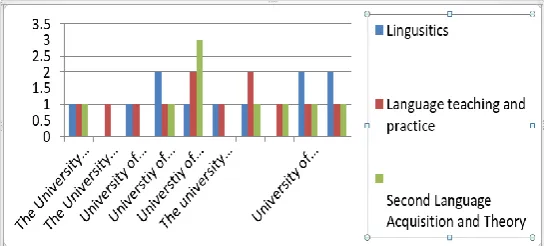
According to Figure 1, the average number of compulsory courses is 3 for opening the TESOL master students. These courses mainly cover “linguistics," "second language acquisition and theory," and “language teaching and practice."
Figure 1 The Number of Compulsory Courses of TESOL in the U.K. universities
According to Figure 2, it shows the proportions of “linguistics”, “second language acquisition and theory”, “language teaching and practice” in the total number of courses. From figure 2, universities in the U.K. pay more attention to the "language teaching and practice” course of TESOL because it covers 38% of the total courses. “Linguistics” course followed is 34%, and the lowest percentage is the "second language acquisition and theory" course, which is only 28%. Meanwhile, in these 10 British universities, only the University of Edinburgh has covered all of these three fields of courses. However, the "language teaching and practice" courses account for the most significant proportion in the University of Leeds. The “second language acquisition and theory” course at the University of Bath is only for 60%. University College London does not offer compulsory courses of "second language acquisition and theory."
Additionally, among the ten universities, the University of Leeds, the University of Surrey, the University of Exeter, Lancaster University, University of Leicester, and the University of Sheffield all set the graduation thesis course as a compulsory course. It reflected the significance of the graduation thesis and emphasized putting theory into practice. By setting the graduation thesis, it would help students to reflect their research direction at the beginning of studying and make proper preparations in advance. Meanwhile, it also built a good bridge into further study.
Figure 2 The Percentage of Compulsory Courses of TESOL in the U.K.
(2) Compulsory courses of TCSOL in the Chinese universities
With the rapid development of the major of TCSOL in China, the students of this major are not only Chinese students but also international students start to join TCSOL. This study mainly discusses the TCSOL course, which only offered to Chinese master students. In China, TCSOL divided into three types, which are core courses, elective courses, and training courses.
Most of the universities have set the core courses are 24 credits, the training courses are 4 credits and 6 credits for teaching practice in TCSOL. The total credits required for all courses of TCSOL should not be less than 38 credits. Five core courses are included in TCSOL major. There is second language acquisition (second language acquisition and theory field), teaching Chinese as a second language (language teaching and practice field), Chinese class teaching cases (language teaching and practice field), communication of Chinese culture and intercultural communication and international education of Chinese language.
master’s period, practical teaching raises more attention. Besides, cross-culture and communication are set as a master of TCSOL, most of them will teach overseas Chinese learners after graduation. Therefore, these courses can help them to overcome cross-cultural communication problems.
The Comparison of Optional courses between TESOL and TCSOL (1) The optional courses in the U.K. universities
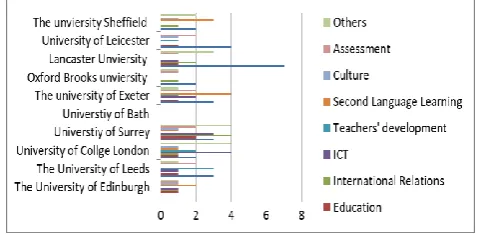
There is a wide range of optional courses for TESOL major in British universities according to Figure 3, however, it no needs every course to be selected. A large number of elective courses in the U.K. can be roughly divided into nine categories, which are linguistics courses, pedagogy courses, international perspective courses, advanced educational technology courses, teacher development courses, second language learning courses, cultural courses, materials analysis and evaluation courses, and other courses. It can be illustrated in Figure 3.
Figure 3 The category of the optional courses in the U.K. universities
Based on Figure 3, the average number of optional courses in 10 British universities is 10.7 courses. However, the different university has different curriculum policy and attitudes for opening optional courses. For instance, the University of Bath does not open any optional courses for TESOL master students. While, there are more than ten optional courses in the University of Leeds, University College London, University of Surrey, the University of Exeter and Lancaster University. Besides, not all of the British universities offered the optional courses every year. The optional course setting based on the TESOL students’ choice and department resources.
Through analysis of the arrangement of optional courses of TESOL, it indicated that each university has autonomy mainly in offering elective courses of TESOL. The setting of optional courses is not the same and based on the characteristics of TESOL of each university. For instance, although the University of Bath has no optional course, however, the other 9 universities all consider the basic needs of master students of TESOL when setting up their curriculum.
Related to Figure 2, all universities open the optional courses about linguistic except the University of Edinburgh. Despite linguistics courses have a large proportion in compulsory courses, British universities still offer relevant courses in optional courses for TESOL. For instance, Lancaster University has the most significant proportion of linguistics courses. Opening linguistic courses as optional course indicate that the universities realized the great importance to linguistics courses and focuses on consolidating TESOL students’ basic knowledge.
On the other hand, eight universities provide pedagogical courses as optional courses. The pedagogical courses are in line with the characteristics of TESOL, which is conducive to change the learners’ roles and learn the pedagogy related knowledge from the perspective of TCSOL teachers. The curriculum of pedagogy plays an essential role in training foreign English teachers. However, in terms of the curriculum of internationalization, four universities do not provide the courses of this type. These include the University of Leeds, the University of Surrey, the University of Exeter, and the University of Leicester. TESOL is aimed at non-native English speaking students, and the setting of internationalization is conducive to establishing an international perspective in the teaching process. However, the courses offered by University College London and Oxford Brooks University account for a large proportion, reflecting that these two universities have a wide range of enrollment from all kinds of backgrounds.
Besides, the Oxford Brooks University, University of Leicester and the University of Sheffield do not offer advanced educational technology courses. Using ICT into the foreign language teaching is advancing with the development of the times. Hence, applying science and technology to teaching should make the class more attractive to students.
Four universities offer to teach development courses that aim at training the quality and ability of teachers. Although only four universities provide relevant optional courses, it can also be explained that colleges and universities pay attention to the development of teachers and focus on cultivating teachers’ abilities.
Five universities offer second language learning courses. It could promote the development of TESOL students' language ability and improve their knowledge level by learning the second language. As a leading TESOL major, the University of Sheffield offers a large number of courses related to second language learning. It indicates that universities set up elective courses according to the actual situation of the university.
As a TESOL teacher, he or she should have not only rich knowledge and teaching skills but also make thoughtful analysis and evaluation of textbooks and students. Only in this way, can he or she consider various factors in the preparation of lessons and make the right judgment on different teaching objects and textbooks in time. Except for the University College London, University of Bath and the University of Sheffield, the other seven universities all offer the educational management courses. It shows that the courses have educational significance in the process of cultivating students.
(2) The optional courses of TCSOL in the Chinese universities
According to Figure 3, it indicated that the elective courses training program of TCSOL for master students are divided into three fields, which are teaching Chinese as a foreign language, Chinese cultural and cross-cultural, education and education management.
Figure 4 The percentage of optional courses in TCSOL
From the above Figure 4, it shows that there are a large number of universities provide teaching Chinese as foreign language courses and education and teaching management courses among the 10 universities in China. These courses could help students to transform their identity in the course of the class, learn to be a qualified Chinese teacher, and learn how to teach Chinese better. The TCSOL for master students would be engaged in the work of Chinese teaching after graduation. However, they are also the ambassadors of communication between China and foreign countries. Therefore, the proportion of Chinese culture and cross-cultural courses is set at 25%. Overseas Chinese language learners only familiar with Chinese culture so that they can master Chinese language learning well. In the process of Chinese teaching, TCSOL teachers will inevitably encounter difficulties in Chinese teaching management. Hence, the curriculum of education and teaching management can help TCSOL master students learn the skills of classroom management, serve the teaching better, and carry out teaching activities better. Besides, the course of Chinese cultural and cross-cultural are recognized as the supplement of the compulsory courses. The proportion is at the low level.
III. DISCUSSION
A. The Compulsory Comparison Courses between TESOL and TCSOL.
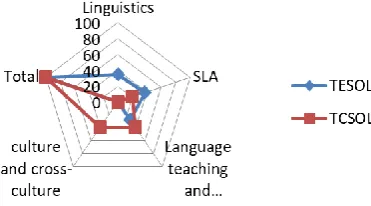
According to Figure 5, both TESOL and TCSOL attach importance to second language teaching and theoretical courses to improve TCSOL students’ teaching awareness. The “linguistics” courses of TESOL account for 34.4% of the compulsory courses, the highest proportion, which indicates that TESOL in British universities focuses on the training TESOL students’ knowledge of the language. However, TCSOL does not provide linguistics courses in the compulsory courses and pay more attention to the training of teaching practice. Therefore, the “language teaching and practice” courses in TESOL and TCSOL respectively are 28.1% and 40% in the compulsory courses. In terms of other courses, the major in the two countries also focuses on different curriculum types. TESOL pays emphasized on training students’ methodology competency, while TCSOL focuses on the cross-cultural training competency.
B. The Optional Comparison Courses between TESOL and TCSOL.
There are more optional courses for TESOL than for TCSOL. It means that students of TESOL have a wide choice of optional courses, and they are high autonomous. TESOL in British universities does not require every student to choose all of the optional courses. Generally, TESOL students only choose three or four courses to learn. Meanwhile, the proportion of pedagogy courses in the elective courses is the largest, which proves that the major of TESOL is based on language education. There are also a lot of international courses in TESOL for meeting the standard of "internationalization." While opening new education technology courses shows that the TESOL tightly keeps pace with the times.
In the optional courses of TCSOL, Chinese as a foreign language course is a significant proportion. It reflects that the TCSOL for master students attaches great importance to teaching methods and teaching management to make students change from "how to learn" to "how to teach." Although the TCSOL for master students will be engaged in the work of Chinese teaching after graduation, they also take responsibility for cultural communication between China and foreign countries. Therefore, the proportion of Chinese culture and cross-cultural courses is 25%. Chinese language learners could learn the Chinese language better when they know the Chinese culture well.
By analyzing and comparing the curriculum of TESOL and TCSOL in the U.K. and China, some discussions are followed. No matter what TESOL and TCSOL, the universities should set up courses that are useful to students, continuously improve students' professionalism. Meanwhile, teaching skills courses of TCSOL should be coordinated with the proportion of Chinese basic knowledge courses, which can provide TCSOL students with a better learning environment. Additionally, the proportion of theory courses should be increased in TCSOL. Although Linguistics courses are the basic theory of teaching Chinese as a second language, the second language acquisition theory, and the teaching theory are the core of the major.
Meanwhile, the practical course is the specific utilization of the underlying theory. Although most curriculums of TCSOL are practical courses, however, students need teaching practice based on a more profound knowledge of linguistics. Lacking theory, they cannot use ontological knowledge to solve problems in class. Therefore, it should emphasize not only practicality but also language theory. On the other hand, it can be seen that not only professional courses but also psychology and research courses are all included in the TESOL curriculum. On the other hand, the short of development time compared to TESOL, the TCSOL more stress on the relations each course to extend the width and the depth in terms of curriculum. Although the setting of optional courses of TCSOL is not as good as that of TESOL in British universities, TCSOL also has its characteristics, such as Chinese culture courses. Concerning it, TCSOL can learn from the TESOL of British universities to make the best use of the university resources, effectively integrate the resources of the universities, and offer courses related to internationalization or teacher development, so that TCSOL students could get a more comprehensive development. More importantly, the optional courses should conform to the characteristics of TCSOL. For instance, the universities must offer Taiji, Chinese painting, Chinese kungfu, cooking, and other courses that are popular with international students. So that students with different backgrounds can make multiple choices.
Additionally, from the curriculum setting of TESOL in British universities, it reflects that British universities pay more attention to students’ individual needs. That is why TESOL offers so many optional courses for students to choose from. In the process of professional development, curriculum setting is essential. However, in the teaching process, teachers should focus on the content of the course, which is suitable for the students. Therefore, the classroom setting should not only meet the training requirements, but also respect the individual differences of students, understand the actual needs of each student, and teach students by their aptitude so that students’ knowledge level and teaching skills can be improved. Hence, teachers should design some reasonable and scientific training programs and courses based on understanding the actual needs of students. The universities should combine the development of contemporary society and employment factors with improving the content of the course according to students’ needs.
IV. CONCLUSION
Through the comparison and analysis of TESOL and TCSOL, this study found some similarities and differences in compulsory and optional courses. This research helps to find out the advantages of TESOL and TCSOL, and provide some reference for TCSOL to improve the curriculum. Besides, it also provides some suggestions to the experts to guide the cultivation of TCSOL in theory and help to train the teachers who meet the requirements of internationalization and genuinely serve students and the society.
ACKNOWLEDGMENTS
This research was supported by 2017 Zhejiang Provincial Education Planning Project (No. 2017SCG387)
REFERENCES
[1] Cao, Y., Qin, Y.P. & Ye, Z.F. (2017). Reflections on the Optimization of the Curriculum for the Master of Chinese International
Education. Journal of Xi'an University of Architecture and Technology, 32(3), 13-17.
12(3), 19-34.
[3] Li, X.Q. (2014). The Development and Prospects of the International Education of Chinese Language: Commemorating the
10th Anniversary of the Establishment of the Confucius Institute. Journal of South China Normal University, 5, 120-129.
[4] Liu, Y.M., & Pan, J.Y. (2018). Research on the Selection and Training Model of Chinese Teacher Volunteers. Overseas Chinese
education, 98(3), 82-87
[5] Ning, J.M. (2018). Rethinking International Chinese Education both as a Profession and an Academic Discipline. Chinese
Journal of Language Policy and Planning, 12, 6-11.
[6] Su. Y.X. (2012).A Case Study on Learning Strategies of Chinese International Students on TESOL Master’s Programme in UK.
Journal of Beijing International Studies University, 204(4), 74-82.
[7] Tian, W.Y., & Teng, X.L. (2018). A Comparative Study of British and American MTESOL.1. Journal of Changchun Normal
University, 1, 35-42.
[8] Wen, Q.F. (2019).From English International Education to Chinese International Education: Reflections and Suggestions.
Chinese Teaching in the World, 33(3), 291-299.
[9] Zhang, X.P. (2012). Research on the Cultivating Problem and Strategy of Foreign Students of MTCSOL. Journal of Chongqing
University, 12(4), 78-85.
[10] Zhou, Y.F. (2015). Thoughts on the Curriculum of Chinese International Education. Journal of Xingtai Vocational and
Technical College, 12(5), 45-57.
YongWu was born in Shaoxing, China. She is currently an associate professor and deputy dean in the English faculty, Zhejiang
Yuexiu University of Foreign Languages, Shaoxing, China. Her research interests include psycholinguistics, second language learning and teaching.
Yuqi Qiu was born in Guangdong province. Now she is the master student in Zhejiang University of Science and Technology
Fonny Dameaty Hutagalung is the senior lecturer in Education Faculty of University of Malaya. Her name very well-known in CRC Balkema Taylor & Francis Publisher as Editor likes Economics, Social Sciences and Informational Management (2015), The Role of Service in Tourism & Hospitality Industri (2015), Social sciences and Interdisciplinary Behavior (2016) and Knowledge, Service, Tourism & Hospitality (2016). Her most recent books 2017 as Author are Research in Early Childhood in Bahasa Malaysia by University Malaya Press Publisher and Social interactions and Networking in Cyber Society with Springer Publisher. More than 20 research articles has been published in Scopus Journal and Proceeding.