R E S E A R C H
Open Access
Privacy-preserving analytics for the
securitization market: a zero-knowledge
distributed ledger technology application
Sophie Meralli
Correspondence:
[email protected] 1Massachusetts Institute of Technology (MIT) Digital Currency Initiative, 285 Third Street, Unit 715, 02142 Cambridge, Massachusetts, USA
Abstract
A zero-knowledge proof or protocol is a cryptographic technique for verifying private data without revealing it in its clear form. In this paper, we evaluate the potential for zero-knowledge distributed ledger technology to alleviate asymmetry of information in the asset-backed securitization market. To frame this inquiry, we conducted market data analyses, a review of prior literature, stakeholder interviews with investors, originators and security issuers and collaboration with blockchain engineers and researchers. We introduce a new system which could enable all market participants in the securitization lifecycle (e.g. investors, rating agencies, regulators and security issuers) to interact on a unique decentralized platform while maintaining the privacy of loan-level data, therefore providing the industry with timely analytics and performance data. Our platform is powered by zkLedger (Narula et al.2018), a zero-knowledge protocol developed by the MIT Media Lab and the first system that enables participants of a distributed ledger to run publicly verifiable analytics on masked data.
Keywords: Structured finance, Securitization, Blockchain, Zero-knowledge proofs, Distributed ledger technology, Privacy, Data analytics
Introduction
The securitization market presents inefficiencies due to the inherent complexity sur-rounding its structured products. The process of bundling thousands of loans and issuing related securities involves many intermediaries, with diverging incentives and access to information (European Central Bank Publication N. 9752008; Fligstein and Roehrkasse 2013). Due to information delays, lack of data standardization and limited traceability of collateral flow throughout the securitization chain, there is a lack of transparency about the performance of the many loans backing up these securities (Sindle et al2017). This lack of transparency prevents investors from making their investment decisions indepen-dently and in a timely manner, and has led to significant regulatory reforms (Code of Federal Regulations Title 17 Commodity and Securities Exchanges Chapter II Part 246 Credit Risk Retention2017) in the past recent years to improve disclosure requirements, network governance and accountability mechanism.
The inherent complexity and lack of transparency involved in the securitization indus-try makes it a compelling use case for distributed ledger technology (DLT) application. Recently, financial institutions and regulators in the industry have investigated DLT’s
potential (Sindle et al2017; Financial Industry Regulatory Authority (FINRA)2017). DLT uses independent computers (referred to as nodes) to record, share and synchronize transactions in their respective electronic ledgers (instead of keeping data centralized as in a traditional ledger) (The World Bank2018). Blockchain is one type of distributed ledger where data is organized into blocks, which are chained together in an append-only mode. In this paper, blockchain and DLT are used interchangeably. Blockchain/DLT enable recording of interactions and transfer ownership of asset (e.g. money, securities, land titles and specific information) peer-to-peer, without a need for a centrally coor-dinating entity (The World Bank2018). Applied to the securitization market, DLT may enable market participants to store and update securely the information of thousands of individual loans on a near-real time basis on one unique shared ledger, without the need for reconciliation among each party’s database (Sindle et al2017). It has the potential to bring secure, traceable near-real time performance data to the industry. However, DLT adoption faces a dilemma between data privacy-preserving and public sharing that can be described by two limitations: 1) participants will lose data privacy if they are to share data in the public ledger (such as loan level data); 2) encrypting loan level data will keep privacy but will therefore not support data analytics at the asset pool-level. As security issuers do not have the incentive to reveal sensitive proprietary loan-level data to investors and third-parties1, current blockchain applications cannot scale at industry level. In order for blockchain applications to scale, there is a need for flexible privacy settings that can reflect the subtleties of current market interactions.
We aim to address this dilemma by introducing a decentralized market platform, zkABS, powered by zero-knowledge proofs and designed for the securitization industry. In cryptography, a zero-knowledge protocol or proof is a method by which one party (the prover) can prove to another party (the verifier) that he knows a secret statement with-out revealing the secret itself (Goldwasser et al.1989). Our platform is based on zkLedger (Narula et al.2018), an experimental system developed by the MIT Media Lab that lever-ages zero-knowledge proofs to preserve data privacy while providing its users with a suite of publicly verifiable analytics at the aggregate level (e.g. sums, averages and variances).
Applied to the securitization industry, we argue that zkLedger could preserve the con-fidentiality of individual loan data while providing participants with publicly verifiable near-real time analytics at the asset pool level. It could therefore power a decentralized digital platform where all market participants (e.g. investors, issuers, regulators, rating agencies) could get access to publicly verifiable market analytics in near-real time. We introduce the concept of near-real time frequency to address the security vulnerability and privacy leaks that real-time frequency solutions entail. In the securitization market, near-real time analytics is defined as data analysis based on up-to-date information and can range from bi-weekly updates to daily updates, depending on the types and volume of assets hosted in the system2.
Our system has applications throughout the value chain: in the security construc-tion and issuance steps, it could enable investors to pick up loans on an aggre-gate basis, without revealing data on the individual loans. In the trading phase, it could provide anonymity of trading in the primary and secondary issuance side and
1Expert interviews of four Investors, four Issuers and one Attorney. See “Introduction” section for more details about
expert interviews
enable investors to get analytics about security ownership concentration. Post-issuance, investors could get anonymized performance analytics and query about trends in the market at any point of time. Overall, our system could reduce asymmetry of information and improve transparency in the securitization market. In summary, the contributions of this paper are:
• Identification of inefficiencies in the securitization market that could benefit from DLT technology, specifically related to information asymmetry between the sell-side and the buy-side of the industry.
• Review of current blockchain initiatives in the industry and their privacy limitations • Introduction of zkABS, a decentralized platform based on zkLedger that aims to
reduce the information asymmetry in the market. In our use case, zkABS is used as a model to share loan electronic records among distrusting participants in a secure and confidential way without compromising the independent verifiability of the data. Due to its selective visibility property, zkABS allows all market participants to interact on the same platform and to benefit from more timely market data.
Research methodology
While there has been an increasing number of companies exploring blockchain-based solutions for their business, reports show that the industry is still nascent (Pemberton and Levy2018; Pawczuk et al.2018). A key headwind to blockchain adoption is the fact that organizations focus on the technology with hopes that it can redefine their business, instead of spending time on identifying practical business use cases that could benefit from the technology (Pawczuk et al.2018). They tend to start by applying the solution first rather than identifying a problem and proving that blockchain is the adequate solution for it, and therefore face challenges in market adoption. In order to capitalize on a blockchain, companies should spend more time identifying frictions and processes that could benefit from the unique characteristics of this technology (Pawczuk et al.2018). In this paper, we purposely spent “Research methodology” section identifying the key market inefficiencies that could benefit from blockchain technology, before introducing a blockchain solution for the market.
Fligstein and Roehrkasse2013; Wheeler et al2017; OICV-IOSCO Technical Committee 2012), the evolution of relevant US regulation (U.S. Department of Treasury 2017) and the business application of distributed ledger technology (Sindle et al2017; U.S. Chamber of Digital Commerce SFIG2017; Catalini and Tucker 2018; Financial Industry Regula-tory Authority (FINRA)2017; The World Bank2018). Relevant literature was identified through a systemic backward search of economic papers from professional and govern-ment organizations, leading scholarly journals and industry publications. A summary of existing blockchain initiatives in the industry is provided in Appendix I. We then per-formed expert interviews with stakeholders in the securitization industry. We interviewed 18 experts, including two portfolio managers and two traders in investment and trading operations for large asset management firms (“Investors”), one trader and three man-agers at large financial institutions issuing securitized assets (“Issuers”), five manager in the asset-backed security origination and servicing department at financial institutions (“Originators and Servicers”), one attorney, two consultants and two auditors special-ized in applying distributed ledger technology to the securitization industry. Experts were selected based on their leadership positions and in some cases their deep knowledge of distributed ledger technology. We intentionally interviewed experts from both senior leadership position and junior positions with operating trading experience to gain com-prehensive insights on the industry. Twelve interviewees were based in the US, four were based in China and the rest were spread worldwide.
Regarding the technology, we leveraged existing literature review on zero-knowledge proofs described in “ZkLedger, a privacy-preserving protocolsection” (Narula et al.2018) and reviewed relevant articles on Pedersen commitments (Pedersen TP1992) and sigma protocols (Maurer2009; Wang and et al2019; Schnorr1991; Cramer et al.1994; Bernhard et al.2012). We received guidance from the zkLedger developing team to validate our approach for designing a novel system based on zkLedger for the securitization market. We took the example of the investor viewpoint to demonstrate zkLedger’s benefits. To build our model, we leveraged anonymized samples of servicer reports and loan tapes obtained during our expert interviews which enabled us to understand existing product for investors.
The inefficiencies of the securitization market
In this section, we provide a brief overview of the market and present the structural problems of today’s securitization market. Structuring securities is a complex process involving different participants. The incentives of these participants are not aligned with each other, which becomes the primary attribution of market inefficiencies. Rather than providing an exhaustive list of pain points, this section aims to provide the readers with an overview of the two main problems we collected from our interviews with market participants and that could be alleviated with zkLedger implementation. For a detailed description of the securitization market and the potential of blockchain technology in the industry, we refer to recent industry reports (Sindle et al2017; U.S. Department of Treasury2017; Financial Industry Regulatory Authority (FINRA)2017).
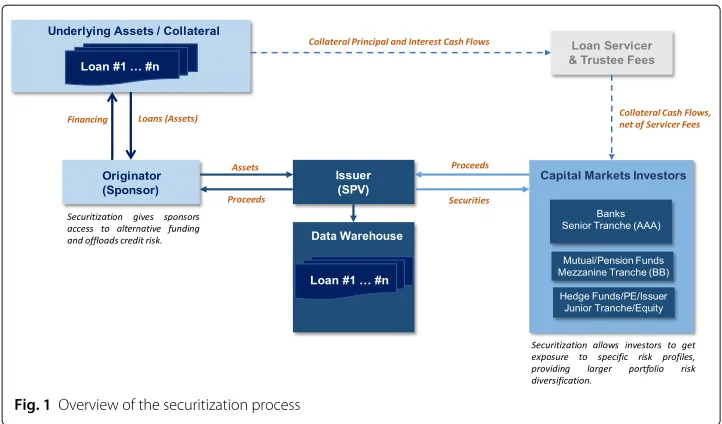
Fig. 1Overview of the securitization process
flows from thousands of individual assets (e.g. auto loans, mortgages, student loans, etc.) from a loan originator are pooled together and transferred to a newly created remote special-purpose vehicle (SPV) managed by a security issuer, and then sold as financial instruments (commonly referred to as “asset-backed securities”3) to investors. By trans-ferring the credit risk of the loans to the SPV in return for cash, the originator is able to recycle capital into the origination of new loans. The SPV finances the purchase of the underlying loans with a mix of equity and debt interests in the pool, structured in tranches4with different risk profiles. For instance, the senior tranche of an asset-backed security has the lowest risk since it has priority liquidation preference over junior tranches in case of default. Rating agencies play a significant role in the process by rating these tranches based on the credit quality of the underlying assets and the reputation of the issuer and originator, using their proprietary rating protocols. These asset-backed securi-ties are then sold to different investors depending on their risk tolerance – senior tranches (e.g. Tranche AAA) are typically bought by central banks and traditional banks. Mezza-nine tranches have higher yields and tend to be bought by mutual funds, while a large portion of the junior tranche and equity remains with the issuer. Over the life of the secu-rity, the cash flows generated by the underlying assets are collected by the loan servicer – sometimes the same entity as the originator – and used to repay investors and equity holders (see Fig.1). Because there are multiple parties involved, there are time lags before investors get notified about the loan payments or defaults.
Misaligned Incentives The securitization process involves transactions among numer-ous participants, with diverse incentives. We can distinguish broadly four types of parties: loan originators, intermediaries (e.g. issuers), third parties (e.g. credit rating agencies, servicers, underwriters, regulators and trustees) and investors. The incentives of these participants are not aligned with each other, which becomes the primary attribution of market inefficiencies. Loan originators collect commissions on loan issuance and aim to
3We use a broad definition of asset-backed securities, which includes securities backed by mortgages (“MBS”) and by any
other types of loans than mortgages (“ABS”).
4A “Tranche” is defined as a group of claims in the asset pool principal repayment. The word derives from the French
offload their credit risk by selling the loans to investors (Fligstein and Roehrkasse2013). However, they are not directly evaluated based on subsequent loan performance and therefore may have incentives to misrepresent the quality of the loans and to engage in opportunistic behavior (European Central Bank Publication N. 975 2008): since origi-nators’ profits increase based on the volume sold, they seek to achieve a high turnover of selling assets with reduced efforts in screening and monitoring borrowers (Euro-pean Central Bank Publication N. 975 2008). Unlike investors, originators will not be directly impacted if the quality of the loans subsequently deteriorates. Intermediaries collect transaction fees based on volume processed and have little incentive to balance the risk/reward trade-off that investors are seeking. Further, third parties such as credit agencies and servicers may not be inclined to perform downgrades or act upon loan delin-quency in a timely manner as they are closely involved with the issuers. Finally, investors aim to maximize their returns and mitigate risk using correlation indexes while delegating the management of their securities to intermediaries and third parties. Due to these mis-aligned incentives and asymmetry of information, investors bear the main risks and tend to rely on the reputation of the originators, issuers and servicers as well as rating agencies to support their investment decisions. It is worth noting that risk retention rules (Code of Federal Regulations Title 17 Commodity and Securities Exchanges Chapter II Part 246 Credit Risk Retention2017) which have already gone into effect have been designed to particularly put a stop to the originate-to-sell model and reduce the misaligned incen-tives. Securitization usage has significantly dropped since their enforcement (Wheeler et al2017).
Lack of Timely Information These misaligned incentives are amplified by the lack of timely information available to investors. Investor due diligence is a necessary component of an efficient market (OICV-IOSCO Technical Committee 2012). Through our inter-views with the trading desks of institutional investors5, we established that investors lack the price and liquidity discovery online tools to perform their due diligence independently and efficiently. Investors receive information at the issuance stage (i.e. in the prospectus), but receive fewer and non-standardized asset-pool performance statistics through the life of the asset (European Central Bank Publication N. 9752008). The information reported in servicer reports lack standardization across servicers: some servicers still do most of their work on paper and scan document copies, which are then stored in siloed databases (servers, data warehouses, government offices) (Sindle et al2017). This makes it increas-ingly difficult to reconcile the information among originators, intermediaries, investors, rating agencies and regulators, and results in market inefficiencies such as information delays, operational errors, and a lack of independence among the different parties. The performance updates are often released with significant time lags (e.g. there is a time lag of several weeks between the date of non-payment of consumer and the date the investor gets notified of the non-performance of his pool). Such delays can be especially signifi-cant in the case of a transfer from one servicer to another, due to difficulty in reconciling data. In consequence, buy-side traders often have to download scanned documents from many servicers and standardize the data themselves to perform their analysis, which is very time consuming and requires a high degree of expertise. As one of our institutional
investor interviewees6pointed out:“it would be great to have online analytics tools to
mon-itor loan performance and track the record of originators in a timely manner.”The lack of
timely information is even more pronounced in the secondary market, where often there is no price listed on market platforms or it is outdated by several weeks. In addition, there is opacity in tracking the flows of collateral and security ownership throughout the value chain and in financial markets. For instance, investors that manage arbitrage or relative value strategies are interested in information about security ownership such as concen-tration or composition for a specific collateral that they own partially. Today, the investors would have to carefully search dealer inventories or speak to dealers in order to find the exact collateral. Therefore, investors lack the information tools to make their investment decisions efficiently. In US, secondary markets for ABS are much smaller compared to agency MBS (Bloomberg database2018). For ABS, the difficulties and delays in accessing information on the underlying loans may be one of the main reasons to drive investors away from these securities or demand a higher risk premium. The possible ’near-time’ solution of zKABS may reduce these issues, encourage more investors and thus increase the size of the ABS market.
Overall, the market suffers from a combination of misaligned incentives and infor-mation asymmetry, which impedes market growth and liquidity. Solving for all of these inefficiencies may be challenging, however we believe that the market would benefit from more transparency. One solution could be to implement a database managed by the issuer that would update and share loan-level information to all participants simultaneously to ensure transparency. The problem with such a solution is that the issuer controlling the data enjoys significant market power over other participants and may prevent the collabo-ration of multiple competing servicers, issuers and originators. Another potential solution could be a new type of decentralized digital platform, such as the one powered by a dis-tributed ledger. Under such a system, no unique party has full control of the platform and its data. Rather, the platform’s ownership and governance can be shared among all the participants. Such a system could reconcile this need for transparency and efficiency without assigning the same degree of control to the intermediary operating and facilitat-ing transactions in the market, therefore separatfacilitat-ing the benefits of network effects from the agency costs they entail in terms of market power (Catalini and Tucker2018).
ZkLedger, a privacy-preserving protocol
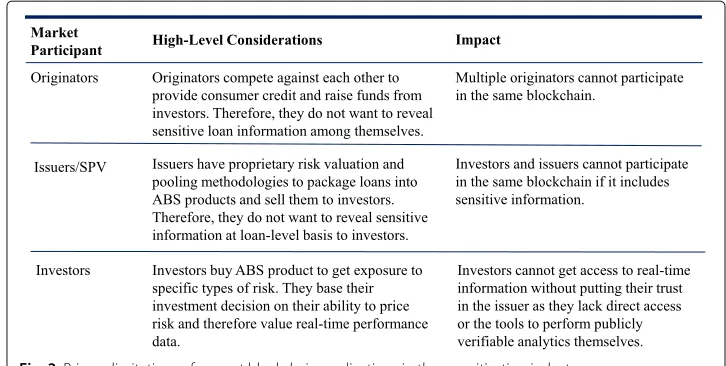
Current distributed ledger solutions are either entirely viewable to all participants or are encrypted to hide sensitive data but do not support data analytics without revealing the content of the data in the ledger. For instance, in order to calculate the net balance of monetary transactions in a private blockchain with distrusting participants, one would need to download all transactions to verify their integrity. This raises privacy concerns for market participants in the US securitization industry (see Fig.2). Due to the information asymmetry and diverging incentives between issuers and investors, there is a high degree of confidentiality and intellectual property surrounding the structuring of asset-backed securities. Although investors can get access to loan tapes7, with loan-level information, it is rather on an occasional basis and may present data quality issues (i.e. completeness, accuracy) (OpenRisk). Investors may get curated off-chain information on an aggregate
6Interview with a buy-side trader on the US asset-backed security market, March 2018
Fig. 2Privacy limitations of current blockchain applications in the securitization industry
basis but are not expected to join the issuers’ blockchain and thus will lack the tools to perform their due diligence independently. Similarly, current blockchain applications do not yet allow for multiple competing issuers to join the same universally agreed-upon ledger and therefore face limitations for applications at the industry level.
zkLedger Overview zkLedger (Narula et al.2018) is an open source protocol devel-oped by the MIT Media Lab Digital Currency Initiative that solves the trade-off between transparency and privacy of current blockchains. It is the first system to generate crypto-graphically verifiable answers to arbitrary analytics queries without revealing confidential information. Currently no other permissioned ledger allows for the ability to run analytics on masked data. Other permissioned ledgers only share information on a need-to-know basis, thus there is no universally agreed upon ledger within these systems. The incom-pleteness of each participants ledger means query responses cannot be verified unless all transactions are announced to the verifier. The combination of zero-knowledge proofs and a distributed ledger is critical to developing flexible privacy settings and selective visibility. Using a secure zero-knowledge proof scheme, zkLedger provides its users with analytical tools that can run on hidden data. As a result, ledger participants do not need to access all the sensitive data in clear form in order to perform provable data analysis.
Security Goals zkLedger maintains privacy: parties non-involved in a transaction can-not see transaction details. In addition, zkLedger ensures completeness through its novel table architecture: when running analytics on the hidden data, the verifier can be ensured that no transactions are omitted. Finally, zkLedger maintains integrity by enabling distrusting parties to perform publicly verifiable analytics.
ledger could be maintained by a third-party (who would not have access to the underly-ing data) or as a distributed ledger maintained by the participants (Narula et al.2018). It can potentially be built on top of existing permissioned ledgers – such as Hyperledger Fabric8. The zkLedger protocol includes a suite of analytics (e.g. sums, averages, corre-lations, variances, outliers, ranges and market concentrations) that each participant can query at any point in time.
How it works A zero-knowledge proof is a protocol defined between a prover and a ver-ifier, such that a prover can convince a verifier of the validity of its knowledge of a secret, without revealing anything else beyond the assertion of this knowledge. Zero-knowledge is a broad field in cryptography with many different instances defined (Wang and et al 2019). In this paper, we focus on the cryptography behind zkLedger and do not cover protocols that use other types of zero-knowledge proofs such as zk-SNARKS and bul-letproofs (Wang and et al2019) in Zcash9. zkLedger is an instance of a zero-knowledge protocol which combines several cryptographic primitives to preserve the privacy of the ledger while still allowing to compute provably correct measurements over the data in the ledger. Zero-knowledge proofs can be either interactive (e.g. Schnorr’s three-move sigma protocol (Cramer et al.1994; Schnorr1991)) or non-interactive (Bernhard et al.2012; Feige et al.1988); for the latter the prover only sends his proofs and the verifier decides to accept or reject the statement without any further interaction (Bernhard et al.2012). zkLedger can be implemented as an interactive or non-interactive protocol. In our design, we adopted the interactive version for security reasons (a party cannot perform an analyt-ics query without approval from the party that it is trying to query). For simplicity purpose we do not outline in this paper the exhaustivity of the zkLedger protocol’s design. See the zkLedger paper (Narula et al.2018) for in-depth explanations and limitations about the technology. Below, we describe the two main cryptographic primitives used in zkLedger.
Schnorr’s protocol Schnorr’s identification protocol (Cramer et al.1994; Schnorr1991) is an interactive three-move signature scheme between a prover and a verifier which allows the prover to prove the knowledge of a discrete logarithm (in our case, the prover’s secret key) without leaking information about its value. Consider a cyclic group H with prime order |H| = q. Using Schnorr’s protocol, one can prove that he knows the dis-crete logxof an elementzto the baseh, i.e., that he knowsxsuch thatz = hx(Maurer 2009). The mechanics of the Schnorr protocol are widely described in the cryptography literature (Schnorr1991; Maurer2009; Wang and et al2019). In zkLedger, every partic-ipant generates a Schnorr signature keypair consisting of a secret keyskand public key
pk=hsk, wherepkis public to all participants.
Pedersen commitment zkLedger combines Schnorr’s protocol with Pedersen commit-ments (Pedersen TP1992), which are schemes that let someone commit to a specific chosen value (e.g. a transaction amount), while keeping it hidden to others. Let vbe the transaction amount in plain text. Then a Pedersen commitment tovis formed as
cm:=COMM(v)=gvhr, wheregandhare two random generators belonging to the same cyclic group of points andris a random integer that ensures semantic security.gandhare
visible to all participants and common to all the entries, whileris hidden and generated randomly for each new entry. For each new entryjin a row, instead of broadcasting plain text transactions on the ledger, the following items are broadcasted to each participanti: a Pedersen CommitmentCOMM(vj):gvjhrjand a Verifier TokenVF(i,j)=pk
rj
i . We will
see below how the verifier can use these tools to perform analytics on hidden data. Ped-ersen commitments have three important characteristics. First, they are perfectly hiding: they do not reveal anything about the committed datav(even in the presence of quan-tum computing). Second, Pedersen commitments are computationally binding: for the samerand two amountsvandv’, one can verify whethervandv’are equal by calculat-ing the discrete logarithmlogh(g). Third, unlike hash functions, Pederson commitments
can be homomorphically combined (e.g. the product of the commitments can be opened to compute sums and averages on hidden data). For two commitmentscm1andcm2, the productcm1xcm2is equal tocm:= gv1hr1gv2hr2 = gv1+v2hr1+r2, which allows for lin-ear computation on masked data. In other words, ifv1 = 1,v2 = 2 andv3 = 4, then
COMM(1)×COMM(2)×COMM(4)=COMM(7).
Illustration for private sums We take the example of a prover who wants to prove a verifier thatv1+v2+v3=100, without revealing anything aboutv1,v2orv3. The verifier knowsg,h,skandpk. He also knows for each entryvi,COMM(vi)and the verifier token
pkri. However, he does not know anything aboutv
iorri.
In order to verify thatv1+v2+v3=100, the following equation must be satisfied based on the additive homomorphic properties of Pedersen commitments:
g
3 1vi×h
3
1ri÷g100=h 3
1ri (1)
Sincepk=hsk, then:
pk
3
1ri =hsk× 3
1ri
and h
3
1ri = pk31ri/sk (2)
Therefore (1) can be written as follows:
g31vi×h31ri÷g100= pk31ri/sk (3)
Sincepk=hsk, then:
sk=logh(pk) (4)
Combining (3) and (4) and applying the discrete logarithm, the following equivalence must be satisfied to verify thatv1+v2+v3=100:
log
g
3 1vi×h
3 1ri÷g100
pk3
1ri=log
h(pk)
Although the verifier does not know vi andri, he can compute the product of the
Pedersen Commitmentsg31vi×h 3
1ri and the product of the Verifier Tokenspk 3
Applying zkLedger to the securitization industry
In this section, we introduce zkABS, a platform based on zkLedger that aims to reduce the information asymmetry in the market. In our use case, zkABS is used as a model to share loan electronic records among distrusting participants in a secure and confi-dential way without compromising the independent verifiability of the data. We argue that the securitization industry would benefit from this technology in order to allow all market participants, including investors, to join the ledger while preserving confidential information. zkLedger could allow investors and issuers to interact on the same decen-tralized digital platform and get access to near-real time updates about ABS products’ performance while preserving the confidentiality of the underlying loan-level data.
Architecture and governance system
This paper does not intend to recommend any DLT architecture for the securitization industry as this would be an ambitious separate problem to address for each step of the securitization lifecycle, but rather, to provide a simplified architecture and governance system and analyze the benefits for market participants. Such a simplified architecture would have the following components:
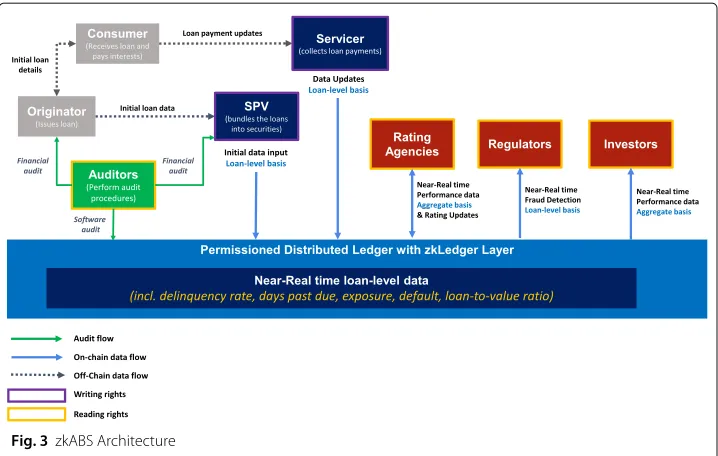
A permisioned ledger Due to the sensitive nature of the information disclosed and the types of participants involved in the securitization market, we adopted the framework of a permissioned ledger with a consensus protocol for append-only information which globally orders all valid transactions. Financial institution consortia are considering the use of permissioned ledgers as they offer efficiency and security. Under these settings, the consortium is responsible for operating the ledger, validating transactions and granting access to new entrants. In zkABS, participants cannot equivocate (assuming the con-sensus model is sound), therefore the information in the ledger is secure and publicly verifiable by participants. By “publicly” verifiable, we imply that anyone with the permis-sion to access zkABS and get a full copy of the ledger can verify the inputs and outputs. Figure3illustrates zkABS’s permissioned distributed ledger architecture for an ABS prod-uct issued by an SPV and backed by auto-loans from the Originator. Each participant in zkABS has two dimensions of flexible settings: write/read permissions and privacy settings.
Read/Write permissions Participants that contribute to building and updating asset-backed securities (e.g. the SPV and Servicer) have modification rights to update loan-level payments, pool-level performance and rating information. Other participants have read-only rights.
• Append permission: the SPV has the right to create new loan ID and append initial information to the ledger.
Fig. 3zkABS Architecture
• Read permission: read permissions are given to Rating Agencies, Investors, Regulators and Auditors of Issuers and Investors in order to perform their data analysis. They act as observatory nodes in the network.
Privacy and Selective Visibility zkLedger introduces the concept of selective visibil-ity. Each participant has access to either loan-level data (loan-level basis access) or asset pool-level data (aggregate basis access). In zkABS, the SPV, Servicer, Auditors and Regu-lators have access to loan-level data (read access for the Auditors and ReguRegu-lators and write access for the SPV and servicer), while investors and rating agencies have only read access to asset pool-level data. This is for illustrative purpose and it is possible to have different privacy settings for each actor within a specific category. For instance, certain investors could get loan-level data access in exchange for a premium charge.
and private holders who may invest in riskier tranches and short-term investments may be interested in more frequent updates about loan performance. Near-real time should therefore be taken as a broad and flexible definition. In our use case, we take the case of auto-loan ABS, which have monthly payments. Originators offer consumers usually two payment dates (beginning or end of month), therefore near-real time frequency is defined as biweekly. As the platform scales and hosts multiple asset classes with different payment collection cycles (credit card loans, revolving loans etc.) and multiple types of investors, near-real time could be defined as daily.
Industry-wide platform In our use-case, we focus on one underlying asset class: auto-loans. As the platform grows, zkABS’s flexible privacy settings could host multiple originators and ABS asset classes (e.g. credit card loans, receivables, etc.) on the same plat-form while maintaining loan-level data privacy among competing originators and issuers. Since zkABS is used as a means to store loan-level records, the data storage required is reasonable (e.g. the number of loans in an asset-backed security is typically constant until maturity). Therefore, the scalability limitations of zkLedger would not be an issue. zkABS could host all the participants of the US securitization market, and thus power a new type of decentralized digital platform with online analytics and benchmarking tools for the industry.
Smart contracts A “smart contract” refers to transactional terms and conditions embedded in computer code which allow automatic execution of the relevant trans-action once precise conformity with those terms and conditions has been estab-lished (Dong et al. 2018). When used in conjunction with blockchain technology, the code itself is replicated across multiple nodes and, therefore, benefits from the security, permanence and immutability that a blockchain offers (Dong et al. 2018). A simple example of a smart contract is the automatic payment of monthly inter-ests on a loan when the due date arises. The goal of this paper is to focus on zkLedger application to reduce asymmetry of information among participants rather than to address the potential efficiency and security gains of automating the busi-ness logic of the securitization process. zkABS architecture currently does not have a smart contract layer due to the lack of legal framework surrounding their appli-cation and the ongoing research on privacy-preserving smart contracts. However, we can imagine that a smart contract layer could be added later in order to automate and bring on-chain several steps of the securitization lifecycle, such as collecting loan payments directly from the consumer, identifying non-performing loans, pricing and rating security. As mentioned in “The inefficiencies of the securitization market” section, zkLedger is agnostic to the DLT used and could be implemented as a set of smart contracts on top of an existing DLT which already has a smart contract layer and then could easily link other smart contracts into zkABS. A smart contract layer could reduce operational errors and speed up data processing, particularly at the Servicer level.
Near-real time analytics about loan performance for investors
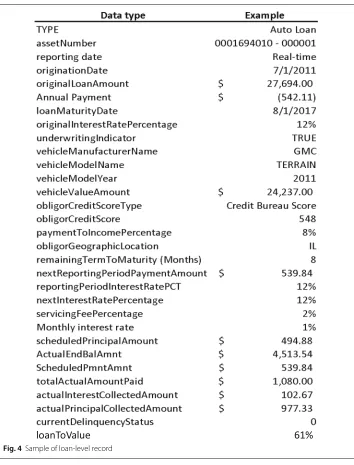
Near-real time analytics tools Currently, there are no available solutions on the mar-ket that enable investors to get near-real time performance data10. As we discussed in “Introduction” section, investors have to perform cumbersome data standardization and offline analysis to price risk and perform benchmarking for this type of securities. In addition, they do not get asset pool performance updates in a timely manner, which can result in suboptimal investment decisions and a lack of liquidity in the secondary mar-ket (Sindle et al2017). With zkABS, financial information about each individual loan is stored and updated in near-real time on zkABS decentralized platform. This informa-tion includes loan principal, annual payments, delinquency rates, credit scores, remaining term to maturity and other information (see Fig.4for a sample of loan-level records for an auto-loan) and serves as a base for issuers to disclose periodic information to investors and regulators (e.g. offering prospectus, TRACE reports).
This information is highly sensitive and issuers may not have the incentive to disclose such data at individual loan-level in near-real time to investors. Further, investors may not want to see the loan-level data points and consumer information in clear form as they would become subject to data privacy regulations11.
Through our interviews, we confirmed that investors would be interested in getting timely updates about the performance of ABS products at the asset pool level (aggregate basis as opposed to loan-level basis) and may be willing to pay a premium for this kind of ABS offering. There is currently no solution in the market that would enable issuers to providepublicly verifiabletimely information at pool level, without revealing loan-level information.
If they adopt zkABS, the issuers’ incentive to include investors in their blockchains may change. With zkABS, issuers can hide sensitive loan-level data on their blockchain and still allow investors to perform analytics on the hidden data in order to get secure aggregate balances and ratios about the performance of their ABS products.
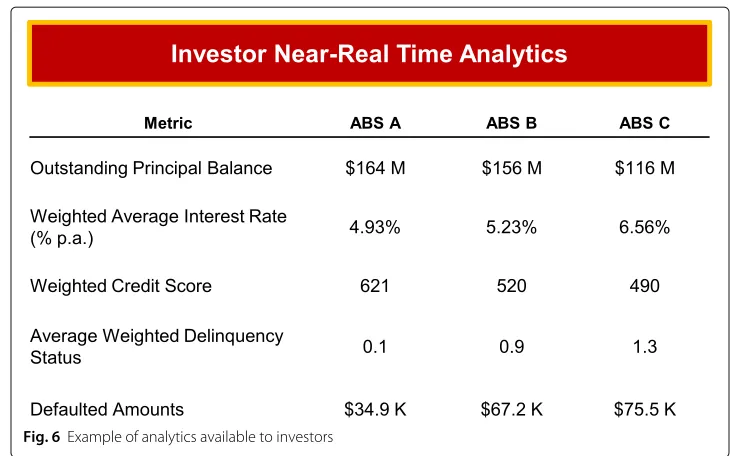
As shown in Fig.5, investors see a hidden view of the ledger and cannot track loan per-formance at loan-level, thus zkABS protects the issuers/SPV’s proprietary and sensitive data such as borrower names and individual loan performance. However, investors can still perform analytics on the hidden data at the pool level as in Fig.6, which allows them to monitor the performance of their loans and improves their ability to price risk effi-ciently and independently.It allows investors to build their own queries at any point of time.For instance, an investor could query trends about loan default in Texas for one particular asset class instead of waiting for the servicer reports. All queries (sum, mean, correlation, etc) are interactive and the party that the investor is trying to query must exchange information with the investor otherwise he cannot query the table, another form of information control for issuers and servicers.
Pricing efficiency zkABS allows multiple SPVs to join the same platform, which will push for data standardization and provide investors with easy-to-compare near-real time information across issuers and related asset-backed securities. As pointed out in the Structured Finance Industry Group’s report (Sindle et al2017), this could fundamentally improve pricing efficiency and deepen the securitization market: “security pricing could become more accurate with a potential narrowing of spreads as investors gain the ability
Fig. 4Sample of loan-level record
Fig. 6Example of analytics available to investors
to make near-real time assessments of security values by tracking shifting patterns in loan-level payments. The pool disclosure–the loans, with their performance and yields– in the security’s offering documentation could also be automatically and almost instantly updated to reflect the very latest portfolio performance.” (Sindle et al2017) Compared to another permissioned blockchain with the right access rights, zkLedger provide investors the ability to perform anonymized analytics that are publicly verifiable, which pro-vides additional security, transparency and reduces asymmetry of information in the market.
Limitations
be accurate. The use of smart contracts and automation from the loan inception phase will greatly minimize the need for manual input and alleviate this concern but is out of the reach of this paper. Finally, there are risks over data security breach when performing analytical queries in a repeated manner: a participant may be able to perform reverse-engineering and guess changes in individual loan level datapoint by querying certain types of analytics (averages, sums, etc.) at high frequency. There is a need to define a limit of number of queries and interval of time between two queries for each asset in order to prevent this threat.
Future work
Conclusion
Distributed ledger technology has the potential to fundamentally change the way markets operate, by reducing agency costs while bringing more transparency and accountabil-ity to each market interaction. In order to unlock such potential, there needs to be flexible privacy settings that can preserve confidential, proprietary information while allowing participants to verify data accuracy in a timely manner. We propose to adopt a zero-knowledge protocol, zkLedger, that addresses the tradeoff between privacy and transparency. We introduce zkABS, a simplified architecture of a decentralized market platform based on zkLedger and designed for the securitization industry. Using widely accepted cryptographic zero-knowledge proofs, zkABS preserves the transparency of transaction at a granular level, while providing distrusting market participants with a suite of anonymized timely analytics on asset pool performance (net cash flow balances, average credit scores, variances, etc.). We argue that zkABS could alleviate market inef-ficiencies related to the lack of transparency over the quality of the underlying assets. Among the potential benefits, zkABS allows investors to better price risk, regulators to monitor fraud and systemic risks and rating agencies to update their ratings in near-real time, making the securitization market more efficient. While our study shows promising applications, privacy solutions for distributed ledgers are an ongoing research area, which we believe open the path towards opportunities for future related work.
in the blockchain and gain access to timely information about the underlying assets at different stages of the securitization process. Unlike zkABS, this platform supports only participants on the sell-side (issuers, brokers, etc.) and does not support the buy-side of the industry (investors, auditors of investors, etc.). Therefore, investors would not be able to verify independently the data accuracy or trade directly on the platform.
Abbreviations
ABS: Asset-backed securities; AICPA: American institute of certified public accountants; AML: Anti-money laundering; FINRA: Financial industry regulatory authority; KYC: Know-your-customer; MBS: Mortgage-backed securities; SOC: Service organization controls; SPV: Special purpose vehicle
Acknowledgements
We would like to thank Neha Narula, Simon Johnson, Nabeel Younis, John V. Levonick, Joshua R. Lester and Yutong Zhang for their guidance during the research.
Authors’ contributions
The research was conducted by myself and the manuscript was written entirely by myself. The author read and approved the final manuscript.
Funding
We received funding solely from our institution to perform this research.
Availability of data and materials
This manuscript has not been published and is not under consideration for publication elsewhere at this moment. We have no conflicts of interest to disclose.
Competing interests
I do not have any competing interest.
Received: 27 October 2018 Accepted: 13 January 2020
References
Bernhard, Pereira, Warinschi (2012) How not to prove yourself: Pitfalls of the fiat-shamir heuristic and applications to helios. In: Wang X, Sako K (eds). ASIACRYPT 2012. LNCS, vol. 7658. Springer, Heidelberg. pp 626-643
Bloomberg database (2018). Accessed in March-April 2018
Catalini C, Tucker C (2018) Antitrust and costless verification: an optimistic and pessimistic view of the implications of blockchain technology. MIT Sloan Research Paper No. 5523-18:3.http://ide.mit.edu/sites/default/files/publications/ SSRN-id3199453.pdf
Cramer, Damgard, Schoenmakers (1994) Proofs of partial knowledge and simplified design of witness hiding protocols. In: In Advances in Cryptology ˚UCRYPTO Š94, Vol. 839 of Lecture Notes in Computer Science. Springer-Verlag. pp 174-187 Code of Federal Regulations Title 17 Commodity and Securities Exchanges Chapter II Part 246 Credit Risk Retention
(2017).https://www.govinfo.gov/app/details/CFR-2016-title17-vol4/CFR-2016-title17-vol4-part246
European Central Bank Publication N. 975 (2008) The incentive structure of the originate and distribute model. ISBN 978-92-899-0370-7 (online)https://www.ecb.europa.eu/pub/pdf/other/
incentivestructureoriginatedistributemodel200812en.pdf
Dong X, Mok RCK, Tabassum D, Guigon P, Ferreira E, Sinha CS, Prasad N, Madden J, Baumann T, Libersky J, McCormick E, Cohen J (2018) Blockchain and emerging digital technologies for enhancing post-2020 climate markets (English). World Bank Group, Washington. http://documents.worldbank.org/curated/en/942981521464296927/Blockchain-and-emerging-digitaltechnologies-for-enhancing-post-2020-climate-markets
Feige, Fiat, Shamir (1988) Zero-knowledge proofs of identity. J Cryptol 1(2):77-94
Financial Industry Regulatory Authority (FINRA) (2017) Report on distributed ledger technology: Implications of blockchain for the securities industry, FINRA Publications.https://www.finra.org/sites/default/files/FINRA_Blockchain_Report.pdf Fligstein, Roehrkasse (2013) All of the incentives were wrong: Opportunism and the financial crisis. Paper presented at
the annual meeting of the American Sociological Association Annual Meeting, Hilton New York and Sheraton New York, New York, NY Online August 2013 975:22.https://www.ecb.europa.eu/pub/pdf/other/
incentivestructureoriginatedistributemodel200812en.pdf
Goldwasser, Micali, Rackoff (1989) The knowledge complexity of interactive proof systems. SIAM Journal on Computing 18(1):186-208.https://doi.org/10.1137/0218012
Jingli S (2017) Baidu joins global group to advance blockchain technologies.http://ChinaDaily.com.cn. Accessed Mar–Apr 2018
Kou G, Peng Y, Wang G (2014) Evaluation of clustering algorithms for financial risk analysis using mcdm methods. Inf Sci 275:1-12
Kou G, Chao X, Peng Y, et al. (2019) Machine learning methods for systemic risk analysis in financial sectors. Technol Econ Develop Econ 25(5):1-27
Narula N, Vasquez W, Virza M (2018) zkLedger: Privacy-Preserving Auditing for Distributed Ledgers. In: 15th USENIX Symposium on Networked Systems Design and Implementation (NSDI 18), USENIX Association.https://www.usenix. org/system/files/conference/nsdi18/nsdi18-narula.pdf
OICV-IOSCO Technical Committee (2012) Principles for ongoing disclosures for asset-backed securities.https://www. iosco.org/news/pdf/IOSCONEWS224.pdf
OpenRisk Loan tape. Open Risk Manual.www.openriskmanual.org. Accessed Mar–Apr 2018
Pawczuk, Massey, Schatsky (2018) Deloitte’s 2018 global blockchain survey, findings and insights.https://www2.deloitte. com/content/dam/Deloitte/global/Documents/Energy-and-Resources/gx-us-fsi-2018-global-blockchain-survey-report.pdf
Pedersen TP (1992) Non-Interactive and Information-Theoretic Secure Verifiable Secret Sharing. In: J. Feigenbaum (ed). Advances in Cryptology ˚U CRYPTO Š91. CRYPTO 1991. Lecture Notes in Computer Science, vol 576. Springer, Berlin, Heidelberg. pp 129-140
Pemberton, Levy (2018) The reality of blockchain. Gartner. https://www.gartner.com/smarterwithgartner/the-reality-of-blockchain/
Schnorr (1991) Efficient signature generation by smart cards. J Cryptol 4(3):161-174 SIFMA database (2018). Accessed Mar-Apr 2018
Sindle et al (2017) Applying blockchain in securitization: opportunities for reinvention. U.S. Chamber of Digital Commerce Structured Finance Industry Group SFIG.https://digitalchamber.org/assets/sfig-blockchain-report.pdf
The World Bank (2018) Blockchain & distributed ledger technology (DLT) brief.https://www.worldbank.org/en/topic/ financialsector/brief/blockchain-dlt
U.S. Chamber of Digital Commerce SFIG (2017) Comments’ on finra’s report on distributed ledger technology.https:// www.finra.org/sites/default/files/Blockchain-SFIG-Comment.pdf
U.S. Department of Treasury (2017) Report to the president – a financial system that creates economic opportunities, capital markets
Wang L, et al (2019) Cryptographic primitives in blockchains. J Network Comput Appl. 1 February 2019 127:43-58 Wind database (2018). Accessed in March-April 2018
Wheeler et al (2017) Ten years after the financial crisis, global securitization lending transformed by regulation and economic growth. Standard and Poors Ratings Direct. Structured Finance Research. Issue 1888500-300871285:5. https://www.spratings.com/documents/20184/1393097/SF10Years/b0f1300a-5ed5-407d-8d3b-77fdc3b1f20c
Publisher’s Note