Scuola di Dottorato in Scienze Psicologiche e della Formazione
PhD Thesis
Cascaded and thresholded processing in
visual word recognition:
does the Dual Route Cascaded model
require a threshold?
Supervisor:
Prof. Remo Job
PhD Candidate:
Co-supervisor:
Veronica Cembrani
Prof. Claudio Mulatti
Prof. Max Coltheart
CONTENENTS
1
GENERAL INTRODUCTION ... 1
1.1 Computational models of reading and visual word recognition ... 2
1.1.1 Cascaded and thresholded processing... 3
1.1.2 The Logogen model ... 5
1.1.3 The Interactive Activation model ... 7
1.2 The Dual-Route Cascaded model ... 10
1.3 On the cascaded processing: some empirical data ... 14
1.3.1 Factorial manipulations of variables: focusing on stimulus quality ... 16
1.3.2 Introducing a threshold in the reading system ... 18
1.4 Goals and outline of the thesis ... 20
2
LENGTH AND ORTHOGRAPHIC NEIGHBORHOOD SIZE IN
NONWORD READING ... 21
2.1 Introduction ... 21
2.2 Method ... 22
2.3 Results ... 24
2.4 Simulation ... 25
2.5 Discussion ... 26
3
TOTAL LETTER CONFUSABILITY IN DEGRADED NONWORD
READING ... 27
3.1 Introduction ... 27
3.2 Method ... 30
3.3 Results ... 31
3.4 Discussion ... 32
3.4.1 Computational modelling ... 33
4
STIMULUS QUALITY AND LETTER STRING LENGTH IN
NONWORD READING ... 37
4.1 Introduction ... 37
4.2 Method ... 40
4.3 Results ... 41
4.4 Discussion ... 42
4.4.1 Computational modelling ... 43
4.4.2 Letter’s position encoding: evaluating a theoretical account ... 44
4.4.3 Conclusion ... 47
5
STIMULUS QUALITY AND ORTHOGRAPHIC
NEIGHBOURHOOD SIZE IN NONWORD READING ... 49
5.1 Introduction ... 49
5.2 Method ... 53
5.3 Results ... 55
5.4 Simulation ... 56
5.4.1 DRC-PR ... 56
5.4.2 DRC 1.2 ... 57
5.5 Discussion ... 58
6
TOTAL LETTER CONFUSABILITY AND LEXICALITY IN
DEGRADED READING ... 63
6.1 Introduction ... 64
6.2 Method ... 66
6.3 Results ... 67
6.4 Discussion ... 68
6.4.1 List composition effects: alternative accounts ... 71
6.4.2 Computational modelling ... 73
7
LIST COMPOSITION EFFECTS IN DEGRADED READING ... 75
7.1 Introduction ... 75
7.2 Method ... 77
7.3 Results ... 79
7.3.1 Analysis on list composition in function of lexicality ... 80
7.3.2 Analysis on the order of presentation in pure lists... 82
7.3.3 Analysis on word frequency ... 84
7.3.4 Analysis on lexicalization errors ... 86
7.4 Discussion ... 87
7.4.1 The route emphasis account ... 88
7.4.2 The time-criterion account ... 89
7.4.3 The lexical checking account ... 90
7.4.4 Simulation ... 91
7.4.5 Conclusion ... 94
8
GENERAL DISCUSSION ... 97
8.1 Review of the main findings ... 99
8.1.1 Factorial manipulations in nonword reading ... 99
8.1.2 Factorial manipulations in reading tasks as a function of list composition ... 101
8.2 Interpretation within the Dual-Route Cascaded model ... 104
8.3 Future studies ... 106
8.4 Computational issues ... 109
8.4.1 Simulating the effect of TLC. A few preliminary results ... 109
8.4.2 Is degradation correctly implemented? A different proposal ... 113
8.5 Thinking to a threshold ... 115
8.6 General conclusion ... 119
REFERENCES ...121
1
GENERAL INTRODUCTION
The development of computational models during the lasts decades has revolutionized the scientific
research in psychological sciences. The idea to model cognition is not new; more than forty years
ago, in fact, Neisser (1967) provided a definition of cognitive psychology characterizing people as
dynamic information-processing systems whose mental operations might be described in
computational terms. Computational models are usually described as having many advantages over
representing the theory about cognition as “verbal model” (Jacobs & Grainger, 1994). Any attempt
to develop a computational model requires indeed completeness since a program will not run unless
the theory is fully specified. Moreover, expressing any theory in computational terms immediately
reveals many ways in which that theory may be incomplete or underspecified. Once the theory is
complete and the program is executable, the adequacy of the theory can be tested by simulations.
The comparison of the human behaviour and the behaviour of the computer program in carrying out
the cognitive activity of interest is a straightforward and powerful way to test the validity of our
scientific accounts. A theory has in fact to be sufficient, thus offering an explanation of all the
relevant empirical phenomena. Mismatching between human behaviour and the behaviour of the
computational model often revels ways in which the theory is incorrect thus suggesting how it can
be reformulated in order to eliminate those mismatches. Other times the mismatches are so
fundamental that modelling leads to theory refutation.
As in other cognitive fields, the interest in computational modelling is evident in
psycholinguistic and, in particular, in the research on reading aloud. Reading, defined as the ability
to generate a phonological code from print, has been largely studied over the last century in
cognitive psychology as evidenced by numerous scientific papers and specialist journals, national
and international conferences and founding of societies focusing on reading and reading
impairments. One of the major aims of these researches has been to explain the complex cognitive
processes involved in reading with the final goal of determining a complete theory of reading aloud
and visual word recognition. Nevertheless, although these studies have resulted in a remarkable
accumulation of knowledge and computational models of visual word recognition and reading aloud
have been recently presented (e.g., Coltheart, Rastle, Perry, Langdon, & Ziegler, 2001; Grainger &
Jacobs, 1996; McClelland & Rumelhart, 1981; Perry, Ziegler, & Zorzi, 2007), the reading process is
The aim of the current thesis is to expand the current understanding of visual word
recognition in healthy skilled readers and to interpret this evidence within a computational account.
We in fact believe that the cognitive processes of interest cannot be understood without a strong
theoretical framework and that computational modelling is a highly valuable approach. The final
goal of this activity will be to evaluate cascaded processing generally assumed in visual word
recognition by referring to recent empirical data claiming the need of a different interpretation (i.e.,
thresholded processing).
This thesis focus on the Dual-Route Cascaded (DRC) model of reading aloud and visual
word recognition (Coltheart et al., 2001). The DRC model has been chosen as the referential
computational model in my thesis for several reasons. First, this thesis aims to evaluate cascaded
processing, one of the main assumptions within the DRC framework. Second, the DRC model is not
restricted to the simulation of English data in that an Italian version of the model has been recently
developed (Mulatti, 2005; Mulatti & Job, 2003a; Mulatti & Job, 2004). Finally, there is a large
agreement within the scientific community in recognizing the DRC model (one of) the most
successful computational model(s) of reading, since “the set of phenomena that the DRC model can
simulate is much larger than the set that any other current computational model of reading aloud
can simulate” (Coltheart et al., 2001, p. 251).
1.1
Computational models of reading and visual word recognition
A computational model is defined as “a computer program that is capable of performing the
cognitive task of interest and does so by using exactly the same information-processing procedures
as are specified in a theory of how people carry out this cognitive activity” (Coltheart et al., 2001, p.
204). There are basically two approaches to generate computational models.
One of them is to develop connectionist models through a learning algorithm like the back
propagation (e.g., Plaut, McClelland, Seidenberg, & Patterson, 1996). Computational models of this
type are usually based on a network with three layers (input units, hidden units, output units) and a
random value is initially assigned to the network connection weights. These values are then
adjusted during the training in such a way to make the response for each stimulus more and more
close to the correct response.
A possible disadvantage of this type of models is that it could be very difficult to discover
network has been structured by the learning algorithm and, thus, it is often not understandable how
the model is actually working in performing the task it has learned.
Another approach consists in pre-specifying the functional architecture of the model, rather
than relying on learning algorithms to do this. In this approach, even if the functional architecture is
specified by the modeller, some form of learning algorithm may be used to set the strength of the
connections between the pre-specified levels of the architecture.
The computational model that will be analyzed in this thesis – the DRC model – has been
developed by applying this latest method. Only this approach will be considered in this dissertation.
1.1.1
Cascaded and thresholded processing
Many different mental operations are usually involved in cognitive activities, even in the most
automatized. As a consequence, when one want to analyze performance in a task involving
information processing, this is typically decomposed into a set of separated sub-processes. When
modelling cognition, different levels of processing corresponding to the different mental operations
are thus assumed and implemented in the system.
The functional architecture of highly successful computational models of reading (e.g.,
Coltheart et al., 2001; McClelland & Rumelhart, 1981; Perry et al., 2007) consists of different
levels1 of processing that get activated when a letter string is presented. In general, the levels in the
reading system are domain-specific: each level has a specific function and different levels have
different functions. Also, the levels are hierarchically organized, so that every level forms a
representation of the input at a different level of abstraction. Each level assumed in the model
usually consists of a number of processing units (or nodes), which accumulate information in the
form of activation; units of the different levels communicates with several others (either at the same
or at a different level of processing) and communication proceeds through the different levels via a
spreading activation mechanism.
The notion of word perception as taking place in a hierarchical information-processing
system isn’t new and, also in the past, it has been advocated by several researchers interested in
word perception (e.g., Adams, 1979; Estes, 1975; Johnston & McClelland, 1980; LaBerge &
Samuels, 1974; McClelland, 1976). Regardless of it is today widely accepted that multiple levels of
representation are involved in visual word recognition, the organization of these levels is otherwise
controversial. In particular, it is still not clear how communication proceeds through the different
1
levels assumed in the reading system and thus, more generally, how information is processed in
visual word recognition. In computational terms, the problem concerns the implementation of the
activation function spreading through the different levels of processing assumed in the model.
Specifically, two major accounts have been proposed in this context. These accounts are
schematically represented in Figure 1.
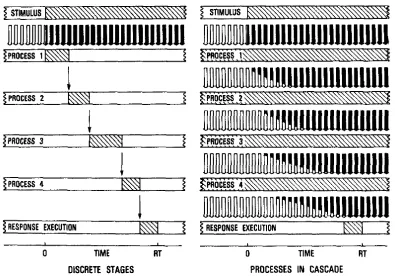
Figure 1. The events that occur between the presentation of a stimulus and the
execution of a response, according to the discrete stage model and to the cascaded model. Arrows represent the transfer of information from one level to the subsequent
one and shading is used to indicate when a process is at work; the blackening of the arrows indicates the degree to which the signals represented
by the arrows reflect the stimulus in input (McClelland, 1979, p. 290, Figure 1).
One hypothesis is that performance may be represented by a model in which sub-processes are
identified as successive temporal stages, each of which occupies a separate interval of time. This
idea dates back to Sternberg (1969), who proposed that many mental processes occur in discrete
series, one beginning when another ends. In models that assume this type of processing (e.g.,
Morton, 1969), activation does not propagate forward through the levels until processing within a
level has reached some threshold (i.e., thresholded processing). Usually, activation is only passed
going on in any level does not begin to affect subsequent levels at an early point in processing;
conversely, none of the processes can begin until the preceding process is completed.
An alternative to thresholded processing is that activation propagates in a cascaded fashion
in the system. McClelland (1976; 1979) proposed that mental processes are cascaded, thus
overlapping in time. According to this account, a process does not begin when the previous one is
ended; on the contrary, information is transferred between the different levels of processing all of
the time. As a consequence, each sub-process in the system is continuously active and its output
always available for processing in the subsequent levels; the activation of a particular processing
unit in a certain level of the network would thus increase with time (up to some asymptotic value),
depending on the strength of the input to it. In models that operate by cascaded processing (e.g.,
Coltheart et al., 2001; McClelland & Rumelhart, 1981) there is not threshold within the levels and,
as soon as activation accumulates in a level, it spreads immediately to the adjacent one. This means
that activation accumulates downstream in the system, without waiting for processing completion in
the early levels.
The different activation propagation modalities described above are alternative hypothesis
and, usually, models implement either cascaded processing or thresholded processing. Despite
cascaded processing is assumed in the most computational accounts of visible language, which
approach modelling cognition better fits the empirical evidence is not yet fully determined in
theories of visual word recognition.
In the following paragraphs I will focus on two models of visual word recognition, the first
assuming thresholded processing (i.e., the Logogen model), the other assuming cascaded processing
(i.e., the Interactive Activation model); both the accounts are central in the development of the
Dual-Route Cascaded model of reading.
1.1.2
The Logogen model
The logogen model isn’t a computational model of language processing, but rather a theory
expressed by the box-and-arrow notation2.
Morton (1969) based his theorizing on the concept of a mental lexicon, which he described
as a system of knowledge about word forms. He referred to this level as logogen system. Another
type of lexicon was assumed in his theory, which is a system of knowledge about word meaning
(i.e., a cognitive system). The logogen system is a set of elements called logogens, one for each
word in the model’s vocabulary. Logogens are evidence-collecting devices with threshold. Evidence
is collected from visual or auditory input and when the amount of evidence collected by a word’s
logogen exceeds that logogen’s threshold, information about that word in the cognitive system (i.e.,
the word meaning) also becomes available as a response in the response buffer. The more frequent a
word, the less evidence is needed to reach the threshold, because each logogen has a resting level of
activation whose value is proportional to the frequency of occurrence in the language of that
logogen’s word.
An input logogen system, responsible for word recognition, and an output logogen system,
responsible for word production, are assumed in the model. The input logogen system consists of a
visual input logogen system, responsible of written word recognition, and of an auditory input
logogen system, responsible of spoken word recognition (see Morton, 1979). Similarly, the output
logogen system consists of an output logogen system for speaking and of an output logogen system
for writing (see Morton, 1980). Finally, grapheme-phoneme and acoustic-phoneme routes are
assumed in the model (see Morton, 1980) in order to make it able to process nonwords (i.e., strings
of letters without a meaning).
The different logogen systems assumed in the model proposed by Morton constitute the
levels of processing assumed in the DRC model. However, whereas the logogen model theorized
both spoken and written language, the DRC model is current applied to visual word recognition
only. Importantly, the evolution of the logogen model has been entirely data driven3: complexities
were added in order to explain the empirical results that a previous and simplest version of model
could not explain. Hence, the complex form of the DRC model, which was inherited from the final
version of the logogen model, is motivated by a series of empirical findings.
1.1.3
The Interactive Activation model
The first computational model of reading is known as Interactive Activation (IA) model
(McClelland & Rumelhart, 1981).
The IA model has been developed by its modellers with the main purpose to account for the
word superiority effect; this effect is attributed to Reicher (1969), who showed that perception of a
letter is facilitate when it is presented in the context of a word than when it is presented in a random
sequence of letter4.
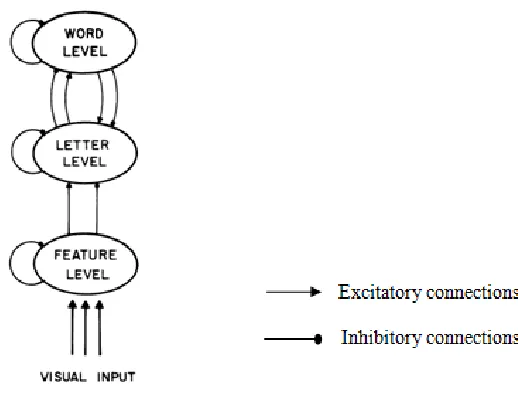
The different mental computations involved in visual word recognition are represented in
the IA model as involving three hierarchically organized purpose-specific levels of processing: the
visual feature level, the letter level and the word level.
The general architecture of the IA model is represented in Figure 2.
Figure 2. The processing system involved in visual word recognition
(McClelland & Rumelhart, 1982, p. 379, Figure 2).
There is a strong similarity between the IA model and the logogen model. The IA model can be in
fact considered “a hierarchical, nonlinear, logogen model (...) with feedback between levels and
inhibitory interactions among logogens at the same level” (McClelland & Rumelhart, 1981, p. 388).
The main difference between the logogen model and the IA model is that the units assumed in the
latter model are not thresholded devices as the logogens assumed in the former. Instead, activation
is assumed to spread through the different levels in a cascaded fashion. This means, for one hand,
that the IA model is spatially parallel within the same level and, from the other, that it involves
processes that operate simultaneously at several different levels. Crucially, perception is intended to
be an interactive process in the IA model: there are bottom-up processing (i.e., feed-forward
connections) and top-down processing (i.e., feedback connections) that work simultaneously and in
conjunction, jointly determining what we perceive. Moreover, the communication in the system
consists of both excitatory and inhibitory messages: excitatory messages increase the activation
level of their recipients, while it is decreased by inhibitory messages. Furthermore, intra-level
inhibitory loops are assumed in the model and represent a kind of lateral inhibition in which
incompatible units at the same level compete each other.
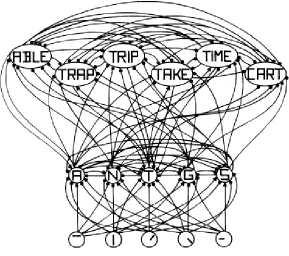
In each level, for every relevant unit in the system an entity called node is assumed. Thus,
there is a node for each word the model knows, and there is a node for each letter in each letter
position within a four-letter string5. Since the nodes are organized into levels, there are word level
nodes and letter level nodes. Each node has connections to a number of other nodes: if two nodes
suggest each other’s existence, then the connections between them are excitatory; on the opposite, if
the two nodes are inconsistent with one another, then the relationship is inhibitory. The amount of
excitation and inhibition that each node sends to the others is proportional to its activation, i.e. more
active nodes send more activation than less active nodes. Each node has a momentary activation
value and is said to be active when this value is positive. In the absence of inputs from other nodes,
all the nodes are assumed to decay back to an inactive state (i.e., to an activation value at or below
zero). The resting value differs from node to node and is determined by the frequency of activation
of the node over the long term.
Connections may occur within levels or between adjacent levels, but there are no
connections between non-adjacent levels. Connections within the word level are mutually
inhibitory, since only one word can occur at any one place at any one time. Connections within the
letter level are similarly organized. Connections between the word level and the letter level may be
either inhibitory or excitatory, depending on whether the letter is a part of the word in that specific
letter position.
Consider now what happens when an input reaches the system. When a stimulus is presented
certain visual features are extracted and a set of feature inputs is thus made available to the system.
The visual features are assumed to be binary in the model: thus, either the presence or the absence
of a particular feature can be detected. The activation immediately spreads to the letter level: letter
nodes that contain the extracted features are activated whereas letter nodes that do not contain those
features are inhibited. The letter nodes, in turn, begin to send activation to those words that contain
that letter in that particular position; also, each letter node inhibits those nodes representing words
that do not contain that letter in that particular position. Within the letter level, each node
representing a letter in a particular position inhibits all the nodes representing different letters in the
same position. As the word level nodes become active, each word node starts to compete with all
the others. In addition, each active word node sends feedback activation to the letter nodes. If the
input features are similar to the features that form a particular set of letters and those letters are
consistent with the letters forming the word that has been activated, the positive feedback in the
system will converge on the appropriate set of letters and on the appropriate word. Otherwise, the
active units inhibit each other and it might be that no single set of letters or single word will obtain
enough activation to dominate the others.
Figure 3. A few of the neighbours of the node for the letter “T”
in the first position in a word and their interconnections (McClelland & Rumelhart, 1981, p. 380, Figure 3).
Computational simulations performed by McClelland and Rumelhart (1981) clearly showed that the
IA model is able to account for the word superiority effect (Reicher, 1969). In particular, this effect
is due to the interactive-activation between the word and the letter levels assumed in the model.
Once a set of features is made available to the system and the letters consistent with those features
node representing that word is activated and, in turn, it will send activation back to the letter nodes.
Letter nodes that are consistent with the activated word will be excited, whereas letter nodes that are
inconsistent with that word will be inhibited. This means that the feedback from the word level
assists target letter recognition by contributing activation to the appropriate nodes and inhibition to
the inconsistent nodes at the letter level. On the contrary, when the stimulus in input is not a word,
there is not feedback from the word level; hence, the letter nodes receive activation from the feature
level only and the identification of the correct letter will be slower and less accurate.
Despite the origin of the IA model, the word superiority effect is not the only evidence that
it is able to explain. On the contrary, this model correctly accounts for various findings of several
experiments in word perception (see McClelland & Rumelhart, 1981, for a detailed treatment). To
date, the IA model has not been refuted. This observation has been critical for the development of
the subsequent DRC model. In science, a new theory should account for all the crucial effects
explained by the previous generation of the same theory or by other competitive theories, plus some
new empirical data. This may be easily achieved by including a previous theory in a new model.
According to the principle of nested incremental modelling, in fact, “a new model should be related
or include at least its own direct predecessor” (Jacobs & Grainger, 1994, p. 1329). Following this
principle, a generalization of the IA model has been included by Coltheart et al. (2001) in their
Dual-Route Cascaded model of reading.
1.2
The Dual-Route Cascaded model
The Dual-Route Cascaded model (Coltheart et al., 2001) is based on traditional dual-route theories
of reading aloud (e.g., Morton & Patterson, 1980) and, as said, has evolved from Morton’s (1969)
logogen model and McClelland and Rumelhart’s (1981) interactive activation (IA) model of
performance in perception task.
The DRC model adopts the architecture of the logogen model but avoids its theoretical
commitment to the idea that the system operates according to the logogen principle; in other words,
the assumption that the mental lexicon is composed of information-gathering devices with threshold
is refuted. Instead, the central assumption of the DRC model is that activation propagates in a
cascaded fashion through the different levels of processing; also, as in the IA model, interactive
activation is assumed so that, as soon as there is activation in an early stage, it flows on to later
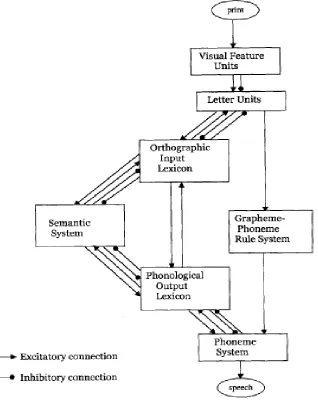
The overall architecture of the DRC model is represented in Figure 4.
Figure 4. The Dual-Route Cascaded model of visual word recognition and reading aloud.
(Coltheart et al., 2001, p. 214, Figure 7).
Two procedures to generate the phonology of a letter string are assumed in the model, the lexical
route and the non-lexical route. Each route is composed of a number of levels containing set of units
interacting each other through excitation (i.e., the activation of a unit contributes to the activation of
other units) or inhibition (i.e., the activation of a unit makes more difficult the activation of other
units). The units represent the smallest individual symbolic parts of the model, such as words and
letters. Within the same level units interact each other only through lateral inhibition. Adjacent
levels communicate fully in both directions in both excitatory and inhibitory ways6.
The first two levels assumed in the model (i.e., the feature level and the letter level) are
common to the two routes. In the model, feature analysis is spatially parallel and feeds forward to
the letter level which processing is again spatially parallel. This portion of the DRC model is a
generalization of the IA model. The only difference between the two models is that whereas the IA
model applied to four-letters words only, its DRC version applies to words of any length up to eight
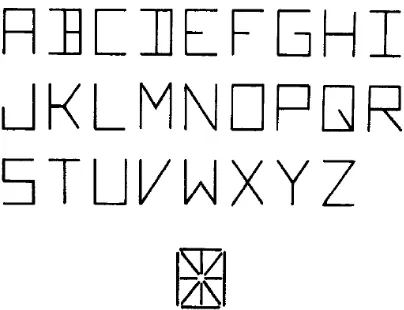
letters. Hence, the visual feature level consists of eight different subsets representing the eight
possible input positions; each subset consists of individual features that are set to on or off
depending on whether that specific visual property is part of the letter in that specific position. The
letter level also consists of eight different subsets and each subset contains units representing the
entire set of letters that can occur (i.e., 26 letters in the English alphabet) plus one unit for the blank
letter. Lateral inhibition occurs at this level, within but not between each of the eight subsets. The
later inhibition will assure that only one letter occurs at any one place at any one time. The output
from the letter level feeds both the lexical and the non-lexical routes.
The lexical route consists of two interconnected lexicons: the orthographic lexicon contains
a single node (lexical entry) for each uniquely spelled word the model knows7; the phonological
lexicon contains a single node for each uniquely sounding word the model knows.
The non-lexical route consists of a grapheme-phoneme correspondence (i.e., GPC) rules
system and works serially along the string of letters. The GPC rules have been chosen on purely
statistical grounds (i.e., for any grapheme, the phoneme assigned to it was the phoneme most
commonly associated with that grapheme in the set of English monosyllables that contain that
grapheme). Single-letter, multi-letter and context-sensitive rules are used for translating graphemes
into phonemes.
The output from both these routes activates the phoneme system which is where the final
pronunciation is produced. The phoneme units are similar organized to the letter units, except that
each of the eight subset contains units for the phonemes that can occur (i.e., 43 in the English
language) plus an unit for the blank phoneme. Pronunciation occurs when all the phonemes of the
letter string have been activated to some criterion of satisfaction in the phoneme system. The DRC
model operates over time units called cycles and the number of cycles it takes to reach criterion is
considered a measure of the DRC model’s response latencies.
Given the dual-route architecture, the phonological code of a string of letters visually
presented can be generated in two different ways within the DRC model by employing the lexical or
the non-lexical route.
7
The pronunciation of the words in the orthographic lexicon is generated by the lexical
route8; this is a parallel procedure that retrieves the whole-word phonology from stored lexical
representation. When a word reaches the system, feature units activate the letter units (in parallel
across letter position), which in turn activate words in the orthographic lexicon. The word units that
have been activated activate the letter units via feedback and the phonological lexicon via
feed-forward connections; finally, activation in the phonological lexicon feeds back to the orthographic
lexicon and feeds forward to the phoneme system activating word’s phonemes (in parallel across all
phoneme positions), thus allowing the pronunciation of that word. A central feature of the lexical
route is that units in the orthographic lexicon are frequency-sensitive: the activation of
high-frequency words raises more quickly that the activation of low-high-frequency words. To achieve this
effect, a constant value is associated with each unit in the lexicon. In languages with shallow
orthographies, the lexical route is necessary to read irregular (or exception) words, i.e. words that
disobey to the rules relating graphemes to their pronunciation9.
The non-lexical route is a serial procedure that allows the model to read nonwords through
the letter-by-letter conversion – from left to right – of each grapheme into the corresponding
phoneme following language-specific correspondence rules. This route works as follow. Visual
features and letter units are activated just as with the lexical route. Then the GPC route operates
after a number of cycles. The set of rules is searched until an appropriate rule is found to convert the
first letter to a phoneme and that phoneme unit in the phoneme system receives some activation.
The next letter become then available to the GPC route10 and the correct rule to translate that letter
into the right phoneme is searched. Once all the letters are matched, pronunciation can occur.
Both the lexical and non-lexical routes are assumed to operate simultaneously – in parallel –
on each stimulus. This means that when a letter string is presented to the system, activation from the
feature units reaches the letter level and in turn both the orthographic lexicon and the GPC system.
From one hand, cascaded processing from the orthographic lexicon eventually leads to a build-up of
activation in the phoneme system (which also feeds back to the previous levels); at the same time,
the GPC system contributes activation to the phoneme system. This feature allows the model to
8 The lexical non-semantic route is described here. A lexical semantic route is also assumed in the model, but a semantic module is not yet implemented in its computational version.
9 The distinction between regular and exception words is important in studying word-recognition in languages with inconsistent orthography like English. In languages with inconsistent orthography, the grapheme-to-phoneme mappings are quite irregular; on the contrary, languages with more transparent orthographies like Italian are characterized by consistent grapheme-to-phoneme mappings.
account for effects due to the influence of the non-lexical procedure in word reading, such as the
regularity effect (Seidenberg, Waters, Barnes, & Tanenhaus, 1984; Taraban & McClelland, 1987)
or the position of the irregularity effect (Rastle & Coltheart, 1999), and the effects due to the
influence of the lexical route on nonword reading, such as the pseudohomophone effect (McCann &
Besner, 1987; Reynolds & Besner, 2005; Seidenberg, Peterson, MacDonald, & Plaut, 1996; Taft &
Russell, 1992), the neighbourhood size (N) effect (McCann & Besner, 1987) or the position of the
diverging letter effect (Mulatti, Peressotti, & Job, 2007).
A substantial amount of empirical data showed by skilled readers both in reading aloud and
in lexical decision tasks, as well as a variety of behaviours exhibited by patients with various form
of acquired dyslexia, are presently accounted for and correctly simulated by the DRC computational
model (see Coltheart et al., 2001, for a more detailed discussion). Although subsequent works have
revealed potential limits11, to date it is perhaps the most successful computational model of reading
today available in literature.
1.3
On the cascaded processing: some empirical data
The assumption of cascaded processing is central in the DRC model but also in many other
frameworks of reading aloud; computational accounts of visible language processing are in fact
almost invariable cascaded and often engaged in interactive-activation between the various levels of
processing. This is mainly because a certain number of well-established empirical findings strongly
support cascaded processing in visual word recognition.
Besides several data may be certainly relevant in this context, cascaded processing in
reading is mostly implicated by a number of effects showing lexical influence when reading
nonwords. Suppose that processing is thresholded and information is processed in serial discrete
stages in the reading system; if so, when a nonword is presented in a reading task, no entry in the
orthographic lexicon will reach the threshold and hence no information will emerge from the
lexicon. This wouldn't explain, for example, why nonwords inconsistent with real words (e.g., heaf;
cf. deaf) yield longer reading latencies than nonwords (e.g., hean) that are not inconsistent with real
words (Glushko, 1979).
In addition, such a thresholded processing is incompatible with numerous findings showing
that the lexical route also influences the computation of phonology of the nonwords that have to be
read (e.g., Rosson, 1983). This is evident, for example, in the so called pseudohomophone effect
(e.g., McCann & Besner, 1987); this effect consists in pseudohomophone nonwords (i.e., nonwords
which pronunciation matched the pronunciation of an existing word; e.g., traxs; cf. tracks) being
read faster than control non-pseudohomophone nonwords (e.g., prax).
Further and strong evidence in favour of cascaded processing emerges from findings
showing the effects of the orthographic neighbourhood size (N) in reading. The index N is defined
as the number of words that can be created from a string of letters by replacing a single letter at a
time (Coltheart, Davelaar, Jonasson, & Besner, 1977). For example, orthographic neighbours of
word are cord, ford, lord, ward, wood, wore, work, worm, worn. Empirical evidence shows that the
size of the orthographic neighbourhood influences reading latencies (e.g., Andrews, 1997, 1989;
McCann & Besner, 1987; Job, Peressotti, & Cusinato, 1998; Peereman & Content, 1995). In skilled
readers, words with many neighbours are read aloud more quickly than those with few or no
neighbours; moreover, it has been largely showed that nonword reading is facilitate by a large N.
The principal explanation of these effects is that they arise from activation within the lexical route
(e.g., Andrews, 1997; Coltheart et al., 1977; Coltheart et al., 2001). Hence, the effects due to the
orthographic neighbourhood in nonword reading can be explained only assuming cascaded
activation in the reading system. More specifically, the N effect clearly suggests that the
orthographic neighbours of a visually presented letter string are sufficiently activated to influence
the computation of the phonology of the nonword that has to be read. Clearly, this activation would
be completely prevented by assuming a threshold between the different levels of processing.
Despite a substantial amount of data supporting cascaded processing clearly exists,
principally obtained in reading aloud experiments examining the effect of the psycholinguistic
variable of interest when factorially combined with the manipulation of stimulus quality in the task.
1.3.1
Factorial manipulations of variables: focusing on stimulus quality
Factorial experiments in which a factor affecting the rate of processing (e.g., stimulus quality) is
varied in conjunction with another factor (e.g., word frequency, semantic priming, repetition
priming, etc.) in reading tasks have been used in the last decades to evaluate different
non-computational accounts of visual word recognition (e.g., Balota & Abrams, 1995; Besner & Smith,
1992; Besner & Swan, 1982; Borowsky & Besner, 1993; Meyer, Schvaneveldt, & Ruddy, 1975;
Plourde & Besner, 1997; Stolz & Neely, 1995). Very recently, a certain number of works used this
same approach to test the validity of computational models of reading (e.g., Besner & O’Malley,
2009; Besner, O’Malley, & Robidoux, 2010; Besner & Roberts, 2003; Blais & Besner, 2007;
O’Malley & Besner, 2008; O’Malley, Reynolds, & Besner, 2007; Reynolds & Besner, 2004). To
date, the most of these studies directly focus on the Dual-Route Cascaded framework.
When only a single factor is manipulated in experiments, the results can often be explained
in a variety of different ways. In other words, many competing explanations – and several different
(computational) models – may be equally accurate in explaining a main effect. However, when two
factors are jointly manipulated, the data pattern is much more complex and it might help to falsify
some of the various accounts. In particular, the manipulation of two different factors sometimes
produces additive effects and sometimes produces interactions (i.e., either underadditive or
overadditive effects) on response latencies. Hence, factorial manipulation of different variables is
considered an useful toll in testing the validity of theoretical and computational accounts and a
powerful investigation to distinguish between competitive theories.
Factorial manipulations in reading studies may consist in the psycholinguistic variable of
interest being manipulated together with a factor affecting the rate of processing. Usually, the latter
factor is the stimulus quality (or SQ), a perceptive variable affecting early processing in visual word
recognition. A common technique to manipulate stimulus quality in experiments is by reducing the
contrast between the visually presented stimulus and the background (e.g., Borowsky & Besner,
1993)12. The typical finding obtained in these tasks is that reading latencies increase for degraded
stimuli. Importantly, stimulus quality is considered an useful second manipulation for testing the
validity of computational accounts of reading because it can be simulated in most computational
models. Typically, degradation is implemented by modifying the connection weights at one or more
levels; specifically to the DRC model, degradation is usually simulated by reducing the weights of
the excitatory and inhibitory connections that regulate the communication from visual feature to
letter units. This manipulation would reduce the rate of activation gain at the perceptual level and
responses will be thus slower for degraded than for clear stimuli. Various simulations documented,
in fact, that DRC model’s responses are delayed as the connection weights between the feature and
the letter levels are reduced, thus miming the effect of degradation obtained for humans.
Strong evidence against cascaded processing has been reported in a number of different
studies using the factorial manipulations described above. In this dissertation, the most critical
results will be discussed. In particular, this thesis will focus on the studies that have examined the
effects of SQ when factorially combined with:
1. letter string length when reading nonwords aloud (Besner & Roberts, 2003);
2. orthographic neighbourhood size (N) when reading nonwords aloud (Reynolds &
Besner, 2004);
3. word frequency when reading aloud (O’Malley & Besner, 2008);
4. lexicality when reading aloud (Besner & O’Malley, 2009; Besner et al, 2010; O’Malley
& Besner, 2008).
These studies will be examined in details in the next chapters of this thesis. At this step it is
sufficient to note that SQ and the other variable have been shown to exert additive effects on skilled
readers’ latencies in all the experiments reported above. In other words, the effects of the
psycholinguistic variables manipulated in these studies (e.g., letter string length, orthographic
neighbourhood size, word frequency, lexicality) have been shown to have the same amplitude for
stimuli presented in a clear (i.e., non-degraded) condition and for stimuli presented in reduced
contrast in the human performance.
Critically, interactions between the two factors are on the contrary simulated by the DRC
model, i.e. the amplitude of the effect of letter string length/orthographic neighbourhood size/word
frequency/lexicality is significantly different for clear and degraded stimuli in the DRC model’s
simulations. These interactions would be caused by the cascaded activation assumed in the model.
In fact, since processing is cascaded, a change in the rate of activation in early processing units (due
to stimulus degradation) will change the rate of activation downstream in the model. As a
assumed in the reading system like letter string length, orthographic neighbourhood size, word
frequency and lexicality.
1.3.2 Introducing a threshold in the reading system
The experiments described above provide significant mismatches between the DRC model’s
performance and the human behaviour; critically, these mismatches have been interpreted as caused
by the cascaded activation assumed in this framework. As a consequence, the previous data contrast
not only the DRC model but rather the same idea that activation proceeds in a cascaded fashion in
the reading system.
Additive effects between variables are easily explained within a thresholded framework by
postulating that those variables affect different levels of processing in the system. Sternberg (1969),
following Donders (1868-1869), noted that one can attempt to study the component processes
implicated in performance by using reaction times data and that additional assumptions about their
temporal relations can be made by observing the pattern of results produced by factorial
manipulations; in particular, one can use experimental manipulations that are assumed to selectively
influence specific levels of processing to study what levels are affected by other manipulations.
Within discrete stage models assuming thresholded processing, the assumption that one
experimental manipulation influences the duration of one level and another manipulation influences
the duration of another level leads to the conclusion that the two factors will have additive effects
on reaction times; on the contrary, factors that influence the duration of the same level will
generally interact with one another. If we adopt cascaded models, however, this logic is only
partially correct. In cascaded models, activation propagates through the levels continuously, i.e.
activation reaches a subsequent level before processing in a previous level is ended. This means that
the effects of a factor is not resolved within the level it affects; rather, the effect of a factor at an
early level would influence processing downstream in the system. This implies, from one hand, that
factors interacting with one another could well be influencing different processes in a cascaded
system and, from the other, that cascaded activation between different levels of processing is not
easily reconciled with evidence showing additive effects between factors affecting those levels. It
follows that the easier way to explain additive effects of factors is by assuming a threshold between
the levels of processing which these factors affect. Additive effects are hardly explained within a
cascaded framework especially when that framework also assumes interactive activation between
experimental manipulations influencing a specific process in the system not only cascades to the
subsequent levels through feed-forward connections, but it also feeds back to the previous ones.
When factorial manipulations of psycholinguistic variables and stimulus quality are
considered within the Dual-Route Cascaded framework, the previsions are the following. Cascaded
activation assumed in the model will cause a variable affecting the rate of processing in early units
(e.g., SQ) to affect the model beyond the perceptual level (i.e., the effect of SQ is not resolved at an
early stage but rather affects processing downstream in the system); in turn, interactive activation
will determine factors affecting later processes to feed their effects back to previous levels, thus
having an effect on earlier factors. As a consequence, SQ will likely to interact in the DRC model
with variables affecting subsequent levels of processing assumed in the system. As said, the DRC
model produces in fact interactions of SQ with letter string length, orthographic neighbourhood
size, word frequency and lexicality, inconsistently with the empirical data. In order to eliminate the
mismatches with the human performance, a reformulation of the DRC model has been pointed out
(e.g., Besner & Roberts, 2003; Blais & Besner, 2007; O’Malley & Besner, 2008; Reynolds &
Besner, 2004). Even if partially different interpretations have been proposed to explain the different
findings, all these solutions generally agree on a critical point: thresholding the letter level rather
than allowing it to cascade provides a simple way to allow the DRC model to fit the additive effects
produced by human readers.
From a theoretical perspective, in fact, SQ is a perceptual variable influencing the
recognizability of letters and degradation would thus not affect the model beyond the letter level;
when the letter level is thresholded, the effect due to degradation would be resolved within early
levels of processing. This would prevent interactions between variables affecting the perceptual
level (e.g., SQ) and variables affecting the subsequent levels of the model (e.g., letter string length,
neighbourhood size, word frequency and lexicality), thus allowing the DRC model to explain the
additivities that have been documented. Furthermore, this proposal is not a merely theoretical
account. Instead, simulation works confirm that changing the model in this way is successful in that
the DRC model so modified correctly simulates the additive effects of SQ and 1) letter string length
in nonwords reading 2) orthographic neighbourhood size in nonwords reading and 3) word
frequency in reading, consistently with the empirical data (see Besner, Reynolds, & Chang, 2003)13.
This solution assumes, however, that at least some processes in the reading system occur in
discrete series, one beginning only when the previous ends; in other words, information processing
in visual word recognition would be thresholded, at least at the level processing letters. Clearly, a
whole change of the DRC model is intrinsic in this proposal and accepting this modification would
more generally mean to reject the idea of cascaded processing per se.
1.4
Goals and outline of the thesis
The current thesis aims to investigate cascaded processing in visual word recognition by testing the
predictions of the Dual-Route Cascaded model of reading aloud. Despite widespread acceptance of
the idea that visual language processing is cascaded, there are circumstances in which such an
account is not easy reconciled with the data produced by skilled readers. In particular, recent
experiments involving factorial manipulations suggested that the information processing implicated
in visual word recognition might be at least partially thresholded. Information processing will be
evaluated by referring to these studies; more specifically, the discussion of the previous results will
be supported by the presentation of new empirical data obtained either in Italian or in English
reading aloud tasks as well as by DRC model’s simulations.
Specifically, the thesis is structured as follow. The studies reported in the first chapters
(Chapter 2 to 5) focus on factorial manipulations in nonword reading; the main aim of these studies
will be to define whether the experiments in which SQ is manipulated together with a second factor
(e.g., letter string length and orthographic neighbourhood size) in nonword reading tasks can be
explained by considering a variable reflecting the visual similarity between the different letters of
the alphabet, namely the Total Letter Confusability. The experiments reported in the last chapters
(Chapter 6 and 7) will instead focus on factorial manipulations in reading as a function of the type
of stimuli presented in the task; in Chapter 6 the effects of factors affecting the recognisability of
letters (e.g., SQ and Total Letter Confusability) will be analyzed when jointly manipulated with
lexical factors (e.g., word frequency and lexicality); the effects due to list composition in degraded
presentation will be directly assessed in Chapter 7. The implications of these findings for theories of
2
LENGTH AND ORTHOGRAPHIC NEIGHBORHOOD
SIZE IN NONWORD READING
In this chapter the joint effects of letter string length and neighbourhood size (N; Coltheart et al,
1997) will be analyzed when reading nonwords aloud. These effects are particularly relevant for the
present purposes given their manipulation in multifactor experiments involving degradation. The
aim of the study presented in this chapter is to analyze the joint effects of letter string length and N
in nonword reading when the stimuli are presented in a non-degraded (i.e., clear) condition. These
effects will be interpreted within the DRC framework that assumes two routes – a lexical and a
non-lexical procedure – operating simultaneously on each stimulus. In this study we explored a
prediction the model makes with respect to nonword reading and that directly follows from its
dual-route architecture and cascaded processing: the orthographic neighbourhood size effect should
increase as letter length increases. The results of the experiment are consistent with this prediction.
2.1
Introduction
The DRC model of visual word recognition and reading aloud appeals to two procedures to
generate the phonology of a letter string: the lexical route and the non-lexical route. The lexical
route is a parallel procedure that retrieves the whole-word phonology from stored lexical
representation and allows the model to read irregular words. The non-lexical route converts serially,
letter by letter (from left to right) each grapheme into the corresponding phoneme following
language-specific correspondence rules; this routine is necessary for nonword reading.
Regardless the characteristics of the stimulus (i.e. whether it is a regular or an irregular
word, or a nonword) both the procedures are hired upon stimulus presentation. Also, both the
procedures are assumed to work simultaneously – in parallel – on the stimulus.
The N effect in nonword reading (e.g., McCann & Besner, 1987) is of specific interest for
the current purposes. The effect is the following: nonword reading times decrease as the number of
its orthographic neighbors increases. Within the DRC framework, the N effect is accounted for by
orthographically similar words in the orthographic lexicon. This activation spreads to the
corresponding phonological representations in the phonological lexicon, which in turn send
activation to the phonemic units in the phonemic buffer. Since the orthographic neighbours of a
nonword and a nonword itself usually share many phonemes, phonemic activation generated by the
lexical routine, paired with correct nonlexical processing, positively contributes to the assembling
of the nonword phonology; in other words, the phonological representations activated by the
orthographic neighbours prime the phonemes in the phoneme system (Coltheart et al., 2001; but see
Reynolds & Besner 2002)14. Thus, according to the DRC model, the N effect in nonword reading is
an effect due to the lexical route, which is a procedure that works in parallel on the stimulus.
However, the DRC relies on the non-lexical routine to read nonwords, which is a procedure that
works serially. This leads to a prediction: the size of the effect of N should increase as the length
(i.e., number of letters) of the nonword increases. As the number of letters in a nonword increases,
the time required to the non-lexical route to reach the last rightmost letter and activate the last
phoneme increases as well. The longer the increase of time, the longer the lexical route works on
the stimulus. Thus, the longer is the increase of time, the stronger the lexical route primes the
neighbour’s phonemes and facilitates nonword reading.
In the experiment reported below we tested this prediction. To this end we collected data
from Italian skilled readers presenting short and long nonwords without orthographic neighbours
and short and long nonwords with one or more orthographic neighbours. We also performed a
simulation with the Italian version of the DRC model (Mulatti, 2005; Mulatti & Job, 2003a). We
expected both humans and the DRC model to show: a) a main effect of neighbourhood size, b) a
main effect of letter length, and c) an interaction between the two factors such that items with
neighbours show a smaller length effect with respect to the items without neighbours.
2.2
Method
Participants. Eighteen students at the Università degli Studi di Padova who had Italian as
their first language and normal or corrected-to-normal vision participated as part of their courses
requirement.
Design. The experiment consisted of a 2 X 2 within-subject design with N (zero-N vs.
one-or-more N) and Length (short vs. long items) as factors.
Materials. A total of 112 orthographically legal disyllabic nonwords were used in an Italian
reading aloud task (these stimuli can be seen in the Appendix, section A). These consisted of 56
nonwords that had no neighbours and 56 nonwords that had one or more neighbours. Within each
group of nonwords, there were 28 stimuli at each of two levels of length (short vs. long). Items that
were 5 letters in length represented the short length condition; items that were 7 letters long
represented the long length condition. Short and long nonwords were balanced with respect to the
initial phoneme. In addition, for nonwords with neighbours (i.e. nonwords derived by changing one
letter of an Italian word, provided the initial phoneme of that word remained intact), short and long
items were balanced in terms of baseword frequency (3.7 vs. 3.8 occurrences per million, t<1),
baseword neighbourhood size (2.2 vs. 2.1, t<1), nonword neighbourhood size (1.2 vs. 1.2, t<1;
range: 1-3), nonword neighbourhood frequency (3.6 vs. 3.2, t<1) and the position of the letter
changed (3.4 vs. 3.4, t<1; see Mulatti et al., 2007).
Apparatus. The experiment took place in a sound attenuated and dim lit room. Stimuli
presentation and data recording were controlled by software developed in E-prime and running on a
personal computer. Stimuli were presented centrally in black lower-case letters on a white
background. The display was synchronized with the screen refresh cycle. Subjects’ naming
responses were detected via a microphone connected to a voice-key. Participants sat in front of the
computer screen and the microphone was placed directly in front of but slightly below the subjects’
face, so as not to obstruct screen view. Response latency was timed from stimulus onset to voice
key activation, which also terminated the display.
Procedure. Participants were tested individually. They were instructed to read each letter
string aloud as quickly and accurately as possible; they were informed that a letter string would be a
pronounceable nonword. Each trial began with a fixation point (+) presented for 500 ms; then, the
display went blank for 100 ms. Immediately after the stimulus appeared and remained on the screen
until a response was registered by the voice-key or 3 sec elapsed. The inter-trial-interval was set to
2 sec. Stimuli were presented in six different pseudorandom orders across participants. A practice
session preceded the experimental session and consisted of 12 items presented at each subject in a
random order. The experimenter coded the pronunciation error as triggering (i.e. voice key failure),
2.3
Results
Articulation errors (11%) and apparatus failures (4.2%) were excluded from the analysis of reaction
times (RTs); also, apparatus failures were excluded from the analysis of accuracy. Correct RTs were
submitted to the Van Selst and Jolicoeur (1994) trimming procedure15, which excluded an
additional 1.3% of the data. Mean naming latencies and percentages of accuracy scores – according
to conditions – are reported in Table 1.
Orthographic Neighborhood
Zero-N One-or-more-N Diff
Length RTs %E RTs %E RTs %E
Long 696 15 645 10 51 5
Short 637 13 626 8 11 5
Diff. 59 2 19 2
Table 1. Mean reaction times (RTs) and percentages of error (E%)
according to conditions.
ANOVAs with N (zero-N vs. one-or-more-N) and Length (short vs. long items) as repeated factors
for the participant analysis (F1) and as independent factors for the item analysis (F2) were
conducted on RTs and accuracy.
RTs. Analysis showed a main effect of N, F1(1, 17) = 20, MSE = 830, p < .001, F2(1, 108)
= 13, MSE = 3118, p < .001, a main effect of Length, F1(1, 17) = 16, MSE = 1688, p < .005, F2(1,
108) = 16, MSE = 3118, p < .001, and, crucially, a significant interaction, F1(1, 17) = 9, MSE = 746,
p = .007, F2(1, 108) = 4, MSE = 3118, p < .05, due to the fact that – as predicted by the DRC model
– the size of the length effect is smaller for the items with neighbours with respect to the items
without neighbours.
Accuracy. Analysis showed a main effect of N, F1(1, 17) = 6.1, MSE = .006, p < .05, F2(1,
108) = 4, MSE = .014, p < .05, whereas neither the effect of Length, F1(1,17) = 1.7, p > .2, F2<1,
nor the interaction, Fs < 1, proved significant.
2.4
Simulation
The Italian version of the DRC model (Mulatti & Job, 2003a) resorts to a vocabulary of Italian
monosyllabic and paroxytone disyllabic words (i.e., words stressed on the second last syllable)
since both are pronounced without reference to supra-segmental information. The architecture of
the DRC and the parameter set governing lexical and non-lexical processing are those of the
English version (Coltheart et al., 2001). There are 6,382 units in the orthographic input lexicon, and
6,372 units in the phonological output lexicon. As in the English version, the non-lexical route uses
single-letter (e.g., p to /p/), multi-letter (e.g., ch to /k/), and context-sensitive (e.g., c[i] to /t∫/) rules
for translating graphemes into phonemes. The model correctly pronounces the whole set of items in
its lexicon, and simulates the regularity effect observed with loan words (Mulatti, 2005; Mulatti &
Job, 2003b; Schereer, 1987; Ziegler, Perry, & Coltheart, 2000) and the effect due to the position of
the diverging letter in nonword reading (Mulatti et al., 2007).
The set of nonwords used with the participants was run through the Italian version of the
DRC model. We chose to use the parameter set that allows the model to correctly simulate the
neighbourhood size effects in reading aloud (see Coltheart et al., 2001, p. 224). The model did not
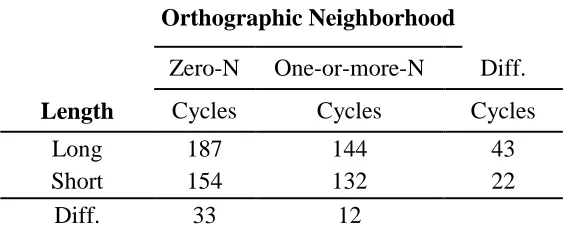
make any error. Mean cycles to criterion are reported in Table 2.
Orthographic Neighborhood
Zero-N One-or-more-N Diff.
Length Cycles Cycles Cycles
Long 187 144 43
Short 154 132 22
Diff. 33 12
Table 2. Mean cycles according to conditions.
An ANOVA with N and Length as independent factors was conducted on cycles. The DRC
behaviour mimed that of humans. Analysis showed a main effect of N, F(1, 108) = 94, p < .001, a
main effect of Length, F(1, 108) = 45, p < .001, and a significant interaction, F(1, 108) = 10, p <
.001, imputable to the size of the length effect being smaller for the items with neighbours than for
2.5 Discussion
The experiment evidenced three different results, all correctly simulated by the DRC model.
First, nonwords with neighbours are read faster than nonwords without neighbours. In the
literature, this result is referred to as the N size effect (e.g., McCann & Besner, 1987; see also
Arduino & Burani, 2004). As mentioned in the introduction, within the DRC framework the N
effect arises from activation in the orthographic lexicon that feeds forward to the phonological
lexicon and primes the phonemes in the phoneme system.
Second, we found a length effect: short nonwords are read aloud faster than long nonwords.
This result is consistent with that of Weekes (1997), who presented his participants with words and
nonwords of three, four, five, and six letters for reading aloud. He found a main effect of letter
length, a main effect of lexicality (i.e., words read faster than nonwords), and a significant
interaction due to the fact that whereas nonwords showed a length effect, words showed no length
effect (however, see Balota, Cortese, Sergent-Marshall, Spieler, & Yap, 2004). Within the dual
route framework, the lexicality by length interaction receives the following explanation: nonwords
are assembled from letters one by one, hence causing a length effect, whereas words are retrieved
from the lexicon as a whole, through a parallel process, hence preventing/attenuating serial effects.
Third, the size of the length effect depends upon the size of N: nonwords without neighbours
exhibit a stronger length effect than nonwords with one or more neighbours. Within the dual route
theory, this interaction is easily explained. If a nonword has one or more orthographic neighbours,
their orthographic and phonological representations receive activation from the stimulus. Activation
grows over time. Nonlexical processing proceeds letter by letter, and therefore longer nonwords
require more time to be assembled. Thus, while processing longer nonwords, the activation in the
lexical route grows for a longer interval of time reaching higher levels. Since the activation of the
lexical route positively contribute to the assembling of the nonword’s phonology, longer nonwords
are more facilitated by their neighbouring words than shorter nonwords.
To conclude, a prediction of the DRC model has been tested through empirical
investigation. The results of our experiment are consistent with this prediction and are all correctly
simulated by the Italian version of the DRC model. The interaction between the letter string length
and the orthographic neighbourhood size (N) that has been obtained is particularly relevant for the
definition of a computational model of visual word recognition and reading aloud. This interaction
strongly supports a cascaded model with a dual route architecture, comprising a route working in
3