International Doctorate School in Information & Communication Technologies
DISI - University of Trento
R
EQUIREMENTS
E
NGINEERING FOR
S
ELF
-A
DAPTIVE
S
OFTWARE
:
B
RIDGING THE
G
AP BETWEEN
D
ESIGN
-T
IME
AND
R
UN
-T
IME
Nauman Ahmed Qureshi
Advisor:
Prof. Anna Perini
Fondazione Bruno Kessler, Trento
First of all I am extremely thankful to my supervisor Prof. Anna Perini for
her kind guidance, advice and support that kept my spirits and gallantry high
during my PhD research. I am honored to be her PhD student. Thank you!!
I also wish to acknowledge and position on record the deep sagacity of
gratitude to Prof. John Mylopoulos, Prof. Carlo Ghezzi, Prof. Franco
Zam-bonelli and Dr. Nelly Bencomo for accepting to be in my thesis committee,
evaluating my work and providing valuable suggestions and comments.
Special thanks are due to Prof. John Mylopolous for providing me the
opportunity to visit his research group at University of Tronto, Canada. During
this visit I came across several colleagues to whom I would like to thank
especially Neil A. Ernst, Daniele Barone for useful discussions and support
during my visit.
I would like to thank Dr. Angelo Susi, Dr. Ivan Jureta, Dr. Norbert
Seyff, Prof. Sotirios Liaskos and Dr. Alessandro Marchetto for their valuable
suggestions on my work and collaborating with me during my PhD research
work. You all have been a great source of inspiration.
I also would like to thank all my fellow colleagues and great friends
especially Cu D. Nguyen, Chiara Di Francescomarino, Mirko Morandini,
Alberto Siena, Andrea Avancini in the software engineering research group at
FBK and many other friends and colleagues Adbul Qader, Tahir, Komminist,
Gianluca, Nevena, Lucilla, Marc, Itzel, Sepideh and Raian who kept my spirits
high, their suggestions & support provided me the courage to carry out my
research.
Last but not the least, I would like to thank my family especially my parents,
enabled me throughout my PhD research. Thank You!!.
Self-Adaptive Software systems (SAS) adapt at run-time in response to
changes in user’s needs, operating contexts, and resource availability, by
re-quiring minimal to no involvement of system administrators. The ever-greater
reliance on software with qualities such as flexibility and easy integrability,
and the associated increase of design and maintenance effort, is raising the
interest towards research on SAS.
Taking the perspective of Requirements Engineering (RE), we investigate
in this thesis how RE for SAS departs from more conventional RE for
non-adaptive systems.
The thesis has two objectives. First, to define a systematic approach to
support the analyst to engineer requirements for SAS at design-time, which
starts at early requirements (elicitation and analysis) and ends with the
spec-ification of the system, which will satisfy those requirements. Second, to
realize software holding a representation of its requirements at run-time, thus
enabling run-time adaptation in a user-oriented, goal-driven manner.
To fulfill the first objective, a conceptual and theoretical framework is
proposed. The framework is founded on core ontology for RE with revised
elements that are needed to support RE for SAS. On this basis, a practical and
systematic methodology at support of the requirements engineer is defined. It
exploits a new aggregate type of requirement, calledadaptive requirements,
together with a visual modeling language to code requirements into a
design-time artifact (called Adaptive Requirements Modeling Language, ARML).
Adaptive requirements not only encompass functional and non-functional
requirements but also specify properties for control loop functionalities such
as monitoring specification, decision criteria and adaptation actions. An
To support the second objective, aContinuous Adaptive RE (CARE)
frame-work is proposed. It is based on a service-oriented architecture mainly
adopt-ing concepts from service-based applications to support run-time analysis
and refinement of requirements by the system itself. The key contribution
in achieving this objective is enabling the CARE framework to involve the
end-user in the adaptation at run-time, when needed. As a validation of this
framework, we perform a research case study by developing a proof of concept
application, which rests on CARE’s conceptual architecture.
This thesis contributes to the research on requirements engineering for SAS
by proposing:
1. a conceptual core ontology with necessary concepts and relations to
support the formulation of a dynamic RE problem i.e. finding adaptive
requirements specification both at design-time and run-time.
2. a systematic methodology to support the analyst for modeling and
opera-tionalizing adaptive requirements at design-time.
3. a framework to perform continuous requirements engineering at run-time
by the system itself involving the end-user.
Keywords Requirements Engineering (RE), Self-Adaptive Software (SAS), Goal-Oriented Requirements Engineering (GORE), Service-Based
1 Introduction 1
1.1 Motivation and Problem . . . 1
1.2 Research Objectives . . . 2
1.3 Case Study: Travel Companion . . . 3
1.4 Approach Overview and Contribution . . . 5
1.5 Structure . . . 7
1.6 List of Published Papers . . . 10
2 State of the Art 13 2.1 Overview . . . 13
2.2 Design Approaches for Self-Adaptive Software Systems . . 14
2.2.1 Component-Based Approaches . . . 14
2.2.2 Middleware-Based Approaches . . . 15
2.2.3 Agent-Oriented Approaches . . . 17
2.2.4 Service-Oriented Approaches . . . 18
2.2.5 Self-Adaptive and Self-Organizing Systems (SASO) 20 2.3 Requirements Engineering for Self-Adaptive Software Systems 21 2.3.1 Goal-Oriented Approaches . . . 22
2.3.2 Requirements Monitoring Approaches . . . 23
2.3.3 Recent Vision for RE for SAS . . . 24
3.1 Overview . . . 27
3.2 Requirements Problem and Core ontology for RE . . . 28
3.3 Defining Run-time Requirements Adaptation Problem . . . . 34
3.4 RE for SAS and its Core Ontology . . . 35
3.5 Run-time Requirements Adaptation Problem: Illustration . . 51
3.6 Benefits & Related Work . . . 55
3.7 Final Remarks . . . 57
4 CARE Framework 59 4.1 Overview . . . 59
4.2 RE levels and Adaptation Types . . . 60
4.3 RE at Design-Time Vs RE at Run-Time . . . 64
4.3.1 RE at Design-Time . . . 64
4.3.2 RE at Run-Time . . . 69
4.4 Conceptual Architecture of CARE . . . 75
4.4.1 Service Request Acquisition . . . 78
4.4.2 Service Lookup . . . 79
4.4.3 Service Selection . . . 80
4.4.4 Update Specification . . . 81
4.4.5 Feedback Control Agents . . . 81
4.5 Related Work . . . 82
4.6 Final Remarks . . . 84
5 Engineering Adaptive Requirements 85 5.1 Overview . . . 85
5.2 Adaptive Requirements . . . 86
5.3 Definition of Adaptive RML . . . 91
5.3.1 Concepts & Relations . . . 92
5.3.4 Requirements Modeling with Adaptive RML . . . . 100
5.3.5 Analyzing Adaptive Requirements . . . 102
5.4 Operationalizing Adaptive Requirements . . . 104
5.4.1 In Practice . . . 108
5.5 Related Work . . . 109
5.6 Final Remarks . . . 113
6 Application of the CARE Framework 115 6.1 Overview . . . 115
6.2 Description of the Travel Companion . . . 116
6.3 Design-Time Modeling of Requirements . . . 117
6.3.1 Specifying Adaptive Requirements . . . 120
6.4 Instantiating CARE at Run-Time . . . 123
6.5 Analyzing Run-Time Adaptation . . . 125
6.6 In Practice . . . 127
6.7 Final Remarks . . . 130
7 Evaluation 133 7.1 Overview . . . 133
7.2 Evaluation of Design-Time Tool . . . 134
7.2.1 Environment of the experiments . . . 134
7.2.2 The parameters of the study . . . 134
7.2.3 Experiment 1: Time to load the variants in the tool . 134 7.2.4 Experiment 2: Time to generate the monitor specifi-cation . . . 135
7.2.5 Experiment 3: Time to configure the monitors . . . . 137
7.3 Qualitative Evaluation of Adaptive RML . . . 138
7.3.1 Requirements Modeling with i* . . . 139
7.3.4 Summary . . . 149
7.4 Empirical Survey on ARML . . . 149
7.4.1 Goal of the Study and Research Questions . . . 149
7.4.2 Hypothesis . . . 150
7.4.3 Subjects . . . 152
7.4.4 Survey Design . . . 152
7.4.5 Survey Procedure . . . 155
7.4.6 Data Analysis and Interpretation . . . 157
7.5 Final Remarks . . . 166
8 Conclusions and Future Work 169 8.1 Conclusions and Summary of Contributions . . . 169
8.1.1 Generality and Limitations . . . 173
8.2 Future Works . . . 174
8.2.1 Integrating Adaptive Requirements and Preferences-based Reasoning for Run-time . . . 174
8.2.2 Online Requirements Engineering . . . 175
8.2.3 Towards the framework for Evolving Requirements . 177 8.2.4 3T process integrating concepts from Agent systems and Testing in RE for SAS . . . 178
8.2.5 Analyzing Intentional Interoperability Requirements 180 8.2.6 Towards a case tool for operationalizing Adaptive Requirements . . . 181
8.2.7 Empirical Study on ARML . . . 182
8.2.8 Continuous Refinement of Requirements at Run-time 182
Bibliography 185
7.1 Aggregated Results of Three Tasks (Modeling, Reasoning,
Visual Notations Analysis) . . . 159
7.2 Aggregated View of the Results (Design-Time Modeling) . . 160
7.3 Modeling Tasks-Questions Mapping to Aspects and Comments 161
7.4 Aggregated View of the Results (Run-Time Reasoning) . . . 163
7.5 Reasoning Tasks-Questions Mapping to Aspects and Comments164
7.6 Aggregated View of the Results (Visual Notation Analysis) . 165
7.7 Visual Notation Analysis Tasks-Questions Mapping to Moody
1.1 Thesis outline . . . 8
3.1 New concepts (ContextandResource) and relations (Relegation andInfluence) related to the concepts of the Core ontology for RE. . . 36
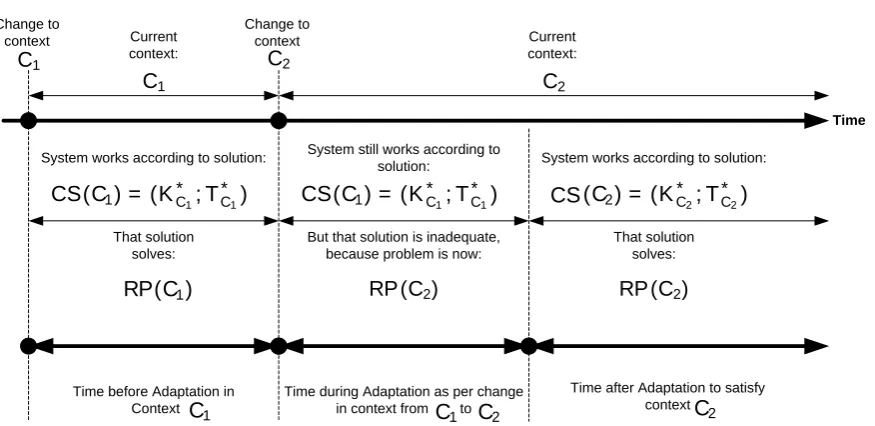
3.2 System Adaptation Sequence in Time . . . 52
4.1 RE process at Design-time and Run-time . . . 65
4.2 Run-time Requirement Artifact (RRA) . . . 70
4.3 User Specified RRA. . . 76
4.4 System Generated RRA. . . 76
4.5 Conceptual Architecture of CARE . . . 77
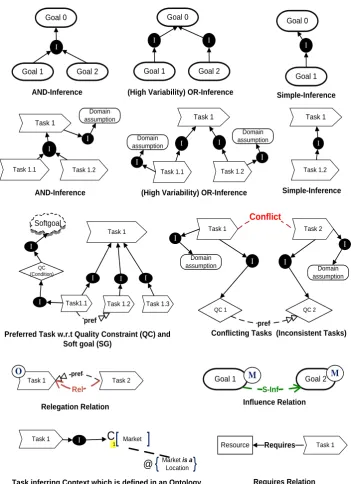
5.1 Visual guide for concepts and relations in Adaptive RML. . . 95
5.2 Requirements Refinement Pattern in Adaptive RML. . . 99
5.3 Modeling using Adaptive RML Concepts and Relations. . . 100
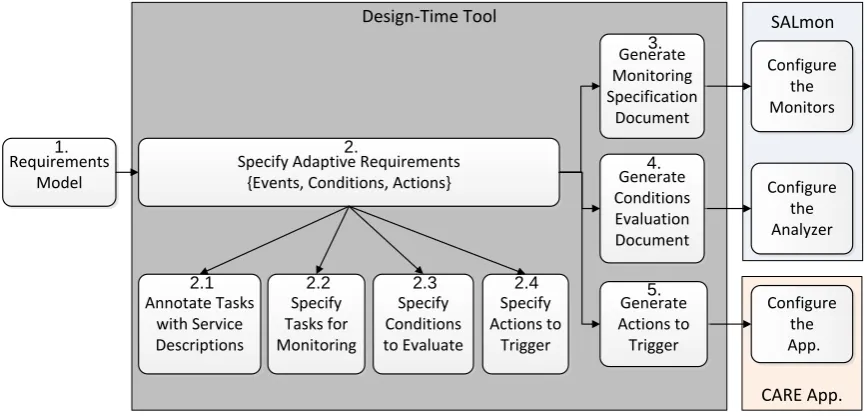
5.4 Design-time process for deriving and configuring Monitor, Analyzer and CARE Application . . . 105
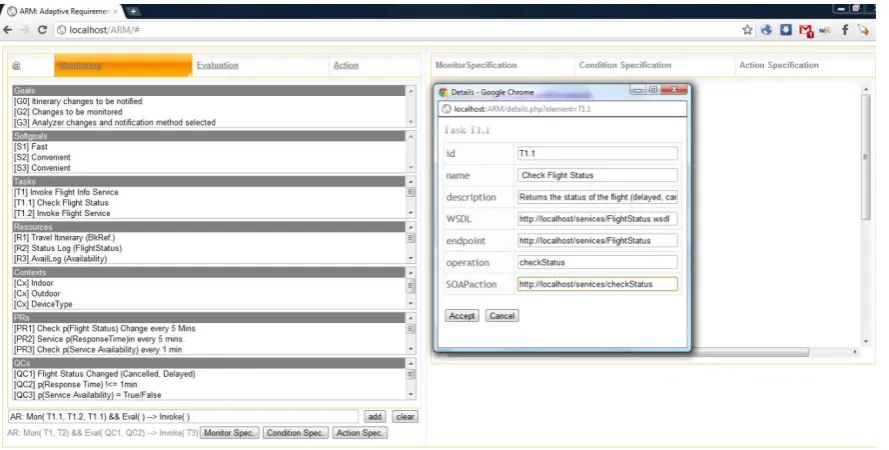
5.5 Design-time process for Annotating the Tasks . . . 108
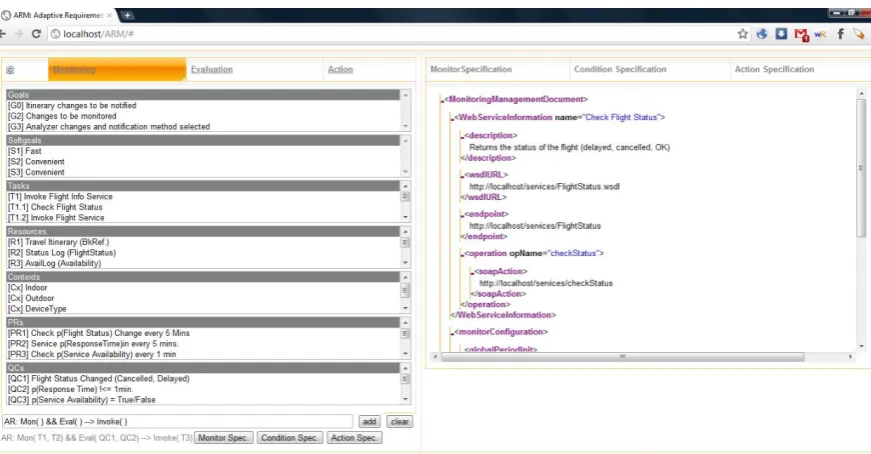
5.6 Deriving Monitoring Specification Document . . . 109
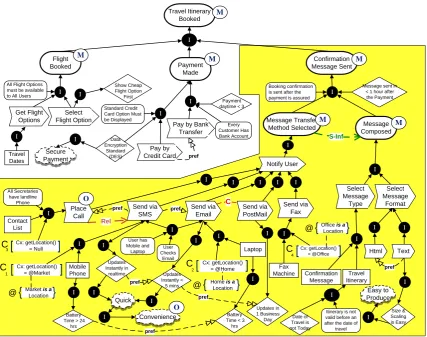
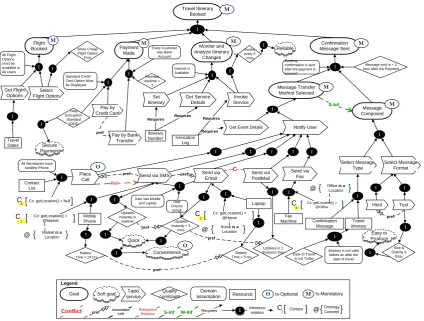
6.1 A Goal Model in ARML . . . 118
6.2 Run-time Process. . . 124
6.5 “iComp” GUI Screen . . . 128
6.6 “iComp” Preference Screen . . . 129
6.7 “iComp” Adaptation in the Scenario . . . 130
7.1 Time to load variants in the tool . . . 135
7.2 Time to generate monitoring specifications . . . 136
7.3 Time to configure monitors . . . 137
7.4 Modeling using iStar Concepts and Relations only. . . 139
7.5 Modeling using Tropos Concepts and Relations (R) and An-notated Goal model with domain properties modeled using Domain Ontology (L) . . . 141
7.6 Example of Plan description . . . 144
7.7 Modeling using ARML Concepts and Relations. . . 147
7.8 Survey Design . . . 153
7.9 Survey Material Snapshot . . . 154
7.10 Averaged Results of Three Tasks . . . 158
7.11 Aggregate Results of Modeling Questions . . . 160
7.12 Aggregate Results of Modeling Questions. . . 162
7.13 Aggregate Results of Visual Notations Questions. . . 164
8.1 Continuous Reasoning Process at Run-Time . . . 174
8.2 Online RE process . . . 176
8.3 Wheel of Evolution . . . 177
8.4 3T AS development cycle . . . 179
Introduction
Contemporary Internet-enabled software applications are increasingly
im-mersed in the fabric of our daily life. This surge in using software by the
end-users with volatile needs has increased the computational complexity and
maintenance problem for such software systems. The increasing reliance on
software has led to growing interest in research on Self-Adaptive Software
systems (SAS) [CGI+08], which have been proposed as a possible solution to
overcome such problems.
1.1
Motivation and Problem
Following recent research agendas [CGI+08, DNGM+08, ST09, SBW+10], in
this thesis, we defineself-adaptive software systemsas: software systems that
adapt their behavior at run-time in response to changing user’s requirements,
operating contexts, and resource availability.
Engineering ofself-adaptive softwareis challenging and influences all the
phases of software development ranging from requirements engineering, to
design, implementation and maintenance. Ongoing research on software
engi-neering forself-adaptive softwareproposes novel design-time methods and
techniques to support run-time adaptation mainly exploiting architecture based
to these approaches is the adoption of component-based [KM07],
middleware-oriented [HFS04], service-middleware-oriented [DNGM+08], agent-oriented [TCW+04]
designs to develop self-adaptive software systems while anticipating run-time
changes. On the other hand, Requirements Engineering (RE) for self-adaptive
softwareis still in its fledgling stages. In RE literature, requirements-driven
approaches have motivated the need to monitor system’s requirements to
vali-date their compliance at run-time [FF95]. However, in case ofself-adaptive
software systems, RE activities need to be performed at various levels of
abstractions, as it is envisioned in [BCZ05].
Along this vision, recent approaches to engineer self-adaptive software
advocate the role of the requirements along the later stages of the software
de-velopment to support run-time adaptation [MPP08, DGM09]. Unfortunately,
in these approaches it is difficult to accommodate new or changed
require-ments. In reality, change is inevitable. End-user requirements change with
respect to the dynamic environment in which applications are executed and
used. RE activities are needed to be performed at design-time with more
explicit constructs to specify requirements for SAS, but are also needed at
run-time. Existing approaches are limited to cope with this. This manifests a
gap between design-time and run-time requirements engineering.
1.2
Research Objectives
In this thesis, we investigate how RE for SAS departs from more conventional
RE for non-adaptive systems, focusing on two concrete objectives:
Obj1 To define a systematic methodology at support of the system analyst to
engineer the requirements of SAS at design-time, which starts at early
requirements (elicitation and analysis) and ends with the specification of
Obj2 To enable software holding a representation of its requirements at
run-time, and support goal- and user-oriented adaptation at run-time.
We elaborate the above objectives with respect to the following research
questions:
RQ1 What concepts and abstractions are needed to formulate the
“require-ments problem” for SAS? [Obj1]
RQ2 How to systematically engineer requirements for SAS at design-time?
[Obj1]
RQ3 How to enable SAS to perform RE at run-time and support goal- and
user-oriented adaptation? [Obj2]
To support the discussion at best, a travel domain case study is exploited.
Travel Companion is a software for travel planning and monitoring, which
is an adaptive service-based application. It is able to adapt with respect to
changes that occur in the end-user needs, operating context and availability
of resources. Other exemplar case studies have been considered during the
research, mainly representative of service-based applications e.g. adaptive
anti-virus, adaptive Personal Media Server (PMS), adaptive meeting
sched-uler, service-based laundry collection scenario (Intentional Interoperability),
adaptive GPS navigation software, and cleaner agent exemplar case study.
In this thesis description we focus on Travel Companion since it shows
the main adaptivity properties such as change in context conditions, changes
in end-user needs, availability of resources and of solutions (i.e. available
services). Below, we give an overview of the case study.
1.3
Case Study: Travel Companion
Travel Companion is a service-based application that is aware of end-users’
and operating environment) it tries to help them accomplishing their goals.
New requirements emerge and that can be operationalized with respect to
existing or available services. It relies on third party services that are assumed
to be available over the Internet. It provides access to end-users’ to get on
the fly information as they require through available services (e.g. weather
forecast). It also allows them to specify their travels and meeting schedules.
Moreover, Travel Companion manages end-users profile and respective
preferences for a particular travel itinerary. It monitors the flight schedules and
notifies the end-users’ about their travel updates (e.g. flight status changes),
meeting reminders (e.g. when, and where meeting is) and in case of situations
where the goals and preferences of the end-users’ are not met, it looks for
alternative solutions (e.g. flight is canceled, look for trains, or rent a car) and
tries to involve the end-users’ by asking their relevant feedback. It tries to
keep track of the available resources (e.g. availability of the Internet, device
battery level, social contacts and agenda etc.). It searches for alternatives to
operationalize the task (e.g. completing services) that may requires a particular
resource (e.g. contacts are needed to inform in case of emergency, agenda is
needed to reschedule meetings).
In addition, it provides relevant information (e.g. news, weather updates)
that are necessary to keep Travel Companion informed about the external
events. At run-time it can act as an analyst by acquiring user input about new
or changed requirements and search for available services as alternative ways
to operationalize these requirements involving the user. In case of goals and
preferences that it is not able to meet, it creates a log for the off line evolution.
This case study is exploited to derive proof of concepts on solutions elaborated
for the two problems below.
Adaptation at Design-time. Adaptive requirements are elicited and require-ments problem is formulated and adapted by finding the adaptive requirerequire-ments
decision criteria are elaborated with the space of alternative tasks that are
needed to enable run-time adaptation.
Adaptation at Run-time, which is performed at various level of details. Key facets that trigger adaptation are: contextual information of the end-user
and/or the system, resource availability, relevant service availability, and new
or emerging needs that an end-user can specify.
1.4
Approach Overview and Contribution
The approach adopted to address the identified objectives, consists in revisiting
core concepts, which were introduced in well known foundational work,
for defining the software requirements problem. In addition, we propose
systematic methods and proof of concept tools to realize solutions solving the
problem of requirements engineering forself-adaptive software systems, both
at design-time and run-time.
• We start with establishing the theoretical and conceptual basis. The idea
is that some elements in the definition of the requirements problem for
self-adaptive software systems, expressed along the classical
require-ments problem formulation by Zave & Jackson in [ZJ97b] and its recent
reformulation [JMF08] at design-time, may change at run-time. This
de-mands for a new requirements problem formulation and a corresponding
set of candidate solutions. We propose a formulation of the requirements
problem for self-adaptive software systemsas a dynamic problem. This
dynamic requirements problem definition is supported by a revised core
ontology for requirements engineering, which includes new concepts and
relations.
• To put these concepts into practical use, we propose a new composite
requirement type, called Adaptive Requirements, that can help analysts
requirements not only encompass functional and non-functional
require-ments but also specify properties for control loop functionalities such as
monitoring specification, decision criteria and adaptation actions. We
exploit the core ontology to perform requirements engineering for
self-adaptive software systems and propose a modeling language, called
Adaptive Requirements Modeling Language (ARML), along with the
guidelines to perform early requirements engineering forself-adaptive
software systems. Following these guidelines, an analyst at design-time
can capture and analyze requirements for the target self-adaptive system
thereby formulating the requirements problem and finding the adaptive
requirements specification.
• This specification provides input to a framework for performing
re-quirements engineering at run-time. We call it Continuous Adaptive
Requirements Engineering (CARE) framework. The framework provides
a systematic way to continuously refine requirements specification that
is made available to the system. At run-time, the system instantiating
CARE acts as an analyst and exploits information gathered through
monitoring or explicitly given by the end-user, for deciding and
select-ing a candidate solution (e.g. usselect-ing available services) to resolve the
requirements problem by itself.
Preliminary evaluations of the proposed ideas are provided. A proof of
concept tool for supporting the operationalization of adaptive requirements
at design-time has been realized. This prototype tool has been applied to
an exemplar case study to evaluate the system performance. A prototype
application has been developed that instantiates CARE framework at run-time
involving the end-user. An empirical evaluation on the effectiveness of the
proposed ARML, through an empirical survey with human subjects, is also
In summary, this thesis contributes to the research in requirements
engi-neering for SAS by proposing:
1. a conceptual core ontology with necessary concepts and relations to
support the formulation of a dynamic requirements problem i.e. finding
adaptive requirements specification both at design-time and run-time.
2. a systematic approach to support the analyst for modeling and
opera-tionalizing adaptive requirement at design-time.
3. a framework to perform continuous requirements engineering at run-time
by the system itself involving the end-user.
1.5
Structure
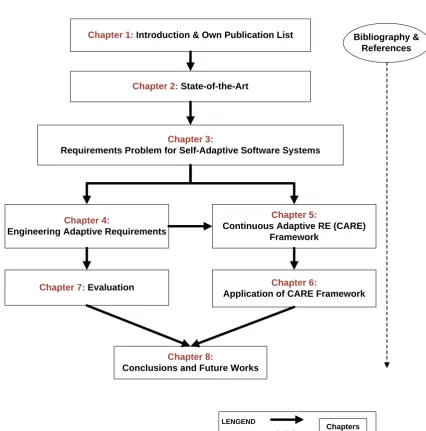
The thesis is organized in chapters with their corresponding dependency links
as shown in the Figure 1.1. The aspects covered in each chapter are briefly
recalled here below.
Chapter 2, presents the state of the art requirements engineering and design
approaches for developingself-adaptive software systems. In particular, we
distinguish architecture centric approaches including service-oriented,
agent-oriented and RE approaches including goal-agent-oriented methods, requirements
monitoring and more recent works on RE forself-adaptive software systems.
Chapter 3, defines the conceptual and theoretical framework in which we
propose a formulation of the requirements problem forself-adaptive software
systems as a dynamic RE problem that a self-adaptive software should be
engineered to solve. At run-time, a self-adaptive software may move from
one requirements problem to another thereby finding solutions to satisfy the
requirements. To support such a dynamic requirement problem formulation
forself-adaptive software systems, we revise the core ontology for RE and
Chapter 1: Introduction & Own Publication List
Chapter 2: State-of-the-Art
Chapter 3:
Requirements Problem for Self-Adaptive Software Systems
Chapter 5:
Continuous Adaptive RE (CARE) Framework
Chapter 4:
Engineering Adaptive Requirements
Chapter 6:
Application of CARE Framework
Chapter 8:
Conclusions and Future Works
Chapter 7: Evaluation
LENGEND
Chapters Logical Flow
Bibliography & References
relegate and influence) to support dynamic problem formulation.
Chapter 4, introduces the Continuous Adaptive RE (CARE) framework,
that supports continuous RE at run-time involving the end-user. To provide a
clear distinction between RE at design-time and RE at run-time, adaptation
types are defined in light of CARE, revisiting the four levels of RE proposed
by Berry et al. [BCZ05]. Concepts and artifacts needed by theself-adaptive
softwareitself at run-time to perform continuous RE involving the end-user
are introduced. A conceptual architecture of an application is proposed, which
instantiates CARE at run-time.
Chapter 5, defines the concept of Adaptive Requirements for self-adaptive
software systems, which are requirements that make explicit the feedback loop
functions such as monitoring specification, decision criteria and alternative
adaptation tasks. To elicit and specify the adaptive requirements, a
system-atic approach is proposed with guidelines to support the analyst/designer at
design-time. In this approach, modeling adaptive requirements helps in
iden-tifying monitoring specification that are operationalized using a monitoring
framework to validate their usability at run-time, respectively. Exploiting
the concepts and relations proposed in the revised core ontology of RE for
self-adaptive software systems, to formulate the requirements problem at
design-time, this chapter proposes visual notations to model adaptive
require-ments for SAS. An Adaptive Requirerequire-ments Modeling Language (ARML) for
self-adaptive software systemsis proposed, which is based on a recently
pro-posed abstract requirements modeling language, Techne [JBEM10b]. ARML
provides basis for modeling the requirements problem with convenient visual
notations.
Chapter 6, illustrates the application of CARE framework to a travel case
study introduced earlier. Continuous RE is supported by the proof of concept
application that instantiates CARE involving the end-user.
preliminary results about measuring scalability and performance of the
design-time tool. Second, a qualitative assessment on modeling requirements for
self-adaptive software is presented. Third, an empirical survey study with
subjects is conducted to evaluate the effectiveness of the modeling concepts,
visual notations and modeling guidelines for ARML.
Chapter 8, presents the conclusions and summary of contributions. Future
research directions which are identified during this thesis work are presented.
On some of the ideas initial exploration has been conducted.
1.6
List of Published Papers
Most parts of this thesis have been published in international conferences and workshops. Below, is a list of papers, which is classified as: published along the years, submitted and in preparations or future work.
List of Published Papers 2011
• Nauman A. Qureshi, Ivan Jureta, Anna Perini. Towards a Requirements Modeling Language for Self-Adaptive Systems. in18th International Working Conference on Requirements Engineering: Foundation for Software Quality (REFSQ’12) [Accepted for publication].
• Marc Oriol, Nauman A. Qureshi, Xavier Franch, Anna Perini, Jordi Marco. Requirements Monitoring for Adaptive Service-Based Applicationsin18th International Working Conference on Requirements Engineering: Foundation for Software Quality (REFSQ’12) [Accepted for
publication].
• Nauman A. Qureshi, Ivan Jureta, and Anna Perini, “Requirements engineering for self-adaptive systems: Core ontology and problem statement”, in23rd International Conference on Advanced Information Systems Engineering (CAiSE’11), pp. 33-47, ser. LNCS, vol. 6741. Springer, 2011.
• Nauman A. Qureshi, Sotirios Liaskos, Anna Perini, “Reasoning About Adaptive Require-ments for Self-Adaptive Systems at Runtime”, inSecond International Workshop on Require-ments@Runtime (RRT’11) at RE’11, pp. 16-22, August 2011.
• Anna Perini, Nauman A. Qureshi, Luca Sabatucci, Alberto Siena, Angelo Susi, “Evolving Requirements in Socio-Technical Systems: Concepts and Practice”, in 30th International Conference on Conceptual Modeling (ER 2011), pp. 440-447, LNCS, Springer, Oct. 2011.
2010
• Nauman A. Qureshi, Anna Perini, “Requirements Engineering for Adaptive Service Based Applications”, in18th IEEE International Requirements Engineering Conference (RE’10), pp. 108-111, September 2010.
• Nauman A. Qureshi, Anna Perini, Neil A. Ernst, John Mylopoulos, “Towards a continuous requirements engineering framework for self-adaptive systems”, inFirst International Workshop on Requirements@Runtime (RRT’10) at RE’10, pp. 9-16, September 2010.
• Nauman A. Qureshi, Anna Perini, “Continuous adaptive requirements engineering: An ar-chitecture for self-adaptive service-based applications”, in First International Workshop on Requirements@Runtime (RRT’10) at RE’10, pp. 17-24, September 2010.
• Nauman A. Qureshi, Cu D Nguyen, Anna Perini, “Analyzing Interoperability Requirements for Adaptive Service-based Applications”, inFourth IEEE International Workshop on Requirements Engineering for Services (REFS’10) at COMSPAC’10, pp. 239-244, July, 2010.
• Alessandro Marchetto, Cu D. Nguyen, Chiara Di Francescomarino, Nauman A. Qureshi, Anna Perini, Paolo Tonella, “A Design Methodology for Real Services”. inSecond International Workshop on Principles of Engineering Service-Oriented Systems (PESOS’10) at ICSE’10, pp. 15-21, May 2010.
• Chiara Di Francescomarino, Chiara Leonardi, Alessandro Marchetto, Cu D Nguyen, Nauman A Qureshi, Luca Sabatucci, Anna Perini, Angelo Susi, Paolo Tonella, Massimo Zancanaro, “A bit of Persona, a bit of Goal, a bit of Process ... a recipe for Analyzing User Intensive Software System”, inFourth International i* Workshop (iStar2010) at CAiSE’10, pp. 36-40, June 2010.
2009
2008
• Nauman A. Qureshi, Anna Perini, “Towards Seamless Adaptation: An Agent-Oriented Ap-proach”, in Second IEEE International Conference on Self-Adaptive and Self-Organizing Systems (SASO ’08), pp.471-472, 20-24 Oct. 2008.
• Nauman A. Qureshi, Anna Perini, “An Agent-Based Middleware for Adaptive Systems”, in
State of the Art
2.1
Overview
The topic of self-adaptive software systems is calling for investigation in
several research areas along many facets of software engineering as stated
in Cheng et al. [CdLG+09]. Many open issues have been identified and
acknowledged by revisiting the current efforts in the field of software
engineer-ing (in particular requirements engineerengineer-ing, analysis and modelengineer-ing, design,
engineering and assurance). Currently, the emphasis of research is more
on design-time solutions to provide run-time adaptation. Despite ongoing
research, requirements engineering for self-adaptive software systems has
received less attention so far1. This results in a gap between design-time
and run-time adaptation activities. Self-adaptive software systems need to be
aware of their own requirements and able to monitor their end-user’s goals and
preferences, domain conditions, operating context, available resources and
the multiple tasks they are able to perform at run-time. However, engineering
such systems is challenging.
In this chapter, we recall state of the art works from software engineering
areas where our research develops, namely, architecture-based design
ap-proaches (Section 2.2) and requirements engineering apap-proaches (Section 2.3).
For the sake of ease in reading, we categorize design approaches along
mid-dleware or service-oriented or software agents based approaches, while for
requirements engineering works we distinguish goal-oriented, variability
mod-eling, formal and informal approaches for self-adaptive software.
2.2
Design Approaches for Self-Adaptive Software Systems
So far, considerable work in realizing self-adaptive software is architecture
driven and based on middleware approaches. Architecture based approaches
abstract the adaptation decision from code level to component level supporting
if there is consistency between the code and the architectural model. The main
idea is to address adaptation needs at design-time defining a set of different
architectures, each one appropriate for specific environment conditions.
2.2.1 Component-Based Approaches
In [OGT+99], two complementary processes are introduced to enable
self-adaptive software, namely, adaptation management i.e. for changing the
application over time upon monitoring, evaluating, planning; and evolution
management, which focuses on the mechanisms that are used to change the
application through system artifacts, also taking into account consistency issue.
These two processes can have humans in the loop, or they can be automated,
through the use of software agents.
Run-time and design-time adaptation are considered in RAINBOW by
Garlan et. al. [CHG+04]. The main idea behind run-time adaptation in
RAINBOW2 is to provide generic externalized adaptation mechanisms based
upon a monitoring-reasoning-adapting loop, using probes and gauges. As for
design-time adaptation, the authors highlight architecture based adaptation
challenges like accurate decompositions and issue of latency at run-time.
Furthermore, it is well argued in [KM07] that the architectural approaches
are promising for developing self-managing systems. This is due to the
gen-erality and the level of abstractions, which helps in satisfying the challenges
posed by self-* systems. Kramer et al. has discussed their component based
reference architecture based on three layers namely - component control layer,
change management layer and goal management layer. Subsequently,
deal-ing with challenges like reconfiguration, ensurdeal-ing application consistency
and avoiding undesirable transient behaviors at component layer. At change
management layer, a fault-tolerant state management and decentralized
con-figuration management is tackled. Lastly, at higher-level, constraint based
planning activity is carried out by aligning “Online” the goals and of the
system. This approach provides suitable arguments for architecture based
ap-proach but require more comprehensive apap-proaches to be integrated in order to
sort out critical system properties. This will help in dealing with the emergent
behaviors.
2.2.2 Middleware-Based Approaches
In [HSSF06] product line engineering techniques are used to mask the user
and resource variability in an ubiquitous environment by proposing a platform
based on MADAM middleware. Its further extension is MUSIC3, which is
an open source platform for building adaptive mobile applications. In this
approach a prototype platform is developed as a collection of components
that supports a generic adaptation mechanism. However, this approach seems
to be simple in terms of adaptation and needs to be improved in terms of
performance.
In [HFS04], FAMOUS4 - an adaptation middleware is used as
compo-nent framework to dynamically select an architecture variant for applications
3http://ist-music.berlios.de/site/platform.html
4FAMOUS is a strategic research project founded by the Research Council of Norway. The goal of FAMOUS
to adapt in the context of mobile environments by exploiting the reflective
architecture, which is a run-time representation of its application framework.
Similar approach is pursued in [GEL+06] but the focus was on using a
middleware to manage self-adaptivity by mirror-based reflections and using a
QuA5 middleware to support services by behaviors. In this, a video streaming
example was demonstrated supported by QuA middleware for observing QoS
parameters using goal-oriented and utility function approaches to quantify the
suitability about adaptation. The main idea was to separate the adaptation
concerns from the application concerns.
In [FHS+06] emphasis was on separation of adaptation concerns from
application concerns by using architectural models generated at run-time
leaving the decision on middleware (MADAM) to reason. The application
variants and their properties are addressed in terms of coarse-grained and
fine-grained variability. Moreover, the focus is on application of architecture
models at run-time providing more consistency. The main idea is on separate
the adaptation concerns from the application concerns as advocated by D.
Garlan et al. [CHG+04].
Most of the work analyzed so far is mainly inspired by middleware
ap-proach using architectural models inherently based on closed-loop control.
This concept of separating the adaptation concerns from the application
con-cerns seems promising in terms of reusability. The approaches discussed so far,
abstract the adaptation decision from code level to component level providing
the specification of a set of alternative architectures that better fit with quality
factors, and take into account environment conditions, at design-time.
How-ever, the link between architecture and requirements for self-adaptive software
is not fully addressed. Moreover, managing the continuously changing needs
of end-users is limited in these works, which makes these approaches more
strict and system architect dependent. Whereas, run-time adaptation requires
more flexible and requirements aware approach.
2.2.3 Agent-Oriented Approaches
Architecture-based approaches employ agents as their core component.
Ac-cording to Perini in [Per09] agent-based approaches are gaining much
popular-ity as due to their natural compatibilpopular-ity for satisfying the visions of autonomic
computing by Kephart et al. in [KC03]. Several agent-oriented methodologies
(e.g. Tropos [BPG+04] and Gaia [ZJW03]) has been proposed providing
abstractions to engineer distributed systems, where an agent can be viewed
as a computational system situated in an environment, capable of performing
autonomous actions and presenting flexible behaviors to fulfill the goals for
which it has been designed.
To achieve its intended purpose, it requires some infrastructural support
for the provisioning of its services, called Multi-Agent Systems (MAS), as
a flourishing software engineering paradigm to develop distributed systems.
In addition, they can be employed to provide flexible infrastructure i.e. to
automate the process-oriented tasks, by Oreizy et al. in [OGT+99].
A well grounded discussion can be seen on the adoption of seamless agent
middleware technology as part of large software systems by Omicini et al.
in [OR04]. This integration ofMAS-as-subsystemis discussed in light with
respect to three dimensions of technology transfer by investigating JADE
agent platform. This stimulates the use of agents to provide flexibility not at
infrastructure level but also at conceptual level. In [SR07], the suitability of
agents has been the key focus, because agents are used as a core artifact to
model system dynamics. The approach entails a requirements driven approach
by expressing adaptivity and to develop self-organizing MAS.
Tesauro et al. in [TCW+04] discuss the IBM’s Unity platform for
auto-nomic computing as an example of how MAS can be used in practice for
implemented in Java, using the Autonomic Manager Toolkit2. The proposed
infrastructure is a composition of agents as autonomic elements including
policy elements (policies to be applied), sentinel elements (ensure monitoring)
and system elements (ensuring resources), supported by autonomic managers
for predicting changes. An exciting part of this work is its application to
perform goal-driven self-assembly, that is a self-configuring autonomic
ele-ment by knowing its high-level goals can contact the registry to get required
services by others to fulfill its goals.
Following the AOSE perspective, [PPSM07a] uses the TROPOS
method-ology to model variability in user’s needs and preferences, in terms of
alter-natives for goal achievement at requirements-time. The modeled variability
reflects into the design and coding of Belief-Desire-Intention (BDI) agents,
which are able to switch from a behavior to a most appropriate one,
depend-ing on the perceived environment conditions (includdepend-ing users preferences)
at run-time. In this work, goal alternatives represented in the requirements
models map to software agents goal models in the design and code artifacts.
However, the intentional abstractions are very much close to the agent-oriented
approaches to designself-adaptive software [MPP08], but at run-time it is not
evident that such approaches are adequate enough for managing changes in
the requirements during the adaptation process.
2.2.4 Service-Oriented Approaches
Service-oriented architectures (SOA) are based over the concept of decoupled
services as their functional unit. SOA as another form of software architecture
providing much better facilities for business concerns to abstract the users
(consumers) from the internal implementation. The idea of using services in
the context of self-adaptive softwareseems promising.
In [DPT07] highlights the use of service-oriented concepts in designing a
loop for adaptation and service invocation. They highlights the importance
of separation of adaptation, fault taxonomy and standard libraries for loosely
coupled application and adaptation modules.
In [IMW07], the authors promote the use of dynamic aspect oriented
programming (d-AOP) in SOA platform in order to reuse the existing services
and adapting it to the new requirements. The main idea is to leveraging the
“Hot-Deployment” feature of the existing Open Gateway Initiative (OSGi)
framework published by Eclipse foundation and by integrating the d-AOP
to realize the dynamic run-time adaptation by deploying aspects as bundles
to provide seamless integration of both by supporting the claim for run-time
adaptation.
Analogously, in the context of service engineering, Papazoglou [Pap08]
proposes a theoretical approach for structural changes of services, which
focuses on service compatibility, compliance, and conformance. This approach
builds upon a detailed analysis of the possible sources of change.
This work inspires our research that focuses on the more specific (although
ambitious) objective concerning software evolution that requires minimal
human intervention. Moreover, in our approach we tend to follow an
artifact-centric approach, similar to that proposed in [BGH+07].
Hence, it seems evident that the choice of using services as the motivating
artifact for the intended self-adaptive software. Based on the concepts like
separation of concern, the services themselves are not able to reason about
“What, Why and How”. Therefore, they need an explicit mechanism like
agents to automate their use at run-time in order to overcome the user’s needs.
Architecture driven approaches provide good abstraction by answering
WHAT to monitor, HOW to evaluateandWHEN to adapt. These design-time
decisions enable run-time adaptation. Taking the perspective of requirements
engineering, these approaches treat requirements at later stages, where the key
code. This treatment leads to strict rules and functions that can aid adaptation
as reconfiguration of components, services or agent behaviors. The core issue
remains open i.e. how to manage changing requirements at run-time.
2.2.5 Self-Adaptive and Self-Organizing Systems (SASO)
To pursue the goal of building autonomic systems, a unified view of the
sys-tem is well articulated in terms of a generic framework in [SFRG08]. The
presented framework supports both self-adaptive softwareand self-organizing
characteristics promoting that a system not only has hierarchical top-down
view - as in case ofself-adaptive software but also is decentralized (in terms
of variety of components) by having a bottom-up view - as in case of
self-organizing systems. Design-time techniques and architecture supporting
run-time infrastructures are the main focus in this work, hence by enabling a
system with self-adaptive software and self-organizing capabilities. Moreover,
supporting the need to have reliable and controllable SASO system, the
emer-gent behavior by respecting the dependable properties such as trustworthiness
in case of security, safety and performance. In contrast to traditional approach
for building resilient and predictable systems, some engineering requirements
are presented. A generic framework is also articulated, which supports the
development of trustworthy, resilient, controllable and self-reconfigurable
SASO systems.
However, argued framework [SFRG08] is under ongoing investigation
by evaluating it on variety of case studies but still it provides some
engineer-ing guidelines for buildengineer-ing SASO systems. This exploits the concepts of
dynamic reconfiguration and keeping systems resilient to threats. Furthermore,
this framework advocates the use of enforcement of policies service, which
controls the adaptation and organization feature by operating on the meta
data. Here, meta data represents the information about components and the
2.2.5.1 Bio-Inspired Self-Adaptive Systems
Recently, there has been a considerable research that is currently being pursued
by relating computing systems with biological systems. In [Bru08], a view on
building bio-inspiredself-adaptive software is presented. The main proposal
revolves around the notion of modeling the biological system, which can be
understood and then using that model by reiterating through it to generate a
software design tool. Such tool yields quality of service such as fault-tolerance,
robustness, security. In particular, software architecture and architectural styles
extends such design tools. In this paper, tiled architectural style is adopted to
support self-assembly model supporting the QoS as fault-tolerance.
2.3
Requirements Engineering for Self-Adaptive Software
Systems
In particular, requirements engineering has been recognized as the seed activity
in the whole software development life-cycle. Requirements engineering
embraces sequential activities including elicitation, analysis, specification
and validation [NE00]. Requirements are not only changed by the business
level, but also emerge at run-time due to changes in the user needs, resource
variability and environment. In this, the notion of requirements management is
the key activity which prevails along all these activities. Requirements change
management is an important activity when dealing with adaptive software.
Berry et al. in [BCZ05] identify four-level model for engineering dynamic
adaptation requirements. It ranges from traditional RE activities, done by
system analyst (level 1), to adaptation requirements the system responds to
at run-time (level 2) and RE done by the analyst to determine adaptation
mechanisms which enable the system to adapt (human-in-the loop adaptation
scenario, level 3) and finally adaptation requirements associated to the specific
2.3.1 Goal-Oriented Approaches
Likewise, to analyze adaptation requirements, goals have been
acknowl-edged and used as a useful abstraction in many requirements engineering
approaches [vL01b, LLY+06]. The goal-oriented approach is also widely
adopted for variability modeling, and has been well acknowledged in (early)
requirements engineering for eliciting, specifying, analyzing, and
document-ing software requirements. The overall idea of goal-oriented modeldocument-ing and
analysis revolves around the notion ofgoal, which allows to capture functional
and non-functional aspects of the system-to-be from stakeholder’s
perspec-tive. At this point, the goal is decomposed into sub goals using AND/OR
decompositions. Later a special attention is given to represent the refinements
of various viewpoints considering the variability concerns. In this way, it
is possible to reason about alternatives based on AND/OR decompositions.
High-level goals are said to be satisfied when the sub goals have been fulfilled.
Penserini et al. in [PPSM07a] uses the TROPOS methodology to model
variability in user’s needs and preferences, in terms of alternatives for goal
achievement at requirements-time. The modeled variability reflects into the
design and coding of Belief-Desire-Intention (BDI) agents, which are able to
switch from a behavior to a most appropriate one, depending on the perceived
environment conditions (including user preferences) at run-time. In this work,
goal alternatives represented in the requirements models map to software
agents goal models in the design and code artifacts. This helps answering the
question of “HOW”, as well as “WHAT and WHY” for run-time adaptation.
self-adaptive software requirements expressed as goal models can be mapped
to BDI architecture resulting into an agent-based design framework to capture
the said adaptivity requirements by Morandini et al. in [MPP08], which seems
promising step towards an agent-oriented self-adaptive software research.
address the problem of variability by configuring software using goal-oriented
approach. High-level user preferences are modeled as goal alternatives and
by matching them with the intended system configuration. Thus supports
reasoning about overlaying goal models to achieve an automatic system
con-figuration. This appears to be a very useful approach to describe the behavior
of autonomic elements based on goals.
More recently, goal models are used to derive autonomic element patterns
by Zhu et al. in [ZLKM08]. Goal-oriented requirements engineering approach
and attribute-based architectural style is used to articulate various autonomic
element patterns. These patterns are organized from least to most flexible ones,
mainly, characterizing maintainability concerns for self-adaptive software.
This approach argues the reification of requirements using goal models, which
constitutes a framework to reason about maintainability impact.
Along the perspective of goal-oriented requirements engineering, the core
requirements ontology is redefined by Jureta et al in [JMF08]. This core
ontology is based on goal-oriented concepts, mentalistic notions (belief, desire,
intention) called modalities and the speech acts. Mainly, this ontology helps in
articulating and understanding the requirements problem in a precise way. But,
in order to buildself-adaptive software, this ontology is not sufficient to deal
with requirements change aspect and the adaptive nature of the requirements.
2.3.2 Requirements Monitoring Approaches
Nonetheless, goal-oriented approaches provide basis for refinement of
require-ments and architecture at run-time. Feather et al. in [FFLP98] use KAOS
goal models to monitor requirements violations to reason for run-time
behav-ior of a system and adapt dynamically using pre-defined adaptation tactics
(parametric or choosing alternative actions). Moreover, KAOS models are
formalized using temporal logic to provide traceability to verify. However,
Goal contributions +/-).
Similarly, Robinson [Rob09] proposed a comprehensive review of
require-ments monitoring approaches. A monitoring framework named REQMon
(new Name EEAT i.e. Event Engineering and Analysis Toolkit) is proposed to
monitor web service requirements using KAOS[DvLF93a]. His approach is
based on identify potential requirements obstacles in order to monitor them.
To do so, for each obstacle, an analyst is required to define a monitor that
would retrieve the needed data. A version of OCL (object constraint language)
for temporal logic is used to specify monitors.
Salifu et al. in [SYN07a] argue that monitoring is essential for
require-ments variations / violations and aids in composing switching behaviors in a
context. This approach deals with the specification of monitoring problems
and switching behaviors of core requirements, considered as invariants,
us-ing state charts to analyze the dynamicity and support elicitation. It differs
from Feather et al. [FFLP98] approach in terms of monitoring the problems
variations in a context besides the core requirements. Furthermore, this
ap-proach helps in deeper understanding of contextual variability and its impact
on monitoring and switching problems, but it is limited, to scenarios, when
considering an adaptive system.
2.3.3 Recent Vision for RE for SAS
Considering the software engineering road map for building self-adaptive
software by B. Cheng et al. in [CGI+08], there has been considerable
em-phasis given on various aspects of software engineering mainly requirements,
modeling and design, engineering and assurance. This study brings forth
many interesting challenges and above all emphasizes more on requirements
engineering for self-adaptive software. The significant issues include having
a requirements specification language, flexible techniques for mapping
online goal refinement. There has been significantly less emphasis given to
requirements engineering in general for buildingself-adaptive software.
Recently, a language for specifying requirements forself-adaptive software
called “Relax” has been proposed by Whittle et al. in [WSB+10]. Relax
language guides the analyst at design-time to model the requirements via
goal refinements adopting a goal modeling language i.e. KAOS [DvLF93b].
Temporal operators e.g. “as soon as possible”, “until” etc. are used to specify
requirements which can be relaxed without compromising the original goals.
Obstacle analysis is used to identify potential threats to the requirements
satis-faction at design-time. Relax uses the traditional RE to specify requirements
at early stages and then uses the proposed modifiers (modal verbs) to relax
SAS requirements. The main aim is to deal with uncertainty when specifying
requirements in a flexible way so that a trade off or satisfaction of the goals can
be reached. It helps in capturing the requirements and addressing the question:
how stakeholders requirements can be relaxed? The proposed language serves
as a first step towards requirements specification language forself-adaptive
software.
It has been emphasized that traditional requirements engineering method
and techniques are not enough to deal with the engineering ofself-adaptive
software. In this work, we follow the perspective of requirements engineering
for buildingself-adaptive software, enabling not only the analyst to carry out
adaptive requirements engineering but empowering the software to reason
for adaptations at run-time. This will enable the software to achieve its
user’s goals and maintain them in case of any changes in the environment or
due to resource variability. Requirements engineering is considered as the
prime activity in the whole software development life-cycle, which must be
2.4
Final Remarks
In summary, existing approaches attempt to anticipate run-time changes at
design-time, which limits them to accommodate new or changed requirements
of end-users at run-time. Conceptualization used in these approaches vary
depending upon the choice of the architecture their solution adopts. Therefore,
there is a need for a requirements engineering (RE) framework that provides
conceptual foundations by providing concepts that are needed to elicit and
specify requirements for self-adaptive software, independent of any
architec-ture. Also, to enableself-adaptive softwareto perform continuous requirement
engineering activities to manage their requirements and solution to satisfy
them at run-time involving the end-user.
In this thesis, we take the perspective of a requirements engineering, which
has received less attention so far. Recent vision papers and road maps have
identified several challenges for the field of RE for self-adaptive software.
Among them, the need for SAS to hold representation of requirements at
run-time and delaying the design decisions until run-run-time have been the foremost.
Likewise, requirements engineering activities must also focus on methods
and techniques that enables the system to perform RE at run-time. For this
aim, revisiting conceptual frameworks for the elicitation and specification of
Requirements Problem for Self-Adaptive
Software Systems
3.1
Overview
In this chapter we present the core concepts that are necessary to formulate
the requirements problem for self-adaptive system. By requirements problem,
we mean finding the specification that is composed of tasks and domain
assumptions that are suitable in a given context and as per resource availability
thus satisfies all the mandatory goals (functional goals and quality constraints)
and also as much optional once. This problem formulation forms the basis of
our approach that we are going to use throughout the thesis. We also present
the interpretation of these concepts and discuss ways in which we exploit
them for deriving the requirements specification for self-adaptive systems. To
show the purpose of this problem definition, we show in subsequent chapters
how this helps in systematically deriving the specification for self-adaptive
systems (SAS) at design-time, thus enabling the SAS-to-be to exploit its own
specification for monitoring and adaptation reasoning at run-time.
The chapter is organized as follows. In Section 3.2 we briefly recall the
general requirements problem definition and its recent revision by using the
present the our definition of requirements problem for self-adaptive software.
In Section 3.4 we introduce new concepts and relations in the existing Core
ontology for RE. In Section 3.5 we illustrate with the help of the running
example how this requirements problem definition can be seen as a dynamic
RE problem at run-time. Finally, in Section 3.6 we discuss the benefits of these
proposed concepts in the Core ontology for RE and requirements problem for
SAS considering the design-time and run-time. We summarize this chapter in
Section 3.7.
3.2
Requirements Problem and Core ontology for RE
Our work builds upon problem definitions and ideas developed in studies
pertaining to specific, although related areas, namely engineering of SAS, as
well as in works on RE methods and specifically on foundations of RE. Basic
concepts are recalled below.
The overall aim of RE is to identify the purpose of the system-to-be and to
describe as precisely and completely as possible the properties and behaviors
that the system-to-be should exhibit in order to satisfy that purpose. This is
also a rough statement of the requirements problem that should be solved
when engineering requirements for any system.
Zave & Jackson [ZJ97b] formalized the requirements problem as finding a
specification (S) in order to satisfy requirements (R) and does not violate
do-main assumptions (K), and thereby ensuring that K, S ` R. This formulation
highlights the importance of the specification to be consistent with domain
assumptions, and that requirements should be derivable from K andS. It was
subsequently argued that there is more to the requirements problem than this
formulation states [JMF08]. Namely, a new core ontology for requirements
(Core) was suggested along with a new formulation of the requirements
different preferences over requirements, that they are interested in choosing
among candidate solutions to the requirements problem, that potentially many
candidate solutions exist (as in the case of service-/agent-oriented systems,
where different services/agents may compete in offering the same functions),
and that requirements are not fixed, but change with new information from
the stakeholders or the operational environment. In absence of preferences, it
is (i) not clear how candidate solutions to the requirements problem can be
compared, (ii) what criteria (should) serve for comparison, and (iii) how these
criteria are represented in requirements models.
New concepts suggested in Core led to the revised formulation of the
re-quirements problem: Giventhe elicited domain assumptions, goals, quality
constraints, softgoals, tasks, some of which are optional, mandatory, and/or
preferred over others, find tasks and domain assumptions which satisfy all
mandatory goals, quality constraints, and ideally also satisfy at least some
of the preferred and/or optional goals and quality constraints. A candidate
solution to this problem will be a consistent set of tasks and domain
assump-tions which satisfy all mandatory goals and quality constraints. Candidate
solutions are compared on the basis of which preferred and/or optional goals
and quality constraints they satisfy, so as to select one solution among the
candidates, and engineer the system-to-be according to the requirements and
other information in that solution.
Techne [JBEM10b], an abstract requirements modeling language was
re-cently introduced as as a starting point for the development of new
require-ments modeling languages that can be used to represent information and
perform reasoning needed to solve the requirements problem. Techne is
abstract in that it assumes no particular visual syntax (e.g., diagrammatic
notation such as those present in i-star [Yu95] and Tropos [PPSM07b]), and
it includes only the minimum concepts and relations needed to formalize
con-sequently a convenient formalism to formalize the run-time requirements
adaptation problem. It is simple and adapted to the concepts, such as goal,
task, domain assumption, and relations (e.g. Techne consequence, Preference,
Is-mandatory, Is-optional) that remain relevant for the RE of SAS. However,
in order to address the challenge of engineering requirements for SAS, Techne
does not offer answers to the following questions:
• What are the important aspects to express adaptivity?
• What will happen if requirements evolve at run-time and demand the
software to adapt?
• What kind of characterization is required to identify adaptive
require-ments with respect to other types?
• How to express the adaptive requirements in more flexible way?
To enable a simple and convenient formalism, we argue that requirements
and other information is available in propositional form, so that every
proposi-tion is nothing but a natural language sentence. We briefly overview below
the requirements problem formulation using parts of Techne that we consider
are relevant for our problem formulation.
Definition 1 Techne language: The languageLis a finite set of expressions, in which every expression φ ∈ L satisfies the followingBNF specification:
x ::= k(p) | g(p) | q(p) | s(p) | t(p) (3.2.1)
y ::=
n
^
i=1
xi →x |
n
^
i=1
xi → ⊥ (3.2.2)
φ ::= x | k(y) (3.2.3)
remark 1 Uppercase Greek letters ∆, Π, Φ, Ψdenote sets of expressions, i.e.,
i.e., members of L. We index or prime symbols as needed. → reads “if– then” and∧ reads “and”. Lowercase Latin alphabet lettersp, q, r, sdenote propositions.
Labels on propositions and expressions refer to concepts in the core
ontol-ogy for requirements, and are assigned as follows:
• Domain assumptions: k(p) if p is an instance of the Domain assumption
concept in the Core ontology, refers to conditions that are believed to hold
(e.g., legal norms, assumptions about how some part of the environment
behaves, what properties it has, and so on).
• Goals: g(p) if p is an instance of the Goal concept, i.e., p refers to
conditions, the satisfaction of which is desired, binary, and verifiable
(e.g., desired functionalities of the system-to-be).
• Quality constraints: q(p) if pis an instance of the Quality constraint
con-cept, that is, refers to conditions that constrain the desired values of
non-binary measurable properties or behaviors (e.g., the length of the
encryption key, the response time of a software module).
• Softgoals: s(p)if pis an instance of theSoftgoalconcept, i.e., refers to a
vague condition that constrains desired values of (potentially) not directly
measurable properties or behaviors (e.g., software should respond quickly,
interface should be usable).
• Tasks: t(p) if pis an instance of theTask concept, and thereby refers to
behaviors of the system-to-be and/or within its operating environment
(e.g., find, transform, produce information, manipulate objects).
The language we have is simply a sorted propositional language in which
only conjunction and implication connectives are allowed, and are used in
a restricted way, as the BNF specification makes clear. The ontology lets us
Definition 2 Sorting function: Sort : L −→ O, where O is the set of sort labels, one for each of the following concepts: Strict domain assumption, Defeasible
domain assumption, Goal,Quality constraint,Softgoal and Task.
remark 2 To simplify notation, we will abbreviate Sort(φ) = g by gφ, to say that φ is a goal. This abuses the notation somewhat, since the BNF
specification tells us that φ = g(p).
In Techne consequence relation is defined as follows.
Definition 3 Techne consequence relation: Let Π ⊆ L, φ ∈ L, and z ∈ {φ,⊥}, then:
• Π |vτ φ ifφ ∈ Π, or
• Π |vτ z if∀1 ≤i ≤n, Π|vτ φi andk(
Vn
i=1φi →z) ∈ Π.
remark 3 The consequence relation |vτ is sound w.r.t. standard entailment in
propositional logic, but is incomplete in two ways: it only considers deducing
positive atoms, and no ordinary proofs based on arguing by contradiction go
through, thus being paraconsistent [JBEM10b].
Techne includes three relations that remain outside the formal Techne
language, as they do not participate in the definition of the consequence
relation in Techne. These relations are as follows.
Definition 4 Preference relation: The preference relation⊆ L × L is an irreflexive binary relation read as follows: if ensuring that φ ∈ L holds is strictly more desirable than ensuring that ψ ∈ L holds, then we say thatφ is strictly preferred to ψ and denote thisφ ψ.
remark 4 We do not require the preference relation to be complete, transitive, or have other specific properties, other than that it is irreflexive. The
reasoning framework chosen to compute the most preferred requirements
given a set of preference relations.
Definition 5 Is-mandatory relation: The is-mandatory relation is a unary relation on a requirement to indicate that the requirement must be satisfied,
or equivalently, that every candidate solution must include the mandatory
requirement.
Definition 6 Is-optional relation: The is-optional relation is a unary relation on a requirement to indicate that it would be desirable for a candidate solution
to include that requirement, but that doing so is not mandatory, or equivalently,
that if two candidate solutions differ only in one optional requirement, then
the candidate solution which includes that optional requirement is strictly
preferred to the candidate solution which does not include that optional
requirement.
The consequence relation leads us to the following conception of the
candidate solutionconcept.
Definition 7 Requirements problem in Techne: Given the elicited or oth-erwise acquired: domain assumptions (in the set K),tasks in T,goals in G, quality constraints in Q, softgoals in S, and preference, is-mandatory and
is-optional relations in A, find all candidate solutions to the requirements problem and compare them using preference and is-optional relations fromA
to identify the most desirable candidate solution.
remark 5 A is a set that includes all preference relations, all is-optional, and all is-mandatory relations.
1. K∗ and T∗ are not inconsistent,
2. K∗,T∗ |vτ G∗,Q∗, whereG∗ ⊆ GandQ∗ ⊆ Q,
3. G∗ and Q∗ include, respe