Vol.8 (2018) No. 4
ISSN: 2088-5334
The design on Conceptual Model for Continuation of Lean
Manufacturing (LM) Implementation in Indonesia Wood Processing
Factory using Soft System Methodology
Aminudin Soetara
#, Machfud
#, M.Joko Affandi
#, Agus Maulana
# #Business School, IPB, Jl. Raya Pajajaran – Bogor, Indonesia, 16151, Website: http://www.sb.ipb.ac.id
E-mail:[email protected]
Abstract— Wood Industry nowadays require productivity improvement to handle the gap between customer demand for a good quality product at reasonable prices, while factory owners always expect profit making and business continuity. The problem facing wood processing factory is incapability to implement Lean Manufacturing (LM) continuously for performance achievement. This research has objective to set up a conceptual model of LM using Soft System Methodology (SSM). Field investigation of 8 (eight) factories in Java found that only 25 percent successfully execute LM continuously. Using Purposively Activities Model (PAM) as results of constructing rich picture and root definition, this research concludes that crucial success factor of LM implementation is top and middle management commitment. Those are needed to support LM concept in technical training; LM culture which is safety, quality, and kaizen; as well as encourage employees participation with infrastructure production. Strategic efforts must be done through effective communication with multimedia. Furthermore, appropriate LM tools should be selected according to company condition.
Keywords— LM Implementation; SSM; PAM; conceptual model
I. INTRODUCTION
During 1980 to 2005 period’s wood industry in Indonesia was prime-sector which large contribution to trade account, gross domestic product, and employment creation. However, recently, slow growth global economy, estimated at 3.5 % in 2017, made demand decreased, so that impose negative impact to wood manufactures production especially export to USA and Europe as a lead market.
In the other hand, wood processing factory has to face hard business challenges because of higher production cost mainly due to 5%, increase of raw materials price, 10% increase per year of labor wage and additional overhead expenditures [1]. Over second quarterly 2017, wood manufacturing industry experience contraction with growth -2.5%. Accordingly, the domestic producer was not able to meet existing demand because of the uncertainty of raw material supply and pricing [2].
Global recession and business environment turbulence which is noted by lower consumer demand, more diverse products, shortened lead time, higher quality expectation for products, increasing the cost of labor, raw material and overhead; in complex with living environmental issues; are high obstacles facing by wood processing industry [3].
These enormous problems require the industry to execute excellent manufacturing system in order to strengthen competitiveness and business continuity [4].
Toyota Manufacturing Company became the benchmark for the global industry because they survive and continue improving its business practices for more than 70 years across several world recessions. The achievement of Toyota to conduct Toyota Production System continuously was inspired by western companies to follow their concepts known as Lean Manufacturing or LM [5].
Previous research on LM application, especially in the United Kingdom from 2001 to 2006 found facts that 90% companies that which applied LM concepts have real experiences in improving their production and save manufacturing cost considerably, reducing production process lead-time as their profits increases [6]. However, only 30% of those companies were able to implement LM continuously [5].
II. MATERIAL AND METHOD
This research used soft system methodology (SSM) to construct a conceptual model known as the Purposively Activities Model [7]. The PAM will be proceeded by logical thinking process through discussion, interviews, debates, and dialogue concerning the problematic situation in line with designing LM [8].
System Science application might utilize pluralist methodology with a wide variation of methods to gain predetermined goals. System approach using SSM generally apply workshop and focus group discussion platform. The first thing to be considered is that problem statement should be ill-structured. The wood processing industry meets that requirement due to complexity, dynamic and uncertainty nature of their business problems [9].
Key success factor for Toyota Production System (TPS) is a reliable improvement on Kaizen, learning the environment and never-ending innovation so that increase labor productivity and adaptive to change. TPS working culture is respective to other, staff involvement in quality improvement; and produce the best products and services to the customer [5]. These are world-class manufacturing system namely the LM. By definition, LM is continuous efforts to eliminate waste and enhance product benefit according to customer satisfaction [10].
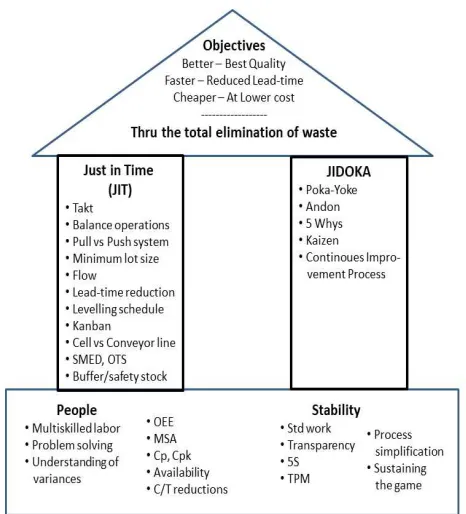
LM based on TPS, has improved production process efficiency, saving materials, reducing inventory and less usage of production and workers space. Simple LM, which is House of Lean (see Fig. 1), is supported by 2 fundamental aspects, i.e., just in time and “Jidoka” as LM application continuity strategy. The foundation of House of Lean is strict quality control equipped by trained and experience technician capable of maintaining the stability of production process. Objectives of House of Lean are better, faster and cheaper of the production system [11].
The main structure on LM implementation is eight waste elimination, which is over production, waiting time, transportation, excessive operation, off grade products, excess movement, and under-utilized employee capability. LM needs deep understanding and knowledge about Lean Technique such as Lean kaizen blitz, gemba, 5S method, 8 waste elimination, simple problem-solving 5-why, value stream mapping, pull system or kanban, single-minutes exchange of dies (SMED), visual board performance, six sigma and lean sigma [12], [13].
Location of the LM research of 8 (eight) wood processing factories which produce wooden doors and door components at Java. Respondents are business stakeholders consist of executive managers, owners, employees, labor association, customers, suppliers and Lean facilitator. In-depth interviews and FGD (focus group discussion) were conducted on knowledge acquisition from the LM experts and practitioners.
Fig. 1 House of Lean [11]
III.RESULT AND DISCUSSION
A. Situational Analysis
Direct observation and survey questionnaires feedback conclude that only 25% of companies can implement LM continuously, while around 75% of companies are failed. At the beginning of the process, LM was activated in high spirit because it performs real productivity increase within relativity short time. These results are not differenced with Kinsey’s study [12] who found that many industries have succeeded at the beginning of LM implementation at all production line through campaign and training of LM extensively, but only a few of them was able to maintain continuously. Success factor of LM implementation is presented in Fig. 2.
Survey results show that the main success factor of LM Implementation is (1) infrastructure support from the company, (2) incremental LM execution and (3) resource availability for LM program. Other important success factors are employees participation, Lean model selection based on readiness to be activated, righteous business culture and Lean training that regularly conducted also most important is top/middle management commitment.
However, 75% of companies, which formerly success-implementing LM, became, failed to continue practicing LM. The failure factors are presented in Fig. 3.
Major cause of failures is (1) poor strategy for internal communication, (2) misunderstanding of LM philosophy, and (3) unawareness of Lean Techniques suited to the company. Other factors are less participation of employee and little commitment of executive. Furthermore, failure factors also include resistance business culture, wrong perception about LM as an ad-hoc project and very few resources available to operate LM consistently.
Fig. 3 Scoring for failure factors for LM Implementing
B. Problem Identification.
First problem situation is gaps between market demand for qualified products, safety, reasonable price, products variety and excellent services, with manufactures capability to perform. Therefore, the company must have a keen intention to implement LM. Most of the surveyed companies (75%) still not yet able to meet customer requirements
because of its failure to implement LM hence downgrading their services.
Second problematic situations are a high expectation of company owners to become the first manufacturing industry through LM so that its profit and market share increased. However, failure to perform LM practices makes productivity, and business outputs could not achieve company target.
Both of problematic situation was identified in this study as causal of widening the information gaps and conflict of interest among customer, owners and factory managers in wood processing factory.
C. Rich Picture
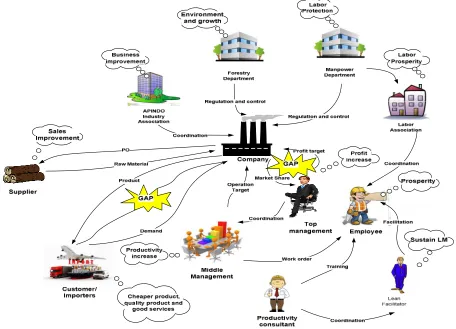
Rich picture (RP) was constructed to assist analytical works in understanding more depth on problem situational through sketch, lines, signs, and icons, so that much easier to gain a comprehensive view. In the RP process, firstly the study identify stakeholders need related to continuation of LM practical work (See Table 1) as required in System Analysis.
After doing need analysis of stakeholders, the RP was created with a holistic view of the LM implementation; and enriched by feedback from actual stakeholders (see Fig. 4)
TABLEI
NEED ANALYSIS OF STAKEHOLDER
No Stakeholders Need Statement
1 Top Managers and Owners Business continuity and higher profit
2 Middle Managers Improvement of productivity
3 Whole Company Become Excellence
Manufacturing
4 Employees Higher Prosperity
5 Customers Quality products, lower price, excellent services and speed delivery
6 Lean Facilitator Budget and facility for training, participation, and commitments
7 Supplies Raw materials demand
increased
8 Government Agencies Environment sustainability and creation
D. Root Definition
To construct Root Definition (RD), further exploration about RP was done through PQR rule, which is what activities must be done (P), how those can be executed (Q) and why such goals should be achieved (R).
According to PQR reasoning (what, how, why) which is related to the logical thinking process, this research set up two-root definition (RD) which are:
• The success of LM execution in wood processing factory (P) was achieved with the full support of top and middle management by providing sufficient infrastructure and preparing human resource capable to run LM progressively with selected proper lean technique. Moreover, employees’ participation has been encouraging with reward and recognition for good achievement, and give training as well as implant lean culture to all staff (Q). The LM must improve company productivity in order to survive within global competition (R).
• Continuity of LM activities at the company (P) was affected by the effectiveness of communication strategy, better selection of Lean Model and understanding philosophical and technique of LM as needed. Long-term LM implementation is directed
toward Lean culture involving safety, quality, and
kaizen (Q) in order to maintain trustworthiness and
consistent demand of customer (R).
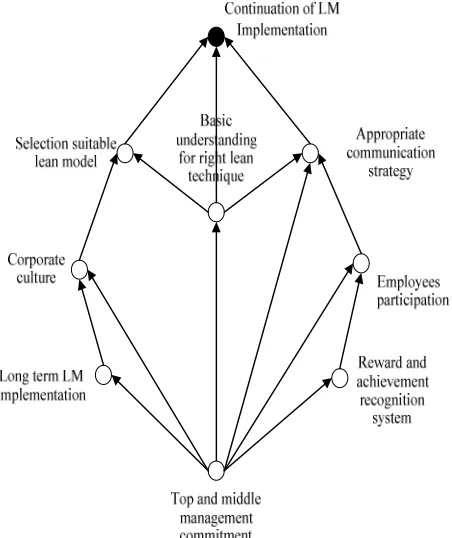
Referring to the RD statements, the research explored feedbacks from an in-depth interview given by practitioners of LM implementation. That knowledge acquisition then presented of Intermediate Objective Map (IOM) to back up the process of designing a conceptual model. The IOM for ensuring LM implementation will not fail in the long run (see Fig. 5), will be used as analytical thinking to construct PAM.
Fig. 5 IOM for continuation LM implementation
E. Conceptual Model: PAM
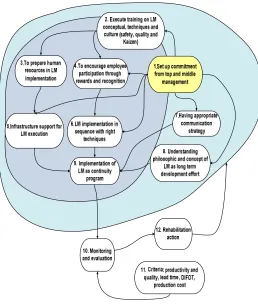
The final result of SSM procedure is PAM (Purposeful Activity Model) as a conceptual model (see Fig. 6), in which stated that from beginning activity must get the full commitment of top and middle management as key success factor of LM. Those commitments will induce training activities concerning concept, techniques and Lean culture (safety, quality, and kaizen) to make LM understandable. In parallel, the management should encourage staff participation by giving award and recognition to employee achievement and innovation.
Fig. 6 Conceptual model: PAM
To assure LM continuity, monitoring and evaluation should be carried out properly using critical criteria of improving productivity and quality, reducing production process Lead time, increasing Delivery Full On Time (DIFOT) while minimizing production cost. Whenever under target performance occurred, there should be rehabilitation action plan to ensure LM continuity.
According to field survey from 8 factories which has experienced in LM implementation, there are several organizational improvement actions are recommended, i.e.:
• Get full commitment from the top and middle management to implement LM continuously;
• Encourage employee participation thru
ο Application of reward and incentive system for workers in LM achievement;
ο Regular LM training for staff and supervisor;
ο Improvement of organization culture to increase LM participation;
ο Assign qualified lean facilitator.
• Selection of most suitable LM techniques to each factory business.
IV.CONCLUSIONS
Implementation of LM in Indonesia wood processing factory is still unsuccessful due to 75% failure rate to preserved LM continuation and only 25% can maintain LM implementation continuously.
This research has indicated success and failure factors in continues LM execution. Through SSM procedure and logical thinking process, the conceptual model of LM has been constructed within the PAM structure. The first phase of LM activities is setting up the firm commitment of top and middle manager to ensure sustainability of LM practices. Employee involvement can be improved by giving achievement recognition and innovation reward.
The communication strategy should be delivered effectively to all employees through the long-term multimedia instrument. Monitoring and evaluation must be carried out with definitive criteria to detect any wrongdoing. Under target, occurrences must be predicted in advance so reparation activities can be properly planned.
Referring to experience in PT CII [1], and comparing with other factories best practices, the LM model that most important to follow is Gemba, 5S technique as housekeeping, and Lean Kaizen 5555. Those lean tools are the foundation of lean culture and should be followed by Total Productive Maintenance (TPM) in order to execute LM continuously.
The improvement of PAM conceptual model can be realized in the next research by using System of System Methodology [14]. It is recommended to apply advanced techniques such as Strategic Assumption Surfacing and Testing or SAST and Analytical Hierarchy Process or AHP.
REFERENCES
[1] [ PTCII ] PT Corinthian Industries Indonesia. 2017. Handbook: Global Challenge and Lean Training. Bogor (ID)..
[2] (KPPN) Ministry of National Development and Planning, 2017. Indonesia and World Economic Development, 2nd Quarter. Jakarta.
[3] Adityawarman M. 2016. Minimum Wages Trending Topic 2017. Jakarta (ID): Apindo Training Centre.
[4] Ghazal M, Suchita J. 2015. Assessing the impact of recession on consumer’s behaviour: An empircal study in Dubai. Researchers
World Journal, 6(3):119-131.
[5] Liker J. 2004. The Toyota Way: 14 Management Principles from the World Greatest Manufacturer. McGraw-Hill Companies, Inc. [6] Lucey JJ. 2008. The State of Lean Manufacturing in the UK 2001 to
2006. Journal Management Service, 52.3 (Auntumn, 2008): 16-20, 22-25..
[7] Checkland P, Poulter J. 2009. Learning for Action: a Short Definitive Account of Soft System Methodology and its Use for Practitioners, Teachers, and Student. New York (US): John Wiley & Sons, Ltd. [8] Checkland PB, Scholes J. 2001. Soft Systems Methodology in Action,
in J. Rosenhead and J. Mingers (eds), Rational Analysis for a Problematic World Revisited. Chichester (GB): Wiley.
[9] Eriyatno, Larasati L. (2013) System science: improving the integration and coordination of management. Volume 2. Center of System. Jakarta (ID): Penerbit Guna Widya.
[10] Gaspersz V, Fontana A. 2011. Lean Six Sigma for Manufacturing and Service Industries. Bogor (ID): Vinchristo Publication.
[11] Wilson L. 2010. How to Implement Lean Manufacturing. (US): The McGraw-Hill Company Inc.
[12] Kinsey M. 2009. Kimberly Clark Indonesia Lean Handbook: Easy to Learn. Bekasi (ID): PT. Kimberly Clark Indonesia.
[13] Sheridan HH. 1997. Kaizen Blitz. Journal Industry Week 246.16, (September 1997); 18-27.