Published online September 20, 2014 (http://www.sciencepublishinggroup.com/j/ijla) doi: 10.11648/j.ijla.20140205.14
ISSN: 2331-0553 (Print); ISSN: 2331-057X (Online)
Witches before flying
Shokhan Rasool Ahmed
English Department, University of Sulaimani, Sulaimani/Kurdistan- Iraq
Email address:
To cite this article:
Shokhan Rasool Ahmed. Witches before Flying. International Journal of Literature and Arts. Vol. 2, No. 5, 2014, pp. 155-172. doi: 10.11648/j.ijla.20140205.14
Abstract:
This paper examines Shakespeare’s Macbeth (1606), and The Late Lancashire Witches (1634) by Thomas Heywood and Richard Brome, and considers in detail the witch scenes in both plays and their stage directions during their entrances and exits. The witches in the Jacobean Macbeth of the First Folio, do not explicitly fly in the stage directions. However, they do in the Restoration Macbeth, namely in Davenant’s second Quarto (1674). The question to be raised here is: what evidence is there in the pre-Restoration Macbeth that the witches flew? In order to explore this, we must consider what performance spaces were used for Macbeth in the Jacobean period. Shakespeare’s Macbeth, and Heywood and Brome’s The Late Lancashire Witches form an interesting comparison since they were both revised by other writers. The Late Lancashire Witches has not received as much scholarly attention as the other witch plays discussed here. Therefore, as a comparative study, this paper will also discuss the joint authorship of Heywood and Brome in The Late Lancashire Witches and the stage directions of the witch scenes. Although it seems that the witches did not fly in Heywood’s and Brome’s version, there is evidence that the stage directions called for flight in The Lancashire Witches (1681), Thomas Shadwell’s later version. A further illuminating comparison between these plays is that the creatures we are considering here are sinister figures in Macbeth but comic figures in The Lancashire Witches. The audience can see that the three Weird Sisters enter the stage and then vanish into the air, but do not see them fly.Keywords:
Stage Directions in the Jacobean Macbeth, Stage Directions in the Restoration Macbeth,Stage Directions in Thomas Shadwell’s The Lancashire Witches, Tegue O Divelly the Irish-Priest, andPepys’ Response to Macbeth The Late Lancashire Witches
1. Introduction
This paper examines Shakespeare’s Macbeth (1606), and
The Late Lancashire Witches (1634) by Thomas Heywood and Richard Brome, and considers in detail the witch scenes in both plays and their stage directions during their entrances and exits. The witches in the Jacobean Macbeth
of the First Folio, do not explicitly fly in the stage directions. However, they do in the Restoration Macbeth, namely in Davenant’s second Quarto (1674). The question to be raised here is: what evidence is there in the pre-Restoration Macbeth that the witches flew? In order to explore this, we must consider what performance spaces were used for Macbeth in the Jacobean period.
Shakespeare’s Macbeth, and Heywood and Brome’s The Late Lancashire Witches form an interesting comparison since they were both revised by other writers. The Late Lancashire Witches has not received as much scholarly attention as the other witch plays discussed here. Therefore,
as a comparative study, this paper will also discuss the joint authorship of Heywood and Brome in The Late Lancashire Witches and the stage directions of the witch scenes. Although it seems that the witches did not fly in Heywood’s and Brome’s version, there is evidence that the stage directions called for flight in The Lancashire Witches
(1681), Thomas Shadwell’s later version. A further illuminating comparison between these plays is that the creatures we are considering here are sinister figures in
Macbeth but comic figures in The Lancashire Witches. The audience can see that the three Weird Sisters enter the stage and then vanish into the air, but do not see them fly.
2. Shakespeare’s
Macbeth
was taken from a prompt-book,1 and it was not entered in the stationers’ books, nor printed, until 1623. 2 St Clair suggests that it was due to their representation of political usurpation that ‘Antony and Cleopatra, Julius Caesar and
Macbeth were among the Shakespearean plays that were not printed in Shakespeare’s life time’.3 Macbeth consists of five acts, and presents a similar dramatic progression to Shakespeare’s other tragedies. The tension rises in the first half of the play (Act 2), reaching a climax in Act 3 before falling in the second half with the hero’s declining power (Act 4), finally ending with the downfall of the hero in Macbeth’s death (Act 5).
The supernatural characters, which are discussed in this chapter, are the Three Sisters, Hecate and the other witches. The three Weird Sisters have a major role in the play, but not Hecate and her fellow witches. The focus here is on the witches’ activities and their influence upon the non-supernatural characters in the play. The chapter examines the way they enter and exit the stage both before and after the Hecate additions which were appended to Macbeth. Furthermore, it explores whether the Hecate scene was written by Shakespeare or whether it was interpolated into
Macbeth by someone other than Shakespeare on the occasion of a theatrical revival.
3. Early Performances of
Macbeth
We know that Macbeth was first performed between 1605 and 1606, two years after the accession of King James I, when there was a great demand for new entertainment involving witches among the theatregoers.4 The accession of King James made Shakespeare’s Macbeth ‘commercially viable and creatively attractive’, and because of the plague in 1606 (which had closed the theatres) and economic necessity, may have led the King’s Men to present Macbeth
at Court first.5 Macbeth was also performed at the Globe on the 20th of April, 1611; Dr Simon Forman recorded one spectacular effect that does not appear in the extant text (Act 1, scene 3):
In Mackbeth at the Glob, 16jo, the 20 of Aprell [Sat.] there was to be obserued, first, how Mackbeth and Bancko,
1 William Shakespeare, William Shakespeare: The Complete Works, ed. by Gary Taylor, and Stanley Wells, 2nd ed. (Oxford: Clarendon Press, 1986), p. xxxv.
2 William Shakespeare, The dramatic writings of Will. Shakspere, with the notes of all the various commentators; Eighteenth Century Collections Online, p. 379.
3 William St Clair, The Reading Nation in the Romantic Period (Cambridge: Cambridge University Press, 2004), p. 143.
4 William Shakespeare, William Shakespeare: Macbeth, ed. by Jonathan Bate and Eric Rasmussen (London: The Royal Shakespeare Company, 2009), p. 6. 5 William Shakespeare, The New Cambridge Shakespeare: Macbeth, ed. by A. R. Braunmuller (Cambridge: Cambridge University Press, 1997), pp. 8-9. The aerial gyrations of the witches in Jacobean drama were generally comic in effect and dramatists after the succession of James I tried to stage witchcraft practices in the theatres in order to satisfy their new audiences’ demand for ever more sophisticated visual spectacle.
2 noble men of Scotland, Ridinge thorowe a wod, the[r] stode before them 3 women feiries or Nimphes (...)6
‘Riding’ on horseback, as noted by Dessen and Thomson, ‘occurs in plays performed at the Globe, before Alarum for London and after The Late Lancashire Witches and the original performance of Macbeth’.7 Forman only recorded three witches, did not mention Hecate and gave no reference to flying. Forman calls them ‘feiries or Nimphes’, which is significantly different. It suggests that their costume was not necessarily hag-like, whatever Macbeth’s words suggest. The audience may have amused by the visual spectacle of the witches since they are not sinister figures, and their gender is recognizably female and had a feminine appearance. Nosworthy argues that the three Sisters turned into ‘“secret, black & midnight hags” with choppy fingers, skinny lips and beards’ in 1612 under the influence of the Court Masque.8 According to Nosworthy, there is not only a revision in the presentation of the three Sisters in 1612 but Shakespeare also added the figure of Hecate, (Act 1, scene 3, 43-7) as it was (Act 4, scene 1, 48-9) if that scene figured at all in the original.9 The Hecate scene and the two songs were probably inserted into the Folio text of Macbeth after the King’s Men performed The Witch at the Blackfriars and employed instrumentalists to provided musical intermissions before and during performances.10 That said, Shakespeare’s original trio of witches did not fly.11 Nosworthy also argues that there is a certain correspondence between Shakespeare’s and Middleton’s use of magical ingredients which belongs to Shakespeare’s revision of 1612 in which Shakespeare wanted to convert Macbeth into a tragedy of spectacle.12 Nosworthy does not account for Shakespeare having retired to Stratford-upon-Avon in 1611, some years before his death. His dramatic career was over, and his last play The Tempest was written in the same year. It is likely that Shakespeare himself did not have a hand in inserting the Hecate scenes into the Folio text of Macbeth.
Although Nosworthy’s opinion on Hecate’s interpolation in Macbeth is different from other contemporary scholars, he believes that Middleton had no hand in Macbeth and that Shakespeare is the sole author and reviser, the purpose of
6 Quoted in The Arden Shakespeare: Macbeth, ed. by Kenneth Muir (London: Methuen, 1951), p. xv.
7 Ibid., p. 388. Such a staging, riding on a horseback, was more likely performed in an outdoor playhouse. Although, a horse appears in Act 5, Scene 5 in the Cambridge Latin play Ricardus Tertius by Thomas Legge, which was performed in St. John’s college in 1580. In Macbeth, the title character and Banquo are riding through a wood when three women ‘feiries’ or ‘Nimphes’ appear.
8 J. M. Nosworthy, Shakespeare’s Occasional Plays: Their Origin and Transmission (London: Edward Arnold, 1965), p. 43.
9 Ibid., p. 43.
10 Glynne Wickham, ‘To Fly Or Not To Fly’, The Problem of Hecate in Shakespeare’s “Macbeth”’ in Essays on Drama and Theatre, ed. by Benjamin Hunningher (Amsterdam: Baarn, 1973), pp. 175-82 ( p. 179).
11Ibid., p. 175.
his revision, being ‘to make the play conformable to the newly prevalent taste for spectacle and melodrama, as sponsored by Beaumont and Fletcher’. 13 He thinks
Macbeth was a result of royal command and a hasty assignment. Fraser criticizes Nosworthy’s belief that Shakespeare wrote Macbeth hastily under the influence of royal command in 1606 while he was preoccupied with
Antony and Cleopatra. He revised Macbeth around 1612, and in this revision, the three nymphs or fairies reported by Simon Forman in 1611 turned to three hags, under the influence of Jonson's Masque of Queens and Middleton's
The Witch (which also supplied two songs, the flying machine, and the cauldron).14 Smidt agrees with previous scholars that, Shakespeare revised his occasional plays for use at the Globe, ‘cutting, augmenting, and altering as required in each case, and that he even originally wrote them with a thrifty view to a double use, private and public’.15 In contrast, Nosworthy as well as his reviewers, Fraser and Smidt, fail to mention that the Middleton material appeared after The Witch was staged around 1616 by which time Shakespeare had retired. At this point he was no longer active in his career to revise his productions. It seems more likely then, Macbeth was revised, for entertainment purposes, not by Shakespeare himself but by the King’s Men Company. As a result, the alterations made to the play, including the addition of the Hecate scenes and the new spectacle of flying witches reflect the cultural climate of a period in which belief in witchcraft was increasing.
There is another potential explanation for these conditions. Anne Lancashire argues that if the added witch songs and dancing come from Middleton’s The Witch, ‘might they not have been interpolated into Macbeth not only for their theatrical effectiveness but also for their political notoriety?’ 16 Lancashire thinks that because of
The Witch’s political connections, namely the 1615-16 Overbury murder trials and convictions, the play was suppressed and the King’s Men carried on, ‘keeping the witch scenes in the public eye through use of their songs and dancing in another King’s Men play not without its own political overtones’.17 However, this political reading
13 Russell Fraser, review of ‘Conceptions of Shakespeare’ ed. by Alfred Harbage; ‘Shakespeare’s Occasional Plays: Their Origin and Transmission’ ed. by. p. 59.
14 Russell Fraser, review of ‘Conceptions of Shakespeare’ ed. by Alfred Harbage; ‘Shakespeare’s Occasional Plays: Their Origin and Transmission’ ed. by J. M. Nosworthy. Renaissance Quarterly, 20 (1967), 57-61 (p. 59). See also Ernest Schanzer, review of ‘Shakespeare’s Occasional plays: Their Origin and Transmission’, ed. by J. M. Nosworthy. Review of English Literature, 18 (1967), 62-64 (p. 63).
15 Kristian Smidt, review of ‘Shakespeare’s Occasional plays: Their Origin and Transmission’, ed. by J. M. Nosworthy, Shakespeare Quarterly, 18 (1967), 190-191 (p. 190-191).
16
Ann Lancashire, ‘The Witch: Stage Flop or Political Mistake’ in
Accompaninge the Players: Essays Celebrating Thomas Middleton, 1580-1980, ed. by Kenneth Friedenreich (New York: AMS Press, 1983), pp. 161-181 (p. 174).
17 Ibid., p. 74.
ignores the fact that witches were in vogue in the 1610s. Thus, a more straightforward explanation is that the King’s Men wanted to enhance the role of the witches in Shakespeare’s play for entertainment purposes.
As Gary Taylor aptly puts it, the Hecate scenes ‘clearly require efficient and quiet flying machinery’ and ‘such machinery was clearly available at the Blackfriars’.18 The flight of the witches in the Hecate scenes may not have been staged at the Globe as it was not as well-equipped with flying machinery as Blackfriars. 19 In other words, pre-Blackfriars Macbeth did not have the Hecate scenes, but after the play was adapted, the Hecate scenes were added and then staged at the Blackfriars. After 1608, the plays were artfully contrived to suit the conditions of Blackfriars Theatre.
4. The Witch Scenes in
Macbeth
The Witches appear in Act 1, scenes 1 & 3, Act 3, scene 5, and Act 4, scene 1. The witches in Macbeth vanish and dispel once they make prophecies to Macbeth and finish casting spells on him (Act 1, scene 3). The question here is why Hecate has been inserted into Macbeth? A likely answer is that Hecate and her crew’s presence on stage offered a kind of magic show, and it may also reflect a taste of the elite Jacobean audience. Briggs points out that witchcraft, ‘is rather decorative than realistic’ in Shakespeare’s Macbeth, Jonson’s The Masque of Queens
and Middleton’s The Witch.20 This may be correct for The Masque of Queens and Macbeth, although not for The Witch, which had political and social ramifications to its witchcraft scenes (as we shall later see). Jonson’s hags are presented with spectacular costumes and effects, and he concentrates more on witches’ festivities. However, Jonson and Shakespeare are somewhat similar in the way they represent their hags ‘primarily through words’ rather than machines or technological effects. Shakespeare uses language to convey their diabolic nature to a greater extent than either Middleton or Jonson do, conjuring up their physical movements through description. When Macbeth
18 Thomas Middleton, Thomas Middleton and Early Modern Textual Culture: A Companion to the Collected Works, ed. by Gary Taylor and John Lavagnino (Oxford: Clarendon Press, 2007), p.384.
19 See example, William Shakespeare, The New Cambridge Shakespeare: Macbeth, ed. by A. R. Braunmuller (Cambridge: Cambridge University Press, 1997), p.256. T. J. King argues that such machinery might not have been required in a variety of plays and might not been available in the majority of playhouses. T. J. King, ‘Shakespearean Staging, 1599-1642’, in The Elizabethan Theatre, ed. by David Galloway, 3 vols (Don Mills: The Macmillan Company of Canada Limited, 1973), pp. 1-13 (p. 11); Irwin Smith believes that Blackfriars had a kind of effective apparatus for descending and ascending actors and equipment; Irwin Smith, Shakespeare’s Blackfriars Playhouse: Its History and Its Design (London: Peter Owen, 1964),pp. 414-418. See also Wickham, ‘To Fly Not To Fly?’, p. 175. And, Bernard Beckerman,
Shakespeare at the G Beckerman lobe, 1599-1609 (New York: Macmillan, 1962), p. 94.
and Banquo speak of them, he uses visual ‘verbs’ to describe the departure of the witches who ‘hover through the fog and filthy air’ (I.i.10), ‘vanish into the filthy air’ and have ‘melted as a breath into the wind’ (I.iii. 78-80).
The sudden disappearance of the witches is suggested even as the method of their departure is indicated. Their abrupt vanishing or melting is achieved through one of the doors into the tiring-house rather than through flying machinery, i.e. free flight. Macbeth comments on the sudden departure of the witches to the air when he converses with Lenox:
LENOX. What’s your Grace’s will? MACBETH. Saw you the Weyard Sisters? LENOX. No my Lord
MACBETH. Come they not by you? LENOX. No indeed my Lord.
MACBETH. Infected be the Ayre whereon they ride (IV.i.149-157)
This line, ‘Come they not by you?’, indicates that the Weird Sisters depart, not through a trapdoor, but through one of the doors into the tiring-house, the same door through which Lenox then enters. This makes sense of why Macbeth might expect Lenox to see them coming ‘by’ him.
Shakespeare makes use of the theatrical resources at his disposal. Elsewhere, to dramatize the visual spectacle of the witches and Hecate, Shakespeare makes use of the heavens. It seems that the witches in Macbeth are also located in the heavens since Hecate ‘sits in a foggy cloud’ (III.v.37). ‘A foggy cloud’ here might possibly mean ‘a theatrical “machine” that lifted the actor from the stage’.21 However, this song belongs to the pre-Folio Macbeth before it was revised. There is no evidence of any kind of smoke machine in existence before Macbeth was written (1606). Harris argues that when the spirit summons Hecate in
Macbeth, ‘the flying machinery was concealed in folds of light drapery, a device that was used extensively in the masques to achieve such effect’.22 As in traditional Greek drama, ‘Hecate is taken up in the cloud, i.e. a stage car, drawn up on pulleys, and concealed by billowing draperies’, 23 in order to intervene in the natural order. Another suggestion of Harris regarding how Macbeth’s witches flew is that, ‘the Sisters climbed up stepladders leading from the yard into which the stage projected’.24 Before the Kings’ Men leased the Blackfriars, the Weird Sisters probably made their entrances and exits through the mechanized trapdoor. The mechanical trapdoor is a more plausible method for the Sisters to ascend and descend the stage in case no flying devices were available. All the departures of the witches are accompanied by thunder and
21 Shakespeare, Macbeth by Braumuller, p. 186.
22 Anthony Harris, Night’s Black Agents: Witchcraft and Magic in Seventeenth-century English Drama (Manchester: Manchester University Press, 1980), p. 170.
23 Macbeth, ed. by Kenneth Muir, p. 101. 24 Harris, Night’s Black Agents, p. 162.
lightning effects, which are used to drown the creaking sound of the trapdoor as well as masking their descent.
It seems that in the cauldron scene the main trap was used to raise the three Weird Sisters to gather around the cauldron. Once the cauldron was removed in the stage, music was provided in order to disguise the noise of the mechanized trap:
Why sinks that cauldron, and what noise is this? (IV.i.106)
The Weird Sisters create the Apparitions (demonic spirits) and summon them. The entrance and departure of the three apparitions may be through the mechanized trap as well as the show of the eight kings. However, if Macbeth was performed at Greenwich or Hampton Court, the Sisters’ entrance may have been made through a curtain similar to that probably used in the Masque as traps would not have been available in these performance spaces.25 There was at least one trap door situated in the main stage in most of Elizabethan theatres, through which, as Harris notes, actors and properties could rise and descend by means of a mechanised structure operated by ropes attached to windlass. Some of these traps were capable of carrying two or more actors simultaneously and ascents and descents could be achieved with considerable rapidity.26
In the Cauldron scene, three apparitions also descend from the heavens to tell Macbeth about his future. Then Hecate calls the witches all to dance with music and then vanish to the air. The ghost also descends after the alteration is made (see stage directions in the Restoration
Macbeth, p. 64), but in the folio text of Macbeth simply ‘enters’: enter the Ghost of Banquo, and sits in Macbeth’s place (III. iv)27
The Ghost of Banquo rises at his feet and it seems that Banquo’s ghost rises on a trap. The three apparitions possibly also rise up through a stepladder, or trap. The three weird Sisters and Hecate appear and hover over Macbeth. These ascents and descents were made through traps in early performances but they might have been done through flying on wires at the Blackfriars by the King’s Men with the help of musical instruments.
The Witches of Macbeth
25 Ibid., p. 168. 26 Ibid., p. 152.
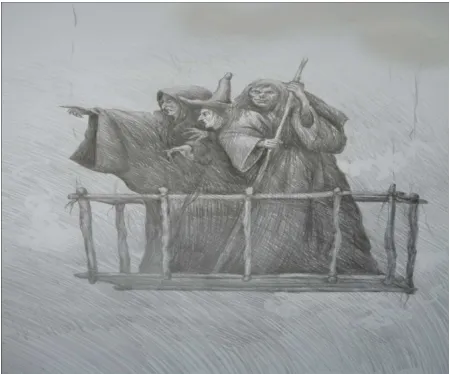
Fig. 1. Image of the three Sisters if they flew into the stage by a chariot. Scholes’s view of the Hecate scene highlights the association between Shakespeare’s use of music and the supernatural. His supernatural entities such as fairies, witches and sometimes ghosts, were especially associated with music.28 For instance, there is a hidden music when Hecate is summoned in the song ‘Come away’ and the audience does not know where this mysterious music comes from. In the other scene when Hecate orders the witches to sing ‘Black Spirits’, Macbeth appears. In short, through this device of hidden music, Shakespeare produces a sense of the weird and uncanny in the mind of the audience. As Scholes writes, ‘it is music that prepares the mind of the audience for ghostly happenings’, 29 as for example in Julius Caesar. Not only music but also thunder and lightning, Harris states, ‘almost invariably marked the appearances on stage of supernatural phenomena’.30 Harris is sceptical on the question of whether Macbeth’s witches flew, and argues that ‘although free-flying devices were available in the Banqueting House and other settings for the masques and entertainments, these were almost certainly not installed in any of the public playhouses until after the first performance of Macbeth’.31 In the first performance of Macbeth at Court and/ or the Globe, the witches did not fly, and no Hecate scenes existed in the text. Therefore, no stage directions called for flight of the witches. However, these Hecate materials do appear in the Jacobean Macbeth.
5.
Macbeth
in the First Folio: Stage
Directions in the Jacobean
Macbeth
Using few stage directions, Shakespeare gave actors the opportunity to add a personal touch to the play rather than
28 Percy A. Scholes, ‘The Purpose behind Shakespeare’s Use of Music’,
Proceedings of the Musical Association, 43rd Sess. (1916-1917), 1-15 (p. 2). 29 Ibid., pp. 4-5.
30 Harris, Night’s Black Agents, p. 151. 31 Ibid., p. 160.
being restrained by authorial directions. According to one recent study of stage directions, Vickers and Dahl argue that ‘dramatists wrote “literary” directions, reflecting the story line, which the company scribe converted into “theatrical” ones’.32 Dramatists may have sent their plays with their lack of stage directions to the company scribe, but these ‘literary’ directions were altered and transcribed according to the physical characteristics of the playhouse where the performance was to take place. The actors ‘parts’ were already supplied with theatrical stage directions.
I have already discussed how the Hecate materials were added by the King’s Men Company into Macbeth, however what I will investigate here are the stage directions of Hecate and her crew in the Jacobean Macbeth. Albright, noting that Hecate, a new witch, or witch-master, (Act 3, scene 5, and Act 4, scene 1) was spliced into Shakespeare’s
Macbeth by someone other than the playwright, points out that in both scenes ‘Hecate is associated with music: the stage directions instruct the witches to perform songs, ‘Come away’ at the end of Act 3, scene 5, and ‘Black Spirits’ at Act 4, scene 1’.33 However, it is obvious that, as Albright says, these songs can be found in Middleton’s The Witch and in the Davenant version of Macbeth (1663-4, published 1674). 34 Davenant rewrote Macbeth for the Restoration stage, adding new stage directions to the text. Fiske shows the places in the play where Davenant added scenes or made textual alterations to Macbeth. He states that, ‘in a shortened version of Hecate’s speech, several witches descend in a machine and sing “Come away”, after which Hecate gets into the machine and is carried up into the sky’ (Act 3, scene 5).35 The stage direction, in the First Folio is: ‘Enter Hecate and the other three Witches’ (Act 4, scene 1).
Similarly, in the First Folio, the stage direction of the witches when they meet Hecate is: ‘Thunder. Enter three Witches, meeting Hecate’ (III.v).36 In another scene the witches again enter (IV.i.):
(First Folio, 142)37
32 Brian Vickers and Marcus Dahl, ‘All’s Well that Ends Well: an attribution refuted’, London University: School of Advanced Study, <http://www.ies.sas.ac.uk/about-us/news/all%E2%80%99s-well-ends-well-attribution-refuted> [accessed 10 July 2012], p. 3.
33 Daniel Albright, ‘The Witches and The Witch: Verdi’s Macbeth’, Cambridge Opera Journal, 17 (2005), 225-252 (p. 228).
34 Ibid., p. 228.
35 Roger Fiske, ‘The “Macbeth” Music’, Music & Letters, 45 (1964), 114-125 (p. 114).
36 Shakespeare, Comedies, Histories and Tragedies (1623), p. 142; William Shakespeare, The Norton Facsimile: The First Folio of Shakespeare, ed. by Charlton Hinman (London, New York, Sydney and Toronto: Paul Hamlyn, 1968),p.750.
37 Shakespeare, William Shakespeare: Comedies, Histories and Tragedies
Shortly afterwards, the stage direction about forty lines further on (IV.i.) is:
(First Folio, 144)38
The first song of ‘Come away’ in the First Folio is added as (III.v):
(First Folio, 143)39
However, the whole song of ‘Come away’ is given in both the Quarto of 1673 and 1674.40 The second song is ‘Black Spirits’ (IV.i)
(First Folio, 144) 41
In short, the name of the song is only given in both the First Folio and the Quarto of 1673. However, in the 1674 Quarto, the whole song is given. After the three Apparitions and the show of eight kings, the witches disappear with music (IV.i):
(First Folio, 144) 42
The same song of the ‘Black Spirits and White’ can be found in both Davenant’s Macbeth of the 1673 version and the First Folio of Shakespeare’s Macbeth. In both texts, only the first two words of the song are given.43 However,
38 Ibid., p. 144.
39Shakespeare: Comedies, Histories and Tragedies (1623), p. 143.
40 William Shakespeare, Macbeth: A Tragedy, ed. by William Davenant (London, 1673), 1-67 (pp. 38-39); William Shakespeare, Macbeth, A Tragedy: with all Alterations, Amendments, Additions, and New Song, ed. by William Davenant(1674), 1-60 (pp. 39-40).
41 William Shakespeare: Comedies, Histories and Tragedies (1623),p. 144. In the Quarto of 1673, the name of the song is only given; William Shakespeare,
Macbeth: A Tragedy, ed. by William Davenant (London: 1673), pp. 41-42. However, in the 1674 Quarto, the whole song is given; William Shakespeare,
Macbeth, A Tragedy: with all Alterations, Amendments, Additions, and New Song, p. 42.
42 William Shakespeare: Comedies, Histories and Tragedies (1623), p. 144; the Norton Facsimile, p. 752.
43 See ‘The Tragedy of Macbeth’ in William Shakespeare, William Shakespeare: Comedies, Histories and Tragedies (London, 1623), 131-151
the whole first and second songs are given in Davenant’s 1674 version, (Act 4, scene 1).44 St. Clair has argued that the first Shakespeare texts may have been affected by the intellectual property rights which applied to printed texts until the mid nineteenth century. However, as St. Clair continues, there is no intellectual property right either in manuscript or in performance, such as the singing of a song, the oral delivery of a sermon or lecture, or the performance of a play, even although such performances might have been transmediated from a printed text or from a manuscript.45
Because of the two witch songs in Macbeth and The Witch, it has been assumed either that Macbeth was written by Shakespeare in collaboration with Middleton, or that
Macbeth was adapted by Middleton or the King’s Men Company. According to St Clair, the fact that only the first line or two of the song was printed in Macbeth was due to intellectual property issues; if the whole song was not printed, then it did not infringe upon another person's intellectual property (copyright law did not exist in the period, but one could still be punished for pirating other people's published writing). That said, The Witch’s songs may have pre-existed both plays. I do not find St. Clair’s argument plausible because the matter here is not about copyright law or breaching another person’s intellectual property, but it is about the physical abilities of the playhouses where both Macbeth and The Witch were performed. The songs could be only performed successfully at the Blackfriars since it was not only about singing and dancing, but it was about visual spectacle as well, such as flying Hecate with the Spirit and the other witches.
Through the cross-references to both Middletonian songs, Stern argues that Macbeth is shorter than any other Shakespearean tragedy which ‘seems to be a cut-down version of a lost, longer text; its reviser may well be Middleton, who was himself a playwright for the King’s Men’.46 It seems that songs were not written directly into the play text during Shakespeare’s time. Stern argues that ‘the pieces of paper on which songs were written were commonly kept outside plays as well as (and sometimes instead of) in them’.47 This means that the written song can be easily lost while the play text survives. However, I do not agree with Stern’s argument since no evidence available in any pre-Jacobean witch plays included these songs. Therefore, Middleton was the pioneer to use these Hecatean songs. Wickham aptly argues that after the successful staging of Middleton’s Hecate scene and the
(p.144). And Davenant’s Macbeth: A Tragedy (London, 1673), 1-67 (p. 41). Hazelton Spencer, ‘D’Avenant’s Macbeth and Shakespeare’s’. PMLA, 40 (1925), 619-644 (p. 624).
44 Shakespeare, Macbeth, ed. by Davenant(1674), p.42.
45 William ST Clair, The Reading Nation in the Romantic Period, p. 150. 46 Tiffany Stern, Making Shakespeare: From Stage to Page (London and New York: Routledge, 2004), pp. 60-61. See also Macbeth, ed. by Kenneth Muir, p. xxxii.
songs, this experiment became the standard prompt-copy for all subsequent revivals of the play. Therefore, its spectacular elements such as the songs, the flying machines and the dance were added to fit Macbeth. Moreover, these spectacles were added to the Folio Macbeth by the time when Hemmings and Condell came to publish the First Folio in 1623. This thesis is in agreement with Wickham’s idea that the songs and all the Hecate material were definitely not added by Shakespeare himself as he had already retired by the time Macbeth was revised, but are taken from Middleton’s The Witch and appended to the Folio text of Macbeth by the King’s Men. These witch scenes in Middleton’s The Witch were specially written as a response to the recent scandal of the Somerset family in 1616, making it likely that these songs did not pre-exist in either play, and secondly, that these songs needed a technologically-advanced playhouse in order to stage the flight of Hecate and Malkin during their singing. In short, the stage directions call for a flight in the two songs. Therefore, the pre-Jacobean playhouses were not able to stage these kinds of spectacular elements at that time until the King’s Men possessed the Blackfriars in 1609.
6. Stage Directions in the Restoration
Macbeth
The Restoration Macbeth, an adaptation of the play produced by William Davenant probably in 1663-4, revised the Folio text into a tragedy of spectacle. The Restoration
Macbeth offers the modern reader an understanding of the age in which it was produced, and about how theatres were used by adapters and company players: how they could increase the number of new patrons and popularity for theatre and the revised plays. After the long-enforced closure during the Civil War, the theatres in London reopened in 1660. Most of Shakespeare’s plays were drastically revised and made to fit the new theatrical conditions of this period. However, while the classical taste always demanded purity of dramatic type, the popular demand was for spectacle. Therefore, opera, which was completely new to England, and masque were the outcome of progressing spectacle in the playhouses in the second half of the seventeenth century. As a result, one can see that both histories of stage spectacle and of theatrical architecture are interlinked.
The revived version of Shakespeare by Davenant was popular at that time due to his addition of music and spectacle in the witches’ scenes. Schafer points out that ‘Davenant worked for the King’s Men in 1630s, and it is thought that he used a playhouse copy of Macbeth as the basis for his adaptation’.48 Davenant died in 1668, and his first Quarto was published in 1673, with the second one following in 1674. Davenant’s Macbeth can be considered
48 Elizabeth Schafer, The Witch: Thomas Middleton (London and New York: A and C Black, 1994), p. xv.
as the most well-known of the adaptations as he tried to show the new court and audience of Blackfriars theatre a more up-to-date version of Shakespeare’s plays which met the demand for spectacle.
Wickham argues that ‘Hecate continued to fly, sing and dance throughout the reign of Charles I, for it was upon this nucleus that Sir William D’Avenant [sic], assisted by Henry Purcell, embroidered the next major variation on the original theme’.49 Regarding the two songs, Evans argues that it seems highly probable that Davenant derived them from some earlier prompt-copy of Shakespeare’s
Macbeth. 50 However, Evans ignores the fact that these songs needed flying machines and a sophisticated playhouse in order to be staged since Hecate and the Cat fly while they are singing. If the full words of the two songs were in any earlier prompt-copy of Shakespeare’s Macbeth, they would have been in the Folio Macbeth as well.
Shakespeare’s Macbeth was acted in a semi-operatic version in 1663, whose ‘flying’ witches proved extremely popular with audiences of that time and afterwards, however this version was not printed until ten years later.51 This version featured goddesses, spirits and witches who intervene in human destiny which were used to rouse pity and terror in the audience. These scenes were conducted with the aid of machines, presenting spectacles when strange wonders were performed, as for instance, when a group of witches were made to fly over the stage under roaring thunder and lightning, and Hecate’s descent in a chariot. Clark argues that, ‘Davenant was obliged by law to revise Shakespeare’s original, whether he wanted or not. But in any case after 1660 Shakespeare’s plays were preferred in adapted versions’.52 Clark also argues that the theatre in 1660 was very different from that of 1642, and that ‘it was not only words and phrases that needed changing for Shakespeare’s texts to satisfy the cultural needs of a new age’.53 This is because in the 1660s and afterwards, witchcraft was used for entertainment purposes and as a subject of pantomime and fantasy, and alterations were made in order to meet with the tastes of the new theatre-goers. Davenant can be considered as a pioneer who initiated the popular lust for spectacle. The change was not only in revision of plays, but the performance space also changed, with performances mostly taking place in the private, indoor, playhouses which were intimate venues with artificial lighting and a proscenium-arch stage.
Different stage directions were written for the entrances
49Wickham, ‘To Fly Or Not To Fly?’, p. 180.
50 William Shakespeare, The Riverside Shakespeare, ed. by G. Blakemore Evans (Boston: Houghton Mifflin Company, 1974), pp. 1306-1342 (p. 1341). See also Tiffany Stern, Documents of Performance in Early Modern England
(Cambridge: Cambridge University Press, 2009), p. 139.
51 Marion Harry Spielmann, Studies in the First Folio: Written for the Shakespearean Association, in Celebration of the First Folio Tercentenary
(Oxford: Oxford University Press, 1923), pp. 166-167.
52 Sandra Clark, Shakespeare Made Fit: Restoration Adaptations of Shakespeare (London: Everyman, 1997), p. xIii.
and exits of the witches in the two quartos. Here, I consider the stage directions in Act 1, scene 1, Act 1, scene 3, Act 3, scene 4 and Act 3, scene 5. In the second Quarto of 1674 the stage direction (Act 1, scene 1) is:
(1674 Quarto, 1) 54
However, the stage direction in the 1673 Quarto and the First Folio is:
(1673 Quarto, 1) 55
In the second quarto the three witches also enter the stage flying (I.iii):
(1674 Quarto, 3)56
However, the stage direction in the 1673 quarto and the First Folio states that the witches simply ‘enter’, not ‘flying’:57
In the stage direction in the second quarto the Ghost descends, not simply enters (III.iv)
(1674 Quarto, 3) 58
However, the Ghost does not descend either in the quarto of 1673 or the First Folio:
(First Folio and 1673 Quarto) 59
Even more interestingly, the second quarto specifies the following for the flight of the witches in the song of ‘Come
54 Macbeth, ed. by Davenant (1674) p. 1; Christopher Spencer, Five Restoration Adaptations of Shakespeare (Urbana: University of Illinois Press, 1965), p. 38.
55 Macbeth: A Tragedy, ed. by Davenant (1673), p. 1. First Folio, p.131. 56 Macbeth, ed. by Davenant (1674), p. 3. See also Spencer, Five Restoration Adaptations of Shakespeare, p.4.
57 Shakespeare, Macbeth: A Tragedy, ed. by Davenant (1673), p. 3; First Folio, p. 132.
58 Shakespeare, Macbeth, A Tragedy, ed. byDavenant (1674), p. 35. 59 Shakespeare, Macbeth: A Tragedy, ed. by Davenant (1673), p. 35; First Folio, p. 142.
away’ (III.v):
(1674 Quarto, 40) 60
Unlike all the previous stage directions I have discussed, this one explicitly names a ‘machine’. This provides internal proof of the advance of technological abilities in the playhouse in which this play was performed. It is likely that a chariot has been used for their descent. It is clear that Davenant revised Macbeth in the 1674 Quarto and added flying in order to meet with the taste of Restoration theatre-goers, which is almost certainly an interpolation derived from The Witch.61
Albright argues that Macbeth was beginning to move towards opera as ‘the witches not only want to fly, but also want to sing; they need to push the play into the dimension of music theatre, just as they sail through the unroofed theatre building to the height of the moon.’ 62 He also points out that it is ‘the witches who motivate the opera lurking near the surface of the drama’.63 Popular demand for a variety of stage spectacle became possible through developing the spaces of theatres as well as adapting new machines and equipment. John Downes, prompter at the Dorset Gardens Theatre, recalls a late-seventeenth century performance of Macbeth (although he does not give the date of this performance):
The Tragedy of Macbeth, alter'd by Sir William Davenant; being drest in all it's finery, as new Cloath's, new Scenes, Machines, as flyings for the Witches; with all the Singing and Dancing in it; the first Compos'd by Mr. Lock, the other by Mr. Channell and Mr. Joseph Priest; it being all Excellently perform'd, being in the nature of an Opera, it Recompenc'd double the Expense; it proves still a lasting Play.64
This important evidence suggests that ‘flyings for the Witches’, like the ‘Clothes’ and ‘Scenes’, are new. It is likely that they flew on a chariot (see fig. 4) rather than by a free-flying wire (see fig. 5). Downes also writes in his description of the production of Shakespeare’s Macbeth
that five new plays were acted there before Macbeth’s adaptation by the Duke’s company at the Dorset Gardens.65 This ‘new and sumptuous house was opened on November 9, 1671’.66 Dorset Gardens was used for operas
60 Shakespeare, Macbeth, A Tragedy, ed. by Davenant (1674), p. 40. 61Harris, Night’s Black Agents, p.160.
62 Albright, ‘The Witches and The Witch: Verdi’s Macbeth’, p. 229. See also
Macbeth, ed. by Braunmuller, pp. 268-274. 63 Ibid., p. 229.
64 John Downes, Roscius Anglicanus, ed. by Judith Milhous and Robert D. Hume (London: The Society for Theatre Research, 1987), p. 71.
65 Ibid., p. 33.
and plays demanding sophisticated staging. 67 In other words, one can say that Dorset Gardens was used as a theatre for popular entertainment; one also notes in this respect Downes’s final point that the play was financially successful.
7. Pepys’ Response to
Macbeth
Pepys’s assessment, as a witness in the audience, of Davenant’s version of the play at the Dorset Gardens, provides further important evidence about how audiences responded to the Restoration Macbeth:
[November 5, 1664]: with my wife to the Duke's house to a play, Macbeth, a pretty good play, but admirably acted.
[7 December 28, 1666]: to the Duke's house, and there saw Macbeth most excellently acted, and a most excellent play for variety.
[January 7, 1667]: to the Duke's house, and saw Macbeth, which, though I saw it lately, yet appears a most excellent play in all respects, but especially in divertisement68, though it be a deep tragedy; which is a strange perfection in a tragedy, it being most proper here, and suitable.
[April 19, 1667]: Here we saw Macbeth, which, though I have seen it often, yet it is one of the best plays for a stage, and variety of dancing and musique that ever I saw.69
Pepys praises the play for its being excellent in all respects and for variety, especially in ‘divertisement’. Although Macbeth was a ‘deep tragedy’, clearly it perfectly met the tastes of the Restoration theatre-goers after being adapted in a spectacular fashion. The Hecate additions were in this way a strange presence in a play which was after all a tragedy, but it satisfied the new tastes of the spectators. Davenant presented a pantomime show of Hecate and Malkin to the Restoration audience, and also ‘improved’ Shakespeare’s language through modernization.70 By the time that Davenant’s Macbeth was performed, belief in witchcraft was not very strong compared to the period when the Jacobean version of the play was staged.
It is obvious that the use of stage entrances and exits of the supernatural characters, of thunder (sometimes with lightning) and music as an accessory of divinity, of the change of scenes, and using ‘machines’, were all characteristics of the Renaissance stage. In general, the techniques of stage scenery and theatrical architecture in England and on the Continent developed from the first half of the seventeenth century onwards. Moreover, the number of theatres also increased in the same period. However, I
67 Downes, Roscius Anglicanus, p.42.
68 ‘Amusement’, Oxford English Dictionary. <http://www.oed.com.ezproxy3.lib.le.ac.uk/noresults?browseType=sortAlpha& noresults=true&page=1&pageSize=20&q=divertisment&scope=ENTRY&sort= entry&type=dictionarysearch> [Accessed May 2014]
69 Quoted in Spencer, ‘D’avenant’s Macbeth and Shakespeare’s, p. 621. 70 Spencer, Five Restoration Adaptations of Shakespeare, p.1.
would argue that a taste for theatrical spectacle developed in the second half of the seventeenth century. One can observe how the stage directions in witchcraft plays tell a narrative of the changing dramatic styles of the seventeenth century. The stage directions in some plays were changed as the technical abilities of the theatres developed and new machines became available, including flying machinery, mechanical trap doors and lighting techniques. More advanced backstage machinery facilitated the movements of the supernatural characters on stage. Stage directions which began as simply ‘enter’ were changed into ‘descend’ in performance because of major changes in the technological progression of the theatre. Theatrical practice informed playbook writing, as scriveners, member of theatre companies and then later modern editors altered stage directions for the supernatural characters to make their exits and entrances.
8.
Macbeth
: Stage Directions in Modern
Editions
The stage directions of the Three Sisters and Hecate in modern editions are to some extent different from the early ones. In the Arden Shakespeare edition, the stage directions of the witches are similar to that of the First Folio, as are the songs. Muir does not change any stage directions and keeps ‘enter’ and ‘Exeunt’ in the entrances and exits of the witches. However, he uses square brackets in signalling the stage directions.71 Sisson admits that Act 3, scene 5 and Act 4, scene 1 are both interpolations in Macbeth. Hecate descends to and ascends from the stage. The stage directions inserted by Sisson in the first song read:
Thunder, Enter Three Witches. Hecate descends [Music and a song within, Come away,
Come away, &c. Hecate ascends.72 Enter Hecate, with Three Other Witches. [Music. The Three Other Witches sing, Black Spirits, &c. Exit Hecate.73
In contrast, only the first line of this song is given in the First Folio. The editions of Rowse, Kittredge and Tyrone Guthrie’s follow that of the First Folio; only the first line of the songs are given and the witches simply ‘enter’. 74
71 The Arden Edition of the Works of William Shakespeare: Macbeth, ed. by Muir, pp. 2-163.
72 William Shakespeare, The Complete Works of Shakespeare: including a bibliography and general Introduction, Glossary and Index of Characters, ed. by Charles Jasper Sisson (London: Odhams, 1953), p.985.
73 Ibid., p. 986.
However, the whole songs are given in Wells and Taylor’s edition. The stage direction in the first song is exactly as in
The Witch. Wells and Taylor put in the same stage direction here because they believe that these songs belong to Middleton and they consider him as the co-author of the Folio Macbeth:
[Spirits appear above.] A spirit like a Cat descends
After Hecate anoints the Cat, ‘she ascends with the Spirit and sings’. By the end of the song, the stage direction reads ‘Exeunt into the heavens the Spirit like a Cat and Hecate’.75 In Bell’s edition, only the whole first song is given but not the second one. The stage direction before Hecate ascends to the heavens reads:
[symphony, whilst Hecate places herself in the machine.76
However, some editions print the whole songs as in the second quarto of Davenant. For instance, in Charles Kean’s and Wells’s and Taylor’s editions, the stage directions are similar to that of The Witch when the Spirit like a cat descends and then ascends back to the heavens with Hecate.77 This shows how modern editors have adapted the Folio text, and the effects of their decision in expanding the text are to show more of the visual spectacle of the witches on stage. The witch scenes, after being adapted, operate more for comic or satirical purposes and were designed to satisfy the tastes of the audience. Each one of The Witch,
The Masque of Queens and the Restoration Macbeth were performed more often during the Royal occasions.
There are several plays thought to have been adapted by Thomas Middleton in the Folio, including Macbeth and
Measure for Measure.78 Timon of Athens is also considered
The Works of Shakespeare, ed. by Howard Staunton (London: Routledge, Warne & Routledge, 1869), iii, 466-525 (pp. 498-501). The Works of William Shakespeare: gathered into one volume (Oxford: Shakespeare Head Press, 1934), 858-884 (pp. 873-874). Arthur Symons, ‘Macbeth’, in The Works of William Shakespeare, eds. Henry Irving and Frank A. Marshall (London: Blackie & Son, 1889), v, 333-430 (pp. 384-385). A New Variorum edition of Shakespeare: Macbeth, ed. by Horace Howard Furness (Philadelphia: J. B. Lippincott, 1873), ii, pp. 190- 204. Complete Works of William Shakespeare, ed. by Dorothy McMillan (Glasgow: HarperCollins Publishers, 1994), 1049-1078 (pp. 1067-1068). The Complete Works of Shakespeare (London: Strand, 1864), 674-692 (pp. 685-686). William Shakespeare: Macbeth, ed. by M. R. Ridley (London: J. M. Dent & Sons Ltd., 1935), pp. 63-68. William Shakespeare: Macbeth, ed. by G. K. Hunter (Harmondsworth: Penguin, 1967), pp. 102-106.
The Tragedy of Macbeth, ed. G. B. Harrison (Harmondsworth: Penguin, 1937), pp. 72-76. The BBC TV Shakespeare: Macbeth, ed. by Peter Alexander (London: British Broadcasting Corporation, 1983), pp. 66-68. The Riverside Shakespeare, ed. by G. B. Blakemore Evan, pp. 1328-1329.
75 The Complete Oxford Shakespeare: Tragedies, ed. by Wells and Taylor (London: Guild Publishing, 1987), iii, 1307-1334 (pp. 1323-1325)
76 William Shakespeare: Bells’ Edition of Shakespeare’s Plays, ed. by John Bell, 8 vols (London: Corn market Press, 1969), i, 1-71 (pp. 45-47).
77 William Shakespeare: The Complete Works: Original-Spelling Edition, ed. by Stanley Wells and Gary Taylor (Oxford: Clarendon Press, 1986), 1101-1128 (pp. 1117-1119). Macbeth, ed. by Charles Kean (London: Corn Market Press, 1970), pp. 60-65.
78John Jowett, Shakespeare and Text (Oxford: Oxford University Press, 2007),
to be a collaboration between Middleton and Shakespeare. It has also been argued recently that Middleton either adapted or had a hand in Shakespeare’s All’s Well That Ends Well. Laurie Maguire and Emma Smith claim that Middleton was co-author of All’s Well especially in terms of ‘orthographical preferences’.79 However, Vickers and Dahl do not support Middleton’s claims to co-authorship in All’s Well. Dahl further argues that ‘there appears to be substantial other evidence to confirm the original whole ascription to Shakespeare, thus the onus of proof for Middleton’s hand must lie with the disintegrators’.80 On the other side of the argument, Gary Taylor believes that
Macbeth was re-written or added to by Middleton, and argues that the evidence of casting and verbal parallels in
Macbeth suggest that Middleton was the co-author. 81 According to John Jowett, Middleton only introduced the songs into Macbeth, but Davenant extended Middleton’s songs by preserving the Hecate scenes and developing the play further towards becoming an operatic piece.82 This approach makes sense because Middleton wrote as freelance for the theatre companies, and during 1613-1621 wrote most of his plays for the King’s Men. Thus, once Middleton had introduced his Hecate scenes, and they were staged successfully by the King’s Men, this undoubtedly led the King’s Men to provide these additions to Macbeth
through the assistance of the Blackfriars’ flying machinery and musical instruments. In short, the Middleton material in
Macbeth can be considered as a result of later revision, not of the original composition.83
Macbeth’s witches are not the only evidence that witches did not fly in the earliest texts and only did so after Davenant’s adaptation of the play. The Late Lancashire Witches is another example which shows that its witches did not fly from the beginning, but later were made to fly after being refashioned by Shadwell. In The Late Lancashire Witches, it is important to consider the stage direction of the scenes when the witches fly over the stage and summon the devil, which is the most spectacular feature of this play.
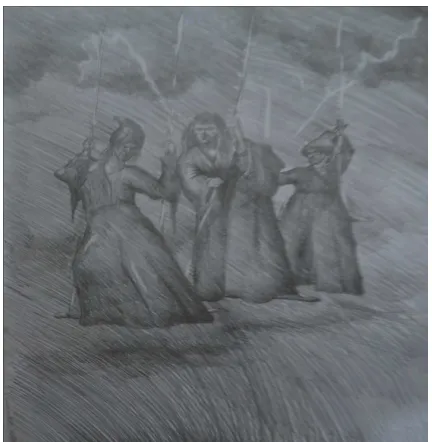
The Three Sisters in Macbeth
pp. 42-43, 90-91.
79 Vickers and Dahl, ‘All’s Well that Ends Well: an attribution refuted’, 1-9 (p.7).
80 Marcus Dahl, ‘A New Shakespeare Collaboration? All’s Not Well in the data’, University of London: School of Advanced Study, 1-23 (pp. 2-3). See also Marcus Dahl, Marina Tarlinskaya, and Brian Vickers, ‘An Enquiry into Middleton’s Supposed “adaptation” of Macbeth’, University of London: School of Advanced Study, 1-37.
81 Thomas Middleton and Early Modern Textual Culture: A Companion to the Collected Works, p. 390. See also Gary Taylor and John Jowett, Shakespeare Reshaped 1606-1623 (Oxford: Clarendon Press, 1993).
82 John Jowett, ‘From Many of Your Companies: Middleton’s Early Reader’, in A Companion to the Collected Works: Thomas Middleton and Early Modern Textual Culture, ed. by Gary Taylor and John Lavagnino (Oxford: Oxford University Press, 2007), pp. 286-327 (p. 294).
Fig. 2. Image of the three Sisters if they flew into the stage through free-flying wires)
9.
The Late Lancashire Witches
As in the other plays mentioned above, Thomas Heywood and Richard Brome’s The Late Lancashire Witches (1634) also exploited public interest as well as the dramatists’ interest in the controversial subject of witchcraft. This play was first performed by the King’s Men at the Globe in 1634. Before I come to the discussion of authorship, I would like to consider the source of this play. To capitalise on a current public affair, Heywood and Brome drew the source of their play from the court documents of a trial of 1612 84 in which twelve people from the Pendle Hill area of Lancashire were condemned to death for practising witchcraft on the Lancashire moors. Another trial in London in 1633 involved certain women from Lancashire who had been tried for witchcraft and were sent to London to be imprisoned. Some scenes in this play are about the depositions between witnesses and defendants in the case.85
Seventeen women were found guilty of witchcraft and four of them were sent to London, Margaret Johnson, Mary Spencer, Frances Dicconson and Jennet Hargreaves. These four women were arrested and accused of witchcraft in Lancashire on 24th March 1634 along with sixteen other women. The main four witches in the play are Mall (Mary Spencer), Gilian (Frances Dicconson), Meg (Granny
84 At this trial, Alice Nutter was found guilty with some others and is source for the character Mrs. Generous in the play. However, the boy, the witches and the incidents concerning witchcraft belong to the trial of 1634.
85 Robert Grant Martin, ‘Is “The Late Lancashire Witches” a Revision?’,
Modern Philology, 13 (1915), 253-265 (p. 253). See also Wallace Notestein,
History of Witchcraft in England from 1558 to 1718 (Washington: The American Historical Association, 1911), pp. 146-158; Montague Summers, A History of Witchcraft and Demonology (London: Kegan Paul, Trench, Trubner, 1926), p. 295.
Johnson) and Mawd (Jennet Hargraves). In the main plot of
The Late Lancashire Witches, Mr. Generous finds out that his wife, Mrs. Generous, is the leader of some witches. After she transforms herself into the shape of a cat, she is then arrested and brought to justice by her husband. In Act two, in order to get Squire Generous’s favourite wine, Mall takes Robin (Generous’s servant) to London on a magic steed. Mall is known to be a witch as she bewitches a pail and makes it move of its own accord. In Act three, the witch-infested wedding of both Seely’s servants, Lawrence and Parnell takes place at Seely’s house. Squire Generous rebukes Robin for lying that he gets his wine from London. Then, Squire Generous tells Robinson (Miller’s son) not to allow his wife to use the gelding again. As a result of refusing her the gelding, she then changes him into a horse and rides him to the witch banquet.86
(III.ii)87
Act four contains the witch banquet as it is described by young Robinson. Gillian arrives with the boy whom she has captured during a hunt, and after he is held prisoner by the witches, Gillian turns him into a horse and flies off the stage with him. Mrs Generous also arrives at the banquet with Robinson. The rest of this act is about the discovery of Mrs. Generous’s being a witch. Act five stages a fight between young Robinson and the devil. The play covers most of the witches’ typical activities such as the Sabbath-meeting of witches during the night, witch banqueting and the transformation of witches from humans into animals such as horses and cats. The witches are summoned to London and are medically examined by physicians and midwives for witch-marks.
Heywood and Brome dramatized the news of the day through the common report which provided accurate information about the witch trials. However, Clark argues that Heywood and Brome did nothing to ‘decrease the popular fury against witches in general, but in this particular case there were rumours of a royal pardon when
the play was written, and more than a suspicion of the bona fides of the two chief witnesses for the prosecution’.88 It is not my aim in this part of the chapter investigate all of the play’s scenes. Instead, I will focus on the witch scenes and especially their theatrical effects of flying on stage after being revised by the scribe. The main plots are assigned to Heywood’s authorship and the sub-plots to Brome’s. In general, after the play was revised, some scenes have been interpolated while some of them were omitted.89 My focus will be more on when the witches of The Late Lancashire Witches started flying on stage.
10. The Co-Authorship of Heywood and
Brome in
The Late Lancashire
Witches
and the Stage Directions of
the Witches
According to the title page, The Late Lancashire Witches was ‘a well received Comedy, lately acted at the Globe on the Bank-Side by the King’s Majesties actors, written by Thom. Heywood and Richard Brome’.90 In Act 6, scene 1, Generous gestures to the summer weather when he remarks that: ‘to sunder beds; but most in these hot months/ June, July August, so we did last night’.91 Heywood was an actor in the Queen’s Company and wrote plays for the same company in 1633.92 He then transferred his service to work for the King’s Men when he was writing The Late Lancashire Witches in 1634.93
It has been argued that the play was written by Heywood, but was revised by Brome. Andrews makes the important point that as well as adding and introducing some new scenes, Brome also changed the names of the witches and spirits throughout the play, and also added the prologue and epilogue and probably the song for Act two.94 However, Martin concludes that the play was written in 1634 and was a collaboration by both authors. However, Martin fails to account for the time when the play was produced and the time when Heywood was active in his career with the Queen’s Company. Andrews argues persuasively against collaboration in revision by referring to the proof that
88 Arthur Melville Clark, Thomas Heywood: Playwright and Miscellanist
(Oxford: Basil Blackwell, 1931), p.242.
89 The discussion of this has been analyzed in both articles by C. E. Andrews, ‘The Authorship of Lancashire Witches’, and Robert Grant Martin, ‘Is “The Late Lancashire Witches” a Revision?’.
90 Thomas Heywood, The Dramatic Works of Thomas Heywood, 6 vols (New York: Russell & Russell. INC, 1964), iv, 165- 260 (p. 167).
91 Thomas Heywood and Richard Brome, The Witches of Lancashire, ed. by Gabriel Egan (London: Nick Hern Books Ltd., 2002), p. 75.
92 Otelia Cromwell, Thomas Heywood: A Study in The Elizabethan Drama of Everyday Life ([Hamden, Conn.]: Archon Books, 1969 [c 1928]), p.13. 93 Martin Robert Grant, ‘Is “The Late Lancashire Witches” a Revision?’, p. 263. See also Cromwell, Thomas Heywood: A Study in The Elizabethan Drama of Everyday Life, p. 27.
94 C. E. Andrews, ‘The Authorship of Lancashire Witches’, Modern Language, 28 (1913), 163-166 (p. 165).
Heywood was still writing for the Queen’s Company in 1633 when The Late Lancashire Witches was produced by the King’s Men, the company for which Brome was writing in 1633-1634. In short, Andrews denies that the scenes assigned to Brome are based directly on the witch trial that occurred in 1633. Therefore, the witch scenes might probably belong to Heywood rather than Brome. Cromwell succinctly states that Heywood in all likelihood wrote the witch scenes but Brome may have composed the songs.95 Stern shows that Brome had signed an agreement with ‘Queen Henrietta’s Men in July 1635 to come up with prologues, epilogues, revised scenes and songs for revivals, so will naturally have thought of all such sections as discrete entities anyway’.96 Brome altered and interpolated some scenes in The Late Lancashire Witches but made no changes to stage directions when the witches enter and exit the stage. The stage direction, in The Late Lancashire Witches by Heywood and Brome, in (Act 2, scene 1) is:
(The Late Lancashire Witches) 97
Again the witches simply enter, but do not fly in Act 4, scene 1, where the stage direction reads:
‘Severall dores’ can be taken as good evidence of the precise manner in which the witches are directed to ‘enter’: the witches simply walk onto the stage at the Globe. All the supernatural characters, such as witches, Spirits, Mrs. Generous and Mall again enter and do not fly (Act 5, scene 1):
Heywood and Brome’s witches do not fly; their feet are firmly on the ground in all the scenes. Although the witches here transform their familiars into horses in order to transport them to the Sabbath feast, it seems that Robin and Robinson do not actually ride as no stage directions call for their riding. They simply enter through several doors. The writers may have intended to denote flying through the words of the conversation between Moll and Robin, and Mrs. Generous and Robinson, rather than flying machinery. However, the stage directions of the witches in some scenes read ‘fly’ when the play was refashioned and altered by Thomas Shadwell 1681.
95 Cromwell, Thomas Heywood, p. 184.