THE ECONOMIC CONDITIONS OF ENTERPRISE FUNCTIONING
Relation between the Level of Clusterization and Tourism Sector Competitiveness
Asta Malakauskaite, Valentinas Navickas
Kaunas University of Technology
Laisves av. 55, LT-44309, Kaunas, Lithuania
e-mail: [email protected], [email protected]
This scientific study is dedicated to the analysis of the link between the level, or degree, of clusterization and tourism sector competitiveness.Itmustbeemphasizedthat clusters, depending on the phase of their growth and development, exercise increasing influence over business organizations, as well as their competitive abilities. The more clusterized a particularbusiness sector is,the more likely it is going to develop a competitive advantage. Therefore, it is important to identify and evaluate the influence of clusterization level on the competitiveness of a tourism sector, for it is one of the key sectors in modern service-based economies. The aim of the study is to identify the relation between the level of clusterization and tourism sector competitiveness; and the objectives of the study are: 1) to identify the main fields of cluster impact on the competitiveness of business sectors, and individual business firms; 2) to relate different cluster formation (growth, development) stages to the dynamics of competitiveness; 3) to develop a measurement tool for the evaluationofclusterizationlevel(ClusterizationIndex,CI); 4) to develop a theoretical model that indicates the relation between the Clusterization Index (CI) and tourism sector competitiveness. The following methods have been applied in the study: logical and comparative analysis of literature; holistic and systematic approach; synthesis and deduction; graphical methods. The influence of clusters on the competitiveness of business sectors and business firms possesses atleastthreedimensions:entrepreneurship (new businesses), productivity, and innovation. Clusters tend to make good incubators of innovative ideas, new companies, and new businesses. Fresh business ventures and clusters may start-up in the collision of several different clusters. The degree of competitiveness is dependant on the life cycle dynamics of a cluster – competitiveness grows when a cluster develops, and decreases as it reaches the phase of decline. At the maturity stage of a cluster, the degree of competitiveness tends to be the highest. The authors of this research have introduced the Clusterization Index, which includes various attributes of clusterization that are to be evaluated by independent experts. The average estimates of all the attributes are to be multiplied by the coefficients of significance and summed together to provide a unified estimate of CI. The index requires further improvement in order to return the most objective and accurate estimation results. The competitiveness level has 2 dimensions – the determinants (factors) and indicators. In order to evaluate thelink betweenthe clusterization level,represented by CI, and competitiveness level (CL), the relations between CI and various indicators of the business (in this case – the
tourism sector) sector competitiveness are to be found. It can be concluded that the analysis of clusterization level, cluster life cycle and their influence on the competitiveness of business firms,isa complex(and multi-stage)process of increasing importance. The field of research related to the level of clusterization is particularly new, thus it demands the growth of scientific and practical attention.
Keywords: tourism sector, clusterization, cluster life cycle, clusterization index, competitiveness.
Introduction
It is widely believed that one of the most efficient ways to improve the competitiveness of national and regional economies (especially – as regards small and medium enterprises, SMEs) is the creation of clusters and cluster-like partnership initiatives. This approach is based on various studies that prove the advantages of being part of a cluster, including increasing ability to start a new business venture and (or) serve specific niche markets, growing productivity, innovativeness, and competitive potential.
It must be noted that the concept of clusterization tends to vary in different scientific works. The authors of this research use the aforementioned term to name the process of clustering or cluster formation. Hereby, clusterization level can be described as a certain stage in cluster formation process. As it has been mentioned before, competitiveness of cluster member companies is largely dependant on the stage of cluster formation, that is – different development and growth phases.
The object of the study is: the level of formation of clusters and its influence on the competitiveness of tourism sector.
The aim of the study is: to identify the relation between the level of clusterization and tourism sector competitiveness.
The objectives of the study are:
1. To identify the main fields of cluster influence on the competitiveness of business sectors, as well as individual companies.
2. To relate different cluster formation stages to the dynamics of competitiveness.
3. To develop a measurement tool for the evaluation of clusterization level (Clusterization Index, CI).
4. To develop a theoretical model that indicates the relation between the Clusterization Index (CI) and tourism sector competitiveness.
The methods of the study are:
• Synthesis and deduction. • Graphical methods.
• Holistic and systematic approach.
Clusters and Competitiveness: from Theories and Concepts to Practical Mechanisms
Both scientific and applied literature sources tend to explain the concept of competitiveness in a variety of – sometimes even conflicting – ways. According to World Economic Forum (2009), competitiveness is to be perceived as a capability of a country to secure the growth of GDP per capita. National Competitiveness Council (2001) defines competitiveness as a country’s ability to successfully operate and efficiently compete in international markets, at the same time maintaining a high quality of life and well-being of its citizens. As it can be noticed, the aforementioned concepts embrace the macro- level; yet, the concept of competitiveness can also be defined on the micro- level, as a potential of companies to compete locally and internationally.
The competitiveness of tourism (or any other sector) cannot be separated from sustainable development. The development of tourist destinations must be harmonious notonlyeconomically, but also in terms of socialpolicy, politics, ecology, culture, etc. The long-term orientation towards qualitative development of industry also adds to the improvement of country or tourist destination image. These factors are not directly related to tourism, however it is common that economically strong countries have a far betterdevelopedinfrastructure, tourism base and possess a more attractive tourism image than economically weak countries (Navickas, Malakauskaite, 2009b). However, the development of infrastructure and formation of a positive image are not sole measurestoachieve the competitiveness of tourism sector. Various forms of interorganizational relations enable tourism firms to be efficient, ingenious, innovative, and profitable. One of these cooperation forms are clusters.
According to Porter (1990, 1998, 2000), clusters exercise a fourfold influence over the competitiveness of business sectors and companies, since they:
• increase the present, or static, productivity level of cluster companies;
• create the preconditions for the intense growth of productivity;
• increase the entrepreneurship level and innovation potential of cluster companies;
• stimulate the origination and development of new businesses, services, companies, especially those with innovation potential.
The majority of cluster-related advantages spring from the links and partnerships among organizations, business units, universities, governmental bodies, and associated institutions. So, it must be emphasized that clusters are to be treated as systems, rather than a sum of member companies (Navickas, Malakauskaite, 2008, 2009a).
The influence of clusters on the competitiveness of business sectors and companies possesses at least 3 dimensions: productivity, innovation, and creation of new businesses (entrepreneurship).
1) Clusters and productivity
The productivity of cluster companies is generally higher than that of non-clustered business units, for: • Cluster companies can access specific information
(usually) at a lower cost than individual companies (Christensen, McIntyre, Pikholz, 2002). It is a very important competitive advantage, for accessibility of information is directly related to dynamic shift of activities, better customer service, and efficient decision-making. Hereby, cluster companies may increase their specialization and productivity.
• Cluster companies tend to be more profitable than individual companies. The link between clustering and increase in profitability has been analyzed and (or) proved in various scientific studies (Baptista, Swan, 1998). Thus, cluster companies have better financial capabilities to invest in new equipment. Modernization of manufacturing plants, tools, and equipment can lead to the increase in productivity and cost-efficiency. • Cluster companies (often) have a better access to a
specialized workforce than individual companies. According to Porter (1998, 2008), cluster member companies can hire the most qualified workforce, as successful clusters tend to attract new potential employees to a particular region.
• Cluster companies can access public services and goods that usually have a rather high cost. Cluster companies can hire a qualified workforce, exploit specialized infrastructure, cooperate with regional academic institutions, organizations, etc. (Becker, 2000; Porter, 1998). Consequently, these services and goods, notwithstanding their high value, tend to become public or quasi-public (free of charge).
• Cluster companies can enter new specific markets efficiently in comparison with individual business units, as their reaction to the changes in needs and tastes of consumers is much faster. Silicon Valley in the US (Bresnahan, Gambardella, 2004), which is famous for being a cluster of modern high-tech companies, is just one of many instances, proving the benefits of specialization and its impact on the growth of productivity. Silicon Valley companies operate in a rapidly changing environment, where continuous technical advancement is crucial. Only deeply interrelated companies that have an access to vital market information can achieve that.
cluster companies can be revealed through the following elements:
- Complementary goods (services). For example, customer satisfaction in the tourism industry is dependent on various components. One of them is the set of complementary services, including hotels, restaurants, souvenir shops, airlines and communication services, etc. Not only do all of the aforementioned services create an attractive tourism product and bind the cluster companies, they also grant a sufficient (in some cases, even extra) value-added for a customer.
- Joint marketing. Interrelated cluster companies may exploit the possibility to benefit from joint marketing measures, such as recommendations from other cluster members, promotional tools, including marketing campaigns, joint websites, customer loyalty programmes, etc. Hence, joint marketing secures a solid and reliable image of cluster companies, and therefore, contributes to their growth. A strong, structured, cooperative, and growing cluster is a weighty, if not essential, precondition for the increase in productivity of its companies.
• Cluster companies often have a greater negotiation power than individual companies. Their suppliers cannot raise the prices in a groundless manner, all the more – contracts with suppliers become more reliable, since the latter are unwilling to spoil their image or reputation; otherwise, it could negatively affect their future contracts with remaining cluster companies (Cincikaite, Belazariene, 2001). Thus, cluster companies gain a competitive advantage in the field of production resources. First of all, their suppliers may even reduce the prices for the sake of benefit to serve a large concentrated realization market. Second, suppliers tend to specialize, since they have better possibilities to analyze the target markets or face lower risks, as the number of their potential new clients (cluster companies) is mostly large.
2) Clusters and innovation
Under the conditions of the modern economy, it is vitally important to supply the most innovative goods and services, using the most advanced production and distribution methods. Consequently, entrepreneurship, as well as innovations, becomes a cornerstone of competitive advantage.
One of the reasons for the popularity of clusters is their potential to stimulate the innovative activities of their member companies, at the same time increasing their competitiveness (Hakanson, 2004). All the more, not only do clusters induce the development or spread of innovations, they also minimize the time, necessary for the implementation of innovations. Close relations between clients, suppliers, and manufacturers largely contribute to the aforementioned benefit. All partners can be (and very often are) involved in the process of innovation. According to Porter (2008), that also adds to customer satisfaction.
Cluster companies can experiment without taking on any excessive responsibilities, while being unsure about the success of a certain innovation project. Non-cluster
companies, located geographically far from the main suppliers, have difficulties in coordinating their innovation activities; thus, they can hardly experiment due to excessive costs.
Clusters offer a wide range of communication and information channels that embrace informal networks and formal communication measures. Even competing cluster companies exchange key competencies, know-how, information, and skills through their employees. As it has been mentioned before, one of the dominating preconditions for the efficient formal communication and operative informal exchange of information is the geographical integration of cluster companies (Bekar, Lipsey, 2001).
The most common innovations that are generated in clusters include new and (or) modified products and services. It is characteristic not only of R&D clusters, but also of many traditional clusters. Nonetheless, the popularity of organizational and marketing (related to distribution, warranty service, etc.) innovations tends to grow, as well.
3) Clusters and entrepreneurship (new businesses)
Clusters induce the development of new business ideas and companies for a variety of reasons. First of all, people that work for cluster companies have better possibilities to identify the supply gaps or free niches in cluster markets. It is a solid incentive to start one’s own business (Porter, 2000).
New companies that develop in a cluster have the initial conditions for the growth: cooperative partners, innovative environment, specified suppliers, informal information sources, access to formal communication networks, basic infrastructure, access to public (quasi-public) goods and services, qualified workforce, etc.
Financial institutions are more likely to finance a new cluster company (if the cluster is successful), for they can collect the available data on a certain cluster, forecast its future prospects, and evaluate the risks of a fresh business venture more efficiently.
Brown (2000) notices that clusters usually take up a large share of the local market. Thus, new business ventures are associated with smaller failure risks than other new companies.
According to Porter (1990, 1998, 2008), Nadabán & Berde (2009) et al., clusters induce the formation of new service companies (in particular), because the rest of cluster companies create the demand for many different services – from cleaning to logistics or R&D. For example, the Silicon Valley high-tech cluster has welcomed a number of companies that offer everyday services (accounting, logistics, market research, etc.) and specific services (risk capital management, patent law consulting, etc.). The Silicon Valley cluster is not a sole example – companies, specialising in maritime law, have been established in the Norwegian maritime cluster (Nordisk Innovations Centre, 2009).
integrated) domestic appliances. The export of the new cluster exceeds that of its parent-clusters.
Many new companies in a cluster are the spin-offs or subsidiaries of existing cluster companies. Parent-companies create these subsidiaries for specific aims, such as R&D, marketing, development of innovations or implementation of new investment projects. Porter (1990, 1998, 2008) notices that clusters, hereby, make perfect incubators for new business ventures.
The development of new businesses in clusters is a positive feedback (Cincikaite, Belazariene, 2001), as it illustrates how beneficial a certain cluster is. On the other hand, new ventures generously contribute to the “health” of their parent-cluster, making it grow faster, renew its capabilities, transform, and further increase the competitive potential of its members.
It can be deduced that under the conditions of the dynamic global economy, with its ups and downs, the
growing importance belongs to the ability to innovate and use the limited resources productively, since they will not secure a sufficient competitive advantage just by being accessible. Companies have to combine their material and human resources in order to successfully operate and compete in the global markets.
Link between the Cluster Life Cycle, Level of Clusterization and Competitive Advantage
The competitive advantage of tourist destinations becomes increasingly important to the countries that intend to control a large share of the rapidly growing tourism market. That is particularly important to the tourism-dependant countries, which heavily rely on the situation in tourism and travel industry (Navickas, Malakauskaite, 2009b).
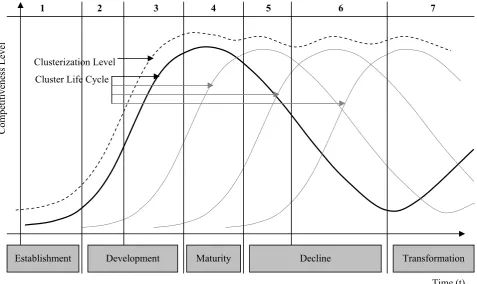
1 2 3 4 5 6 7
Clusterization Level Cluster Life Cycle
Time (t) 1 – Establishment of a cluster
2 – Slow growth (development) of a cluster 3 – Fast growth (development) of a cluster 4 – Maturity of a cluster
5 – Maturity, transforming to the decline of a cluster 6 – Decline of a cluster
7 – Transformation of a cluster
Figure 1. The Correlation between the Life Cycle of a Cluster, Clusterization Level and Competitiveness Level Source: the authors, 2009.
The competitiveness of tourism sector encloses many factors, such as natural environment (geographic location, climate, scenery, etc.), artificial environment (tourism infrastructure, transport, supply of leisure or entertainment services, retail stores, hotel network), and globalization of markets. Tourism sector can be described as competitive only when tourist destinations are attractive and high-class products (services) are competitive in terms of quality, as compared with products and services of other tourist destinations,aimedatthe same market segments. Thus, it
can be concluded, that the competitiveness of tourism sector and tourist destinations depends on juridical, political, economic, social, cultural, ecological, and technological environment. In spiteofthat,onlyspecificor tourism market-related factors form the core of tourism destination competitiveness (Navickas, Malakauskaite, 2009a, 2009b).
When estimating competitiveness, it is relevant to take into account the fact that competition is characteristic of separate business units – companies and organizations –
Establishment Development Maturity Decline Transformation
Co
mp
etitiv
en
ess Lev
rather then business sectors or countries. However, it is impossible to disassociate from the mezzo- and macro- context. The universality of the concept of competitiveness is revealed in various scientific works (Strandskov, 2006; Snieska, Draksaite, 2007; Gerasymchuk, Sakalosh, 2007; Zvirblis, 2007; Rutkauskas, 2008; Snieska, Bruneckiene, 2009; Navickas, Malakauskaite, 2007, 2009b). Clusters are the subject to the mezzo- level of competitiveness.
The life cycle and formation of a cluster, as a tool of competitiveness, is a research problem, analyzed in many different scientific studies, research works (Hui, 2005; Nadabán, Berde, 2009; Ffowcs-Williams, 2004; Yafei, De'an, 2007; Fengtian, Yu, 2006 et al.).
The level of competitiveness is directly dependant on the life cycle dynamics of a cluster: it grows when a cluster evolves and decreases as it reaches the phase of decline (see Figure 1).
Usually there is more than one cluster in a certain region – some clusters are still forming (the formation of
clusters embraces their establishment-development phases), while others are in their maturity, decline and transformation phases (Menzel, Fornahl, 2007).
The level of clusterization follows the changes in all clusters and their life cycles, since it demonstrates the degree of clustering at a certain period of time. In other words, if most regional clusters are in their rapid growth or maturity phase, the level of clusterization is the highest.
As the level of clusterization must be evaluated or measured, the authors of this scientific study introduce the Clusterization Index (CI), which includes various attributes of clusterization that are to be evaluated in a chosen scale by independent experts.
The average estimates of all chosen attributes are to be multiplied by the coefficients of significance and summed together to provide a unified estimate of CI.
The comprehensive estimation procedure through which CI is obtained is explained below:
Estimate (1st expert) + Estimate (2nd expert) + … + Estimate (nth expert)
Average Estimate (zth attribute) =
Number of experts (n)
CI = Average Estimate (1st attribute) * CS(1) +…+ Average Estimate (zth attribute) * CS(z), where
• z – the number of chosen attributes
• CS(x) – coefficient of significance, CS(x) = [0;1], x = [1;z]
For example, the attributes of clusterization in the tourism industry embrace:
• the links between tourism and related businesses; • the links among companies, governmental bodies and
associated institutions;
• the coordinative role of a national tourism board or similar institution in the tourism sector;
• the incidence (presence) of joint marketing in the tourism sector;
• the availability of a unified tourism product, that is, a complex of tourism and related services (from restaurants to shopping and recreation facilities);
• etc.
All of the aforementioned clusterization attributes can be estimated in the scale of “weak – strong” (1-10 points or similar). It means that some of the attributes dominate, or clearly manifest themselves, while others barely characterize the chosen tourism sector.
Each attribute may differ in terms of importance, that is, some of them are more associated with clusters than others, and thus, their coefficients of significance must vary.
For instance, the strong role of a national tourism board or similar institution may or may not indicate a cluster in the tourism sector. Therefore, the coefficient of significance for this attribute should be lower.
Once CI is obtained, it must be related or linked to the tourism sector competitiveness level, which can be expressed as follows:
Competitiveness Level = f (CI, F1, F2, F3, F4,…Fn), where F1-Fn – competitiveness factors.
As it can be seen from the formula, provided above, CI for the tourism sector is one of the competitiveness
factors analyzed above that determine the competitiveness level of the tourism industry.
The competitiveness level has 2 dimensions – the determinants (CI, etc.) and competitiveness indicators (tourism share of GDP, value-added, etc.). In order to estimate the link between the clusterization level (CI) and competitiveness level (which can be expressed by different competitiveness indeces and methodics), the correlations between CI and various competitiveness indicators must be found.
It can be deduced that the Clusterization Index has to be devoloped, improved further, in order to achieve the most objective and accurate estimation results. But it must be emphasized that the new index not only has the room for improvement, but also demonstrates vast prospects of application and practical use.
Conclusions
1. The influence of clusters on the competitiveness of business sectors and companies possesses at least 3 dimensions – entrepreneurship (new businesses) productivity, and innovation. Clusters make good incubators of innovative ideas, or new companies. Fresh business ventures and clusters may start-up even in the collision of several different clusters.
3. The authors of this research have introduced the Clusterization Index (CI), which includes various attributes of clusterization that are to be evaluated in a chosen scale by independent experts. It must be noted, that the average estimates of all chosen attributes have to be multiplied by the coefficients of significance and summed together to provide a unified estimate of CI. The index requires further improvement in order to
return the most objective and accurate estimation results.
4. The competitiveness level has 2 dimensions – the determinants (factors) and indicators. In order to evaluate the link between the clusterization level (CI) and competitiveness level (CL), the relations between CI and various indicators of the business (in this case – tourism) sector competitiveness are to be found.
References
Approach to Measuring Competitiveness. Annual Competitiveness Report. (2001). National Competitiveness Council. Available from Internet: <http://www.forfas.ie/>
Baptista, R., Swan, P. (1998). Do Firms in Clusters Innovate More. Research Policy, 27, 58-63. Becker, G. S. (2000). Global Silicon Valleys? First, Kill All the Subsidies. Business Week, March.
Bekar, C., Lipsey, R. G. (2001). Clusters and Economic Policy. Montreal: Policies for the New Economy.
Bresnahan, T., Gambardella, A. eds. (2004). Building High-Tech Clusters: Silicon Valley and Beyond. Cambridge: Cambridge University Press.
Brown, R. (2000). Cluster Dynamics in Theory and Practice with Application to Scotland. Regional and Industrial Policy Research Paper. European Policies Research Centre, University of Strathclyde.
Christensen, P., McIntyre, N. and Pikholz, L. (2002). Bridging Community & Economic Development. A Strategy for Using Industry Clusters to Link Neighborhoods to the Regional Economy. Shorebank Enterprise Group, Cleveland. Cincikaite, J. ir Belazariene, G. (2001). Klasteriai ir regionų konkurencingumas. Tarptautinės konferencijos „Regionų
plėtra-2001“ pranešimų medžiaga. Kaunas: Lietuvos regioninių tyrimų institutas.
Cluster Management Toolbox (2009). Nordisk Innovations Center. Available from Internet: <http://www.nordicinnovation.net/> Fengtian, Z. and Yu, C. (2006). The formation and Evolutionary Mechanism of Entrepreneurs and Chinese Rural
Industrial Clusters, A Case Study Analysis. China Software Science, No.1, 100-107.
Ffowcs-Williams, I. (2004). Cluster Development: Red Lights and Green Lights. Sustaining Regions 4(2), 26-32.
Gerasymchuk, V. H., Sakalosh, T. V. (2007). Konkurencingumas ir žinių ekonomika: informacinės ir komunikacinės technologijos įtakos vertinimas. Verslas: teorija ir praktika-Business: Theory and Practice, 8(4), 195-203.
Global Competitiveness Report. (2009). World Economic Forum. Available from Internet: <http://www.weforum.org/> Hakanson, L. (2004). Epistemic Communities and Cluster Dynamics: on the Role of Knowledge in Industrial Districts.
Academy of Management Best Conference Paper ENT: E1.
Hui, Z. (2005). A Study on Upgrading Modes for Local Enterprise Clusters Under the Global Value Chains. China Industrial Economy, 9, 11-18.
Maskell, P. (2001). Growth and the Territorial Configuration of Economic Activity. The DRUID conference in honour of Nelson and Winters.
Menzel, M. P. and Fornahl, D. (2007). Cluster Life Cycles – Dimensions and Rationales of Cluster Development. Jena Economic Research Papers in Economics, 2007-076.
Nadabán, M. V. And Berde, Á. B. (2009). Clusters: Definition, Tipology and Characteristics of Some Clusters in the Észak-Alföld Region. Case Study. Conference 4th Aspects and Visions of Applied Economics and Informatics, Debrecen.
Navickas, V., & Malakauskaite, A. (2007). Efficiency of Event Usage for the Increase in Competitiveness of Companies. Inzinerine Ekonomika-Engineering Economics(2), 91-97.
Navickas, V., Malakauskaite, A. (2008). Nauji makroekonominės politikos svertai: klasterių fenomenas. Verslas: teorija ir praktika-Business: Theory and Practise. 9(4), 245-252.
Navickas, V., Malakauskaite, A. (2009a). Tarporganizacinių verslo ryšių formavimosi turizmo sektoriuje prielaidos. Ekonomika ir vadyba: 2009. 14, 863-870.
Navickas, V., & Malakauskaite, A. (2009b). The Possibilities for the Identification and Evaluation of Tourism Sector Competitiveness Factors. Inzinerine Ekonomika-Engineering Economic(1), 37-44.
Porter, M. E. (1990). The Competitive Advantage of Nations. New York: Free Press.
Porter, M. E. (1998). The Microeconomic Foundations of Economic Development [parts I and II]. The global competitiveness report. Geneva: World Economic Forum.
Porter, M. E. (2008). Clusters, Innovation, and Competitiveness. EU Conference on Innovation and Clusters, Stockholm. Rutkauskas A. V. (2008). On the sustainability of regional competitiveness development considering risk. Technological
and Economic Development of Economy 14(1), 89-99.
Snieska, V., & Bruneckiene, J. (2009). Measurement of Lithuanian Regions by Regional Competitiveness Index. Inzinerine Ekonomika-EngineeringEconomics(1), 45-57.
Snieska, V., & Draksaite, A. (2007). The Role of Knowledge Process Outsourcing in Creating National Competitiveness in Global Economy. Inzinerine Ekonomika-Engineering Economics(3), 35-41.
Strandskov, J. (2006). Sources of Competitive Advantages and Business Performance. Journal of Business Economics and Management, 7(3), 119-129.
Yafei, L. and De'an, S. (2007). The Research of the Relationship between Cluster's Development Stage and Entrepreneurship Based on an Ecology-Model: An Empirical Study from Zhongguancun Science Park. Management of Engineering and Technology, 5(9), 574-583.
Zvirblis, A. (2007). Paslaugų bendrojo vertingumo ir jų konkurencingumo vertinimo principai. Verslas: teorija ir praktika-Business: Theory and Practice, 8(2), 82-86.
Asta Malakauskaitė, Valentinas Navickas
Klasterizacijos lygio ir turizmo sektoriaus konkurencingumo sąryšis
Santrauka
matuojamas įvairiais konkurencingumo indeksais, ir klasterizacijos lygio, kuriam įvertinti šio tyrimo autoriai siūlo klasterizacijos indeksą (KI), būtina rasti koreliacijas tarp įvairių ekonomikos (šiuo atveju turizmo) sektoriaus konkurencingumo rodiklių ir klasterizacijos indekso įverčio. Taigi galima daryti išvadą, kad klasterio gyvavimo ciklo, klasterizacijos lygio ir jų poveikio konkurencingumui analizė yra sudėtingas daugiapakopis procesas. Tokio vertinimo reikšmė šių dienų žinių ekonomikoje, grįstoje klasteriais ir inovacijomis, gerokai auga. Klasterizacijos lygis kaip tyrimo objektas yra dar visiškai naujas. Jo svarba turėtų paskatinti tiek mokslinių, tiek praktinių tyrimų interesų augimą.
Raktažodžiai: turizmo sektorius, klasterizacija, klasterio gyvavimo ciklas, klasterizacijos indeksas, konkurencingumas.