Research Article
Genetic profiling of sugarcane genotypes using Inter Simple Sequence Repeat
(ISSR) markers
Sachin B. Kalwade1,2, Rachayya M. Devarumath1,2*, Prashant G Kawar1, K. V. Sushir3
1Molecular Biology and Genetic Engineering Division, Vasantdada Sugar Institute, Manjari (Bk), Pune 412307,
India.
2 Department of Biotechnology, Shivaji University,Vidyanagari, Kolhapur 416004,India. 3 Plant breeding Division, Vasantdada Sugar Institute, Manjari (Bk), Pune 412307, India.
*Email: [email protected], [email protected]
(Received: 01 Nov 2011; Accepted: 22 Feb 2012)
Abstract:
Study of genetic diversity is an important factor in sugarcane breeding programs to identify genetically diverse parents for developing hybrid cultivars with improved cane and sugar yield. Genetic profiling studies of 17 sugarcane genotypes were carried out by using 27 ISSR markers having di, tri and tetra nucleotide repeat motifs. Out of the 252 amplicons amplified by 27 ISSR primers, 212 were polymorphic (84.13%) with an average of 9.3 alleles per locus. The polymorphic information content (PIC) value ranged from 0.19 (UBC 808, 843) to 0.36 (UBC876) primers with poly 'AG', 'CT' motifs and poly '(GATA) (GACA)' motifs respectively with an average of 0.27. The primer UBC 825 had a highest resolving power value 9.8 among the 27 primers. Genetic similarity indices by Jaccard’s similarity coefficient ranged from 0.26 to 0.72 indicating a high level of genetic diversity and significant correlation found with biometrical data of sugarcane genotype. Cluster analysis by UPGMA method revealed similarity coefficient of 0.49 which was mainly attributed to inter specific diversity. Thus, ISSR markers can be used as a potential marker system for genetic profiling of sugarcane genotypes.
Key words: Sugarcane, ISSR marker, Polymorphic Information Content, Resolving power, Genetic diversity Introduction
Sugarcane is one of the major source of sugar, plays a vital role in the economy of many countries through the sugars and ethanol production. Sugarcane (Saccharum spp. hybrid) is a C4 grass belongs to
genus Saccharum of the family Poaceae with
complex polyploidy genome. Present day modern cultivars are inter specific hybrids having genome 2n=100-300 and are believed to have originated from complex hybridization event (nobelization) estimated about 70-80% are from S. officinarum L. (2n=80),
10-20% of S. spontaneum L. (2n=40-128)
(Sreenivasan et al, 1987; D’Hont et al., 1996).
Several other species including S. robustum, S. barberi Jesw. and S. Sinense Roxb. have been
involved to lesser extent in development of modern sugarcane varieties (Irvine, 1999). Sugarcane has characteristic ability to accumulate high sucrose concentration of approximately 650 mM in storage parenchyma, such high concentration and of usable compound encourage to do study on sugarcane genome for identification of diverse parents and genes associated with the sucrose accumulation in sink tissue of sugarcane. Currently, plant scientists working in crop improvement program encountered slow research progress due to its very narrow genetic base (Jackson 2005). Molecular marker technology
has great potential to contribute to the genetic improvement of sugarcane by identifying novel genetic variation, improving the heritability related to the sucrose contributing trait (McIntyre et al., 2001).
Genetic profiling by using DNA-based molecular marker technique is an important tool to study genetic diversity in sugarcane breeding programs to identify genetically diverse parents for developing hybrid cultivars with improved cane and sugar yields. DNA-based molecular markers help to dissect the genome because of its specificity, robustness, required less DNA and it does not affected by environmental conditions during developmental stages of plant. There are numerous PCR based molecular marker techniques such as RAPD (Random amplified polymorphic DNA) (Kawar et al., 2009), RFLP (Restriction Fragments Length
Polymorphism), AFLP (Amplified Fragment Length Polymorphism) (Selvi et al., 2005), SSR (Simple
Sequence Repeat) or microsatellite (Maccheroni et al., 2009), STMS (Sequence Tag Micro Satellite)
(Singh et al., 2005), ISSR (Inter Simple Sequence
Repeat) (Shrivastava and Gupta 2008), TRAP (Target Region Amplified Polymorphism) (Alwala et al.,
Microsatellites or simple sequence repeat (SSR) marker amplified tandemely di, tri and tetra nucleotide repeats that are widely distributed on genome. A modification of SSR-based marker system
i.e. ISSR (inter simple sequence repeat) analysis
which target the flanking region of identical SSR in inverse direction. ISSR analysis is simpler than any other marker system because it generates highly reproducible and distinct results which helps in the differentiation of distinct sugarcane genotypes.
In the present study, ISSR markers were used to assess genetic profiling of cultivars with high, moderate and low sucrose sugarcanes and some wild-type sugarcane subjected to amplify and evaluate genetic diversity by using ISSR markers in comparison with biometrical data obtained from field .
Material and methods
The material consisted of 17 sugarcane genotypes including 5 wildtype and 12 Saccharum spp. hybrids
of subtropical India available at research farm of VSI, Pune (Table 1). A total 27 ISSR primers with major motifs of poly ‘AG’, poly ‘AC’, poly ‘GT’ was used for the study (Table 2). Genomic DNA was isolated from freshly harvested leaves of each sugarcane genotypes by using CTAB method (Aljanabi et al.
1999). Quality and quantity of DNA were estimated by UV-visible spectrophotometer and also visually by ethidium bromide staining to 0.8% (w/v) agarose gel. DNA was diluted to uniform concentration of 10ng/ul. PCR reaction was performed in 96 well plate thermal cycler (Eppendorf AG 22331, Mastercycler, Germany) with reaction volume of 15 µl containing 50 ng of template DNA, 0.2 uM primer (University of British Columbia, Vancouver, Canada), 200 uM each dNTP, 1x PCR buffer with 10 mM Tris-Cl (pH 8.3), 50 mM KCl, 2.0 mM MgCl2 and 1U of Taq
polymerase (Sigma-Aldrich, USA). PCR amplification conditions were set as initial denaturation at 940C for 6 min followed by 30 cycles
of denaturation at 940C for 50 sec, annealing at 500C
for 50 sec, extension at 720C for 90 sec, and final
extension at 720C for 7 min. The amplified products
were mixed with gel loading dye, resolved on 3% (w/v) agarose gel having ethidium bromide using 1X Tris borate EDTA (TBE) buffer under room temp at constant voltage 100V. The gels were documented under ultraviolet light using gel documentation unit (UVITech).
Data Analysis: Amplified products with reproducible and distinct bands were scored as 1 or 0 depending on its presence and absence for data analysis. Allelic diversity at a given locus was measured by PIC for polymorphic band of primer and was calculated as 1-p2-q2, where, p is presence of band frequency and q is
absence of band frequency (Mondal et al., 2009). The
ability of primer to distinguish between genotypes was assessed by calculating their resolving power (Rp) as Rp = ∑lb. Where, lb is band informativeness, lb = 1- (2 x │0.5-pi│), where pi is the proportion of
genotype containing the band ith (Prevost and
Wilkinson, 1999). The genetic association among genotypes was evaluated using Jaccard’s similarity coefficient. All stastical analysis was done by using the software NTSYS-pc version 2.02 (Rohlf, 2000).
Results and Discussion
Polymorphism within sugarcane: The use of ISSR-PCR markers for the amplification of sugarcane genotypes showed high level of polymorphism. Genetic profiling studies of seventeen sugarcane genotypes were carried out by using twenty seven ISSR markers having di, tri and tetra nucleotide repeat motifs. The Total Number of Allele scored (TNA), Number of Polymorphic Alleles (NPA), Polymorphic Information Content (PIC) and Resolving power (Rp) obtained per ISSR-PCR markers were shown in Table 2. In all, total 252 alleles amplified by 27 ISSR markers, 212 were polymorphic (84.13%) with an average of 9.3 alleles per locus. Number of allele scored for locus by the marker ranged from 6 to 14 alleles amplified by UBC828 and UBC834 primer with di nucleotide repeat motifs of TG and AG respectively. The Polymorphic Information Content (PIC) value ranged from 0.19 (UBC808 and 843) to 0.36 (UBC876) primers with di nucleotide repeat motifs of ‘AG’ and tetra nucleotide repeat motifs ‘(GATA) (GACA)’ respectively with an average value of 0.27. The primer UBC 825 exhibited highest resolving power (Rp) value 9.8 among twenty seven primers. Genetic similarity indices were estimated by Jaccard’s similarity coefficient which ranged from 26% to 72% that indicated more informativeness about genotype discrimination and genetic diversity study in sugarcane genotypes.
Unique and rare loci: Among the 27 primers amplified in 17 sugarcane genotypes, two unique loci were obtained with primer 13 and 15 that differentiate the wild-type Erianthus ciliaris from the
rest of genotypes. However, two rare bands with low band frequency of 510bp and 700bp were amplified by the primer 23 which was unanchored tri nucleotide (ATG) repeat primer able to distinguish Co 94012 and Co 85004 high sucrose genotypes while rest of the primers did not amplify rare bands.
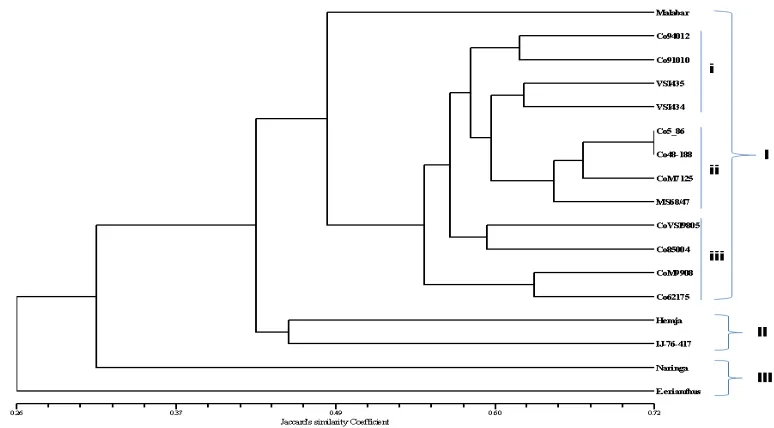
seventeen sugarcane genotypes. Genetic similarity indices were estimated by Jaccard’s similarity coefficient. The similarity value varied in - between ranged from 26 % to 72 % with a mean value of 49 %. The range of diversity was more among the wild type sugarcane genotypes such a Malabar, Hemja, IJ-76-417, Erianthus ciliaris and Naringa. It showed
that all 17 sugarcane genotypes could be clearly differentiated by UPGMA dendrogram and most of the wild relatives formed different grouping patterns in clusters. A dendrogram with cophenetic value of 0.97 was generated and genotypes were grouped into 3 main clusters with 3 sub clusters (fig.2). The number of genotypes varied from 2 (cluster II and III) to 4 (sub cluster i, ii and iii). Cluster I had thirteen sugarcane genotypes, it was a large cluster found in the dendrogram, all genotypes were derived as
Saccharum officinarum hybrids. Cluster I
differentiated into three subclusters shown in dendrogram (fig. 2). Subcluster (i) had four genotypes Co 94012, Co 91010, VSI 435 and VSI 434 with an average of 62% similarity coefficients. Pedigree data of the genotypes showed the closeness among themselves (Table1). Subcluster (ii) had four genotypes CoVSI 5-86, CoVSI 48-188, MS 68/47 and CoM 7125 in which CoVSI 5-86 and CoVSI 48-188 had highest similarity of 72% found. The average similarity for the sub cluster (ii) was found to be 64%. Subcluster (iii) had four genotypes CoVSI 9805, Co 85004, Co M9908 and Co 62175 and found with 60% of average genetic similarity with no similar pedigree data for the genotypes.
Cluster II had two sugarcane genotypes, Hemja and IJ-76-417 which belongs to parentage of Saccharum
barberi and wild type Saccharum robustum
respectively. GS was found to be 44% which was less than Saccharum officinarum hybrid of cluster I. Also
cluster III formed with the two genotypes Narenga
and Erianthus ciliaris derived from wild type
sugarcane Narenga and Erianthus with29% GS and
it was the lowest GS value among the grouped pairs of seventeen genotypes. Association between the inter species and wild types sugarcane genotypes are shown in two and three dimensional figures.
The cane yield and yield contributing characters along with Hand Refractometer brix % data were depicted in Table 3. Clones from three different generas i.e. Sachharum, Erianthus, Narenga were
undertaken for the present evaluation. The
Saccharum includes species of S. officinarum, S.barberi and S. robustum along with some
Saccharum species hybrid derivatives. Erianthus ciliaris (424.00) ‘000/ha. Narenga prophyocoma
showed very high number of millable cane but less
single cane weight (0.56 kg) and brix (6.55%), whereas, Narenga is grass type habit with lowest
expected cane yield of 24.00 t/ha. The another accession IJ 76-416 from S. robustum group of wild
species recorded 108.00/ha with low brix (9.80%), whereas cultivated S. offficinarum recorded with
moderate brix (18.54%) and high NMC (144.00) ‘000/ha. Indigenous cane of India S.barberi, hemja
recorded a very high number of millable canes (320.00) ‘000/ha and low single cane weight (0.13 kg) and brix (13.80%) respectively.
The Saccharum species hybrid viz. Co 94012, Co91010, VSI 435, VSI 434, CoVSI 9805, Co 85004, CoVSI 5-86, CoVSI 48-188, MS 68/47, CoM 7125, CoM 9908 and Co 62175 recorded high single cane weight and HR brix % than the Erianthus and Narenga.
In the present study the amplified DNA profiles generated by ISSR-PCR were significantly scored from independent gels for making identical data sets. Obtained results of twenty-seven ISSR-PCR markers showed polymorphism percentage ranging from 56 to 100% among seventeen sugarcane genotypes which are nearly greater than the range of 43-100% polymorphism found (Shrivastava and Gupta, 2008) in forty-two genotypes generated by ten ISSR-PCR markers. This may be because of the number of genotypes and availability of target sites in genome for primer motifs binding. Polyploid plants have increased heterozygosity and also harbor higher level of genetic diversity than was anticipated that may also beneficial for biochemical estimations. Comparison of allele per locus generated by ISSR-PCR marker from nuclear to mitochondrial and chloroplast genome analysis, it is clear that more allele per locus are produced by nuclear than mitochondrial and chloroplast genome of sugarcane (Virupakshi and Naik, 2008) that had happened because of large genome and heterozygocity in sugarcane. Genetic diversity in different accessions of sugarcane have been performed in most of the country because of its distribution in different geographic region by using various DNA based molecular markers such as RAPD, SSR, ISSR, STMS, TRAP and AFLP. Polymorphic allele per locus generated by ISSR are more than RAPD, SSR and STMS markers (Creste et al., 2010; Babu et al.,
2010; Filho et al., 2010; Kawar et al., 2009) while
among seventeen sugarcane genotypes, twelve belongs to the Saccharum spp. hybrids which show
highest genetic similarity. Another possibility may be due to the use of limited number of markers for dissecting large genome size of sugarcane (2500-4000 Mb) (Babu et al., 2010). GS value clearly
differentiated all genotypes from 26-72%, which contrasts with the value of 68-97% obtained by Dice similarity coefficient in Indian sugarcane (Shrivastava and Gupta, 2008). Most of the markers show 100% GS and it is unable to differentiate genotypes of more pedigree similarity, since the consistency of genetic similarity depends upon number and localization of markers in the genome (Lima et al., 2002) as well as the number of
accessions used for genetic diversity study. Polymorphic information contents significantly measures the informativeness of ISSR-PCR towards the genetic diversity study (Maccheroni et al., 2009;
Filho et al. 2010; Mondal et al., 2009) other than that
presence of specific motifs provides the evidences of tolerance and yield like traits (Reddy et al., 2009).
AG repeat motifs obtained with lowest PIC value (0.19) and GATA, GACA repeat motifs highest PIC value (0.36) can be correlated with the tolerance and yield of sugarcane. It has been proved that the AG motifs are frequently present and differentiates the flood-tolerant varieties of rice from drought and salt tolerance and it also exhibits photosensitive property (Reddy et al. 2009) while tetra nucleotide repeats are not efficiently correlated with tolerance and yield because of its less abundance in sugarcane genome. Estimated Rp value revealed a large variation (1.9 to 9.8) among the primers (Table 2). Higher PIC and Rp values indicated more informativeness about the genotype discrimination and genetic diversity studies (Mondal et al., 2009). Therefore, the ISSR markers
are the most efficient marker system because of their capacity to reveal several informative bands in a single amplification (Fernandez et al., 2002).
A dendrogram with cophenetic value of 0.97 was generated by the ISSR data matrix agrees better association within the seventeen sugarcane genotypes (Fig. 1) and said to indicate a strong goodness of fit for dendrogram (Rohlf, 2000). Based upon the parentage, genotypes were grouped into 3 main clusters with 3 sub clusters. The range of diversity was more among the wild type sugarcane genotypes such a Malabar, Hemja, IJ-76-417, Erianthus ciliaris
and Naringa. Cluster I formed largest group of sugarcane genotypes which are derived from
Saccharum spp. hybrid except Malabar. Genotypes in
sub-cluster (i) and sub-cluster (iii) possess a high sucrose yielding character and most of the genotypes show parental similarity. Three sub-clusters are
present in the cluster I and it can be positively correlated with sucrose yielding trait. Sub-cluster (i) and (iii) genotypes are contributed to high sucrose varieties and their brix values 18-22% determined. It has been observed that most of the genotypes from sub-cluster (i) and (iii) have same pedigree records, Co 94012, VSI 434 and VSI 435 which are derived as somaclones of CoC 671 variety which is known for its higher stalk diameter, juice quality and brix (Ahmed and Obeid, 2010). VSI 434 and VSI 435 varieties were developed through plant tissue culture while CoVSI 9805 was developed through poly-cross (PC) of Co 8371 by breeding program of Vasantdada Sugar Institute (VSI) Pune, India. Sub-cluster (ii) genotypes had low brix values 12-16 % determined (Table 3) and pedigree data of MS 68/47 and CoM 7125 had common male parent Co 775 but it does not show any significant correlation in their brix value. These high and low sugar yielding sub-clusters help to find out the distinct polymorphism and it may be applicable to development of SCAR marker (Villancourt et al., 2008) as well as it could help from
phylogenetic analysis to validation of marker identified in sugarcane genotypes contributing to sucrose yielding trait. Cluster II had two sugarcane genotypes, Hemja and IJ-76-417 which belongs to the Saccharum barberi and wild type of Saccharum robustum respectively. Brown et al., (2007) had
analyzed clonal germplasm from one fifty six accessions of five Saccharum species and six
cultivated commercial clones, they found that most of the clones showed association between clones of
Saccharum barberi and Saccharum robustum on
three dimensional plot. Cluster III formed with the two genotypes Narenga and Erianthus ciliaris
derived from wild type sugarcane Narenga and Erianthus which shows the lowest GS value and
diverse in three dimensional plot among the grouped pairs of seventeen genotypes indicating the extent of genetic divergence from Saccharum officinarum.
Attempts were made to represent the relationship between selected different seventeen genotypes of Saccharum related genera at molecular and biometrical level. The S. officinarum related group
which showed moderate to high sucrose comes in cluster I. whereas, Saccharum species related to
S.robostum and S. barberi grouped in separate cluster
at molecular level i.e. cluster II. Similar type of finding was observed in the Saccharum related genera with very low brix value in Erianthus and Narenga in cluster III. Hence the yield and quality
identification. In our view, crossing of genotypes belonging to high and low sugar yielding trait from the same group as studied in this research work can lead to confirmation of polymorphism contributing for sugar accumulation trait. This genetic diversity data would support for the gene isolation and gene expression studies in most divergent sugarcane genotypes.
Acknowledgment
The authors are grateful to the Director General and Director, Agricultural Science and Technology, Vasantdada Sugar Institute (VSI), Pune for their support during research work. We are also thankful to Dr. R. S. Hapase and Dr. J. M Repale, Plant Breeding section for providing sugarcane genotype leaf samples.
References
Ahmed, A.O. and Obeid, A. 2010. Genetic divergence among sugarcane genotypes (Saccharum spp.) for
cane yield attributes and quality determinants.
African J. Agric. Res.,5(16):2103-2107.
Aljanabi, S.M., Froget, L., and Dookun, A. 1999. An improved and rapid protocol for the isolation of polysaccharide and polyphenol free sugarcane DNA. Plant Mol. Biol. Rep.,17:1-8.
Alwala, S., Suman, A., Arro, J.A., Veremis, J.C., and Kimbeng, C.A. 2006. Target region amplified polymorphism (TRAP) for assessing genetic diversity in sugarcane Germplasm collections.
Crop Sci.,46:448-455.
Babu, C., Kodalingam, K., Natarajan, U.S., Govindaraj, P. and Shanthi, R.M. 2010. Sugar Cane Internat.,
28 (5):206-215.
Brown, J.S., Schenell, R.J., Power, E.J., Douglas, S.L. and Kuhn, D.N. 2007. Analysis of clonal germplasm from five Saccharum species: S. barberi, S. robustum, S. offiinarum, S. sinense and S. spontaneum. A study of inter and intra-species
relationships using microsatellite markers. Genet. Resour. Crop Evol.,54(3):627-648.
Creste, S., Sansoli, D.M., Tardiani, A.C.S., Silva, D.N., Goncalves, F.K., Favero, T.M., Medeiros, C.N.F., Festucci, C.S., Carlini–Garcia, L.A., Landell, M.G.A. and Pinto, L.R. 2010. Comparision of AFLP, TRAP and SSRs in the estimation of genetic relationships in sugarcane. Sugar Tech.,
12(2):150-154.
D’Hont, A., Grivet, L., Feldmann, P., Glaszmann, J.C., Rao, S. and Berrding, N. 1996. Charecterisation of the double genome structure of modern sugarcane cultivars (Saccharum spp.) by molecular cytogenetics. Mol. and Gen. Genet.,
250:405-413.
Fernandez, M.E., Figueiras, A.M. and Benito, C. 2002. The use of ISSR and RAPD markers for detecting DNA polymorphism, genotypes identification and genetic diversity among barley cultivars with known origin. Theor. Appl. Genet.,104:845-851.
Filho, D.L.S.C., Silva, P.P., Santos, J.M., Barbosa, G.V.S., Ramalho-Neto, C.E., Soares, L., Andrade, J.C.F., Almida, C. 2010. Genetic similarity among genotypes of sugarcane estimated by SSR and coefficient of parentage. Sugar Tech.,12
(2):145-149.
Irvine, J.E. 1999. Saccharum species as horticultural
classes. Theor. Appl. Genet.,98: 186-194
Jackson, P.A. 2005. Breeding for improved sugar content in sugarcane. Field Crops Res.,92:277-290.
Kawar, P.G., Devarumath, R.M., Nerkar, Y. 2009. Use of RAPD marker for assessment of genetic diversity in sugarcane cultivars. Indian J. Biotech., 8
:67-71.
Lima, M.L.A., Garcia, A.A.F., Oliverira, K.M., Motsuoka, S., Arizono, H., De Souza Jr., C.L. and de Souza, A.P. 2002. Analysis of genetic similarity detected by AFLP and coefficient of parentage among genotypes of sugarcane (Saccharum spp.). Theor. Appl. Genet.,104:30-38.
Maccheroni, W., Jordao, H., De Gaspari, R., De Moura. G.L. and Matsuoka, S. 2009. Development of a dependable microsatellite-based fingerprinting system for sugarcane. Sugar Cane Internat.,
27(2):47-52.
McIntyre, L., Aitken, K., Berding, N., Casu, R., Drenth, J., Jcakson, P., Jordan, D., Piperidis, G., Reffay, N., Smith, G., Tao, Y. and Whan, V. 2001. Identification of DNA markers linked to agronomic traits in sugarcane in Australia. Proc. Int. Soc. Sugarcane technol.,24:560-562. Mondal, S., Sutar, S.R., Badigannavar, A.M. 2009.
Assessment of genetic diversity in cultivated groundnut (Arachis hypogaea L.) with
differential responses to rust and late leaf spot using ISSR markers. Indian J. Genet.,63
(3):219-224.
Powell, W., Machrar, G.C. and Proven, J. 1996. Polymortphism revealed by simple sequence repeats. Trends in Plant Sci.,7:215-222.
Prevost, A. and Wilkinson, M.J. 1999. A new system of comparing primers applied to ISSR fingerprinting of potato cultivars. Theor. Appl. Genet.,98
:107-112
Reddy, S., Babu, A.P., Swamy, M.P., Kaladkar, K., Sarla, N. 2009. ISSR marker based on GA and AG repeats reveal genetic relationship among rice varieties tolerant to drought, flood or salinity. J. Zhejisng Univ. Sci. B.,10(2):133-141.
Rohlf, F.J. 2000. NTSYSpc Numerical Taxanomy and Multivariate Analysis System, Exeter Software, New York.
Selvi, A., Nair, N.V., Noyer, J.L., Singh, N.K., Balasundaram, N., Bansal, K.C., Koundal, K.R. and Mohapatra, T. 2005. Genomic constitution and genetic relationship among the tropical and sub tropical Indian sugarcane cultivars revealed by AFLP. Crop Sci.,45:1750-1757.
Singh, R.K., Singh, P., Misra, P., Singh, S.P. and Singh, S.B. 2005. STMS marker for tagging high sugar genes in sugarcane. Sugar Tech.,7 (2&3):74-76.
Sreenivasan, T.V., Ahloowalia, B.S. and Heinz, D.J. 1987. Cytogenetics.In: Heinz DJ (ed) Sugarcane improvement through breeding. Elsevier Amsterdam 211–253.
Villancourt, A., Nkongolo, K.K., Michael, P., Mehes, M., 2008. Identification, charecterisation and chromosome locations of rye and wheat specific ISSR and SCAR markers useful for breeding purposes. Euphytica,159:297-307.
Table1. List of genotypes and their respective parentage
Table2. Sequences and number of fragments amplified by the 27 ISSR primers
Sr. No. Primer ISSR Sequence 5’ 3' Total number of alleles scored
Number of Polymorphic
Alleles PIC Rp
1 UBC808 (AG)8C 11 10 0.19 4
2 UBC818 (CA)8G 9 5 0.25 3.3
3 UBC819 (GT)8A 7 7 0.21 4.7
4 UBC822 (TC)8A 8 7 0.24 7.1
5 UBC823 (TC)8C 8 7 0.26 5.1
6 UBC824 (TC)8G 6 5 0.2 4.4
7 UBC825 (AC)8T 11 9 0.32 9.8
8 UBC826 (AC)8C 10 7 0.35 6.9
9 UBC827 (AC)8G 11 7 0.23 3.3
10 UBC828 (TG)8A 6 5 0.27 3.9
11 UBC834 (AG)8YT 14 12 0.23 4.2
12 UBC835 (AG)8YC 13 11 0.35 6.9
13 UBC836 (AG)8YA 11 11 0.27 4
14 UBC843 (CT)8RA 9 9 0.19 2.2
15 UBC844 (CT)RC 9 8 0.24 2.6
16 UBC846 (CA)8RT 11 9 0.21 5.1
17 UBC847 (CA)8RC 7 4 0.25 2.1
18 UBC849 (GT)8YA 9 8 0.2 1.9
19 UBC850 (GT)8YC 10 8 0.22 2.4
20 UBC851 (GT)8YG 8 6 0.28 4.6
21 UBC857 (AC)8YG 8 7 0.24 2
22 UBC859 (TG)8RC 9 8 0.22 2.5
23 UBC864 (ATG)6 10 9 0.21 2.2
24 UBC866 (CTC)6 8 7 0.3 3.2
25 UBC868 (GAA)6 13 11 0.24 8.8
26 UBC876 (GATA)2(GACA)2 7 7 0.36 4
27 UBC886 HBH (AG)7 9 8 0.22 2.6
Total 252 212
Average 9.3 7.9 0.25 4.2
Note: R= (A, G); Y=(C, T); B= (C, G, T); and H= (A, C, T).
Sr. No. Genotypes Parentage
1 Malabar Saccharum officinarum
2 Hemja Saccharum barberi
3 IJ-76-417 Saccharum robustum
4 E. ciliaris Erianthus
5 Narenga propyrocoma Narenga
6 Co 94012 Somaclones of CoC 671
7 Co 91010 Co 312 ×Co 775
8 VSI 435 Somaclones of CoC 671
9 VSI 434 Somaclones of CoC 671
10 CoVSI 9805 Co 8371PC
11 Co 85004 Co 6304×Co 740
12 CoVSI 5-86 Co 87002×CoH 70
13 CoVSI 48-188 CoC 8001GC
14 MS 68/47 Co798×Co 775
15 CoM 7125 Co740×Co 775
16 CoM 9908 Co740×CoC 671
Table 3. Average mean values for cane yield and yield contributing characters with brix % recorded for different genotypes
Genotypes
no. Cane Yield Expected (t/h)
NMC
1000/ha height (cm) Millable internodes No. of diameter Cane (cm)
Single cane
weight (kg) (12 month) HR brix %
1 95.04 114.00 182.65 17.00 2.15 0.66 18.54
2 41.60 320.00 55.00 14.50 1.20 0.13 13.80
3 60.48 108.00 235.54 23.50 2.15 0.56 9.80
4 80.56 424.00 290.54 18.00 1.15 0.19 6.55
5 24.00 160.00 102.23 17.00 0.50 0.15 4.60
6 80.42 67.58 202.55 20.00 2.83 1.19 22.80
7 101.80 82.77 194.65 18.00 2.03 1.23 21.65
8 76.50 74.28 202.60 21.00 2.42 1.03 23.00
9 79.80 70.00 196.43 19.00 2.70 1.14 24.20
10 106.25 61.42 208.16 21.00 3.12 1.72 22.28
11 101.47 105.70 222.11 17.66 2.30 0.96 23.60
12 124.80 80.00 195.43 18.90 2.70 1.56 16.80
13 141.39 74.42 202.18 19.00 2.87 1.90 12.20
14 127.83 65.22 208.23 19.00 3.30 1.96 16.20
15 58.82 82.85 197.71 20.50 2.70 0.71 21.40
16 54.51 75.71 195.43 18.00 1.81 0.72 22.00
17 110.55 61.42 220.56 21.33 2.83 1.80 18.90