ISSN: 2334-2986 (Print), 2334-2994 (Online) Copyright © The Author(s). All Rights Reserved. Published by American Research Institute for Policy Development DOI: 10.15640/jea.v4n2a8 URL: https://doi.org/10.15640/jea.v4n2a8
Improving the Thermal Comfort of ferrocement Classrooms by Involving the
Community in the Use of Alternative Construction Technology
José Luis Caballero-Montes
1, María E. Pérez-Flores
2, Rafael Alavéz-Ramírez
3& Armando Alcántara-Lomelí
4Abstract
This study was planned to realize two objectives: one, to determine how to use bioclimatic strategies to solve the thermal problems in classrooms constructed of ferrocement in one school in the community in Sta. María Roalo, Oaxaca, México. The other was a social objective that dealt with the involvement of students, teachers and parents as a mechanism to help them develop through workshop activities skills needed to improve the conditions in the school. A physical diagnosis was carried out on the environmental conditions in the classrooms during different observations and with measurements taken during the 2010 summer season. The observations of the students and teachers on the comfort levels in the classrooms were collected by questionnaire. Their perceptions of what needed to be done to improve both the aesthetics and the thermal conditions in the classrooms were collected from the students and teachers in informal meetings and other questionnaires. The study established a method of bioclimatic analysis that can be used to form a basis for designing strategies to improve the environment and the comfort level of the classrooms. The study proposes a participatory methodology in which students and other users of the classrooms work together in workshops to develop the capacity to use construction techniques appropriate for the conditions found in the classrooms.
Keywords: Appropriated technology, bioclimatic strategies, ferrocement classrooms, qualitative study.
1. Introduction
It is urgent that the neediest sectors of society develop solutions to long standing problems with infrastructure especially in school and housing construction. It is also true, that this situation presents an opportunity to committed professionals to work in solidarity with people in their communities in order to help them become protagonists in finding solutions to their problems. This paper presents one way in which expertise in construction at the Centro Interdisciplinario de Investigación para el Desarrollo Integral Regional (CIIDIR) from the Instituto Politécnico Nacional Unidad Oaxaca, México has been transferred to a community to help with problems in school construction.
1Researcher-Professor, Department of Research, Instituto Politécnico Nacional. CIIDIR-Oaxaca. Hornos 1003 Colonia
Noche Buena. Sta. Cruz Xoxocotlán, C.P. 71230, Oaxaca, México. Email: [email protected]. Tel. +52 9515170610, Fax + 52 9515170610
2Researcher-Professor, Department of Research, Instituto Politécnico Nacional. CIIDIR-Oaxaca. 71230, Oaxaca, México.
Email:[email protected]
3Researcher-Professor, Department of Research, Instituto Politécnico Nacional. CIIDIR-Oaxaca. 71230, Oaxaca, México.
Email: [email protected].
The principle underlying the project is to help the members of the community help themselves by locating the responsibility for the planning and management of the project in the village (González et al., 2011; Pérez, 2001).
It was decided to use a method that is mutually beneficial to both CIIDIR and the community. For CIIDIR the objectives are to enrich the academic programs in three areas; teaching, research and extension. For the community, especially for the students, the teachers and the parents of the school, the objectives are to become aware of the problems and their possible solutions, particularly by acquiring technical skills which are easy to learn (Garzón, 2001). It is possible that with the experience gained in this project the community will be able to identify and address other concerns in the community for example, issues related to housing, potable water and sanitation. In this case with this newly-acquired knowledge and these skills, they will be able to solve the problems of comfort in the interior of the classrooms and the school in general.
2. Localization
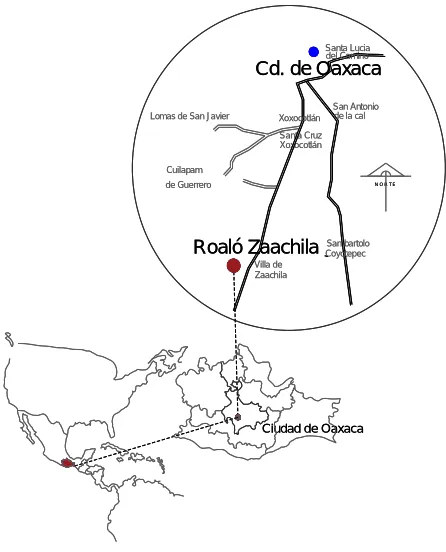
This study occurred in Santa María Roalo which is part of the municipality of Zaachila located in the state of Oaxaca, México. The geographical coordinates of the town are latitude 15º 47’02’, longitude 96º 55 and altitude 1500 msnm (Figure 1)
Villa de
San Antonio del Camino
Lomas de San Javier
Cuilapam
Zaachila
de la cal
Roaló Zaachila Xoxocotlán
de Guerrero
San bartolo N O R T E Cd. de Oaxaca
Santa Cruz
Coyotepec Santa Lucia
Xoxocotlán
Ciudad de Oaxaca
Roaló Zaachila
N O R T E
Ciudad de Oaxaca
Xoxocotlán Santa Cruz
del Camino Santa Lucia Cd. de Oaxaca
de la cal San Antonio
Coyotepec San bartolo
Zaachila Villa de Lomas de San Javier
de Guerrero Cuilapam
Xoxocotlán
Figure 1. Project localization
3. Methodology
The study (Caballero et al., 2010) was conducted at the Escuela Telesecundaria in the community of Santa Maria Roaló, Zaachila, Oaxaca, México. It examined the issues of comfort in the classrooms which were built with ferrocement technology (Figure 2). The research team, following the methods of participatory action research,(Alberich, 2002; Maffrand et al., 2002), adopted the following structure: a)participatory diagnosis, b) the development of a conceptual frame work and c) a participatory action plan to implement the solutions to the problems.
Figure 2. School built with ferrocement technology. Sta. María Roaló, Zaachila. (Photo: J. Caballero, 2010)
3.1 Diagnosis
The diagnosis comprised a quantitative study (Lertsatitthanakorn et al., 2009; Krugger and Givoni, 2004) in which the temperature of the classroom environment was measured. The diagnosis also included qualitative information (Clemes-Croome et al., 2008; Buidawi, 2007) from the students and teachers on their perceptions of the thermal conditions in the school with on-site physical observations made on four separate occasions of the activities in the classroom and of the behaviors of the users.
3.1.1 Physical diagnosis comfort classrooms
Dataloggers temperature recorders (HOBOS) were used in two classrooms which presented critically high
temperatures. The temperatures in the classrooms were recorded during the summer season (May and June 2010) at hourly intervals for sixty days. The aim of the measurements was to discover, analyze and evaluate the thermal behavior of these ferrocement classrooms.
3.1.2 Qualitative diagnosis
Figure3. Participatory diagnosis with students and parents. (Photos: R. Alavéz, 2010)
Specifically the questionnaires collected data on the following information: perceptions of the variations in temperature, typical activities in the classrooms, satisfaction with the comfort level inside the classroom, preferences for types of ventilation and lighting, impressions of the impact of the temperature in the classrooms on students´ health and perceptions of an ideal model classroom for students.
3.1.3 Developing a Conceptual Framework
The information obtained from physical diagnosis of the classrooms together with the information from the questionnaires completed by students and teachers, was collected, synthesized and analyzed. The results were made available to the students, teachers and parents. Following that the CIIDIR team presented alternative and strategies to resolve the problems of comfort in the classrooms.
3.1.4 Participatory Action Workshop
This strategy was proposed as a way of training members of the school community, students, parents and teachers, to be the generators of their own solutions, through the acquisition of knowledge and the interpretation of their circumstances (Enet, 2012; Mori, 2008). With that understanding, they can move to transform their reality.
The workshop developed the following agenda:
1)
The adoption of a social pedagogy which allows the participants to work as partners to achieve: a) to motivate people to take individual responsibility in their community, b) to work together to identify their problems, and c) to design and implement solutions. In this case the problems were identified as difficulties with stabilizing the comfort level and with associated health problems in the classrooms.2) The Methodology first called for the establishment of an environment in which the group could work. Second, in that environment they would have opportunities to learn from the personnel of CIIDIR both the knowledge and the processes of construction. Third, they would need time to discuss how they felt about the appropriateness of this alternative construction and whether it would meet their needs. Fourth, they would have the opportunity to practice using the methods of alternative construction and to decide if it is what they need.
Figure 4. Workshop Activities. (Photo: J. Caballero, 2010)
4. Results
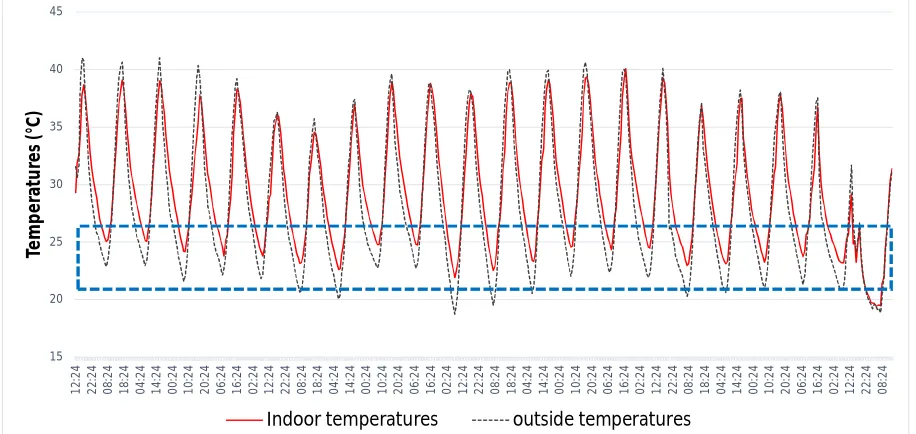
Figure 5 shows the average temperatures recorded in one of the classrooms in the study period (The data in Figure 4 presents information from one of the Dataloggers, because the other Dataloggers failed). The thermal comfort zone for Oaxaca City, 21.5 to 26.5oC, is presented in horizontal blue discontinued lines. 80% of the temperature
readings both inside and outside the classroom are located outside of this zone. Moreover, there is little difference in thermal lag presented during school hours, from 7 am to 14 pm. This indicates that the insulating capacity of ferrocement is almost zero. Therefore the community decided to take actions to improve the thermal conditions in the classrooms. 15 20 25 30 35 40 45 1 2: 2 4 2 2: 2 4 0 8: 2 4 1 8: 2 4 0 4: 2 4 1 4: 2 4 0 0: 2 4 1 0: 2 4 2 0: 2 4 0 6: 2 4 1 6: 2 4 0 2: 2 4 1 2: 2 4 2 2: 2 4 0 8: 2 4 1 8: 2 4 0 4: 2 4 1 4: 2 4 0 0: 2 4 1 0: 2 4 2 0: 2 4 0 6: 2 4 1 6: 2 4 0 2: 2 4 1 2: 2 4 2 2: 2 4 0 8: 2 4 1 8: 2 4 0 4: 2 4 1 4: 2 4 0 0: 2 4 1 0: 2 4 2 0: 2 4 0 6: 2 4 1 6: 2 4 0 2: 2 4 1 2: 2 4 2 2: 2 4 0 8: 2 4 1 8: 2 4 0 4: 2 4 1 4: 2 4 0 0: 2 4 1 0: 2 4 2 0: 2 4 0 6: 2 4 1 6: 2 4 0 2: 2 4 1 2: 2 4 2 2: 2 4 0 8: 2 4 Te m p er at u re s (° C)
Indoor temperatures outside temperatures
Figure 5. Temperatures in lecture halls during the summer
4.1 Bioclimatic Strategies
Figure 6. Vegetation outside of classrooms to provide fresh air. (Photo: R. Alavéz)
Another design strategy is to use thermal insulation on the roof and ferrocement walls, this can be done by building a second roof (Figure 7) using local materials and urban solid waste (recycled plastic bottles and cardboard).
Figure 7. Bioclimatic strategies-second roof on classrooms. (Photo: R. Alavéz)
4.2 Results of the questionnaire
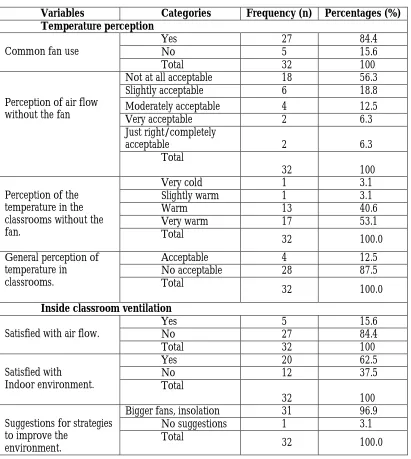
An analysis of the questionnaires completed by 38 students yields the following information: The average age of the students who completed the questionnaire is 14.4 years. The student group consisted of 56.3% male and 43.8% female. The majority of the students said that the principal activities in the classroom during school hours are to study (69.8%), to write (25%) and to read (6.3%).
Table 1. Perception of temperature and ventilation in classrooms
Variables Categories Frequency (n) Percentages (%) Temperature perception
Common fan use
Yes 27 84.4
No 5 15.6
Total 32 100
Perception of air flow without the fan
Not at all acceptable 18 56.3
Slightly acceptable 6 18.8
Moderately acceptable 4 12.5
Very acceptable 2 6.3
Just right/completely
acceptable 2 6.3
Total
32 100
Perception of the temperature in the classrooms without the fan.
Very cold 1 3.1
Slightly warm 1 3.1
Warm 13 40.6
Very warm 17 53.1
Total 32 100.0
General perception of temperature in classrooms.
Acceptable 4 12.5
No acceptable 28 87.5
Total
32 100.0
Inside classroom ventilation
Satisfied with air flow.
Yes 5 15.6
No 27 84.4
Total 32 100
Satisfied with Indoor environment.
Yes 20 62.5
No 12 37.5
Total
32 100
Suggestions for strategies to improve the
environment.
Bigger fans, insolation 31 96.9
No suggestions 1 3.1
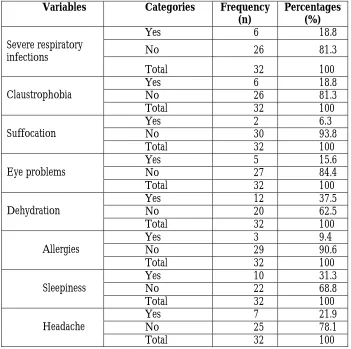
Table 2. Health problems from the environmental classrooms conditions
Variables Categories Frequency (n)
Percentages (%)
Severe respiratory infections
Yes 6 18.8
No 26 81.3
Total 32 100
Claustrophobia
Yes 6 18.8
No 26 81.3
Total 32 100
Suffocation
Yes 2 6.3
No 30 93.8
Total 32 100
Eye problems
Yes 5 15.6
No 27 84.4
Total 32 100
Dehydration
Yes 12 37.5
No 20 62.5
Total 32 100
Allergies
Yes 3 9.4
No 29 90.6
Total 32 100
Sleepiness
Yes 10 31.3
No 22 68.8
Total 32 100
Headache
Yes 7 21.9
No 25 78.1
Total 32 100
The results show that the majority of the students surveyed (94%) said that they suffered some physical reactions to the environment in the classrooms, the most common being sensations of dehydration and sleepiness. The students indicated their tastes and preferences from the point of view of the esthetics of the building. They wanted any changes in the school to reflect their responses in Table 3.
Table 3. Ideal classroom preferences
Variables Categories Frequency Percentages
Exterior walls classroom color preferences
Clear/Bright 28 87.4
Dark 2 6.3
Not answered 2 6.3
Total 32 100
Preferred environment outside of classroom
Planters 21 65.6
Trees 5 15.6
Water mirrors 5 15.6
Total 31 96.9
Results showed that teenagers prefer square shapes and bright colors for their "ideal classrooms". These features are similar to traditional schools built in many Oaxaca regions. This trend is due mainly to the preference that they have regarding the physical space of the classrooms, especially as they relate to their experiences both real and imagined (Silva, 2008). Preferences for the outside environment of the "ideal classroom" followed the directions established by Alvarez (2011), who believes that preferences in regard to physical space are linked to nature and necessity. These young students live in a rural setting with abundant vegetation and as a consequence their responses are shown in drawings of an ideal outdoor space, replete with planters, trees, bushes and ornamentation (Figure 8).
Figure 8. Detailing a model of an ideal classroom by the students. (Photos: J. Caballero, 2010)
4.3 Workshop
The development of the workshop enabled the community participants to acquire basic skills in organization and cooperation. It enabled the researchers from CIIDIR to modify their approach when working in order to link the construction technology with the needs of the communities. There was ample time and space during the workshop for reflection and an exchange of information on the experiences of the participants. The workshop was designed to include each of the stakeholder groups, in particular the students, teachers and people in the community. Because of its inclusiveness it was possible for all the participants to learn about and understand the expectations and aspirations of the other participants and to plan ways to realize their aspirations (Figure 9).
Figure 9. Construction of planters using plastic bottles. (Photo: J. Caballero, 2010)
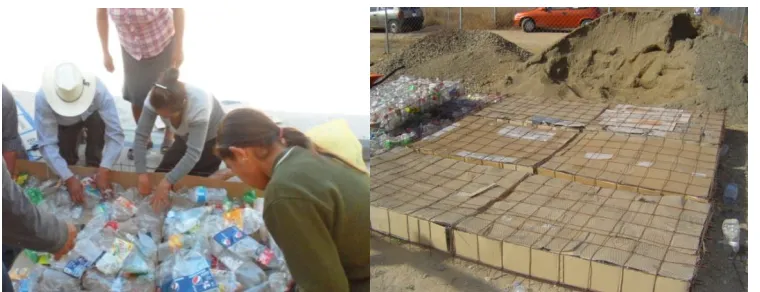
Figure10. Women and men filling the panel with recycled material. (Photos: J. Caballero, 2010)
The technology was adapted to fit the local resources- human, material, cultural and economic. The modular construction systems use components which required the use of recycled material and a minimal amount of readily available conventional material. The techniques of construction are easy to learn and allow for the ownership of the construction by the people of a community with few qualifications and little training. In addition because the system of construction is simple it does not require the use of sophisticated equipment or tools for implementation. During the workshop theoretical session, participants were informed on technical and economic benefits of the building technology (sandwich panel). Then CIIDIR team proceeded to organize working groups to build sandwich panels supervising their activities. Learned the construction technique participants were able to build insulating walls. This strategy has the purpose of helping the classrooms inside comfort (Figure 11).
Figure 11. Construction technique implemented on classroom walls to isolate them. (Photo: J. Caballero, 2010)
5. Conclusions
The collaboration and knowledge of appropriate building technologies and methods of organization should permit the students, teachers and parents to solve future problems of school improvement. Participatory approach will be an important strategy to bring actions based on proposals obtained from the bioclimatic study to improve classrooms comfort. CIIDIR researchers will continue with technical assistance and training workshops with students, teachers and community participation. In conclusion researchers have asocial responsibility to the community and it can be best fulfilled through the dissemination and application of alternative technologies in construction to improve the quality of life of people in the larger Oaxaca communities.
Acknowledgement
The researchers wish to acknowledge financial support from Instituto Politécnico Nacional de México-Secretaría de Investigación y Posgrado for the Project “Desarrollo de la Tecnología Fe+reciclado para vivienda de bajo costo y su evaluación sísmica en la ciudad de Oaxaca. SIP 2010”. In the same vein, the authors acknowledge the support of COFFA-IPN for the exclusive grant and Professor George Haley for their contribution to this paper.
References
Alberich, T. (2009). IAP, Redes y Mapas sociales: desde la investigación a la intervención social. Revista Portularia, pp. 1-28. Álvarez, S. (2011). ¿Cómo el diseño de espacios y la arquitectura influyen en la psicología del hombre? : Proyecto de Grado
(Doctoral dissertation, Medellín: Marymount School).
Arrow, K. (1962). The Economic Implications of Learning by Doing. Review of Economic Studies (The Review of Economic Studies), 29, 3, pp. 155-173
Bolos, S. (2003). Organizaciones sociales y gobiernos municipales: construcción de nuevas formas de participación. Universidad Iberoamericana, Mexico.
Budaiwi, I.M. (2007). An approach to investigate and remedy thermal-comfort problems in buildings. Building and Environment, 42, pp. 2124–2131.
Caballero-Montes, J.L., Alavéz-Ramírez, R.& Pérez-Flores, M.E. (2010). Proyecto para el mejoramiento del confort térmico en escuela de ferrocemento con participación estudiantil y comunitaria. VI Simposio Universitario Iberoamericano sobre Medio Ambiente.15 Convención Científica de Arquitectura e Ingeniería. CUJAE. La Habana, Cuba.
Caballero-Montes, J.L., Alavéz-Ramírez, R., & Juárez-Ruiz, L.A. (2013).Procedimiento constructivo de panel tipo sándwich para vivienda con materiales no convencionales. Congreso Patología, control de calidad y recuperación de la Construcción 2013. Cartagena de Indias, Colombia.
Clements-Croome, D.J., Awbi, H.B., Bako-Biró, ZS., & Williams, M. (2008).“Ventilation rates in schools”. Building and Environment, 43, pp. 362–367.
Enet, M. (2012). Diseño participativo: Estrategia efectiva para el mejoramiento ambiental y economía social en viviendas de baja renta. Cuadernos de Vivienda y Urbanismo. 5, 10, pp. 198-233
Frans, G. (1997). 80 Herramientas para el Desarrollo Participativo: diagnóstico, planificación, monitoreo, evaluación. Prochalate–IICA, San Salvador, el Salvador. 208 p.
Garzón, B. (2001). Sistemas Sanitarios Alternativos de participación para la construcción social del hábitat residencial rural. Boletín del Instituto de la Vivienda, 16, 43, pp. 77-87.
González, D., Alvárez, N., Ayala, O., & Pérez, D. (2011). Unidades locales para la Gestión Integral del Hábitat. Experiencia Cubana. Revista INVI, 26, 73, pp. 167-198.
Krüger, E., & Givoni, B.(2004). Predicting thermal performance in occupied dwellings. Energy and Buildings, 36, pp. 301–307 Lertsatitthanakorn, C., Atthajariyakul, S., & Soponronnarit, S. (2009).Techno-economical evaluation of a rice husk ash (RHA)
based sand–cement block for reducing solar conduction heat gain to a building. Construction and Building Materials, 23, pp. 364–369.
Maffrand, G., Ferrero, A., Martínez, M., & Rebord, G. (2002). Intervención socio-habitacional para la gestión asociada en sectores pobres de municipios medianos y pequeños. Boletín del Instituto de la Vivienda, 17, 45, pp.183-195.
Mori, M.P. (2008). Una propuesta metodológica para la intervención comunitaria. LIBERABIT, 14, pp.81-90