ISSN: 2372-4951 (Print), 2372-496X (Online) Copyright ©The Author(s). All Rights Reserved. Published by American Research Institute for Policy Development DOI: 10.15640/smq.v4n4a3 URL: https://doi.org/10.15640/smq.v4n4a3
Propelling Social Entrepreneurship towards Unambiguous
Recognition in Social Economy
Ariana Chang1, Jersan Hu2 & Wei Lo3
Abstract
This paper addresses the issue on how social entrepreneurship has shaped the modern social economy by examining the effects of social entrepreneurship. Thus, confronted are issues in regards to neglected meaningful social oriented activities that are quintessential for our economy. A conceptual framework comprehensively illustrates how certain activities can perhaps shift to be recognized. The conclusion coalesces the aforementioned examinations that social entrepreneurship and ancillary policy implementation entails attention to social issues with recognition that social entrepreneurship embed inherent value..
Keywords: social entrepreneurship, social value, social economy
1. Introduction
Be the change you want to see in the world-Ghandi
In the 21st century, one of the most pressing challenges of our time is the bipolarity of wealth among global citizens. Wealth has solely been concentrated at the top with a wide chasm between the poor and the rich. The rich are becoming wealthier as the poor sinks even more to the bottom. A global economic phenomenon of a polarized society that denotes the two extremes of rich and poor is ubiquitous.
1Ariana Chang, Ph.D Candidate, Graduate Institute of Business Administration, Fu Jen Catholic University, Taiwan. Email: [email protected]
2Jersan Hu, Professor, Graduate Institute of Business Administration, Fu Jen Catholic University, Taiwan. Email:[email protected]
The concept of a M-form society was first found in writings of William G. Ouchi (1984) depicting that the middle class would steadily vanish in a modern society due to the emergence of a M-shape society. Japanese economist Kenichi Ohmae (2006) later coined the term M-shaped society, stating that the structure of Japanese society has emerged into a M-shaped distribution. As a result, people in the lower-income group will have a harder time to ascend on the social ladder, especially as they will have fewer opportunities. The rise of a M-Shape society is due to the consequences of globalization that eventually assimilates the middle class to either end. However, this trend is not only prevalent in Japan. It is emerging in East Asian countries such as Taiwan and in the West such as United States.
Next to capitalism, the modern corporation represents the most important type of economic organization (Swedberg, 2003). The 2007 financial crisis reached a new high in September 15, 2008 when Lehman Brothers filed for bankruptcy that witnessed the collapse of the largest bankruptcy filing in U.S history, even surpassing the WorldCom and Enron scandals. The global financial crisis from 2007-2008 is considered one of the worst financial crises since the Great Depression of the 1930s. The bailout of banks by national governments prevented the collapse of financial institutions while the stock market plummeted. The recent surge of inequality in the West has been driven by the revolution in technology and inequality has soared within nations (Milanovic, 2016). Many of existing social issues such as poverty and hunger, environment maintenance and liberty rights pose imminent threat to the well-being of global citizens (Jensen et al., 2010).
In consequence, there is a pressing demand for alternative forms of businesses such as organizations that are set up for a social purpose, which can concurrently generate economic value. To effectively respond to societal needs, a vast majority of organizations arise to help or alleviate social issues. In this backdrop, the social economy sector is ever so important as it could help relief social matters. Organizations that encompasses social mission and generate some definite economic value through provided services at the same time lies in the concept of social economy (Quarter, Mook, & Armstrong, 2009).
Organizations within the social economy could then be the means to readdresses social issues neglected or that are remained status quo by the government due to budgetary constraints. Growth can generate prosperity and opportunity, advancing human development ultimately leading to economic growth. Despite high GDP growth, poverty is still on the rise. Notably, Africa continues to grow strongly but poverty and inequality remain persistently high (World Bank, 2013).
According to the World Bank’s report, almost one out of every two Africans still lives in extreme poverty today and suggests that most of the world’s poor people by 2030 will live in Africa. Hence, social protection should be set up to turn Africa’s adversity from the effects of globalization and climate volatility.
1.1 Research Objective
1.2 Public Welfare
Welfare economics is associated with two fundamental theorems with the first stating that given certain assumptions, competitive markets produce Pareto efficient outcomes (Hindriks and Myles, 2013).
The other captures the logic of Adam Smith's invisible hand (Mas-Colell et al. 1995) as markets are guided by natural force. Pareto efficiency or Pareto optimality is a concept named after Vilfredo Pareto (1848–1923), an Italian economist who used the concept in his studies of economic efficiency and income distribution. According to Pareto efficiency, it is almost impossible to make one party better off without making the other worse off. Economist Deaton (2013) stated that economists often incorrectly apply the Pareto argument to income, ignoring other costs while undermining and valuing wellbeing too narrowly. Living standard cannot be the sole criteria when assessing a society. To fully capture a human being’s wellbeing, wealth is only one of the many subjective components. Overall, Pareto efficiency has a minimal assumption of optimality since it makes no statement about equality or the overall wellbeing of a society that results from a socially desirable distribution (Sen, 1993).
The addition of new enterprises to the economy has been considered imperative to economic growth. In addition, many nonprofit organizations have already ventured out to pursue economic, social or environmental aims that policy makers consider to be invaluable agents (Haugh, 2007). Particularly, social entrepreneurship could help tackle social challenges by providing opportunities to alleviate societal problems by strengthening communities and encouraging social enterprises. This paper focuses on how social entrepreneurship pertains to address social concerns since it helps concede unrecognized beneficial activities.
Thus, they are willing to pay more for the quality products rather than the quantity. The eco-friendly farming system of organic agriculture is critical to our society since it has a role ofhelping to decrease ecological disasters and a growing lack of care for our ecosystem.
The rise of social entrepreneurship has unfolded against the backdrop of the crisis of global capitalism. While much of social ventures embed inherent social value, much of the activities stay tacit due to the unquantifiability. In fact, not all activities can be quantifiable. However, certain activities could surface by policy implementation as policy shapes activities so they can be include in the national economic assessment. One area worthy of exploring is on how to make social entrepreneurship more elusive since they embed social value that are critical to our society since they assist in filling the social gap.
2. Economic Systems
2.1 Current economic assessments
To determine a country’s economic performance, GDP and GNP are extensively used despite the fact that GDP and GNP ignore non-market goods such as voluntary labor (Vos et al. 2012). Maximizing GDP growth is limited albeit much of our economic policy today only centers on growth. One of the reasons for this exclusion is attributed to the tedious work of attempting to monetize and quantify volunteer labor. Most importantly, leisure time and work provided by homemakers are activities are not accounted in GDP (Deaton, 2013).In addition; other tacit activities such as homecare services for children and the elderly are neglected. Nevertheless, it is unequivocally that these tacit activities generate certain social value. Social entrepreneurs yield social value from generating positive externalities that impact beyond current activities because they do not forthrightly profit from the services of society (Auserwald, 2009).
It has been published on a regular basis in the United States since October 1947. Until 1990s, most countries used as the economic indicator GNP. It is defined as the market value of goods and services produced by labor and property supplied by a nation’s residents. The majority of U.S national accounts shifted from GNP to GDP in 1991. There is quite a query of how GDP reflects the quality of life of national citizens since it only represent the sum of the economy’s income during a given period. A hidden veil might cover the beguiling figures of GDP since the “mesmerizing” numbers may have other underlying implications.
GDP is the sum of the economy’s incomes during a given period.
GDP’s composition is formulated as Y=C+I+G+(X-M). The C stands for consumption, goods, and services purchased by consumers. It often constitutes the largest component of GDP (USA 2010, it accounted for 70.5% of GDP). I stands for investment such as the sum of non-residential investment and residential investment (purchase of people for new houses). G stands for government spending, expressing the purchases of goods and services by federal, state and local governments. Worthy of note, not included are government transfers such as social security payments or interest payments on government debt. The summation of C, I, G determines the purchases of goods and services by consumers, firms and government. Nations’ purchases of goods and services are determined by subtracting import from exports those results in X-M, which is called trade balance.
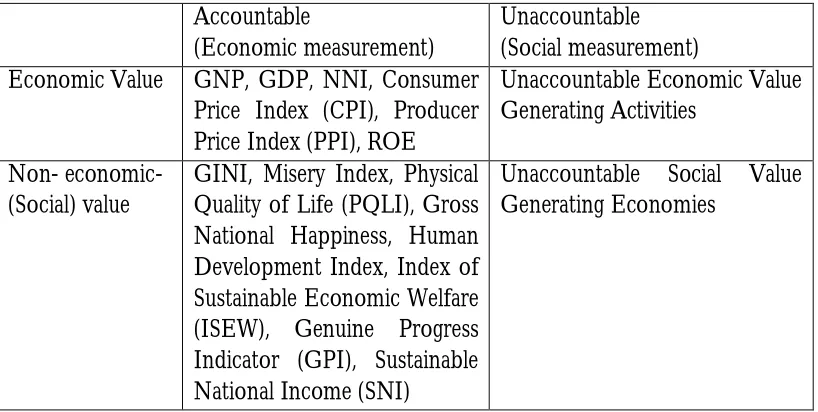
Below is a table constructed to classify value-generating measurements and accountability of economic and social activities? Two dimensions are used to construct table of Classification of Value Generating Activities. Especially as one dimension accounts for value measurement and the other accounts for value generation.
Table 1: Value Generating Measurements in Accountability of Economic and Social Activities Accountability
Accountable
(Economic measurement)
Unaccountable (Social measurement) Economic Value A. Current mainstream
economic indicators
C. Unaccountable Economic value-generating Activities Social Value B. Non-economic indicators
for well-being
D. Unaccountable social value-generating Economies
A. Accountable economic value-generating activities
Accountable economic value-generating activities include current economic indicators such as GDP and GNP, measuring the size of the economy and economic growth of a nation. The GDP of a country is defined as the total market value of all final goods and services produced within a country in a given period of time.
B. Non-economic social value-generating activities
C. Unaccountable economic value-generating activities
Unaccountable economic value-generating economies try to compensate for social costs. To improve certain environmental aspects, many social businesses automatically try to reduce ecological footprint that is not required by federal law. This paper pinpoints unrecognized beneficial activities. For GDP, it recognizes activities that could be transferred to monetization. For example, a homemaker who stays at home for services such as taking care of his or her children or the elderly are excluded from GDP.
Other activities such as unpaid household care, at-home parenting, volunteering; home-based production use and subsistence agriculture all lies in the caring economy. As aforesaid, various twentieth century economists have suggested the flawed logic of emphasizing market exchanges. Apart from cash transactions, transactions that make up the caring economy are expressed in terms of bartering. Therefore, it is of great significance to note that many of the activities comprised in this caring economy focuses on self-sufficiency, wherein a great amount of these activities is mainly done to self-provide. However, through government subsidy, these activities could be included in GDP. This paper pinpoints unrecognized beneficial activities. However, social policy proposals, social housing could also be a remedy for housing inequality.
Co-operatives are membership corporations, owned and democratically controlled by members and designed to operate for the benefit of members (Manwaring, Valentine &Thomson, 2011). They are diverse and supportive communities with self-contained units, convenient amenities, and professional management staff. There are more than 2,000 non-profit housing co-ops from buildings with four units to complexes with hundreds of apartments in Canada. There are 263 in B.C. alone.
According to the Co-operative Housing Federation of B.C, most were created with federal and provincial funding from the 1970s to the 1990s, according to the Co-operative Housing Federation of B. C. Housing co-op for a one-bedroom, 600 sq.-ft. apartment with a balcony in Vancouver's popular Gastown is around $732 per month (utilities included) in comparison to $1,600 to $1,900 per month private rental.
Housing co‑operatives provide not-for-profit housing for their members and thus, members do not own equity in their housing. Once they move, their home is returned to the co‑op, to be offered to another individual or family who needs an affordable home. In addition, some households pay a reduced monthly rent that is geared to their respective income. Government funds cover the difference between this payment and the co‑op’s full charge. Since co‑ops charge their members only enough to cover costs, repairs, and reserves, housing offered is much more affordable than average private sector rental costs wherein offering security. There is also no outside landlord since members who have a vote in decisions about their housing control co‑ops.
Vancouver’s co-housing project stemmed from the idea that community living is better for the environment has gained traction. Co-housing is a Danish idea that has been brought to North America by American architect Mr. Charles Durrett, based in California, USA. This growing phenomenon emerged from the concept of sharing economy with sharing activities such as cars, tools, books…etc. For the co-housing project, suburban homes may be too large for some homeowners. Thus, with shared courtyards, gardens, kitchen, dining room meals features solar panels, and electric-car outlet could be better alternatives. With high membership participation levels, co-housing could connect people from all walks of life.
Cohousing facilitates interaction among neighbors for social and practical benefits, economic and environmental benefits (McCamant and Durett, 1994; Durrett, 2009) undergirded by principles such as collaborative participatory process in which facilities are resident-managed.
D. Unaccountable social-value generating activities
Unaccountable Social Value Generating Economies accounts for activities that is hard to put into monetization such as social services, home-based production, agricultural subsistence, charity work, agricultural reactivation and community revival. In environmental economy, included are costs that are absorbed from pollution, building prisons, costs of waste in natural resources. Costs such as cleaning up pollution and building prisons are defined as defensive expenditures that are regrettably necessary to allow things that are good (Nordhaus and Tobin, 1972). This suggests that overall GDP will increase if there is more cleaning up and repairing after natural disasters, hence counting in the repairs results in being completely ignorant of the costs of destruction.
Complementary Programs
Many public libraries around North America have now surpassed other borrowing opportunities, as citizens are not only limited to borrow books. A side from just having a regular library, Toronto, Canada has supplemented an instrument-lending program in addition to its impressive tool library of kitchen implements and gardening tools. For music lovers who are not quite ready to buy an instrument, one can try out one first from his local library. In partnership with Sun Life Financial, the Parkdale branch will begin with 100 instruments. To expand its donation drive, the library is accepting gently used instruments at its branch and Long and McQuade stores. As a government organization, it could overlap with the private sector businesses illustrating its interconnectedness in the social economy with other institutions.
It is not always easy to demarcate social economy from the private and public sectors. This is particularly as boundaries are not always apparent (Mook, Quarter, & Ryan, 2010).
Keys to the Streets
Launched in spring 2013, Keys to the Streets brings an innovative approach to Vancouver’s public spaces by providing vibrantly painted pianos for all to play, celebrating music. It is a volunteer run operation that is uniquely supported by Vancouver community organizations. For provided is to help address the issue of social isolation in an urban environment, this music space encourages connections between many ethnic groups regardless of the level of musical skill aiming to create a space that makes Vancouver a more vibrant, engaged, and interactive city. The pianos that are painted by local artists offer a space for improvisational gatherings and connect people through music. Community stewarding organizations will look after the pianos during the duration of the program. Hence, this project has been identified as one the most engaging and accessible projects in Vancouver.
3. Concept of Social Economy
The term social economy first came into existence in France includes mutual benefit societies and nonprofit associations (Defourny et al., 1999). In other words, social economy encompass organizations that are set up to tackle social issues while generating economic value through product sales and services (Mook, Quarter & Richmond, 2007; Quarter, Mook, & Armstrong, 2009). Worth mentioning is that there is a dynamic interaction between social economy and other sectors. Many organizations within the social economy have distinct characteristics; however, they are still interconnected to the public and private sector (Mook, Quarter & Ryan, 2010).
3.1 Social Entrepreneurship
For social entrepreneurship, social value is difficult to measure and even if improvements could be measured, social entrepreneurs often cannot capture the value they generated in an economic form (Dees, 2001). A socially driven business is a business created to further a social purpose in a financially sustainable way. Mair and Marti (2006) have suggested that discovering social needs is necessary for social entrepreneurs. Social entrepreneurs are not only limited to create social value from direct profiting the service of society, but also by participating in activities that have an impact that reaches beyond current activities which is call generating positive externalities in economic terms (Auserwald, 2009). Especially as economic values are created when there is financial return on investment and the creation of social value is generated from combinations of resources and inputs to help improve the society as a whole (Gair, 2002).
According to the European commission, social enterprise is an operator in the social economy whose main objective is to have social impacts rather than making profit for their owners and stakeholders. It is necessary for social entrepreneurs to discover social needs (Mair and Marti, 2006). Overall, one of the most important tasks that lie in social enterprises is striving to achieve sustainability and create social value (Weerawardena and Mort, 2006). With the burgeoning ubiquitous prevalence of social enterprises, creating social value is the most vital mission for social entrepreneurship.
Results
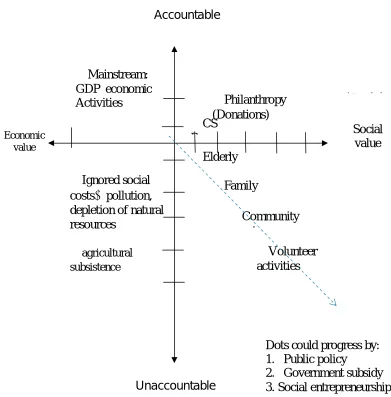
A conceptual framework has been proposed in this paper to illustrate that social welfare could be furthered by policy implementation. It is paramount that generating social impact accrues by interacting with public provision since political power could have the necessary resources to translate an organization’s needs into demands (Mulgan, 2010). Through policy implementation, these latent demands could turn into effective demand.
Figure 1: Trajectory of Social and Economic Activities
Conclusion and Discussion
Using market mechanism by rectifying the problems of unrecognized social productive activities forces social entrepreneurship to fill unfulfilled social needs. Thus, coupled with government subsidy and policy implementation to tackle market failures could be obtained by transforming productive social activities to be more apparent.
Economic value
(Social Accountable
Unaccountable
●Mainstream:
GDP economic Activities
●agricultural subsistence
●Volunteer
activities
●Elderly
care
●Family
care
●CS R
●Community
events
Dots could progress by:
1. Public policy
2. Government subsidy
3. Social entrepreneurship
●Philanthropy
(Donations)
●Ignored social
costs:pollution,
depletion of natural resources
Accordingly, it is imperative that policy makers create economic indicators that have social significance without resorting to current economic indicators. Therefore, this paper sheds light on the various productive social activities that are unnoticed in society The ability to synchronize different resources available for social entrepreneurship are allegedly critical as it can help social entrepreneurs engage in dynamic and sustainable operations.
Table 2: Classification of Value Generating Indicators
Accountable
(Economic measurement)
Unaccountable (Social measurement) Economic Value GNP, GDP, NNI, Consumer
Price Index (CPI), Producer Price Index (PPI), ROE
Unaccountable Economic Value Generating Activities
Non- economic- (Social) value
GINI, Misery Index, Physical Quality of Life (PQLI), Gross National Happiness, Human Development Index, Index of Sustainable Economic Welfare (ISEW), Genuine Progress Indicator (GPI), Sustainable National Income (SNI)
Unaccountable Social Value Generating Economies
One of the major challenges for the 21st century lies in the reform of institutions with the aim of broadening the social economy. Social entrepreneurship could potentially be a dynamic instrument to aid social problems in which shared prosperity could be attained. Social entrepreneurship needs to be preceded with recognizing neglected beneficial activities. As there could be differences of opinions responding to growing problems, social entrepreneurs with passion and commitment could offer the solution to lead a better society where citizens can benefit.
References
Auerswald, P. (2009). Creating Social Value. Stanford Social Innovation Review, Spring, 51-55.
Blanchard, O. and Johnson, D. H. (2013). Macroeconomics, 6th Edition, Pearson press. Chaves, R.A., and Monzon, J.L.C. (2007). The Social Economy in the European Union.
Report drawn for European Economic and Social Committee by the CIRIEC. Crawford, T. (2016). It’s not just Vancouver. Most urban Canadians upset over soaring housing
prices: poll. Retrieved from:
http://www.vancouversun.com/business/just+Vancouver+Most+urban+Ca nadians+upset+over+soaring+housing+prices+poll/11746578/story.html Deaton, A. (2013). The Great Escape: Health, Wealth, and the Origins of Inequality.
Princeton: Princeton University Press.
Dees, J. G. (1998). The meaning of social entrepreneurship,
http://www.fuqua.duke.edu/centers/case/documents/dees_SE.pdf.
Dees, J.G. (2001). The Meaning of “Social Entrepreneurship”. Center for the Advancement of Social Entrepreneurship, Fuqua School of Business, Duke University. Retrieved from:
http://faculty.fuqua.duke.edu/centers/case/files/dees-SE.pdf
Defourny, J., Develtere, P., &Fontaneau, B. (1999). The social economy: The worldwide making of a third sector. In L’econmiesociale au nord et au sud. Centre D’econmieSociale, Universite de Liege.
Durrett, Charles. (2009). Senior Cohousing: A Community Approach to Independent
Living.Gabriola Island, B.C.: New Society Publishers.
Fioramonti, L. (2013).Gross Domestic Problem: The Politics Behind the World’s Most Powerful
Number.(London: Zed Books).
Gair, C. (2002). A report from the good ship SROI. San Francisco: The Roberts Foundation.
Golden,Lonny and Wiens-Tuers, Barbara. (2008). Living Standards and Social Well-Being. Review of Social Economy, 66 (1), 25-49.
Grieco, C. (2005). Assessing Social Impact of Social Enterprises. Springer Briefs in Business. Grieco, C. (2015). Assessing Social Impact of Social Enterprises: Does One Size Really Fit All?
Springer Briefs in Business.
Haugh, Helen (2007). Community-Led Social Venture Creation. Entrepreneurship Theory
and Practice, 31(2), 161-182.
Hindriks, Jean and Myles, Gareth D. (2013). Intermediate Public Economics (2nd ed.), Cambridge, MA: MIT Press
Levitan-Reid, E., & Torjman, S. (2006). Evaluation framework for federal investment in the
social economy: A discussion paper. Ottawa, ON: Caledon Institute of Social Policy.
Manwaring, S. M., Valentine, A., and Thomson, M. (2011). Social enterprise in Canada:
Structural options. Publisher: MaRS Discovery District. Toronto, Canada.
Mas-Colell, A., Whinston, Michael, D. and Green, J. R. (1995). Chapter 16: Equilibrium
and its Basic Welfare Properties, Microeconomic Theory, Oxford University Press.
McCamant, Kathryn; Durrett, Charles (1994). Cohousing: A Contemporary Approach to
Housing Ourselves. Berkeley, Ca.: Ten Speed Press.
Meyer, C. and Kirby, J. (2012). Standing on the Sun: How the Explosion of Capitalism
Abroad Will Change Business Everywhere. Harvard Business Review Press.
Milanovic, B. (2016). Global Inequality: A New Approach for the Age of Globalisation. Harvard University Press
Mook, L., Quarter, J., and Richmond, B.J. (2007). What counts: Social accounting for
nonprofits and cooperatives (2nd ed.). London: Siegel Press.
Mook, L., Quarter, J., and Ryan, S. (2010). Researching the Social Economy. University of Toronto Press.
Mulgan G. (2010). Measuring Social Value. Stanford Innovation Review.
Nordhaus, W., & Tobin, K. (1972). Is growth obsolete?. In Economic Research :
Retrospect and prospect.(5, pp. 1-80). National Bureau of Economic Research.
Ohmae, K. (2006). The Rising Impact of the Lower-Middle Class Population in Japan. Tokyo, Kodansha.
Ouchi, W.G. (1984). The M-Form Society: How American Teamwork Can Recapture the
Competitive Edge. Addison-Wesley.
Piketty, T. (2016). Why Save the Bankers? And Other Essays On Our Economic and Political
Crisis. Houghton Mifflin Harcourt.
Porter, M.E. and Kramer, M.R. (2011). Creating Shared Value: How to reinvent capitalism and unleash a wave of innovation and growth. Harvard Business
Review.
Quarter, J., Mook, L. and Armstrong, A. (2009).Understanding the Social Economy: A
Canadian Perspective. Toronto: University of Toronto Press.
Restakis, J. (2006). Defining the social economy-the BC context. Prepared for: BC Social Economy Roundtable.
Rubin, Richard E. (2010). Foundations of Library and Information Science (3rd ed). Neal-Schuman Publishers: New York.
Sen, A. (1993). Markets and freedom: Achievements and limitations of the market mechanism in promoting individual freedoms. Oxford Economic Papers, 45(4), 519–541.
Sey, A., Coward, C., Rothschild, C., Clark, M., and Koepke, L. (2013). Public libraries
connecting people for development: Findings from the Global Impact Study. Seattle:
Technology & Social Change Group, University of Washington Information School.
Vos, S., Breesch, D., Késenne, S., Lagae, W., Lagae, J. V., Vanreusel, B., and Scheerder, J. (2012). The value of human resources in non-public sports providers: the importance of volunteers in non-profit sports clubs versus professionals in for-profit fitness and health clubs. International Journal Sport
Management and Marketing, 11(1/2), 3 - 25.
Weerawardenaa, Jay and Mort, Gillian Sullivan (2006). Investigating social entrepreneurship: A multidimensional model. Journal of World Business, 41, 21-35.
World Bank (2013).