ISSN: 2334-2986 (Print), 2334-2994 (Online) Copyright © The Author(s). 2014. All Rights Reserved. Published by American Research Institute for Policy Development DOI: 10.15640/jea.v2n2a7 URL: http://dx.doi.org/10.15640/jea.v2n2a7
Application of a Methodology for Ergonomic Diagnosis of Open Spaces
Carlos A. C Niemeyer1 & Lucila C. Labaki2
Abstract
The article presents a case study regarded to the studies of the ergonomics of the built environment by adopting a methodology of cognitive assessment of open spaces where evokes issues of environmental psychology that involves the system man-environment.In the course of this methodology interviews with goers of the square chosen randomly and with different ages, seeking to grasp levels of empathy and ownership with the environment were carried out.The study aims to contribute in environment-behavior studies serving as an auxiliary model in the diagnosis of environmental performance of open spaces.The methodological tool called "constellation of attributes" generates graphical models that allow visually identify qualifiers attributes in the cognitive framework.Induced questions about the imaginary environment (subjective) and real (objective) generate answers that demonstrate attributes of relevance and the resulting "psychological distance" associated with the affective functionality of habitat.The objective is to present a methodology useful to the dynamic work of architects and designers of the urban environment to allow means to focus the psychological awareness of the user by making an instrument for diagnostic analysis of the constructed environment.
Keywords: Evaluation Post-occupancy, Built Environment, Environmental Ergonomics, Environmental Psychology
1 Introduction
The architecture, while functional art is one that establishes a protective physical structure around our lives, organizing and humanizing the habitat of man with its purposes and intentions.
Zevi (1977) highlights the role of architectural space as something that goes beyond a set of geometric-abstract dimensions, but one that has an "inner space" full of intentions and itcan not grasp without becoming involvedin an intense experience of appropriation.
The perception we have of the architectural space assumes fundamental and psychological, that is precisely the surroundings closed that will determine our reactions of empathy and attractiveness with the place.The public squares, which is the object of this study, are intensely in this environmental materiality the extent that morphologically establishes an empty space and integrated internal structure of cities setting up a mediating element and symbolic of social life.
1
Msc.Pos-Graduate Program Scholl of Civil Engineering and Architecture of Campinas University. São Paulo, Brasil. Email: [email protected]. Tel 55 (19) 3521-2307.
2
They are indispensable elements for the welfare of the urban population, relieving feelings of oppression to lessen the weight of the masses built among other benefits linked to environmental performance.For this aspect, its importance for an effective social appropriation binds to a required environmental quality and a methodological-projetual approach that provides and ensures a proper performance of their functions both in the urban system and the social aspects.
In compliance with such requirements, and when properly maintained by public authorities, the social acceptance of a public open space is automatically and is reflected in the construction of a morphological identity creating the conditions conducive to its attractiveness.Previse the deploymentin harmony with the environment, arousing elements of perception and awareness of the city which, in the words of Merrifield (1996), "symbolize the solidarity and collective experience".Otherwise, it is fall in mishaps of the fragmentary and hedonistic city that scorns the urbanity when valuing the places of conviviality restricted,concludes Solà-Morales (2002).
In this context, classical studies in the field of environmental perception allow us to understand the importance of (re)building affective and cognitive ties in the apprehension of expectations and satisfactions with the urban environment.
Among these highlights the power of articulation of the urban landscape aroused feelings and emotions that allow the exaltation of affectivity described by Cullen (1971), the importance of environmental legibility as product of immediate sensations and the memory of preterit life experiences, conceptualized by Lynch (1960), passing through the contribution of studies of environmental psychology with GarlockBarker (1968) resulting from the theory of behavior setting or even the definition of psychological assumptions relational person-environment developed by Ittelson, Proshansky, Rivlin and Winkel (1974) whose conceptual basis will help in further studies regarded to the subjectivity of environmental perception.
In this course, highlights the analytical contribution given by Tuan (1974; 1977), for whom the spatial information received by the sense organs go beyond a simple perceptual relationship subject-object.Tuan (op. cit) refers to the affective experiential link to introduce a series of assignments from the term "topophilia" - the way in which people respond cognitively to physical environment- and that delimit by four axs: the appraisal aesthetics, the apprehension of physical space, the relationship of familiarity with the environment and life experiences.Tuan (op. cit.) will call "topophobia" the sensations of aversion and antipathy to place or physical environment, which refers to the concept of "landscape of fear" and the denial of the place.
To ensure individual and collective attractiveness, the environment provides a state of harmony of our experiences and desires of appropriation of the city and its places.Therefore, the construction of place involves feelings of topophilia founded in aesthetic appreciation, in the relations of influence and to sensory stimuli that, acting unconsciously, potentiate conditions of empathy and pleasantness with the place.If this empathy strengthens our bonds of belonging, feelings contrary to this can also generate hostile feelings generating revulsion and even in some cases encourage vandalism. Studies show this relationship crime/feeling of insecurity and "untying of the place", affirming a social pathology that imposesfleetingness to the relationship of people with the urban environments (Jacobs, 1961).
For this reason the square requires a constant rethinking of morphological conformations that meet the predicates of socio-environmental performance in local and temporal contexts for which historically holds its aggregate power of attractiveness.
Organizational weaknesses observed in the process of designing such as insufficiencyof previous studies or uncertaintyof goals and needseventually motivate projects little connected with the place, referring to a negative relation with the product generated.Designed on the basis of intuition of the designer and free from measurements more sensitive, projects surface can result in confusion, discomfort and disfunctionality, notes Martin (2009), which cancels the perspective of construction of the place, seen as counterpoint the abstraction of physical space undifferentiated. The "place" in the perspective of topophiliamustassimilate affective values and a sense of welcome and belonging that favors their appropriation.
However, in the projetual dynamics to which we concentrate (lean,are discussing), the affective and cognitive components active are not always possible to be identified in view of the subjectivity of perceptual issues involved and its intangibility as to allow exteriorize physically. This approach affects the studies of environmental psychology, suggests the application of methodologies that allow properly to grasp the elements that constitute and qualify sensoriallythe environment and so that we can reajustit to our psychosocial demands. Thus returning the sense of belonging that should illuminate the perspective of usability of the communal space and correctional element to travelthereconstructionof the places.
2 Grounding
According to the International Ergonomics Association (IEA), "Ergonomics is the scientific discipline concerned with the understanding of interactions among humans and other elements of a system" according to their needs, abilities and limitations.And it is up to the environmental ergonomics, a branch of ergonomics that studies the human-environment interactions, provide the means and techniques required to identify and systematize actions of correction / prevention of adverse conditions that interfere with the performance of the built environment.
The environmental ergonomics which is guided this study directs its gaze to physiological, cognitive, social, organizational and environmental factors that act and determine the functionality of the architectural space (Mont'alvão&Villarouco, 2011; Vasconcelosetali, 2009 and 2010; Villarouco, etali, 2012).Issues related to thermal, acoustic and luminous comfort are associated to cognitive impressions making the set concerns about the suitability of the environments to our needs of comfort and usability.The case study presented below focuses on a post-occupational diagnosis trampled on an informational process of cognitive analysis of an open space in the perspective provided by the environmental ergonomics illuminatingconditions of adaptability and conformity of the space to leisure activities and sociability prevised there.
The study aims to contribute to the understanding of these issues related to the cognitive perception of the environment where it adopts the analytical tool called Constellation of Attributes, theorized pioneered by Abraham Moles (1968) and developed by Ekambi-Schimidt (1974), researchers from the Institute of Psychology of Strasbourg in the interest of understanding the so-called "psychological awareness" of the user. Applied to the specific conditions of open spaces, inquiresa sample of usersbyfocusing on the analysis of the quality of the human-environment system considering attributes linked to safety, environmental comfort, furnishings, functionality, aesthetics and maintenance.
3 Materials and Methods
The methodology establishes the reading of variables (attributes) captured and systematized from the anwersobtained that involve the two specific realities to the casestudy on screen: the lived reality and theimage we haveof the space.Questions addressed to respondents guide the analysis in two steps of procedures whose results analytically dialogue. The interrogators are instructed to not limit the answers grouped into qualifying and elected categories.The question (1) refers to the imaginary field, the wishes and desires of the user as a living and open space that in its view, it would causepleasantness: What images or ideas comes to your mind when you think in a square?The objective of this question is to determine perceptionsabout the ideal environment linked to expectations of comfort even if operate in this process stereotyped visions arising from mass-behaviors and values, second puts Ekambi-Schimidt (1974).The question (2) refers to the image of the real square: What images or ideas comes to your mind when you think about this square? The question seeks to capture a particular and affective opinion no longer affected by the images and stereotypes, capturing spontaneous returns of the interviewee.
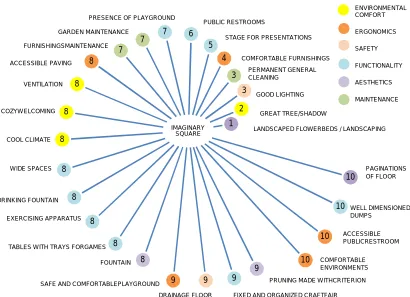
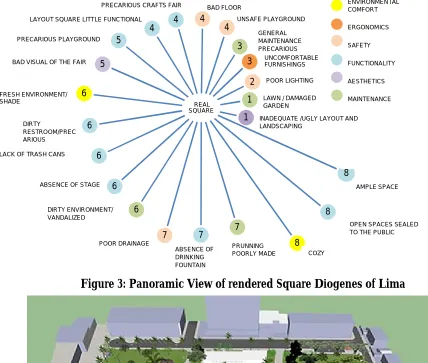
The graphic model generated allows visually capture the level of affective perception of the user and establish a chain of attributes according to its frequency of appearance in the answers. The generated model also allows the calculation of "psychological distance" (see tables) that refer to the attractive nessdimensiongiven to each attribute. Two "constellations of attributes" (real and imagined) are as well builtas a result of raised compilations providing a reading of this man-environment interface.The variables are represented graphically through the definition of the probability (Pi) of the attribute association (i) with the object evaluated from the formula (a) and the "psychological distance" (D) in cm that separates each attribute of the object of study basedon the formula (b) described below.
(a) = b) =
Being Pi = probability of association of the attribute i D = psychological distance (cm)
ni = number of appearances of attribute i
N = total replies
4 Results
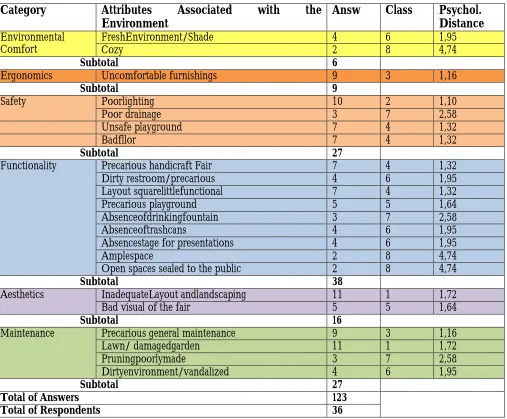
Following presentsthe frames(1 and 2) statements with the quantifications of categorized attributes with the respective psychological distances calculated on the basis of the formula above.The categories are represented by the chromatic code associated to those indicated in the tables with the measures of the bars (scaled in centimeters) calculated by the frequency that attend.The results lead to the construction of two constellations in sequence representing the materialization of a studied phenomenon where interact psychosocial factors, physical social and historical-cultural providing the reading of cognitive perception of the environment.
Table 1: Attributes associated with the Imaginary Square
Category Attributes Associated with the Environment
Answ Class Psychol. Distance Environmental
Comfort
Many tress/shadow 12 2 1,05
Ventilation 4 8 2,12
Cozy welcoming 4 8 2,12
Cool climate 4 8 2,12
Subtotal 24
Ergonomics Comfortablefurnishings 8 4 1,29
Acessiblepaving 4 8 2,12
Comfortableenvironments 2 10 5,86
Accessiblepublicrestroom 2 10 5,86
Safe playground / comfortable 3 9 2,88
Subtotal 19
Safety Drainagefloor 3 9 2,88
Goodlighting 9 3 1,21
Subtotal 12
Functionality Playground 5 7 1,76
Stage for presentations 7 5 1,40
Clean publicrestroom 6 6 1,54
WideSpaces 4 8 2,12
Exercisingapparatus 4 8 2,12
Tables with trays for games 4 8 2,12
Dumpswelldimensioned 2 10 5,86
DrinkingFountain 4 8 2,12
Fixed and organized handicraft fair 3 9 2,88
Subtotal 39
Aesthetics Pruningmadewithcriterion 3 9 2,88
Landscapedflowerbeds/Landscaping 13 1 1,01
Fountain 4 8 2,12
Paginationsoffloor 2 10 5,86
Subtotal 22
Maintenance Garden maintenance 5 7 1,76
Permanent general cleaning 9 3 1,21
Furnishingsmaintenance 5 7 1,76
Subtotal 19
Total ofAnswers 135
Table 2: Attributes associated with the Real Square Category Attributes Associated with the
Environment
Answ Class Psychol. Distance Environmental
Comfort
FreshEnvironment/Shade 4 6 1,95
Cozy 2 8 4,74
Subtotal 6
Ergonomics Uncomfortable furnishings 9 3 1,16
Subtotal 9
Safety Poorlighting 10 2 1,10
Poor drainage 3 7 2,58
Unsafe playground 7 4 1,32
Badfllor 7 4 1,32
Subtotal 27
Functionality Precarious handicraft Fair 7 4 1,32
Dirty restroom/precarious 4 6 1,95
Layout squarelittlefunctional 7 4 1,32
Precarious playground 5 5 1,64
Absenceofdrinkingfountain 3 7 2,58
Absenceoftrashcans 4 6 1,95
Absencestage for presentations 4 6 1,95
Amplespace 2 8 4,74
Open spaces sealed to the public 2 8 4,74
Subtotal 38
Aesthetics InadequateLayout andlandscaping 11 1 1,72
Bad visual of the fair 5 5 1,64
Subtotal 16
Maintenance Precarious general maintenance 9 3 1,16
Lawn/ damagedgarden 11 1 1,72
Pruningpoorlymade 3 7 2,58
Dirtyenvironment/vandalized 4 6 1,95
Subtotal 27
Total of Answers 123
Total of Respondents 36
The size of the bars shows the essence of the method and its graphical output with the lesser or greater symbolic value for the attributes in screen; thus greater distances show little affinity, while the smaller show a higher affinity providing this wayemotional information associated with the considered aspects.
Figure 1: Constellation of Attributes for the Imaginary Square
IMAGINARY SQUARE
7 5
4
3 3
2 1
10
10
10
10 9
9 9 9 8 8 8 8 8 8
8 8
8
7 7 6
ENVIRONMENTAL COMFORT
ERGONOMICS
SAFETY
FUNCTIONALITY
AESTHETICS
MAINTENANCE SUBTITLE
LANDSCAPED FLOWERBEDS / LANDSCAPING GREAT TREE/SHADOW
GOOD LIGHTING PERMANENT GENERAL CLEANING
COMFORTABLE FURNISHINGS ACCESSIBLE PAVING
PUBLIC RESTROOMS
STAGE FOR PRESENTATIONS GARDEN MAINTENANCE
FURNISHINGSMAINTENANCE
VENTILATION
COZYW ELCOMING
COOL CLIMATE
PRESENCE OF PLAYGROUND
W IDE SPACES
DRINKING FOUNTAIN
EXERCISING APPARATUS
TABLES W ITH TRAYS FORGAMES
FOUNTAIN
SAFE AND COMFORTABLEPLAYGROUND
DRAINAGE FLOOR FIXED AND ORGANIZED CRAFTFAIR PRUNING MADE W ITHCRITERION
COMFORTABLE ENVIRONMENTS
ACCESSIBLE PUBLICRESTROOM
WELL DIMENSIONED DUMPS
PRUNNING POORLY MADE
OPEN SPACES SEALED TO THE PUBLIC
ABSENCE OF DRINKING FOUNTAIN
Figure 2: Constellation of Attributes for the Real Square
Figure 3: Panoramic View of rendered Square Diogenes of Lima
5 Conclusions
The results show that the imaginary environment meets a strong identification with attributes related to the environmental comfort, functionality and aesthetics, highlighting in the valuedperception of functional aspects related to the playful use of the square as the presence of playground, stagefor presentations and more ample spaces, a dissatisfaction with the design of it.This aspect reveals the tension with the winding and narrow disposition of the existing paths that restricts the use of the square face to the limitations of the appropriate standard of eclectic typology of the promenade.
REAL SQUARE
4 4
3 3
2
1
1
8
8
8 7
7 7
6 6 6 6 6
5 5
4 4
ENVIRONMENTAL COMFORT
ERGONOMICS
SAFETY
FUNCTIONALITY
AESTHETICS
MAINTENANCE SUBTITLE
AMPLE SPACE
COZY POOR DRAINAGE
DIRTY ENVIRONMENT/ VANDALIZED ABSENCE OF STAGE LACK OF TRASH CANS
DIRTY
RESTROOM/PREC ARIOUS FRESH ENVIRONMENT/ SHADE
BAD VISUAL OF THE FAIR PRECARIOUS PLAYGROUND
LAYOUT SQUARE LITTLE FUNCTIONAL
PRECARIOUS CRAFTS FAIR BAD FLOOR
UNSAFE PLAYGROUND GENERAL MAINTENANCE PRECARIOUS
UNCOMFORTABLE FURNISHINGS
POOR LIGHTING
LAWN / DAMAGED GARDEN
Confronting this category with the real scenario we verify that it confirmsthe "barely functional" provisionaggregate the existing insecurity of the playground, absence of stage for popular musical / theatrical presentations and the precariousness of the handicraftfairinstallationsexisting there on the weekends.Still in this real environment it glimpses uncomfortable with the insecurity of constructive aspects (precarious lighting and drainage and unsafe playground) and the lack of maintenance of the enclosure.
With respect to aesthetics it can be seen that the imaginary attribute of greater request comes from the existence of flowered gardens, finding support in real environment where this important attribute is revealed along with the inadequacy of its layout (design) landscape.Furthermorethe square is revealed attractive on weekends regarded to the craft fair, however seen as "poor"by the incompatibility with the space intended to it.Recommendations should be observed regarding the need to reform its design to better accommodate an architectural program to meet the needs there conferred, seen superficially here.
By this pointthe space analyzed catalyzes a context of poor environmental performance and low esteem of the user population. The square is revealed this way conflicting with the playful needs of the population resulting in difficulty of appropriation for and consequentabandonment of the same, which configuresa negative indicator to the valuation ofthe public sphere and the quality of the experience.In general, the study allowed to assess the effectiveness of the tool in cognitive performance of open environments as it already does in the indoor environments allowing better understand the demands of the user population.
Foresee its use for diagnostics of the built environment to allow a gleam of hidden psychological aspects anddifficult to quantify and evaluate on a process of investigation more judicious.
6. References
ALTMAN, I & CHEMRS, M (1980),Living Cities. In: Culture and Enviroment. Monterey, Ca:Brooks/Cole. BARKER, G (1968), Ecological psychology.Stanford University Press.
BOMFIM, Zulmira Áurea Cruz (2008), Afetividade e Ambiente Urbano: uma proposta metodológica pelos mapas afetivos.In:
PINHEIRO & GUNTHER, Hartmut (Org), Métodos de Pesquisa nos Estudos pessoa-ambiente. São Paulo: Casa do Psicólogo,p. 253-280.
CULLEN, Gordon (1971), Townscape, Architectural Press.
EKAMBI-SCHMIDT, J (1974),La percepcióndel hábitat. Barcelona: G. Gili.
FONSECA, Juliane F &RHEINGANTZ, Paulo A (2009), O ambiente está adequado? Prosseguindo com a discussão. Produção, v.19, no. 3. São Paulo, Set/dez, p 502-513.
IEA (International Ergonomics Association), 2009.What is Ergonomics.Availablein: http://www.iea.cc/browse.php?contID=what_is_ergonomics.
ITTELSON, W, PROSHANSKY, H, RIVLIN, L & WINKEL, G (1974), An introduction to environmental psychology.New York: Holt. Rinehart & Winston.
JACOBS, Jane (1961), the Death and Life of Great American Cities.New York: Random House and Vintage Books. LYNCH, Kevin, (1960), The image of city. MIT.
MARTIN, Christian, O ergonomista nos projetos arquitetônicos. In: FALZON, Pierre (2009), Ergonomia. São Paulo: Edgard Blucher, p. 357-369.
MERRIFIELD, A (1996). Public space: Integration and exclusion in urban life. City, 5 (6), 57-72. MOLES, A (1968). Sociodinámica de La cultura. Barcelona: Editora Gustavo Gili.
SOLÀ-MORALES, Ignaside (2002), Territórios. Barcelona: Gili.
TUAN, Yi-fu (1974).Topophilia: a study of environmental perception, attitudes, and values. Prentice-Hall, Englewood Cliffs, NJ. _____ , Yi-Fu (1977).Space and Place: The Perspective of Experience. University of Minnesota Press, Minneapolis, MN.
VASCONCELOS, Christina S.F, et ali (2010), Contribuição da Psicologia Ambiental na análise ergonômica do ambiente construído. Revista Ação Ergonômica. Rio de Janeiro: ABERGO/UFRJ, volume 5, no. 3, p.14-20.
_______________, Christina S.F (2009). Avaliação Ergonômica do Ambiente Construído: estudo de caso em uma biblioteca universitária. Ação Ergonômica, no. 4, no. 1, Rio de Janeiro. ABERGO/UFRJ, volume 4, no. 1, p.5-25.
VILLAROUCO, Vilma (2009), An ergonomic look at the work environment. In PROCEEDINGS OF THE 17th WORLD
CONGRESS ON ERGONOMICS, Beijing-China, IEA.