METHODOLOGY
An efficient approach to BAC based
assembly of complex genomes
Paul Visendi
1,2, Paul J. Berkman
3, Satomi Hayashi
1, Agnieszka A. Golicz
1, Philipp E. Bayer
1,4, Pradeep Ruperao
1,4,
Bhavna Hurgobin
1,4, Juan Montenegro
1, Chon‑Kit Kenneth Chan
1,4, Helena Staňková
5, Jacqueline Batley
1,4,
Hana Šimková
5, Jaroslav Doležel
5and David Edwards
1,4*Abstract
Background: There has been an exponential growth in the number of genome sequencing projects since the intro‑ duction of next generation DNA sequencing technologies. Genome projects have increasingly involved assembly of whole genome data which produces inferior assemblies compared to traditional Sanger sequencing of genomic frag‑ ments cloned into bacterial artificial chromosomes (BACs). While whole genome shotgun sequencing using next gen‑ eration sequencing (NGS) is relatively fast and inexpensive, this method is extremely challenging for highly complex genomes, where polyploidy or high repeat content confounds accurate assembly, or where a highly accurate ‘gold’ reference is required. Several attempts have been made to improve genome sequencing approaches by incorporat‑ ing NGS methods, to variable success.
Results: We present the application of a novel BAC sequencing approach which combines indexed pools of BACs, Illumina paired read sequencing, a sequence assembler specifically designed for complex BAC assembly, and a custom bioinformatics pipeline. We demonstrate this method by sequencing and assembling BAC cloned fragments from bread wheat and sugarcane genomes.
Conclusions: We demonstrate that our assembly approach is accurate, robust, cost effective and scalable, with appli‑ cations for complete genome sequencing in large and complex genomes.
Keywords: Next‑generation sequencing, SASSY, BAC, Assembly, 7DS, Triticum aestivum, Saccharum spp
© 2016 Visendi et al. This article is distributed under the terms of the Creative Commons Attribution 4.0 International License (http://creativecommons.org/licenses/by/4.0/), which permits unrestricted use, distribution, and reproduction in any medium, provided you give appropriate credit to the original author(s) and the source, provide a link to the Creative Commons license, and indicate if changes were made. The Creative Commons Public Domain Dedication waiver (http://creativecommons.org/ publicdomain/zero/1.0/) applies to the data made available in this article, unless otherwise stated.
Background
Genome sequencing is revolutionising our understand-ing of biology, and the field is developunderstand-ing rapidly due to advances in DNA sequencing technologies. However, as a greater number of genomes are sequenced, there has been a general decline in the quality of published whole genome shotgun assemblies due to gaps and miss-assem-blies [1–3]. Many biological questions can be answered without the need of a gold standard pseudo molecule ref-erence assembly. For example, the analysis of gene con-tent, the discovery and application of molecular genetic markers and evolutionary studies can be undertaken with
draft whole genome shotgun assemblies which are rela-tively quick and inexpensive to produce. However, these draft assemblies have limitations, particularly in complex and polyploid genomes where it is difficult to resolve par-alogues or homoeologues. Finished pseudo molecules are also required for the detailed study of genome rearrange-ments. The production of at least one high quality refer-ence assembly should be a goal for all major crop plants.
Despite recent advances, the production of refer-ence genomes remains hampered by factors such as a high repeat content, gene and genome duplication [4, 5]. Incorporating repeat spanning mate pair (MP) data and newer long read third generation sequencing plat-forms such as Single Molecule Real-Time (SMRT) DNA sequencing have partially resolved this, though the high error rates of long read data can also confound accu-rate assembly [6, 7]. The accuracy of a final assembly is
Open Access
*Correspondence: [email protected]
4 School of Plant Biology, University of Western Australia, Perth, WA 6009, Australia
Page 2 of 9 Visendi et al. Plant Methods (2016) 12:2
determined by a combination of the complexity of the genome being sequenced, the quality of data used and the assembly approach [8].
For large, repetitive and complex genomes, whole genome shotgun (WGS) assembly usually results in highly fragmented assemblies that require consider-able effort to order and orientate to produce acceptconsider-able pseudo molecules. In addition to the incorporation of MP and long read data, approaches may include the use of genetic and physical maps [9, 10], synteny to closely related species with reference genomes [4, 11], genotyp-ing by sequencgenotyp-ing [12] and population sequencing [13].
The more traditional BAC-by-BAC approaches to genome sequencing generally produce much higher quality assemblies than WGS, however BAC sequenc-ing remains relatively expensive due to the cost of mak-ing BAC libraries, fmak-ingerprintmak-ing BAC clones and the sequencing of large numbers of overlapping BACs. Sequencing of the 2.5 Gbp maize genome using a BAC-by-BAC approach was estimated to cost US$50 million [14–16].
Bread wheat and sugarcane both have large and com-plex genomes which are challenging to assemble. Bread wheat has a hexaploid genome (2n = 6x = 42) that con-tains three ancestral diploid genomes (AABBDD), each with 7 chromosomes. The genome is large, around 17 Gbp and is predominantly made up of repeat elements [17, 18]. Sugarcane varieties have smaller genomes, around 10 Gbp [8, 19] but most are hybrids of two spe-cies, Saccharum spontaneum and Saccharum offici-narum, S. officinarum being an octoploid with 2n = 80 chromosomes and S. spontaneum demonstrating vary-ing ploidy (5–16x) and 2n chromosome number rangvary-ing from 40 to 128.
The complexity of the bread wheat and sugarcane genomes makes producing reference genome assem-blies a challenge. While BAC-by-BAC approaches offer complexity reduction, individual BACs would still con-tain a high percentage of repeats (~80 %) in wheat as repeats are distributed in the genome. Thus BACs gen-erated from such genomes are referred to as complex and repetitive despite the reduction in size. Decreas-ing the cost of BAC sequencDecreas-ing while maintainDecreas-ing or improving the accuracy of assembly has the potential to significantly decrease the cost of sequencing these genomes and enables the application of BAC-by-BAC approaches to diverse species. We present an efficient and cost effective approach for the sequencing and assembly of complex BACs using an optimised BAC pooling, data generation and bioinformatics assembly pipeline, and demonstrate the use of this approach by assembling BACs from bread wheat chromosome arm 7DS and sugarcane.
Results and discussion
Determination of the optimal sequencing depth for BAC assembly
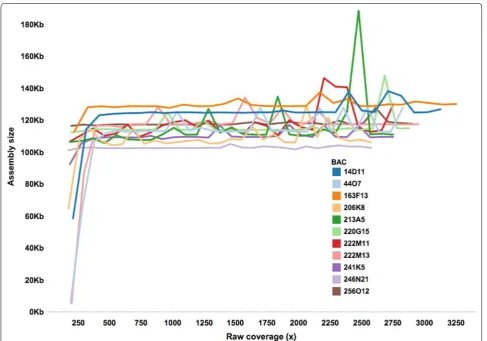
To determine the level of sequence coverage for accu-rate BAC assembly, eleven individual sugarcane BACs from the sugarcane cultivar R570 BAC library [20] were sequenced to extremely high coverage (>3000x). Reads were split into subsets representing 200x–3000x cover-age, with 100x increments. The subsets were assembled with SASSY [21] (https://github.com/minillinim/SaSSY), which is an assembler customised for the assembly of complex repetitive BACs. Assemblies had an average N50 of 52 Kb and average number of contigs per BAC of 5.2 (Additional file 1: Table S1). For each of the BACs, assem-bly length increased until around 450x, then levelled off until 900x (Fig. 1). This suggests that >450x coverage is required for optimal BAC assembly, consistent with pre-vious findings [21] in which the SASSY assembler was demonstrated to require a relatively large amount of data. The variation in assembly length observed for data-sets greater than 900x (Fig. 1) is likely to be due to the increase in number of erroneous reads confounding the assembly process.
Assessing the accuracy of BAC pooled assemblies
Even with the high degree of indexing available with Illumina DNA sequencing methods, the sequencing of individual BACs remains expensive. A pooling strat-egy was consequently established to increase through-put and reduce costs. The number of BACs which can be sequenced in a single lane of Illumina HiSeq 2000 is determined by the coverage required (450x–900x), the mean BAC length (around 120 Kb) and the data volume from the Illumina HiSeq (around 40 Gbp per lane). This suggests that pooling 384 BACs within a single lane, with accurate quantification and normalisation should produce around 850x coverage for each BAC. Consider-ing that BAC DNA is likely to contain some contamina-tion with Escherichia coli genomic sequence, the actual sequence coverage is likely to be less than this and fitting well within the range of 450x–900x shown to produce optimal assemblies.
B and G assembled as a single contig. Assemblies of pooled BACs (ABCE, BCEF, CEFG and EFGH) (Table 1) had an average N50 of 41 Kb with an average of 5.3 con-tigs per BAC.
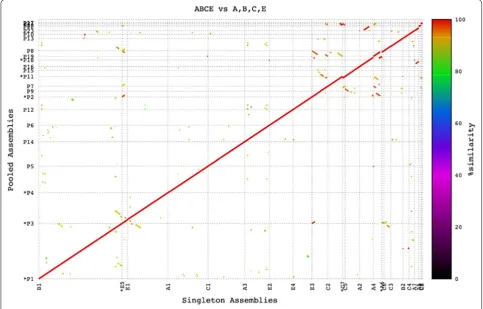
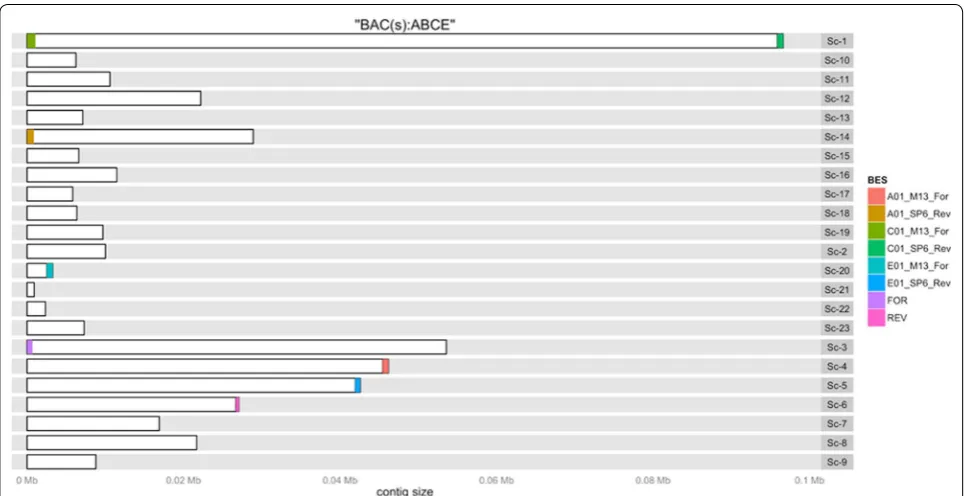
A sequence comparison of contigs from individually assembled BACs (Additional file 1: Table S3) showed the integrity of individual BAC assemblies in pooled assemblies was maintained and assemblies of BAC pools remained collinear with those of individual BAC assemblies (Fig. 2). Pooled assemblies were further vali-dated by comparison with their Sanger sequenced BAC ends. Mappings of BAC ends showed individual BACs remained separate in a pooled assembly (Fig. 3).
High throughput wheat BAC assembly
Following an assessment of the sequencing depth and pooling strategy, 96 BAC pools, each representing four randomly selected BACs from a bread wheat 7DS BAC library [22] were indexed and sequenced using a single lane of Illumina HiSeq 2000. E coli and vector sequences were removed resulting in a mean coverage per BAC of
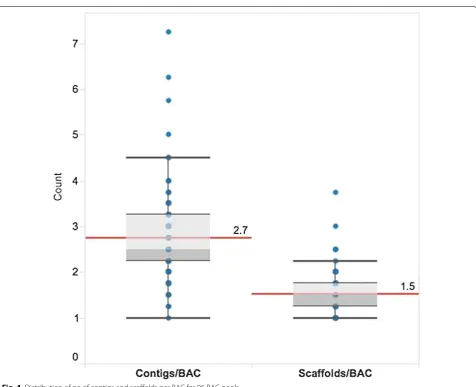
690x with a range of between 184x and 889x. Only 3 % (12/384) of the BACs had coverage below 490x. Data from BAC pools was assembled using SASSY. The result-ing assemblies (Table 2) had a mean N50 of 80 Kb, with an average of 2.7 contigs per BAC (Fig. 4). An average of 2.7 contigs per BAC for 96 pools compared to 5.3 con-tigs per BAC for four BAC pools (ABCE, BCEF, CEFG and EFGH) (Table 1) was lower and more accurate as a result of the higher number of BACs assembled. Of all the BACs, 99.5 % (382/384) had seven contigs or less per BAC, while 75 % of the BACs (288/384) had three con-tigs or less per BAC (Fig. 4; Additional file 1: Table S3). Assemblies were further improved by scaffolding with mate pair (MP) reads. Scaffolding resulted in an increase in N50 from 80 to 106 Kb. The average number of con-tigs per BAC after scaffolding was reduced from 2.7 to 1.5 (Fig. 4). After scaffolding, 99.5 % (382/384) of the BACs had four scaffolds or less per BAC (Fig. 4; Additional file 1: Table S4), while 75 % of the BACs (288/384) had two scaffolds or less per BAC (Fig. 4; Additional file 1: Table S4).
Page 4 of 9 Visendi et al. Plant Methods (2016) 12:2
Paired read orientations and insert sizes of MP reads mapped to E coli and the 96 pool assemblies showed 99 % of the MP reads mapped with the expected MP orienta-tion (RF) and expected insert size of 6 Kb (Fig. 5; Table 2).
Scaffolds of the 96 pools had 97 % of the MP reads map-ping with the expected MP orientation (RF) and expected insert size of 6 Kb. Shadow library and chimeric MP mapping orientations (FR), (FF and RR) respectively Table 1 Assembly statistics of seven single bread wheat BACs and simulated BAC pool assemblies
BACs A, B, C, E, F, G and H assembled individually and in simulated pools ABCE, BCEF, CEFG and EFGH
a Raw coverage estimated at 120 Kb prior to assembly b Final coverage estimated at 120 Kb
BAC samples Pre-processing statistics Assembly statistics
Name Coverage xa Vector % E.coli % Clonal % Coverage xb Contigs N50 Kb Longest Kb Length Kb
A 811 4 13 0.6 643 4 99 99 113
B 1041 5 10 0.8 844 1 118 118 118
C 709 5 10 0.6 572 7 23 50 115
E 833 4 14 0.5 656 4 81 81 128
F 748 4 11 0.6 599 5 32 46 111
G 943 5 10 0.8 773 1 102 102 102
H 829 4 28 0.4 519 4 90 90 113
ABCE 849 4 12 0.6 679 23 43 97 452
BCEF 833 5 11 0.6 668 21 43 97 443
CEFG 808 4 11 0.6 650 22 32 81 433
EFGH 838 4 16 0.6 637 20 46 81 430
were altogether <3 % (Table 2) on both E coli, the 96 pool assemblies and scaffolds. This was within the expected values for Illumina Nextera MP libraries of ~2 % [23]. This suggests the contiguity of the assemblies is accurate.
A comparison of assembly sizes of the 96 pooled BACs to that of the sum of their corresponding individual BAC sizes estimated by fingerprinted contigs (FPC) software (Table 2) showed the average assembly size for a pool of four BACs was 441 Kb while the average predicted FPC size was 440 Kb. It is expected that assembly size and FPC size estimates would not be equal as repeats
influence assembly sizes while FPC size estimates are approximations derived from the number of visualized restriction fragments. Despite this, paired t tests showed there was no significant difference between the FPC sizes and assembly sizes of the 96 pooled BACs (t = −0.14, df = 95, p > 0.8870).
While previous studies in barley recommended the use of read lengths >600 bp sequenced by Roche/454 [24], no current studies have demonstrated accurate robust pooled BAC assemblies using Illumina short reads in wheat. Our results show accurate assemblies of highly repetitive and complex genomes can be achieved using Illumina short reads with <3 % chimeric assemblies com-pared to previous estimates of 24–47 % using Roche/454 [24].
Conclusions
BAC-by-BAC approaches are currently the most accurate assembly approaches available for highly repetitive and polyploid plant genomes. Compared to shotgun sequenc-ing, a generally reported limitation of BAC-by-BAC approaches is the cost. However, this comparison ignores additional costs incurred during gene cloning projects due to incomplete and highly fragmented whole genome assemblies and the cost of anchoring and improv-ing the assemblies. We have shown through indeximprov-ing pooled BACs, costs can be substantially reduced while
Fig. 3 BES mappings on contigs of simulated pool (ABCE). Clones A, C and E have forward (M13_For) and reverse (SP6_Rev) BES (A01_M13_For, A01_SP6_Rev, C01_M13_For, C01_SP6_Rev, E01_M13_For, E01_SP6_Rev) respectively correctly mapped. Clone B had no BES available but 120 bp sequences from cloning vector ends (FOR and REV) were used to identify contig ends of clone B
Table 2 Mate pair mapping orientations on E. coli, contigs and scaffolds
Orientation Reference % of pairs Median insert size (Kb)
RF E coli 99 6
Contigs 99 6
Scaffolds 97 6
FR E coli 0.3 4
Contigs 0.6 8
Scaffolds 2 98
FF/RR E coli 0.7 3
Contigs 0.8 3
Page 6 of 9 Visendi et al. Plant Methods (2016) 12:2
generating high quality assemblies. Physical coverage is critical for accurate assembly. We have shown pools with uneven physical coverage can easily be identified, re-sequenced and re-assembled at sufficient coverage.
We are currently applying our assembly approach to completely sequence and assemble wheat chromosome arm 7DS, with possible future applications in sequencing and assembly of the other wheat chromosome arms. The availability of a complete and accurate wheat reference sequence will greatly accelerate gene cloning, facilitate evolution and functional studies and speed up crop-breeding programs by providing a solid basis for marker development.
We recommend using the SASSY assembler with >450x coverage and pooling and indexing four BACs to attain highly accurate and robust assemblies for complex highly repetitive genomes at a reduced cost.
Methods
Plant material
Sugarcane BAC clones were selected from a BAC library of sugarcane (Saccharumspp) cultivar R570 [20], consist-ing of 103, 296 BAC clones with an average insert size of 130 Kb.
A wheat (Triticum aestivum, L.) 7DS—specific BAC library, constructed from a flow-sorted 7DS arm of cv. Chinese Spring [22] and having average insert size of 113 Kb, was used as a source of wheat BAC clones. The clones were previously fingerprinted using the SNaPshot-based high-information-content-fingerprinting (HICF) technology [25] and a physical contig map (https://urgi. versailles.inra.fr/gb2/gbrowse/wheat_phys_7DS_v1/) was constructed using FPC software [26]. A minimal tiling path (MTP) of 4608 BAC clones was selected to repre-sent the 7DS arm.
BAC DNA isolation and sequencing
The sugarcane DNA isolation and BAC library construc-tion was done using the R570 cultivar as described in [27, 28]. Sequencing libraries of individual clones were prepared using TruSeq DNA HT kit (Illumina) and sequenced on the Illumina HiSeq 2000 platform with an insert size or 300 bp and read length of 100 bp. The sequencing depth was between 7000x and 50,000x per BAC.
Wheat BAC DNAs were isolated using NucleoSpin 96 Flash kit (Macherey–Nagel, Düren, Germany). A total of seven randomly selected MTP BAC clones were used to individually prepare sequencing libraries using TruSeq DNA HT kit (Illumina). The libraries were sequenced on Illumina HiSeq 2000 with an insert size of 300 and 150 bp paired end reads resulting in between 709x–1041x cov-erage per BAC. A total of 384 MTP BACs (one plate) from the same library were pooled into 96 pools of four non overlapping BACs, indexed in 96 well plates and sequenced on Illumina HiSeq 2000 with an insert size of 500 and 150 bp paired end reads resulting in >500x cov-erage per BAC. A mate pair library was prepared from the same MTP plate using Nextera Mate Pair Sample Preparation Kit (Illumina) and sequenced on the Illu-mina HiSeq 2000, 6–10 Kb insert size, 150 bp read length and ~100x coverage per BAC.
Paired BAC end sequences (BES) were generated for all MTP BAC clones by Sanger sequencing using four prim-ers in total: T7 (For), SP6 (Rev), M13 Forward and M13 Reverse.
Estimation of optimum coverage
Appropriate sequencing depth for assembly was determined by assembling different coverages of 11 deep sequenced sugarcane BAC clones which ranged from 4000x–10,000x coverage. Subsets of estimated 200x–3000x coverage in 100-fold increments were gener-ated for each of the 11 clones by random selection of read pairs with replacement from the sequenced datasets. A total of 319 datasets were thus assembled with SASSY using default parameters at read lengths of 70 bp. Data points with fold coverage between 200x and 1000x were fitted with a local regression model (LOESS) [29]. LOESS is a robust non-parametric regression technique imple-mented in the R statistical package (R version 3.0.2). LOESS fits linear regressions over a subset of local-ized data points while limiting over-fitting. The result-ing LOESS regression model was based on a smoothresult-ing parameter of 0.75, degrees of 2, and 91 observations.
Determination of assembly integrity and accuracy
Contigs from assemblies of simulated BAC pools and single BACs were compared using BLASTN [30] with default parameters (gap opening penalty 5, gap exten-sion 2, match 1, mismatch 2, evalue 10 and word size 11). BLAST mappings were used to pair a contig from a simulated pool assembly to its corresponding singleton assembly. MUMmer3 [31] was likewise used to compare single BAC and pooled BAC assemblies using default parameters. BAC end sequences (BES) were used to eval-uate assembled contigs and to de convolute clones from
Page 8 of 9 Visendi et al. Plant Methods (2016) 12:2
the pools. Due to the high repeat content of wheat, sev-eral BES mapped to multiple positions within contigs of an assembled pool with exact matches. To evaluate the assembly accuracy of contigs using BES mapping posi-tions, it was necessary to determine the correct position of a BES as below. For each BES (B) with a hit on a contig with bit score b and shortest distance to the edge of that contig ds where length of B > 120 bp and length of B < X, the correct position of B was determined by the highest score S of all hits of B. S was obtained by subtracting the shortest distance ds from each hits’ bit score b. BLAST bit scores were used as they incorporate both % identity and aligned length. The selected BES mapping positions per pool were visualized using R scripts implemented using the R software package ggbio [32].
High throughput assembly pipeline
Using a custom pipeline, 96 pools of four bread wheat BACs each were filtered for E. coli str. K-12 and the clon-ing vector pIndigoBAC5 usclon-ing SOAP2 [33] with param-eters -m 400, -x 600, -M 0, -r 1, -v 0. If a read mapped singly to either E coli or pIndigoBAC, the whole pair was filtered out. Clonal reads were estimated using a custom clonal removal script and filtered out. Filtered datasets were then assembled using the SASSY assembler [21]. Mate pair libraries were adapter filtered using Cutadapt [34] to remove external Illumina adapters followed by removal of internal adapters using NxTrim [35]. Adapter filtered MP reads were mapped to all assembled pools. Using Perl scripts, mapped MP reads were selected for scaffolding each of the 96 pools individually. When a read pair (Read A and B) both mapped to the same pool with 100 % sequence identity, and full read length, the pairs’ mapping positions on contigs and pool were reg-istered and used to generate an SSPACE [36] tab file for scaffolding that pool. The pools were then scaffolded with SSPACE with parameters K = 10, insert size of 4–9 Kb. Adapter filtered reads were re-mapped to scaf-folded contigs and E coli using BLAST. Perl scripts were used to evaluate mapping orientations of MP read pairs that mapped only once to the same contig, with 100 % sequence identity and read lengths >100 bp.
Authors’ contributions
Conceived and designed experiments: PV, PB, DE, JB, Hana S, JD and DE. Performed sequencing and data preparation: Helena S, SH, AG, PEB, PR, BH, JM, Additional file
Additional file 1: Table S1. Assembly statistics of sugarcane BAC clones.
Table S2. Assembly statistics of 96 wheat BAC pools. Table S3. Contig sequence comparison between individual assemblies and pooled assem‑ blies. Table S4. Number of contigs and scaffolds per BAC in percentiles of 384 BACs.
and CKC. Analysed the data and wrote the paper: PV, PJB, DE. All authors read and approved the final manuscript.
Author details
1 School of Agriculture and Food Science, University of Queensland, Brisbane, QLD 4072, Australia. 2 Centre for Biotechnology and Bioinformatics, College of Biological and Physical Sciences, University of Nairobi, P. O. Box 30197, Nairobi 00100, Kenya. 3 CSIRO Plant Industry, Brisbane, QLD 4072, Australia. 4 School of Plant Biology, University of Western Australia, Perth, WA 6009, Australia. 5 Institute of Experimental Botany, Centre of the Region Haná for Biotechnological and Agricultural Research, Šlechtitelů 31, 78371 Olomouc, Czech Republic.
Acknowledgements
The authors would like to acknowledge funding support from Bio platforms Australia and the Australian Research Council (Projects LP0882095, LP0883462 and DP0985953). Support is also acknowledged from the Australian Genome Research Facility (AGRF), the Queensland Cyber Infrastructure Foundation (QCIF), Australia Awards and the CSIRO Office of the Chief Executive, Czech Science Foundation (Award No. P501/12/2554) and the National Program of Sustainability I (award LO1204) from the Czech Ministry of Education, Youth and Sports.
Competing interests
The authors declare that they have no competing interests.
Received: 30 September 2015 Accepted: 8 January 2016
References
1. Ruperao P, Chan C‑KK, Azam S, Karafiátová M, Hayashi S, Čížková J, Saxena RK, Šimková H, Song C, Vrána J, Chitikineni A, Visendi P, Gaur PM, Millán T, Singh KB, Tara B, Wang J, Batley J, Doležel J, Varshney RK, Edwards D. A chromosomal genomics approach to assess and validate the desi and kabuli draft chickpea genome assemblies. Plant Biotechnol J. 2014;12:778–86.
2. Kelley DR, Salzberg SL. Detection and correction of false segmental dupli‑ cations caused by genome mis‑assembly. Genome Biol. 2010;11:R28. 3. Alkan C, Sajjadian S, Eichler EE. Limitations of next‑generation genome
sequence assembly. Nat Methods. 2010;8:61–5.
4. Berkman PJ, Visendi P, Lee HC, Stiller J, Manoli S, Lorenc MT, Lai K, Batley J, Fleury D, Šimková H, Kubaláková M, Weining S, Doležel J, Edwards D. Dispersion and domestication shaped the genome of bread wheat. Plant Biotechnol J. 2013;11:564–71.
5. Kajitani R, Toshimoto K, Noguchi H, Toyoda A, Ogura Y, Okuno M, Yabana M, Harada M, Nagayasu E, Maruyama H, Kohara Y, Fujiyama A, Hayashi T, Itoh T. Efficient de novo assembly of highly heterozygous genomes from whole‑genome shotgun short reads. Genome Res. 2014;24:1384–95. 6. Paterson AH, Bowers JE, Bruggmann R, Dubchak I, Grimwood J, Gundlach
H, Haberer G, Hellsten U, Mitros T, Poliakov A, Schmutz J, Spannagl M, Tang H, Wang X, Wicker T, Bharti AK, Chapman J, Feltus FA, Gowik U, Gri‑ goriev IV, Lyons E, Maher CA, Martis M, Narechania A, Otillar RP, Penning BW, Salamov AA, Wang Y, Zhang L, Carpita NC, et al. The sorghum bicolor genome and the diversification of grasses. Nature. 2009;457:551–6. 7. Au KF, Underwood JG, Lee L, Wong WH. Improving PacBio long read
accuracy by short read alignment. PLoS One. 2012;7:e46679. 8. Salzberg SL, Phillippy AM, Zimin A, Puiu D, Magoc T, Koren S, Treangen
TJ, Schatz MC, Delcher AL, Roberts M, Marcais G, Pop M, Yorke JA. GAGE: a critical evaluation of genome assemblies and assembly algorithms. Genome Res. 2012;22:557–67.
9. Chen M, Presting G, Barbazuk WB, Goicoechea JL, Blackmon B, Fang G, Kim H, Frisch D, Yu Y, Sun S, Higingbottom S, Phimphilai J, Phimphilai D, Thurmond S, Gaudette B, Li P, Liu J, Hatfield J, Main D, Farrar K, Henderson C, Barnett L, Costa R, Williams B, Walser S, Atkins M, Hall C, Budiman MA, Tomkins JP, Luo M, et al. An integrated physical and genetic map of the rice genome. Plant Cell. 2002;14:537–45.
• We accept pre-submission inquiries
• Our selector tool helps you to find the most relevant journal • We provide round the clock customer support
• Convenient online submission • Thorough peer review
• Inclusion in PubMed and all major indexing services • Maximum visibility for your research
Submit your manuscript at www.biomedcentral.com/submit
Submit your next manuscript to BioMed Central
and we will help you at every step:
Koo DH, Bang JW, Park B‑S, Lim YP. The reference genetic linkage map for the multinational Brassica rapa genome sequencing project. Theor Appl Genet. 2007;115:777–92.
11. Brenchley R, Spannagl M, Pfeifer M, Barker GLA, D’Amore R, Allen AM, McKenzie N, Kramer M, Kerhornou A, Bolser D, Kay S, Waite D, Trick M, Bancroft I, Gu Y, Huo N, Luo M‑C, Sehgal S, Gill B, Kianian S, Anderson O, Kersey P, Dvorak J, McCombie WR, Hall A, Mayer KFX, Edwards KJ, Bevan MW, Hall N. Analysis of the bread wheat genome using whole‑genome shotgun sequencing. Nature. 2012;491:705–10.
12. Poland JA, Brown PJ, Sorrells ME, Jannink J‑L. Development of high‑ density genetic maps for barley and wheat using a novel two‑enzyme genotyping‑by‑sequencing approach. PLoS One. 2012;7:e32253. 13. Mascher M, Muehlbauer GJ, Rokhsar DS, Chapman J, Schmutz J, Barry
K, Muñoz‑Amatriaín M, Close TJ, Wise RP, Schulman AH, Himmelbach A, Mayer KFX, Scholz U, Poland JA, Stein N, Waugh R. Anchoring and order‑ ing NGS contig assemblies by population sequencing (POPSEQ). Plant J. 2013;76:718–27.
14. Chandler VL. The maize genome sequencing project. Plant Physiol. 2002;130:1594–7.
15. Martienssen RA, Rabinowicz PD, O’Shaughnessy A, McCombie WR. Sequencing the maize genome. Curr Opin Plant Biol. 2004;7:102–7. 16. Schnable PS, Ware D, Fulton RS, Stein JC, Wei F, Pasternak S, Liang C,
Zhang J, Fulton L, Graves TA, Minx P, Reily AD, Courtney L, Kruchowski SS, Tomlinson C, Strong C, Delehaunty K, Fronick C, Courtney B, Rock SM, Belter E, Du F, Kim K, Abbott RM, Cotton M, Levy A, Marchetto P, Ochoa K, Jackson SM, Gillam B, et al. The B73 maize genome: complexity, diversity, and dynamics. Science. 2009;326:1112–5.
17. Eilam T, Anikster Y, Millet E, Manisterski J, Sagi‑Assif O, Feldman M. Genome size and genome evolution in diploid Triticeae species. Genome. 2007;50:1029–37.
18. Wicker T, Mayer KFX, Gundlach H, Martis M, Steuernagel B, Scholz U, Šimková H, Kubaláková M, Choulet F, Taudien S, Platzer M, Feuillet C, Fahima T, Budak H, Doležel J, Keller B, Stein N. Frequent gene move‑ ment and pseudogene evolution is common to the large and complex genomes of wheat, barley, and their relatives. Plant Cell. 2011;23:1706–18. 19. D’Hont A. Unraveling the genome structure of polyploids using FISH
and GISH; examples of sugarcane and banana. Cytogenet Genome Res. 2005;109:27–33.
20. Tomkins JP, Yu Y, Miller‑Smith H, Frisch DA, Woo SS, Wing RA. A bacte‑ rial artificial chromosome library for sugarcane. Theor Appl Genet. 1999;99:419–24.
21. Kazakoff SH, Imelfort M, Edwards D, Koehorst J, Biswas B, Batley J, Scott PT, Gresshoff PM. Capturing the biofuel wellhead and powerhouse: the chloroplast and mitochondrial genomes of the leguminous feedstock tree Pongamia pinnata. PLoS One. 2011;7:e51687–e51687.
22. Šimková H, Safár J, Kubaláková M, Suchánková P, Cíhalíková J, Robert‑ Quatre H, Azhaguvel P, Weng Y, Peng J, Lapitan NLV, Ma Y, You FM, Luo M‑C, Bartos J, Doležel J. BAC libraries from wheat chromosome 7D: efficient tool for positional cloning of aphid resistance genes. J Biomed Biotechnol. 2011;2011:1–11.
23. Park N, Shirley L, Gu Y, Keane TM, Swerdlow H, Quail MA. An improved approach to mate‑paired library preparation for Illumina sequencing. Methods Next Gen Seq. 2013;1:10–20.
24. Taudien S, Steuernagel B, Ariyadasa R, Schulte D, Schmutzer T, Groth M, Felder M, Petzold A, Scholz U, Mayer KF, Stein N, Platzer M. Sequencing of BAC pools by different next generation sequencing platforms and strate‑ gies. BMC Res Notes. 2011;4:411.
25. Luo M‑C, Thomas C, You FM, Hsiao J, Ouyang S, Buell CR, Malandro M, McGuire PE, Anderson OD, Dvorak J. High‑throughput fingerprinting of bacterial artificial chromosomes using the snapshot labeling kit and sizing of restriction fragments by capillary electrophoresis. Genomics. 2003;82:378–89.
26. Soderlund C, Humphray S, Dunham A, French L. Contigs built with finger‑ prints, markers, and FPC V4.7. Genome Res. 2000;10:1772–87.
27. Zhang H‑B, Choi S, Woo S‑S, Li Z, Wing R. Construction and characteriza‑ tion of two rice bacterial artificial chromosome libraries from the parents of a permanent recombinant inbred mapping population. Mol Breeding. 1996;2:11–24.
28. Tomkins JP, Yu Y, Miller‑Smith H, Frisch DA, Woo SS, Wing RA. A bacte‑ rial artificial chromosome library for sugarcane. Theor Appl Genet. 1999;99:419–24.
29. Cleveland WS, Devlin SJ. Locally weighted regression: an approach to regression analysis by local fitting. J Am Stat Assoc. 1988;83:596–610. 30. McGinnis S, Madden TL. BLAST: at the core of a powerful and diverse
set of sequence analysis tools. Nucleic Acids Res. 2004;32(Web Server):W20–5.
31. Kurtz S, Phillippy A, Delcher AL, Smoot M, Shumway M, Antonescu C, Salzberg SL. Versatile and open software for comparing large genomes. Genome Biol. 2004;5:R12.
32. Yin T, Cook D, Lawrence M. ggbio: an R package for extending the gram‑ mar of graphics for genomic data. Genome Biol. 2012;13:R77.
33. Li R, Yu C, Li Y, Lam TW, Yiu SM, Kristiansen K, Wang J. SOAP2: an improved ultrafast tool for short read alignment. Bioinformatics. 2009;25:1966–7. 34. Martin M. Cutadapt removes adapter sequences from high‑throughput
sequencing reads. EMBnet J. 2011;17:10.
35. O’Connell J, Schulz‑Trieglaff O, Carlson E, Hims MM, Gormley NA, Cox AJ. NxTrim: optimized trimming of Illumina mate pair reads. bioRxiv 2014;007666.