The Thirty-Third AAAI Conference on Artificial Intelligence (AAAI-19)
Connecting Language to Images: A Progressive Attention-Guided
Network for Simultaneous Image Captioning and Language Grounding
Lingyun Song,
1Jun Liu,
2Buyue Qian,
1Yihe Chen
31Department of Computer Science and Technology, Xi’an Jiaotong University, Xi’an, 710049, China 2Guang Dong Xi’an Jiaotong University Academy, Shunde, China
3Department of Statistical Science, University of Toronto, Toronto, M5S 3G3, Canada
[email protected],{liukeen,qianbuyue}@xjtu.edu.cn, [email protected]
Abstract
Image captioning and visual language grounding are two im-portant tasks for image understanding, but are seldom con-sidered together. In this paper, we propose a Progressive Attention-GuidedNetwork (PAGNet), which simultaneously generates image captions and predicts bounding boxes for caption words. PAGNet mainly has two distinctive properties: i) It can progressively refine the predictive results of image captioning, by updating the attention map with the predicted bounding boxes. ii) It learns bounding boxes of the words us-ing a weakly supervised strategy, which combines the frame-works of Multiple Instance Learning (MIL) and Markov De-cision Process (MDP). By using the attention map generated in the captioning process, PAGNet significantly reduces the search space of the MDP. We conduct experiments on bench-mark datasets to demonstrate the effectiveness of PAGNet and results show that PAGNet achieves the best performance.
1
Introduction
Deep neural networks have great advances on the tasks of image understanding, such as object detection and image captioning. Object detection aims to recognize and local-ize the objects that occur in images, which overlooks the relationships among objects in natural language and thus is far from the end of image understanding. Image captioning aims to compress salient visual information into descriptive language and the state-of-the-art performance is achieved by neural image captioning models (Anderson et al. 2018), which usually adopt the encoder-decoder framework (Cho et al. 2014) consisting of two components: a Convolutional Neural Network (CNN) for image feature extraction and a Recurrent Neural Network (RNN) for caption generation.
Considering the fact that each caption word is always related to partial image contents, neural image captioning models usually incorporate attention mechanisms to allow their models to attend to different parts of the input image. However, in these models the attended regions for predict-ing each word may be meanpredict-ingless and inaccurate (Liu et al. 2017), which impedes their performance. Besides, these models cannot predict accurate locations (i.e., the bounding box) for the words of the generated captions, which is in-consistent with the ability of human vision and limits their
Copyright c2019, Association for the Advancement of Artificial Intelligence (www.aaai.org). All rights reserved.
applicability to vision tasks, such as image annotation (Song et al. 2016) and visual question answering (Anderson et al. 2018).
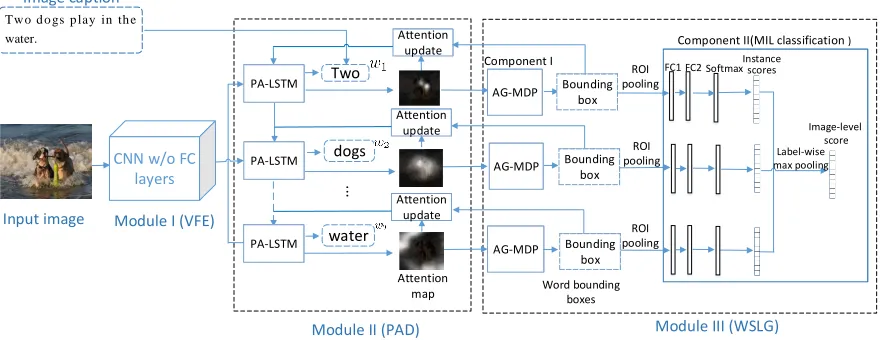
To address the above limitations, we propose a Progressive Attention-Guided Network (PAGNet), which not only generates descriptive sentences for input images, but grounds (i.e., aligns) the words of the generated descrip-tions to image regions.
1.1
Contributions
The contributions of this paper can be summarized as fol-lows: 1) We combines the tasks of image captioning and language grounding by a PAGNet, which has two appeal-ing properties: i) PAGNet predicts caption sentences for im-ages in a progressive manner. Specifically, the attention over the image can be progressively updated using the grounding results (i.e., bounding boxes) of the words, which enables PAGNet to refine the predictive captions. ii) By combin-ing the frameworks of MDP and MIL, PAGNet can predict bounding boxes for caption words via only image-level an-notations, without the requirement of region proposal algo-rithms to hypothesize target locations. 2)We conduct exten-sive experiments on several benchmark datasets to evaluate the performance of PAGNet and results show that PAGNet achieves state-of-the-art performance on all the datasets.
2
Related work
2.1
Image captioning
Two
dogs
Tw o d o gs p lay in th e water.
water Input image
Image caption
Module II (PAD) Module I (VFE)
Module III (WSLG)
...
PA-LSTM
AG-MDP
AG-MDP
AG-MDP
Word bounding boxes
FC1 FC2 Softmax Instance scores
CNN w/o FC layers
Label-wise max pooling
Image-level score
Component I
Component II(MIL classification )
Attention update
Attention update
Attention update PA-LSTM
PA-LSTM
ROI pooling
ROI pooling
ROI pooling Attention
map
Attention map
Bounding box
Bounding box
Bounding box
Figure 1: The framework of PAGNet, which consists of three modules: VFE, PAD and WSWA.
generates template sentences that have slot locations tied to image regions, then fills the slots with the concepts detected from the regions using object detectors. The attention used for predicting each word conveys the alignment information from language space to image space, and the correctness of the attention influences the final performance. However, the aforementioned approaches implicitly infer the attention by the hidden states of LSTM, which cannot ensure the correct-ness of the learned attention (Liu et al. 2017).
2.2
Visual language grounding
This task has been studied by many works (Plummer et al. 2017; 2015; Karpathy and Fei-Fei 2015; Karpathy, Joulin, and Fei-Fei 2014), which align text phrases to image re-gions. For example, Plummer et al.(2017) proposed a frame-work for localization or grounding of phrases in images. Karpathy et al. (2014) decomposed images and sentences into fragments and inferred their inter-modal alignment us-ing a rankus-ing objective. Different from these works that only focus on learning correspondence between text phrases and image regions, our model integrates image captioning and language grounding into one framework, which not only can generate captions for images, but can align each word of the generated captions to image regions.
2.3
Object detection
Our model is also related to weakly supervised object de-tection (WSD) (Durand, Thome, and Cord 2016) and Deep Reinforcement Learning (DRL) based detection (Jie et al. 2016; Caicedo and Lazebnik 2015). Many WSD approaches formulate the object localization as a MIL problem, where each image is represented as a bag of instances. Though localizing objects via only image-level annotations, most WSD approaches depend on region proposal algorithms (Zitnick and Doll´ar 2014) to hypothesize object locations. This limitation does not exist for DRL based approaches, which cast the object localization as a MDP. For example, Caicedo and Lazebnik; Jie et al.(2015; 2016) proposed to localize objects in images by a MDP, in which an agent
is set to deform a bounding box with a sequence of pre-defined actions. However, during training phase these ap-proaches need ground-truth boxes of objects, which are dif-ficult to collect. In contrast, by combining MIL and DRL, our model localizes words in images using only image la-bels. Besides, as DRL is a trial-and-error process, its success relies on the agent’s luck in achieving the goal by chance in the first place(Lin 1992). The MDP in previous DRL based approaches usually search the locations of objects starting from the whole image, which makes it difficult to shorten the learning time and even leads to a failure.
3
The Proposed Model
3.1
Overview
Figure 1 illustrates the framework of PAGNet, which pre-dicts image captions by using the framework of encoder-decoder, where Module I acts as the encoder and Module II acts as the decoder. Module III predicts bounding boxes for the caption words by combining MIL and DRL. The in-puts to PAGNet is an image and its text captions{wt}Tt=1,
where T represents the number of words in the captions. Specifically, Module I is a CNN that encodes the input image into a convolutional feature map. Based on the feature map, Module II predicts captions for the image by a Progressively Attention guided LSTM (PA-LSTM), which can progres-sively modulate its attention over the image. Besides, PA-LSTM also outputs attention maps that comprises the atten-tion weights over the input feature map. The attenatten-tion maps are fed into Module III consisting of two components: Atten-tion Guided MDP (MDP) and MIL classificaAtten-tion. AG-MDP aligns each caption word to an image region, whereas the MIL classification plays an auxiliary role to align the word to an region that constitutes an object.
3.2
Module I: VFE
higher convolution layers (e.g., the layers in block 5), the lower convolution layers can capture more information for the tiny objects in images. Thus, we combine feature maps from lower and higher convolution layers. Specifically, we concatenate the feature maps from last convolutional layers of the Blocks3,4,5to form a unified feature map, i.e., the Concatblock. To apply the concatenation, the Blocks3and
4 are followed by max-pooling layers to synchronize their feature maps to the same size, i.e., the size of the feature maps from Blocks5. Finally, a1×1convolution layer is ap-pended to shrink the channel size of theConcatblock. The channel size of final feature map is the same as the convolu-tion layer of Block5.
Concat Block 1
Block 3
1x1 Conv
Block 4 Block 2
Block 5
Pooling Pooling
Figure 2: The architecture of Module I.
3.3
Module II: PAD
PAD consists of two components: i) PA-LSTM. ii) Attention update.
PA-LSTM Previous attention based approaches infer the attention using the hidden states of LSTM units, which can-not ensure the correctness of the inferred attention. To solve this limitation, PA-LSTM progressively modulates the atten-tion by the results of the language grounding in Module III. In PA-LSTM, we use the LSTM units (Zaremba, Sutskever, and Vinyals 2014) consisting of an input gatei, a forget gate
f, an output gateo, a cell statecas well as the hidden state
h. At time step oft, the interaction between the gates and the hidden state is defined by
it=σ(Wiyt−1+Uiht−1+Eixt+bi), (1) ft=σ(Wfyt−1+Ufht−1+Efxt+bf), (2) ct=ftct−1+ittanh(Wcyt−1+Ucht−1+Ecxt+bc), (3) ot=σ(Woyt−1+Uoht−1+Eoxt+bo), (4)
ht=ottanh(ct), (5)
whereW, U, Z denote weight matrices,bdenotes the bi-ases,σis a sigmoid function,ytdenotes the embedding
vec-tor ofwt,xtdenotes the attentive feature for generatingwt.
Specifically,xtis computed by the weighted summation
over the vectors of feature setV = [v1,v2,· · · ,vm], which
is obtained by flattening the widthW0 and the heightH0
of the input feature map. The parameter m = W0 ×H0
and eachvi ∈ RC (1 ≤ i ≤ m)represents the feature of thei-th location on the feature map, whereCrepresents the
channel number of the feature map. The computation ofxt
is formulated by
xt=
m
X
i=1
αtivi, (6)
where αti is the attention weight on the i-th location.
At time stpe t, the attention map is denoted by αt = [αt1, αt2,· · · , αtm], which is computed using a multilayer
perceptron followed by a softmax function, and can be for-mulated by
αt = sof tmax(Msst+b), (7)
st = tanh((MvV +bs)⊕Mhht−1), (8)
whereMv ∈Rk×C,Mh∈Rk×dandMs∈Rkare transfor-mation matrices that mapV andht−1 to a common space.
Theb ∈R1andbs ∈Rk are biases,ddenotes the dimen-sionality ofht. The symbol⊕represents the addition of a
matrix and a vector, which is performed by adding each col-umn of the matrix by the vector. After obtaining xt,
PA-LSTM follows (Xu et al. 2015) to predict the wordwtby a
deep output layer (Pascanu et al. 2013) conditioned onxt,
ht, andwt−1, which is formulated by
p(wt|V, wt−1)∝exp(Po(yt−1+Phht+Pzxt)), (9)
where the parametersPo, Ph, Pzare initialized randomly.
Thehtandctare initialized by inputting the average of
viinto two separate MLPs:c0 =finitc( 1
m
Pm
i=1vi),h0=
finith( 1
m
Pm
i=1vi), wherefinitcandfinithare the functions
of two MLPs.
Attention update In this part, we progressively modulate
αtusing the bounding box ofwtoutput by Module III. The
motivation is that the generated bounding box straightly in-dicates the region highly related towt, which is more
impor-tant than the rest regions. Thus, we updateαttoα˜tby
˜
αt=αt×zt, (10)
wherezt = [zt1, zt2,· · · , ztm] is a binary coefficient
vec-tor and each elementzti∈ {0,1}. If thei-th image location
is in the predicted bounding box ofwt,zti is set to1,
oth-erwise set to0. In this way, the attention of PA-LSTM is progressively led to the regions that are highly related to the generated word, which prevents PA-LSTM from focusing on meaningless regions.
With α˜t, PA-LSTM can refine the predictive captions.
Specifically, we first substitute Eq. (10) into Eq. (6) to com-pute new attentive featurex˜t, which is then substituted into
Eq.(1) - Eq. (4) to compute newh˜t. Finally,h˜tand˜xtare
substituted into Eq. (9) to predict new captions. Besides,h˜t
is also substituted into Eq.(7) and (8) to compute new at-tention maps, which are fed into Module III to start new episodes. The details are described in Subsection 3.4.
3.4
Module III: WSLG
AG-MDP MDP has been applied to localize objects in many works (Jie et al. 2016) and achieves promising per-formance. However, existing MDP searches targets starting from the whole image, which greatly increases the difficulty of localizing target boxes with such large state space.
To solve this problem, we propose a new AG-MDP that can be directed to first explore the most promising region containing targets, by using the attention map output by Module II. Specifically, an attention box generated from the attention map is used as the starting window for the MDP. The attention region corresponding to each word is gener-ated on the attention map by selecting a square region which has the largest attention weights. The size of the selected re-gion is set to4×4, which corresponds to a64×64patch in the original image. We also experimentally vary the size to
8×8and observe that the performance changes slightly. As the attention map is progressively updated in Module II, thus the staring window of each episode in MDP will pro-gressively approximate the correct location of targets, which is conducive to reducing the difficulty of localizing targets and improving the localization accuracy. Note that AG-MDP is performed on the last feature map of Module I, rather than the original image. AG-MDP has a set of actionsA, a set of statesS, and a reward functionR, which are described as below.
State: The state representation is the concatenation of two components: a feature vectorbof the current observed win-dow and a memory vectorvhthat captures the last ten
ac-tions selected by the agent. The vectorbis generated based on the last feature map V of Module I and the attention weights α. Specifically, we first modulate the V toV˜ by
˜
V =V ·α = [˜v1,v˜2,· · ·,v˜m]. Then, a ROI pooling layer
(Girshick 2015) is added on top ofV˜ to obtain a fixed-length feature vector of the current window. The history vectorvh
is a binary vector that indicates which actions have been taken in the past. Each action in the history vector is rep-resented by a 1-of-K vector, where only one element corre-sponding to the taken action is1and all other elements are0. As there are15different actions presented in the following section, thevh∈R150.
Left Right Up Down
Narrow_1
Shorter Thinner Higher Fatter
Smaller Bigger Narrow_2 Narrow_3 Narrow_4 Trigger
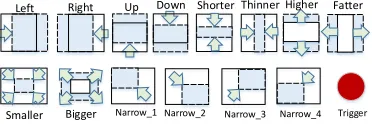
Figure 3: Illustration of the actions used in the MDP. Blue windows with dashed lines represent the windows obtained by taking one of the actions.
Actions: Figure 3 illustrates the set of actionsA, which consists of fourteentransformationactions that can be used to deform the observed window, and oneTriggeraction used to stop the searching process. The transformation actions can be categorized into three groups: i) Move actions that aim to change the location of the boxes. This group contains four actions, each of which moves the window by0.2times
of the current window size. ii) Scaling actions that aim to proportionally change the scales of the windows. This group contains six scaling actions, each of which scales the win-dow by0.25times of the current window size. iii) Ratio ac-tions that aim to modify aspect ratios of the windows. This group contains four ratio actions, each of which changes the horizontal/vertical size by0.15times of the current window size. Thetriggeraction indicates that the agent has correctly localized an object and the sequence of the current search should be terminated.
Rewards: At time stept0 of MDP, the agent receives a
rewardRat0 for its actionat0, which moves the state from
st0tost0+1. Each statest0has an associated windowbt0. As the grounding-truth bounding boxes of each word are unavailable, PAGNet measures the rewardRat0 by
Rat0 =
( 1 τ(b
t0+1,yt)−τ(bt0,yt)>0.05 −1 τ(bt0+1,yt)−τ(bt0,yt)<0
0 otherwise
(11) wherebt0+1andbt0+1denote the feature vector of the win-dowbt0+1andbt0, respectively. Theytdenotes the embed-ding vector ofwt, andτ(b,yt)denotes the semantic
simi-larity betweenbt0(orbt0+1) andyt. The semantic similarity is evaluated by the method in (Plummer et al. 2015), which first learns an embedding of the window and word features to a shared latent space using canonical correlation analysis (Hotelling 1936), and then uses cosine distance in that space to score the semantic similarity.
As seen from Eq. (11), when statest0 is changed to state
st0+1, the reward function returns+1if the improvement of the similarityτis larger than0.05, returns−1ifτdecreases, or returns0otherwise. As thetriggerdoes not transform the box, we define its reward by
Rat0 =
+3 τ(φ(bt0),yt)> η
−3 otherwise (12)
whereηis a threshold that indicates the minimum semantic similarity allowed to consider the word is correctly local-ized. We setη= 0.8during the training phase.
Localization policy: In MDP, the agent selects actions ac-cording to a policy. We learn the optimal policy by the deep Q-learning algorithm (Mnih et al. 2015), which estimates the value of each state-action pair using a deep Q-network. Specifically, the deep Q-network is a multi-layer neural net-work containing two hidden layers, which takes the state representation as input, and predicts a vector of action values
Q(s, a;θq). Theθqare the parameters of the neural network.
C a p t i o n s e n t e n c e : A man i s grilling green beans .
Image labels: Man, Beans.
A man in a green shirt , blue coat , and blue jeans walking
A man in a green shirt , blue coat, and blue jeans is walking. Image labels: Man, shirt, coat, jeans.
Column-wise max pooling Instance-score
label layer Image-level score
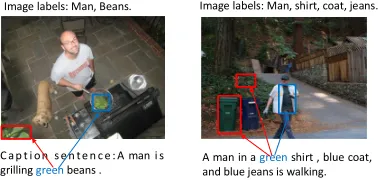
Figure 4: Examples of word-region alignments generated by AG-MDP.
MIL classification Although the reward function in AG-MDP tends to find regions that has high semantic similarity with the caption words, it still cannot ensure the obtained regions are meaningful and described by the correspond-ing caption words. For example, as shown in Fig. 4, AG-MDP wrongly grounds the caption word in blue to the red boxes, whereas the ground-truth is the blue boxes. This oc-curs because the captions usually describe the objects of im-ages. However, the reward function used in PA-LSTM can-not guide the words to be grounded to the object regions.
To solve this problem, after AG-MDP we append a MIL classification network, which takes the bounding boxes gen-erated in AG-MDP as inputs, to perform MIL image clas-sification. Specifically, each grounding box is treated as an instance and one ROI pooling layer is used to extract the feature representation of each instance. The labels used for MIL classification refer to the objects (i.e., the nouns in cap-tions) of images, and in this way the caption words are en-forced to be grounded to the regions that constitute objects. As shown in Fig.1, the MIL classification network consists of two Fully Connected (FC) layers with ReLU activation, one FC layer with softmax output for instance-level classifi-cation scores. The final image-level classificlassifi-cation scores are computed using a max-pooling on the instance-level scores.
Objective function We jointly train AG-MDP and the MIL classification network. The objective functionJ(θ)is
J(θ) = max
θq,θc (1
T T
X
t=1
Rt(θq)−λH(θc,pn,y˜n)), (13)
whereθq andθc are the parameters of the deep Q-network
and the classification network, respectively.T represents the number of time steps in PA-LSTM.Rt(θq)denotes the
av-erage of the expected reward overN samples andT0 time steps in AG-MDP. Specifically,Rt(θq)is computed by
R(θq) = 1 N T0
N
X
n=1
T0 X
t0=1
E[((r(ant0) +γmaxant0+1Q(snt0+1,
ant0+1;θq)−Q(snt0, ant0;θq))2],
(14)
where γ denotes the discount factor. The function
H(θc,pn,˜yn) denotes the average sigmoid cross entropy
loss overNtraining samples.
H(θc,pn,y˜n) =− 1 N
N
X
n=1
K
X
k=1
[˜ynk ×log(pnk) + (1−y˜kn)
×log(1−pnk)],
(15)
wherepn = [pn
1, pn2,· · ·, pnK]denotes the predictive score
vector of then-th image with respect to each label,y˜n = [˜yn
1,y˜2n,· · ·,y˜Kn]denotes the corresponding ground-truth
la-bel vector andKis the total number of labels.
3.5
Training strategy
During training, we first train Module I separately to ob-tain visual features of the input image, then fix the layers of Module I and train module II and III alternatively. Specifi-cally, we first train Module II to predict image captions and attention maps. Then, we fix Module II and fed the attention maps into Module III, which searches the bounding boxes for each word by a MDP. The starting window of the MDP is generated using the input attention maps. After obtaining the bounding boxes of all the caption words, we fix Module III and input the generated bounding boxes to the component Attention updateof Module II, for modulating the attention maps and refining the results of image captioning.
The motivation behind this alternative strategy is that: i) The attention map provides important clues to find the re-gions related to words, and thus can act as ateacherto guide AG-MDP of Module III to first explore the most promis-ing region that contains target objects. The more accurate the attention map is, the more effective it is in reducing the difficulty of the localization and improving the accuracy of localization. ii) With the progress of training, the accuracy of the bounding boxes of caption words output by Module III becomes higher and higher, which is conducive to gradu-ally improving the accuracy of the attention maps. We repeat the alternative training several times for better performance.
4
Experiments
4.1
Datasets
For the task of image captioning, we report the experimental results obtained by different models on the the COCO (Lin et al. 2014) and Flickr30k Entities (Plummer et al. 2015) datasets. COCO contains123,000images and Flickr30k En-tities contains31,783images. Flickr30k Entities augments the Flickr30k dataset (Young et al. 2014) with bounding boxes for each entity (noun phrases) of image captions. The entities are categorized into eight types including peo-ple (peo.), body parts (body.), animals (ani.), clothing/color (clo.), instruments (ins.), vehicles (veh.), scene (sce.), and other. In some cases where some phrases correspond to mul-tiple boxes, we follow (Plummer et al. 2015) to treat the union of the boxes as ground truth. Each image of these two datasets has at least five ground-truth captions.
To make our results comparable to others, we use the publicly available splits1 of training, testing and validating
1
sets for both Flickr30k Entities and COCO. Specifically, for COCO dataset we use 113,287 images for training,5,000
images for both validation and testing. For Flickr30k Enti-ties dataset we use 1,000 images for validation,1,000 im-ages for testing and the rest for training. We convert all sen-tences to lowercase, filter non-alphanumeric characters and words that occur less than 5 times in the training set, which results in7,414, and8,791words for Flickr30K Entities and COCO datasets, respectively.
4.2
Evaluation metrics
For the task of image captioning, we use BLEU (B1, B2, B3, B4)2 (Papineni et al. 2002), METEOR (M) (Banerjee and Lavie 2005), CIDEr (C) (Vedantam, Lawrence Zitnick, and Parikh 2015), and ROUGE-L (R) (Lin 2004) as evaluation metrics. The scores of these metrics are computed with the codes3released by COCO Evaluation Server.
The task of language grounding is akin to object detec-tion, we evaluate the performance using the mean Average Precision (mAP), which is computed over all the regions processed by the agent during the episodes in AG-MDP. we consider that a word is correctly grounded if the predicted bounding box has an IoU ratio of at least50%with the corre-sponding ground-truth bounding box. We only report the ex-perimental results of language grounding on Flickr30k Enti-ties, as the ground-truth of the bounding boxes of the words in COCO is not available.
4.3
Implementation details
The size of input images is 224×224. The length of the captions longer than18in COCO or22in Flickr30k Entities are truncated. Each caption word is represented as a300-D word2vec (Mikolov et al. 2013) feature. During training, the layers of the first five convolution blocks in Module I are ini-tialized with the weights of the corresponding layers of the VGG16 pre-trained on ImageNet. The rest layers of Mod-ule I are randomly initialized with Gaussian distributions
G(µ;σ), whereµ= 0andσ= 0.01. We train PAGNet with SGD at a learning rate of0.0001and a mini-batch size of64. The momentum and weight decay are set to0.9and0.0005, respectively. During the training and testing, we align each word of the generated captions to image regions. The words other than nouns are aligned to the regions that constitute an object or a part of an object. This is because image descrip-tions often make frequent references to objects that occur in images. During testing, for the task of language grounding, we use the Stanford parser to identify nouns of the gener-ated captions and evaluate the performance only on these nouns, because other words (e.g. determiner and preposi-tion) do not have accurate location. In Flickr30k Entities dataset, the bounding boxes associated with noun-phrases is viewed as the ground-truth bounding boxes of the nouns in the phrases. As the generated captions are often different from the ground-truth captions, we evaluate the performance only on the matched nouns between the generated captions and the ground-truth captions.
2
Bn is the geometric average of then-gram precision.
3
https://github.com/tylin/coco-caption
4.4
Experimental results
Ablation study To reveal the contribution of each com-ponent, we test the performance of PAGNet with different configurations, including: i) PAGNet-1, which is obtained by removing the component Attention update from Mod-ule II. WithoutAttention update, the bounding boxes output by Module III cannot be used to update the attention and thus the predicted captions cannot be refined. ii) PAGNet-2, which is obtained by removing the componentMIL classifi-cationfrom Module III.
Table 1: Results (%) of the ablation study on COCO test set.
Algorithms B1 B2 B3 B4 M R C
PAGNet-1 68.6 51.8 36.7 28.5 23.2 50.8 86.1 PAGNet-2 76.3 59.7 44.9 35.8 26.9 55.2 110.3
PAGNet 83.2 62.8 46.3 40.8 30.4 58.6 118.6
Table 2: Results (%) of the ablation study on Flickr30k En-tities test set.
Algorithms B1 B2 B3 B4 M R C
PAGNet-1 65.6 43.3 30.4 21.2 19.1 53.3 49.6 PAGNet-2 70.3 51.2 38.3 27.5 22.6 57.9 54.3 PAGNet 74.8 55.8 41.2 30.7 25.2 61.4 57.5
The experimental results of the ablation study on image captioning are shown in Table 1 forCOCOdataset and Ta-ble 2 forFlickr30k Entitiesdataset. From the tables, we can observe that PAGNet (w/o update) exhibits the worst perfor-mance in all metrics, which indicates that the component At-tention updatematters more than the componentMIL classi-fication. Without theAttention update, PAGNet (w/o update) cannot update attention weights for each word and thus lose the ability to refine the predictive captions, which results in a significant performance drop. With the incorporation of theAttention update, PAGNet (w/o MIL) outperforms PAG-Net (w/o update) on both experimental datasets. However, without the MIL classification network, PAGNet (w/o MIL) cannot ensure that words are grounded to the regions of ob-jects, which may lead the PA-LSTM to focus on meaningless background clutter and thus impedes the performance.
Table 3: AP (%) values of the ablation experiments on Flickr30k Entities test set.
Algorithms peo. body. ani. clo. ins. veh. sce. other mAP PAGNet-1 42.8 19.4 22.8 26.4 28.5 39.2 36.4 27.9 30.4 PAGNet-2 48.4 24.5 33.7 31.1 29.2 44.1 38.9 29.3 34.9 PAGNet 54.6 28.4 35.8 39.2 34.3 52.6 46.2 34.5 40.7
which indicatesAttention updatehas a larger influence on language grounding. For example, compared with PAGNet (w/o update), PAGNet improves the mAP from 30.4% to
40.7%, with a10.3%margin at most. This is because the in-troduction of theAttention updateenables PA-LSTM to pro-gressively update the attention map corresponding to each word, which results in a more accurate starting window for AG-MDP. Compared with PAGNet (w/o MIL), PAGNet im-proves the performance by5.8%, which reveals that theMIL Classificationdoes contribute to improve the performance of language grounding. TheMIL Classificationcan be viewed as a discriminator to penalize the agents that align words to background clutter.
Comparison with other models To the best of our best knowledge, no previous works have conducted the experi-ments of grounding the words of the generated captions to image regions. Therefore, we only compare PAGNet with other models on the task of image captioning.
Table 4: Experimental results (%) of image captioning for different models on COCO dataset.
Algorithms B1 B2 B3 B4 M R C
M-RNN 62.5 45.0 32.1 23.0 19.5 - 66.0
LSTM+Attn 71.8 50.4 35.7 25.0 23.0 -
-Adaptive-Attn 74.2 58.0 43.9 33.2 26.6 - 108.5
LSTM-A 73.5 56.6 42.9 32.4 25.5 53.9 99.8
CNN+attn 71.1 53.8 39.4 28.7 24.4 52.2 91.2
up-down 77.2 - - 36.2 27.8 56.4 113.5
PAGNet 83.2 62.8 46.3 40.8 30.4 58.6 118.6
Table 5: Experimental results (%) of image captioning for different models on Flickr30k entities dataset.
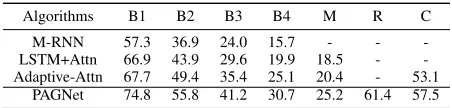
Algorithms B1 B2 B3 B4 M R C
M-RNN 57.3 36.9 24.0 15.7 - -
-LSTM+Attn 66.9 43.9 29.6 19.9 18.5 -
-Adaptive-Attn 67.7 49.4 35.4 25.1 20.4 - 53.1
PAGNet 74.8 55.8 41.2 30.7 25.2 61.4 57.5
The baseline models include non-attention models and attention-based models. The non-attention models in-cludes M-RNN(Karpathy and Fei-Fei 2015) and LSTM-A(Yao et al. 2017). The attention-based models includes LSTM+Attn(Xu et al. 2015),Adaptive-Attn(Lu et al. 2017), CNN+attn(Aneja, Deshpande, and Schwing 2018), up-down(Anderson et al. 2018). The experimental results on COCO and Flickr30k Entities datasets are shown in Ta-ble 4 and TaTa-ble 5, respectively. We also show some qual-itative results and analysis in supplementary material. As shown in the tables, the results across all evaluation met-rics consistently indicate that PAGNet achieves better per-formance than all other models. In particular, taking the re-sults onCOCOas an example, PAGNet makes the relative improvement over the non-attention models by at least8.4%,
4.9%,4.7%,18.8%in BLUE(B-4), METEOR, ROUGR-L and CIDEr, respectively. PAGNet also outperforms all the
attention-based models, improves the state-of-the-art on B-4 from 36.2%to40.8%, METEOR from27.8%to30.4%, ROUGR-L from56.4%to58.6%, and CIDEr from113.5%
to 118.6%. Similarly, on Flickr30k Entities, PAGNet im-proves the state-of-the-art with a large margin.
The superior performance of PAGNet can be attributed to the following two reasons: i) PAGNet can progressively update the attention map for predicting each word. The cor-rectness of the attention map is a key factor in improving the performance of image captioning. However, these baseline models cannot ensure the correctness of the attention (Liu et al. 2017). ii) By combining the framework of MIL and MDP, PAGNet grounds the word to the regions of the objects in im-ages, which prevents the PA-LSTM from focusing on mean-ingless background clutter. In contrast, the baselines allow their models to attend any visual parts of images.
5
Conclusion
In this paper, we propose PAGNet that combines image cap-tioning and language grounding, which can be mutually re-inforced to improve their performance. Specifically, PAGNet generates captions for input images by a PA-LSTM, which can progressively update the attention corresponding to each word by using the outputs of language grounding. PAGNet grounds each word to image regions by a AG-MDP, which searches target bounding boxes starting from the window generated by the attention map output by PA-LSTM, rather than the whole image. Experimental results show that PAG-Net outperforms all the baselines on all datasets.
6
Acknowledgments
This work was supported by National Key Research and Development Program of China (2018YFB1004500), Na-tional Natural Science Foundation of China (61532015, 61532004, 61672419, and 61672418), Innovative Research Group of the National Natural Science Foundation of China(61721002), Innovation Research Team of Ministry of Education (IRT 17R86), Project of China Knowledge Centre for Engineering Science and Technology, Science and Technology Planning Project of Guangdong Province (No. 2017A010101029), the program of China Scholarship Council (201706280198).
References
Anderson, P.; He, X.; Buehler, C.; Teney, D.; Johnson, M.; Gould, S.; and Zhang, L. 2018. Bottom-up and top-down at-tention for image captioning and visual question answering. InProceedings of the IEEE Conference on Computer Vision and Pattern Recognition.
Caicedo, J. C., and Lazebnik, S. 2015. Active object lo-calization with deep reinforcement learning. InProceedings of the IEEE International Conference on Computer Vision, 2488–2496.
Chen, L.; Zhang, H.; Xiao, J.; Nie, L.; Shao, J.; Liu, W.; and Chua, T.-S. 2016. Sca-cnn: Spatial and channel-wise atten-tion in convoluatten-tional networks for image capatten-tioning. arXiv preprint arXiv:1611.05594.
Cho, K.; Van Merri¨enboer, B.; Gulcehre, C.; Bahdanau, D.; Bougares, F.; Schwenk, H.; and Bengio, Y. 2014. Learning phrase representations using rnn encoder-decoder for statis-tical machine translation. InProceedings of the Conference on Empirical Methods in Natural Language Processing. Durand, T.; Thome, N.; and Cord, M. 2016. Weldon: Weakly supervised learning of deep convolutional neural networks. InProceedings of the IEEE Conference on Computer Vision and Pattern Recognition, 4743–4752.
Girshick, R. 2015. Fast r-cnn. InProceedings of the IEEE international conference on computer vision, 1440–1448. Hotelling, H. 1936. Relations between two sets of variates. Biometrika28(3/4):321–377.
Jie, Z.; Liang, X.; Feng, J.; Jin, X.; Lu, W.; and Yan, S. 2016. Tree-structured reinforcement learning for sequential object localization. InProceedings of the Annual Conference on Neural Information Processing Systems, 127–135.
Karpathy, A., and Fei-Fei, L. 2015. Deep visual-semantic alignments for generating image descriptions. In Proceed-ings of the IEEE Conference on Computer Vision and Pat-tern Recognition, 3128–3137.
Karpathy, A.; Joulin, A.; and Fei-Fei, L. F. 2014. Deep fragment embeddings for bidirectional image sentence map-ping. InProceedings of the Annual Conference on Neural Information Processing Systems, 1889–1897.
Lin, T.-Y.; Maire, M.; Belongie, S.; Hays, J.; Perona, P.; Ra-manan, D.; Doll´ar, P.; and Zitnick, C. L. 2014. Microsoft coco: Common objects in context. InProceedings of the European Conference on Computer Vision, 740–755. Lin, L.-J. 1992. Self-improving reactive agents based on reinforcement learning, planning and teaching. Machine learning8(3-4):293–321.
Lin, C.-Y. 2004. Rouge: A package for automatic evaluation of summaries.Text Summarization Branches Out.
Liu, C.; Mao, J.; Sha, F.; and Yuille, A. L. 2017. Attention correctness in neural image captioning. InProceedings of the AAAI Conference on Artificial Intelligence, 4176–4182. Lu, J.; Xiong, C.; Parikh, D.; and Socher, R. 2017. Knowing when to look: Adaptive attention via a visual sentinel for image captioning. InProceedings of the IEEE Conference on Computer Vision and Pattern Recognition, volume 6, 2. Lu, J.; Yang, J.; Batra, D.; and Parikh, D. 2018. Neural baby talk. InProceedings of the IEEE Conference on Computer Vision and Pattern Recognition, 7219–7228.
Mikolov, T.; Sutskever, I.; Chen, K.; Corrado, G. S.; and Dean, J. 2013. Distributed representations of words and phrases and their compositionality. In Proceedings of the
Annual Conference on Neural Information Processing Sys-tems, 3111–3119.
Mnih, V.; Kavukcuoglu, K.; Silver, D.; Rusu, A. A.; Ve-ness, J.; Bellemare, M. G.; Graves, A.; Riedmiller, M.; Fidjeland, A. K.; Ostrovski, G.; et al. 2015. Human-level control through deep reinforcement learning. Nature 518(7540):529.
Papineni, K.; Roukos, S.; Ward, T.; and Zhu, W.-J. 2002. Bleu: a method for automatic evaluation of machine transla-tion. InProceedings of the 40th annual meeting on associa-tion for computaassocia-tional linguistics, 311–318.
Pascanu, R.; Gulcehre, C.; Cho, K.; and Bengio, Y. 2013. How to construct deep recurrent neural networks. arXiv preprint arXiv:1312.6026.
Plummer, B. A.; Wang, L.; Cervantes, C. M.; Caicedo, J. C.; Hockenmaier, J.; and Lazebnik, S. 2015. Flickr30k enti-ties: Collecting region-to-phrase correspondences for richer image-to-sentence models. InProceedings of the IEEE In-ternational Conference on Computer Vision, 2641–2649. Plummer, B. A.; Mallya, A.; Cervantes, C. M.; Hocken-maier, J.; and Lazebnik, S. 2017. Phrase localization and visual relationship detection with comprehensive image-language cues. In Proceedings of the IEEE International Conference on Computer Vision.
Simonyan, K., and Zisserman, A. 2015. Very deep convo-lutional networks for large-scale image recognition. In Pro-ceedings of the International Conference on Learning Rep-resentations.
Song, L.; Luo, M.; Liu, J.; Zhang, L.; Qian, B.; Li, M. H.; and Zheng, Q. 2016. Sparse multi-modal topical coding for image annotation. Neurocomputing214:162–174.
Sutton, R. S., and Barto, A. G. 1998. Reinforcement learn-ing: An introduction. MIT press.
Vedantam, R.; Lawrence Zitnick, C.; and Parikh, D. 2015. Cider: Consensus-based image description evaluation. In Proceedings of the IEEE Conference on Computer Vision and Pattern Recognition, 4566–4575.
Xu, K.; Ba, J.; Kiros, R.; Cho, K.; Courville, A.; Salakhudi-nov, R.; Zemel, R.; and Bengio, Y. 2015. Show, attend and tell: Neural image caption generation with visual attention. InProceedings of the International Conference on Machine Learning, 2048–2057.
Yao, T.; Pan, Y.; Li, Y.; Qiu, Z.; and Mei, T. 2017. Boosting image captioning with attributes. InProceedings of the IEEE International Conference on Computer Vision, 22–29. Young, P.; Lai, A.; Hodosh, M.; and Hockenmaier, J. 2014. From image descriptions to visual denotations: New simi-larity metrics for semantic inference over event descriptions. Transactions of the Association for Computational Linguis-tics2:67–78.
Zaremba, W.; Sutskever, I.; and Vinyals, O. 2014. Re-current neural network regularization. arXiv preprint arXiv:1409.2329.