The Thirty-Third AAAI Conference on Artificial Intelligence (AAAI-19)
Mirroring without Overimitation:
Learning Functionally Equivalent Manipulation Actions
Hangxin Liu,
1Chi Zhang,
1,2Yixin Zhu,
1,2Chenfanfu Jiang,
3Song-Chun Zhu
1,2 1UCLA Center for Vision, Cognition, Learning and Autonomy2International Center for AI and Robot Autonomy (CARA)
3UPenn Computer and Information Science Department
{hx.liu,chi.zhang,yixin.zhu}@ucla.edu, [email protected], [email protected]
Abstract
This paper presents a mirroring approach, inspired by the neuroscience discovery of the mirror neurons, to transfer demonstrated manipulation actions to robots. Designed to ad-dress the different embodiments between a human (demon-strator) and a robot, this approach extends the classic robot Learning from Demonstration (LfD) in the following aspects: i) It incorporates fine-grained hand forces collected by a tac-tile glove in demonstration to learn robot’s fine manipula-tive actions; ii) Through model-free reinforcement learning and grammar induction, the demonstration is represented by a goal-oriented grammar consisting of goal states and the cor-responding forces to reach the states, independent of robot embodiments; iii) A physics-based simulation engine is ap-plied to emulate various robot actions and mirrors the ac-tions that arefunctionally equivalentto the human’s in the sense of causing the same state changes by exerting similar forces. Through this approach, a robotreasonsabout which forces to exert and what goals to achieve to generate actions (i.e., mirroring), rather than strictly mimicking demonstra-tion (i.e., overimitation). Thus the embodiment difference be-tween a human and a robot is naturally overcome. In the ex-periment, we demonstrate the proposed approach by teaching a real Baxter robot with a complex manipulation task involv-ing haptic feedback—openinvolv-ing medicine bottles.
1
Introduction
A hallmark of machine intelligence is the capability to adapt to new tasks rapidly and “achieve goals in a wide range of environments” (Legg and Hutter 2007). In comparison, a human can quickly learn new skills by observing other in-dividuals, expanding their repertoire swiftly to adapt to the ever-changing environment. To emulate the similar learning process, the robotics community has been developing the framework ofLearning from Demonstration(LfD) (Argall et al. 2009), some of which has shown promising results.
However, the “correspondence problem” (Dautenhahn and Nehaniv 2002),i.e., the difference of embodiments be-tween a human and a robot, is rarely addressed in the prior work of LfD. As a result, a one-to-one mapping is usually handcrafted between the human demonstration and the robot execution, restricting the LfD only to mimic the demon-strator’s low-level motor controls and replicate the (almost)
Copyright c2019, Association for the Advancement of Artificial Intelligence (www.aaai.org). All rights reserved.
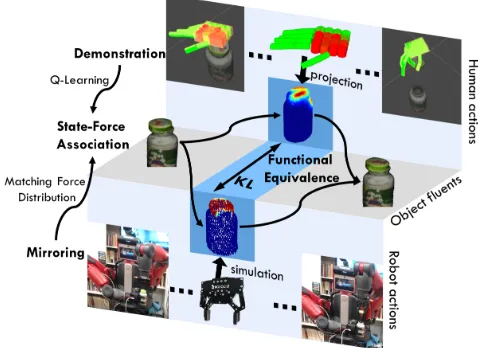
Figure 1: A robot mirrors human demonstrations with func-tional equivalence by inferring the action that produces sim-ilar force, resulting in simsim-ilar changes of the physical states. Q-Learning is applied to associate types of forces with the categories of the object state changes to produce human-object-interaction (hoi) units.
identical procedure to achieve the goal. Such behavior is analogous to a phenomenon called “overimitation” (Lyons, Young, and Keil 2007) observed in human children. There-fore, the acquired skills can hardly be adapted to new robots or new situations, demanding better solutions.
Meanwhile, the neuroscience discovery of mirror neurons in primate (Gallese et al. 1996) showed that the mirror neu-ron system facilitates imitation learning in macaque monkey and human (Rizzolatti, Fogassi, and Gallese 2001): a mirror neuron fires when a primate performs agoal-directedaction or sees others performing the same action. Further findings verify that human mirror neurons are activated during the observation of robot task performance (Gazzola et al. 2007; Oberman et al. 2007) even with different embodiments.
Inspired by the mirror neurons, we propose a mirroring
func-tionally equivalent but possibly visually different actions that can produce the same effect and achieve the same goal as those in the demonstration. In particular, our approach has three characteristics compared to the standard LfD.
• Force-based: We deploy a low-cost tactile glove to col-lect human demonstration with fine-grained manipulation forces. Beyond visually observable space, these tactile-enabled demonstrations capture a deeper understanding of the physical world that a robot interacts with, providing an extra dimension to address the correspondence problem. • Goal-oriented: A “goal” is defined as the desired state of
the target object and is encoded in a grammar model. The terminal node of the grammar model is the state changes caused by the forces, independent of the embodiments. • Mirroring without overimitation: Different from the
clas-sic LfD, a robot does not necessarily mimic every action in the human demonstration. Instead, the robot reasons about the action to achieve the goal states based on the learned grammar and the simulated forces.
To validate the proposed approach, we mirror the hu-man hu-manipulation actions of opening medicine bottles with a child-safety lock to a real Baxter robot. The challenge in this task lies in the fact that opening such bottles requires to push or squeeze various parts, which is visually simi-lar to opening one without a child-safe lock. Figure 1 out-lines the mirroring approach with functional equivalence. Specifically, we explicitly model the forces on the object exerted by the hand in the demonstration with a pose and force sensing tactile glove. The collected distribution of the forces on the object is compared to a set of the force distri-butions exerted by the robot gripper on the same object in a physics-based simulator. Simulated actions with sufficiently small Kullback−Leibler (KL) divergence with respect to the demonstration are considered functionally equivalent, thus hinting this action would be the best robot action to accom-plish the task.
Our contributions are three-fold. First, we extend the classical LfD to a mirroring approach represented by a goal-oriented grammar to overcome the differences between embodiments. Second, we allow a robot itself to reason aboutfunctionally equivalentactions, instead of overimitat-ing demonstrations. Third, we show that the proposed sys-tem performs well in a complex manipulation task of open-ing medicine bottles.
1.1
Related Work
Mirror Neuronsor the mirror neuron system (MNS) has been found and proven to play an essential role in human action recognition, understanding, and imitations (Rizzolatti and Craighero 2004; Thill et al. 2013). These findings mo-tivate several neural-network-based computational models, which primarily study grasping actions and are validated by hand stimuli (Oztop and Arbib 2002; Bonaiuto, Rosta, and Arbib 2007). In these cases, the studies were strictly confined by hands’ relative position to an object, and lit-tle embodiment difference was presented. In parallel work, Itoet al. (Ito and Tani 2004) adopted a Recurrent Neural Network to model MNS. Although it extends hand-object relation to the body movements, it is still restricted to
simi-lar embodiments. Further, these models lack a deeper under-standing (e.g., the goal) of the demonstration. In contrast, the proposed mirroring approach emphasizes the intent of the demonstration as changing the target object to desired states regardless of the embodiment.
LfD contains a vast amount of literature; we refer the readers to two surveys (Argall et al. 2009; Osa et al. 2018). Here, we only highlight some exemplary work that is closely related, specifically on how to address the correspondence problem. Defining a set of task-level actions on robots (Konidaris et al. 2012; Niekum et al. 2015; Edmonds et al. 2017) omits the correspondence as a robot only learns ac-tion scheduling from the set based on the demonstraac-tion. By manually defining the keypoints between the demon-strator and the robot, keypoint-based methods (Koenemann, Burget, and Bennewitz 2014; Shu et al. 2017) are capable of mapping between different embodiments but with lim-ited flexibility. Trajectory-based methods are more favorable since the robot’s motion planner handles the embodiments difference. Specifically, the robot end-effector’s trajectory is either directly mapped to demonstrator’s trajectory (Pastor et al. 2009; Yang et al. 2015) or indirectly mapped using tra-jectory optimization methods (Maeda et al. 2016). However, these approaches fall short of complex manipulation due to the lack of haptic information.
Force-based Demonstrationexists in prior work of LfD. Lin et al. (2012) utilized fingertip force for grasping but did not address the correspondence problem. Although us-ing kinesthetic teachus-ing methods (Kormushev, Calinon, and Caldwell 2011; Montebelli, Steinmetz, and Kyrki 2015; Manschitz et al. 2016; Racca et al. 2016) was capable of incorporating forces into the demonstrations for in-contact tasks, it is still difficult to transfer the demonstration to a different embodiment. Furthermore, kinesthetic teaching is hard to design for fine interactive tasks, e.g., opening medicine bottles with a child-safety lock.
Policy Search Methods use human demonstrations as the initial policy to constrain the search space (Kober and Peters 2009), and reinforcement learning is usually ap-plied to derive a control policy, circumventing the cor-respondence problem. These methods have succeeded in robot’s constrained reaching (Guenter et al. 2007), locomo-tion (Theodorou, Buchli, and Schaal 2010), grasping (Prieur, Perdereau, and Bernardino 2012) and soft hand controlling (Gupta et al. 2016). To avoid being confined by the hu-man demonstration, Levine and Abbeel (2014; 2015) uses guided policy search for robot manipulations. However, pol-icy search methods have not yet demonstrated successful ap-plications in very complex tasks, especially those where un-observable/latent information (e.g., force) plays a vital role.
demonstra-Figure 2: Illustration of a T-AOG. The T-AOG is a tempo-ral grammar in which the terminal nodes are thehoiunits. Anhoi unit (shown in the grey area) contains a single ac-tion ai that transits the state from the pre-condition si to the post-conditionsi+1. The fluents function fi represents the changes of the physical statesi on object caused by the forcesFiexerted by the actionai:si+1=fi(si, ai;Fi).
tions (Ng, Harada, and Russell 1999). This challenge is of-ten magnified by task complexity, making it computationally highly expensive (MacGlashan and Littman 2015). Our ap-proach is partially similar to IRL in the sense that it recovers the action-state relations from the demonstration. Instead of learning only from the demonstration, we deploy a physics-based simulation to generate feasible motions.
2
Representation
We represent the action sequence to execute a task by a structural grammar model Temporal And-Or Graph (T-AOG)(Zhu and Mumford 2007) (see Figure 2). A T-AOG is a directed graph which describes a stochastic context-free grammar (SCFG), encoding both a hierarchical and a com-positional representation. Formally, a T-AOG is defined as a five-tupleG= (S, V, R, P,Σ). Specifically,
• S is the start symbol that represents an event category (e.g., opening a bottle).
• V is a set of nodes including non-terminal nodesVN T and terminal nodesVT:V=VN T∪VT.
• Thenon-terminalnodes can be divided into And-nodes and Or-nodes:VN T=VAN D∪VOR. And-nodesVAN D represent the compositional relations: a nodevis an And-node if the entity represented byv can be decomposed into multiple parts represented by its child nodes. Or-nodesVORindicate the alternative configuration among its child nodes: a nodevis an Or-node if the entity rep-resented byvhas multiple mutually exclusive configura-tions represented by its child nodes.
• TheterminalnodesVTare the entities that cannot be fur-ther decomposed or do not have different configurations. For a T-AOG, the terminal nodes represent the human-object-interaction (hoi)units (Johnson-Frey et al. 2003). Anhoiunit encodes actionsai that an agent can perform (e.g. grasp, twist), the spatiotemporal relations between the object and the agent’s hand, and how the forceFi
pro-duced by such primitive causes the changes of physical states on the object.
• R={r:α→β}is a set of production rules that represent the top-down sampling process from a parent nodeαto its child nodesβ.
• P:p(r) =p(β|α)is the probability associated with each production rule.
• Σis the language defined by the grammar,i.e., the set of all valid sentences that can be generated by the grammar. Aparse treeptis an instance of the T-AOG, where one of the child nodes is selected for each Or-node. The terminal nodes of aptform a valid sentence; in this case, terminal nodes are a set ofhoiunits consisting of the actions for an agent to execute in a fixed order, as well as the state changes after performing such an action sequence.
3
Force-based Goal-oriented Mirroring
3.1
Learning Force and State Associations as
hoi
To transfer across different embodiment, we need to know the effect of a particular type of forces so that the desired action can be planned, requiring to investigate the state changes caused by the forces. We cast this problem in a re-inforcement learning framework to learn a policy that as-sociates forces and state changes. The state space and the action (force) space from human demonstrations are dis-cretized and quantized, and an iterative Q-Learning scheme is applied. We believe the proposed learning framework does not lose generality since one can scale up the process to con-tinuous state space or action space by using DQN (Mnih et al. 2015) or other advanced policy gradient methods.
Categorize Force The pose and force data of human demonstrations were collected using a tactile glove. See Sec. 4.1 for details. The forces exerted by a human hand, together with the poses, are projected onto the mesh of the object. Formally,
Fto=g(aht(Fth, pht)), t∈ {1,2, . . . , n} (1)
where t is the frame index, and n is the total number of frames.gis an implicit projection function that maps a hu-man actionaht, parameterized by the force exertedFthand the poseph
t, toFtothe force projected on the object mesh. Each element in the resulting forceFtois a 4-dimensional vector, where the first three dimensions represent the posi-tion of one object surface vertex and the fourth dimension the force magnitude on this vertex.
K-means clustering (Kanungo et al. 2002) is adopted to categorize the forceFo
i intoNtypes,i.e.,
lk=c(Fto), t∈ {1,2, . . . , n}, k∈ {1, . . . , N} (2)
wherec(·)denotes the clustering function andlkis the label of thek-th cluster type. After assigning labels to each frame, we aggregate the frames with the same label into a segment and take the average,
Fk=avg(Fto), ∀t, c(F o
t) =lk. (3)
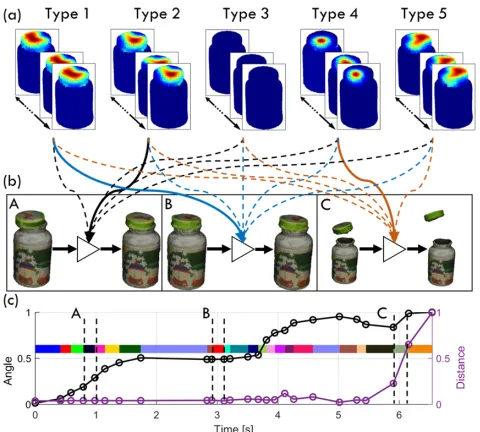
Figure 3: Force and state associations ashoiunits. The ma-nipulation force is clustered into 21 types. (a) Five examples of force types, in which Type 3 has no force. (c) Given the categorized force and quantized states based on the forces, (b) the Q-learning algorithm associates a force to a specific state change (A: lid is twisted; B: initiate contact; C: pull off the lid) shown by the solid lines. The dash lines indicate the forces that are incompatible to the given fluents functions, represented by the triangles.
Quantize State The relative poses can describe the states of a rigid target object under manipulation actions among object’s parts,e.g., bottle and lid, multiple Lego blocks,etc.. Without loss of generality, we use the relative distance and relative rotation angle between the lid and the bottle, which are derived from their relative poses, as our state space. As shown in Figure 3b, within each segment of the force (shown in color bars), we take the average of the corresponding an-gle and distance and normalize their magnitude to unit size,
si=hdi, θii ∈[0,1]2,∀i∈ {1, . . . , M} (4)
whereM is the total number of states, anddiandθidenotes the relative distance and angle, respectively.
Associate Force and State as hoi Units by Q-Learning
By replacing the actions in Q-learning with the labels of the forcelk, we adopt the tabular Q-Learning that associates the current statesito a force type using the iterative Q-Learning update rule in a temporal difference fashion,
Q(si, lk) = (1−α)·Q(si, lk) +α·
r(si, lk) +γ·max
k Q(si+1, lk)
, (5)
whererdenotes the reward,Qthe Q-function,αthe learning rate, andγthe discount factor. Here, we assume the system dynamics is deterministic.
Inference We pick the best action according to the Q-functionl∗= arg maxkQ(si, lk). The association amongsi,
si+1and correspondingFk naturally forms anhoiunit (see Figure 2) and will be used for learning a goal-oriented gram-mar discussed in the next section.
3.2
Learning Goal-Oriented Grammar
Grammar Induction Each successful demonstration con-tributes a sequence of hoi units that encode the types of forces and the state evolvement. We induce a T-AOGGfrom multiple demonstrations using a modified version of Auto-matic Distillation of Structure (ADIOS) algorithm presented in (Qi et al. 2017). The objective function is the posterior probability of the grammar given the training dataX,
p(G|X)∝p(G)p(X|G) = 1 Ze
−α||G|| Y
pti∈X
p(pti|G), (6)
wherepti= (hoi1, hoi2, . . . , hoim)∈X represents a valid parse graph ofhoiunits with lengthm.
Action Sequence Sampling To generate a valid sentence,
i.e., a parse treept= (hoi0, . . . , hoiK), we sample T-AOGG by decomposing all the And-nodes and selecting one branch at each Or-node. Thisptisgoal-oriented in the sense that its terminal nodes hoik∈ptencode the forces of reaching sub-goal states that are invariant across embodiments for the given task. Note that this process is non-Markovian, while the force-state association using Q-Learning is Markovian.
3.3
Mirroring to Robot without Overimitation
Simulation-based Action Synthesis Discrete robot action primitives are given by a dictionary Ωar={ar1, . . . , arM}, M= 10, parameterized by the change of end-effector poses, including moves in all six canonical di-rections, rotations in both clockwise and counter-clockwise directions, and opening/closing the gripper. The task of opening a medicine bottle can be accomplished by the com-binatorics of the actions. Given apt, we seek to generate a sequence of robot actions{ar
i, i= 1, . . . , m}that produce forces sufficient to cause the same changes of states as en-coded in the sampledpt. In this sense, we say the robot ac-tionari isfunctionally equivalentto the demonstration action sequenceahi. Additionally, since the goal of the generated action sequences is to achieve the same effects, such gen-erated action sequences can be different from the observed demonstrations and will not overimitate the observed ones.
A physics-based simulator (see Figure 4) is introduced to estimate the force exerted by the robot gripper on the bottle. We denote the force obtained from the simulator asFsim
m , wheremis the index of the robot primitives, and compare it to the correspondingFk, the average force exerted by hu-man demonstrations with labellk. Formally,Fk andFmsim are formalized as distributions,
P(Fk) =
1 Zk
Fk, and P(Fmsim) =
1 Zsim
m
Fmsim, (7)
whereZk andZmsim are the normalization factors, obtained by summing over the force magnitudes on all vertices of the object. The similarity of the two forces can be measured by the KL divergence, and the robot action is selected by
F∗sim= arg min
m
KL P(Fk)kP(Fmsim)
= arg min
m
X
v
PFk(v) log
PFk(v) PFsim
m (v)
Figure 4: Based on the demonstrations, the force in the same clusterlk produces a force distribution on the objectFto, and the average is the distribution of the force categoryFk. Among the simulated force responsesFmsimobtained from a physics-based simulator, the corresponding primitive of the most similar force, measured by the KL distance, is selected for the robot execution. (a) The forces in the same cluster. (b) The simulated robot primitives (downward, no contact, contact, and twist) and their force responses. (c) The force distributions of the same cluster in each frame. (d) The distributions ofFk against each simulated force distributionFsim
m , denoted by blue and red, respectively.
wherevis the vertex index on the object mesh. OnceF∗sim
is selected, the robot would choose the corresponding prim-itivear∗that producesF∗sim.
Physics-based Simulation The physics-based simulation needs to be able to capture intricate frictional contact be-tween the robot gripper and the bottle. The total force ap-plied at each point located at the surface of the bottle consists of several terms: the normal component of squeezing force from the gripper, the tangential component of static friction force from the gripper, the internal elastic force from the rest of the continuous bottle material and gravity.
The key to achieving such a force balance in the simulator is to model the deformation of the bottle. Various physical constitutive models and stress-strain relationships exist for
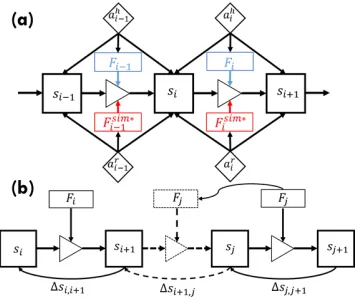
Figure 5: (a) A fragment of apt. The forces Fi−1 andFi produced by human (in blue) change the bottle states from
si−1tosi+1. The robot action that produces the closest force
distribution obtained by simulation (in red) is chosen and causes the same changes of object states. (b) Ifsi+16=sj,
and∆si+1,j is closer to∆sj,j+1than any other fluents, we
assign the forceFjto change the state fromsi+1tosj.
polymers, and it is impractical for us to find the exact mate-rial parameters through mechanical tension or compression tests. Thus, we assume the deformation of the bottle is suf-ficiently far away from the plastic regime, and adopt a stan-dard hyperelastic model: the Neo-Hookean model (Macosko 1994) to describe the mechanical stress under deformation
P=µ(F−F−T) +λlog(det(F))F−T, (9)
where F is the deformation gradient tensor encoding the strain at each point,Pis the first Piola-Kirchoff stress tensor describing its elastic mechanical stress, andµ,λare material parameters describing the stiffness and incompressibility of the bottle, respectively. The governing equation describing the force balance of the bottle is given by
∇ ·P=fext, (10)
wherefextdenotes the total external force on the bottle. We solve Equation 10 using the Finite Element Method (Bonet and Wood 1997). The input bottle geometry is first converted from a triangulated surface to a tetrahedralized volume using TetGen (Si 2015). The robot gripper mesh is converted into a watertight level set represented by Open-VDB (Museth et al. 2013), which allows natural treatment of frictional contact under arbitrary kinematic rigid motion. The additional parameters including friction coefficient,µ, andλare set empirically. Once the discretized equation sys-tem is solved to convergence, we evaluate the force magni-tude at each discrete point of the object surface mesh and store them inFmsim.
Execution Ideally, a robot can accomplish the task using the primitives obtained from the simulator (see Figure 5a). However, we may encounter two types of discontinuity is-sues in robot execution.
1. Discontinuity in object state space. The post-condition
si+1of actionaiand the pre-conditionsi+10of the next
actionai+1 are not necessarily the same from the
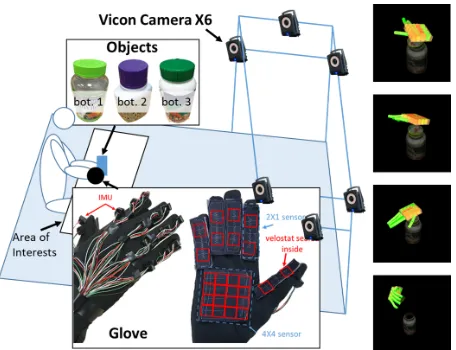
Figure 6: Data collection environment. A tactile glove is uti-lized to collect hand poses and forces, and the Vicon MoCap system for relative poses of hand and objects.
additional primitive is needed. We define a subtraction operator,∇−(·,·)for two consecutive states such that
∆si,j=∇−(si, sj) =hdj−di, θj−θii. (11)
As shown in Figure 5b, by comparing the discontinuity
∆si+1,j with any other changes of states, we choose the most similar one in terms ofL2norm. The corresponding
type of force is assigned to interpolate the discontinuity. 2. Discontinuity in robot action space.We use B-Spline to
fill in two discontinuous primitives assuming no obsta-cles, and the robot is able to follow the trajectory speci-fied by the spline. Once the end-effector reaches the joint limit, it is set to restore to the initial position. For in-stance, if the generated primitive is rotating in the clock-wise direction, reaching robot’s joint limit, the robot will first rotate back to its natural pose before the execution.
4
Experiment
4.1
Preliminary
Robot Platform We exercise the proposed framework in a robot platform with a dual-armed 7-DoF Baxter robot mounted on a DataSpeed mobility base. The robot is equipped with a ReFlex TakkTile gripper on the right wrist and a Robotiq S85 parallel gripper on the left. The entire sys-tem runs on ROS, and the arm motion is planned byMoveIt!.
Dataset The hand pose and force data is collected us-ing an open-sourced tactile glove (Liu et al. 2017) that is equipped with i) a network of 15 IMUs to measure the ro-tations between individual phalanxes, and ii) 6 customized force sensors using Velostat, a piezoresistive material, to record the force in two regions (proximal and distal) on each phalange and a4×4 regions on palm. Figure 6 depicts the tactile glove and the data collection environment. The rela-tive poses between the wrist of hand and object parts (i.e., bottle, and lid) are obtained from Vicon. The data of10 hu-man hu-manipulation sequences is collected, processed, and vi-sualized using ROS.
Figure 7: (a) The cumulative rewards during training and evaluation. (b) The landscape of the learned Q table, where yellow indicates high values and blue low. (c) The 21 types of actions (forces) by clustering in one exemplary demon-stration. (d) The 25 discretized states based on the forces (some force types appear more than once).
4.2
Learning
Figure 7a-b shows the Q-learning results, with a discount factor0.99, reward for success+1, reward for failure−1, and reward for all others0. We use-greedy exploration with exponential decay to obtain the state-force associations.
Figure 7a shows the cumulative reward during each train-ing episode in red, and the average cumulative reward durtrain-ing evaluation in blue. During training, the cumulative reward generally increases until finding a path that leads to the max-imum reward and begins fluctuating. This fluctuation hap-pens due to the marginal probability of a non-optimal ac-tion being chosen at each step in-greedy exploration pol-icy, even though an optimal path has been found. The eval-uation is performed every ten episodes during training with a policy induced by the Q-table. During the evaluation, the reward monotonically increases slowly at first and jumps to the maximum, due to the optimal path found during training and the learning signals propagated into the Q-table. The policy induced from the Q-table converges to the optimum after approximately900episodes in training. The resulting Q-table is shown in Figure 7b.
4.3
Robot Execution with Functional Equivalence
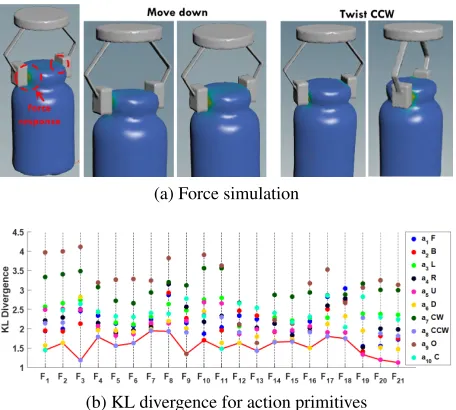
A pt is first sampled from the T-AOG induced from the learned policy to obtain a sequence of force types the robot should imitate in order to cause the same changes of object states. Our physics-based simulation then emulates a set of robot actions to obtain their force responses; some examples are shown in Figure 8a.
Figure 8b shows an example of aptconsisting of 21hoi
(a) Force simulation
(b) KL divergence for action primitives
Figure 8: (a) Simulations of the robot actions’ force re-sponses. (b) The KL divergence for all action primitives in a
pt. In this case, the primitives area1move forward,a2move
backward,a3move left,a4move right,a5move up,a6move
down,a7 rotate clockwise,a8rotate counter-clockwise,a9
open gripper, anda10close gripper. The solid red line is the
sequence of actions for a robot to execute.
are selected for robot execution.
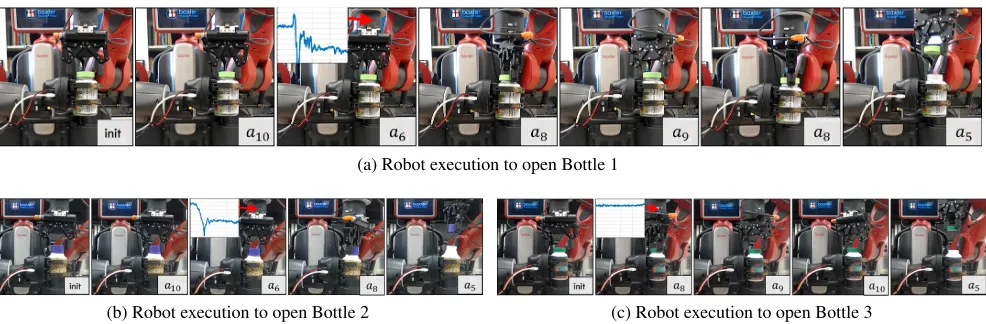
The execution of a Baxter robot is shown in Figure 9a. It starts from an initial position and sequentially performs the corresponding primitives indicated in the grey area in the lower right corner. The a6 downwardprimitive indeed
generates forces which are captured by the force sensor (top left) in the robot wrist, which demonstrate that themirroring
approach indeed allows the robot to fulfill the challenging task of opening medicine bottles with a set of actions that are different from demonstrations.
The result also shows that the similarity between forces can be adequately measured by KL divergence to deter-mine whether two actions are functionally equivalent. For instance, the primitiveopening the gripper has the largest divergence in most of the cases as it produces no force to the object, except inF9when the demonstrator releases the
lid after one rotation. The pressing force critical to our task is also captured and mirrored to robot well (seeF2andF16
where a downward primitive is planned). Finally, upward
primitives are selected to finish the task by pulling the lid.
4.4
Ablative Analysis
We further present a quantitative analysis of the proposed
mirroring approach. A baseline experiment is designed to only account for the trajectories of the hand in demonstra-tion, which are directly mapped to robot end-effectors. We also test the proposed approach, without new training, in similar tasks of opening two additional medicine bottles– Bottle 2 with the same press-open mechanism but in differ-ent shape and size, and Bottle 3 with no lock.
Table 1 shows the success rate. Frames of the executions are shown in Figure 9b-9c. The success rates of the base-line (B) are significantly lower than those of our approach (M) for Bottle 1 and 2, showing the necessity of capturing the hidden force information and the effectiveness of our ap-proach in transferring the manipulative actions. As pressing the lid is not required for opening Bottle 3, the success rates do not vary a lot between both methods.
Without mimicking the observed demonstrations, the learned the grammar model T-AOG is capable of sampling a pt that can be different from demonstration to alleviate overimitation. In the particular ptshown in Figure 9c, an
a6 move down action is not planned and no significant
downward force is applied when twisting. The ablative anal-ysis performed here shows that our approach can be general-ized to similar but different tasks, and it is possible to avoid overimitation in new scenarios using the proposed approach.
5
Discussion
Overimitation in Infants, Children, and Animals. A phenomenon termed overimitation (Lyons, Young, and Keil 2007) illustrates a seeming cost of our imitative prowess. Children have been observed to overimitate,i.e., to repro-duce an adult’s obviously irrelevant actions (Tomasello et al. 2005; McGuigan et al. 2007), even in situations where chim-panzees correctly ignored the unnecessary steps (Horner and Whiten 2005; Want and Harris 2002; Whiten et al. 1996). However, such overimitation only occurs when the chil-dren are trying to discover the hidden structure of complex problems given the demonstrations (Lyons, Young, and Keil 2007). Younger infants, on the contrary, often do not exhibit the overimitation and only imitate rationally (Skerry, Carey, and Spelke 2013); but will still try to explore the world by discovering the hidden causes to explain the unexpected ob-servations (Stahl and Feigenson 2015).
What are advantages and disadvantages of using simu-lation? Physics-based simulation can be difficult to tune and has a reality gap that does not match the real world per-fectly. However, it still affords a powerful tool for a robot to explore the action space to reach the desired goal of a task rather than mimicking the demonstrations. On the other hand, if the accurate tactile sensing gripper and good object state perception are available, the simulation engine could be replaced in the proposed approach.
What is unique aboutGoal-orientedandMirroring com-pared with other LfD methods? Prior work that learns action-state policy in using IRL (Osa et al. 2018) is similar to ourGoal-orientedmethod that associates force types to state changes ashoiunits. The IRL assumes a Markov De-cision Process; however, the use of T-AOG that is composed
Table 1: The success rate for opening 3 bottles using the baseline model (B) and the proposed approach (M).
Bottle 1 Bottle 2 Bottle 3
B 38.5% 30.8% 76.9%
(a) Robot execution to open Bottle 1
(b) Robot execution to open Bottle 2 (c) Robot execution to open Bottle 3
Figure 9: Starting from the initial pose, the primitives (in grey) are performed sequentially. The robot “pushes” bya6(
down-ward) (see force plot) and opens the medicine bottle bya5(upward).
of hoiunits yields a non-Markovian model.Mirroring ac-tions allows to generate an unseen action sequence for the robots that goes beyond the observed demonstration.
6
Conclusion
We present aforce-based, goal-oriented mirroringapproach for a robot to learn a manipulation task by imitating the forces from the demonstrations and the changes of the ob-ject’s physical states caused by the forces. This approach differs from prior work that either mimics the demonstra-tor’s trajectory or matches the keypoints, providing a deeper understanding of the physical world for a robot.
In the experiment, we use a tactile glove to collect hu-man demonstrations of opening medicine bottles with safety locks. The discretized force types and object state changes are associated by a policy learned using the Q-Learning. A T-AOG is further induced to provide a robot the task planner on how to change the physical states by exerting a partic-ular type of force. Our physics-based simulation engine is capable of emulating the forces produced by a set of robot actions. Finally, human demonstrations are successful “mir-rored” to robot’s actions withfunctional equivalenceas they both produce similar forces and cause similar changes in object states, which is validated by an actual Baxter robot opening various medicine bottles.
Acknowledgments: The work reported herein was sup-ported by DARPA XAI grant N66001-17-2-4029, ONR MURI grant N00014-16-1-2007, ARO grant W911NF-18-1-0296, and an NVIDIA GPU donation grant. We thank Prof. Tao Gao from the UCLA Statistics Department for useful discussions on the motivation of this work.
References
Abbeel, P., and Ng, A. Y. 2004. Apprenticeship learning via inverse reinforcement learning. InICML.
Argall, B. D.; Chernova, S.; Veloso, M.; and Browning, B. 2009. A survey of robot learning from demonstration. Robotics and Au-tonomous Systems57(5):469–483.
Bonaiuto, J.; Rosta, E.; and Arbib, M. 2007. Extending the mirror neuron system model, i.Biological Cybernetics96(1):9–38. Bonet, J., and Wood, R. D. 1997.Nonlinear continuum mechanics for finite element analysis. Cambridge university press.
Dautenhahn, K., and Nehaniv, C. L. 2002. Imitation in Animals and Artifacts. MIT Press Cambridge, MA.
Edmonds, M.; Gao, F.; Xie, X.; Liu, H.; Qi, S.; Zhu, Y.; Rothrock, B.; and Zhu, S.-C. 2017. Feeling the force: Integrating force and pose for fluent discovery through imitation learning to open medicine bottles. InIROS.
Gallese, V.; Fadiga, L.; Fogassi, L.; and Rizzolatti, G. 1996. Action recognition in the premotor cortex.Brain119(2):593–609. Gazzola, V.; Rizzolatti, G.; Wicker, B.; and Keysers, C. 2007. The anthropomorphic brain: the mirror neuron system responds to hu-man and robotic actions.Neuroimage35(4):1674–1684.
Guenter, F.; Hersch, M.; Calinon, S.; and Billard, A. 2007. Rein-forcement learning for imitating constrained reaching movements.
Advanced Robotics21(13):1521–1544.
Gupta, A.; Eppner, C.; Levine, S.; and Abbeel, P. 2016. Learning dexterous manipulation for a soft robotic hand from human demon-strations. InIROS.
Horner, V., and Whiten, A. 2005. Causal knowledge and imi-tation/emulation switching in chimpanzees (pan troglodytes) and children (homo sapiens).Animal cognition8(3):164–181. Ito, M., and Tani, J. 2004. On-line imitative interaction with a humanoid robot using a dynamic neural network model of a mirror system.Adaptive Behavior12(2):93–115.
Johnson-Frey, S. H.; Maloof, F. R.; Newman-Norlund, R.; Farrer, C.; Inati, S.; and Grafton, S. T. 2003. Actions or hand-object in-teractions? human inferior frontal cortex and action observation.
Neuron39(6):1053–1058.
Kanungo, T.; Mount, D. M.; Netanyahu, N. S.; Piatko, C. D.; Sil-verman, R.; and Wu, A. Y. 2002. An efficient k-means clustering algorithm: Analysis and implementation. PAMI24(7):881–892. Kober, J., and Peters, J. R. 2009. Policy search for motor primitives in robotics. InNIPS, 849–856.
Robot learning from demonstration by constructing skill trees.
IJRR31(3):360–375.
Kormushev, P.; Calinon, S.; and Caldwell, D. G. 2011. Imitation learning of positional and force skills demonstrated via kinesthetic teaching and haptic input.Advanced Robotics25(5):581–603. Legg, S., and Hutter, M. 2007. Universal intelligence: A definition of machine intelligence.Minds and Machines17(4):391–444. Levine, S., and Abbeel, P. 2014. Learning neural network policies with guided policy search under unknown dynamics. InNIPS. Levine, S.; Wagener, N.; and Abbeel, P. 2015. Learning contact-rich manipulation skills with guided policy search. InICRA. Lin, Y.; Ren, S.; Clevenger, M.; and Sun, Y. 2012. Learning grasp-ing force from demonstration. InICRA, 1526–1531.
Liu, H.; Xie, X.; Millar, M.; Edmonds, M.; Gao, F.; Zhu, Y.; Santos, V. J.; Rothrock, B.; and Zhu, S.-C. 2017. A glove-based system for studying hand-object manipulation via joint pose and force sens-ing. InIROS.
Lyons, D. E.; Young, A. G.; and Keil, F. C. 2007. The hidden structure of overimitation.PNAS104(50):19751–19756.
MacGlashan, J., and Littman, M. L. 2015. Between imitation and intention learning. InIJCAI.
Macosko, C. W. 1994. Rheology: principles, measurements, and applications. Wiley-vch.
Maeda, G.; Ewerton, M.; Koert, D.; and Peters, J. 2016. Acquiring and generalizing the embodiment mapping from human observa-tions to robot skills.IEEE RA-L1(2):784–791.
Manschitz, S.; Gienger, M.; Kober, J.; and Peters, J. 2016. Prob-abilistic decomposition of sequential force interaction tasks into movement primitives. InIROS.
McGuigan, N.; Whiten, A.; Flynn, E.; and Horner, V. 2007. Im-itation of causally opaque versus causally transparent tool use by 3-and 5-year-old children.Cognitive Development22(3):353–364. Mnih, V.; Kavukcuoglu, K.; Silver, D.; Rusu, A. A.; Veness, J.; Bellemare, M. G.; Graves, A.; Riedmiller, M.; Fidjeland, A. K.; Ostrovski, G.; et al. 2015. Human-level control through deep rein-forcement learning.Nature518(7540):529–533.
Montebelli, A.; Steinmetz, F.; and Kyrki, V. 2015. On handing down our tools to robots: Single-phase kinesthetic teaching for dy-namic in-contact tasks. InICRA.
Museth, K.; Lait, J.; Johanson, J.; Budsberg, J.; Henderson, R.; Alden, M.; Cucka, P.; Hill, D.; and Pearce, A. 2013. Openvdb: an open-source data structure and toolkit for high-resolution vol-umes. InACM SIGGRAPH 2013 courses, 19.
Ng, A. Y.; Harada, D.; and Russell, S. 1999. Policy invariance under reward transformations: Theory and application to reward shaping. InICML.
Ng, A. Y.; Russell, S. J.; et al. 2000. Algorithms for inverse rein-forcement learning. InICML.
Niekum, S.; Osentoski, S.; Konidaris, G.; Chitta, S.; Marthi, B.; and Barto, A. G. 2015. Learning grounded finite-state representations from unstructured demonstrations.IJRR34(2):131–157.
Oberman, L. M.; McCleery, J. P.; Ramachandran, V. S.; and Pineda, J. A. 2007. Eeg evidence for mirror neuron activity during the observation of human and robot actions: Toward an analysis of the human qualities of interactive robots. Neurocomputing 70(13-15):2194–2203.
Osa, T.; Pajarinen, J.; Neumann, G.; Bagnell, J. A.; Abbeel, P.; Pe-ters, J.; et al. 2018. An algorithmic perspective on imitation learn-ing.Foundations and TrendsR in Robotics7(1-2):1–179.
Oztop, E., and Arbib, M. A. 2002. Schema design and imple-mentation of the grasp-related mirror neuron system. Biological Cybernetics87(2):116–140.
Pastor, P.; Hoffmann, H.; Asfour, T.; and Schaal, S. 2009. Learning and generalization of motor skills by learning from demonstration. InICRA.
Prieur, U.; Perdereau, V.; and Bernardino, A. 2012. Modeling and planning high-level in-hand manipulation actions from human knowledge and active learning from demonstration. InIROS. Qi, S.; Huang, S.; Wei, P.; and Zhu, S.-C. 2017. Predicting human activities using stochastic grammar. InICCV.
Racca, M.; Pajarinen, J.; Montebelli, A.; and Kyrki, V. 2016. Learning in-contact control strategies from demonstration. In
IROS, 688–695.
Ramachandran, D., and Amir, E. 2007. Bayesian inverse reinforce-ment learning. InIJCAI.
Rizzolatti, G., and Craighero, L. 2004. The mirror-neuron system.
Annual Reviews Neuroscience27:169–192.
Rizzolatti, G.; Fogassi, L.; and Gallese, V. 2001. Neurophysio-logical mechanisms underlying the understanding and imitation of action.Nature Reviews Neuroscience2(9):661–670.
Shu, T.; Gao, X.; Ryoo, M. S.; and Zhu, S.-C. 2017. Learning social affordance grammar from videos: Transferring human interactions to human-robot interactions. InICRA.
Si, H. 2015. Tetgen, a delaunay-based quality tetrahedral mesh generator.ACM Transactions on Mathematical Software41(2):11. Skerry, A. E.; Carey, S. E.; and Spelke, E. S. 2013. First-person ac-tion experience reveals sensitivity to acac-tion efficiency in prereach-ing infants.PNAS201312322.
Stahl, A. E., and Feigenson, L. 2015. Observing the unexpected enhances infants’ learning and exploration.Science348(6230):91– 94.
Theodorou, E.; Buchli, J.; and Schaal, S. 2010. Reinforcement learning of motor skills in high dimensions: A path integral ap-proach. InICRA.
Thill, S.; Caligiore, D.; Borghi, A. M.; Ziemke, T.; and Baldas-sarre, G. 2013. Theories and computational models of affordance and mirror systems: an integrative review. Neuroscience & Biobe-havioral Reviews37(3):491–521.
Tomasello, M.; Carpenter, M.; Call, J.; Behne, T.; and Moll, H. 2005. In search of the uniquely human. Behavioral and brain sciences28(5):721–727.
Want, S. C., and Harris, P. L. 2002. How do children ape? apply-ing concepts from the study of non-human primates to the devel-opmental study of ‘imitation’ in children. Developmental Science
5(1):1–14.
Whiten, A.; Custance, D. M.; Gomez, J.-C.; Teixidor, P.; and Bard, K. A. 1996. Imitative learning of artificial fruit processing in chil-dren (homo sapiens) and chimpanzees (pan troglodytes). Journal of comparative psychology110(1):3.
Yang, Y.; Li, Y.; Ferm¨uller, C.; and Aloimonos, Y. 2015. Robot learning manipulation action plans by” watching” unconstrained videos from the world wide web. InAAAI.
Zhu, S.-C., and Mumford, D. 2007. A stochastic grammar of im-ages.Foundations and TrendsR in Computer Graphics and Vision
2(4):259–362.