491
Copyright © 2011-15. Vandana Publications. All Rights Reserved.
Volume-5, Issue-2, April-2015
International Journal of Engineering and Management Research
Page Number: 491-496
Automated Medication Kit
V. L. Charishma1, K. Harika2, A. Kavya3, Mr. T. P. Kausalya Nandan4
1,2,3,4
Department
of Electronics and Communication Engineering, INDIA
ABSTRACT
Because of people’s busy schedule or due to forgetfulness or due to memory loss (because of age) many a times they skip their medical schedule which has to be taken at a particular time (especially in rural and blind people). Apart from these the rural people cannot be able to read the medical prescription written by doctor because of illiteracy or eye sight. This may not be harmful in case of normal diseases like fever, headache etc. But when it comes to diseases like asthma, heart attack, Tuberculosis, sugar patients they need to take the scheduled medicines at specific time. Sometimes the wrong combination of the medicines also leads to further increase of disease, results in costlier medicines and prolong of medicine course. This is a critical problem for Medical Researchers as it hampers treatment success. This paper proposes the automated medicinal remainder for rural India and blind people which reminds the people of their medicinal schedules and also provides by passing of requirement so that they can be notified again and again whenever they are busy.
Keywords— Carefree life, medical non-adherence, medical
adherence, medical prescriptions, skipping schedule.
I.
INTRODUCTION
[3] Medical non-adherence is the degree to which the patient forget his medicine intake, skips his medicine, wrong combination of medicines or [4] even neglecting medication because of ethnicity and cultural influence. [2] Medical researchers has proves that that in developed countries, medical adherence is about 50%. The situation in developing countries is even worse. [3] Medical adherence is the degree to which a patient correctly follows the medical advice correctly. In India majority part is rural people. [4] The problem of medication non-adherence is critical in case of our country, specifically in the rural areas because of
1. Forgetfulness in the elders 2. Illiteracy factor
3. Lack of knowledge on technology to
utilize various mobile based applications as remainders
4. Unable to identify the correct medicine among many medicines
The solution for this problem is presented in this paper especially for rural people who cannot afford to buy smart phones which are having medicine remainder apps and few other applications
II.
METHODOLOGY
Existing solution:
The available solutions for this problem can be divided into Software based and Hardware based methods. The software based solutions comprises generally of various medication reminder applications for several mobile platforms which cannot be used by illiterate and elderly rural people.
Proposed solution:
492
Copyright © 2011-15. Vandana Publications. All Rights Reserved.
at the particular scheduled time by providing a wirelesscommunication between controlling module and user tag module efficiently
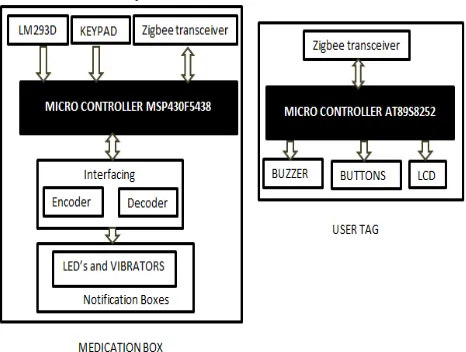
Figure 2: Block diagram of medication kit
III.
IMPLEMENTATION
A) Hardware implementation
The hardware components are sectorized into three modules. They are 1.Controlling module 2.Medicinal boxes module 3. Usertag module .The controlling module comprises of MSP430F5438 microcontroller which is experimental board (TI component) along with Tarang zigbee transceivers for notifying the patient.
Controlling module:
A TIMSP430F5438 microcontroller is the back end of this device. It is set to Low Power Mode displaying REAL TIME CLOCK, when there is no activity, to save power. Its LCD makes up the User-Interface of the device. A vibrator and LED are placed on the MedAssist Box both of which are triggered during the alarm time. The MedAssist Box has 5 compartments for 5 different types of medications. A push button is incorporated as a sensor. This way, mcu can track whether user has opened the compartment during the alarm time or not. At the time of an alarm, The MCU sends the signal to the LEDs/Vibrators and also to AT89S8252 using zigbee having a transceiver RF module, which transmits the signal to User-Tag module.
Medicinal boxes module:
This medicinal box contains medicines individually. Each box contains one particular medicine. Whenever the particular alarm matched for a medicine rises then that particular box led along with vibrator goes ON. Its gets OFF only when the user takes those medicines. Each box is provided with led and vibrator for user interface. The number of boxes to be taken depends on user. Whenever a medicine is taken, then the user must
press a master switch so that the controller can understand that medicine has been taken by the patient. If he forgets to do so then the particular box goes to missed alarm list
User Tag module:
Whenever the given info tracks with the information, through zigbee transceiver the info is passed to receiver section containing 8052 microcontroller along with LCD display. LCD indicates “MEDICATION KIT” in idle mode. Once the info is received its displays “Alert” to the user. He can even skip the alarm when is he busy by this switch also. Whenever is skips the alarm, the MSP430F5438 will send the signal again after a span of 15 minutes continuously till1 hour.
Figure 3: Keypad layout
B) Software implementation
This section explains how the various functionalities of Medication kit is programmed
Figure 4: Functionality of medication kit
The list of alarms and missed alarms are provided so that the patient if missed any dosage can consult the doctor for alternate prescription to avoid further problems
IV.
WORKING ANALYSIS
A) Operation of automated medication kit
493
Copyright © 2011-15. Vandana Publications. All Rights Reserved.
box indicated by a led/vibrator. Apart from time of themedicine, it stores information like number of pills to be taken and for how many days the medicine is to be taken. The Working is broken into parts:
Step 1: After getting the medicine prescriptions from doctor, the caretaker puts the medicines in compartments and sets the schedules for all the medicines using the On-device Keypad and LCD.
Step 2: After Step 1, all the required info is with the device. It keeps tracking with a real time clock. When the time comes to take a pill, it notifies the user by buzzer at usertag.
Step 3 (Notification): It notifies the user by making a loud noise with a buzzer installed in the device and also uses RF Transmission to the “User Tag” with the user. The indicator light next to the compartment with the medicine scheduled to be taken will also turn on, and an attached vibrator is turned on (for the blind). The light/vibrator is connected to the compartment lid, and when that will be opened, they will go off (i.e. the device will assume that the user opened the compartment to take the medicine).
This system is designed for rural India as the major benefit is that it assumes no knowledge on the part of the patient. All that is required is to that once notified, the patient takes the medicine which has corresponding indicator
B) Pseudo code analysis
The different modes are explained below: Home
While (1) {
If (no activity for some time)
Go to
Low_power_mode; Else {
If (Interrupt “Notifications” triggered) Notifications ();
If (Interrupt “Set an alarm” is triggered) Set_Alarm ();
If (Interrupt “List of alarms” is triggered) List_Alarm ();
If (Interrupt “List of missed alarms” is triggered) Stack_Alarm ();}
}
Figure 5: Pseudo code for Interrupt
: By default, the device is set in Home mode which shows Real Time Clock (RTC) on LCD screen and the microcontroller is in its Low Power Mode. In the event of an interrupt, it exits low power mode, executes the desired function, and goes back into low power mode. Notification of an alarm is an internal interrupt function and rest are external hardware interrupts caused due to pressing buttons on 4X4 Keypad or opening pill-boxes.
Set an alarm
Enter No. of medication box;
Enter No. of days of medication;
Enter No. of pills at each time;
Enter No. of alarms per day;
for (No. of alarms per day){
Enter the alarm (hours & min); add the alarm to the list; }
Return to Home; Go to Low Power Mode;
Figure 6: Pseudo-Code for Set_Alarm () : Pressing one specific button on the Keypad triggers the interrupt corresponding to ‘Set an Alarm’. The device wakes up from low power mode and calls ‘Set_Alarm’ function, executes it and goes back to Low power mode.
List Alarms
Show the first alarm in the sorted list;
If (Up or down arrow pushed) {
Show the next/previous alarm in the list; }
if (Delete button pressed ) delete(current alarm); Return to Home;
Go to Low Power Mode;}
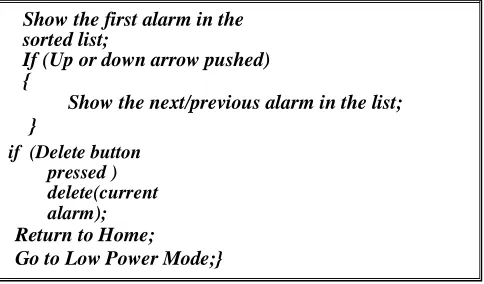
Figure 7: Pseudo-Code for List_Alarm () : To view the list of alarms that are fed in the device, a button on the Keypad corresponding to “List_Alarm ()” can be pressed. It displays the list of alarms which can be navigated using buttons on the Keypad. User also has the option to delete any particular alarm using the Delete button.
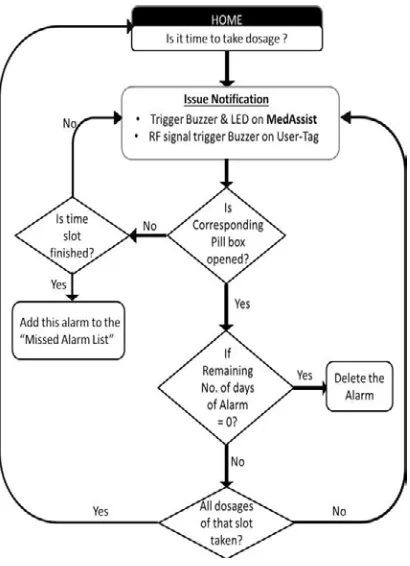
Notification: When the time of an alarm matches with the Real time clock of MCU, Notifications interrupt is triggered. Flowchart of Notifications is shown in Figure 7. As the Notification interrupt is triggered, the Box buzzer is activated and the LED and Vibrator of the corresponding compartment along with the main LED turn on.
494
Copyright © 2011-15. Vandana Publications. All Rights Reserved.
Figure 8: Flowchart analysisV.
RESULTS AND DISCUSSIONS
We validated the effectiveness and advantages of our proposed methodology by doing software testing. Each module of the program was verified with various test cases. The device was programmed in such a way that it uses the available memory of TI MSP430 MCU efficiently. The prototype was well designed to implement all the software modules and tested with all possible cases. All the basic functionalities mentioned in the proposed solution were successfully implemented in the prototype. The device has been demonstrated through the attached below.
Figure 9: The controlling modules with medicine boxes
495
Copyright © 2011-15. Vandana Publications. All Rights Reserved.
Figure 10: User tag indicating medicine taken display
Figure 11: Real time clock display at ideal mode
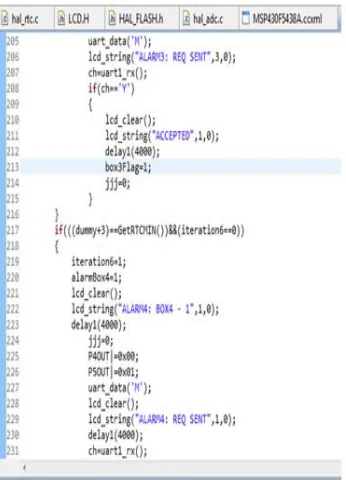
Figure 12: CCS code for medication kit
VI.
CONCLUSION
All the basic functionalities mentioned in the proposed solution were successfully implemented in the prototype. We estimate the cost of the proposed device to be nearly $20 after optimization. It is quite less when compared to the existing devices whose cost varies from $70 to $800. The User-tag uses wireless communication, thus making it possible for the user to sense the notification even when he/she is very far away from the device. The pills are to be kept within the medication packet inside the kit. Thus all the crucial important about the medicines, like their expiry dates, directions to use, etc. are preserved for future reference. The device is completely battery operated as opposed to other existing devices, which makes it even more usable for rural households in India. The prototype suffers from some limitations as well. It is built using TI MSP430F5438 MCU which has limited memory, and therefore, there is a limitation on maximum number of alarms that it can store. The size of User-Tag is very large and can be reduced. Since here we are using a complete Launchpad as the User-Tag, we can argue that the size can be reduced by using a simplified RF Module.
VII.
FUTURE SCOPE
Extensive user testing is required for the device to comment about its usability and reliability in the rural environment. With required changes, Medication boxes can be mass produced for usage in rural India. Since we are using components like complete MCU’s and zigbee for simple operations, we argue that the device can be made feasible for poor people. There are also a couple of features that we plan to add.. We plan to use a smaller RF module so as to make the User-Tag similar to a wrist-watch. Adding voice-based prompts such as ‘Take this medicine after lunch’ and ‘Take this medicine before dinner’ can increase the usability of the device as well. Also, a mobile based app instead of RF user tag can be developed targeting urban crowd in the country. This app can also be used to track the intake of medicines by the patient
REFERENCES
[1]A meta-analysis of the association between adherences to drug
http://www.bmj.com/content/333/7557/15#ref-2 [2] http://www.ti.com/product/msp430f5438
496
Copyright © 2011-15. Vandana Publications. All Rights Reserved.
http://www.who.int/chp/knowledge/publications/adherence_full_report.pdf
[4] http://circ.ahajournals.org/content/119/23/3028.full [5] http://www.medscape.com/viewarticle/409940 [6] http://www.imedicalapps.com/2010/09/iphone-android-blackberry-medication-reminder-app/ (determining the best medication reminder apps)