Research Article
Urinary Incontinence in Women Living in Nursing Homes:
Prevalence and Risk Factors
Inkontinensia Urin pada Perempuan yang Tinggal di Panti Werdha:
Prevalensi dan Faktor Risiko
Chairul Rijal, Surahman Hakim
Department of Obstetrics and Gynecology Faculty of Medicine University of Indonesia/
Dr. Cipto Mangunkusumo Hospital Jakarta
Abstract
Objective: To identify the prevalence of urinary incontinence, the distribution of the type of urinary incontinence and related risk fac-tors in women older than 50 years.
Method: This is a descriptive study with cross sectional design. Two hundred and seventy eight women older than 50 years old living in nursing home were interviewed using the Questionnaire for Urinary Incontinence Diagnosis (QUID) that has been translated and vali-dated. The prevalence will be presented in the form of percentage; while the relationship between risk factors and the incidence or uri-nary incontinence will be analyzed using Chi square test or Fisher’s exact test, as appropriate, and multivariate analysis.
Result: Of 278 research subjects, we obtained 95 subjects (34.2%) suffering from urinary incontinence. Moreover, the distribution of the type is 67 subjects (70.5%) with mixed urinary incontinence, 17 (17.9%) with stress incontinence and 11 subjects (11.6%) with urge incontinence. Body mass index (BMI) showing overweight and obe-sity are not related with the prevalence of urinary incontinence (p>0.05), which may be caused by the low number of subjects with overweight and obesity. Meanwhile, factors related to urinary incon-tinence are age older than 60 years (OR=7.79, p=0.021), menopause 10 years (OR=5.08, p=0.004) and multiparity (OR=1.82, p=0.019). Based on multivariate analysis, the risk factor of age older than 60 years is no longer related to urinary incontinence (p>0.05). Thus it can be inferred that age older than 60 years is not a singular factor causing urinary incontinence but rather a part of a multifactorial model.
Conclusion: This study shows that the prevalence of urinary incon-tinence in women living in nursing home is 34.2%; while the distri-bution of the urinary incontinence is 67 subjects (70.5%) with mixed urinary incontinence, 17 subjects with stress incontinence (17.9%) and 11 subjects (11.6%) with urge incontinence. Risk factors for uri-nary incontinence are menopause 10 years and multiparity. [Indones J Obstet Gynecol 2014; 4: 193-198
Keywords: mixed urinary incontinence, menopause, multiparity, prevalence, stress incontinence, urge incontinence, urinary inconti-nence, Questionnaire for Urinary Incontinence Diagnosis (QUID)
Abstrak
Tujuan: Untuk mengetahui prevalensi inkontinensia urin, sebaran tipe inkontinensia urin dan faktor-faktor risiko yang berhubungan pada perempuan berusia di atas 50 tahun.
Metode: Penelitian ini merupakan penelitian deskriptif dengan desain potong lintang. Sebanyak 278 perempuan berusia di atas 50 tahun yang tinggal di panti werdha, telah dilakukan wawancara secara ter-pimpin menggunakan Questionnaire for Urinary Incontinence Diagno-sis (QUID) yang telah diterjemahkan dan divalidasi. Prevalensi inkon-tinensia urin disajikan dalam bentuk persentase, sedangkan hubung-an hubung-antara faktor risiko denghubung-an kejadihubung-an inkontinensia urin dihubung-analisa dengan uji Chi square atau uji Fisher sesuai sebaran data, dan juga di-lakukan uji multivariat.
Hasil: Dari 278 subjek penelitian, didapatkan sebanyak 95 orang (34,2%) menderita inkontinensia urin, dengan sebaran tipe sebagai berikut: inkontinensia urin tipe campuran 67 orang (70,5%), inkonti-nensia urin tipe stres 17 orang (17,9%) dan inkontiinkonti-nensia urin tipe ur-gency 11 orang (11,6%). Indeks massa tubuh (IMT) berlebih dan obesitas tidak memiliki hubungan dengan kejadian inkontinensia urin (p>0,05), yang dapat dijelaskan oleh sedikitnya jumlah subjek dengan IMT berle-bih dan obesitas. Faktor-faktor risiko yang berhubungan dengan inkon-tinensia urin adalah usia di atas 60 tahun (OR=7,79; p=0,021), meno-pause >10 tahun (OR=5,08; p=0,004), dan multipara (OR=1,82; p=0,019). Saat dilakukan uji multivariat, faktor risiko usia di atas 60 tahun dida-patkan menjadi tidak berhubungan dengan kejadian inkontinensia urin (p>0,05). Dari situ disimpulkan bahwa faktor usia di atas 60 tahun bukan merupakan faktor tunggal terjadinya inkontinensia urin me-lainkan bagian dari sebuah model multifaktorial.
Kesimpulan: Penelitian ini menunjukkan bahwa prevalensi inkonti-nensia urin pada perempuan yang tinggal di panti werdha adalah se-besar 34,2%. Tipe inkontinensia urin yang ditemui adalah 67 orang dengan inkontinensia urin tipe campuran (70,5%), 17 orang dengan inkontinensia urin tipe stres (17,9%) dan 11 orang dengan inkontinen-sia urin tipe urgensi (11,6%). Faktor-faktor risiko inkontineninkontinen-sia urin termasuk menopause >10 tahun dan multipara.
[Maj Obstet Ginekol Indones 2014; 4: 193-198]
Kata kunci: inkontinensia urin, inkontinensia urin tipe campuran, in-kontinensia urin tipe stres, inin-kontinensia urin tipe urgensi, meno-pause, multipara, prevalensi, Questionnaire for Urinary Incontinence Diagnosis (QUID)
INTRODUCTION
Urinary incontinence based on International Con-tinence Society (ICS) is defined as involuntary loss of urine that can be demonstrated objectively and of social and hygienic problems.1-4 Urinary
incon-tinence is a medical problem that can commonly be seen in aging patients, especially in women.5,6
This problem has serious impacts on physical (sleep disturbance and sexual intercourse), psy-chologic (sadness, depression, shamefulness), and social (social stigma, social isolation) wellbeing.1,7
Urinary incontinence is often not reported by the patients or their family, because such problem is considered as taboo or shameful to be discussed, the lack of knowledge regarding urinary inconti-nence and considering such condition as normal aging process and does not require medical help.4
Urinary incontinence is commonly met in aging female patients. The high prevalence of urinary in-continence in this group is considered as part of the aging processs. Various research has shown that the etiology of urinary incontinence is multi-factorial and highly related to age and menopause. As the patient age, there are physiological changes in the urinary tract, partly caused by diseases out-side the urinary tract and partly caused by struc-tural changes in the urinary tract due to aging. These changes include reduced elasticity of the bladder and decreased strength of detrusor mus-cle, increasing frequency of spontaneous contrac-tion of detrusor muscle, decreasing capability in holding urine and decreased urethral closure pres-sure.8,9
The prevalence of urinary incontinence vary in the range of 5-60%.14 In 1998, Asia Pacific
Conti-nence Advisory Board (APCAB) stated that the prevalence of urinary incontinence in Asian wo-men is about 14.6%. While a study by Wiratmoko, done in Semarang, regarding urinary incontinence showed the prevalence to be about 23.6%.10 The
prevalence vary between countries because of se-veral factors such as the difference of incontinence definition used, the study population and study methods.11,12
From various literature, it is stated that the pre-valence of urinary incontinence increase in accor-dance with age. There is also belief that complains of involuntary urinary leakage is considered sha-meful or taboo or considered normal in elderly pa-tients; thus many patients with urinary
inconti-nence do not seek medical attention. Therefore, we expect that the prevalence of urinary incontinence in the general population is higher than reported and were interested in conducting a study of the prevalence of urinary incontinence with the dis-tribution of the type and related risk factors in the general population of aging women. However, be-cause of limitation in funds, time, and convenience in sampling, we limited the sample to women living in nursing homes.
METHOD
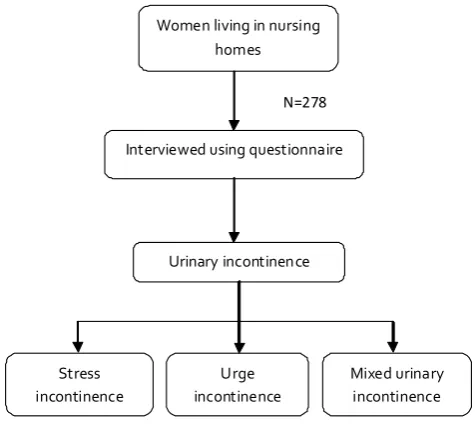
We performed a descriptive categorical study with cross-sectional design. The study is conducted in 3 nursing homes in Jakarta, namely the TMII nursing home, Ciracas nursing home and Cengkareng nur-sing home. From sample size calculation for des-criptive categorical research, the sample needed is 278 samples. The study subjects were recruited consecutively until the required number of sub-jects is met. The samples were interviewed using QUID questionnaire that has been translated and validated. Prevalence of urinary incontinence is presented in percentage, while the relationship between risk factors and the incidence of urinary incontinence is analyzed using Chi Square or Fi-sher’s exact test, as needed. Multivariate analysis was also performed. All statistical analysis were performed using SPSS version 20.
Women living in nursing homes
Interviewed using questionnaire
Urinary incontinence
Urge incontinence Stress
incontinence
Mixed urinary incontinence
N=278
RESULT
Table 1. Basic Characteristic of Research Subjects
Characteristic (n = 278)Subject
Age (years) 71.5 (50-95)*
Age group
Age 50-59 year 15 (5.4)
Age 60-69 year 97 (34.9) Age 70-79 year 88 (31.7) Age 80-89 year 67 (24.1) Age 90 year 11 (4.0)
Body Mass Index
Underweight (<18.5 kg/m2) 24 (8.6) Normal (18.5-24.9 kg/m2) 247 (88.8)
Overweight (25-29.9 kg/m2) 6 (2.2) Obese ( 30 kg/m2) 1 (0.4) Years of menopause
1-9years 29 (10.4)
10 years 249 (89.6) Method of childbirth
Spontaneous delivery 278 (100)
Forceps extraction -Vacuum extraction -Cesarean section
-Hysterectomy
-Level of education
Did not attend formal education 123 (44.2) Elementary school 119 (42.8) Junior high school 21 (7.6)
Senior high school 13 (4.7) Academy or higher 2 (0.7)
Data presented as n (%) unless stated otherwise
* Data presented as mean (range)
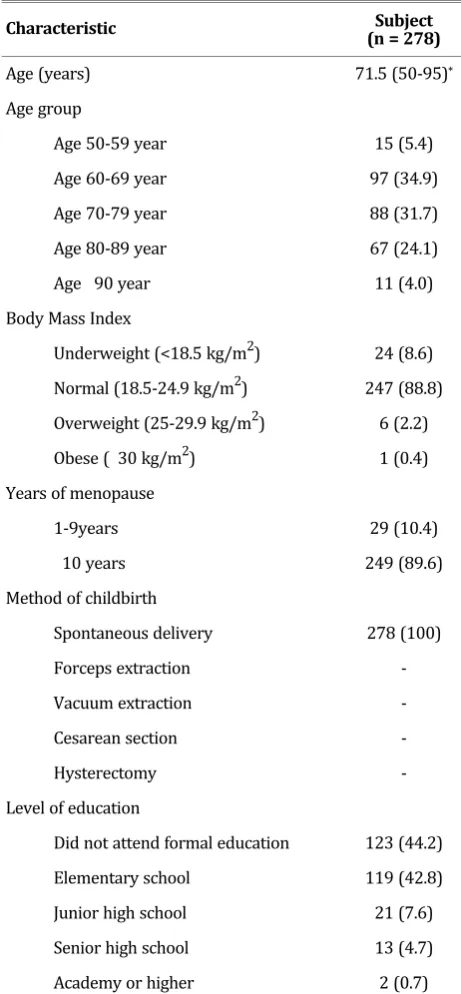
Of three nursing homes in Jakarta, we recruited 278 women who were willing to participate in the study. The mean age is 71.5 (range=50-95) years old, and most of the subjects belong to the 60-69 year old and 70-79 years old age-groups, which are 97 (34.9%) and 88 (31.7%) respectively. Around 89% of samples have normal body mass index (BMI). All of our subjects has experienced meno-pause and 249 has experienced menomeno-pause 10 years (89.6%). The demographic data of our sam-ple is shown in Table 1.
Of 278 subjects, 95 subjects (34.2%) experience urinary incontinence (Table 2). While based on the urinary incontinence type, 67 subjects (70.5%) suf-fer from mixed urinary incontinence, 17 subjects (17.9%) suffer from stress incontinence and 11 subjects (11.6%) suffer from urge incontinence.
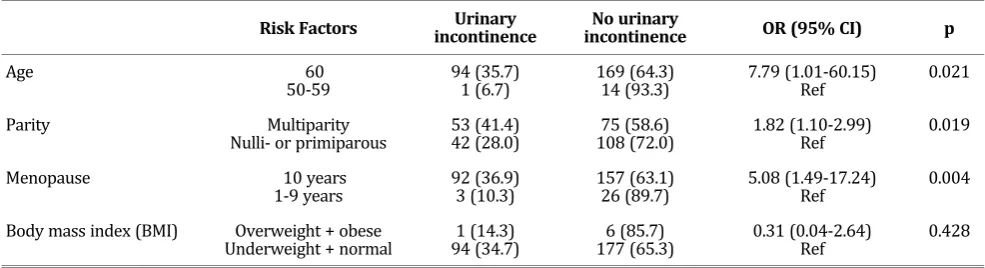
We found more urinary incontinence in subjects aged over 60 years than those younger than 60 years old. This is reflected by a statistically signifi-cant relationship between the >60 years old age group with the risk of urinary incontinence (OR=7.79; 95% CI=1.01-60.15; p=0.021). There is also a statistically significant relationship between multiparity with the incidence of urinary inconti-nence compared to primiparous or nulliparous women (OR=1.82; 95% CI=1.10-2.99; p=0.019). All subjects in this study have gone through meno-pause. Furthermore, we found a statistically signifi-cant relationship between menopause 10 years and the incidence of urinary incontinence (OR=5.08; 95% CI=1.49-17.24; p=0.004). While in this study, increasing BMI (classified as overweight and obe-se) is not related to the incidence of urinary incon-tinence (p>0.05). The risk factors associated with urinary incontinence are presented in Table 3.
Table 2. The Prevalence of Urinary Incontinence Urinary incontinence N % 95% CI
Yes 95 34.2 31.4-37
No 183 65.8
From multivariate analysis, it is obtained that age, compared to other factors (multiparity and on-set of menopause), is statistically insignificant. The data is presented in our original thesis.
DISCUSSION
Urinary incontinence is a condition in which the patient present with complaints regarding involun-tary urine loss. Such disorder is related to quality of live and daily activity, because patients lose their self-confidence and may feel depressed, ashamed and anxious.1,7
In this study, we recruited 278 women, meeting the required sample based on previous calcula-tions. This study was done by interviewing women using Questionnaire for Urinary Incontinence Diag-nosis (QUID) that has been translated and vali-dated. The "r" Cronbach alpha value for questions regarding stress type urinary incontinence is 0.965 while for urge incontinence is 0.962. Thus, we con-clude that the reliability and validity of this ques-tionnaire is good.
We observed that the mean age of our subjects is 71.5 years (range=50-95 years) and all subjects had experienced menopause, with the proportion of subjects already experiencing menopause for 10 years adding up to 89.6%. In this study, 95 subjects (34.2%) had urinary incontinence and 183 subjects (65.8%) did not. This result is in accord-ance with studies from other countries where the prevalence of urinary incontinence in women liv-ing in nursliv-ing homes varied around 30-60%.4,5,13,14
A study done in America on women living in nur-sing home showed that the prevalence of urinary incontinence is 37%.15 Moreover, research done by
Wiratmoko showed that the prevalence of urinary
incontinence in women aged >50 years old in Se-marang was 23.6%.15 The interstudy difference in
urinary incontinence prevalence is caused by the difference of urinary incontinence definition, the methods employed, the age group, country and ethnicity of the subjects in the study.3,6
This study obtained the prevalence of urinary incontinence in women aged 50 years based on the type of the urinary incontinence is as follow: prevalence of mixed urinary incontinence was 70.5%; stress incontinence was 17.9%; while urge incontinence was 11.6%. Such result is in accord-ance with the study by Wiratmoko, in which mixed urinary incontince is the type most commonly found in women aged >50 years.15 Similar results
was also obtained by Juliana et al in Brazil, where the prevalence of mixed urinary incontinence was 36.2%, urge incontinence was 26.8% and stress in-continence was 24.2%.16 Previous literature
ex-plained that women who has gone through meno-pause (experiencing hypoestrogen state) will expe-rience urethral mucosa atrophy causing urethral dysfunction and weakness of bladder musculature causing bladder dysfunction, which may cause uri-nary incontinence, especially mixed uriuri-nary incon-tinence.8,9
The prevalence of urinary incontinence increa-ses in accordance with age. From this study, the prevalence of urinary incontinence is 6.7% in the 50-59 years age group, 28.9% in the 60-69 years age group, 35.2% in the 70-79 years age group and 47.8% in the 80-89 years age group. However, the prevalence decreased to 27.3% in the 90 years age group. This is probably due to the lack of sub-jects aged 90 years old. From the study done by Hannested in women from all age groups, it is known that there is increasing prevalence of
uri-Table 3. Risk Factors Associated with Urinary Incontinence.
Risk Factors incontinenceUrinary incontinenceNo urinary OR (95% CI) p
Age 60
50-59 94 (35.7)1 (6.7) 169 (64.3)14 (93.3) 7.79 (1.01-60.15)Ref 0.021 Parity Multiparity
Nulli- or primiparous 53 (41.4)42 (28.0) 108 (72.0)75 (58.6) 1.82 (1.10-2.99)Ref 0.019 Menopause 10 years
1-9 years 92 (36.9)3 (10.3) 157 (63.1)26 (89.7) 5.08 (1.49-17.24)Ref 0.004
Body mass index (BMI) Overweight + obese
nary incontinence until the age of 50 (reaching up to 50%), then the prevalence will plateau or de-crease from the age 50-70 years old, and inde-crease again in those more than 70 years old.17,18
In terms of parity, no statistically significant re-lationship was found between nulliparous and parous women. However, there is a statistically sig-nificant relationship between multiparity and uri-nary incontinence with p=0.019 and OR 1.82. Ba-sed on a study done in Australia, it was found that parity is closely related to the incidence of urinary incontinence in younger women (18-23 years). For women aged 45-50 years old, only minimal rela-tionship was found, and no relarela-tionship was found in aging population (70-75 years old).19,20
All subjects in this study has experienced meno-pause. There is a statistically significant relation-ship between women who had menopause for 10 years with the incidence of urinary incontinence (p=0.004). Women who had menopause for 10 years have a five-fold increase in the risk of urinary incontinence compared to women who had meno-pause for <10 years. This result is in accordance with previous studies by Wiratmoko, in which a significant relationship between menopause for 10 years with the incidence of urinary inconti-nence was identified.15
In this study, we identified no statistically sig-nificant relationship between high BMI, classified as overweight and obese, with the incidence of uri-nary incontinence. This may be explained by the small number of subjects with overweight and obe-sity. However, research by Subak et al showed that the increase of BMI by 5 unit is related to a 20%-70% increased incidence of urinary incontinence.21
From another study conducted in United Kingdom on 6424 overweight and obese women, it is con-cluded that there is increasing risk of stress incon-tinence (OR=1.4 and 2.3, respectively) and overac-tive bladder (OR=1.3 and 1.2, respecoverac-tively).22,23
The relationship of age 60 years with the inci-dence of urinary incontinence became insignificant when multivariate analysis was performed. This may lead to the interpretation that the age variable itself is not directly related to the increase of uri-nary incontinence incidence. As age increases, there is increased possibility that the subject is multiparous or having menopause 10 years. Pre-vious literature has explained that the prevalence of urinary incontinence increase as age increases and the etiology of urinary incontinence is
multi-factorial. Increasing age also cause physiological changes in urinary tract, partly caused by condi-tions outside the urinary tract and partly caused by structural changes in the urinary tract related to aging. These changes include reduction in de-trusor muscle strength, increasing frequency of spontaneous detrusor muscle contraction, decreas-ing capability in holddecreas-ing urine and decreased ure-thral closure pressure.8
CONCLUSION
The prevalence of urinary incontinence in women living in nursing home aged 50 years is 34.2%. There are 3 major types of urinary incontinence suffered by this population: mixed urinary inconti-nence (67 subjects; 70.5%), stress incontiinconti-nence (17 subjects; 17.9%) and urge incontinence (11 subjects; 11.6%). Risk factors related to the inci-dence of urinary incontinence are multiparity and onset of menopause 10 years.
REFERENCES
1. Ermawati. Inkontinensia Urin Tipe Stres. In: Junizaf, Santoso BI. (eds.) Buku Ajar Uroginekologi Indonesia. Jakarta: Him-punan Uroginekologi Indonesia, Bagian Obstetri dan Gine-kologi FKUI; 2011; pp: 75-91.
2. Setiati S, Pramantara IDP. Inkontinensia Urin dan Kandung Kemih Hiperaktif. Buku Ajar Ilmu Penyakit Dalam. Jakarta: Interna Publishing; 2009.
3. Nygaard I, Menefee SA, Wall LL. Lower Urinary Tract Dis-orders. In: Berek JS. (ed.) Berek & Novak’s Gynecology. 14th
ed. Philadelphia: Lippincott Williams and Wilkins; 2007; pp: 849-96.
4. Shakespeare K, Barradell V, Orme S. Management of urinary incontinence in frail elderly women. Obstet Gynecol Reprod Med 2011; 21(10): 281-7.
5. Hunskaar S, Ostbye T, Borrie MJ. The prevalence of urinary incontinence in elderly Canadians and its association with dementia, ambulatory function, and institutionalization. Norwegian J Epidemiol 1998; 8(2): 177-82.
6. Hannestad YS, Rortveit G, Sandvik H, et al. A community-based epidemiological survey of female urinary inconti-nence: The Norwegian EPINCONT Study. J Clin Epidemiol 2000; 53(11): 1150-7.
7. Alling ML, Lose G, Jorgensen T. Risk factors for lower uri-nary tract symptoms in women 40 to 60 years of age. Obstet Gynecol 2000; 96(3): 446-51.
8. Menezes M, Pereira M, Hextall A. Predictors of female uri-nary incontinence at midlife and beyond. Maturitas 2010; 65: 167-71.
9. Nitti VW. The prevalence of urinary incontinence. Rev Urol 2001; 3(suppl I): S2-S6.
11. Aggazzotti G. Prevalence of urinary incontinence among in-stitutionalized patients: a cross-sectional epidemiologic stu-dy in a midsized city in northern Italy. Urol 2000; 1(56): 245-9.
12. Bhopal R. Revisiting race/ethnicity as a variable in health research. Am J Public Health 2002; 92(2): 156-7.
13. Lagaay AM, van Asperen IA, Hijmans W. The prevalence of morbidity in the oldest old, aged 85 and over: a population-based survey in Leiden, The Netherlands. Arch Gerontol Geriatr 1992; 15(2): 115-31.
14. Coppola L, Caserta F, Grassia A, et al. Urinary incontinence in the elderly: relation to cognitive and motor function. Arch Gerontol Geriat 2002; 35: 27-34.
15. Walid MS. Prevalence of urinary incontinence in female residents of American homes and association with neurop-sychiatric disorders. J Clin Med Res 2009; 1: 37-9. 16. Burti JS, Santos AMB, Pereira RMR, et al. Prevalence and
clinical characteristics of urinary incontinence in elderly in-dividuals of a low income. Arch Gerontol Geriat 2012; 54: e42-e6.
17. Cardozo L, Staskin D. Textbook of Female Urology and Urogynaecology. London: Martin Dunitz; 2002: 11-46
18. Miller YD, Brown WJ, Russell A, et al. Urinary incontinence across the lifespan. Neurourol Urodynamics 2003; 22: 550-7.
19. Chiarelli P, Brown W, McElduff P. Leaking urine: prevalence and associated factors in Australian women. Neurourol Uro-dynamics 1999; 18: 567-77.
20. Rortveit G, Hannestad YS, Daltveit AK, et al. Age and type-dependent effects of parity on urinary incontinence: the Norwegian EPINCONT study. Obstet Gynecol 2001; 98(6): 1004-10.
21. Subak LL, Richter HE, Hunskaar S. Obesity and urinary in-continence: epidemiology and clinical research update. J Urol 2009; 182: S2-S7.
22. McGrother CW, Donaldson MMK, Hayward T, et al. Urinary storage symptoms and comorbidities: a prospective popu-lation cohort study in middle-aged and older women. Age and Ageing 2006; 35: 16-24.