Volume 2, Issue 1, January 2013
Page 182
ABSTRACT
Digital images contain large amount of information that need evolving effective techniques for storing and transmitting the ever increasing volumes of data. Image compression addresses the problem by reducing the amount of data required to represent a digital image. The uncompressed image data requires a large storage capacity and transmission bandwidth. The purpose of the image compression algorithm is to reduce the amount of data required to represents the image with less degradation in the visual quality and without any information loss. In a monochrome image, the neighbouring pixels are more correlated. The discrete cosine transform (DCT) and wavelet transform are commonly used to reduce the redundancy between the pixels and for energy compaction. The JPEG standard uses the DCT and the JPEG2000 standard uses the wavelet Inter Color Correlation Based Enhanced Color In a color image, correlation exists between the neighbouring pixels of each color channel and as well as between the color channels But match so we will introduce a new method that is based on the image byte streaming and pixel correlation.
Keywords: - Discrete cosine transform (DCT), Wavelet transform, JPEG2000.
1.
INTRODUCTION
Image compression addresses the problem of reducing the amount of data required to represent a digital image. It is a process intended to yield a compact representation of an Image, thereby reducing the image storage/transmission requirements. Compression is achieved by the removal of one or more of the three basic data redundancies:
1. Coding Redundancy 2. Interpixel Redundancy 3. Psycho visual Redundancy
Coding redundancy is present when less than optimal code words are used. Inter pixel redundancy results from correlations between the pixels of an image. Psycho visual redundancy is due to data that is ignored by the human visual system. An inverse process called decompression (decoding) is applied to the compressed data to get the reconstructed image. Image compression systems are composed of two distinct structural blocks: an encoder and a decoder.
Figure: Encoding and Decoding Process Model
F(x, y) Encoder Compressed image F(x, y) Decoder Image f(x, y) is fed into the encoder, which creates a set of symbols form the input data and uses them to represent the image. If we let n1 and n2 denote the number of information
A Review of Image Compression Using Pixel
Correlation & Image Decomposition with
Results
Navrisham Kaur
Volume 2, Issue 1, January 2013
Page 183
carrying units( usually bits ) in the original and encoded images respectively, the compression that is achieved can be quantified numerically via the compression ratio, CR = n1 /n2
2.
IMAGE
COMPRESSION
TECHNIQUES
The image compression techniques are broadly classified into two categories depending whether or not an exact replica of the original image could be reconstructed using the compressed image.
These are:
1. Lossless technique 2. Lossy technique
2.1 LOSSLESS COMPRESSION
In lossless compression techniques, the original image can be perfectly recovered form the compressed (encoded) image. These are also called noiseless since they do not add noise to the signal (image).It is also known as entropy coding since it use statistics/decomposition techniques to eliminate/minimize redundancy. Lossless compression is used only for a few applications with stringent requirements such as medical imaging.
Following techniques are included in lossless compression: 1. Run length encoding
2. Huffman encoding 3. LZW coding 4. Area coding
2.2 LOSSY COMPRESSION
Lossy schemes provide much higher compression ratios than lossless schemes. Lossy schemes are widely used since the quality of the reconstructed images is adequate for most applications .By this scheme, the decompressed image is not identical to the original image, but reasonably close to it.
In this prediction – transformation – decomposition process is completely reversible .The quantization process results in loss of information. The entropy coding after the quantization step, however, is lossless. The decoding is a reverse process. Firstly, entropy decoding is applied to compressed data to get the quantized data. Secondly, dequantization is applied to it & finally the inverse transformation to get the reconstructed image.
Figure: Outline of lossy image compression
As shown above the outline of lossy compression techniques .In this prediction – transformation – decomposition process is completely reversible .The quantization process results in loss of information. The entropy coding after the quantization step, however, is lossless. The decoding is a reverse process. Firstly, entropy decoding is applied to compressed data to get the quantized data. Secondly, dequantization is applied to it & finally the inverse transformation to get the reconstructed image.
Major performance considerations of a lossy compression scheme include: 1. Compression ratio
2. Signal - to – noise ratio 3. Speed of encoding & decoding.
Lossy compression techniques includes following schemes: 1.Transformation coding
2. Vector quantization 3. Fractal coding
Volume 2, Issue 1, January 2013
Page 184
3.
PURPOSED
METHOD
An image is firstly converted into no. of pixels then applies the DCT algorithm. The array of integers is converted into byte [] stream and match the values of color by using binary tree to sort the values of color and mark the reference of the location of stream index. This index will fill the color of the reference location. This helps to no reduction of value to achieve the lossless image. There is no neighbour color correlation by which more efficient image compression will achieve. The main steps of this algorithm:
Step 1: Take a jpeg image.
Step 2: Image convert it into pixels. Step 3: Apply the DCT conversion.
Step 4: Fetch value of the Red(R) mode of image.
Step 5: Replace the value of same color with array references. Step 6: Repeat same process for Green (G) and Blue (B). Step 7: Write image to the hard disk.
4.
RESULT
AND
DISCUSSION
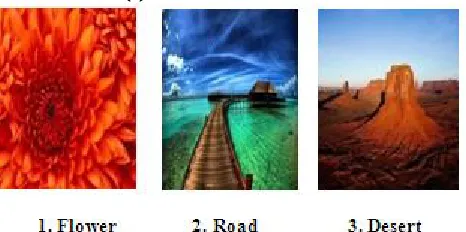
A complete compression process has been implemented to test compression ratio of the proposed algorithm. In result analysis, we take these different images of different size and compare the frame size with its new size of these images.
(a)ORIGINAL IMAGES
The size reduction is depend on the color coefficients, if there is more same color coefficients then the more size is reduced. It is used a bit references so there are no artefacts and any type of distortion in compressed images.
(b) RECONSTRUCTED IMAGES
TABLE – COMPARISON OF SIZE
Sr No.
Name Frame Size
New Size
CR
1 Flower 858kb 118kb 7.2
2 Road 836kb 154kb 5.4
3 Desert 826kb 121kb 6.8
Volume 2, Issue 1, January 2013
Page 185
COMPRESSION RATIO GRAPH
5.
CONCLUSION
Image compression techniques reduce the number of bits required to represent an image. In this paper, image compression technique using a new method of pixel correlation with DCT is implemented. New technique is used only on JPEG images. The following table and graph shows the compression ratio of the images. It achieves more than 50% compression ratio without any effect to quality of images as compare to other techniques. There is no neighbour color correlation by which more efficient image compression will achieve. In a new method, it compressed any size of images. The technique is particularly used to design of relatively simple and fast decoders and it can be used as key component for compression.
REFERENCES
[1] M. I. Khalil , “Image Compression Using New Entropy Coder”, International Journal of Computer Theory and Engineering, Vol. 2, No. 1 February, 2010
[2] M. Santhi, R. S. D. Wahida Banu , “Inter Color Correlation Based Enhanced Color SPIHT Coder” Department of Electronics and Communication Engineering Government College of Engineering, Salem, TamilNadu, India
[3] Jagdish H. Pujar, Lohit M. Kadlaskar, “A New Lossless Method of Image Compression and Decompression using Huffman Coding Techniques”, Department of EEE, BVB College of Engg. & Tech., Hubli, India-580 031. [4] Stefan Stolevski, “Hybrid PCA Algorithm for Image Compression”.
[5] S. Manimurugan, “Secure Medical Image Compression Using Block Pixel Sort Algorithm”, CSE Department, Karunya University, Coimbatore, India.
[6] Jayakar Mahesh, K.V.S Anand Babu, “Color Compression Using SPIHT Algorithm”, Dept. of Telecommunication R.V College of Engineering, Bangalore-59, India.
[7] Sathik M.Mohamed, Kannan K.Senthamarai et al., “Hybrid JPEG Compression using Edge based Segmentation”, Department of Computer Science, Sadakathullah Appa College, Tirunelveli, India.
[8] Telagarapu Prabhakar, Naveen V.Jagan et al., “Image Compression Using DCT and Wavelet Transformations”, GMR Institute of Technology, Rajam – 532 127, Srikakulam District, Andhra Pradesh, India.
[9] Ricardo L. de Queiroz, Member IEEE, IEEE Transaction on Image Processing, vol.7, No. 12, December 1998. [10] David Taubman, Member IEEE, IEEE Transaction On Image Processing, vol.9, No. 7, July 2000.
[11] Shantanu D. Rane and Guillermo Sapiro, Member IEEE, IEEE Transactions on Geosciences and Remote Sensing, vol. 39, No. 10, October 2001.
[12] Ismail Avcıbas¸, Member IEEE, Nasir Memon, Member IEEE, et al,IEEE Signal Processing Letters, vol.9, No.
10, October 2002.
[13] Chin Chye Koh, Student Member, IEEE, Jayanta Mukherjee, Member, IEEE, et al, IEEE Transactions on Consumer Electronics, vol.49, No. 4, November 2003.
[14] D.Malarvizhi, “A New Entropy Encoding Algorithm for Image Compression using DCT”, Dept of Computer Science & Eng., Alagappa University, Karaikudi – 630 003.
[15] G. Murugan, “Lossless Image Compression Algorithm For Transmitting Over Low Bandwidth Line”, CMJ University, Meghalaya, INDIA.
[16] Sonal, Kumar Dinesh, “A Study of Various Image Compression Techniqes”, Department of Computer Science & Engineering Guru Jhambheswar University of Science and Technology, Hisar.
[17] Kodituwaku S.R. & Amarasinghe U.S. “Compression of Lossless Data Compression Algorithms for Text Data” S.R. Kodituwakku et. al. / Indian Journal of Computer Science and Engineering, Vol 1 No 4 416-425.
Volume 2, Issue 1, January 2013
Page 186
[19] San Xing, Cait Hua et al,“Color Image Coding By Using Inter-Color Coralaton” Dept. of Electronic Eng. and Information Science, University of Science and Technology of Chinat Media Communication Group, Microsoft Research Asia, Beijing, China
[20] Taubman D. S., "High performance scalable image compression with EBCOT", IEEE Transaction Image Processing, Vol. 9, No. 7, pp. 1158–1170, July 2000.
AUTHOR