379
Copyright © 2011-15. Vandana Publications. All Rights Reserved.
Volume-5, Issue-3, June-2015
International Journal of Engineering and Management Research
Page Number: 379-386
Optimization of Drilling Parameters of JIG Boring Machine
Vedprakash Sen1, Dr. S. K. Ganguly 2
1
M.E. (Production), Department of Mechanical Engineering, Bhilai Institute of Technology Durg, INDIA
2
Department of Mechanical Engineering, Bhilai Institute of Technology, Durg, INDIA
ABSTRACT
In this project work an experimental study is being carried out for optimization of drilling process parameters of Jig boring machine to provide better tool life as well as high material removal rate (MRR). Taguchi method with L9
orthogonal array is used, for design of experiment and for analysis purpose grey relational analysis with fuzzy logic is used. Four main process parameters spindle speed, feed rate, depth of cut , and drill tool diameter are investigated in order to minimize thrust force and maximize MRR . Mild steel is used as work material and high speed steel twist drill as tool. Mild steel is well known extensively used engineering material in various industries such as steel making, structural, aerospace and aircraft industries. For the accomplishment of our project jig boring machine is used. Jig boring machine almost like semi CNC machine in terms of precision and accuracy in fact the jig borer's development helped advance machine tool technology toward later development.
Keywords---- Optimization, Grey fuzzy analysis, JIG boring.
I.
INTRODUCTION
The increase of consumer needs for quality of drilled holes in terms of precision and better surface finish has driven metal cutting industry to continuously improve quality of cutting process and jig boring machine is one of the most precise and efficient way to get the desired output. It is used to get the products, which require very low tolerances.
The jig boring machine used in project work is model no. 2450, the model 2450 precision jig boring machine is designed for drilling holes in jigs , fixtures and parts where high class accuracy is required for the center to center distance of drilled holes. The machine can also be used for laying out precision templates for checking linear
dimensions and center to center distance. The model 2450 jig borer is not only a very precise machine for performing various boring operations but also a measuring machine for precision transpositions in the ‘rectangular coordinate system‘. The machine is also used for light milling jobs and is provided for this purpose with a power feed for the table and saddle.
Grey relational analysis (GRA) is used to solve complicated interrelationships among the multiple performance characteristic problems effectively. In GRA, system has a level of information between black and white. In other words, in a grey system, some information is known and some information is unknown. The grey means the primitive data with poor, incomplete, and uncertain information in the grey systematic theory, the incomplete relation of information among these data is called the grey relation. Grey relational analysis is to compare quantitative analysis between every sequence in the grey system dynamically, and to describe the relation degree between an objective sequence (a collection of measurements or experimental results) and a reference sequence in the grey system. The measure of relevancy between two sequences can be expressed as the grey relational coefficient, and then grey relational grade (GRG) is obtained by averaging the grey relational coefficient [2].
380
Copyright © 2011-15. Vandana Publications. All Rights Reserved.
II.
REVIEW OF LITERATURE
An extensive literature review has been studied and observed for selecting drilling process parameters. A. Krishnamoorthy et al [2] have found effect of input parameters spindle speed, point angle, and feed rate on output responses as thrust force, torque, entry delamination, exit delamination and eccentricity of the holes. M. Saravanan et al [12] have selected feed rate and the torque of drilling tool as input parameters, and the optimization parameters selected are hole eccentricity and material removal rate. . Reddy Sreenivasalu et al have taken input parameters as Cutting speed, feed rate, drill diameter, point angle and cutting fluid mixture ratio and response as surface roughness and roundness error.
Different literature review has been presented to show the ranges of material used in drilling research work. M. K. A Mohd Ariffin et al [7] glass fiber reinforced plastic (GFRP) sandwich part number of BMS 4 – 17. Reddy Sreenivasalu et al have used Al 6061 alloy for their research work. Shivapragash et al. (2013) focused on composite Al-TiBr2.
There are different project work have been done on various kind of drilling machine, as per literature review. Yogendra Tyagi et al [4] have worked on CNC drilling machine, with a mild steel work piece and HSS tool. Arshad Noor Siddiquee et al [9] focused CNC lathe machine using solid carbide cutting tool on material AISI 321 austenitic stainless steel. Shivapragash et al. (2013) focused on multiple response optimization of drilling process for composite Al-TiBr2 to minimize the damage events occurring during drilling process. Taguchi method with grey relational analysis was used to optimize the machining parameters.
It was observed that the process parameters in drilling operation are optimized to get the product with higher quality, Taguchi technique for design of experiment and grey fuzzy technique for optimization are implemented successfully. All the review of literature has left the scope to study the optimization of the machining parameters spindle speed, feed rate, depth of cut, and drill tool diameter, and to investigate influence of all these parameters on material removal rate and thrust force.
III.
MATERIAL AND METHOD
3.1. Material
Mild steel, also known as plain-carbon steel has a relatively low tensile strength, but it is cheap and easy to form. Mild steel is the least expensive of all steel and the most commonly used in nearly every type of product created from steel. Many of the daily use objects are made using mild steel, including automobile chassis, motorcycle frames.In our project mild steel contains 0.13% of carbon, manganese (Mn) 0.49%, silicon (Si) 0.20% , phosphorus (P) 0.017% , sulphur (S) 0.012%. A rectangular mild steel
plate of size 250mm × 88mm × 18mm is used. The density is approximately 7.85 g/cm3 (7850 kg/m3 or 0.284 lb/in3
Output parameters
a. Material removal rate: The material removal rate (MRR) in drilling is the volume of material removed by the drill per unit time. It can also be taken as weight of chip removed per unit time. The MRR was determined from the amount of material worn during the period of machining. The high precision digital balance meter precision up to 0.0001 gm was used to weigh the samples.
b. Thrust force: it may be explained as the force required by the drill tool during drilling operation. A drill tool dynamometer is used to measure the thrust force during processing.
3.3 Experimental set up a. Jig boring machine
) and the Young's modulus is 210 GPa (30,000,000 psi), Melting Point (1400ºC) ,Bulk Modulus(140GPa)
3.2. Experimental parameters and their measurement: Input parameters
a. Spindle speed : The speed of a drill is usually measured in terms of the rate at which the outside or periphery of the tool moves in relation to the work being drilled. It is expressed in rpm (revolution per minute).
b. Feed rate : It may be defined as the relatively small movement per cycle of the cutting tool, It is expressed in millimeter per revolutions (mm/rev).
c. Depth of cut : It can be defined as the thickness of the material removed during machining. It is the cutting depth in the work piece by the tool.
d. Drill tool diameter : The diameter over the margins of the drill measured at the point.
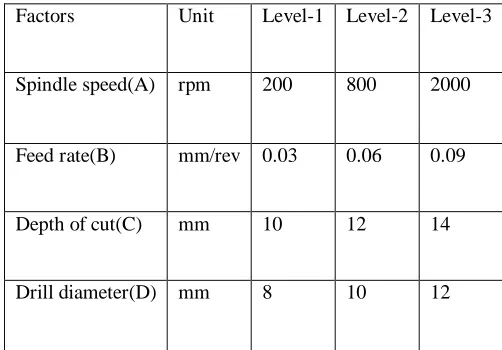
Table 1 shows the input parameters and their levels taken for the experiment.
Table 1: domain of experiments
Factors Unit Level-1 Level-2 Level-3
Spindle speed(A) rpm 200 800 2000
Feed rate(B) mm/rev 0.03 0.06 0.09
Depth of cut(C) mm 10 12 14
381
Copyright © 2011-15. Vandana Publications. All Rights Reserved.
(a)(b)
Fig. 1: (a) jig boring machine model no. 2450 and (b) drill tool dynamometer
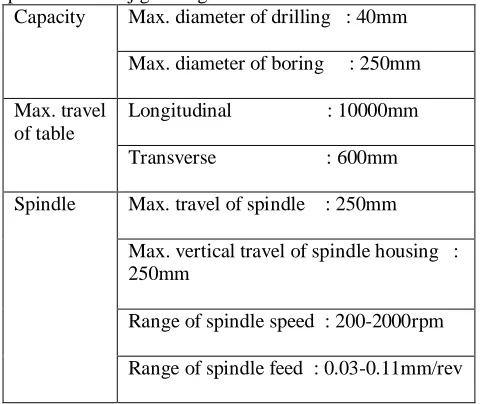
Specification of jig boring machine
Capacity Max. diameter of drilling : 40mm
Max. diameter of boring : 250mm
Max. travel of table
Longitudinal : 10000mm
Transverse : 600mm
Spindle Max. travel of spindle : 250mm
Max. vertical travel of spindle housing : 250mm
Range of spindle speed : 200-2000rpm
Range of spindle feed : 0.03-0.11mm/rev
Working conditions: the manufacturer guarantees precise operation of the machine only if following states are strictly observed. The machine should be mounted in a special room completely isolated from vibrations produced by the other machining operations nearby.
• Temperature in room should be 20±2ºC
• Humidity of the ambient air should not exceed 55 %
b. Drill tool dynamometer: This is strain gauge based Drill Tool Dynamometer and Micro Controller Based Digital Indicator designed to measure thrust and torque during drilling operation. This dynamometer is suitable for drilling a hole up to 25mm size in Mild Steel. It has Digital force indicators to measure force up to 250kg capacity. Figure 1 shows dynamometer.
d. Tool specification: For drill tool we have preferred is made of high speed steel tapered shank twist drills. The twist drills of 8 mm (flute length: 75 mm: overall length: 158 mm), 10 mm (flute length: 87 mm: overall length: 168 mm) and 12 mm (flute length: 100 mm: overall length: 182 mm).
3.4 METHODOLOGY a. Design of experiment
The experiments were designed on the Taguchi’s method. Taguchi has given a well defined matrix model called orthogonal array. Use of Taguchi’s orthogonal array makes this process simpler by reducing the number of experiments. As per Taguchi method the total degree of freedom of selected orthogonal array must be greater than or equal to the total DOF required for experiment [16]. There are four process parameters for three level, so DOF required for experiment [4× (3-1)], i.e. 8, thus L9
Sl. No.
orthogonal array were taken . Table 2 shows L9 orthogonal array.
Table 2: L9 orthogonal array
A B C D
1. 1 1 1 1
2. 1 2 2 2
3. 1 3 3 3
4. 2 1 2 3
5. 2 2 3 1
6. 2 3 1 2
7. 3 1 3 2
8. 3 2 1 3
9. 3 3 2 1
b. S/N ratio to compute quality characteristics
This ratio has the three kind of characteristics which are ‘larger the better’ , ‘smaller the better’, and ‘nominal the better’[9]. In our study we have two major output parameters thrust force, and material removal rate (MRR), So thrust force has considered for ‘smaller the better’ type and MRR for ‘larger the better’ type.
For larger the better type
S/N ratio = -10 log (1/n) ∑ (1/yij2) ….. (1)
For smaller the better type
S/N ratio = -10 log (1/n) ∑ (yij2) …..(2)
382
Copyright © 2011-15. Vandana Publications. All Rights Reserved.
c. Normalization of S/N ratio of the quality characteristics(data processing) using grey relational analysis
The grey theory is one of the important theories and can be used for the uncertainty, multi-input and discrete data. A grey system has a level of information between black and white. The grey relational analysis is a measurement of an absolute value of the data difference between sequences, and is also used to measure an approximate correlation between sequences. It is an effective means of analyzing the relationship between the sequences with less data and can analyze many factors. [1]
There are various methodologies of data pre-processing available for grey relational analysis. If the target value of the original sequence is infinite, then it has a characteristic of the ‘‘higher-the- better’’. The original sequence can be normalized as follows:
xij = max ( yij) – min ( yij)yij – min (yij) ………….(3)
For lower-the-better criterion, the normalized data can be expressed as:
xij =
max ( yij) − yij
max ( yij) – min (yij) ……….(4)
Where xij is normalized S/N ratio, yij is S/N ratio obtained
from Taguchi analysis, min. yij and max.yij are the min. and
max. value of S/N ratio respectively.
d. Computation of grey relational coefficient and grey relational grade:
The grey relational analysis is used to measure the relevancy between two systems. The sequences used in the grey relational analysis are called as a grey relational coefficient [2]. The grey relational coefficient can be calculated as:
cij =
Δmin + β Δmax
Δij + β Δmax …………(5)
Δij = |x0 - xi|is difference of the absolute value, also can be
treated as quality loss, β is distinguishing coefficient whose value is adjusted to meet the systematic actual need and defined in the range between 0 and 1 , here β = 0.5, Δmin and
Δmax
Third stage is to generate fuzzy rule base, which is a series of IF, THEN control rule. In this project max min compositional operation of Mamdani is adopted.
are the min. and max. values. Grey relational grade is the average value of grey relational coefficient of all the response variables.
e. Computation of grey fuzzy reasoning grade:
MATLAB toolbox is used for finding the grey– fuzzy reasoning grade. The inputs of each variable are being converted into linguistic fuzzy subset with triangular membership function and there range is defined. The output is also undergone with same procedure and they have also been given triangular fuzzy subset.
For example let x1, x2, be the GRC, and A, B, C
are the subsets with member ship function µA µB µC
Rule 1: IF x
, then Mamdani is described as:
1 is A1 and x2 is B1 THEN y is C1
Rule 2: IF x2 is A2 and x2 is B2 THEN y is C2 ……… Rule n : IF x1 is An and x2 is Bn THEN y is Cn
And the member function for output can be expressed as
µc0(y) = µA1(x1) ∩ µ B1(x2)∩ µC1(y) U …. µAn(x1)∩
µBn(x2) ∩µCn(y)
where ∩ is minimum and U is maximum operation and
µc0(y) is membership function of GFRG[16].
Last stage is defuzzification, so for this center – of – gravity method was adopted, and transform fuzzy inference output into crisp value, i.e. grey fuzzy reasoning grade (GFRG)
y0
S. No.
= ∑ y µc0(y)
∑µc0(y) ………(6)
the large the value of GFRG indicates that the experimental results are close to ideally normalized value.
f. Performing ANOM
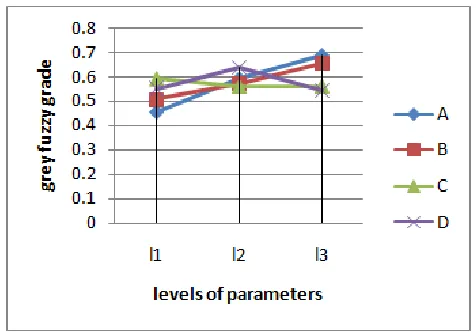
Analysis of means (ANOM) is performed to find the optimum level of combinations of process parameters , and it is obtained by calculating the average value of each process parameter at their corresponding level. For example, for parameter A the mean at level 1 is calculated by calculating the average of GFRG values which are obtained by using level 1 of parameter A, like in experiment run 1,2,3.[1] Graphs are also shown to show the relationship between GFRG and level of factors. The optimum combinations are chosen for each parameter by taking the maximum value of mean among all the levels.
IV.
RESULT AND DISCUSSION
In this section the result obtained are presented
4.1 Grey relational analysis: As per the Taguchi
orthogonal array, the experiments were performed one by one and three replications were taken for each experiment run. Table 3 shows the average value of response.
Table 3: Experimental data.
Thrust (N) MRR(gm/min)
1 91.528 4.792667
383
Copyright © 2011-15. Vandana Publications. All Rights Reserved.
3 150.3673 12.783
4 71.915 16.14567
5 140.5617 17.65367
6 222.2833 34.763
7 179.788 27.826
8 107.8723 68.24367
9 304.0463 52.293
Normalization of S/N ratio have been done through grey relational for normalization ‘lower the better’ formula eq. no. 4 is adopted for thrust force and ‘higher the better’ formula eq. no. 3 is used to normalize material removal rate data.
With the help of eq. no. 5 described in methodology grey relational coefficient for individual output parameter is calculated by taking the reference value all for one. Table 4 shows the values of grey relational coefficient (GRC) and grey relational grade (GRG)
Table 4: GRC and GRG. Sl. No. Thrust MRR GRG
1. 0.3634 0.3333 0.3483
2. 0.4908 0.3776 0.4342
3. 0.4463 0.4632 0.4547
4. 0.3333 0.5003 0.4168
5. 0.4329 0.5165 0.4747
6. 0.5444 0.6820 0.6132
7. 0.4864 0.6172 0.5518
8. 0.3074 1 0.6537
9. 1 0.456 0.720
4.2 Grey fuzzy reasoning analysis: Then by using
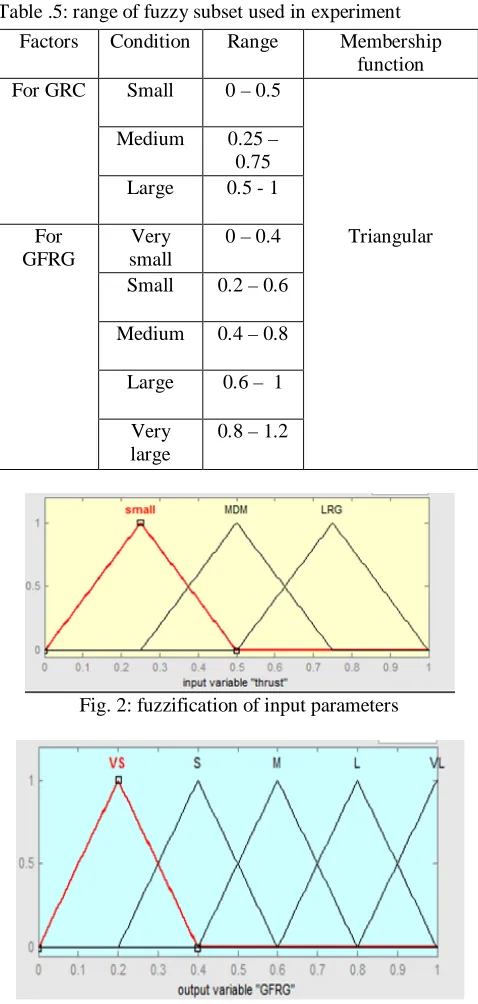
MATLAB grey fuzzy reasoning grade is calculated. Fuzzy logic approach involves fuzzification of input data, rule inference and defuzzification. Fuzzification is the process of making a crisp quantity fuzzy using linguistic variables [1]. The grey relational coefficient of each input variables is been given triangular membership function as ‘small’ , ‘medium’ , and ‘large’ and their ranges are defined and then same procedure is adopted for GFRG and this been given five membership functions , shown in table 5 and by fig. 2 and fig.3.
Table .5: range of fuzzy subset used in experiment
Fig. 2: fuzzification of input parameters
Fig. 3: fuzzification of output parameter
The rule inference system deduces or infers a conclusion based on a set of rules framed by the expert opinion or intuition. The structure of the rules is given as follows:
IF premise (antecedent) THEN conclusion (consequent)[17]
Mamdani’s implication method of inference is applied in this work. It is used for yielding aggregation of fuzzy rules and is known as max–min inference method. So
Factors Condition Range Membership function For GRC Small 0 – 0.5
Medium 0.25 – 0.75 Large 0.5 - 1
For GFRG
Very small
0 – 0.4 Triangular
Small 0.2 – 0.6
Medium 0.4 – 0.8
Large 0.6 – 1
Very large
384
Copyright © 2011-15. Vandana Publications. All Rights Reserved.
in rule editor tool box IF , THEN rule is activated to run theFIS based on table 6.
Table 6: fuzzy rule table, [16]
Grey fuzzy reasoning grade
Grey relation coefficient for MRR
S M L
Grey relation
coefficient for thrust S VS S M
M S M L
L M L VL
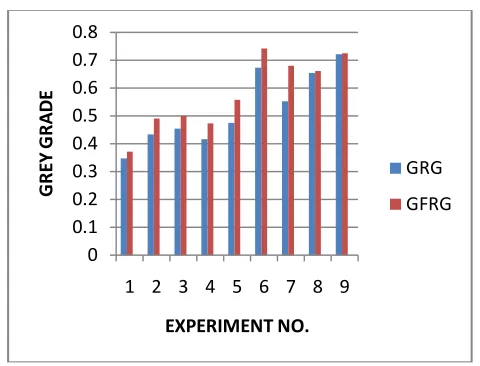
The next step in fuzzy logic approach is defuzzification , Centroid method was used in work. The fuzzy logic approach provides improvement in grey relational grade that has a definitely lower uncertain output than that of grey relational analysis. After the rule generation in rule editor, defuzzification process can be seen in rule viewer. The grey fuzzy reasoning grade (GFRG) obtained as described, Table 7 shows the values of GFRG as obtained from predicted values of FIS for all the experiments and their rank. We can see that the maximum value of GFRG is 0.742. Previously which was 0.6732, it can be seen that experiment no. 6 has the optimum factor level combination.
Table no.7: GFRG and rank
Sl. No. Grey fuzzy reasoning grade
GFRG rank
1. 0.3710 9
2. 0.49 7
3. 0.5 6
4. 0.473 8
5. 0.557 5
6. 0.742 1
7. 0.679 3
8. 0.661 4
9. 0.725 2
Fig. 4: comparison between GRG and GFRG
On comparing GRG and GFRG, it can be seen that there is an improvement in the values of GFRG, thus the uncertainty of data is reduced. fig. 4 shows that results. Response table 8 is obtained by calculating the average values of each input drilling parameter at its corresponding level. Optimum level of process parameters are chosen by selecting the maximum value of mean for that particular parameter and also can be seen by response graphs in fig. 5, so spindle speed should at level 3, feed rate at level 3, depth of cut at level 1, and drill diameter at level 2 are the optimum levels. The rank of max-min indicates most influencing parameter. So spindle speed is the most influencing parameter followed by feed rate, drill diameter and depth of cut.
Table 8 : Response table for grey fuzzy reasoning grade
0 0.1 0.2 0.3 0.4 0.5 0.6 0.7 0.8
1 2 3 4 5 6 7 8 9
G
RE
Y G
RADE
EXPERIMENT NO.
385
Copyright © 2011-15. Vandana Publications. All Rights Reserved.
Fig. no. 5: response graph for parameters4.3 Prediction of grey fuzzy reasoning grade and
conformity test : After finding the suitable optimal
parameters, it is necessary to predict the grey fuzzy reasoning grade theoretically. The grey fuzzy reasoning grade can be predicted by using the following equation :
γij = γom + ∑𝑘𝑘 (𝛾𝛾𝑜𝑜𝑜𝑜 − 𝛾𝛾𝑜𝑜𝑜𝑜)
𝑖𝑖=1
where γom is the mean value of the grey fuzzy reasoning grade and γol is the grey fuzzy reasoning grade at the optimum level and k is the number of influencing parameters that affect the multiple performance characteristics [2], table 9 shows the comparison results. Initial setting value spindle speed at level 1, feed at level 1, depth of cut at level 1, The initial value of grey fuzzy reasoning grade is 0.371, predicted value of GFRG is 0.843. . As our optimal level of process parameters do not match with any of the experiment performed in orthogonal array, we have performed three conformity test to validate our result. Our experimental value of GFRG is 0.747 by the conformity test we have found that the thrust force has reduced from 91. 5287 N to 78.252 N, and material removal rate has increased from 4.792 gm min-1 to 35.4306 gm min
-1
Item .
Table 9: comparison of results of initial and optimum process parameter
Setting level
Thrust force
(N)
MRR
(gm/mi n)
GFR G
Grade impro
v-ement
Initial A1B1C1
D1 91.52
4.79 0.371
Predicte d
A3B3C1
D2 -
- 0.843 0.472
Experim en-tal
A3B3C1
D2 78.25 35.43 0.747 0.376
V.
CONCLUSION
In this project work, drilling of mild steel plate have been executed. Jig boring machine is used for this accomplishment, with independent factors as spindle speed, feed rate, depth of cut, and drill tool diameter, and dependent parameters as thrust force and material removal rate. Taguchi method is used for the performance of experiment with L9
• Drilling parameters are optimized with respect to multiple performances in order to achieve maximum value of material removal rate and minimum value of thrust force in mild steel material.
orthogonal array. Further optimization of process parameters was carried out using grey relational analysis integrated with fuzzy logic analysis to reduce the uncertainty of the data.
• It was identified that spindle speed of 2000 rpm, feed rate at 0.09 mm/rev , depth of cut at 10 mm, and drill tool diameter of 10 mm is optimal combination of drilling parameters that produced a high value of grey fuzzy reasoning grade of 0.747 which is close to that of reference value.
• ANOM revealed that spindle speed is the most influencing parameter followed by feed rate, drill diameter and depth of cut.
• Compared to initial value our thrust force has reduced from 91.5287 N to 78.2589 N and material removal rate has increased from 4.792 gm min-1 to 35.4306 gm min-1
• Thus it is concluded that optimization procedure proposed in this project work significantly improves the drilled hole quality and increase the productivity in drilling of mild steel in jig boring machine.
.
REFERENCES
[1] T. Rajmohan , K. Palanikumar , S. Prakash (2012) ,Grey-fuzzy algorithm to optimize machining parameters in drilling of hybrid metal matrix composites. Part B 50 (2013) 297–308
[2] A. Krishnamoorthy , S. Rajendra Boopathy , K. Palanikumar , J. Paulo Davim (2011), Application of grey fuzzy logic for the optimization of drilling parameters for CFRP composites with multiple performance characteristics. Measurement 45 (2012) 1286–1296
[3] Basavarajappa S, Chandramohan G, Davim JP. (2008),
Some studies on drilling of hybrid metal matrix composites based on Taguchi techniques. J Mater Process Technol. [4] Yogendra Tyagi, Vedansh Chaturvedi, Jyoti Vimal (2012), Parametric Optimization of Drilling Machining Process using Taguchi Design and ANOVA Approach.
386
Copyright © 2011-15. Vandana Publications. All Rights Reserved.
Advanced Engineering, ISSN 2250-2459, Volume 2, Issue7, July 2012.
[5] Rupesh Kumar Tiwari ,(2013), Multi Objective Optimization of Drilling Process Variables Using Genetic Algorithm for Precision Drilling Operation. International Journal of Engineering Research and Development, Volume 6, Issue 12 (May 2013), PP. 43-59
[6] Pantawane. P.D, Ahuja. B.B(2011), Experimental investigations and multi-objective optimization of friction drilling process on AISI 1015. international journal of applied engineering research, dindigul, volume 2, no 2, 2011.
[7] M. K. A Mohd Ariffin, M. I. Mohd Ali, S. M. Sapuan and N. Ismail (2009), An optimise drilling process for an aircraft composite structure using design of experiments.
Scientific Research and Essay Vol.4 (10), pp. 1109-1116, October 2009.
[8] K. Lipin and Dr. P. Govindan , A Review on Multi Objective Optimization of Drilling Parameters Using Taguchi Methods. AKGEC international journal of technology, Vol. 4, No. 2
[9] Arshad Noor Siddiquee, Zahid A. Khana, Pankul Goelb, Mukesh Kumarb, Gaurav Agarwalb, Noor Zaman Khana (2014), Optimization of Deep Drilling Process Parameters of AISI 321 Steel using Taguchi Method. 3rd International Conference on Materials Processing and Characterisation (ICMPC 2014), Procedia Materials Science 6 (2014 ) 1217 – 1225
[10] Sunil Hansdaa , Simul Banerjeeb (2014), Optimizing Multi Characteristics in Drilling of GFRP Composite using Utility Concept with Taguchi’s Approach. 3rd International Conference on Materials Processing and Characterisation (ICMPC 2014), Procedia Materials Science 6 ( 2014 ) 1476 – 1488
[11] Hari Vasudevana , Ramesh R. Rajgurub,, Naresh C. Deshpandea (2014), Multiobjective Optimization of Drilling Characteristics for NEMA G-11 GFRP/Epoxy Composite using Desirability coupled with Taguchi Method. 12th global congress on manufacturing and management, gcmm 2014, procedia engineering 97 ( 2014 ) 522 – 530
[12] M.saravanan, D.ramalingam, G.manikandan, R.rinu kaarthikeyen (2012), multiobjective optimization of drilling parameters using genetic algorithm. procedia engineering 38 ( 2012 ) 197-207.
[13] Suman Chatterjeea, Kumar Abhisheka, Siba Sankar Mahapatrab, Saurav Dattac, Rajiv Kumar Yadava (2014),
NSGA-II Approach of Optimization to Study the Effects of Drilling Parameters in AISI-304 Stainless Steel. 12th global congress on manufacturing and management, gcmm 2014, procedia engineering 97 ( 2014 ) 78 – 84.
[14] P. suresh, K. marimuthu, S. ranganathan, T. rajmohan (2014), Optimization of machining parameters in turning of Al−SiC−Gr hybrid metal matrix composites using grey
-fuzzy algorithm. Trans. Nonferrous Met. Soc. China
24(2014) 2805−2814.
[15] Santosh Tamang and M. Chandrasekaran (2014)
Application of grey fuzzy logic for simultaneous optimization of surface roughness and metal removal rate
in turning Al-SiCp metal matrix composites. 5th
International & 26th All India Manufacturing Technology, Design and Research Conference (AIMTDR 2014).
[16] Sarojrani Pattnaik & D. B. Karunakar & P. K. Jha (2013), Multi-characteristic optimization of wax patterns in the investment casting process using grey–fuzzy logic. Int J Adv Manuf Technol (2013) 67:1577–1587. Vol-1,P.- 832-841.
[17] Arun Kumar Pandey & Avanish Kumar Dubey (2013),
Multiple quality optimization in laser cutting of difficult-to-laser-cut material using grey–fuzzy methodology. Int J Adv Manuf Technol (2013) 65:421–431.
[18] Nun-Ming Liu & Jenn-Tsong Horng & Ko-Ta Chiang (2009), The method of grey-fuzzy logic for optimizing multi-response problems during the manufacturing process: a case study of the light guide plate printing process. Int J Adv Manuf Technol (2009) 41:200–210.
[19] Shailesh Dewangan, C.K.Biswas and Ritanjali Sethy (2013), Multiple Response Optimisation of EDM Process
Using Grey-Fuzzy Logic Technique. 3rd International