VOLUME NO.5(2015),ISSUE NO.12(DECEMBER) ISSN 2231-5756
A Monthly Double-Blind Peer Reviewed (Refereed/Juried) Open Access International e-Journal - Included in the International Serial Directories
Indexed & Listed at:
VOLUME NO.5(2015),ISSUE NO.12(DECEMBER) ISSN 2231-5756
INTERNATIONAL JOURNAL OF RESEARCH IN COMMERCE, IT & MANAGEMENT
CONTENTS
Sr.
No.
TITLE & NAME OF THE AUTHOR (S)
Page
No.
1
.
THE IMPACT OF USE OF ICT FOR BUSINESS PROCESS MANAGEMENT IN e-TOURISM
VIDYULLATA V. PAWAR & DR. S. D. MUNDHE
1
2
.
A ROLE OF KNOWLEDGE BASED SYSTEM IN INFORMATION SYSTEM AUDIT
A. B. DEVALE & DR. R. V. KULKARNI
3
3
.
XML DATABASE: PAST, PRESENT AND FUTURE
KUMAR KALAMADI
6
4
.
CRITICAL CHALLENGES AND TRANSFORMATIONS IN EDUCATION IN NIGERIA: SYNTHESIS AND
PROGNOSIS
TITUSAMODU UMORU
8
5
.
IMPACT OF INFORMATION AND COMMUNICATION TECHNOLOGY (ICT) AMONG EXPORTER: A
CRITICAL REVIEW OF LITERATURE
S.SHOBANA & DR. M. RAJAPRIYA
12
6
.
SCOPE OF INFORMATION TECHNOLOGY IN THE BANKING SECTOR
SHRI VALLABH H. LELE
21
7
.
PROBLEMS AND CHALLENGES OF COLLECTION DEVELOPMENT IN DIGITAL LIBRARIES
S.R. MANDALE & DR. KHOT N. B.
23
8
.
IMPLEMENTATION OF ARTIFICIAL NEURAL NETWORK IN CONCURRENCY CONTROL OF
DISTRIBUTED DATABASE SYSTEM
A. A. SATTIKAR & A. A. GOVANDE
26
9
.
RESEARCH INFORMATION TECHNOLOGY: BEHAVIORAL ACCOUNTING
PATIL BHAGWAN SHANKAR
30
10
.
A STUDY ON USERS’ PREFERENCE TOWARDS MATRIMONIAL SITES IN COIMBATORE CITY
R.MONISHA
33
11
.
FEDENA: EFFECTIVE ICT TOOL FOR EDUCATION MANAGEMENT SYSTEM
VARSHA P. DESAI
36
12
.
SYSTEMATIC AND SCIENTIFIC APPROACH OF WEB DESIGNING
NILESH RAYGONDA PATIL
40
13
.
PROMINENCE OF LISTENING EXPERTISE IN COMMUNICATION
DEEPA PATIL
42
14
.
A REVIEW ON THE ROLE OF MOBILE BANKING IN SELECTED AREAS OF KARAD
SANTOSH B. POTADAR
44
15
.
CHALLENGES IN WIRELESS NETWORK
SARIKA BABAN GAIKWAD
46
16
.
RURAL INVESTORS’ PERCEPTION TOWARDS MUTUAL FUND DISTRIBUTION
L. MEENA
48
17
.
IMPACT OF GENETIC ALGORITHM IN CODE COVERAGE FOR TEST SUIT BY JUNIT IN DYNAMIC
CONVERSION
SASHIBHUSAN NAYAK & ANIL KUMAR BISWAL
52
18
.
A STUDY ON CUSTOMER SERVICES OF NATIONALISED BANKS IN BANGALORE CITY
NANDINI.N
56
19
.
A CRITICAL APPRAISAL OF RISK MANAGEMENT STRATEGIES OF MICROFINANCE INSTITUTIONS IN
GHANA
ALHASSAN BUNYAMINU & CHARLES BARNOR
63
20
.
CONSUMER TRUST IN ONLINE SHOPPING IN THE DOABA REGION OF PUNJAB
SHABNAM GULATI & DUSHANT NARULA
71
VOLUME NO.5(2015),ISSUE NO.12(DECEMBER) ISSN 2231-5756
CHIEF PATRON
PROF. K. K. AGGARWAL
Chairman, Malaviya National Institute of Technology, Jaipur
(An institute of National Importance & fully funded by Ministry of Human Resource Development, Government of India)
Chancellor, K. R. Mangalam University, Gurgaon
Chancellor, Lingaya’s University, Faridabad
Founder Vice-Chancellor (1998-2008), Guru Gobind Singh Indraprastha University, Delhi
Ex. Pro Vice-Chancellor, Guru Jambheshwar University, Hisar
FOUNDER PATRON
LATE SH. RAM BHAJAN AGGARWAL
Former State Minister for Home & Tourism, Government of Haryana
Former Vice-President, Dadri Education Society, Charkhi Dadri
Former President, Chinar Syntex Ltd. (Textile Mills), Bhiwani
FORMER CO-ORDINATOR
DR. S. GARG
Faculty, Shree Ram Institute of Business & Management, Urjani
ADVISORS
PROF. M. S. SENAM RAJU
Director A. C. D., School of Management Studies, I.G.N.O.U., New Delhi
PROF. M. N. SHARMA
Chairman, M.B.A., Haryana College of Technology & Management, Kaithal
PROF. S. L. MAHANDRU
Principal (Retd.), Maharaja Agrasen College, Jagadhri
EDITOR
PROF. R. K. SHARMA
Professor, Bharti Vidyapeeth University Institute of Management & Research, New Delhi
CO-EDITOR
DR. BHAVET
Faculty, Shree Ram Institute of Engineering & Technology, Urjani
EDITORIAL ADVISORY BOARD
DR. RAJESH MODI
Faculty, Yanbu Industrial College, Kingdom of Saudi Arabia
PROF. SANJIV MITTAL
University School of Management Studies, Guru Gobind Singh I. P. University, Delhi
PROF. ANIL K. SAINI
Chairperson (CRC), Guru Gobind Singh I. P. University, Delhi
DR. SAMBHAVNA
VOLUME NO.5(2015),ISSUE NO.12(DECEMBER) ISSN 2231-5756
INTERNATIONAL JOURNAL OF RESEARCH IN COMMERCE, IT & MANAGEMENT
DR. MOHENDER KUMAR GUPTA
Associate Professor, P. J. L. N. Government College, Faridabad
DR. SHIVAKUMAR DEENE
Asst. Professor, Dept. of Commerce, School of Business Studies, Central University of Karnataka, Gulbarga
ASSOCIATE EDITORS
PROF. NAWAB ALI KHAN
Department of Commerce, Aligarh Muslim University, Aligarh, U.P.
PROF. ABHAY BANSAL
Head, Department of I.T., Amity School of Engineering & Technology, Amity University, Noida
PROF. A. SURYANARAYANA
Department of Business Management, Osmania University, Hyderabad
PROF. V. SELVAM
SSL, VIT University, Vellore
DR. PARDEEP AHLAWAT
Associate Professor, Institute of Management Studies & Research, Maharshi Dayanand University, Rohtak
DR. S. TABASSUM SULTANA
Associate Professor, Department of Business Management, Matrusri Institute of P.G. Studies, Hyderabad
SURJEET SINGH
Asst. Professor, Department of Computer Science, G. M. N. (P.G.) College, Ambala Cantt.
FORMER TECHNICAL ADVISOR
AMITA
Faculty, Government M. S., Mohali
FINANCIAL ADVISORS
DICKIN GOYAL
Advocate & Tax Adviser, Panchkula
NEENA
Investment Consultant, Chambaghat, Solan, Himachal Pradesh
LEGAL ADVISORS
JITENDER S. CHAHAL
Advocate, Punjab & Haryana High Court, Chandigarh U.T.
CHANDER BHUSHAN SHARMA
Advocate & Consultant, District Courts, Yamunanagar at Jagadhri
VOLUME NO.5(2015),ISSUE NO.12(DECEMBER) ISSN 2231-5756
CALL FOR MANUSCRIPTS
We invite unpublished novel, original, empirical and high quality research work pertaining to recent developments & practices in the areas of Computer Science & Applications; Commerce; Business; Finance; Marketing; Human Resource Management; General Management; Banking; Economics; Tourism Administration & Management; Education; Law; Library & Information Science; Defence & Strategic Studies; Electronic Science; Corporate Governance; Industrial Relations; and emerging paradigms in allied subjects like Accounting; Accounting Information Systems; Accounting Theory & Practice; Auditing; Behavioral Accounting; Behavioral Economics; Corporate Finance; Cost Accounting; Econometrics; Economic Development; Economic History; Financial Institutions & Markets; Financial Services; Fiscal Policy; Government & Non Profit Accounting; Industrial Organization; International Economics & Trade; International Finance; Macro Economics; Micro Economics; Rural Economics; Co-operation; Demography: Development Planning; Development Studies; Applied Economics; Development Economics; Business Economics; Monetary Policy; Public Policy Economics; Real Estate; Regional Economics; Political Science; Continuing Education; Labour Welfare; Philosophy; Psychology; Sociology; Tax Accounting; Advertising & Promotion Management; Management Information Systems (MIS); Business Law; Public Responsibility & Ethics; Communication; Direct Marketing; E-Commerce; Global Business; Health Care Administration; Labour Relations & Human Resource Management; Marketing Research; Marketing Theory & Applications; Non-Profit Organizations; Office Administration/Management; Operations Research/Statistics; Organizational Behavior & Theory; Organizational Development; Production/Operations; International Relations; Human Rights & Duties; Public Administration; Population Studies; Purchasing/Materials Management; Retailing; Sales/Selling; Services; Small Business Entrepreneurship; Strategic Management Policy; Technology/Innovation; Tourism & Hospitality; Transportation Distribution; Algorithms; Artificial Intelligence; Compilers & Translation; Computer Aided Design (CAD); Computer Aided Manufacturing; Computer Graphics; Computer Organization & Architecture; Database Structures & Systems; Discrete Structures; Internet; Management Information Systems; Modeling & Simulation; Neural Systems/Neural Networks; Numerical Analysis/Scientific Computing; Object Oriented Programming; Operating Systems; Programming Languages; Robotics; Symbolic & Formal Logic; Web Design and emerging paradigms in allied subjects.
Anybody can submit the soft copy of unpublished novel; original; empirical and high quality research work/manuscriptanytime in M.S. Word format after preparing the same as per our GUIDELINES FOR SUBMISSION; at our email address i.e. [email protected] or online by clicking the link online submission as given on our website (FOR ONLINE SUBMISSION, CLICK HERE).
GUIDELINES FOR SUBMISSION OF MANUSCRIPT
1. COVERING LETTER FOR SUBMISSION:
DATED: _____________
THE EDITOR
IJRCM
Subject: SUBMISSION OF MANUSCRIPT IN THE AREA OF .
(e.g. Finance/Mkt./HRM/General Mgt./Engineering/Economics/Computer/IT/ Education/Psychology/Law/Math/other, please specify)
DEAR SIR/MADAM
Please find my submission of manuscript entitled ‘___________________________________________’ for possible publication in one of your journals.
I hereby affirm that the contents of this manuscript are original. Furthermore, it has neither been published elsewhere in any language fully or partly, nor is it under review for publication elsewhere.
I affirm that all the co-authors of this manuscript have seen the submitted version of the manuscript and have agreed to their inclusion of names as co-authors.
Also, if my/our manuscript is accepted, I agree to comply with the formalities as given on the website of the journal. The Journal has discretion to publish our contribution in any of its journals.
NAME OF CORRESPONDING AUTHOR :
Designation :
Institution/College/University with full address & Pin Code :
Residential address with Pin Code :
Mobile Number (s) with country ISD code :
Is WhatsApp or Viber active on your above noted Mobile Number (Yes/No) :
Landline Number (s) with country ISD code :
E-mail Address :
Alternate E-mail Address :
VOLUME NO.5(2015),ISSUE NO.12(DECEMBER) ISSN 2231-5756
INTERNATIONAL JOURNAL OF RESEARCH IN COMMERCE, IT & MANAGEMENT
NOTES:
a) The whole manuscript has to be in ONE MS WORD FILE only, which will start from the covering letter, inside the manuscript. pdf. version is liable to be rejected without any consideration.
b) The sender is required to mention the following in the SUBJECT COLUMNof the mail:
New Manuscript for Review in the area of (e.g. Finance/Marketing/HRM/General Mgt./Engineering/Economics/Computer/IT/ Education/Psychology/Law/Math/other, please specify)
c) There is no need to give any text in the body of mail, except the cases where the author wishes to give any specific message w.r.t. to the manuscript.
d) The total size of the file containing the manuscript is expected to be below 1000 KB.
e) Abstract alone will not be considered for review and the author is required to submit the complete manuscript in the first instance.
f) The journal gives acknowledgement w.r.t. the receipt of every email within twenty four hours and in case of non-receipt of acknowledgment from the journal, w.r.t. the submission of manuscript, within two days of submission, the corresponding author is required to demand for the same by sending a separate mail to the journal.
g) The author (s) name or details should not appear anywhere on the body of the manuscript, except the covering letter and the cover page of the manuscript, in the manner as mentioned in the guidelines.
2. MANUSCRIPT TITLE: The title of the paper should be bold typed, centeredand fully capitalised.
3. AUTHOR NAME (S) & AFFILIATIONS: Author (s) name, designation, affiliation (s), address, mobile/landline number (s), and
email/alternate email address should be given underneath the title.
4. ACKNOWLEDGMENTS: Acknowledgements can be given to reviewers, guides, funding institutions, etc., if any.
5. ABSTRACT: Abstract should be in fully italicized text, ranging between 150 to 300 words. The abstract must be informative and explain the background, aims, methods, results & conclusion in a SINGLE PARA. Abbreviations must be mentioned in full.
6. KEYWORDS: Abstract must be followed by a list of keywords, subject to the maximum of five. These should be arranged in alphabetic order separated by commas and full stop at the end. All words of the keywords, including the first one should be in small letters, except special words e.g. name of the Countries, abbreviations.
7. JEL CODE: Provide the appropriate Journal of Economic Literature Classification System code (s). JEL codes are available at www.aeaweb.org/econlit/jelCodes.php, however, mentioning JEL Code is not mandatory.
8. MANUSCRIPT: Manuscript must be in BRITISH ENGLISH prepared on a standard A4 size PORTRAIT SETTING PAPER. It should be free from any errors i.e. grammatical, spelling or punctuation. It must be thoroughly edited at your end.
9. HEADINGS: All the headings must be bold-faced, aligned left and fully capitalised. Leave a blank line before each heading.
10. SUB-HEADINGS: All the sub-headings must be bold-faced, aligned left and fully capitalised.
11. MAIN TEXT:
THE MAIN TEXT SHOULD FOLLOW THE FOLLOWING SEQUENCE:
INTRODUCTION
REVIEW OF LITERATURE
NEED/IMPORTANCE OF THE STUDY
STATEMENT OF THE PROBLEM
OBJECTIVES
HYPOTHESIS (ES)
RESEARCH METHODOLOGY
RESULTS & DISCUSSION
FINDINGS
RECOMMENDATIONS/SUGGESTIONS
CONCLUSIONS
LIMITATIONS
SCOPE FOR FURTHER RESEARCH
REFERENCES
APPENDIX/ANNEXURE
VOLUME NO.5(2015),ISSUE NO.12(DECEMBER) ISSN 2231-5756
12. FIGURES & TABLES: These should be simple, crystal CLEAR, centered, separately numbered & self explained, and titles must be above the table/figure. Sources of data should be mentioned below the table/figure. It should be ensured that the tables/figures are referred to from the main text.
13. EQUATIONS/FORMULAE: These should be consecutively numbered in parenthesis, horizontally centered with equation/formulae number placed at the right. The equation editor provided with standard versions of Microsoft Word should be utilised. If any other equation editor is utilised, author must confirm that these equations may be viewed and edited in versions of Microsoft Office that does not have the editor.
14. ACRONYMS: These should not be used in the abstract. The use of acronyms is elsewhere is acceptable. Acronyms should be defined on its first use in each section: Reserve Bank of India (RBI). Acronyms should be redefined on first use in subsequent sections.
15. REFERENCES: The list of all references should be alphabetically arranged. The author (s) should mention only the actually utilised references in the preparation of manuscript and they are supposed to follow Harvard Style of Referencing. Also check to make sure that everything that you are including in the reference section is duly cited in the paper. The author (s) are supposed to follow the references as per the following:
•
All works cited in the text (including sources for tables and figures) should be listed alphabetically.•
Use (ed.) for one editor, and (ed.s) for multiple editors.•
When listing two or more works by one author, use --- (20xx), such as after Kohl (1997), use --- (2001), etc, in chronologically ascending order.•
Indicate (opening and closing) page numbers for articles in journals and for chapters in books.•
The title of books and journals should be in italics. Double quotation marks are used for titles of journal articles, book chapters, dissertations, reports, working papers, unpublished material, etc.•
For titles in a language other than English, provide an English translation in parenthesis.•
Headers, footers, endnotes and footnotes should not be used in the document. However, you can mention short notes to elucidate some specific point, which may be placed in number orders after the references.PLEASE USE THE FOLLOWING FOR STYLE AND PUNCTUATION IN REFERENCES:
BOOKS
•
Bowersox, Donald J., Closs, David J., (1996), "Logistical Management." Tata McGraw, Hill, New Delhi.•
Hunker, H.L. and A.J. Wright (1963), "Factors of Industrial Location in Ohio" Ohio State University, Nigeria.CONTRIBUTIONS TO BOOKS
•
Sharma T., Kwatra, G. (2008) Effectiveness of Social Advertising: A Study of Selected Campaigns, Corporate Social Responsibility, Edited by David Crowther & Nicholas Capaldi, Ashgate Research Companion to Corporate Social Responsibility, Chapter 15, pp 287-303.JOURNAL AND OTHER ARTICLES
•
Schemenner, R.W., Huber, J.C. and Cook, R.L. (1987), "Geographic Differences and the Location of New Manufacturing Facilities," Journal of Urban Economics, Vol. 21, No. 1, pp. 83-104.CONFERENCE PAPERS
•
Garg, Sambhav (2011): "Business Ethics" Paper presented at the Annual International Conference for the All India Management Association, New Delhi, India, 19–23UNPUBLISHED DISSERTATIONS
•
Kumar S. (2011): "Customer Value: A Comparative Study of Rural and Urban Customers," Thesis, Kurukshetra University, Kurukshetra.ONLINE RESOURCES
•
Always indicate the date that the source was accessed, as online resources are frequently updated or removed.WEBSITES
VOLUME NO.5(2015),ISSUE NO.12(DECEMBER) ISSN 2231-5756
INTERNATIONAL JOURNAL OF RESEARCH IN COMMERCE, IT & MANAGEMENT
IMPLEMENTATION OF ARTIFICIAL NEURAL NETWORK IN CONCURRENCY CONTROL OF DISTRIBUTED
DATABASE SYSTEM
A. A. SATTIKAR
ASST. PROFESSOR
V. P. INSTITUTE OF MANAGEMENT STUDIES & RESEARCH
SANGLI
A. A. GOVANDE
ASST. PROFESSOR
V. P. INSTITUTE OF MANAGEMENT STUDIES & RESEARCH
SANGLI
ABSTRACT
Current Database Management Systems (DBMSs) work in multiuser environment where users access the database concurrently. Therefore the DBMSs must have to control over the concurrent execution of user transactions, so that the overall correction of the database is maintained. A transaction is a user program accessing the database. To control over concurrent execution of transactions is becoming problematic thing in case of Distributed Database System (DDS). Although there are several techniques exists to control over Concurrent execution, some factors like time to lock and release objects, implementation complexity, memory space requirement, etc are not sufficient to avoid or control over concurrent execution of transaction appropriately in case of DDS. So in this paper we have proposed ANN model for Concurrency control of DDS, which may resolve the problems present in earlier techniques.
KEYWORDS
concurrent execution, DBMS, memory space.
1. INTRODUCTION
ABOUT DISTRIBUTED DATABASE
distributed database is a database in which portions of the database are stored on multiple computers within a network. Users have access to the portion of the database at their location so that they can access the data relevant to their tasks without interfering with the work of others. A centralized distributed database management system (DDBMS) manages the database as if it were all stored on the same computer. The DDBMS synchronizes all the data periodically and, in cases where multiple users must access the same data, ensures that updates and deletes performed on the data at one location will be automatically reflected in the data stored elsewhere.
2. WHAT IS TRANSACTION?
Transaction is series of actions, carried out by user or application, which accesses or changes contents of database. It is a logical unit of work on the database. It transforms database from one consistent state to another, although consistency may be violated during transaction.
3. DISTRIBUTED CONCURRENCY CONTROL
In database systems and transaction processing (transaction management) distributed concurrency control refers primarily to the concurrency control of a distributed database. It also refers to the concurrency control in a multi-database (and other multi-transactional object) environment (e.g., federated database, grid computing, and cloud computing environments.
A major goal for distributed concurrency control is distributed serializability (or global serializability for multi-database systems). Distributed concurrency control poses special challenges beyond centralized one, primarily due to communication and computer latency. It often requires special techniques, like distributed lock manager over fast computer networks with low latency, is a general serializability technique that achieves distributed serializability (and global serializability in particular) effectively on a large scale, without concurrency control information distribution (e.g., local precedence relations, locks, timestamps, or tickets), and thus without performance penalties that are typical to other serializability techniques.
Executions of transactions guaranteed to ensure consistency is identified by the concept of serializability with those schedules of reads / write. There are two types of schedule Serial schedule and Non-Serial schedule. Serial schedule: is where operations of each transaction are executed consecutively without any interleaved operations from other transactions. Non serial Schedule: Schedule where operations from set of concurrent transactions are interleaved. Techniques used for concurrency Control are Locking and Timestamping. Both are conservative approaches when delay transactions in case they conflict with other transactions. These techniques are basically divided in two main categories Pessimistic and Optimistic. Optimistic methods assume conflict is rare and only check for conflicts at commit. Transaction uses locks to deny access to other transactions and so prevent incorrect updates. A transaction must claim a shared (read) or exclusive (write) lock on a data item before read or write. Lock prevents another transaction from modifying item or even reading it, in the case of a write lock. Rules of locking are, if transaction has shared lock on item, can read but not update item, and if transaction has exclusive lock on item, can both read and update item, Reads cannot conflict, so more than one transaction can hold shared locks simultaneously on same item, Exclusive lock gives transaction exclusive access to
that item.The most common distributed concurrency control technique is strong strict two-phase locking
4. PROBLEM DEFINITION
There is inability to provide consistency in the database when long transactions are involved. It will not be able to identify if there is any violation of database consistency during the time of commitment. It is not possible to know, if the transaction is with undefined time limit.
There is no serializability when many users work on shared objects. During long transactions, optimistic transactions and two phase locking will result in deadlock. Two phase locking forces to lock resources for long time even after they have finished using them. Other transactions that need to access the same resources are blocked. The problem in optimistic mechanism with Time Stamping is that it causes repeated rollback of transactions when the rate of conflicts increases significantly.
5. ABOUT ANN
An artificial neuron network (ANN) is a computational model based on the structure and functions of biological neural networks. Information that flows through the network affects the structure of the ANN because a neural network changes - or learns, in a sense - based on that input and output. ANNs are considered nonlinear statistical data modeling tools where the complex relationships between inputs and outputs are modeled or patterns are found. ANN is also known as a neural network.
VOLUME NO.5(2015),ISSUE NO.12(DECEMBER) ISSN 2231-5756
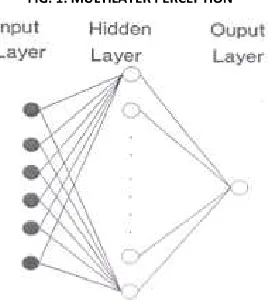
An ANN has several advantages but one of the most recognized of these is the fact that it can actually learn from observing data sets. In this way, ANN is used as a random function approximation tool. These types of tools help estimate the most cost-effective and ideal methods for arriving at solutions while defining computing functions or distributions. ANN takes data samples rather than entire data sets to arrive at solutions, which saves both time and money. ANNs are considered fairly simple mathematical models to enhance existing data analysis technologies. ANNs have three layers that are interconnected. The first layer consists of input neurons. Those neurons send data on to the second layer, which in turn sends the output neurons to the third layer.
FIG. 1: MULTILAYER PERCEPTION
6. IMPLEMNTING BACKPROPAGATION ALGORITHM OF ANN IN CONCURENCY CONTROL
6.1 BACKPROPAGATION ALGORITHM (BPA)
The BPA uses the steepest-descent method to reach a global minimum. The number of layers and number of nodes in the hidden layers are decided. The connections between nodes are
initialized with random weights. As shown in following steps a pattern from the training set is presented in the input layer of the network and the error at the output layer is calculated. The error is propagated backwards towards the input layer and the weights are updated. This procedure is
repeated for all the training patterns. At the end of each iteration, test patterns are presented to
ANN, and the classification performance of ANN is evaluated. Further training of ANN is continued till the desired classification performance is reached.
6.2 STEPS INVOLVED FORWARD PROPAGATION
• The weights and thresholds of the network are initialized.
• The inputs and outputs of a pattern are presented to the network.
• The output of each node in the successive layers is calculated.
o(output of a node) = 1/(1+exp(_wij xi + Θ))
• The error of a pattern is calculated
E(p) = (1/2) _(d(p) – o(p))2 REVERSE PROPAGATION
• The error for the nodes in the output layer is calculated
δ(output layer) = o(1-o)(d-o)
• The weights between output layer and hidden layer are updated
W(n+1) = W(n) + ηδ(output layer) o(hidden layer)
• The error for the nodes in the hidden layer is calculated
δ(hidden layer) = o(1-o) _δ(output layer) W(updated weights between hidden and output layer)
• The weights between hidden and input layer are updated.
W(n+1) = W(n) + ηδ(hidden layer) o(input layer)
The above steps complete one weight updation.
Second pattern is presented and the above steps are followed for the second weight updation. When all the training patterns are presented, a cycle of iteration or epoch is completed. The errors of all the training patterns are calculated and displayed on the monitor as the mean squared error(MSE).
E(MSE) = _ E(p)
TABLE 1: LOCK MANAGEMENT VARIABLES
User Object Mode
Where,
User represents the client
Object represents the database/ file/ record
Mode represents type of lock assigned to an object.
exclusive (X) mode: Data item can be both read as well as written.
shared (S) mode: Data item can only be read..
intention-shared (IS): Indicates explicit locking at a lower level of the tree but only with shared locks.
Intention-exclusive (IX): Indicates explicit locking at a lower level with exclusive or shared locks.
shared and intention-exclusive (SIX): The sub tree rooted by that node is locked explicitly in shared mode and explicit locking is being done at a lower level with exclusive-mode locks.
A intention locks allow a higher level node to be locked in S or X mode without having to check all descendent nodes.
In Table 2, column 1 represents the lock type. Column 2 represents the value to be used in the input layer of the ANN in module 1 and module 3. Column 3 gives binary representation of Lock type to be used in the output layer of module 1 and module 3. The values are used as target outputs in the module 1 and module 3 during lock release on a data item.
VOLUME NO.5(2015),ISSUE NO.12(DECEMBER) ISSN 2231-5756
INTERNATIONAL JOURNAL OF RESEARCH IN COMMERCE, IT & MANAGEMENT
TABLE 2: LOCK TYPE AND THEIR BINARY REPRESENTATIONLock type (Input layer representation numerical value). Binary representation in target layer of the ANN
S 1 001
X 2 010
IS 3 011
IX 4 100
Object Not locked 0 000
TABLE 3: SEQUENCE OF OBJECT ACCESS BY TWO USERS
User / Intermediate transaction Object (a) Object (b) Mode S,X ,IS,IX Lock Enabled – (1)
Otherwise (0)
T1 a - S 1
T2 a - S 1
T1 a - X 1
T1 - B S 1
T2 a - X 1
T1 - B X 1
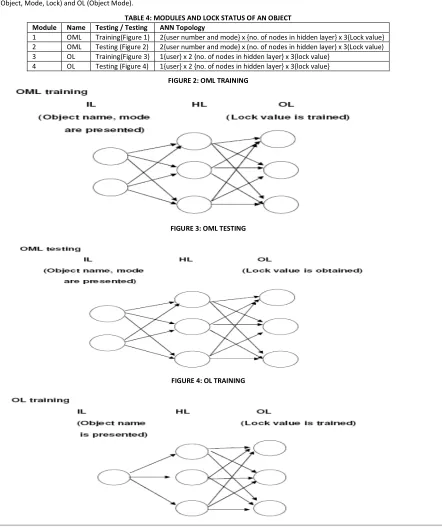
This work uses for modules of algorithm which work using BPA given in Table 1. The modules given in Table 4 gives their usage for learning and finding the lock states. OML(Object, Mode, Lock) and OL (Object Mode).
TABLE 4: MODULES AND LOCK STATUS OF AN OBJECT
Module Name Testing / Testing ANN Topology
1 OML Training(Figure 1) 2{user number and mode} x {no. of nodes in hidden layer} x 3{Lock value}
2 OML Testing (Figure 2) 2{user number and mode} x (no. of nodes in hidden layer) x 3(Lock value)
3 OL Training(Figure 3) 1{user} x 2 {no. of nodes in hidden layer} x 3{lock value}
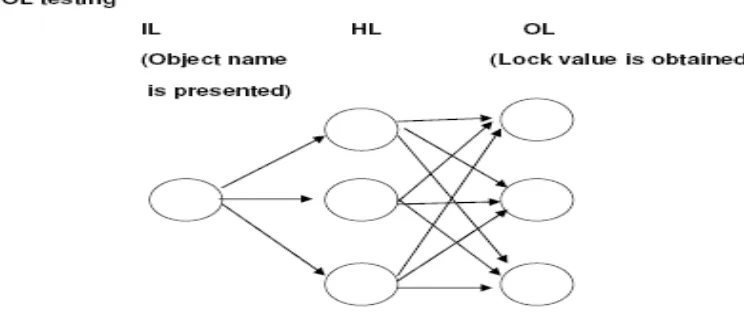
4 OL Testing (Figure 4) 1{user} x 2 {no. of nodes in hidden layer} x 3{lock value}
FIGURE 2: OML TRAINING
FIGURE 3: OML TESTING
VOLUME NO.5(2015),ISSUE NO.12(DECEMBER) ISSN 2231-5756 FIGURE 5: OL TESTING
7. SEQUENCE OF MODULES EXECUTED WHEN A TRANSACTION REQUESTS LOCK OR RELEASES LOCK
1. Initialize randomly the weights of module 1 and module 3
2. A transaction Ti requests lock on an object (a ,b, )
3. Module 4 is tested with object (a, b,…) requested in step 2 to obtain binary value. If ‘000’ is output in the output layer of module 4, then the object is free to
be accessed. If (001, 010, 011, 100 is output then the object is under use. If the output value is 001, then the transaction in step is given access to the requested object
4. In any case , if Ti is given transaction to requested object, then module 1 and module 3 are weight updated using the back propagation algorithm (forward
and backward steps)
5. In any case , if the object is under any lock mode other than shared or no lock, then the transactions are kept under queue.
8. CONCLUSION
An approach has been attempted to implement ANN in concurrency control. The approach has to be verified with different types of files operated by many users in a distributed environment. ANN algorithms can be attempted to achieve concurrency control in distributed database applications which are more beneficial than conventional techniques like two phase locking, timestamp ordering, etc.
REFERENCES
1. A. H. Skarra, and S. B. Zdonik. “Concurrency Control and Object- Oriented Databases”. In Kim, W., and Lochovsky, F. H., Ed., Object-Oriented Concepts,
Databases, and Applications, ACM Press, New York, NY, 1989, pp. 395-421
2. Arun Kumar Yadav & Ajay Agarwal, 2010, “An Approach For Concurrency Control In Distributed Database System”, International Journal Of Computer Science
& Communication Vol. 1, No. 1, pp. 137-141.
3. Barghouti.N. S.,and Gail E.Kaiser, 1991, Concurrency Control in Advanced Database Applications, ACM Computing Surveys, Vol. 23, No.3, pp. 269-317.
4. Cosmin Stoica Spahiu, 2011, “Concurrency Control Techniques for a Multimedia Database System”, Proceedings of The Federated Conference On computer
Science And Information Systems, pp. 751–754.
5. F. Bancilhon, W. Kim and H. Korth. “A Model of CAD Transactions”. In Proceedings of the11th International Conference on Very Large Data Bases, Morgan
Kaufmann, August, 1985, pp. 25-33
6. Muthu Kumaravel .A, Purushothaman .S and Rajeswari .S, International Journal of Innovative Research in Computer and Communication Engineering (An ISO
3297: 2007 Certified Organization) Vol. 3, Issue 8, August 2015 Copyright to IJIRCCE DOI: 10.15680/IJIRCCE.2015. 0308215 7169 Implementation of Artificial Neural Network and Fuzzy Logic for Concurrency Control in CAD Data Base
7. P. Klahold, G. Schlageter, R. Unland and W. Wilkes, “A Transaction Model Supporting Complex Applications in Integrated Information Systems”. In Proceedings
of the ACM SIGMOD International Conference on the Management of Data, ACM Press, May, 1985, pp.388-401
8. P. Raviram, & R.S.D. Wahidabanu, India implementation of artificial neural network in Concurrency control of computer integrated Manufacturing (cim)
database
9. S. Purushothaman, Y. G. Srinivasa. “A back Propagation Algorithm applied to Tool wear Monitoring”. International Journal of Tools Manufacture ,1994, Vol
34, No 5, pp 625-631
VOLUME NO.5(2015),ISSUE NO.12(DECEMBER) ISSN 2231-5756
INTERNATIONAL JOURNAL OF RESEARCH IN COMMERCE, IT & MANAGEMENT
REQUEST FOR FEEDBACK
Dear Readers
At the very outset, International Journal of Research in Commerce, IT & Management (IJRCM) acknowledges
& appreciates your efforts in showing interest in our present issue under your kind perusal.
I would like to request you to supply your critical comments and suggestions about the material published
in this issue as well as on the journal as a whole, on our E-mail
for further
improvements in the interest of research.
If you have any queries, please feel free to contact us on our E-mail
.
I am sure that your feedback and deliberations would make future issues better – a result of our joint effort.
Looking forward an appropriate consideration.
With sincere regards
Thanking you profoundly
Academically yours
Sd/-
Co-ordinator
DISCLAIMER