University of Bolton
UBIR: University of Bolton Institutional Repository
IMRI: Journal Articles (Peer-Reviewed) Institute for Materials Research and Innovation
2010
Development of advanced personal protective
equipment fabrics for protection against slashes
and pathogenic bacteria: Part 2: Development of
antimicrobial hygiene garments and their
characterization.
K. Kanchi Govarthanam
University of Bolton, [email protected]
Subhash Anand
University of Bolton, [email protected]
Subbiyan Rajendran
University of Bolton, [email protected]
This Article is brought to you for free and open access by the Institute for Materials Research and Innovation at UBIR: University of Bolton Institutional Repository. It has been accepted for inclusion in IMRI: Journal Articles (Peer-Reviewed) by an authorized administrator of UBIR: University of Bolton Institutional Repository. For more information, please [email protected].
Digital Commons Citation
Govarthanam, K. Kanchi; Anand, Subhash; and Rajendran, Subbiyan. "Development of advanced personal protective equipment fabrics for protection against slashes and pathogenic bacteria: Part 2: Development of antimicrobial hygiene garments and their characterization.." (2010).IMRI: Journal Articles (Peer-Reviewed).Paper 45.
Development of Advanced Personal Protective Equipment Garments for Protection against Slashes and Pathogenic Bacteria
Part 2:Development of Antimicrobial Hygiene Garments and Their Characterisation
K Kanchi Govarthanam*, S C Anand and S Rajendran
Centre for Materials Research and Innovation, The University of Bolton, Deane Road, Bolton, BL3 5AB, UK
ABSTRACT:
Knife is the most commonly used single weapon in the UK and studies reveal that majority of the knife inflicted wounds were slash type that could be disfiguring or life threatening. Currently available stab resistant armours do not protect the arms, neck and face as they are rigid to be worn comfortably for everyday use. The main objectives of this research programme are; a) to develop and characterise a novel cut resistant and slash proof material that is lightweight, comfortable and efficient; and b) to integrate barrier properties in such garments which would incorporate suitable antimicrobial and other suitable chemicals to provide protection against a range of micro organisms. The design and development of novel slash proof materials for the police, armed forces, children and the public, that is lightweight, comfortable and efficient was discussed in Part 1 of this series.
This part discusses the application and study of antimicrobial properties on this novel two-layered weft knitted slash resistant fabric that has only 13.6% of its fibres effectively available for incorporation of antibacterial agents. The anti-bacterial formulation was applied at different concentrations onto the fabric using pad-dry-cure method. Antimicrobial properties of the treated fabrics were evaluated using modified AATCC
Test method 147-1998 against common pathogenic bacteria, Staphylococcus aureus and
Escherichia coli. It was found that the formulation with 10% concentration showed optimum antimicrobial property with good washing fastness. The durability of the antimicrobial agents were evaluated, both with and without cross-linking agents, for up to 10 washes and better washing fastness was achieved with a cross-linking agent on the face knitted with the composite WF 528 yarn.
KEYWORDS: antimicrobial, microorganisms, personal protective equipment, PPE, garments, test methods, standards.
INTRODUCTION
The law enforcement and medical personnel require high level of protection when dealing with physical threats. With knives being used more commonly now-a-days, the general public require high level protection from crimes. The first part of this two-part series of papers presented a comprehensive review of the need for protection against slash and stab, the aims of the research programme and the design, development and characterisation of novel slash proof materials for the police, armed forces, children and the public. This paper discusses the application, testing and evaluation of antimicrobial agents to the novel slash proof materials described in Part-I.
It is well established that microorganisms create and aggravate problems by transmitting diseases and infections through clothing, bedding, etc. They exist in large quantities on
textile materials and aid in transmitting diseases and infections1. Microorganisms cause
damage to fibres under normal usage and storage conditions thereby reducing the wear
life of the materials2. The moisture transport characteristics of fabrics made wholly of
synthetic fibres tend to cause a greater degree of ‘perspiration wetness’3 which causes
discomfort to the wearer and they retain more odour causing bacteria than natural fibres,
especially polyamide fibres4.
One of the main objectives of the research programme is to incorporate suitable antimicrobial agents into novel materials to provide protection against a range of pathogenic bacteria and to fully characterise the barrier properties of the treated materials. The application of antibacterial agents into the novel slash resistant fabric itself presents a challenge since the fabric has only 13.6% of its fibres by weight (polyamide) effectively available for incorporation of antibacterial agents. The remaining 86.4% of the fabric is made of para-aramid fibres, ultra high molecular weight polyethylene and glass fibres which pose problems imbuing antimicrobial agents into fibre matrix. The slash resistant fabric is designed as a two layered structure, one face formed entirely of Kevlar® aramid fibres and the other face with the engineered composite yarn that is double covered using a polyamide continuous-filament yarn.
A lot of attention has been given to the development of antimicrobial textiles for health-care workers as they are highly exposed to numerous biological hazards in the work
place5,6,7 and numerous papers have already discussed the applications and advancements
in antibacterial finishes on textile products8,9,10,11. The fibres that are available for
incorporating antibacterial agents are made up of polyamide (Nylon6,6) and considerable research has been carried out to successfully incorporate antibacterial agents into the
textile structures12,13. Different methods of evaluation of antimicrobial finish have been
discussed elsewhere3,14,15,16 and this part, therefore, focuses on the up-to-date results from
EXPERIMENTAL WORK
Preparation of Antibacterial Finish
A synergistic system of antimicrobial chemical formulation has been prepared and optimised for maximum antimicrobial activity. All the four chemicals were combined in various proportions in water to form the antimicrobial solution. They were mechanically stirred for 30 minutes to help with even dispersion in water. Formulations with two different proportions of the chemicals were initially evaluated using the Zone of Inhibition test. Since both variations of the proportions showed similar results on both Gram positive and Gram negative bacteria, only one of the combinations of chemicals were used for further studies. The details of the chemicals and the proportions used have been omitted intentionally in order to protect the Intellectual Property Rights (IPR) associated with this innovation.
Preparation of Bacterial Cultures
The antimicrobial properties of the novel slash resistant garments were evaluated using
Gram-positive Staphylococcus aureus (ATCC 29213) and Gram-negative Escherichia
coli (ATCC 35218) bacteria. A suspension of each organism was prepared from frozen
colonies in a nutrient broth containing 5g/1000ml of Peptone and 3g/1000ml of beef extract. The broth was dispensed in 9.0 ml amounts in conventional bacteriological
culture bottles and sterilised for 15 minutes at 1200C before dispensing the organisms.
Further dilutions of the organisms were made to get dilutions of up to 10-6.
Preparation of Test Specimens
The formulation was imbued into the fabric using pad-dry-cure method. The fabric was
padded with the antibacterial solution, drip dried and dried at 800C for 25 minutes and
then cured at 1000C for 5 minutes. Due to heavy knitted construction of the novel slash
resistant garment, it was difficult to cut the fabrics in circles to test the zone of inhibition. Therefore, the test specimens were cut in 2 cm squares using an electric scissor.
Test Procedure
15 ± 2 ml of sterilised nutrient agar was poured into a standard 90mm flat bottomed Petri dish and allowed to gel firmly at room temperature. Contrary to using 4 mm inoculating
Due to the two layered bulky structure of the test specimen and to make sure that the fabric is in contact with the inoculum, tests were carried out twice by placing each face of the specimen in contact with the bacterial inoculum. The agar plates were then incubated
at 37 ± 20C for 24 hours.
Evaluation of Zone of Inhibition
Generally, for a zone of inhibition test the fabric is required to be cut as a circle so as to enable the incorporated chemicals to be leached out evenly in all the directions to arrest or kill the bacteria in the agar medium. Due to the extremely high cut resistance of the developed fabric and the structure of the fabric, it was impossible to cut the fabric as a circle. Therefore the fabric was cut in 2 cm squares and the zone of inhibition was measured in all the four sides and an average was recorded. The size of the zone of inhibition is then compared to that of an untreated control specimen.
Durability Testing
To test the durability of the antimicrobial finish, treated specimens were examined for antimicrobial efficacy after 1, 5 and 10 launderings. The procedure used for laundering is
described in the AATCC Test Method 6118. AATCC standard reference detergent WOB
(without optical brightener) was used19.
RESULTS AND DISCUSSION
Pick-up of Chemical Formulation
The antibacterial formulation was applied at concentrations of 5%, 10%, 15%, 20% and 25%.
Pick-up %
y = 1.021x - 0.0231
R2 = 0.9985
0% 5% 10% 15% 20% 25%
0% 10% 20% 30%
Chemical Concentration
P
ic
k
-u
p
%
Pick-up %
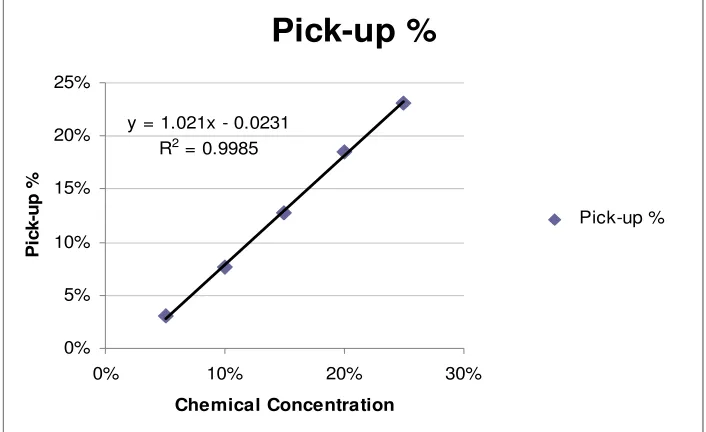
The pick-up percentage of the fabrics at different concentrations was studied to analyse the efficiency of fabric to take up the chemicals and ten specimens were tested for each concentration. It can be seen from Figure 1 that the pick-up percentage varied with the concentration of the recipe and it is linear. Table 1 shows the values of pick-up % for different recipe concentration at 95% confidence limits.
The relationship between the pick-up percentage for the novel slash resistant material and the recipe concentration is calculated by using the linear regression equation-1 with a
correlation coefficient (R2) value of 0.9985.
y = 0.0511x – 0.0231 --- (1)
Table 1: Take-up Percentage of the Formulation at Different Concentrations.
Recipe Concentration
5% 10% 15% 20% 25%
Pick-up
% 3.01 ± 0.01 7.62 ± 0.01 11.53 ± 0.01 18.55 ± 0.04 23.08 ± 0.07
Antimicrobial Activity against Gram-positive Bacteria
Different dilutions of Staphylococcus aureus at 10-4, 10-5 and 10-6 were studied to test the
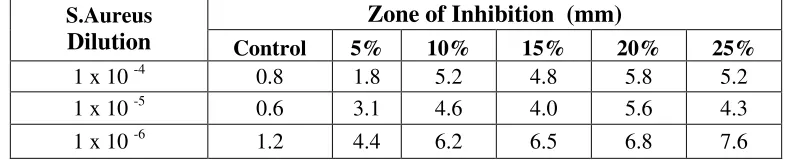
antimicrobial activity of the slash resistant fabric at of 5%, 10%, 15%, 20% and 25%. Since the fabric specimens could not be fully immersed in the agar solution, the test was conducted separately for both faces of the fabric. Two specimens were tested for each face, giving a total of four specimens and 16 zone of inhibition points. An average of all the 16 points was recorded and the values are shown in Table 2.
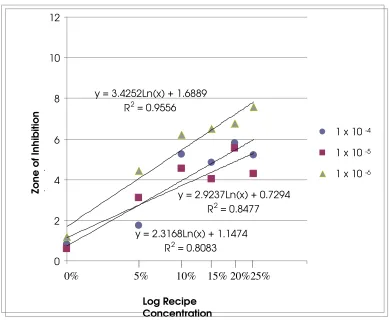
The logarithmic trend lines in Figure 2 illustrate that optimum antimicrobial activity is reached at 10% of recipe concentration. It should be mentioned that the rate of antimicrobial activity increases with the increase in concentration of recipe up to 10%
and thereafter the increase is not significant. The coefficient of correlation (R2) value is
least for log concentration of 10-5 at 0.8083 and is more consistent for lower bacterial
concentration of 10-6 at 0.9556. It should be noted that these results can not be construed
Figure 2: Zone of inhibition using Staphylococcus aureus
The antimicrobial effect of the slash resistant fabric on different dilutions of bacteria can be predicted using the following equations:
for 10-4 dilution:
y = 2.9237 ln(x) + 0.7294 ---(2)
R2 = 0.8477
for 10-5 dilution:
y = 2.3168 ln(x) + 1.1474 ---(3)
R2 = 0.8083
for 10-6 dilution:
y = 3.4252 ln(x) + 1.6889 ---(4)
R2 = 0.9556
where, y = the zone of inhibition in mm; x = antimicrobial chemical concentration; and
R2 = correlation coefficient.
y = 2.9237Ln(x) + 0.7294 R2 = 0.8477
y = 2.3168Ln(x) + 1.1474 R2 = 0.8083 y = 3.4252Ln(x) + 1.6889
R2 = 0.9556
0 2 4 6 8 10 12
1 10
Log Recipe Concentration
Z
o
n
e
o
f
In
h
ib
it
io
n
(m
m
)
1 x 10 -4
1 x 10 -5
1 x 10 -6
Table 2: Zone of Inhibition using Staphylococcus aureus.
Zone of Inhibition (mm) S.Aureus
Dilution Control 5% 10% 15% 20% 25%
1 x 10 -4 0.8 1.8 5.2 4.8 5.8 5.2 1 x 10 -5 0.6 3.1 4.6 4.0 5.6 4.3 1 x 10 -6 1.2 4.4 6.2 6.5 6.8 7.6
It can be observed from Table 2 that the optimum antibacterial activity can be obtained at 10% concentration with zone of inhibition of 5.2mm, 4.6mm and 6.2mm at various bacterial dilutions. Figure 3 shows the antibacterial activity of the control untreated fabric
against Staphylococcus aureus at 10-4 dilution and Figure 4 shows the antibacterial
activity of the fabric treated with 10% concentration of the chemical formulation. The zone of inhibition obtained at 15% concentration (see Table 2) is slightly lower than that of 10% concentration and increases marginally at concentrations of 20% and 25%. Higher concentrations of the formulation could not be tested as the chemicals reach the saturation point at just about 25% concentration.
White face of the fabric Yellow face of the fabric
White face of the fabric Yellow face of the fabric
Figure 4: Zone of inhibition of treated fabric (10% recipe) against Staphylococcus aureus
Antimicrobial Activity against Gram-negative Bacteria
Figure 5: Zone of inhibition using Escherichia coli
y = -0.3283x2 + 2.9624x - 1.6362 R2 = 0.7441
y = -0.3151x2 + 2.9055x - 1.3656 R2 = 0.7021
y = -0.8414x2 + 7.0095x - 5.0297 R2 = 0.9155
0 2 4 6 8 10 12
0 1 2 3 4 5 6 7
Recipe Concentration
Z
o
n
e
o
f
In
h
ib
it
io
n
(
m
m
)
1 x 10 -4
1 x 10 -5
1 x 10 -6
Figure 5 shows a plot between different bacterial concentrations of Escherichia coli and the extent of antimicrobial activity at different concentrations of the synergistic chemical formulation applied on the novel slash resistant fabric. Even though the data does not conform to the relationship between the measured zone of inhibition at different concentrations of chemicals and the log of different concentrations of bacteria, the values shown in Table 3 prove that there is significant antimicrobial activity against Gram-positive bacteria. Figure 6 shows the antibacterial activity of the control untreated fabric
against Gram-negative bacteria, Escherichia coli at 10-4 dilution and Figure 7 shows the
zone of inhibition of the treated fabric at 10% concentration against Escherichia coli.
Table 3: Zone of Inhibition using Escherichia coli.
The relationship between the chemical concentration and bacterial concentration against
Gram-positive Escherichia coli is given by:
for 10-4 dilution:
y = -0.3151x2 + 2.9055x - 1.3656 ---(5)
R² = 0.7021
for 10-5 dilution:
y = -0.8414x2 + 7.0095x - 5.0297 ---(6)
R² = 0.9155
for 10-6 dilution:
y = -0.3283x2 + 2.9624x - 1.6362 ---(7)
R² = 0.7441
Once again, the effect of chemicals against the Gram-negative bacteria shows the optimum antimicrobial activity, with zones of 5.2mm, 6.1mm and 7.1mm, at 10% concentration of the antibacterial recipe.
Zone of Inhibition (mm) E.Coli
Dilution Control 5% 10% 15% 20% 25%
White face of the fabric Yellow face of the fabric
Figure 6: Zone of inhibition of control untreated fabric against Escherichia coli
White face of the fabric Yellow face of the fabric
Durability of Antimicrobial Finish against Gram-positive Bacteria
The novel slash resistant fabric is made of two layers with different yarn constituents, one face with Kevlar that is yellow in colour, and the other face with the composite WF 528 that is white in colour. Both yarns have different absorption properties and hence the durability of the antimicrobial finish was evaluated on both the faces of the fabric.
Table 4 and Figure 8 show the zone of inhibition in mm against Staphylococcus aureus
Table 4: Durability of Antimicrobial Activity on Yellow (Kevlar) Face with and without Cross-linking Agent (CL) against Staphylococcus aureus.
Yellow Face - with CL Yellow Face - without CL
1 Wash 5 Wash 10 Wash 1 Wash 5 Wash 10 Wash
S.Aureus
Dilution Unwashed Treated
Control Zone of Inhibition
(mm)
Reduction in Zone of Inhibition
(%)
Zone of Inhibition
(mm)
Reduction in Zone of Inhibition
(%)
Zone of Inhibition
(mm)
Reduction in Zone of Inhibition
(%)
Treated Unwashed
Control
Zone of Inhibit
ion (mm)
Reduction in Zone of Inhibition
(%)
Zone of Inhibition
(mm)
Reduction in Zone of Inhibition
(%)
Zone of Inhibition
(mm)
Reduction in Zone of Inhibition
(%)
10-4 6.7 4.2 37% 1.0 85% 1.6 76% 5.8 3.2 45% 2.2 62% 2.0 66%
10-5 6.4 3.1 52% 2.0 69% 2.6 59% 4.8 1.5 69% 0.6 88% 0.5 90%
0.0 2.0 4.0 6.0 8.0 10.0 12.0 Treated Unwashed Control
1 Wash 5 Wash 10 Wash
Yellow Face - with CL
Z o n e o f In h io b it io n ( m m ) 10-4 10-5 10-6 0.0 2.0 4.0 6.0 8.0 10.0 12.0 Treated Unwashed Control
1 Wash 5 Wash 10 Wash
Yellow Face - without CL
Z o n e o f In h ib it io n ( m m ) 10-4 10-5 10-6
Figure 8: Durability of antimicrobial activity on yellow (Kevlar) face with and without
cross-linking agent (CL) against Staphylococcus aureus
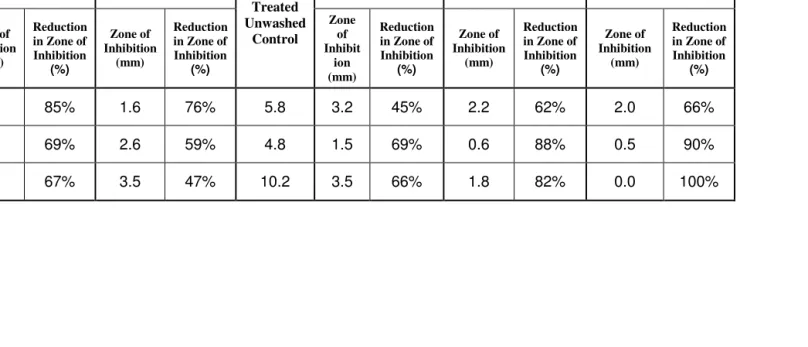
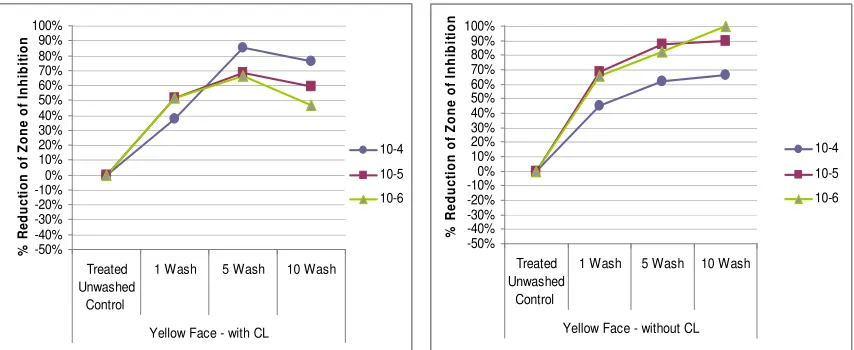
It can be seen from Table 4 that the percent reduction in zone of inhibition after washing is mostly higher in the case of samples without the cross-linking agent. The average reduction at all dilutions is 85% after 10 washes for the specimen without the cross-linking agent while the average reduction for the specimen treated with the cross-cross-linking
agent is only 60%. For a bacterial dilution to the order of 10-6, the percentage reduction in
zone of inhibition is 47% after 10 washes with the cross-linking agent and there is no antimicrobial activity at all without the cross-linking agent.
Figure 9: Percent reduction in zone of inhibition on yellow (Kevlar) face with and
without cross-linking agent (CL) against Staphylococcus aureus
Comparing with the antimicrobial activity on the yellow Kevlar face, the white WF 528
-50% -40% -30% -20% -10% 0% 10% 20% 30% 40% 50% 60% 70% 80% 90% 100% Treated Unwashed Control
1 Wash 5 Wash 10 Wash
Yellow Face - with CL
% R e d u c ti o n o f Z o n e o f In h ib it io n 10-4 10-5 10-6 -50% -40% -30% -20% -10%0% 10% 20% 30% 40% 50% 60% 70% 80% 90% 100% Treated Unwashed Control
1 Wash 5 Wash 10 Wash
Yellow Face - without CL
Table 5: Durability of Antimicrobial Activity on White (WF 528) Face with and without Cross-linking Agent (CL) against Staphylococcus aureus.
White Face - with CL White Face - without CL
1 Wash 5 Wash 10 Wash 1 Wash 5 Wash 10 Wash
S.Aureus
Dilution Unwashed Treated
Control Zone of Inhibition
(mm)
Reduction in Zone of Inhibition
(%)
Zone of Inhibition
(mm)
Reduction in Zone of Inhibition
(%)
Zone of Inhibition
(mm)
Reduction in Zone of Inhibition
(%)
Treated Unwashed
Control
Zone of Inhibit
ion (mm)
Reduction in Zone of Inhibition
(%)
Zone of Inhibition
(mm)
Reduction in Zone of Inhibition
(%)
Zone of Inhibition
(mm)
Reduction in Zone of Inhibition
(%)
10-4 4.6 6.0 -30% 6.2 -35% 4.0 13% 5.2 5.3 -2% 2.9 44% 2.0 62%
10-5 4.7 3.1 34% 3.6 23% 2.2 53% 11.6 5.9 49% 2.9 75% 1.9 84%
0.0 2.0 4.0 6.0 8.0 10.0 12.0 Treated Unwashed Control
1 Wash 5 Wash 10 Wash
White Face - with CL
Z o n e o f In h ib it io n ( m m ) 10-4 10-5 10-6 0.0 2.0 4.0 6.0 8.0 10.0 12.0 Treated Unwashed Control
1 Wash 5 Wash 10 Wash
White Face - without CL
Z o n e o f In h ib it io n ( m m ) 10-4 10-5 10-6
Figure 10: Durability of antimicrobial activity on white (WF 528) face with and without
cross-linking agent (CL) against Staphylococcus aureus
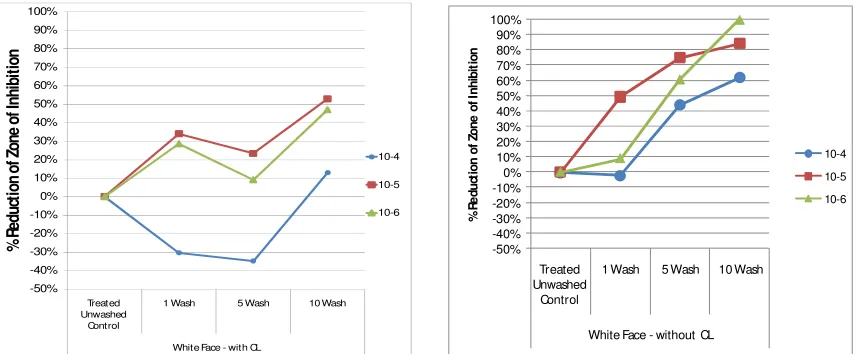
The antimicrobial activity of a fabric treated with an antibacterial agent is generally expected to either stay the same or to reduce after every single wash. But, during this
experiment, for bacterial dilutions to the order of 10-4, there was an increase of 30% in
the antimicrobial activity after 1 and 5 washes. This could be due to experimental error or there could have been a higher take-up of the antimicrobial chemicals at the particular part of the specimen.
Figure 11: Percent reduction in zone of inhibition on white (WF 528) face with and
without cross-linking agent (CL) against Staphylococcus aureus
Durability of Antimicrobial Finish against Gram-negative Bacteria
The durability of the antimicrobial finish on Gram-negative bacteria is lower when compared to the durability against Gram-positive bacteria. The reduction in antimicrobial
-50% -40% -30% -20% -10% 0% 10% 20% 30% 40% 50% 60% 70% 80% 90% 100% Treated Unwashed Control
1 Wash 5 Wash 10 Wash
White Face - with CL
% R ed uc ti on o f Z on e of In hi bi ti on 10-4 10-5 10-6 -50% -40% -30% -20% -10% 0% 10% 20% 30% 40% 50% 60% 70% 80% 90% 100% Treated Unwashed Control
1 Wash 5 Wash 10 Wash
White Face - without CL
Table 6: Durability of Antimicrobial Activity on Yellow (Kevlar) Face with and without Cross-linking Agent (CL) against Escherichia coli.
Yellow Face - with CL Yellow Face - without CL
1 Wash 5 Wash 10 Wash 1 Wash 5 Wash 10 Wash
E.Coli Dilution
Treated Unwashed
Control Zone of Inhibition
(mm)
Reduction in Zone of Inhibition
(%)
Zone of Inhibition
(mm)
Reduction in Zone of Inhibition
(%)
Zone of Inhibition
(mm)
Reduction in Zone of Inhibition
(%)
Treated Unwashed
Control
Zone of Inhibit
ion (mm)
Reduction in Zone of Inhibition
(%)
Zone of Inhibition
(mm)
Reduction in Zone of Inhibition
(%)
Zone of Inhibition
(mm)
Reduction in Zone of Inhibition
(%)
10-4 7.2 3.0 58% 1.2 83% 1.4 81% 3.2 3.9 -22% 0.0 100% 1.1 66%
10-5 8.0 6.7 16% 2.4 70% 1.3 84% 11.0 5.3 52% 0.0 100% 1.0 91%
Figure 12: Durability of antimicrobial activity on yellow (Kevlar) face with and without
cross-linking agent (CL) against Escherichia coli
Figure 13: Percent reduction in zone of inhibition on yellow (Kevlar) face with and
without cross-linking agent (CL) against Escherichia coli
There was no significant difference in the retention of the antimicrobial agents on the yellow face when a cross-linking agent is used. The average percentage reduction in zone of inhibition is 88% with cross-linking agent and 86% without cross-linking agent (see Table 6). -50% -40% -30% -20% -10% 0% 10% 20% 30% 40% 50% 60% 70% 80% 90% 100% Treated Unwashed Control
1 Wash 5 Wash 10 Wash
Yellow Face - with CL
% R e d u c ti o n o f Z o n e o f In h ib it io n 10-4 10-5 10-6 -50% -40% -30% -20% -10% 0% 10% 20% 30% 40% 50% 60% 70% 80% 90% 100% Treated Unwashed Control
1 Wash 5 Wash 10 Wash
Yellow Face - without CL
% R e d u c ti o n o f Z o n e o f In h ib it io n 10-4 10-5 10-6 0.0 5.0 10.0 15.0 20.0 25.0 Treated Unwashed Control
1 Wash 5 Wash 10 Wash
Yellow Face - with CL
Z o n e o f In h ib it io n ( m m ) 10-4 10-5 10-6 0.0 5.0 10.0 15.0 20.0 25.0 Treated Unwashed Control
1 Wash 5 Wash 10 Wash
Yellow Face - without CL
Table 7: Durability of Antimicrobial Activity on White (WF 528) Face with and without Cross-linking Agent (CL) against Escherichia coli.
White Face - with CL White Face - without CL
1 Wash 5 Wash 10 Wash 1 Wash 5 Wash 10 Wash
E.Coli
Dilution Unwashed Treated
Control Zone of Inhibition
(mm)
Reduction in Zone of Inhibition
(%)
Zone of Inhibition
(mm)
Reduction in Zone of Inhibition
(%)
Zone of Inhibition
(mm)
Reduction in Zone of Inhibition
(%)
Treated Unwashed
Control
Zone of Inhibit
ion (mm)
Reduction in Zone of Inhibition
(%)
Zone of Inhibition
(mm)
Reduction in Zone of Inhibition
(%)
Zone of Inhibition
(mm)
Reduction in Zone of Inhibition
(%)
10-4 6.1 6.4 -5% 4.7 23% 4.2 31% 3.3 4.7 -42% 0.0 100% 1.0 70%
10-5 11.5 6.6 43% 5.2 55% 3.7 68% 11.0 4.9 55% 0.0 100% 1.5 86%
Figure 14: Durability of antimicrobial activity on white (WF 528) face with and without
cross-linking agent (CL) against Escherichia coli
Figure 15: Percent reduction in zone of inhibition, on white (WF 528) face with and
without cross-linking agent (CL) against Escherichia coli
Compared to the antimicrobial activity on the yellow Kevlar face, there is an increase in activity by 11% on the white WF528 face when a cross-linking agent is used indicating the durability of the antimicrobial.
CONCLUSIONS -50% -40% -30% -20% -10% 0% 10% 20% 30% 40% 50% 60% 70% 80% 90% 100% Treated Unwashed Control
1 Wash 5 Wash 10 Wash
White Face - with CL
% R e d u c ti o n o f Z o n e o f In h ib it io n 10-4 10-5 10-6 -50% -40% -30% -20% -10% 0% 10% 20% 30% 40% 50% 60% 70% 80% 90% 100% Treated Unwashed Control
1 Wash 5 Wash 10 Wash
White Face - without CL
% R e d u c ti o n o f Z o n e o f In h ib it io n 10-4 10-5 10-6 0.0 5.0 10.0 15.0 20.0 25.0 Treated Unwashed Control
1 Wash 5 Wash 10 Wash
White Face - with CL
Z o n e o f In h ib it io n ( m m ) 10-4 10-5 10-6 0.0 5.0 10.0 15.0 20.0 25.0 Treated Unwashed Control
1 Wash 5 Wash 10 Wash
White Face - without CL
Gram-positive and Gram-negative bacteria. The antimicrobial activity of the treated slash resistant fabric was studied at different concentrations of chemical formulation and it was found that optimum antimicrobial activity is reached at 10% concentration and, thereafter, the increase is not significant.
The durability of the chemical formulation at 10% concentration has been studied for up to 10 washes. The study indicates that the antimicrobial activity existed after testing up to 10 washes. A comparative study has been conducted on the durability by adding a cross-linking agent into the antimicrobial chemical formulation and it was found that the percentage retention of the antimicrobial agent is significantly higher on the white WF528 face when a cross-linking agent is used.
ACKNOWLEDGEMENT
The authors would like to express their sincere gratitude to Future Textiles, Alfreton, UK, who provided financial support and their facilities to carry out this research programme. The authors would also like to express their appreciation to World Fibres Inc, Concord, US, who provided us their facilities to develop the composite yarns.
REFERENCES
1. Rajendran, S. and Anand, S.C. (1999). Development of a versatile Antimicrobial Finish for Textile Materials for Healthcare and Hygiene Applications, In Anand, S.C.
Medical Textiles. Proceedings of the International Conference, 24 & 25 August 1999, Bolton, UK.
2. Seventekin, N. and Ucarci, O. (1993). Damage Caused by Microorganisms to Cotton
Fabrics, Journal of Industrial Textiles, 84: 304-313.
3. Radford, P.J. (1973). Application and Evaluation of Anti-microbial Finishes, American
Dyestuff Reporter, Nov: 48-59.
4. Vigo, T.L. (1994). Textile Processing and Properties: Preparation, Dyeing, Finishing
and Performance, London, Elsevier.
5. Placencia, A.M. and Peeler, J.T. (1996). Evaluation of Health Care Workers’ Apparel
using Microbiological Methods, In Johnson, S.K. and Mansdorf, S.Z. ed. Performance of
Protective Clothing, Fifth Volume, 103-109, American Society for Testing and Materials.
6. Leonas, K.K. (2005). Microorganism Protection. In Scott, R.A. ed. Textiles for
Protection, 441-451, Woodhead Publishing, Cambridge.
7. Broughton, R.M., Worley, S.D., Unchin, C. et al. (1999). Textiles with Antimicrobial
8. Rigby, A.J., Anand, S.C. and Miraftab, M. (1993). Medical Textiles: Textile Materials
in Medicine and Surgery, Textile Horizons, Dec: 42-45.
9. Manezes, E. (2002). Antimicrobial Finishing for Speciality Textiles, The Textile
Industry & Trade Journal, Jan-Feb: 35-38.
10. Gao, Y. (2008). Recent Advances in Antimicrobial Treatments of Textiles, Textile
Research Journal, 78(1): 60-72.
11. Gagliardi, D.D. (1962). Antibacterial Finishes, American Dyestuff Reporter, 51(2):
31-40.
12. Buchenska, J. (1996). Antibacterial Polyamide Fibres, Fibres & Textiles in Eastern
Europe, 4: 53-59.
13. Kawata, T. (1998). First Permanently Antibacterial and Deodorant Fibres, Chemical
Fibres International, 48: 38-43.
14. Thomas, S. and McCubbin, P. (2003). A Comparision of the Antimicrobial Effects of
Four Silver-Containing Dressings on Three Organisms, Journal of Wound Care, 12(3):
101-107.
15. Lashen, E. S. (1971). New Method for Evaluating Antibacterial Activity Directly on
Fabric, Applied Microbiology, 21(4): 771-773.
16. Leonas, K.K. (1997). Using Laser Scaning Confocal Electron Microscopy to Evaluate
Microorganism Transmission Through Surgical Gown Fabrics, Medical Textiles ’96
Conference Proceedings, 60-65.
17. American Association of Textile Chemists and Colorists. (1998). Antibacterial
Activity Assessment of Textile Materials: Parallel Streak Method, AATCC, North Carolina.
18. American Association of Textile Chemists and Colorists. (2007). AATCC Test
Method 61 Colorfastness to Laundering: Accelerated, AATCC, North Carolina.
19. American Association of Textile Chemists and Colorists. (1993). Standard Reference
1
Rajendran, S. and Anand, S.C. (1999). Development of a versatile Antimicrobial Finish for Textile Materials for Healthcare and Hygiene Applications, In Anand, S.C. Medical Textiles. Proceedings of the International Conference, 24 & 25 August 1999, Bolton, UK.
2
Seventekin, N. and Ucarci, O. (1993). Damage Caused by Microorganisms to Cotton Fabrics, Journal of Industrial Textiles, 84: 304-313.
3
Radford, P.J. (1973). Application and Evaluation of Anti-microbial Finishes, American Dyestuff Reporter, Nov: 48-59.
4
Vigo, T.L. (1994). Textile Processing and Properties: Preparation, Dyeing, Finishing and Performance, London, Elsevier.
5
Placencia, A.M. and Peeler, J.T. (1996). Evaluation of Health Care Workers’ Apparel using Microbiological Methods, In Johnson, S.K. and Mansdorf, S.Z. ed. Performance of Protective Clothing, Fifth Volume, 103-109, American Society for Testing and Materials.
6
Leonas, K.K. (2005). Microorganism Protection. In Scott, R.A. ed. Textiles for Protection, 441-451, Woodhead Publishing, Cambridge.
7
Broughton, R.M., Worley, S.D., Unchin, C. et al. (1999). Textiles with Antimicrobial Functionality. Book
of Papers, INDA Tec, 20.1-20.12, INDA, Cary, NC.
8
Rigby, A.J., Anand, S.C. and Miraftab, M. (1993). Medical Textiles: Textile Materials in Medicine and Surgery, Textile Horizons, Dec: 42-45.
9
Manezes, E. (2002). Antimicrobial Finishing for Speciality Textiles, The Textile Industry & Trade Journal, Jan-Feb: 35-38.
10
Gao, Y. (2008). Recent Advances in Antimicrobial Treatments of Textiles, Textile Research Journal,
78(1): 60-72.
11
Gagliardi, D.D. (1962). Antibacterial Finishes, American Dyestuff Reporter, 51(2): 31-40.
12
Buchenska, J. (1996). Antibacterial Polyamide Fibres, Fibres & Textiles in Eastern Europe, 4: 53-59.
13
Kawata, T. (1998). First Permanently Antibacterial and Deodorant Fibres, Chemical Fibres International,
48: 38-43.
14
Thomas, S. and McCubbin, P. (2003). A Comparision of the Antimicrobial Effects of Four Silver-Containing Dressings on Three Organisms, Journal of Wound Care, 12(3): 101-107.
15
Lashen, E. S. (1971). New Method for Evaluating Antibacterial Activity Directly on Fabric, Applied Microbiology, 21(4): 771-773.
16
Leonas, K.K. (1997). Using Laser Scaning Confocal Electron Microscopy to Evaluate Microorganism Transmission Through Surgical Gown Fabrics, Medical Textiles ’96 Conference Proceedings, 60-65.
17
American Association of Textile Chemists and Colorists. (1998). Antibacterial Activity Assessment of
Textile Materials: Parallel Streak Method, AATCC, North Carolina.
18
American Association of Textile Chemists and Colorists. (2007). AATCC Test Method 61 Colorfastness
to Laundering: Accelerated, AATCC, North Carolina.
19
American Association of Textile Chemists and Colorists. (1993). Standard Reference Detergent and