Sensorless Speed Control of Switched Reluctance Motor Drive
Using the Binary Observer with Online Flux-Linkage
Estimation
S. Sedghizadeh*, C. Lucas** and H. Ghafoori Fard***
Abstract: An adaptive online flux-linkage estimation method for the sensorless control of
switched reluctance motor (SRM) drive is presented in this paper. Sensorless operation is achieved through a binary observer based algorithm. In order to avoid using the look up tables of motor characteristics, which makes the system, depends on motor parameters, an adaptive identification algorithm is used to estimate of the nonlinear flux-linkage parameters. This method makes position and speed estimation more accurate and robust towards any model uncertainty, also it is suitable replacement for a priori knowledge of motor characteristics.
Keywords: Sensorless control, Switched reluctance motor (SRM), Binary observer,
Adaptive identification.
1 Introduction 1
Switched reluctance motors (SRMs) have been the focus of many researches over the past decades. The simple mechanical construction is one of the main attractive features because it has no windings or permanent magnets on the rotor so its manufacturing cost appears to be lower compared to other motor types. Also it has the advantages of simple structure, low cost and high efficiency. However, the rotor position sensing requirement is a disadvantage for SRM. Using the position sensors occupy extra space and add to the total cost of drive, they also reduce the reliability of the drive. So replacing such sensors by suitable estimation methods seems better. A large number of papers of sensorless control methods have been published in the last decade, and all of the indirect rotor position sensing methods is based on measurements of the periodically varying phase inductance or phase flux [1].
In this paper an online estimation of flux linkage characteristics method is proposed to achieve sensorless velocity control of the SRM. In this method actual flux
Iranian Journal of Electrical & Electronic Engineering, 2009. Paper first received 28 Dec. 2008and in revised form 22 Apr. 2009. * The Author is with the Control Group, Electrical Engineering Department, K.N. Toosi University of Technology, Tehran, IRAN. E-mail: [email protected].
** The Author is with the Center of Excellence for Control and Intelligent Processing, University of Tehran, IRAN.
E-mail: [email protected]
*** The Author is with the Electrical Engineering Department, AmirKabir University of Technology, Tehran, IRAN.
linkage can be computed directly from terminal measurements: voltage and current of the phases and estimated flux linkage is obtained by the adaptive estimating algorithm. Actual and estimated flux linkages are used by a binary observer to estimate the velocity and rotor position. We must notice that all these processes are done online. The algorithm is tested on simulation of a real 6/4 motor that we manufactured and the relevant test results are presented. Although we did not actually construct the electronic drive to implement the proposed method experimentally as well, the validity of the simulation models for the electromotor under consideration has been extensively studied via both FE calculations and laboratory experimentation as reported in [24, 25] and its references. The method is suitable for velocity control applications, such as drill machines, washing machines and banknote counting machines.
The paper is organized as follows:
Section 2 is a short review of the existing sensorless methods. Section 3 introduces the dynamic model of SRM and system differential equations. Section 4 proposes an online flux-linkage estimation method. Section 5 represents the binary observer. Section 6 represents the complete block diagram of the system. Section 7 tests the proposed method by simulation on a 6/4 SRM and reports the most important results. Section 8 concludes the paper.
2 A Short Review of Existing Sensorless Methods Several indirect position sensing methods have been suggested and published for sensorless control of SRM drives. They can be divided into two groups,
1. Non-intrusive methods, where position information is obtained from terminal measurements of voltages and currents and associated computation. These methods rely on the machine characteristics for estimating the rotor position and the terminal measurements of phase voltage or mutual voltage and current are used as inputs for an estimator to obtain the rotor position. The wave form detection techniques [2], model-based or observer-based estimator techniques [3]-[7], the flux-current method [8] and the mutual voltage method [9, 10] are examples of methods that fall under this category. Observer based methods and flux-current methods are examples of schemes that could be used for high resolution position sensing. These methods are also suitable for position sensing at high speeds, but high speed computational requirements tend to increase the cost of these types of indirect sensors even more. 2. Intrusive methods, where low level, high frequency signals are injected into an idle phase to determine the position dependent, unsaturated phase inductance characteristics. Methods based on monitoring current waveforms or passive waveform detection [11, 12], modulation based techniques [13] and flux sensing techniques [14] are examples of methods belonging to this family. The simplicity of these methods is a define advantage, although inherent speed limitation and generation of negative torque in the sensing phases could be a drawback in some cases.
3 System Differential Equation and Dynamic Model of SRM
The dynamic characteristics of SRM consist of its electromagnetic, torque and mechanical equations. By neglecting the mutual effect of the phases, the voltage applied to one phase of SRM can be expressed as follows: n , 1, j , dt dλ i R
vj = ⋅ j+ j = L (1)
where, :
vj Voltage of the phase j
:
ij Current of the phase j
:
R Phase winding resistance :
λj Flux linkage of the phase j
:
n Number of phases.
In the SRM, flux is a function of both the current and the rotor position,
dt dθ θ λ dt di i λ dt
dλ j
j j j j j j ⋅ ∂ ∂ + ⋅ ∂ ∂ = (2) where, :
θ Rotor position
So the phase current can be expressed as follows,
⋅ ∂ ∂ − ⋅ − ⋅ ∂ ∂ = − dt dθ θ λ i R v i λ dt di j j j j j j 1 j j j (3)
When each phase of the SRM is exited, it produces an instantaneous torque. The instantaneous torque of each phase can be shown as below:
di θ ) θ , (i λ Τ j i 0 j j j j
j ∫ ⋅
∂ ∂
= (4)
and the total torque of the motor can be found by adding the instantaneous torques of the phases, as follow,
(
)
∑ = = n 1j j j j
m Τ i,θ
Τ (5)
Mechanical equations can be expressed as below:
ω B dt dω J Τ
Τm− L = ⋅ + ⋅ (6)
where, :
ΤL Load torque
:
ω Rotor speed :
J Moment of inertia :
B Coefficient of friction.
When equation (6) is re-arranged in order to write the speed we found the following equation:
(
Τ Τ B ω)
J1 dt dω
L
m− − ⋅
= (7)
In this equations the phase flux linkageλj, the rotor
position θ and the rotor speed ω constitute the state variables.
We must notice that, in this modeling λ and Τm are
the nonlinear parameters and usually they are derived using flux-current-angle
(
λ−i−θ)
and torque-current-angle(
Τ−i−θ)
characteristics data, obtained by finite element analysis [15] or by some approximation modeling techniques, such as adaptive identification methods [16]-[17] and neural networks based or fuzzy logic based methods [18]-[22]. The flux linkage characteristic of the 6/4 SRM that we manufactured has shown in Fig. 1. As shown in Fig.1 the flux linkage characteristic is nonlinear because the lines are not the equidistance in different angles.4 Online Flux Estimation Method
In this research, an adaptive self–tuning method is proposed to flux-linkage estimation. As shown in Fig. 1 we can divide the magnetic characteristics of the SRM into two main regions, linear and saturated, according to the level of current. The linear region is distinguished by a current level less than the so-called saturation value
S
I .The saturated region is located beyond IS. This
division can be applied to all magnetic characteristics as represented in [1], [18], [20] and [23]. We put the ISas
a constant value in this algorithm. Our assumption of fixed IS, despite its obvious shift, for example as seen
in Fig. 10, can still lead to acceptable control performance. We have also studied errors caused by the assumption of local models before and after the saturation currents else where and found them acceptable for our purposes. In this method the flux-linkage in the j th phase is assumed to be given by,
( )
( )
( )
( )
≥ ⋅ + ⋅ < ⋅ = s j j 3 s 2 s j j 1 j j I i i θ K I θ K I i i θ K θ , i λ (8)for j=1,L,n where I is the saturated current as shown S
in Fig. 1 and Ki
( )
θ is a second order function that can be expressed as follows:( )
θ a bθ cθ , i 1,2,3K 2
i i i
i = + + = (9)
where ai, bi and ci are the coefficients that estimated
online by recursive least square (RLS) method for eachKi
( )
θ . The RLS algorithms can be expressed as below:[
]
[
]
[
]
− = + = = − + = + + + − + + + + + + + + + + k T 1 k 1 k 1 k 1 1 k k T 1 k 1 k k 1 k 1 k 1 k k T 1 k 1 k 1 k k 1 k P Φ Z I γ 1 P Φ P Φ γI Φ P Φ P Z X Φ Y Z X X (10) where, :P Covariance matrix :
γ
Learning rate , (0.95<γ<1)The initial value of covariance matrix must be grater than zero. During the estimation procedure, the parameters are converged to values which account for the electromagnetic characteristics of the machine including the effects of magnetic saturation. This method makes the system robust towards any model uncertainty and changes in characteristics of the switched reluctance machine.
Fig. 1..Flux-linkage characteristics of the SRM.
5 Binary Observer for SRM
In this work, a binary observer is used to provide the estimated value of the rotor angle θand speed
ω
. A second order binary observer can be configured as below: f θe k ωˆ dt θˆ d + = f ωe k dt ωˆ d = (11) (12) where, :θˆ Estimated rotor position
:
ωˆ Estimated speed
:
ef Error function
: k ,
kθ ω Constant gains
The error function defined as follow:
∑ −
=
=
n
1
j j j j
f µ λ λˆ
e (13)
with,
(
µ sgn(λ λˆ ))
k dt dµ j j j j j − − − = (14) where, :
λˆ Estimated flux-linkage
:
kj Constant gain
The constant kj must be selected suitably. If kj is selected very large, it makes µj discontinuous and if kj is selected very small, µj is continuous but it take a long time for the estimation error of the rotor speed to converge zero. The more detail and stability analysis of the binary observer appear in [6].
6 Complete Drive System
The general block diagram of the observer-based adaptive estimator for SRM drives has shown in Fig. 2. The system has three main parts:
1. SRM drive. 2. Binary observer. 3. Flux estimator.
Fig. 2.. Block diagram of the observer-based adaptive sensorless SRM drive.
Fig. 3. Flux-current-angle
(
λ−i−θ)
characteristicsThe terminal measurements of phase current and voltages are used to calculate and estimate the flux-linkage and then the error of the calculated and estimated values are used in binary observer to estimate the speed and angle. A fuzzy PID controller was used to speed controller.
7 Simulation Results
In this section we represent the simulation results that obtained from the SRM drive. A 4KW, 3 phases, 6/4 SRM was used to test the online flux-linkage estimation technique though simulation. This motor was manufactured and we use the real parameters. Table 1. shows the parameters of SRM.
Table 1. The parameters of SRM
Unaligned inductance Lu =6.5mH Aligned inductance La=126.3mH Phase winding
resistance
0.5ohms R=
Coefficient of friction B=0.004 Moment of inertia J=0.005kgm2 Nominal load torque ΤL=13.5Nm Nominal rotor speed Nn =3000rpm
The magnetic characteristic of this motor has shown in Fig.3. In this simulation the motor current was limited to 30A and the motor was simulated at the nominal speed 3000rpm and nominal load torque 13.5Nm. The initial value of all estimated parameters a, b and c was chosen 0.0001 and the initial value of covariance matrix was chosen P(0)=(50.1)⋅I3×3. The sampling time of simulation is 15µ5. The saturation current level is IS=4.8A. To obtain the better performance at the different speed level and different load torque conditions, especially in robustness test, the observer gainsk andω k were readjusted automatically. θ
7.1 Work at Nominal Condition
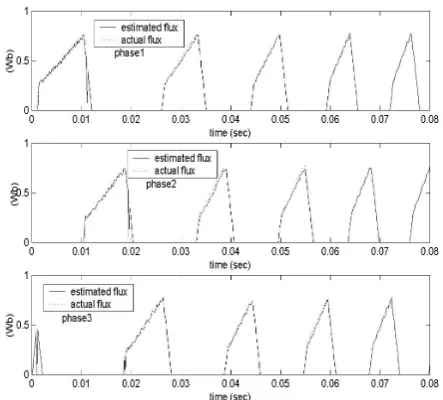
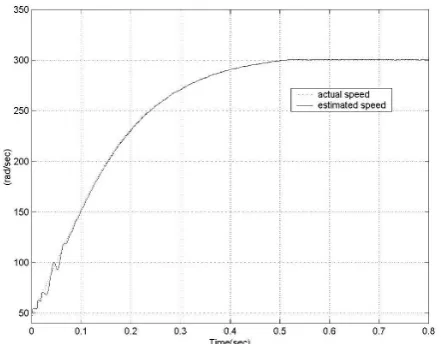
Fig. 4 shows the actual and estimated flux-linkage for each phase. Fig. 5 shows the speed and position estimation at 3000rpm with initial value for speed at 500rpm. Estimation error for speed
(
eω=ω−ωˆ)
and position(
eθ=θ−θˆ)
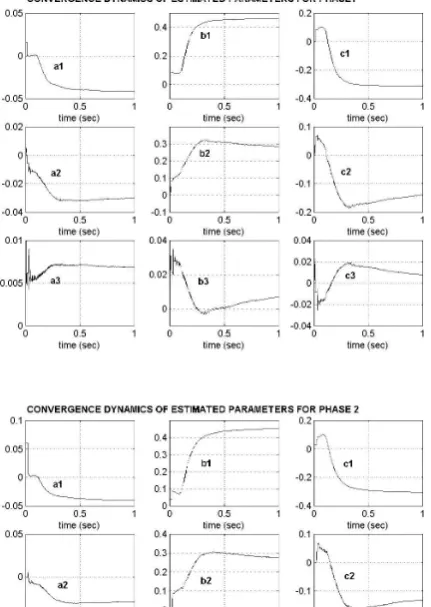
is shown at Fig. 6.Fig. 7 shows convergence dynamics of the estimated parameters for each phase.
Fig. 4. Actual and estimated flux-linkage for each phase
Fig. 5. Speed and position estimation at 3000 rpm
Fig. 6. Estimation error for speed and position
As we said before the method is suitable for velocity control applications, such as drill machines, washing machines and banknote counting machines and it is not suitable for position control applications, for which the robustness of our proposed method seems doubtful and already in fig. 6 steady state error seems to be much.
7.2 Robustness Test
This method is robust towards any disturbance and model uncertainty. Fig. 8 shows the speed tracking capability of the estimated speed in tracking the actual speed and disturbance rejection when occurs a step change in load torque from 10Nm to 15Nm at t=0.4sec in close loop system. Increasing the load torque forces the actual speed to drop, but the speed controller and binary observer can follows the change and rejects the disturbance finely. The binary observer gains were adjusted to obtain better performance. Fig. 9 shows the speed tracking of the close loop system by changing the command speed from 300rad/sec to 280rad/sec at t=0.4sec. As shown in Fig. 9 the estimated speed can follow this change.
Fig. 7. Convergence dynamics of estimated parameters for each phase.
In order to show the effect of model uncertainty we change some of the SRM modeling parameters. Fig. 10 shows effect of changing the unaligned inductance and
aligned inductance in the flux-linkage characteristics of the SRM. The new values are Lu =3mH and La=40mH. Fig. 11 shows the actual and estimated speed and position under this condition. As shown in Fig. 11 the system works finely in this condition.
Fig. 8. The estimated and actual speeds when the load torque varied from 10Nm to 15Nm at t=0.4sec in close loop system.
Fig. 9. The estimated and actual speeds under command speed variation from 300rad/sec to 280rad/sec at t=0.4sec in close loop system.
Fig. 10. Flux-current-angle
(
λ−i−θ)
characteristics of the SRM when Lu = 3 mH and La = 40 mHFig. 11. The estimated and actual speed and position when Lu= 3 mH and La = 40 mH
8 Conclusions
An online adaptive flux-linkage estimation method is represented in this paper, in order to achieve sensorless speed control of the SRM. RLS algorithm and a second order binary observer are used to estimation and sensorless operation. The method is applied on the simulation of real 3 phases, 6/4 SRM that we manufactured and modeled by Miller model. Although, there is steady state error on angle estimation, the simulation results show that it works well for velocity estimation and control.
Furthermore, the robustness of this method is tested towards any disturbance and model uncertainty by changing the load torque, command speed and aligned and unaligned inductance in the flux-linkage characteristics separately and satisfactory results are obtained and algorithm could estimate the velocity without any steady state error.
References
[1] Fahimi B., Suresh G., Ehsani M., "Review of Sensorless Control Methods in Switched reluctance motor drives", IEEE-IAC, Conf. Rec. , Vol. 3 , pp. 1850-1875, 2000..
[2] Acarnley P. P., Roland J., Clive W., "Detection of Rotor Position in Stepping and Switched Motors by Monitoring of Current Waveforms", IEEE Trans. On Industrial Electronics, Vol. IE-32, No. 3, pp. 215-222, Aug 1985..
[3] Lumsdaine A., Lang J. H., " State observers for variable-reluctance motors", IEEE Trans. Industrial Electronics, Vol. 37, No. 2, pp. 133-142, Apr.. 1990..
[4] Husain I., Sodhi S., Ehsani M., "A sliding mode observer based controller for switched reluctance motor drives", IEEE-IAS Conf. Rec. , Vol. 1, pp. 635-643, Oct.. 1994..
[5] McCann R.A., Islam M. S., Husain I.,
"Application of a sliding mode observer for
position and speed estimation in switched reluctance motor drives", IEEE Trans. On Industry Applications, Vol. 37, No. 1, pp. 51-58, Jan/Feb 2001..
[6] Yang I. W., Kim Y. S., Lee Y. G., "The rotor speed and position sensorless control of SRM using the binary observer", IEEE-IAS, Conf. Rec., Vol. 1, pp. 533-538, 1999.
[7] Yang I.W., Shin J.W., Kim Y.S., "The rotor speed and position sensorless control of switched reluctance motor using the adaptive observer", IEEE-TENCOON 99 Conf., Vol. 2, pp. 1450-1453, Dec..1999..
[8] Lyons J. P., MacMinn S.R. , Preston M.A. , "Flux-current methods for SRM rotor position estimation", IEEE-IAS Conf. Rec., Vol. 1, pp. 482-487, Oct..1991..
[9] Husain I., Ehsani M., "Rotor position sensing in switched reluctance motor drives by measuring mutually induced voltages", IEEE Trans. On Industry Applications, Vol. 30, No. 3, pp. 665-672, May/Jun..1994..
[10] Chi, H.P., Liang, T.J., Chu, C.L., Chen, J.F., Chang, M.T., "Improved mutual voltage technique of indirect rotor position sensing in switched reluctance motor", IEEE Power Electronics Spec. Conf., Vol. 1, pp. 271-275, 2002..
[11] Panda S.K., Amaratunga G., "Waveform detection techniques for indirect rotor position sensing of switched reluctance motor drives, Part I Analysis and Part II Experimental Results", IEE Proceedings, Vol. 140, No. 1, pp. 80-96, Jan..
1993..
[12] Panda S.K., Amaratunga G., "Comparison of two techniques for closed loop drive of VR step motors without direct rotor position sensing", IEEE Trans. Industrial Electronics, Vol. 38, No. 2, pp. 95-101, Apr.. 1991..
[13] Ehsani M., Husain I., Mahajan S., Ramani K.R., "New modulation techniques for rotor position sensing in switched reluctance motors" , IEEE Trans. on Industry Applications, Vol. 30, No. 1, pp. 85-91, Jan/Feb.. 1994..
[14] Mvungi N.H., Lahoud M.A., Stephenson J.M., "A new sensorless position detector for SR drives" , Power Electronics and Variable Speed Drives, pp. 249-252, Jul. 1990..
[15] Parreira B., Rafael S., Pires A.J., Branco P.J.C., "Obtaining the magnetic characteristics of an 8/6 switched reluctance machine: from FEM analysis to the experimental tests", IEEE Trans. on Industrial Electronics, Vol. 52, No. 6, pp. 1635- 1643, Dec.. 2005..
[16] Islam M.S., Husain I, "Self-tuning of sensorless switched reluctance motor drives with online parameter identification", IEEE-IAS Conf. Rec., Vol. 3, pp. 1738-1744, 2000.
[17] Husain I., Hossain S.A., "Modeling, simulation, and control of switched reluctance motor drives", IEEE Trans. on Industrial Electronics, Vol. 52, No. 6, pp. 1625- 1634, Dec.. 2005..
[18] Cheok A., Ertugrul N., "A model free fuzzy logic based rotor position sensorless switched Reluctance motor drive", IEEE-IAS Conf. Rec., Vol. 1, pp. 76-83, Oct..1996..
[19] Ertugrul N., Cheok A., "Use of fuzzy logic for modeling, estimation and prediction in switched reluctance motor drive", IEEE Trans. On Industrial Electronics, Vol. 46, No. 6, pp. 1207-1224, Dec..1999..
[20] Ertugrul N., Cheok A., "High robustness of an SR motor angle estimation algorithm using fuzzy predictive filters and heuristic knowledge-based rules", IEEE Trans. On Industrial Electronics, Vol. 46, No. 5, pp. 904-916, Oct..1999..
[21] Eyguesier C., Tseng K.J., Yan F., Cao S., "A basic algorithm of sensorless rotor position detection using fuzzy logic for the switched reluctance motor drive", IEEE ISIE'99, Vol. 2, pp. 684-688, 1999..
[22] Lin Z., Reay D.S., Williams B.W., He X., "Online modeling for switched reluctance motors using B-Spline neural networks", IEEE Trans. on Industrial Electronics, Vol. 54, No. 6, pp. 3317-3322, Dec.. 2007..
[23] Buja G.S., Valla M.I., "Control characteristics of the SRM drives. Part II: Operation in the saturated region", IEEE Trans. on Industrial electronics, Vol. 41, No. 3, pp. 316-325, Jun..1994
..
[24] Farshad M., Faiz J., Lucas C., "Development of analytical models of switched reluctance motor in two-phase excitation mode: extended miller model",IEEE Trans. on Magnetic, Vol. 41, No. 6, pp. 2145-2155, Jun.. 2005..
[25] Farshad M., Faiz J., Lucas C., Ghafoorifard H., "Examination And Modeling Of The Mutual Coupling Effects Of Phases Windings In SR 6/4 Motor Using Two-Dimensional FE Analysis". University of Tehran, Journal of Faculty of Engineering, Vol. 3, No. 38, pp. 381-393, 2004.
Saba Sedghizadeh received her B.Sc. and M.Sc. from IAU in Tehran, Iran in 1998 and 2001, both in Electrical and Control Engineering. She is currently a member of Control Department of K.N. Toosi University of Technology. Her field of interest includes Linear Control Systems and Switched Reluctance Motors Drives Control.
Caro Lucas received the M.S. degree from the University of Tehran, Tehran, Iran in 1973 and the Ph.D. degree from the University of California, Berkeley, in 1976. He is a Professor, and a member (as well as the founder-Director) of Center of Excellence for Control and Intelligent Processing, Department of Electrical and Computer Engineering, University of Tehran, as well as a Researcher at the School of Cognitive Sciences (SCS), Institute for Studies in Theoretical Physics and Mathematics (IPM), Tehran, Iran. He has served as the Director of Intelligent Systems Research Faculty, IPM (1993-1997) and Chairman of the ECE Department at the University of Tehran (1986-1988). He was also a Visiting Associate Professor at the University of Toronto, Toronto, Canada (summer, 1989-1990), University of California, Berkeley (1988-1989), an Assistant Professor at Garyounis University (1984-1985), University of California, Los Angeles (1975-1976), a Senior Researcher at the International Center for Theoretical Physics, and the International Center for Genetic Engineering and Biotechnology, both in Trieste, Italy, the Institute of Applied Mathematics, Chinese Academy of sciences, Harbin Institute of Electrical Technology, a Research Associate at the Manufacturing Research Corporation of Ontario, and a Research Assistant at the Electronic Research Laboratory, University of California, Berkeley. His research interests include biological computing, computational intelligence, uncertain systems, intelligent control, neural networks, multi agent systems, data mining, business intelligence, financial modeling, and knowledge management. He was the founder of the ISRF, IPM and has assisted in founding several new research organizations and engineering disciplines in Iran. He is the holder of the patent for Speaker Independent Farsi Isolated Word Nero recognizer. Dr. Lucas has served as Managing Editor of the Memories of the Engineering Faculty, University of Tehran (1979-1991), Reviewer of Mathematical Reviewers (since 1987), Associate Editor of the Journal of Intelligent and Fuzzy Systems (1992-1999), and Chairman of the IEEE, Iran Section (1990-1992). He has served as the Chairman of several international conferences.
Hassan Ghafoori Fard received his B.Sc. from the University of Tehran, Tehran, Iran in physic in 1965 and M.Sc. degrees from University of Japan in seismology in 1969 and Ph.D. degree from Kansas University, in nucleonic physic in 1977. He is currently an associate Professor and a member of Electrical Engineering Department of Amirkabir University of Technology (Tehran Polytechnic). He was the president of IKI University from 2006 to 2009. His research has focused mainly on Electronics, Wave and Electromagnetic and Quantum Mechanics.