Please cite this article as: R. Davarnejad, K. Zangene, A. R. Fazlali, R. Behfar, Ibuprofen Removal from a Pharmaceutical Wastewater using Electro-Fenton Process: An Efficient Technique, International Journal of Engineering (IJE), TRANSACTIONS B: Applications Vol. 30, No. 11, (November 2017) 1639-1646
International Journal of Engineering
J o u r n a l H o m e p a g e : w w w . i j e . i rIbuprofen Removal from a Pharmaceutical Wastewater using Electro-Fenton Process:
An Efficient Technique
R. Davarnejad*, K. Zangene, A. R. Fazlali, R. Behfar
Department of Chemical Engineering, Faculty of Engineering, Arak University, Arak, Iran
P A P E R I N F O
Paper history:
Received 17 March 2017
Received in revised form 16 July 2017 Accepted 08 September 2017
Keywords: COD Electro-Fenton
Pharmaceutical Wastewater Treatment
A B S T R A C T
The aim of this research is to evaluate the effective parameters such as pH, current density (mA/cm2), H2O2/Fe2+ molar ratio, volume ratio of H2O2 to pharmaceutical wastewater (PhW) (ml/l) and reaction time (min) on the electro-Fenton process for the ibuprofen (as a pharmaceutical waste in water) removal. Since a synthetic wastewater with the same concentration of ibuprofen in a real pharmaceutical wastewater (400 ppm) was chosen in this research, the sample was tested in terms of the chemical oxygen demand (COD). The parameters were statistically optimized under response surface mythology (RSM). The software was also applied to minimize the number of runs. The optimum conditions for 98.29% COD removal experimentally were at pH of 2.43, current density of 23.08 mA/cm2, H
2O2/Fe2+ molar ratio of 2.69, volume ratio of H2O2/PhW of 1.84 ml/l and reaction time of 28.08 min.
doi: 10.5829/ije.2017.30.11b.03
1. INTRODUCTION1
One of the drugs that are widely used for muscle pain and inflammatory disorders is ibuprofen. Ibuprofen (2-[4-(2-methylpropyl) phenyl] propanoic acid) structural formula is shown in Figure 1 [1].
Pharmaceutical factories have a wastewater containing large amounts of medicines. These materials can be dangerous for human and animal health [2]. So, treatment process on this type of wastewater would be necessary. There are several methods such as biological, physical, chemical and their combination for the pharmaceutical wastewater treatment. Furthermore, there are other treatment techniques such as treatment by O3 and O3/H2O2 [3], activate sludge [4], up-flow aerobic stage reactor [5], submerged membrane bioreactors [6], RO/NF membrane [7], membrane and activated carbon [8]. Advanced oxidation processes are also suggested for the organic pollutants treatment in aqueous media [9]. In this area, the most common method was the electro-Fenton process [10] due to some
*Corresponding Author’s Email: [email protected] (M. Oloomi Buygi)
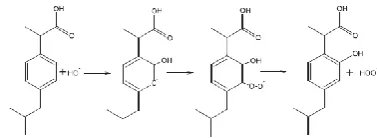
dramatic benefits such as short reaction time and large amount of pollutant removal [11, 12]. Hydroxyl radical obtained from Fe2+ ions and hydrogen peroxide reaction decomposes the organic compounds [13, 14]. The cyclohexadienyl radicals readily react with dissolved O2 (peroxy radicals formation). The peroxy radicals may eliminate HO2•. They may also undergo ring-opening reaction. Therefore, the linear dicarboxylic acid molecules can be formed. The ring-opening reaction is an important step of mineralization. In fact, the radical scavenging reaction opens a new reaction channel for degradation. Furthermore, the intermediates cannot be transformed back to the starting molecules [15]. The product of this process is shown in Figure 2 [1].
Figure 1. Ibuprofen structural formula [1]
Figure 2. Ibuprofen degradation by hydroxyl radical (during electro-Fenton process) [1]
In this paper, electro-Fenton process was applied to decompose ibuprofen as a sample of pharmaceutical waste in the water. Effect of five parameters on this process were considered together and optimized.
2. MATERIALS AND METHODS
2. 1. Wastewater Source and Characteristics
According to a report obtained from Parand Daru Co. (Saveh, Iran), ibuprofen concentration in wastewater was around 400 ppm. However, ibuprofen solubility in
water is around 21 ppm at 25 °C [15], but, according to
a mass balance reported by the company there is 400 ppm ibuprofen in the company wastewater which a part of it is in the solid phase as sediment [16]. Therefore, an aqueous solution with the same concentration was prepared (ibuprofen 400 mg tablet was purchased from Parand Daru Co. and dissolved in distilled water) and homogenized by a magnetic stirrer (400 rpm) during the
electro-Fenton process. Since coagulation,
sedimentation and mineralization assist this process [9], immiscible ibuprofen will be added to the sludge phase during the process. Moreover, for preventing any error regarding various pharmaceuticals conflicting on each other, a synthetic wastewater containing ibuprofen (as a pharmaceutical sample) was only prepared. The product was saved in a plastic vessel and stored in a cold room at 4°C. The characteristics of this wastewater are reported in Table 1.
2. 2. Experimental Set-up A glass beaker with 400 cm3 capacity (as reactor) equipped with a magnetic stirrer was used. The parallel electrodes were made of iron (with a gap of 3 cm. Each electrode had an area of 20.5 cm2 with effective surface area of 1 cm2). In each run, 250 cm3 of PhW was taken and poured in the reactor; pH of each run was set by H2SO4 (0.1 N) and NaOH
TABLE 1.Characteristics of the used wastewater
Parameter Unit Value
Chemical oxygen demand (COD) mg/l 685
Total dissolved solid (TDS) mg/l 288
pH - 4.5
(0.1 N) and controlled by a pH-meter (METTLER-TOLEDO 320). The electrods were connected to a DC power supply (fabricated by Kala Gostaran-e-Farada supplier, 30 V and 3 A). For each experiment, a spcifed amount of iron salt (FeSO4.7H2O, Merck grade) was added to the reactor. The stirrer speed was fixed at 400 rpm (without any vortex observation) and at ambient temperature (25 °C). H2O2 (purchased from Merck with purity of 30%) as a reaction accelerator was added to the reactor and power current was switched on. At the end of each run, power source was turned off and the sampel was unmoved around 15 min (for settling solid particles). Then, the sample was filtered by filter paper and placed in a UV-Vis spectrophotometer (HACH, US) with wavelength of 300 nm which carefully measured and validated [17] for ibuprofen. Moreover, initial sampel of PhW was taken and diluted in five different volumes. Absorption mounts for these concentrations were obtained (at 300 nm) for the calibration chart. After each run, the electrods were washed with distilled water to remove any gross solids
.
2. 3. Experiments Design The response surface
methodology (RSM) was used to minimize the number of experiments and optimize the operating conditions [18]. The Design-Expert software (version: 7.0.0) was used for this purpose [19]. Box-Behnken design (BBD) which is under RSM was applied in this research [20]. Forty six experiments were designed and the goal was to maximize the ibuprofen removal. The independent variables were pH (X1), current density (X2), H2O2/Fe
2+
molar ratio (X3), volume ratio of H2O2/PhW (X4) and reaction time (X5). COD removal was chosen as a dependent variable. All of the variables were coded and they were illustrated as low level number of -1, medium level number of 0 and high level number of 1 in Table 2.
This work was performed by the following equation:
Xi = (xi - x0)/∆x (1)
Removal percentage of PhW (ibuprofen or COD) was calculated by the following equation:
Removal (%) = (Ci – C0)/Ci (2)
TABLE 2. Independent variables and their levels obtained from the BBD
Symbol Factor Coded levels of variables
-1 0 1
X1 pH 2 2.5 5
X2 Current density (mA/cm2) 20 50 80
X3 Molar ratio H2O2/Fe2+ 0.5 2.75 5
X4 H2O2/PhW (ml/l) 0.3 1.4 2.5
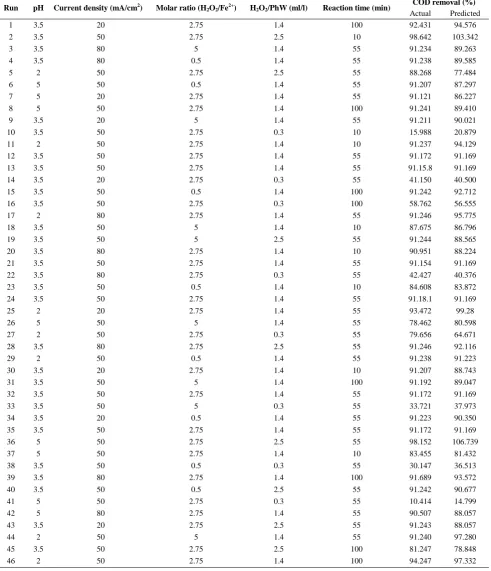
where, Ci and C0 are initial and final ibuprofen concentration, respectively. Table 3 shows the matrix design obtained from the software and responses
obtained from the experiments (Actual) and software (Predicted)
.
TABLE 3. Experimental matrix design
Run pH Current density (mA/cm2) Molar ratio (H
2O2/Fe2+) H2O2/PhW (ml/l) Reaction time (min)
COD removal (%)
Actual Predicted
1 3.5 20 2.75 1.4 100 92.431 94.576
2 3.5 50 2.75 2.5 10 98.642 103.342
3 3.5 80 5 1.4 55 91.234 89.263
4 3.5 80 0.5 1.4 55 91.238 89.585
5 2 50 2.75 2.5 55 88.268 77.484
6 5 50 0.5 1.4 55 91.207 87.297
7 5 20 2.75 1.4 55 91.121 86.227
8 5 50 2.75 1.4 100 91.241 89.410
9 3.5 20 5 1.4 55 91.211 90.021
10 3.5 50 2.75 0.3 10 15.988 20.879
11 2 50 2.75 1.4 10 91.237 94.129
12 3.5 50 2.75 1.4 55 91.172 91.169
13 3.5 50 2.75 1.4 55 91.15.8 91.169
14 3.5 20 2.75 0.3 55 41.150 40.500
15 3.5 50 0.5 1.4 100 91.242 92.712
16 3.5 50 2.75 0.3 100 58.762 56.555
17 2 80 2.75 1.4 55 91.246 95.775
18 3.5 50 5 1.4 10 87.675 86.796
19 3.5 50 5 2.5 55 91.244 88.565
20 3.5 80 2.75 1.4 10 90.951 88.224
21 3.5 50 2.75 1.4 55 91.154 91.169
22 3.5 80 2.75 0.3 55 42.427 40.376
23 3.5 50 0.5 1.4 10 84.608 83.872
24 3.5 50 2.75 1.4 55 91.18.1 91.169
25 2 20 2.75 1.4 55 93.472 99.28
26 5 50 5 1.4 55 78.462 80.598
27 2 50 2.75 0.3 55 79.656 64.671
28 3.5 80 2.75 2.5 55 91.246 92.116
29 2 50 0.5 1.4 55 91.238 91.223
30 3.5 20 2.75 1.4 10 91.207 88.743
31 3.5 50 5 1.4 100 91.192 89.047
32 3.5 50 2.75 1.4 55 91.172 91.169
33 3.5 50 5 0.3 55 33.721 37.973
34 3.5 20 0.5 1.4 55 91.223 90.350
35 3.5 50 2.75 1.4 55 91.172 91.169
36 5 50 2.75 2.5 55 98.152 106.739
37 5 50 2.75 1.4 10 83.455 81.432
38 3.5 50 0.5 0.3 55 30.147 36.513
39 3.5 80 2.75 1.4 100 91.689 93.572
40 3.5 50 0.5 2.5 55 91.242 90.677
41 5 50 2.75 0.3 55 10.414 14.799
42 5 80 2.75 1.4 55 90.507 88.057
43 3.5 20 2.75 2.5 55 91.243 88.057
44 2 50 5 1.4 55 91.240 97.280
45 3.5 50 2.75 2.5 100 81.247 78.848
3. RESULTS AND DISCUSSION
3. 1. Consideration of Regression Model and Analysis of Variance (ANOVA) The following equation was used to predict this work response [21]:
Y = β0 + ∑𝑘𝑖=1 βxi+ ∑𝑘𝑖=1βiixi 2
+ ∑𝑖=1∑𝑖≠𝑗=1βijxixij + ε (3)
where Y and β0 are COD removal percentage and constant coefficient, respectively. βi, βii and βij are the liner regression coefficients. xi and xj are the coded variables for the independent variables and ε is the random error.
The following equation was investigated for COD removal percentage (R%) by software.
R% = 91.17-5.15A -0.38B -0.16C +26.19D +2.80E +1.30AB 3.19AC + 19.78AD +1.19AE+2.025E -003BC -0.32BD – 0.12BE -0.89CD -1.67CE – 15.04DE +0.21A2 +0.92B2 – 2.28C2 – 25.46D2 – 0.81E2
(4)
where, A, B, C, D and E are pH, current density (mA/cm2), H2O2/Fe2+ molar ratio, volume ratio of H2O2/PhW (ml/l) and reaction time (min), respectively.
According to Figures 3a and 3b, the quadratic model is suitable for this work, because the actual data are very close to the straight line.
(a)
(b)
Figure 3. Normal probability vs. internally studentized residuals values (a) and predicted vs. actual values (b) for COD removal
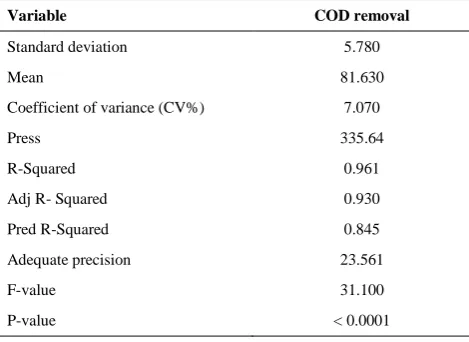
Table 4 shows ANOVA data obtained from the software. According to this table, R2, R2 adjusted (Adj) and R2 predicted (Pred) were close to one. The adequate precision (AP) was more than four and F-value was a large amount. The coefficient of variance percentage (CV%) was less than ten. All of these parameters confirmed that the quadratic model properly works in this research [21-24].
3. 2. Three Dimensional Plots for the Regression Model Figure 4a shows interaction of current density and pH on COD removal. As shown in this figure, maximum removal can occur at minimum pH and current density. Figure 4b shows interaction between pH and H2O2/Fe2+ molar ratio. According to this figure, molar ratio effect is more than that of the pH. Furthermore, Figure 4c shows a weak effect of pH against volume ratio of H2O2/PhW on the COD removal. Interaction between reaction time and pH is shown in Figure 4d, as well. As shown in this figure, COD removal increased with increasing the reaction time and pH reduction. As illustrated in Figure 4e, a middle range of pH and H2O2/Fe2+ molar ratio can improve COD removal. This output can be found from Figures 4a and 4b. In fact, the reaction rate decreased when pH was much more than that of the optimum point (that was around 2.43 in this research) [23, 25]. Hydroxyl radicals cannot be easily produced in the alkaline conditions [26]. Therefore, the removal efficiency will be decreased. Furthermore, the current density has a significant role in production of hydroxyl radicals and metal ions [27]. Ferrous irons regeneration (from ferric ions) on cathode is a contributing factor [28]. An increase in the current density above its optimum value (23.08 mA/cm2) can activate the competitive reactions and inhibit the main electro-Fenton reactions [23, 29, 30].
TABLE 4. Quadratic model ANOVA results responses
Variable COD removal
Standard deviation 5.780
Mean 81.630
Coefficient of variance (CV%) 7.070
Press 335.64
R-Squared 0.961
Adj R- Squared 0.930
Pred R-Squared 0.845
Adequate precision 23.561
F-value 31.100
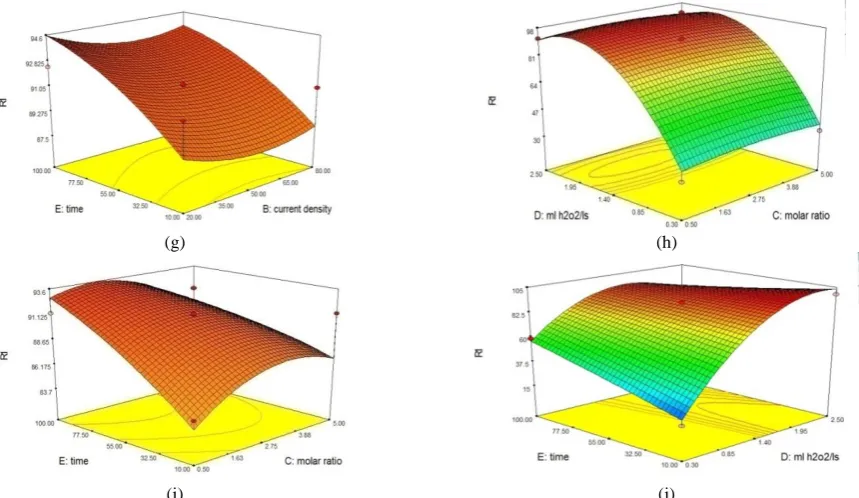
As shown in Figure 4f, COD removal increased with the volume ratio of H2O2/PhW (ml/l) increment when the current density was at mid-range. Figure 4g shows interaction of current density and reaction time on the COD removal. The response increased with increase in both parameters. Figure 4h shows interaction between H2O2/Fe2+ molar ratio and H2O2/PhW (ml/l) on COD removal. This figure indicates that a middle range of these independent variables will increase the removal. Figure 4i shows that reaction time (against H2O2/Fe2+ molar ratio) has a positive effect on the removal, while reaction time reduction [against volume ratio of H2O2/PhW (ml/l)] has a good effect on the removal where the volume ratio increases (as shown in Figure 4j).
The optimum values of H2O2/Fe2+ molar ratio and volume ratio of H2O2/PhW were at 2.69 and 1.84 ml/l, respectively. Further increase in these two parameters can active the side reactions between H2O2 and OH [31]. Moreover, reaction time normally increases COD
removal, although it decreases after the optimized reaction time (28.08 min). Its reason is due to H2O2 decomposition to O2 and H2O [14].
According to the literature, the other techniques such as ultrasonic, solar photo-catalysis, photo-Fenton could remove ibuprofen from a pharmaceutical wastewater at 98, 98 and 40%, respectively [32-34].
3. 3. Optimization and Validation The
optimization process was statistically carried out with COD removal enhancement (as a goal). The operating conditions were at current density of 23.08 mA/cm2, Fe2+/H2O2 molar ratio of 2.69, volume ratio of H2O2/PhW of 1.84 (ml/l) and reaction time of 28.08 min for 99.740% of COD removal. For validation, an experiment was carried out at the same operating conditions. According to this experiment, COD removal was around 98.290%. These data are presented in Table 5.
(a) (b)
(c) (d)
(g) (h)
(i) (j)
Figure 4. Three-dimensional surface of COD removal as a function: (a) pH andcurrent density (mA/cm2), (b) pH and H
2O2/ Fe2+
molar ratio, (c) pH and H2O2/PhW (ml/l), (d) pH and reaction time (min), (e) current density (mA/cm2) and H2O2/Fe2+ molar ratio, (f)
current density (mA/cm2) and H
2O2/PhW (ml/l), (g) current density (mA/cm2) and reaction time (min), (h) H2O2/ Fe2+ molar ratio
and H2O2/PhW (ml/l), (i) H2O2/Fe 2+
molar ratio and reaction time (min), (j) H2O2/PhW (ml/l) and reaction time (min)
TABLE 5.Optimum conditions found by design expert and experimental verification for COD removal
pH Current density (mA/cm2)
Molar ratio (H2O2/Fe2+)
H2O2/PhW (ml/l)
Reaction time (min)
Removal% observed
Removal%
predicted Error
2.43 23.08 2.69 1.84 28.08 98.290 99.740 1.450
4. CONCLUSION
In this research, a synthetic pharmaceutical wastewater in terms of ibuprofen simulated with a real pharmaceutical wastewater was treated through electro-Fenton technique. Five independent variables were simultaneously considered on this process. Box-Behnken design under RSM was applied for number of runs minimization and optimization. A good correlation for removal of a pharmaceutical waste in water based on the independent variables was developed (with R2=0.961). Ibuprofen concentration was decreased from 400 ppm (in the initial wastewater) to 6.840 ppm (in the final wastewater) through the optimum operating conditions
.
5. REFERENCES
1. Skoumal, M., Rodriguez, R.M., Cabot, P.L., Centellas, F., Garrido, J.A., Arias, C. and Brillas, E., "Electro-fenton, uva photoelectro-fenton and solar photoelectro-fenton degradation of the drug ibuprofen in acid aqueous medium using platinum and
boron-doped diamond anodes", Electrochimica Acta, Vol. 54, No. 7, (2009), 2077-2085.
2. Brown, J., Paxeus, N., Forlin, L. and Larsson, D., "Plasma levels of non-steroidal anti-inflammatory drugs (NSAIDS) and gemfibrozil in fish exposed to sewage effluents: Assessing the risk of discharges to aquatic environments", (2007).
3. Balcıoglu, I.A. and Otker, M., "Treatment of pharmaceutical wastewater containing antibiotics by O3 and O3/H2O2 processes",
Chemosphere, Vol. 50, No. 1, (2003), 85-95.
4. Joss, A., Zabczynski, S., Gobel, A., Hoffmann, B., Loffler, D., McArdell, C.S., Ternes, T.A., Thomsen, A. and Siegrist, H., "Biological degradation of pharmaceuticals in municipal wastewater treatment: Proposing a classification scheme", Water
Research, Vol. 40, No. 8, (2006), 1686-1696.
5. Chelliapan, S., Wilby, T. and Sallis, P.J., "Performance of an up-flow anaerobic stage reactor (UASR) in the treatment of pharmaceutical wastewater containing macrolide antibiotics",
Water Research, Vol. 40, No. 3, (2006), 507-516.
6. Kimura, K., Hara, H. and Watanabe, Y., "Removal of pharmaceutical compounds by submerged membrane bioreactors (MBRS)", Desalination, Vol. 178, No. 1-3, (2005), 135-140. 7. Kosutic, K., Dolar, D., Asperger, D. and Kunst, B., "Removal of
antibiotics from a model wastewater by RO/NF membranes",
Separation and Purification Technology, Vol. 53, No. 3,
8. Snyder, S.A., Adham, S., Redding, A.M., Cannon, F.S., DeCarolis, J., Oppenheimer, J., Wert, E.C. and Yoon, Y., "Role of membranes and activated carbon in the removal of endocrine disruptors and pharmaceuticals", Desalination, Vol. 202, No. 1-3, (2007), 156-181.
9. Davarnejad, R. and Sahraei, A., "Industrial wastewater treatment using an electrochemical technique: An optimized process",
Desalination and Water Treatment, Vol. 57, No. 21, (2016),
9622-9634.
10. Thirugnanasambandham, K., Sivakumar, V. and Maran, J.P., "Application of chitosan as an adsorbent to treat rice mill wastewater—mechanism, modelling and optimization",
Carbohydrate Polymers, Vol. 97, No. 2, (2013), 451-457.
11. Paramo-Vargas, J., Camargo, A.M.E., Gutierrez-Granados, S., Godinez, L.A. and Peralta-Hernandez, J.M., "Applying electro-fenton process as an alternative to a slaughterhouse effluent treatment", Journal of Electroanalytical Chemistry, Vol. 754, No., (2015), 80-86.
12. Mert, B.K., Yonar, T., Kilic, M.Y. and Kestioglu, K., "Pre-treatment studies on olive oil mill effluent using physicochemical, fenton and fenton-like oxidations processes",
Journal of Hazardous Materials, Vol. 174, No. 1, (2010),
122-128.
13. Brillas, E., Mur, E., Sauleda, R., Sanchez, L., Peral, J., Domènech, X. and Casado, J., "Aniline mineralization by aop's: Anodic oxidation, photocatalysis, electro-fenton and photoelectro-fenton processes", Applied Catalysis B:
Environmental, Vol. 16, No. 1, (1998), 31-42.
14. Zhang, H., Choi, H.J. and Huang, C.-P., "Optimization of fenton process for the treatment of landfill leachate", Journal of
Hazardous Materials, Vol. 125, No. 1, (2005), 166-174.
15. Illés, E., Takács, E., Dombi, A., Gajda-Schrantz, K., Rácz, G., Gonter, K. and Wojnárovits, L., "Hydroxyl radical induced degradation of ibuprofen", Science of the Total Environment, Vol. 447, No., (2013), 286-292.
16. Scheytt, T., Mersmann, P., Lindstädt, R. and Heberer, T., "Determination of sorption coefficients of pharmaceutically active substances carbamazepine, diclofenac, and ibuprofen, in sandy sediments", Chemosphere, Vol. 60, No. 2, (2005), 245-253.
17. Davarnejad, R. and Hosseinitabar, P., "Application of iron electrode in textile industry wastewater treatment using electro-fenton technique: Experimental and statistical study",
International Journal of Engineering-Transactions A: Basics,
Vol. 29, No. 7, (2016), 887-895.
18. Suárez-Escobar, A., Pataquiva-Mateus, A. and Lopez-Vasquez, A., "Electrocoagulation—photocatalytic process for the treatment of lithographic wastewater. Optimization using response surface methodology (RSM) and kinetic study",
Catalysis Today, Vol. 266, (2016), 120-125.
19. Davarnejad, R. and Nikseresht, M., "Dairy wastewater treatment using an electrochemical method: Experimental and statistical study", Journal of Electroanalytical Chemistry, Vol. 775, (2016), 364-373.
20. Kabuk, H.A., İlhan, F., Avsar, Y., Kurt, U., Apaydin, O. and Gonullu, M.T., "Investigation of leachate treatment with electrocoagulation and optimization by response surface methodology", CLEAN–Soil, Air, Water, Vol. 42, No. 5, (2014), 571-577.
21. El-Ghenymy, A., Garcia-Segura, S., Rodriguez, R.M., Brillas, E., El Begrani, M.S. and Abdelouahid, B.A., "Optimization of the electro-fenton and solar photoelectro-fenton treatments of sulfanilic acid solutions using a pre-pilot flow plant by response surface methodology", Journal of Hazardous Materials, Vol. 221, (2012), 288-297.
22. Kushwaha, J.P., Srivastava, V.C. and Mall, I.D., "Organics removal from dairy wastewater by electrochemical treatment and residue disposal", Separation and Purification Technology, Vol. 76, No. 2, (2010), 198-205.
23. Davarnejad, R., Mohammadi, M. and Ismail, A.F., "Petrochemical wastewater treatment by electro-fenton process using aluminum and iron electrodes: Statistical comparison",
Journal of Water Process Engineering, Vol. 3, (2014), 18-25.
24. Körbahti, B.K., Aktaş, N. and Tanyolaç, A., "Optimization of electrochemical treatment of industrial paint wastewater with response surface methodology", Journal of Hazardous
Materials, Vol. 148, No. 1, (2007), 83-90.
25. Deng, Y., "Physical and oxidative removal of organics during fenton treatment of mature municipal landfill leachate", Journal
of Hazardous Materials, Vol. 146, No. 1, (2007), 334-340.
26. Shafieiyoun, S., Ebadi, T. and Nikazar, M., "Treatment of landfill leachate by fenton process with nano sized zero valent iron particles", International Journal of Environmental
Research, Vol. 6, No. 1, (2012), 119-128.
27. Gameel, A., Malash, G., Mubarak, A. and Hussein, M., "Treatment of spent caustic from ethylene plant using electro-fenton technique", American Journal of Environmental
Engineering and Science, Vol. 2, No. 4, (2015), 37.
28. Moussavi, G. and Aqanaghad, M., "Performance evaluation of electro-fenton process for pretreatment and biodegradability improvement of a pesticide manufacturing plant effluent",
Sustain Environ Res, Vol. 25, (2015), 249-254.
29. Mohajeri, S., Aziz, H.A., Isa, M.H., Zahed, M.A. and Adlan, M.N., "Statistical optimization of process parameters for landfill leachate treatment using electro-fenton technique", Journal of
Hazardous Materials, Vol. 176, No. 1, (2010), 749-758.
30. Bensadok, K., El Hanafi, N. and Lapicque, F., "Electrochemical treatment of dairy effluent using combined al and ti/pt electrodes system", Desalination, Vol. 280, No. 1, (2011), 244-251.
31. Lee, H. and Shoda, M., "Removal of cod and color from livestock wastewater by the fenton method", Journal of
Hazardous Materials, Vol. 153, No. 3, (2008), 1314-1319.
32. Méndez-Arriaga, F., Torres-Palma, R., Pétrier, C., Esplugas, S., Gimenez, J. and Pulgarin, C., "Ultrasonic treatment of water contaminated with ibuprofen", Water Research, Vol. 42, No. 16, (2008), 4243-4248.
33. Méndez-Arriaga, F., Maldonado, M.I., Gimenez, J., Esplugas, S. and Malato, S., "Abatement of ibuprofen by solar photocatalysis process: Enhancement and scale up", Catalysis Today, Vol. 144, No. 1, (2009), 112-116.
Ibuprofen Removal from a Pharmaceutical Wastewater using
Electro-Fenton Process: An Efficient Technique
RESEARCH NOTE
R. Davarnejad, K. Zangene, A. R. Fazlali, R. Behfar
Department of Chemical Engineering, Faculty of Engineering, Arak University, Arak, Iran
P A P E R I N F O
Paper history:
Received 17 March 2017
Received in revised form 16 July 2017 Accepted 08 September 2017
Keywords: COD Electro-Fenton Pharmaceutical Wastewater Treatment ديكچ ه فده زا ماجنا ا ی ن شهوژپ سررب ی جنپ رتماراپ رد ارف ی دن نوتنفورتکلا رد فذح نفورب زا ی ک باسپ وراد یی تسا . ای ن اهرتماراپ pH ، لاگچ ی رج ی ،نا تبسن لوم ی
H2O2/Fe2+
و تبسن مجح ی
H2O2/PhW (ml/l)
و نامز شنکاو دنتسه . رد ا ی ن قحت ی ق ی ک باسپ زتنس ی تسد تخاس اب نامه تظلغ ا ی نفوربوب رد باسپ عقاو ی ppm) 400 ( باختنا دش . هنومن اه رب ساسا ن ی زا هب سکا ی نژ ش ی م یا یی ( COD ) امزآ ی ش دندش . اهرتماراپ تحت شور حطس خساپ (RSM) هب ی هن -زاس ی دندش . هدافتسا زا ا ی ن شور دادعت امزآ ی ش ه ا ار هب لقادح دناسر . ارش ی ط هب ی هن ارب ی فذح 29 / 98 ٪ COD رد امزآ ی هاگش تحت ارش ی ط pH 43 / 2 ، لاگچ ی رج ی نا mA/cm2 08 / 23 ، تبسن لوم ی
H2O2/Fe2+
69 / 2 ، تبسن مجح ی
H2O2/PhW(ml/l)
84 / 1 و نامز شنکاو 08 / 28 قد ی هق ب ه تسد دمآ .