Please cite this article as: S. A. Rizvi, S. P. Tewari, Effect of Different Welding Parameters on the Mechanical and Microstructural Properties of Stainless Steel 304H Welded Joints, International Journal of Engineering (IJE), TRANSACTIONS A: Basics Vol. 30, No. 10, (October 2017) 1592-1598
International Journal of Engineering
J o u r n a l H o m e p a g e : w w w . i j e . i rEffect of Different Welding Parameters on the Mechanical and Microstructural
Properties of Stainless Steel 304H Welded Joints
S. A. Rizvi*, S. P. Tewari
Mechanical Engineering Department, Indian Institute of Technology (BHU), Varanasi, India
P A P E R I N F O
Paper history:
Received 18 April 2017
Received in revised form 07 July 2017 Accepted 07 July 2017
Keywords: Gas Metal Arc Welding Shielding Gas Mechanical Properties Morphology Stainless Steel Ferrite
A B S T R A C T
In this research work, an attempt has been made to examine the different welding parameters which affect the weldability of 304H Austenitic stainless steel (ASS) welded joint using the proper filler wire. Chemical composition of filler wire was same as that of base metal. Further this study addressed the combined effect of various welding parameters on the metallurgical and mechanical properties of the weldments. Welding was carried out at different parameters such as welding wire speed, shielding gas flow rate, welding current and arc voltage etc. Tensile tests and V-notch Charpy tests were conducted as per ASTM to determine the mechanical properties of the welded specimens. In order to determine the microstructured changes that occurred, the interface regions of the welded specimens were examined by microscope. As a result, it is reported that changing the shielding gas flow rate and wire feed speed affects the microstructure and mechanical properties of weldment. Impact tests reveal that toughness of the welded joint increases with increasing in welding current, while ultimate tensile strength (UTS) first increases and then decreases.
doi: 10.5829/ije.2017.30.10a.21
1. INTRODUCTION1
Nowadays welding is widely used in all types of industries and usually it is defined as a branch of engineering and technology that is used to join the same/different materials [1] under different conditions. In this research work, Gas Metal Arc Welding (GMAW) is used to bond the Stainless Steel 304H. GMA welding is a joining process in which a continuous copper coated wire is used. MIG welding is chosen due to its numerous advantages over conventional welding [2]. Stainless Steel 304H material is extensively used in chemical, petrochemical, biomedicine and nuclear reactors industries due to its high tensile strength, good corrosion resistance and excellent ductility [3, 4]. Shielding gas flow rate is one of the welding parameter which also affects the properties of welded joint, more over it also determines the shape and penetration pattern in welding process [5, 6]. During welding process shielding is very helpful to
*Corresponding Author’s Email: [email protected] (S. A. Rizvi)
produce good strength, toughness and corrosion resistance welded joint [7].
In welding process shielding gas protects molten metal pool from any atmospheric contamination and also stabilizes the arc and promotes uniform metal transfer [8].
SS304 and they observed an improvement in the mechanical properties. Weld morphology also improves using different types of activated flux in comparison to the ordinary TIG welding. Doniavi et al. [11] applied RSM and ANOVA for prediction and optimization of mechanical properties of St52 in GMAW. They observed that the temperature difference between the weld HAZ areas results in lower tensile stress. Zarouni and Eslami-Farsani [12] determined the effect of heat input on the intermetallic compound layer and mechanical properties in arc welding-brazing dissimilar joining of aluminum alloy to galvanized steel. They observed that increasing the weld heat input enhanced the thickness of IMCs layer formed at the interface of steel/weld seam. Sathiya et al. [13] investigated the effect of shielding gases on the weld bead and mechanical properties of AISI 904L bonded by CO2 laser-GMAW hybrid welding. They concluded that joining laser-GMAW hybrid had higher impact and tensile strength. Palani and Murugan [14] studied the effect of wire feed speed and pulsed current during the welding of 317L by flux cored wire. Authors concluded that wire feed speed is affected by the changes in welding current. Kumar et al. [15] studied the microstructure and mechanical properties of 304
austenitic steel welded by GTA and SMAW. Impact testing revealed that welds made using SMA exhibited significantly higher toughness as compared to TIG welding as the filler does not contain boron.
2. EXPERIMENTAL PROCESS
In this research work austenitic Stainless Steel 304H was selected as work piece with dimensions of 150× 50×5 mm. Chemical composition of base metal and filler wire are shown in Table 1. GMA bead-on Stainless Steel 304H plate weld for microstructure examination and butt welding for tensile test were carried out by a semiautomatic welding machine (Lincoln USA make) with a filler wire of ER308 grade.
To determine the weldability of Stainless Steel 304H, welding was carried out at various welding parameters and these parameters are listed in Table 2.
In welding, HAZ is defined as heat affected zone and it is a zone of base material, either a metal or a thermoplastic, which is not melted and has its microstructure and properties changed by welding. Formation of austenite transformation in Stainless Steel 304H in HAZ is shown in Figure 1.
TABLE 1. Chemical composition of parent metal and filler wire
Material C (%) Cr(%) Ni(%) Si(%) Mn (%) p(%) S (%) Fe
Stainless Steel 304H 0.08 18.20 8.5 0.45 1.55 0.012 0.03 rest
Filler wire ER 308 0.05 18.5 10 0.4 1.7 0.05 0.032 rest
TABLE 2. Welding process parameters
Factors I Unit Level I Level II Level III
Welding current A 150 150 150
Arc voltage V 20 21 22
Shielding gas flow rate l/min 10 15 20
Wire feed speed IPM 250 300 350
(a)
(b)
Figure 1. Austenite transformation in HAZ in steel of
composition No. 1 (a) and composition No. 2 (b) [5]
In this research work pure Argon was used as shielding gas. Shielding gas range was from 10 to 20 l/min. Welding was carried out by 2 mm diameter wire. For microstructure examination, welded parts were cut transversely from joint.
For mechanical test purpose different tests, for example, ultimate tensile strength (UTS), toughness, microhardness were completed. Microhardness was assessed on hardness analyzer under a heap of 10 kg for 10 s. Tensile test specimen are shown in Figure 2 which were prepared as per ASTM. Microstracture of welded specimens were dissected at (Devender make), magnifying instrument. micrcamsoftware. Micrstructure tests arranged for microstructure as appeared in Figure 3
.
Figure 2 shows the failure of tensile test specimens at weld bead portion.After cold setting test pieces were ground on a double disk polishing machine with various evaluations of emery paper I,e from 80 to 1500 micron for 10 min each, at the speed scope of 250-350 rpm. In the last test, pieces were cleaned by Alumina suspension glue. After that etched specimens were carved in Glyceria arrangement and swab up to 2 min through experimentation technique. Etching was performed at room temperature. Test pieces were then ready for microstructure examinations.
Figure 2. Samples for ultimate tensile strength as per ASTM
[17]
Figure 3. Samples for microstructure examination
3. RESULTS
3.1. Microstructure The experimental results after MIG welding were estimated in terms of the following measured performances: (1) ultimate tensile strength (UTS), (2) microhardness and (3) impact energy (IE) of charpy impact test results of welded specimen before fracture. In order to attain supreme weldability, nine experiments were conducted.
Figure 4(a)-(i) show the microstructure behavior of Stainless Steel 304H welded joint sample with Ar as a shielding gas. These samples were welded at given values of welding parameters such as voltage and flow rate of shielding gas and wire feed speed. In microstructure of welded sample, cooling rate and heat input play an important role to affect the microstructure [8]. Figure 4 shows microstructure of weld pool at different heat input.
From Figure 4 it is very clear that solidification microstructure of welded pool differ from cellular to dendritic microstructure from fusion line and format of delta- ferrite is different in austenite region.
Figure 4. Morphology of delta ferrite in samples (a)
It is only due to the different welding conditions as mentioned above and it is also very clear from the results that grain size of welded joint increases with increasing current. The results of this work are consistent with the report of Gulenc et al. [16].
The formation of delta-ferrite promotes the formation of chromium depleted zone which harms the austenitic behavior.
3. 2. Mechanical Properties For mechanical examination tensile test, impact charpy test and microhardness test was carried out for different samples. To determine the UTS of welded samples, specimens were tested on universal testing machine and after test, failure occurred at weld bead portion.
3. 3. Microhardness of Welded Joint
Microhardness of weldment was measured from
transverse direction. Figure 5 shows the hardness profile of welded joint. It also indicates that at the top of the weld bead hardness value is higher. It is only possible due to faster cooling rate at the top of weld bead portion [17]. From Figure 5 it is observed that for low heat input microhardness of weldment increases from 199 VHN, 186 for medium and 160 VHN for high heat input. Results of microhardness of this research are in agreement with the others [18].
3. 4. Toughness of Weldment Toughness is of
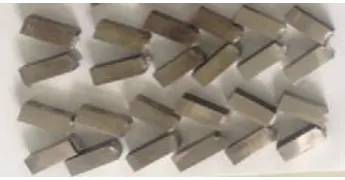
great importance for high strength steels when they are used at low temperature conditions. Impact test of weldment was carried out at room temperature. Impact V notch specimens is shown in Figure 6. Test piece are fabricated as per ASTM [19] standard. V notch was cut at center of test pieces as shown in Figure 6.
TABLE 3. Values of UTS, microhardness and impact strength
S.No Voltage (V) Wire feed speed (RPM) Gas flow rate (l/h) Current (Amp) UTS (MPa) Microhardness Impact strength (J)
1 20 250 10 150 470 182 178
2 20 300 15 150 510 161 160
3 20 350 20 150 505 181 240
4 21 250 10 150 437 190 246
5 21 300 15 150 528 165 198
6 21 350 20 150 497 175 266
7 22 250 10 150 480 190 250
8 22 300 15 150 453 199 262
9 22 350 20 150 525 177 240
Figure 5. Microhardness at different zone of welded joint at
various heat input
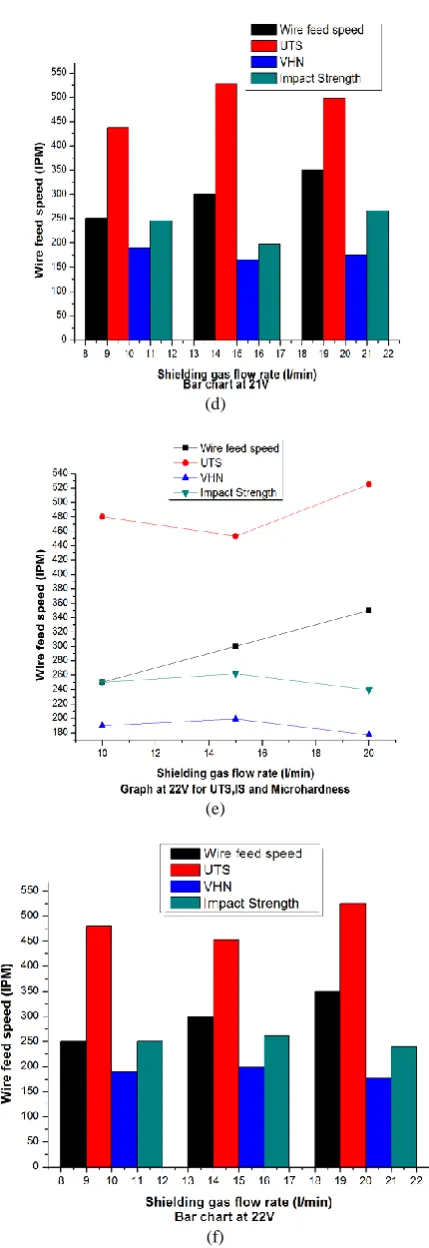
Effect of wire feed speed and shielding gas flow rate on ultimate tensile strength, toughness and microhardness of weldment is presented in line format as well as bar format at different volts in Figure 8 (a)-(f).
Figure 6. Position of notch in toughness sample as per ASTM
It is observed in this figure that format of line diagram and bar chart is not symmetrical. The figure also shows a comparison of mechanical properties of weldments at different voltages. From Figure 8 (a)-(f) it is very clear that toughness of welded metal first decreases and then increases. Figure 9 shows toughness test piece after fracture. It is very clear that V notch test piece were failure at V notch center line.
(a)
(b)
(c)
(d)
(e)
(f)
Figure 8. (a-f) Effect of wire feed speed and gas flow rate on
Figure 8. Toughness test pieces are fractured
4. CONCLUSSION
In this research article Stainless Steel 304H with 6 mm thickness V-groove welded with MIG welding process; the following conclusion are derived from the experiments:
1. Highest tensile strength was obtained at 21V 2. Impact strength of welded samples were also
found highest at 21V
3. Microstructure of welded samples showed not any cracking, tearing or any related defects
4. Grain size of Stainless Steel 304H welded joints were different at different gas flow rates and wire feed speeds.
5. Grain size of welded joint increased with increasing the heat input.
6. In Figure 4(a)-(i), some grains are fine and some are coarse. It is only due to effect of various welding parameters.
7. Full penetration was achieved in welded joint without any defects
8. UTS, hardness and toughness of welded joints are functions of microstructure hence all these properties are structural penetrating.
9. There is sudden decrement in microhardness values from low heat input to higher heat input. 10. It is observed from microhardness measurements
that hardness near the upper surface of the weldment is highest and lowest near the center of the weld, only due to the cooling of the outside rather than inside of the weldment portion.
5. REFERENCES
1. Handbook, W., "Welding processes", American Welding Society, Vol. 2, (1991), 8-14.
2. Kalpakjian, S. and Schmid, S.R., "Manufacturing engineering and technology”, Pearson Upper Saddle River, NJ, USA, (2014).
3. Jiménez–Come, M., Turias, I. and Trujillo, F., "An automatic pitting corrosion detection approach for 316l stainless steel",
Materials & Design, Vol. 56, (2014), 642-648.
4. Lo, K.H., Shek, C.H. and Lai, J., "Recent developments in stainless steels", Materials Science and Engineering: R: Reports, Vol. 65, No. 4, (2009), 39-104.
5. Handbook, W., "Aws", Welding Processes, Vol. 2, (1991). 6. Shanping, L., Hidetoshi, F. and Kiyoshi, N., "Effects of CO2
shielding gas additions and welding speed on gta weld shape",
Journal of Materials Science, Vol. 40, No. 9-10, (2005), 2481-2485.
7. Liao, M. and Chen, W., "The effect of shielding-gas compositions on the microstructure and mechanical properties of stainless steel weldments", Materials Chemistry and Physics, Vol. 55, No. 2, (1998), 145-151.
8. Kou, S., "Welding metallurgy, John Wiley & Sons, (2003). 9. Hebda, M. and Sady, R., "Software for the estimation of steel
weldability", Advances in Engineering Software, Vol. 58, (2013), 13-17.
10. Choudhary, S. and Duhan, R., "Effect of activated flux on properties of ss 304 using tig welding", International Journal of Engineering-Transactions B: Applications, Vol. 28, No. 2, (2014), 290-298.
11. Doniavi, A., Hosseini, A. and Ranjbary, G., "Prediction and optimization of mechanical properties of st52 in gas metal arc weld using response surface methodology and anova",
International Journal of Engineering- Transactions C: Aspects, Vol. 29, No. 9, (2016), 1307-1313.
12. Zarooni, M. and Eslami-farsani, R., "Effect of welding heat input on the intermetallic compound layer and mechanical properties in arc welding-brazing dissimilar joining of aluminum alloy to galvanized steel", International Journal of Engineering-Transactions B: Applications, Vol. 29, No. 5, (2016), 669-678.
13. Sathiya, P., Mishra, M.K. and Shanmugarajan, B., "Effect of shielding gases on microstructure and mechanical properties of super austenitic stainless steel by hybrid welding", Materials & Design, Vol. 33, (2012), 203-212.
14. Palani, P. and Murugan, N., "Modeling and simulation of wire feed rate for steady current and pulsed current gas metal arc welding using 317l flux cored wire", The International Journal of Advanced Manufacturing Technology, Vol. 34, No. 11, (2007), 1111-1119.
15. Kumar, S. and Shahi, A., "Effect of heat input on the microstructure and mechanical properties of gas tungsten arc welded aisi 304 stainless steel joints", Materials & Design, Vol. 32, No. 6, (2011), 3617-3623.
16. Gülenç, B., Develi, K., Kahraman, N. and Durgutlu, A., "Experimental study of the effect of hydrogen in argon as a shielding gas in mig welding of austenitic stainless steel",
International Journal of Hydrogen Energy, Vol. 30, No. 13, (2005), 1475-1481.
17. RajaKumar, G., Ram, G. and Rao, S., "Microstructure and mechanical properties of borated stainless steel (304b) gta and sma welds", La Metallurgia Italiana, No. 5, (2015).
18. Kurt, H.I. and Samur, R., "Study on microstructure, tensile test and hardness 304 stainless steel jointed by tig welding",
International Journal of Science and Technology, Vol. 2, No. 2, (2013), 163-168.
Effect of Different Welding Parameters on the Mechanical and Microstructural
Properties of Stainless Steel 304H Welded Joints
S. A. Rizvi, S. P. Tewari
Mechanical Engineering Department ,Indian Institute of Technology (BHU), Varanasi, India
P A P E R I N F O
Paper history:
Received 18 April 2017
Received in revised form 07 July 2017 Accepted 07 July 2017
Keywords: Gas Metal Arc Welding Shielding Gas Mechanical Properties Morphology Stainless Steel Ferrite ديكچ ه
( يتينتسآ گنزدض دلاوف يراكشوج رب هك يفلتخم شوج ياهرتماراپ هك تسا هدش شلات قيقحت نيا رد
ASS
) 304
H
نكرپ ميس زا هدافتسا اب هدش هداد شوج دنراذگ ريثات
گ رارق يسررب دروم ، ري ن د كرت . بي ش ييايمي س مي زلف دننامه هدننكرپ
اپ هي ا رب هولاع .دوب ،ني
نيا كرت هب هعلاطم بي
اهرتماراپ رثا ي ژرولاتم صاوخ رب شوج فلتخم يكي
ناكم و يكي طاقن شوج
هراشا هدش هداد دراد
راكشوج . ي اهرتماراپ اب ي س تعرس دننام فلتخم مي
رج تعرس ،شوج ناي
ج ،ظفاحم زاگ ناير
شوج
غ و سوق ژاتلو و هري
اهنومزآ .تسا هدش ماجنا ي ششك ي امزآ و تاشي V-notch Charpy اسا رب س ASTM ارب ي عت نيي ناكم صاوخ يكي اه هنومن ي قطانم ،داد خر هك يراتخاس زير تارييغت نييعت روظنم هب .تسا هدش ماجنا شوج طوطخ
طبار
تن رد .دنتفرگ رارق يسررب دروم پوكسوركيم زا هدافتسا اب هدش هداد شوج ياه هنومن ،هجي
غت هك تسا هدش شرازگ ريي
رج ناي تعرس و ظفاحم زاگ س لاقتنا
مي رب ر راتخاسزي ناكم صاوخ و يكي
شوج تسا راذگريثات اه نومزآ .
ي ناشن هبرض
م ي گمرقچ هك دهد ي
طاقن ازفا اب هدش هداد شوج شي نايرج ازفا شوج شي م ي ،دباي لاح رد ي هك UTS ازفا ادتبا شي و
م شهاك سپس ي
دباي .

![Figure 2. Samples for ultimate tensile strength as per ASTM [17]](https://thumb-us.123doks.com/thumbv2/123dok_us/205522.2014857/3.595.90.250.601.731/figure-samples-ultimate-tensile-strength-as-per-astm.webp)
![Figure 6. Position of notch in toughness sample as per ASTM [19]](https://thumb-us.123doks.com/thumbv2/123dok_us/205522.2014857/4.595.356.495.622.710/figure-position-notch-toughness-sample-astm.webp)