International Journal of Engineering
J o u r n a l H o m e p a g e : w w w . i j e . i rSimulation and Genetic Algorithms for Optimizing Comminution Circuit at
Gol-e-Gohar Iron Plant
A. A. Yousefi* a, A. A. Rahmania, A. Farzaneganb, S. Rostamic
a Department of Mining Engineering, Imam Khomeini International University, Qazvin, Iran b School of Mining, College of Engineering, University of Tehran, Tehran, Iran
c Gol-e-Gohar Iron Mineral Processing Plant, Hematite Plant, Sirjan, Iran
P A P E R I N F O
Paper history: Received 11 June 2012
Received in revised form 29 December 2012 Accepted 24 January 2013
Keywords: Simulation Optimization Genetic Algorithm Comminution Circuits Hydrocyclone Underflow
A B S T R A C T
Simulation optimization is a scientific tool that is widely used for design and optimization of comminution circuits in mineral processing plants. In this research, first of all, in order to determine the suitable d80 for cicuit hydrocyclone underflow, the parameters required for simulator (residence time
distribution, breakage function, selection function and Plitt’s model calibration) were determined. Then, simulation of comminution circuit by presentation of BMCS® software under MATLAB
environment was performed. Finally, the GA toolbox of MATLAB software was used for optimization of the comminution circuit by determining the simulator as fitness function. The results showed that by determining the optimum value of input parameters (solid content, fresh feed and water rate to the input streams), the genetic algorithm is able to achieve a suitable d80 for circuit cuf (cyclon underflow).
doi:10.5829/idosi.ije.2013.26.06c.11
1. INTRODUCTION 1
Comminution circuits have the highest level of energy consumption in mineral processing plants. Therefore, improving design and operation of comminution devices in order to optimize performance and energy consumption, are always important parts of manufacturers and process engineer’s research [1]. Optimization leads to better yield of valuable products (or reduced yields of contaminants), reduced energy and reagent consumption, higher production rates and fewer shutdowns. Simulation of grinding circuits at steady state which is done based on validated mathematical models is a scientific tool for optimization of circuits.
Recent advances in computer hardware and software allowed researchers to develop new research strategies to be used in function optimization problems. Therefore, it is now possible to better integrate optimization algorithms into simulation packages. Gradient search is one of the mostly used algorithms in numerical optimization tools [2].
*Corresponding Author Email: [email protected] (A. A. Yousefi)
Some outstanding algorithms have surfaced in recent times. Some of these methods include the genetic algorithm [3], simulated annealing [4], particle swarm optimization [5], ant colony optimization [6], evolutionary algorithms [7], Response Surface Methodology (RSM) and stochastic optimization. Genetic algorithm is one of the optimization methods that has been used by several researchers in order to optimize the operation of crushing plants [8], maximize the overall revenue of coal preparation plants [9], and to optimize ball mill systems [10]. Combining simulation and optimization algorithm provides a more powerful tool for mineral processors for finding the best circuit design and operation parameters.
The purpose of this research is to optimize the performance of Gol-e-Gohar grinding circuit so that d80 of hydrocyclone underflow can be increased to 250 microns from the current value of 180 microns. Because, return the fine particle (-90 micron) to ball mill from hydrocyclone underflow cause to high power. Consumption of mill and increased the finer particle (-20 microns) which cause some problems in the next process i.e., flotation stage. To solve this problem, we
used simulation optimization method. Firstly, computer simulation of grinding circuit is done via BMCS (BMCS-based Modular Comminution Simulator) under MATLAB simulator and then, the GA toolbox of MATLAB was used for optimization of comminution circuit. The organization of this paper is as follows: BMCS simulator is explaned in section 2; simulation of comminution circuit in section 3, and simulation optimization in section 4. Genetic algorithm and optimization of circuit based on genetic algorithm are explained in sections 5 and 6, respectively, and finally, the conclusions are summarized in section7.
2. BMCS SOFTWARE
The BMCS simulator is a modular and sequential program written in ANSI C language and is run under MS DOSTM environment [11]. Presently, it includes
mathematical models to simulate the ball mill, hydrocyclones, air separators, efficiency curves, junctions, splits and convergence block. This software takes the advantage of population balance method and Weller’s RTD modeling for simulation of ball mills [12], and Plitt’s model for simulation of hydrocyclones [13]. MATLAB software provides a toolbox for genetic algorithm and direct search methods. For this reason, the BMCS under MATLAB as Fitness Function of genetic algorithm was used. This version of BMCS consists of only a single executive file (a *.mex file) and
can be easily run from the command line and also from any MATLAB file. When the BMCS program is executed, the iteration number and the name of the module which is being executed are displayed in MATLAB command window. The simulator output is automatically saved in a text file called bmcs.out located in the current directory [2].
3. SIMULATION OF COMMINUTION CIRCUIT
Simulation of a comminution circuit requires great effort for estimating the parameters of models in order that the simulation results can be reliable. The parameters which are obtained are particle size distribution, breakage function, selection function, residence time distribution and the calibration of Plitt’s model. The first step of every simulation is sampling. Model parameters are obtained from results of sampling.
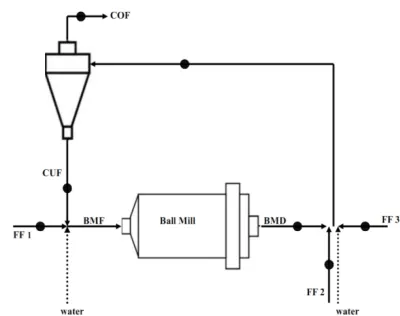
3. 1. Sampling For simulation of a grinding circuit, it is necessary to collect representative samples from all of the main streams. The grinding circuit of Gol-e-Gohar Hematite Plant and sampling points are shown in Figure 1. The period of sampling was 7 days in the first stage for calibration of simulator and 2 days in the
second stage for simulation validation. After obtaining particle size distribution (PSD) and flow rate of each sampling point, data adjustment should be done by using software such as NORBAL [14]. This improves the quality of data set and leads to a more accurate simulation. If a stream is unreachable and cannot be sampled, its flow rate can be estimated by NORBAL.
Figure 1. Closed-circuit ball milling flowsheet and sampling points
TABLE 1. Breakage function of 3 particle sizes by MH& F bij
Particle Size (µm) 1400 355 250
1400 0 0 0
1000 0.412 0 0
710 0.2 0 0
500 0.125 0 0
355 0.084 0 0
250 0.057 0.548 0
180 0.038 0.191 0.517
125 0.026 0.1 0.242
90 0.017 0.06 0.114
63 0.012 0.037 0.054
45 0.008 0.023 0.026
in a particular size fraction is an acceptable sample. The sample is ground for a short period of time, t. Then, grinding should continue to include times 2t, 4t, 8t … until 40% to 60% of primary mass remains on the first sieve. After each grinding time period, PSD of material should be examined and then the value of breakage function can be calculated by BFDS software. This software can be used to calculate the breakage function with three methods: Berube, Herbst & Fuerstenau (H&F) and modified Herbst & Fuerstenau (MH&F) [15]. The breakage function of Hematite Gol-e-Gohar plant for 3 particle size (250, 355 and 1400 microns) by M H&F method is shown in Table 1.
3. 3. Selection Function Selection function is the rate of breakage in a first order reaction. Its estimation is done by sampling from feed and discharge streams and Weller’s model parameter. Particle size distribution, as a result of these samplings is used to determine the selection function via GrindSim1.1 software. Selection
function of this project is shown in Figure 2.
3. 4. Residence Time Distribution Weller’s RTD
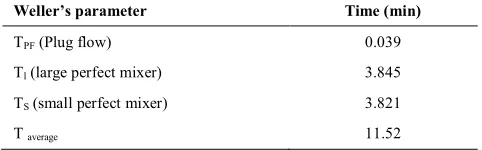
model consists of one plug flow reactor, one large perfect mixer vessel and two small perfect mixer vessels. Parameters of this model can be estimated by implementation of a tracer test on an operating mill [16]. In order to measure the particles residence times in ball mill, it was attempted to add 80 kg of NaOH to the feed of the mills. The amount of NaOH was then determined in the mill input and output by measuring pH within different sequential times. In fact, NaOH was the tracer in the mill to specify the residence times in the ball mill. In the next step, the residence time distribution was obtained using simulation software (simulation of residence time distribution in open and closed circuits, version 1.1). Average residence time value of particles in the ball mill was estimated to be 11.52 minutes. The results are presented in Figure 3 and Table 2.
3. 5. Calibration of Plitt’s Model BMCS software uses the Plitt’s model for hydrocyclone simulation [13]. The calibration of this model should be done by comparison of operation and Plitt’s calculation values. Samples were collected from feed, overflow and underflow streams every 15 minutes during 2 hours in 5 stages. Calibration coefficients of this hydrocyclone are shown in Table 3.
3. 6. Circuit Simulation with BMCS Software After determination of breakage function, selection function values, retention time parameters and hydrocyclone calibration, performance of the circuit can be simulated by BMCS software at a specific rate and size distribution of feed. The results of simulation and actual
data are shown in Figure 4.
Figure 2. Selection function with M H&F methods
Figure 3. The residence time distribution of particles in ball mill (closed circuit)
TABLE 2. Weller’s Parameter calculated with RTD software
Weller’s parameter Time (min)
TPF (Plug flow) 0.039
Tl (large perfect mixer) 3.845
TS (small perfect mixer) 3.821
T average 11.52
TABLE 3. Calibration coefficients of Plitt’s model
Parameter d50c P m S R f
Figure 4. Simulation and actual results of hydrocyclone underflow & overflow
Figure 5. Combined grinding simulation and optimization model [4]
4. SIMULATION OPTIMIZATION
Simulation optimization refers to the process of finding optimal design of a system whose performance is estimated by simulation [17]. Structure of a simulation optimization computer program includes at least two main building blocks, i.e., a simulation module and an optimization module. While the simulation module is specific to the problem at hand, such as a comminution simulator, the optimization module is a general direct pattern search routine or a genetic-based search algorithm. Both simulation and optimization modules must be integrated to provide a unified process optimization environment for finding the best values of input variables. The important step in simulation optimization is problem setting. At this step, decision variables, objective function and constrains must be defined [2].
5. GENETIC ALGORITHMS (GA)
Genetic algorithm was presented by J. Holland who was inspired by biological evolutionism in 1975. GA is
based on an analogy with the evolution theory, i.e. the inevitable course of nature. Alike in nature, an original population of individuals is manually created and represents a primitive generation of parents [18]. At each step, the GA selects individuals at random from the current population to be parents and uses them to produce the children for the next generation. In GA optimization, the factors involved are: the size of the initial population, the crossover factor, the mutation factor, and a fitness function. A fitness function is used to evaluate individuals, since reproductive success varies with fitness. The advantage of the GA approach lies in the ease with which it can handle arbitrary kinds of constraints and objectives and allow the decision maker to select the best alternative [10]. GA has several advantages over the traditional techniques. These are briefly described here:
v Because of its probabilistic nature, GA does not require initial guesses of the decision variables and needs only their lower and upper bounds. v GA works only with the values of the objective
functions not their gradients.
v GA can solve single-objective, multi-objective as well as multi-modal optimization problems.
v GA can handle a number of decision variables and constraints efficiently [19].
v For nonlinear optimization problems, heuristic methods such as genetic algorithms can be used [2].
5. 1. Fitness Function To use GA toolbox of
MATLAB, a fitness function with a specific structure is needed which must be written as a separate file by the user in MATLAB language. This file includes the function that should be minimized. And its handle is entered into Genetic Algorithm toolbox problem setup and results dialog window. There are many options that can be set before running GA algorithm such as constraints, population parameters and stopping criteria. The purpose of this project is to optimize the performance of grinding circuit so that d80 of underflow
can be increased to 250 microns from the current value of 180 microns. The fine particles in ball mill with cyclone underflow impose high energy consumption. Figure 5 shows the combination of GA toolbox and BMCS simulator under MATLAB environment.
6. OPTIMIZATION OF COMMINUTION CIRCUIT BY GA
In this case, the simulation optimization problem was defined as finding the best values for the fresh feed rate and solid content of the 3 input streams, water addition rate to the ball mill sump and water addition rate to the hydrocyclone sump. To increase the d80 of underflow
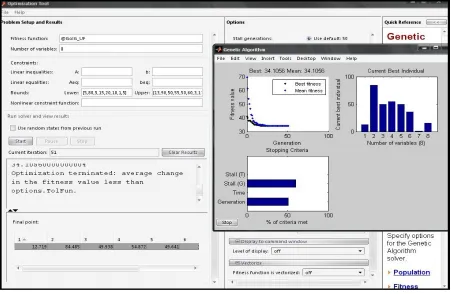
combination of BMCS software under MATLAB environment and GA as shown in Figure 6. The initial values of all parameters and their lower and uppers bounds used in GA toolbox are given in Table 4. Then, many search parameters and options in GA box (e.g. number of variables, constraints, mutation, Crossover, stopping criteria, fitness scaling etc.) which was proven in previous work [2] were set. The values for these parameters are shown in Table 5.
TABLE 5. Search parameters settings used in GA toolbox
Parameters Setting
Number of variables 8
Population type and size Double vector, 20
Scaling function Rank
Reproduction elite count 2
Crossover function and fraction Scattered, 0.8 Migration direction, fraction and interval Forward, 0.2, 20
Function tolerance 0.001
Generations 500
TABLE 4. Input variables initial, lower and upper bounds algorithm used in GA toolbox and optimum value by GA
Variables Initial value Lower value Upper value Optimum value
FF1 rate (t/h) 6.89 5 13 12.7
FF2 rate (t/h) 17.23 15 55 54.87
FF3 rate (t/h) 1.62 1 3 1
Solid percent of FF1 (%) 86.25 80 90 84.48
Solid percent of FF2 (%) 39 20 50 49.64
Solid percent of FF3 (%) 16.2 5 17 15.68
Water addition rate to ball mill (t/h) 22 5 50 49.93
Water addition rate to cyclone sump (t/h) 20 10 60 36.17
7. CONCLUSIONS
The optimization of comminution circuit leads to lower energy consumption, higher quality of production and increase of the throughput in grinding circuit. Simulation softwares are the scientific tools for such optimization. For optimization of Gol-e-Gohar grinding circuit, in order to increase the d80 of hydrocyclone
underflow from 180 to 250 microns, the first stage was simulation of the circuit with the BMCS simulator. The required parameters for simulation are particle size distribution, breakage function, selection function, residence time distribution and calibration of Plitt’s model. The first step of simulation was sampling. To estimate the breakage function values by laboratory-scale mill, single-sized samples (250, 355 and 1400 microns) that were a mass of material in one size fraction, were selected. As the results in Table 1 shows the breakage function is normal. The next parameter which requires simulation was RTD. To estimate this parameter NaOH as a tracer in ball mill was used. The results are shown in Table 2 and Figure 3. As can be seen from Figure 3, the best residence time achieved was about 11.52 minutes. Also, RTD software, input and output RSD of ball mill and Weller’s parameters were employed to calculate the selection function. The calibration of the Plitt’s model was done by comparison of operation and Plitt’s calculation values. Hence, samples were collected from feed, overflow and underflow streams. Comparison of simulation and real data in Figure 4 show that the estimation of simulator is very good. After simulation of the circuit, it was used to optimize the grinding circuit with GA tool window of MATLAB, which is shown in Figure 6. The initial values of all parameters, their lower and uppers bounds used in GA toolbox and the optimum value by GA are given in Table 4. Under the optimum condition, the d80
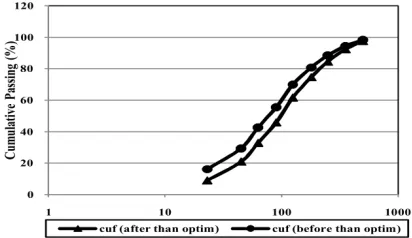
of cyclone underflow increases from 180 to 220 microns which is shown in Figure 7. The results from this research showed that in order to achieve a suitable d80
for underflow, the genetic algorithm is able to optimize grinding circuit performance.
Figure 7. CUF size distribution before and after optimization
8. ACKNOWLEDGMENT
The authors would like to thank Gol-e-Gohar Iron Ore Mineral Processing Plant for their kind assistance for providing access to their Hematite Processing plant and especially Mr. Gorbannejad, for his scientific cooperation and helps.
9. REFERENCES
1. Hasanzadeh, V. and Farzanegan, A., "Robust hpgr model calibration using genetic algorithms", Minerals Engineering, Vol. 24, No. 5, (2011), 424-432.
2. Farzanegan, A. and Vahidipour, S., "Optimization of comminution circuit simulations based on genetic algorithms search method", Minerals Engineering, Vol. 22, No. 7, (2009), 719-726.
3. John, H., "Holland, adaptation in natural and artificial systems", MIT Press, Cambridge, MA. (1992)
4. Kirkpatrick, S., Jr., D. G. and Vecchi, M. P., "Optimization by simulated annealing", Science, Vol. 220, No. 4598, (1983), 671-680.
5. Parsopoulos, K. E. and Vrahatis, M. N., "Recent approaches to global optimization problems through particle swarm optimization", Natural Computing, Vol. 1, No. 2-3, (2002), 235-306.
6. Dorigo, M. and Gambardella, L. M., "Ant colony system: A cooperative learning approach to the traveling salesman problem", IEEE Transactions on Evolutionary Computation,, Vol. 1, No. 1, (1997), 53-66.
7. Schwefel, H., "Evolution and optimum seeking", Wiley, New York. (1995)
8. Svedensten, P. and Evertsson, C. M., "Crushing plant optimisation by means of a genetic evolutionary algorithm",
Minerals Engineering, Vol. 18, No. 5, (2005), 473-479.
9. Gupta, V., Mohanty, M., Mahajan, A. and Biswal, S., "Genetic algorithms—a novel technique to optimize coal preparation plants", International Journal of Mineral Processing, Vol. 84, No. 1, (2007), 133-143.
10. Wang, H., Jia, M.-p., Huang, P. and Chen, Z.-l., "A study on a new algorithm to optimize ball mill system based on modeling and ga", Energy Conversion and Management, Vol. 51, No. 4, (2010), 846-850.
11. Farzanegan, A., Adviser-Laplante, A. and Adviser-Lowther, D., "Knowledge-based optimization of mineral grinding circuits", McGill University, (1998).
12. Luckie, P. and Austin, L., "A review introduction to the solution of the grinding equations by digital computation", Miner. Sci. Eng, Vol. 4, No. 2, (1972), 24-51.
13. Plitt, L., "A mathematical model of the hydrocyclone classifier",
CIM bulletin, Vol. 69, No. 776, (1976), 114-123.
14. Spring, R., "Norbal 3: Software for material balance reconciliation", Center de Recherché Noranda, Point-Claire,
Quebec, (1992).
15. Herbst, J. and Fuerstenau, D., "The zero order production of fine sizes in comminution and its implications in simulation",
Transactions AIME, Vol. 241, No. 4, (1968), 538-49.
16. Weller, K., "Hold-up and residence time characteristics of full-scale grinding circuits", Automation in Mining, Mineral and
17. Kabirian, A. and Olafsson, S., "Allocation of simulation runs for simulation optimization", in Simulation Conference, Winter, IEEE, (2007), 363-371.
18. Kahrom, M., "Optimization of heat transfer enhancement of a flat plate based on pareto genetic algorithm", International
Journal of Engineering, Vol. 23, (2011).
19. Ghobadi, P., Yahyaei, M. and Banisi, S., "Optimization of the performance of flotation circuits using a genetic algorithm oriented by process-based rules", International Journal of
Simulation and Genetic Algorithms for Optimizing Comminution
Circuit at Gol-e-Gohar Iron Plant
RESEARCH NOTE
A. A. Yousefi a, A. A. Rahmania, A. Farzaneganb, S. Rostamic
a Department of Mining Engineering, Imam Khomeini International University, Qazvin, Iran b School of Mining, College of Engineering, University of Tehran, Tehran, Iran
c Gol-e-Gohar Iron Mineral Processing Plant, Hematite Plant, Sirjan, Iran
P A P E R I N F O
Paper history: Received 11 June 2012
Received in revised form 29 December 2012 Accepted 24 January 2013
Keywords: Simulation Optimization Genetic Algorithm Comminution Circuits Hydrocyclone Underflow
هﺪﯿﮑﭼ
ﻪﻨﯿﻬﺑ ﻪﯾﺎﭘﺮﺑيزﺎﺳ ي
ﻪﯿﺒﺷ هدﺮﺘﺴﮔرﻮﻃﻪﺑﻪﮐﺖﺳايﺪﯿﻔﻣﯽﻤﻠﻋراﺰﺑايزﺎﺳ ﻪﻨﯿﻬﺑوﯽﺣاﺮﻃرد
راﺪﻣيزﺎﺳ يﺎﻫ ﺶﯾادﺮﺧ
ﻪﻧﺎﺧرﺎﮐ ﯽﻣ راﺮﻗ هدﺎﻔﺘﺳا درﻮﻣ يروآﺮﻓ يﺎﻫ دﺮﯿﮔ
.
ﺖﺳد رﻮﻈﻨﻣ ﻪﺑ ،ﺶﻫوﮋﭘ ﻦﯾا رد ﻪﺑ ﯽﺑﺎﯾ
d80
بﻮﻠﻄﻣ ﻪﺗ رد ﺰﯾر
،راﺪﻣنﻮﻠﮑﯿﺳورﺪﯿﻫ ﻪﯿﺒﺷزﺎﯿﻧدرﻮﻣيﺎﻫﺮﺘﻣارﺎﭘاﺪﺘﺑا
ﺳ يزﺎ
)
ﻊﺑﺎﺗ،ﺖﺴﮑﺷﻊﺑﺎﺗ،ﺪﻧﺎﻣنﺎﻣز لﺪﻣنﻮﯿﺳاﺮﺒﯿﻟﺎﮐوبﺎﺨﺘﻧا
ﺖﯿﻠﭘ
(
ﻪﯿﺒﺷﺲﭙﺳوﻪﺒﺳﺎﺤﻣ راﺰﻓامﺮﻧزاهدﺎﻔﺘﺳاﺎﺑﺶﯾادﺮﺧراﺪﻣيزﺎﺳ
BMCS
ﺖﻣﺖﺤﺗ
ﺪﺷاﺮﺟاﺐﻟ
.
راﺰﺑاﻪﺒﻌﺟزاﺖﯾﺎﻬﻧرد
ﺖﻣﻂﯿﺤﻣردﮏﯿﺘﻧژﻢﺘﯾرﻮﮕﻟا ﻪﻨﯿﻬﺑرﻮﻈﻨﻣﻪﺑﺐﻟ
ﻪﯿﺒﺷﯽﻓﺮﻌﻣﺎﺑﺶﯾادﺮﺧراﺪﻣيزﺎﺳ ناﻮﻨﻋﻪﺑزﺎﺳ
ﻊﺑﺎﺗ هدﺎﻔﺘﺳا،فﺪﻫ ﺪﯾدﺮﮔ
.
ﻢﺘﯾرﻮﮕﻟاﻪﮐﺪﻧدادنﺎﺸﻧﻖﯿﻘﺤﺗﻦﯾازاﻞﺻﺎﺣﺞﯾﺎﺘﻧ ﻦﺘﻓﺎﯾﻪﺑردﺎﻗﯽﺑﻮﺧﻪﺑﮏﯿﺘﻧژ
d80
ﻪﺗﺐﺳﺎﻨﻣ ﻦﯿﯿﻌﺗﺎﺑنﻮﻠﮑﯿﺳورﺪﯿﻫﺰﯾر
ﻪﻨﯿﻬﺑﺮﯾدﺎﻘﻣ ي راﺪﻣيدورويﺎﻫﺮﯿﻐﺘﻣ
)
ﺪﺻرد نﺎﯾﺮﺟيدوروبآوﺪﻣﺎﺟژﺎﻨﺗوﺪﻣﺎﺟ ﺎﻫ
(
ﯽﻣ ﺪﺷﺎﺑ
.
![Figure 5. Combined grinding simulation and optimization model [4]](https://thumb-us.123doks.com/thumbv2/123dok_us/236263.2018283/4.595.85.255.304.417/figure-combined-grinding-simulation-and-optimization-model.webp)