Impact of Prompting Agents on
Task Completion in the Virtual World
https://doi.org/10.3991/ijoe.v13i06.6850
Tao Xie
Xi’an Jiaotong University, Xi An, Shaan Xi, China [email protected]
Laiming Luo
Chongqing University of Posts and Telecommunications, Chongqing, China [email protected]
Abstract—Based on a realized 3D virtual laboratory and virtual agents, this study was to investigate whether the virtual agents influence task completion. A total of 90 students participated in the experiment. They were evenly divided in-to three groups one for the control group with no intervention and the other two for experiment groups with different interventional levels. The results show students who used the virtual agents worked faster and more efficient than those who did not. The satisfaction of the experiment groups was superior to that of the control group. The correlation analysis showed a weak negative correlation between time in total and satisfaction (r = -.365), a strong positive correlation between speed and satisfaction (r = .626), and a strong negative correlation be-tween time per task and satisfaction (r = -.685). However, correlation degree wasn't in concord with the interventional levels. This study suggests that virtual agents have promising effects on task completion and perceived satisfaction.
Keywords—3D Virtual World, Prompting Agent, Task Completion, Satisfac-tion
1
Introduction
In the last decades, an increasing number of works used 3D virtual world(3DVW) to conduct simulated scientific experiment[1-3] with an intention that students not only get access to laboratory resources conveniently[4] but also they obtain real-like hands-on experience[5]. The 3DVW provides strong immersion and fidelity, and has a promising outlook for learning[6]. The current research projects have reported that such environments can effectively improve learning motivation, engagement, learning achievement and so on [1, 7].
achieve-ments. To address this problem, researchers adopted prompting agents [9, 10] to pro-vide one-on-one tutoring. They have rich expression, vivid action and life-like image which could promote meaningful learning in lessons[11]. Much literature has noted that the virtual agents are capable of enhancing interaction and emotion and improv-ing learnimprov-ing interest and self-efficacy[12-14].
This study investigates how virtual agents influence the task completion of the novice users. This refers to measurements of individual's skill to accomplish tasks and subjectively perceived satisfaction under the virtual agents' intervention. The skill means the effort degree of task completion while satisfaction implies the active evalu-ation that influences the future usage. By exploring these two aspects, we expected to gain more insights on the effect of virtual agents and their pedagogical implications, thereby enlighten the design of more complex experiment activity henceforth. To do this, we develop virtual prompting agents to adapt to different challenges of tasks and measure students' responses. Our research questions are:
1. To what extent do students afford to effectively complete tasks in the 3DVW? 2. In what growth of perceived satisfaction do students exhibit in the 3DVW?
3. What is the relationship between task completion and perceived satisfaction? This is to identify if the higher intervention result in better task completion and more satisfaction.
2
Agents in 3DVW
3DVW uses computers to simulate the real situation and interaction. Not only do users construct information actively but also they become actors who play particular roles. Many research projects reported that the 3DVW enhances learning primarily due to the following characteristics.
1. Immerse-real experiences. Objects and their mode exercises are close to or even accord with the real situations. The students experience in real-like conditions that they feel immersed in the visual world as if being in the physical one [15].
2. Flexible-interactive approaches. Students control tempo with immediate feedbacks, and their computer-animated gestures and expressions approximate to the so-called "face-to-face" communication [16, 17].
3. Hands-on learning experiences. Students create visual objects, actively engage in activities, and gradually achieve the goals [18]. It is particularly used when it's im-possible to conduct a real experiment or the conditions are happening frequently[19].
envi-ronment [5] where a user can select, use, assemble virtual devices and modify their parameters through flexible manipulations.
The virtual prompting agent is also called animated pedagogical agent (APA) in some literature [10-13, 21, 22]. The APA was described as a human-like or cartoon animated character which is displayed within a computer-based learning environment to provide learners with pedagogical assistance. The virtual agents can enhance teach-ing interaction, elicit learnteach-ing interest and improve the learnteach-ing achievement [6, 7]. From the constructivist point of view, teaching and learning are a learning context that provides students with various cognitive tools and learning materials, upon which they build individual meaning through interacting with the surroundings. In the mean-ing construction, virtual agents play a positive role which directs attention to relevant information, provides feedbacks or delivers methodological instruction [23]. It keeps students focusing on essential information and provides context-specific learning strategies [24].
3
Methodology
3.1 Research context
We prepared a 3DVW to conduct scientific experiments orienting to novice users. Three aspects are included.
Architectures and interactions. The realization was based on an open-source 3DVW called Open Simulator. The architectures included a hall, a meeting center, a showroom of experiment apparatuses, a reference room, a testing section, an electrical hall of fame, and an operating room. Each of them had scripted interactions such that one get immediate responses as he/she triggered the object of interest.
A course subject. "The current in series and parallel circuits" in the part of Elec-trical Science of high school was incorporated. The experimental apparatuses includ-ing virtual powers, voltage meters, current meters, light bulbs and slidinclud-ing rheostats were displayed in the showroom. All the items can be selected and recombined de-pending on specific tasks.
demonstrated the visual effects. The troubleshooting agent monitored a user's pro-posed question, abstracted the possible keywords, and matched them with a pre-installed repository. If matched, the virtual agents give answers to the user. The char-acter guidance was to coach students to change the charchar-acter's appearance, such as height and weight, facial features and dress. The information guidance provided assis-tance associated with the experiment such as seeking experiment apparatuses and specific materials. The navigation guidance solved the problem of users not finding the way to a destination or not knowing whether or not they were on the right destina-tion. This agent popped up a menu and prompted key information about how to travel the destination according to the user's selection. The creating agent supplied methodo-logical help of hands-on operation, such as connecting experiment apparatuses and taking notes to record the experiment process and results. To complete these tasksit is important to establish a conversation between users and agents so that users can follow the instructions of the agents step by step
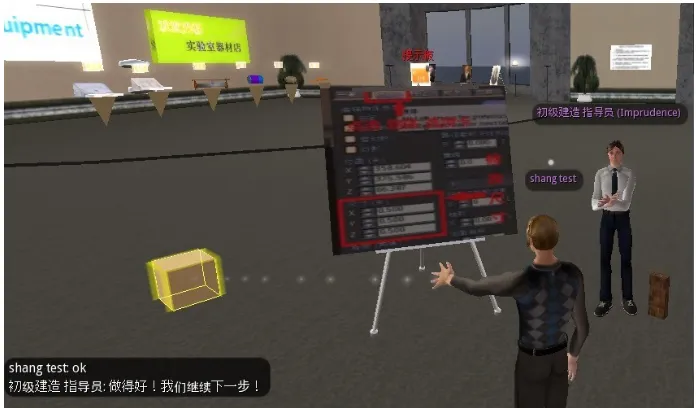
Fig. 1. A sample screenshot of one-on-one tutoring.
is determined by the user 's behavior rather than the text he has inputted. When stu-dents respond to the agents by doing something, the agent decides whether it is right or wrong according pre-established logics, and then feeds back to the user.
Students communicate with the virtual tutor when they feel it necessary. They are told to select the proper instruments in the showroom, bring them to the laboratory, and connect them in the right way. The task is completed if the light bulb is lightened; otherwise, they should repeat the process following the instructions prompted by the virtual tutor. The students will be able to 1) know the names of instruments in order to select the instruments that are on-target and task-relevant; 2) tell the functions and roles in order to further understand the concepts of electronics; 3) analyze the princi-ples that make the circuits work; 4) find the correct methods to connect the instru-ments; and 5) use a note card to record the readings. In addition, this study concerns the skill level and attitude level of students. As to the skill level, we compute the cumulative number of tasks, cumulative time of task completion, the time consumed by per task and the completion speed. As to the attitude level, we develop a scale to assess the students' satisfaction.
3.2 Procedure
We conducted a quasi-experimental design. This study was performed with the ap-proval of the local ethical committee. A total of ninety high school students voluntari-ly participated in this experiment (mean = 16.4, SD = 2.58). They were evenvoluntari-ly as-signed to three classes, one for the control group, one for the experiment group A (EG-A), and the other for the experiment group B (EG-B). Each group had 30 stu-dents. The independent variable of this study was the treatment of virtual agents. The control group did not use virtual agents. All the members in the group experienced independently. Students of EG-A and EG-B were both provided with virtual agents. EG-A was provided with low intervention, while EG-B was provided with high inter-vention. In the low intervention, virtual agents prompted information about what a student was doing, whether he/she was at the right position, and how to direct success. In the high intervention, the virtual agents prompted how to precisely achieve the goals with detailed suggestions. The dependent variables were the number of tasks completed, the time consumed when tasks were completed, and users' perceived satis-faction after using virtual agents.
students within a group were closely balanced between male and female, the ratio of Engineering to non-Engineering was approximate to 2:1, and students who had prior experience are 7 in control group, 6 in EG-A, and 7 in EG-B.
The tasks in both control group and experiment groups were the same. The stu-dents in the control group were asked to experience independently without any help, neither by artificial cue nor by virtual agents. The experiment groups were required to complete the tasks only with the help of virtual agents. The virtual agents were used to provide students with information assistance, either by adapting the virtual tools or by giving explicit guidance and technical support. The process was time-limited and they had to try their best to complete the tasks. To conduct one-one tutoring, we ex-clude the influence of one character/avatar on other ones. Therefore, six server copies were created in a virtual machine that installed Open Simulator. Then, six participants could get access to the 3D virtual laboratory individually. The data was gathered us-ing logs, so scriptlets are developed and hidden in the scenes. After each of the tasks was completed, they recorded the completion time and the serial number of tasks and then prompted a message to guide students to fill out an inventory to measure the perceptions. Finally, we computed the cumulative number of tasks and cumulative time of task completion via retrieving and processing logs. Besides, we considered the time consumed by per task and the completion speed. The time per task was presented as the cumulative time divided by cumulative number and the completion speed is the reciprocal of the time per task.
3.3 Instruments
We designed six tasks, and each contained several subtasks shown in Table 1. To address the research question one, the quantitative indexes of the inventory were the number of operated components and time consumed in total.
We then developed a scale to assess the students' satisfaction. The scale contained 10 items with a five-point Likert rating scheme with "1" being not at all true and "5" being very true, which examined students' subjective perceptions of the process, such as "I often felt disoriented", "I often felt lonely", "I can effectively manage my ava-tar", "I can easily find science lab and apparatuses" and so on. The estimated Cronbach’s alpha value of the questionnaire was 0.724, showing good reliability in internal consistency.
Table 1. Tasks and sub-tasks
ID Tasks Sub-tasks
3.4 Analysis
As to the question one and question two, we first answer whether virtual agents have effects on task completion followed by the extent to which the effects are. Therefore, we ran independent sample t-test on the control group and EG-A to ob-serve whether the effect is significant in terms of the time in total, time per task, com-pletion speed, and satisfaction with the use and non-use of virtual agents. Then we ran descriptive statistics and analysis of deviation on the control group, EG-A, and EG-B followed by a post hoc test to observe the statistical difference among groups. As to the question three, we ran Pearson correlation analysis between the satisfaction, time in total, completion speed, time per task. We also plotted mean charts to present the target relations. We assume the less time the participants invested represented the lower operational challenge. The higher satisfaction scores the participants got repre-sented the better experiences. The analysis software was SPSS V.18. We used an alpha level .05 to establish significance unless otherwise noted.
4
Results
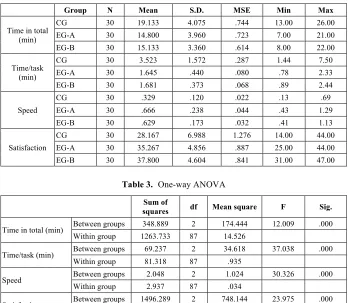
4.1 To what extent do students afford to effectively complete tasks? Normal distribution tests on total time, time per task, and speed between the con-trol group and EG-A were conducted using P-P plot and showed they were approxi-mate normal distribution. Therefore, the independent sample t-test was carried out. There was no significant difference in variance between the two populations (F = .485, p = .489 > .05). The mean of time populations between the control group and EG-A had significant difference (t = 4.177, p = .00 < .05). The population variance of time per task had significant difference (F = 12.651, p = .001 < .05). The mean of time per task populations between the control group and experiment group A had significant difference (t = 6.304, p = .00 < .05). The population variance of speed had significant difference (F = 7.966, p = .007 < .05). The mean of speed populations between the control group and experiment group A had significant difference (t = -6.913, p = .00 < .05). These results showed that using virtual agents had significant impacts on the students' task completion.
Table 2. Descriptive statistics
Group N Mean S.D. MSE Min Max
Time in total (min)
CG 30 19.133 4.075 .744 13.00 26.00 EG-A 30 14.800 3.960 .723 7.00 21.00 EG-B 30 15.133 3.360 .614 8.00 22.00
Time/task (min)
CG 30 3.523 1.572 .287 1.44 7.50 EG-A 30 1.645 .440 .080 .78 2.33 EG-B 30 1.681 .373 .068 .89 2.44
Speed
CG 30 .329 .120 .022 .13 .69
EG-A 30 .666 .238 .044 .43 1.29
EG-B 30 .629 .173 .032 .41 1.13
Satisfaction
CG 30 28.167 6.988 1.276 14.00 44.00 EG-A 30 35.267 4.856 .887 25.00 44.00 EG-B 30 37.800 4.604 .841 31.00 47.00
Table 3. One-way ANOVA Sum of
squares df Mean square F Sig.
Time in total (min) Between groups 348.889 2 174.444 12.009 .000 Within group 1263.733 87 14.526
Time/task (min) Between groups 69.237 2 34.618 37.038 .000 Within group 81.318 87 .935
Speed Between groups 2.048 2 1.024 30.326 .000 Within group 2.937 87 .034
Satisfaction Between groups 1496.289 2 748.144 23.975 .000 Within group 2714.833 87 31.205
4.3 What is the relationship between task completion and perceived satisfaction?
The correlation analysis was presented in Table 4. As can be learned that the Pear-son correlation coefficient of time investment and satisfaction was -.365, indicating weak negative correlation. The two populations were non-zero correlation (p = .000 < .01). This implied that the less time investment would result in higher satisfaction. On the other hand, the satisfaction was a strong positive correlation with completing speed (r = .626). If they completed the tasks faster, they ran into fewer roadblocks in progress. In other words, they might receive more useful information from the virtual agents. It also supplied that satisfaction was strongly negatively correlated with time per task (r = -.685), implying that the less time per task consumed would result in much higher satisfaction.
Table 4. Correlations analysis
Time in total Speed Time per task
Satisfaction
Pearson Correlation -.365** .626** -.685**
Sig.(2-tailed) .000 .000 .000
N 90 90 90
Correlation is significant at the 0.01 level (2-tailed).
Fig. 2. Mean of satisfaction across groups.
Fig.4. Mean of time per task across groups.
5
Discussion and implications
The agents provided immediate assistance through life-like characters and played a role of learning companions. This process enhanced emotional experience and self-pleasure. For example, members with virtual agents in both experiment groups scored much higher than those in the control group in terms of satisfaction. The control group got 28.17 points on average, compared to 35.27 of the experiment group A. Three students scored between 0 and 20 in the control group but no one did in the experiment group A. Fifteen students scored between 20 and 30 in the control group compared to 6 students in the experiment group A.
mean time was 2.8 minutes, faster by 0.8 minutes. And, in the more difficult task of "navigate", only 7 students in the control group succeeded, compared to all the stu-dents did in the experiment group A, who spent less time than the control group by 1.2 minutes. Five students in the control group completed the advanced task of "cre-ate". However, all the members in the experiment groups did it. These data indicated that the virtual agents improved the efficiency of task completion.
In conclusion, this paper considers two learning outcomes when users explore the virtual world with the virtual agents. The results show the virtual agents improve individual’s skill and promote task completion by prompting related information. Also, the virtual agents improve users’ satisfaction by providing immediate assistance when users are trapped. The limitation of the paper is that we don’t present correla-tions between interventional level of the agent and the perceived satisfaction although we present correlations between satisfaction and tasks such as time in total and time per task. To address this, we need to develop a new scale. It is very interesting and we will include it in the new version of the paper.
6
References
[1] D.J. Ketelhut, et al., “A multi-user virtual environment for building and assessing higher order inquiry skills in science,” British Journal of Educational Technology, vol. 41, no. 1, 2010, pp. 56-68. https://doi.org/10.1111/j.1467-8535.2009.01036.x
[2] P. Ari-Gur, et al., “Transforming Undergraduate Engineering Education with 3D Virtual Reality Laboratory,” 2013 Asee Annual Conference, ASEE Annual Conference & Exposi-tion, Amer Soc Engineering EducaExposi-tion, 2013.
[3] V. Dmitriyev and Y. Daineko, “Implementing Physics Virtual Laboratory in 3D: An Ex-ample of Atwood Machine,” 2015 Twelve International Conference on Electronics Com-puter and Computation (Icecco), 2015, pp. 116-120. https://doi.org/10.1109/ICECCO. 2015.7416891
[4] A. Maiti, et al., “Joining the game and the experiment in peer-to-peer remote laboratories for STEM education,” Proc. Experiment@ International Conference (exp. at'15), 2015 3rd, IEEE, 2015, pp. 213-218. https://doi.org/10.1109/expat.2015.7463268
[5] E.Ince, et al., “3 Dimensional and Interactive Istanbul University Virtual Laboratory Based on Active Learning Methods,” Turkish Online Journal of Educational Technology, vol. 13, no. 1, 2014, pp. 1-20.
[6] D.J. Ketelhut, “The Impact of Student Self-efficacy on Scientific Inquiry Skills: An Ex-ploratory Investigation in River City, a Multi-user Virtual Environment,” Journal of Sci-ence Education and Technology, vol. 16, no. 1, 2007, pp. 99-111. https://doi.org/10.1007/ s10956-006-9038-y
[7] B.C. Nelson and D.J. Ketelhut, “Exploring embedded guidance and self-efficacy in educa-tional multi-user virtual environments,” Internaeduca-tional Journal of Computer-Supported Col-laborative Learning, vol. 3, no. 4, 2008, pp. 413-427. https://doi.org/10.1007/s11412-008-9049-1
[9] J. Gratch and S. Marsella, “Lessons from Emotion Psychology for the Design of Lifelike Characters,” Applied Artificial Intelligence, vol. 19, no. 3-4, 2005, pp. 215-233. https://doi.org/10.1080/08839510590910156
[10] Y. Kim and A.L. Baylor, “Pedagogical Agents as Learning Companions: The Role of Agent Competency and Type of Interaction,” Educational Technology Research and De-velopment, vol. 54, no. 3, 2006, pp. 223-243. https://doi.org/10.1007/s11423-006-8805-z [11] R. Moreno, et al., “The Case for Social Agency in Computer-Based Teaching: Do Students
Learn More Deeply When They Interact With Animated Pedagogical Agents?,” Cognition and Instruction, vol. 19, no. 2, 2001, pp. 177-213. https://doi.org/10.1207/S153269 0XCI1902_02
[12] H.C. Lane, et al., “The Effects of a Pedagogical Agent for Informal Science Education on Learner Behaviors and Self-efficacy,” Artificial Intelligence in Education: 16th Interna-tional Conference, AIED 2013, Memphis, TN, USA, July 9-13, 2013. Proceedings, H. C. Lane, et al., eds., Springer Berlin Heidelberg, 2013, pp. 309-318. https://doi.org/10.1007/ 978-3-642-39112-5_32
[13] A. Mitrovic and P. Suraweera, “Evaluating an Animated Pedagogical Agent,” Intelligent Tutoring Systems: 5th International Conference, ITS 2000 Montréal, Canada, June 19–23, 2000 Proceedings, G. Gauthier, et al., eds., Springer Berlin Heidelberg, 2000, pp. 73-82. https://doi.org/10.1007/3-540-45108-0_11
[14] H.C. Lane, et al., “Intelligent Tutoring Goes to the Museum in the Big City: A Pedagogical Agent for Informal Science Education,” Artificial Intelligence in Education, Lecture Notes in Artificial Intelligence 6738, G. Biswas, et al., eds., 2011, pp. 155-162. https://doi.org/10.1007/978-3-642-21869-9_22
[15] M.D. Dickey, “Game design and learning: a conjectural analysis of how massively multi-ple online role-playing games (MMORPGs) foster intrinsic motivation,” Educational Technology Research and Development, vol. 55, no. 3, 2007, pp. 253-273. https://doi.org/10.1007/s11423-006-9004-7
[16] G. Sharma, et al., “Communication in virtual world: Second life and business opportuni-ties,” Information Systems Frontiers, vol. 15, no. 4, 2013, pp. 677-694. https://doi.org/10.1007/s10796-012-9347-z
[17] H. Al Hayek, et al., “Science Communication in 3D Virtual Worlds: The Science Circle Alliance in Second Life,” 2015 5th International Conference on Information & Communi-cation Technology and Accessibility (Icta), 2015.
[18] I. Duncan, et al., “A taxonomy of virtual worlds usage in education,” British Journal Of Educational Technology, vol. 43, no. 6, 2012, pp. 949-964. https://doi.org/10.1111/j.1467-8535.2011.01263.x
[19] Y. Daineko, et al., “3D Physics Virtual Laboratory as a Teaching Platform,” Augmented and Virtual Reality: Second International Conference, AVR 2015, Lecce, Italy, August 31 - September 3, 2015, Proceedings, T. L. De Paolis and A. Mongelli, eds., Springer Interna-tional Publishing, 2015, pp. 458-466. https://doi.org/10.1007/978-3-319-22888-4_34 [20] R. Soloperto, et al., “A 3D virtual immersive laboratory for distributed telemeasurement,”
Proc. IEEE Symposium on Virtual Environments, Human-Computer Interfaces and Meas-urement Systems, 2005., 2005, pp. 5 pp. https://doi.org/10.1109/vecims.2005.1567556 [21] G. Ozogul, et al., “Investigating the impact of pedagogical agent gender matching and
learner choice on learning outcomes and perceptions,” Computers & Education, vol. 67, 2013, pp. 36-50. https://doi.org/10.1016/j.compedu.2013.02.006
[23] S. Heidig and G. Clarebout, “Do pedagogical agents make a difference to student motiva-tion and learning?,” Educamotiva-tional Research Review, vol. 6, no. 1, 2011, pp. 27-54. https://doi.org/10.1016/j.edurev.2010.07.004
[24] R.E. Clark and S. Choi, “Five Design Principles for Experiments on the Effects of Ani-mated Pedagogical Agents,” Journal of Educational Computing Research, vol. 32, no. 3, 2005, pp. 209-225. https://doi.org/10.2190/7LRM-3BR2-44GW-9QQY
7
Authors
Xie Tao is with the Department of Computer Science and Technology, Xi’an Jiao-tong University, Xi An, Shaan Xi, 710049, P.R. China. He received the BS degree in 2007 and MS degree in 2010 in educational technology from Southwest University, China. He is a PhD candidate in computer science in Xi’an Jiaotong University, Chi-na. His research areas include mobile learning, game-based teaching, data mining, and technology-enhanced learning.
Luo Laiming(Corresponding author) is with the Department of School of Eco-nomics and Management, Chongqing University of Posts and Telecommunications, Chongqing, 710049, P.R. China. He received the BS degree in physical in 1990 from Sichuan Normal University BS degree in Engineering Management in 1990 from Sichuan Normal University and PhD degree in Economics in 2009 from Sichuan University China. His research areas include macroeconomic, regional economy, network economy, and educational technology.