Permanent draft genome sequence of Dethiosulfovibrio
peptidovorans type strain (SEBR 4207
T)
Kurt LaButti1, Shanmugam Mayilraj2,7, Alicia Clum1, Susan Lucas1, Tijana Glavina Del Rio1, Matt Nolan1, Hope Tice1, Jan-Fang Cheng1, Sam Pitluck1, Konstantinos Liolios1, Natalia Ivanova1, Konstantinos Mavromatis1, Natalia Mikhailova1, Amrita Pati1, Lynne Goodwin1,3, Amy Chen4, Krishna Palaniappan4, Miriam Land1,5, Loren Hauser1,5, Yun-Juan Chang1,5, Cynthia D. Jeffries1,5, Manfred Rohde6, Stefan Spring7, Markus Göker7, Tanja Woyke1, James Bristow1, Jonathan A. Eisen1,8, Victor Markowitz4, Philip Hugenholtz1, Nikos C. Kyrpides1, Hans-Peter Klenk7*, and Alla Lapidus1
1 DOE Joint Genome Institute, Walnut Creek, California, USA
2 MTCC - Microbial Type Culture Collection, Institute of Microbial Technology, Chandigarh, India
3 Los Alamos National Laboratory, Bioscience Division, Los Alamos, New Mexico, USA 4 Biological Data Management and Technology Center, Lawrence Berkeley National
Laboratory, Berkeley, California, USA
5 Lawrence Livermore National Laboratory, Livermore, California, USA 6 HZI – Helmholtz Centre for Infection Research, Braunschweig, Germany
7 DSMZ - German Collection of Microorganisms and Cell Cultures GmbH, Braunschweig, Germany
8 University of California Davis Genome Center, Davis, California, USA
*Corresponding author: Hans-Peter Klenk
Keywords: anaerobic, motile, vibrio-shaped, thiosulfate-reducing, H2S producing, peptide uti-lization, Synergistaceae, Synergistetes, GEBA
Dethiosulfovibrio peptidovorans Magot et al. 1997 is the type species of the genus Dethiosul-fovibrio of the family Synergistaceae in the recently created phylum Synergistetes. The strictly anaerobic, vibriod, thiosulfate-reducing bacterium utilizes peptides and amino acids, but nei-ther sugars nor fatty acids. It was isolated from an offshore oil well where it was been re-ported to be involved in pitting corrosion of mild steel. Initially, this bacterium was described as a distant relative of the genus Thermoanaerobacter, but was not assigned to a genus, it was subsequently placed into the novel phylum Synergistetes. A large number of repeats in the genome sequence prevented an economically justifiable closure of the last gaps. This is only the third published genome from a member of the phylum Synergistetes. The 2,576,359 bp long genome consists of three contigs with 2,458 protein-coding and 59 RNA genes and is part of the GenomicEncyclopedia ofBacteria andArchaea project.
Introduction
Strain SEBR 4207
T(= DSM 11002 = JCM 15826) is
the type strain of the species
Dethiosulfovibrio
peptidovorans
(‘curved rod-shaped [vibrio]
bacte-rium that reduces thiosulfate devouring
pep-tides’), which represents the type species of the
genus
Dethiosulfovibrio
[1].
D. peptidovorans
strain
SEBR 4207
Twas isolated in 1989 from an offshore
oil well in the Congo (Brazzaville) and initially
de-scribed by Magot
et al.
in 1997 [1]. The strain
pro-vided the first experimental evidence for the
in-volvement of microbial thiosulfate reduction in
the corrosion of steel (pitting corrosion). Strain
SEBR 4207
Tutilizes only peptides and amino
ac-ids, but no sugar or fatty acids. For the first few
years neither the strain nor the genus
Dethiosulfo-vibrio
could be assigned to an established higher
taxonomic situation of the species was only
re-cently further enlightened, when Jumas-Bilak
et al
.
[2] combined several genera with anaerobic,
rod-shaped, amino acid degrading, Gram-negative
bac-teria into the novel phylum
Synergistetes
[2]. The
phylum
Synergistetes
contains organisms isolated
from humans, animals, terrestrial and oceanic
ha-bitats:
Thermanaerovibrio
,
Dethiosulfovibrio
,
Ami-niphilus
,
Aminobacterium
,
Aminomonas
,
Anaeroba-culum
,
Jonquetella
,
Synergistes
and
Thermovirga
.
Given the novelty of the phylum it is not
surpris-ing that many of the type strains from these
gene-ra are already subject to genome sequencing
projects. Here we present a summary
classifica-tion and a set of features for
D. peptidovorans
strain SEBR 4207
T, together with the description
of the genomic sequencing and annotation.
Classification and features
The 16S rRNA genes of the four other type strains
in the genus
Dethiosulfovibrio
share between
94.2% (
D. salsuginis
[3]) and 99.2% (
D. marinus
[4]) sequence identity with strain SEBR 4207
T,
whereas the other type strains from the family
Synergistaceae
share 83.6 to 86.6% sequence
identity [5]. There are no other cultivated strains
that closely related. Uncultured clones with high
sequence similarity to strain SEBR 4207
Twere
identified in a copper-polluted sediment in Chile
(clones LC6 and LC23, FJ024724 and FJ024721,
99.1%). Metagenomic surveys and environmental
samples based on 16S rRNA gene sequences
pro-vide no indication for organisms with sequence
similarity values above 88% to
D. peptidovorans
SEBR 4207
T, indicating that members of this
spe-cies are not abundant in habitats screened thus
far. The majority of these 16S rRNA gene
se-quences with similarity between 88% and 93%
originate from marine metagenomes (status July
2010).
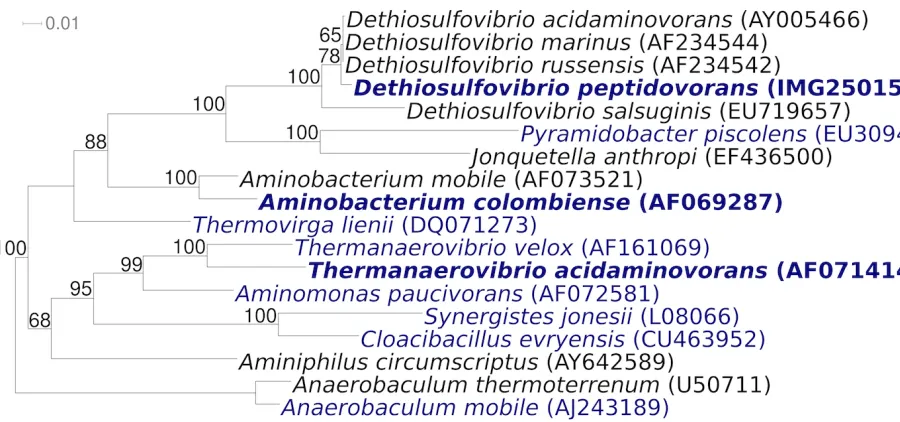
Figure 1 shows the phylogenetic neighborhood of
D. peptidovorans
SEBR 4207
Tin a 16S rRNA based
tree. The five copies of the 16S rRNA gene differ
by up to one nucleotide from each other and by
eight nucleotides from the previously published
sequence generated from DSM 11002
(DPU52817).
Cells of
D. peptidovorans
SEBR 4207
Tstain
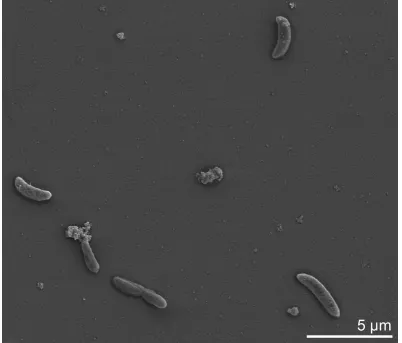
Gram-negative [1]. Cells are vibriod with pointed or
round ends and lateral flagella (Figure 2, flagella
not visible) and a size of 3-5 by 1 µm [1] (Table 1).
Spores were not detected [1]. Optimal growth rate
was observed at 42°C, pH 7.0 in 3% NaCl [1].
D.
peptidovorans
is capable of utilizing peptides and
amino acids as a sole carbon and energy source and
can ferment serine and histidine. In the presence of
thiosulfate, strain SEBR 4207
Tis capable of utilizing
alanine, arginine, asparagines, glutamate,
isoleu-cine, leuisoleu-cine, methionine and valine as an electron
acceptor. The strain is capable of producing acetate,
isobutyrate, isovalerate, 2-methylbutyrate, CO
2and
H
2from peptides. The strain uses elemental sulfur
and thiosulfate but not sulfate as electron acceptor.
H
2S is produced with a decrease in H
2. Cells do not
have cytochrome or desulfoviridin [1]. When yeast
extract was added as sole carbon and energy
source together with trypticase, thiosulfate was
used as sole electron acceptor. Strain SEBR 4207
Twas not able to utilize gelatine, casein, arabinose,
fructose, galactose, glucose, lactose, maltose,
man-nose, rhamman-nose, ribose, sucrose, sorbose, trehalose,
xylose, acetate, propionate, butyrate, citrate and
lactate.
Genome sequencing and annotation
Genome project history
This organism was selected for sequencing on the
basis of its phylogenetic position [17], and is part
of the
G
enomic
E
ncyclopedia of
B
acteria and
A
rc-haea
project [18]. The genome project is
depo-sited in the Genome OnLine Database [10] and the
complete genome sequence is deposited in
Gen-Bank. Sequencing, finishing and annotation were
performed by the DOE Joint Genome Institute
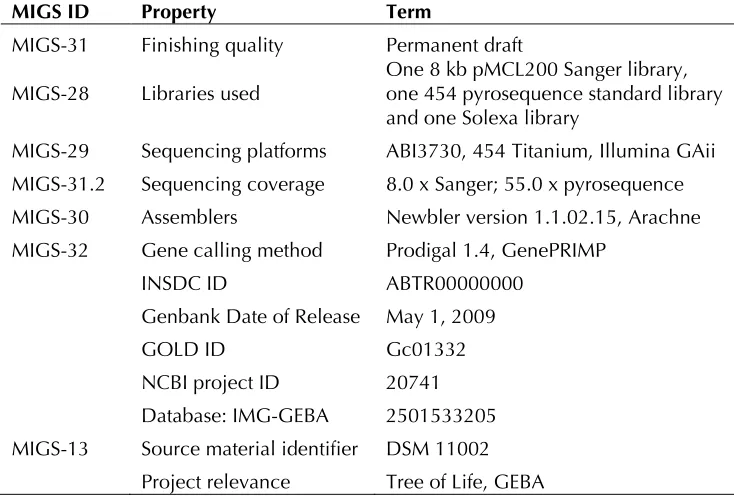
(JGI). A summary of the project information is
shown in Table 2.
Table 1. Classification and general features of D. peptidovorans SEBR 4207T according to the MIGS recommendations [13].
MIGS ID Property Term Evidence code
Current classification
Domain Bacteria TAS [14]
Phylum Synergistetes TAS [2]
Class Synergistia TAS [2]
Order Synergistales TAS [2]
Family Synergistaceae TAS [2]
Genus Dethiosulfovibrio TAS [1]
Species Dethiosulfovibrio peptidovorans TAS [1]
Type strain SEBR 4207 TAS [1]
Gram stain negative TAS [1]
Cell shape curved rods (vibrioid) TAS [1]
Motility motile via lateral flagella TAS [1]
Sporulation non-sporulating TAS [1]
Temperature range mesophile, 20-45°C TAS [1]
Optimum temperature 42°C TAS [1]
Salinity slightly halophilic, optimum 3% NaCl TAS [1]
MIGS-22 Oxygen requirement anaerobic TAS [1]
Carbon source peptides and amino acids TAS [1]
Energy source peptides and amino acids TAS [1]
MIGS-6 Habitat marine, oil wells TAS [1]
MIGS-15 Biotic relationship free living NAS
MIGS-14 Pathogenicity non pathogenic NAS
Biosafety level 1 TAS [15]
Isolation from corroding off-shore oil wells TAS [1] MIGS-4 Geographic location Emeraude oil field, Congo (Brazzaville) TAS [1]
MIGS-5 Sample collection time before 1989 TAS [1]
MIGS-4.1
MIGS-4.2 Latitude Longitude -5.05 11.78 NAS
MIGS-4.3 Depth not reported
MIGS-4.4 Altitude about sea level NAS
Evidence codes - IDA: Inferred from Direct Assay (first time in publication); TAS: Traceable Author Statement (i.e., a direct report exists in the literature); NAS: Non-traceable Author Statement (i.e., not directly observed for the living, isolated sample, but based on a generally accepted property for the species, or anecdotal evidence). These evidence codes are from of the Gene Ontology project [16]. If the evidence code is IDA, then the proper-ty was observed by one of the authors or an expert mentioned in the acknowledgements.
Chemotaxonomy
None of the classical chemotaxonomic features
(peptidoglycan structure, cell wall sugars, cellular
fatty acid profile, menaquinones, or polar lipids)
are known for
D. peptidovorans
SEBR 4207
Tor any
of the other members of the genus
Dethiosulfovi-brio
.
Growth conditions and DNA isolation
D. peptidovorans
SEBR 4207
T, DSM 11002, was
grown anaerobically in DSMZ medium 786 (
Dethi-osulfovibrio peptidovorans
Medium) [19] at 42°C.
Table 2. Genome sequencing project information
MIGS ID Property Term
MIGS-31 Finishing quality Permanent draft
MIGS-28 Libraries used One 8 kb pMCL200 Sanger library, one 454 pyrosequence standard library and one Solexa library
MIGS-29 Sequencing platforms ABI3730, 454 Titanium, Illumina GAii MIGS-31.2 Sequencing coverage 8.0 x Sanger; 55.0 x pyrosequence MIGS-30 Assemblers Newbler version 1.1.02.15, Arachne MIGS-32 Gene calling method Prodigal 1.4, GenePRIMP
INSDC ID ABTR00000000
Genbank Date of Release May 1, 2009
GOLD ID Gc01332
NCBI project ID 20741 Database: IMG-GEBA 2501533205 MIGS-13 Source material identifier DSM 11002
Project relevance Tree of Life, GEBA
Genome sequencing and assembly
The genome was sequenced using a combination
of Sanger and 454 sequencing platforms. All
gen-eral aspects of library construction and
sequenc-ing can be found at th
ing reads were assembled using the Newbler
as-sembler version 1.1.02.15 (Roche). Large Newbler
contigs were broken into overlapping fragments
of 1,000 bp and entered into assembly as
pseudo-reads. The sequences were assigned quality scores
based on Newbler consensus q-scores with
mod-ifications to account for overlap redundancy and
adjust inflated q-scores. A hybrid 454/Sanger
as-sembly was made using Arachne assembler.
Poss-ible mis-assemblies were corrected and gaps
be-tween contgis were closed by primer walks off
Sanger clones and bridging PCR fragments and by
editing in Consed. A total of 392 Sanger finishing
reads were produced to close gaps, to resolve
re-petitive regions, and to raise the quality of the
fi-nished sequence. Illumina reads were used to
im-prove the final consensus quality using an
in-house developed tool (the Polisher [20] ). The
er-ror rate of the final genome sequence is less than 1
in 100,000. Together, the combination of the
San-ger and 454 sequencing platforms provided 63.0×
coverage of the genome. The final assembly
con-tains 35,314 Sanger reads and 626,193
pyrose-quencing reads.
Genome annotation
Genes were identified using
of the Oak Ridge National Laboratory genome
an-notation pipeline, followed by a round of manual
curation using the JGI
The predicted CDSs were translated and used to
search the National Center for Biotechnology
In-formation (NCBI) nonredundant database,
Uni-Prot, TIGRFam, Pfam, PRIAM, KEGG, COG, and
In-terPro databases. Additional gene prediction
anal-ysis and functional annotation was performed
within the Integrated Microbial Genomes - Expert
Review (IMG-ER) platform [23].
Genome properties
Figure 3. Graphical circular map of the genome (without the two small 1.5 and 7.4 kbp plasmids. From out-side to the center: Genes on forward strand (color by COG categories), Genes on reverse strand (color by COG categories), RNA genes (tRNAs green, rRNAs red, other RNAs black), GC content, GC skew.
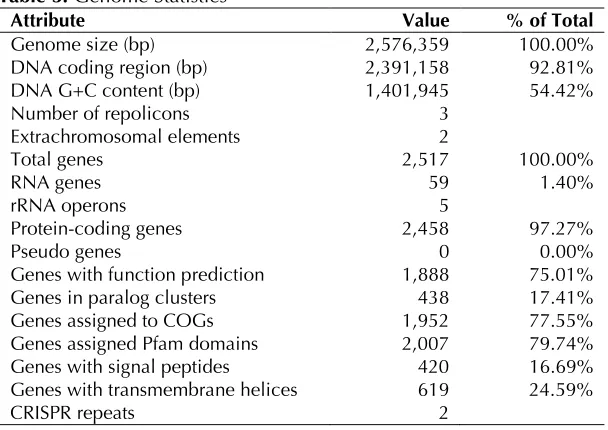
Table 3. Genome Statistics
Attribute Value % of Total
Genome size (bp) 2,576,359 100.00%
DNA coding region (bp) 2,391,158 92.81%
DNA G+C content (bp) 1,401,945 54.42%
Number of repolicons 3
Extrachromosomal elements 2
Total genes 2,517 100.00%
RNA genes 59 1.40%
rRNA operons 5
Protein-coding genes 2,458 97.27%
Pseudo genes 0 0.00%
Genes with function prediction 1,888 75.01%
Genes in paralog clusters 438 17.41%
Genes assigned to COGs 1,952 77.55%
Genes assigned Pfam domains 2,007 79.74%
Genes with signal peptides 420 16.69%
Genes with transmembrane helices 619 24.59%
Table 4. Number of genes associated with the general COG functional categories Code value %age Description
J 149 6.7 Translation, ribosomal structure and biogenesis A 0 0.0 RNA processing and modification
K 129 5.9 Transcription
L 115 5.3 Replication, recombination and repair B 0 0.0 Chromatin structure and dynamics D 28 1.3 Cell cycle control, mitosis and meiosis Y 0 0.0 Nuclear structure
V 32 1.5 Defense mechanisms
T 133 6.1 Signal transduction mechanisms M 119 5.5 Cell wall/membrane biogenesis N 75 3.5 Cell motility
Z 0 0.0 Cytoskeleton
W 0 0.0 Extracellular structures
U 46 2.1 Intracellular trafficking and secretion, and vesicular transport O 70 3.2 Posttranslational modification, protein turnover, chaperones C 142 6.5 Energy production and conversion
G 113 5.2 Carbohydrate transport and metabolism E 252 11.6 Amino acid transport and metabolism F 65 3.0 Nucleotide transport and metabolism H 99 4.6 Coenzyme transport and metabolism I 44 2.0 Lipid transport and metabolism
P 125 5.8 Inorganic ion transport and metabolism
Q 31 1.4 Secondary metabolites biosynthesis, transport and catabolism R 243 11.2 General function prediction only
S 161 7.4 Function unknown - 565 22.5 Not in COGs
Acknowledgements
We would like to gratefully acknowledge the help of Esther Schüler for growing D. peptidovorans and
Su-sanne Schneider for DNA extraction and quality analy-sis (both at DSMZ). This work was performed under the auspices of the US Department of Energy's Office of Science, Biological and Environmental Research Pro-gram, and by the University of California, Lawrence Berkeley National Laboratory under contract No. DE-AC02-05CH11231, Lawrence Livermore National
La-boratory under Contract No. DE-AC52-07NA27344, and Los Alamos National Laboratory under contract No. DE-AC02-06NA25396, UT-Battelle and Oak Ridge National Laboratory under contract DE-AC05-00OR22725, as well as German Research Foundation (DFG) INST 599/1-2. The Indian Council of Scientific and Industrial Research provided a Raman Research Fellowship to Shanmugam Mayilraj.
References
1. Magot M, Ravot G, Campaignolle X, Ollivier B, Patel BKC, Fardeau ML, Thomas P, Crolet JL, Garcia JL. Dethiosulfovibrio peptidovorans gen. nov., sp. nov., a new anaerobic, slightly halophil-ic, thiosulfate-reducing bacterium from corroding offshore oil wells. [9226912]. Int J Syst Bacteriol
1997; 47:818-824
2. Jumas-Bilak E, Roudière L, Marchandin H. De-scription of 'Synergistetes' phyl. nov. and
emended description of the phylum
'Deferribacteres' and of the family Syntrophomo-nadaceae, phylum 'Firmicutes'. [19406787]. Int J Syst Evol Microbiol 2009; 59:1028-1035;
3. Diaz-Cárdenas C, López G, Patel BKC, Baena S.
4. Surkov AV, Dubinina GA, Lysenko AM, Glöckner FO, Kuever J. Dethiosulfovibrio russensis sp. nov.,
Dethiosulfovibrio marinus sp. nov. and Dethiosul-fovibrio acidaminovorans sp. nov., novel anae-robic, thiosulfate- and sulfur-reducing bacteria isolated from 'Thiodendron' sulfur mats in differ-ent saline environmdiffer-ents. Int J Syst Evol Microbiol
2001; 51:327-337. PubMed
5. Chun J, Lee JH, Jung Y, Kim M, Kim S, Kim BK, Lim YW. EzTaxon: a web-based tool for the iden-tification of prokaryotes based on 16S ribosomal RNA gene sequences. Int J Syst Evol Microbiol
2007; 57:2259-2261
6. Lee C, Grasso C, Sharlow MF. Multiple sequence alignment using partial order graphs. Bioinformat-ics 2002; 18:452-464
7. Castresana J. Selection of conserved blocks from multiple alignments for their use in phylogenetic analysis. Mol Biol Evol 2000; 17:540-552
8. Stamatakis A, Hoover P, Rougemont J. A Rapid Bootstrap Algorithm for the RAxML Web Servers.
Syst Biol 2008; 57:758-771
9. Yarza P, Richter M, Peplies J, Euzeby J, Amann R, Schleifer KH, Ludwig W, Glöckner FO, Rosselló-Móra R. The All-Species Living Tree project: a 16S rRNA-based phylogenetic tree of all se-quenced type strains. Syst Appl Microbiol 2008;
31:241-250
10. Liolios K, Chen IM, Mavromatis K, Tavernarakis N, Kyrpides NC. The Genomes OnLine Database (GOLD) in 2009: status of genomic and metage-nomic projects and their associated metadata.
Nucleic Acids Res 2010; 38:D346-D354
11. Chovatia M, Sikorski J, Schöder M, Lapidus A, Nolan M, Tice H, Glavina Del Rio T, Copeland A, Cheng JF, Lucas S, et al. Complete genome se-quence of Thermanaerovibrio acidaminovorans
type strain (Su883T). Stand Genomic Sci 2009;
1:254-261
12. Chertkov O, Sikorski J, Brambilla E, Lapidus A, Copeland A, Glavina Del Rio T, Nolan M, Lucas S, Tice H, Cheng JF, et al. Complete genome se-quence of Aminobacterium colombiense type strain (ALA-1T). Stand Genomic Sci 2010; 2
:280-289
13. Field D, Garrity G, Gray T, Morrison N, Selengut J, Sterk P, Tatusova T, Thomson N, Allen MJ, An-giuoli SV, et al. The minimum information about a genome sequence (MIGS) specification. Nat Biotechnol 2008; 26:541-547
14. Woese CR, Kandler O, Wheelis ML. Towards a natural system of organisms. Proposal for the do-mains Archaea and Bacteria. Proc Natl Acad Sci USA 1990; 87:4576-4579
15. Classification of bacteria and archaea in risk groups. www.baua.de TRBA 466
16. Ashburner M, Ball CA, Blake JA, Botstein D, But-ler H, Cherry JM, Davis AP, Dolinski K, Dwight SS, Eppig JT, et al. Gene ontology: tool for the un-ification of biology. The Gene Ontology Consor-tium. Nat Genet 2000; 25:25-29
17. Klenk HP, Göker M. En route to a genome-based classification of Archaea and Bacteria? Syst Appl Microbiol 2010; 33:175-182
18. Wu D, Hugenholtz P, Mavromatis K, Pukall R, Dalin E, Ivanova NN, Kunin V, Goodwin L, Wu M, Tindall BJ, et al. A phylogeny-driven genomic encyclopaedia of Bacteria and Archaea. Nature
2009; 462:1056-1060
19. List of growth media used at DSMZ:
20. Lapidus A, LaButti K, Foster B, Lowry S, Trong S, Goltsman E. POLISHER: An effective tool for us-ing ultra short reads in microbial genome assem-bly and finishing. AGBT, Marco Island, FL, 2008. 21. Hyatt D, Chen GL, Locascio PF, Land ML,
Lari-mer FW, Hauser LJ. Prodigal Prokaryotic Dynam-ic Programming Genefinding Algorithm. BMC Bioinformatics 2010; 11:119
22. Pati A, Ivanova N, Mikhailova N, Ovchinikova G, Hooper SD, Lykidis A, Kyrpides NC. GenePRIMP: A gene prediction improvement pipeline for mi-crobial genomes. Nat Methods 2010; 7:455-457
23. Markowitz VM, Ivanova NN, Chen IMA, Chu K, Kyrpides NC. IMG ER: a system for microbial ge-nome annotation expert review and curation. Bio-informatics 2009; 25:2271-2278
![Table 1. Classification and general features of D. peptidovorans SEBR 4207T according to the MIGS recommendations [13]](https://thumb-us.123doks.com/thumbv2/123dok_us/673273.2066076/4.612.69.547.74.506/table-classification-general-features-peptidovorans-sebr-according-recommendations.webp)