Dr Sonika Batra
Periodic Patterns in the Main-Group Elements
1 Hydrogen, the Simplest Atom
2 Trends Across the Periodic Table: The Period 2 Elements
3 Group 1A(1): The Alkali Metals
4 Group 2A(2): The Alkaline Earth Metals
5 Group 3A(13): The Boron Family
6 Group 4A(14): The Carbon Family
7 Group 5A(15): The Nitrogen Family
Trends for the Period 2 Elements
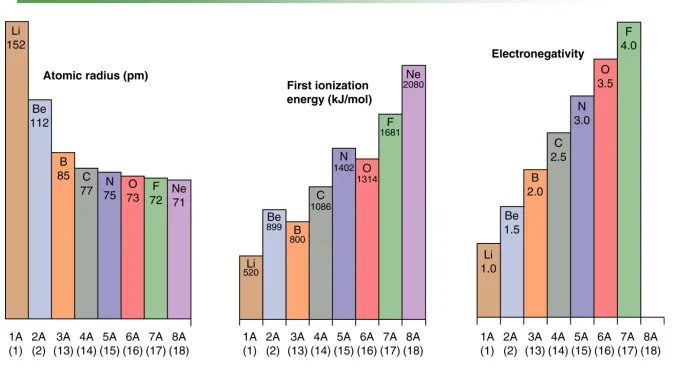
• Atomic size generally ___________across the period.
• Ionization energy ____across the period.
• Electronegativity ____ across the period.
• Metallic character ______ across the period.
• Oxides of the elements become more acidic/Basic across the period.
Trends for the Period 2 Elements
• Atomic size generally decreases across the period.
• Ionization energy and electronegativity increase across the period.
• Metallic character decreases across the period.
– The type of bonding exhibited changes with metallic character.
• Oxides of the elements become more acidic across the period.
Anomalous Behavior in Period 2
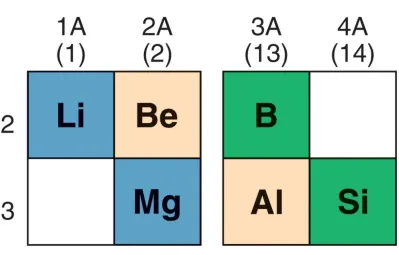
Anomalous behavior in some Period 2 elements is due to their relatively small size and small number of valence orbitals.
Lithium is the only element in Period 2 that forms a simple oxide and nitride.
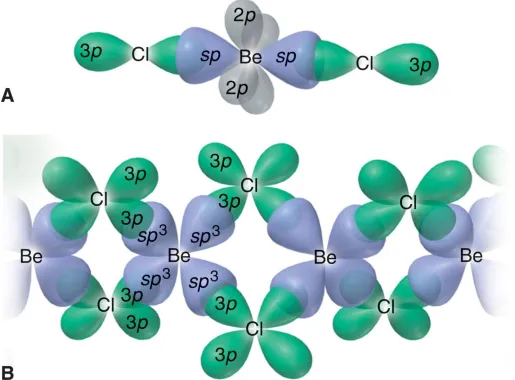
All beryllium compounds exhibit covalent bonding. This is due to the high charge density of Be2+.
Anomalous Behavior in Period 2
Carbon bonds to itself extensively and gives rise to organic compounds.
Oxygen is the only gas in Group 6A and is much more reactive than the other members of its group.
Nitrogen is a triple-bonded, unreactive gas and is very different from the other Group 5A elements, which are reactive solids.
Fluorine is much more electronegative than the other halogens. It reacts violently with water, and HF is a weak
Group 1A(1): The Alkali Metals Family Portrait
• Alkali metals are powerful reducing agents.
– They always occur in nature as +1 cations rather than as free metals.
• Alkali metals reduce halogens to form ionic solids:
– 2E(s) + X2 → 3EX(s) (X = F, Cl, Br, I and E is the alkali metal).
• Alkali metals react vigorously with H2O:
– 2E(s) + H2O(l) → 2E+(aq) + 2OH-(aq) + H
2(g)
• Alkali metals reduce H2 to form ionic hydrides.
– 2E(s) + H2(g) → 2EH(s)
• Alkali metals reduce O2 in air, and tarnish rapidly.
Family Portrait
Properties of the Alkali Metals
• Alkali metals are the largest elements in their respective periods and their valence electron configuration is ns1.
– The valence e- is relatively far from the nucleus, resulting in
weak metallic bonding.
• Alkali metals are unusually soft for metals. They can be cut easily with a knife.
• Alkali metals have lower melting and boiling points than any other group of metals.
Lithium floating in oil floating on water. Alkali metals have low densities.
Figure 14.4 Lattice energies of the Group 1A(1) and 2A(2) chlorides.
Group 2A(2): The Alkaline Earth Metals
• The oxides of Group 2A(2) elements form basic solutions and melt at extremely high temperatures.
• Group 2A(2) elements have higher ionization energies than Group 1A(1) elements
– due to their higher effective nuclear charge and smaller size.
Group 2A(2): The Alkaline Earth Metals Family Portrait
• The metals reduce O2 to form oxides:
– 3E(s) + O2(g) → 3EO(s)
• The larger metals reduce water to form H2 gas:
– 2E(s) + H2O(l) → 2E2+(aq) + 2OH-(aq) + H
2(g) (E = Ca, Sr, Ba) • The metals reduce halogens to form ionic halides:
– E(s) + X2 → EX2(s) [X = F (not with Be), Cl, Br, I]
• Most of the elements reduce H2 to form ionic hydrides:
– E(s) + H2(g) → EH2 (s) (E = all except Be)
Family Portrait
• The elements reduce nitrogen to form ionic nitrides:
– 3E(s) + N2(g) → E3N2(s)
• Except for BeO, the element oxides are basic:
– EO(s) + H2O(l) → E2+(aq) + 2OH-(aq)
• All carbonates undergo thermal decomposition:
Δ
ECO3(s) EO(s) + CO2(g)
Family Portrait
Group 3A(13): The Boron Family Family Portrait
• The elements react sluggishly, if at all, with water:
– 2Ga(s) + 6H2O(hot) → 2Ga2+(aq) + 6OH-(aq) + 3H
2(g)
– 2Tl(s) + 2H2O(steam) → 2Ga+(aq) + 2OH-(aq) + H
2(g)
• When strongly heated in pure O2, all members form oxides:
– Tl forms Tl2O
• All members reduce halogens (X2)
– 2E(s) + 3X2 → 2EX3 (E = B, Al, Ga, In) – 2Tl(s) + X2 → 2TlX(s)
Family Portrait
GROUP 3A(13) REACTIONS
Influence of Transition Elements on
Group 3A(13)
Zeff increases for the larger 3A elements due to poor shielding by d and f electrons.
The larger 3A elements have smaller atomic radii and
larger ionization energies than electronegativities than expected.
Features of Group 3A(13) Elements
Larger Group 3A elements exhibit multiple oxidation
states. They may lose either the np electron only, or both the np and ns electrons.
The lower oxidation state becomes increasingly prominent down the group, since the ns2 electrons form an inert pair.
Oxides of the element in the lower oxidation state are more basic than oxides in the higher oxidation state.
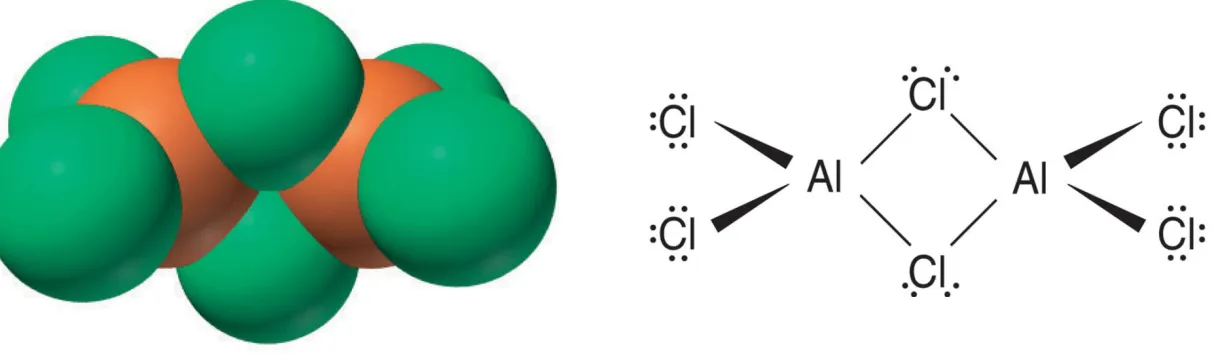
Figure 14.6 The dimeric structure of gaseous aluminum chloride.
Group 4A(14): The Carbon Family Family Portrait
• The Group 4A(14) elements are oxidized by halogens:
– E(s) + 2X2 → EX4 (E = C, Si, Ge)
– The +2 halides are more stable for tin and lead, SnX2 and PbX2.
• The elements are oxidized by O2:
– E(s) + O2(g) → EO2 (E = C, S, Ge, Sn) – Pb forms the +2 oxide, PbO.
• Oxides become more basic down the group. • Hydrocarbons react with O2:
– CH4(g) + 2O2(g) → CO2(g) + 2H2O(g)
Family Portrait
Allotropes
Allotropes are different crystalline or molecular forms of the same element.
One allotrope of a particular element is usually more stable than another at a particular temperature and pressure.
Carbon has several allotropes, including graphite, diamond, and fullerenes.
Bonding in Group 4A(14) Compounds
Carbon forms predominantly covalent bonds, but the larger members of the group form bonds with
increasing ionic character.
Elements of this group also exhibit multiple oxidation states. Lower oxidation states become more
prominent down the group.
Salt-like +2 chlorides and oily +4 chlorides show greater metallic character of tin and lead in the lower oxidation
Carbon in Organic Chemistry
Catenation is the process whereby carbon bonds to itself to form stable chains, branches, and rings.
Since C is small, the C-C bond is short enough to allow effective side-to-side overlap of p orbitals. C readily forms double and triple bonds.
The large number and wide variety of organic compounds is due to the ability of C to bond to itself, and to form
Freon-12 (CCl2F2), a chlorofluorocarbon.
Chlorofluorocarbons (CFC’s or Freons) are chemically and thermally stable, nontoxic, and nonflammable. They are excellent cleaners,
Group 5A(15) Elements
• Nitrogen is a diatomic gas (N2) with a very low boiling point, due to its very weak intermolecular forces.
• Phosphorus exists most commonly as tetrahedral P4 molecules. It has stronger dispersion forces than N2.
• Arsenic exists as extended sheets of As atoms covalently bonded together. The covalent network structure gives it a high melting point.
Group 5A(15): The Nitrogen Family Family Portrait
Family Portrait
GROUP 5A(15) REACTIONS
• Nitrogen is “fixed” industrially in the Haber process:
– N2(g) + 3H2(g) D 2NH3(g)
• Hydrides of other group members are formed by reaction in water or acid of a metal phosphide, arsenide, etc.
– Ca3P2(s) + 6H2O(l) → 2PH3(g) + 3Ca(OH)2(aq)
• Halides are formed by direct combination of the elements:
– 2E(s) + 3X2 → 2EX3 (E = all except N)
Family Portrait
• Oxoacids are formed from the halides in a reaction with water:
– EX3 + 3H2O(l) → H3EO3(aq) + 3HX(aq) (E = all except N)
Patterns of Behavior in Group 5A(15)
• N gains 3 electrons to form the anion N3-, but only in
compounds with active metals.
• The higher elements in the group are metallic and lose
electrons to form cations.
• Oxides change from acidic to amphoteric to basic as you move down the group.
Oxides of Nitrogen
• Nitrogen forms six stable oxides. DHf for all six oxides is
positive because of the great strength of the NΞN bond.
• NO is produced by the oxidation of ammonia:
– 4NH3(g) + 5O2(g) → 4NO(g) +6H2O(g)
– This is the first step in the production of nitric acid.
• NO is converted to 2 other oxides by heating:
– This type of redox reaction is called disproportionation.
• NO2 is a component of photochemical smog.
Group 6A(16) Elements
• Oxygen, like nitrogen, occurs as a low-boiling diatomic gas, O2.
• Sulfur, like phosphorus, occurs as a polyatomic molecular solid.
• Selenium, like arsenic, commonly occurs as a gray metalloid.
Group 6A(16): The Oxygen Family Family Portrait
GROUP 6A(16) REACTIONS
• Halides are formed by direct combination:
– E(s) + X2(g) → various halides (E = S, Se, Te; X = F, Cl)
• The other elements in the group are oxidized by O2:
– E(s) + O2(g) → EO2 (E = S, Se, Te, Po)
• SO2 is oxidized further:
– 2SO2(g) + O2(g) → 2SO3(g)
• The thiosulfate ion is formed when an alkali metal sulfite reacts with sulfur:
– S8(g) + 8Na2SO3(s) → 8Na2S2O3(aq)
Allotropes in the Oxygen Family
Oxygen has two allotropes:
- O2, which is essential to life, and - O3 or ozone, which is poisonous.
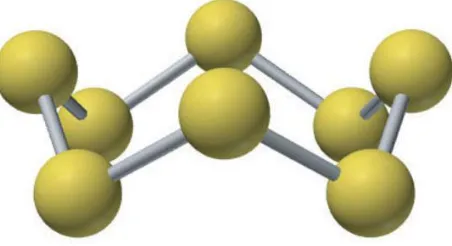
Sulfur has more than 10 different forms, due to the ability of S to catenate. S–S bond lengths and bond angles may vary greatly.
Figure 14.20 The cyclo-S8 molecule.
top view side view
Hydrides of the Oxygen Family
• Oxygen forms two hydrides:
– water (H2O) and hydrogen peroxide (H2O2). – H2O2 contains oxygen in a -1 oxidation state.
• The hydrides of the other 6A elements are foul-smelling, poisonous gases.
– H2S forms naturally in swamps from the breakdown of organic matter and is as toxic as HCN.
• H2O and H2O2 can form H bonds, and therefore have higher melting and boiling points than other H2E
compounds.
Halides of the Oxygen Family
Except for O, the Group 6A elements form a wide range of halides.
Their structure and reactivity patterns depend on the sizes of the central atom and the surrounding halogens.
As the central atom becomes larger, the halides become more stable.
Highlights of Sulfur Chemistry
• Sulfur forms two important oxides:
– SO2 has S in its +4 oxidation state. It is a colorless, choking gas that forms when S, H2S or a metal sulfide burns in air.
– SO3 has S in the +6 oxidation state.
• Sulfur forms two important oxoacids.
– Sulfurous acid (H2SO3) is a weak acid with two acidic protons. – Sulfuric acid (H2SO4) is a strong acid, and is an important
Group 7A(17): The Halogens Family Portrait
KEY ATOMIC PROPERTIES, PHYSICAL PROPERTIES, AND REACTIONS
Reactivity of the Halogens
A halogen atom needs only one electron to fill its valence shell. Halogens are therefore very reactive elements.
The halogens display a wide range of electronegativities, but all are electronegative enough to behave as nonmetals.
A halogen will either
- gain one electron to form a halide anion or - share an electron pair with a nonmetal atom.
Bond energies and bond lengths of the halogens.
F2 shows an anomalous bond energy. The F-F bond is weaker
The relative oxidizing ability of the halogens.
Halogens are strong oxidizing agents. The oxidizing ability of X2
Group 8A(18): The Noble Gases Family Portrait
KEY ATOMIC PROPERTIES, PHYSICAL PROPERTIES, AND REACTIONS
Noble Gases
• Noble gases have a full valence shell.
• The noble gases are the smallest elements in their
respective periods, with the highest ionization energies.
• Atomic size increases down the group and IE decreases.
• Noble gases have very low melting and boiling points. • Only Kr, Xe, and Rn are known to form compounds.