S H O R T R E P O R T
Open Access
Insertion site preference of Mu, Tn5, and Tn7
transposons
Brian Green
1, Christiane Bouchier
2, Cécile Fairhead
3, Nancy L Craig
4and Brendan P Cormack
1*Abstract
Background:Transposons, segments of DNA that can mobilize to other locations in a genome, are often used for
insertion mutagenesis or to generate priming sites for sequencing of large DNA molecules. For both of these uses, a transposon with minimal insertion bias is desired to allow complete coverage with minimal oversampling. Findings:Three transposons, Mu, Tn5, and Tn7, were used to generate insertions in the same set of fosmids containingCandida glabratagenomic DNA. Tn7 demonstrates markedly less insertion bias than either Mu or Tn5, with both Mu and Tn5 biased toward sequences containing guanosine (G) and cytidine (C). This preference of Mu and Tn5 yields less uniform spacing of insertions than for Tn7, in the adenosine (A) and thymidine (T) rich genome ofC. glabrata(39% GC).
Conclusions:In light of its more uniform distribution of insertions, Tn7 should be considered for applications in which insertion bias is deleterious.
Keywords:Tn7, Mu, Tn5, Mutagenesis, Insertion site, DNA transposon, Mobile element
Background
Transposons, mobile DNA elements that can integrate into target DNA molecules, are useful for insertional mutagenesis, gene tagging, gene transfer, and sequencing applications. A major class of transposable elements used for genome engineering is DNA ‘cut and paste’ transposons. The transposases for DNA transposons cut the transposon away from the donor DNA by a variety of mechanisms and the excised transposon integrates into a new target site by joining of its 3’OH termini to staggered positions on the top and bottom DNA strands of the target. This staggered joining results in a target site duplication of a defined number of base pairs, which can be used to map precisely the site of integra-tion for the transposon [1].
In most of the applications of transposons to molecu-lar biology, it is important that the transposon insert into target DNA with little to no sequence bias. Limited sequence bias will lead to more complete coverage of a region for a given number of insertion events. However,
most transposons have been shown to exhibit some pre-ference for certain sequences or sequence features [1]. Clearly, insertion site bias may be a confounding factor for large scale transposon mutagenesis projects.
A number of manuscripts reporting insertion motifs for various transposons have been published, but the target DNA, transposition protocol and environment (in
vitroversusin vivo) vary widely, making direct
compari-sons difficult. For example, individual genes [2],
Escheri-chia coli genomic DNA [3], and Saccharomyces
cerevisiae genomic DNA [4] have been used. In this
publication, three transposon systems were evaluated using the same target DNA in vitro: Mu, Tn5, and a modified Tn7 [5]. Previous work had identified a CPy (G/C)PuG or similar motif for Mu [6-8], a GPyPyPy(A/ T)PuPuPuC motif for Tn5 [9,10] and negligible bias for the modified Tn7 [11]. Since previous publications all used different target DNA, and because our DNA of interest (C.glabrata genomic DNA) has a moderately high A/T content (61%, [12]), specificity and distribution of insertion sites for all three transposons was assessed on the same target DNAs.
* Correspondence: [email protected]
1Department of Molecular Biology and Genetics, Johns Hopkins University
School of Medicine, Hunterian 617, 725 North Wolfe Street, Baltimore, MD 21205-2185, USA
Full list of author information is available at the end of the article
Methods
BACs containing C. glabrata genomic DNA were pre-pared as follows. First, the vector plasmid pBAC-NAT was constructed in two steps. pCR2.1-NAT was con-structed by amplifying the NAT cassette using primers
ON-5’NAT (CCGCTGCTAGGCGCGCCGTGGAAG
TTCCTATACTTTCTAGAGAATAGGAACTTCGAT CCCCCCCATAAAGCACGTGATAGCTTC) and
ON-3’NAT
(GCAGGGATGCGGCCGCTGACGAAGTTCC- TATTCTCTAGAAAGTATAGGAACTTCAGCTTGA-TATCGAATTCCGCAAATTAAAGCC) from pCaNAT1 (a gift of Julia Koehler) and cloning that into pCR2.1 using the TA/TOPO kit (Life Technologies, Carlsbad, CA, USA 92008) The NAT cassette was amplified using primers ON3601 (AGTCGCGGCCGCGTTTAAACG GCGCCCCGCTGCTAGGCGCGCCGTG) and ON3602 (AGTCGGCCCGGGCGGCCACGCGTTGACCCGC GGGCAGGGATACGGCCGCTGAC), cloned into pCR2.1, sequence verified, and a NotI/SfiI fragment of that was inserted into pBAC [13] cut with NotI/SfiI to yield pBAC-NAT (pB1895).
Next, genomic DNA was inserted into pBAC-NAT. The four plasmids into which transposons were mobi-lized contain genomic DNA from C. glabrata from the indicated ORF to the telomere. The genomic DNA began at CAGL0A00187gfrom the strain BG2 [14] for pB1907 (24,252 bp and 34% GC insert), from
CAGL0C00297g and strain BG2 for pB1908 (31,757 bp
and 34% GC insert), from CAGL0C05599g and strain BG2 for pB1909 (25,125 bp and 34% GC insert), and
from CAGL0C05599g and strain CBS138 [12] for
pB1910 (19,423 bp and 31% GC insert). Although pB1909 and pB1910 contain the region from the same gene to the telomere from different strains, they are only homologous for the centromeric (rightmost in fig-ures) approximately 8 kb, after which they diverge com-pletely (data not shown).
Mu transposition reactions were carried out per the manufacturer’s recommendations using the Finnzyme Template Generation System Kit (Thermo Fisher Scien-tific, Waltham, MA, USA 02454), with pB1909 and pB1910 as target DNA sequences. Tn5 transposition reactions were carried out per the manufacturer’s recommendations using the Ez-Tn5 kit (Epicentre, Madison, WI, USA 53713) with pB1907, pB1908, pB1909, and pB1910 as targeting sequences. Tn7 reac-tions were carried out as published, [13] with pB1907, pB1908, pB1909, and pB1910 as targeting sequences.
All sequencing was done using the ABI BigDye Termi-nator Kit v1.1 (Life Technologies, Carlsbad, CA, USA 92008). The primers used for sequencing the Mu trans-poson containing clones were SeqE (CGACACACTC-CAATCTTTCC) and SeqW (GGTGGCTGGAGT
TAGACATC). The primers used for sequencing the Tn5 transposon containing clones were KAN-2 FP-1 (ACCTACAACAAAGCTCTCATCAACC) and KAN-2 RP-1 (GCAATGTAACATCAGAGATTTTGAG). The primers used for sequencing the Tn7 transposon con-taining clones were ON661 (ATAATCCTTAAAAACTC CATTTCCACCCCTCCCAG) and ON662 (GACTT-TATTGTCATAGTTTAGATCTAT TTTGTTCAG).
BLogo sequence logos were generated using the web form at http://www.bioinformatics.org/blogo/cgi-bin/ Blogo/Blogoform.pl[15] as type 2 logos with coloring for symbols with P < 0.001 (Fisher’s exact test) and base representation calculated from the fosmid sequences into which the various transposons were integrated. The background frequencies of A, C, G, and T used for the BLogo sequence logos are given in the figure legends.
Results
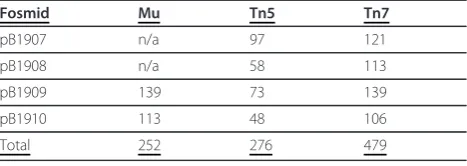
Fosmids containing subtelomeric and telomeric genomic DNA fromC. glabratawere used as targets for transpo-son insertionin vitrofor the transposons Mu, Tn5, and Tn7. Following transformation to select insertions, the resulting clones were individually selected and sequenced from both ends of the transposon. The two reads for each clone were merged to yield the sequence of the ten nucleotides upstream of the transposon mediated duplication, the duplication, and ten nucleo-tides downstream of the duplication. Table 1 shows the number of these insertion events that could be mapped to locations within the target fosmid.
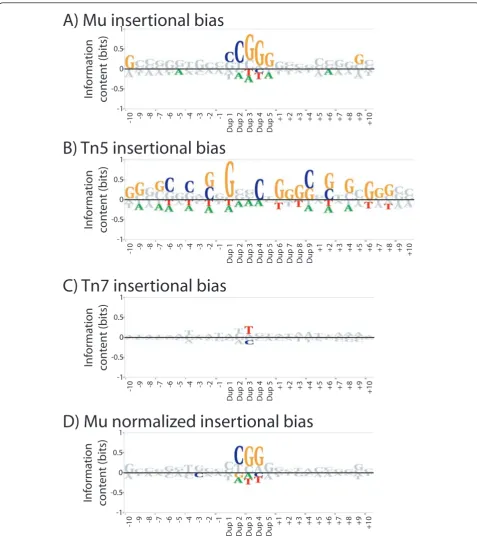
All insertion events for a given transposon were used to generate BLogo sequence logo plots of position speci-fic sequence bias, with positions colored if signispeci-ficant at P < 0.001 (Figure 1). BLogo sequence plots are a posi-tion specific log based measure of the overrepresenta-tion (above the line) or underrepresentaoverrepresenta-tion (below the line) of each base at each position around the insertion sites. The plot for Mu insertions (Figure 1A) shows a strong bias for a CGG motif central to the 5 bp dupli-cated region, which has been previously reported [8]. The Tn5 insertions are also biased (Figure 1B), with a strong preference for G at the first bp of the duplication and a general bias for G and C across the analyzed
Table 1 Number of insertions mapped
Fosmid Mu Tn5 Tn7
pB1907 n/a 97 121
pB1908 n/a 58 113
pB1909 139 73 139
pB1910 113 48 106
A) Mu insertional bias
B) Tn5 insertional bias
1
-1 0.5
-0.5 0
Inf
ormation
co
nt
ent (bits)
-10 -9 -8 -7 -6 -5 -4 -3 -2 -1
Dup 1 Dup 2 Dup 3 Dup 4 Dup 5
+1 +2 +3 +4 +5 +6 +7 +8 +9
+10
C) Tn7 insertional bias
-1 0.5
-0.5 0
Inf
ormation
co
nt
ent (bits)
-10 -9 -8 -7 -6 -5 -4 -3 -2 -1
Dup 1 Dup 2 Dup 3 Dup 4 Dup 5
+1 +2 +3 +4 +5 +6 +7 +8 +9 +10
1 1 0.5
-1 -0.5 0
Inf
ormation
co
nt
ent (bits)
-10 -9 -8 -7 -6 -5 -4 -3 -2 -1
Dup 1 Dup 2 Dup 3 Dup 4 Dup 5 Dup 6 Dup 7 Dup 8 Dup 9
+1 +2 +3 +4 +5 +6 +7 +8 +9 +10
D) Mu normalized insertional bias
1
-1 0.5
-0.5 0
Inf
ormation
co
nt
ent (bits)
-10 -9 -8 -7 -6 -5 -4 -3 -2 -1
Dup 1 Dup 2 Dup 3 Dup 4 Dup 5
+1 +2 +3 +4 +5 +6 +7 +8 +9 +10
Figure 1Insertion biases of Mu, Tn5, and Tn7. BLogo sequence logos are shown for all insertion sites for Mu(A), Tn5(B), and Tn7(C)
transposons intoCandida glabratasubtelomeric DNA. Ten bases on either side of the transposon mediated duplication of five (Mu and Tn7) or
nine (Tn5) bases were used to generate the sequence logo, and bases significant atP< 0.001 are shown in color. Mu insertion events were
used to create a BLogo sequence logo with background base frequencies obtained from selecting all 25 mers within the target fosmids
containing a central CGG(D). The background frequencies of A, C, G, and T used for the BLogo sequence logos are respectively: 0.32, 0.19, 0.18,
region. This motif is similar, but not identical, to that previously reported for Tn5 mutagenesis [9]. In contrast, the Tn7 has only a very weak bias, toward a T in the middle position of the duplication site (Figure 1C).
The G/C content of the fosmids mutagenized is not uniform across their length (see below), so some of the apparent bias in the flanking base pairs might be simply due to a sampling bias due to a strongly biased central core. In fact, if the base percentages used in BLogo are calculated from all 25mers in the fosmids containing a central CGG core, no other positions show significant bias for Mu transposition (Figure 1D). The results from a similar analysis for Tn5 were ambiguous, but since many of the Tn5 insertions were in theC. glabrata telo-meric repeats (which are very G/C rich), this could explain the observed flanking bias.
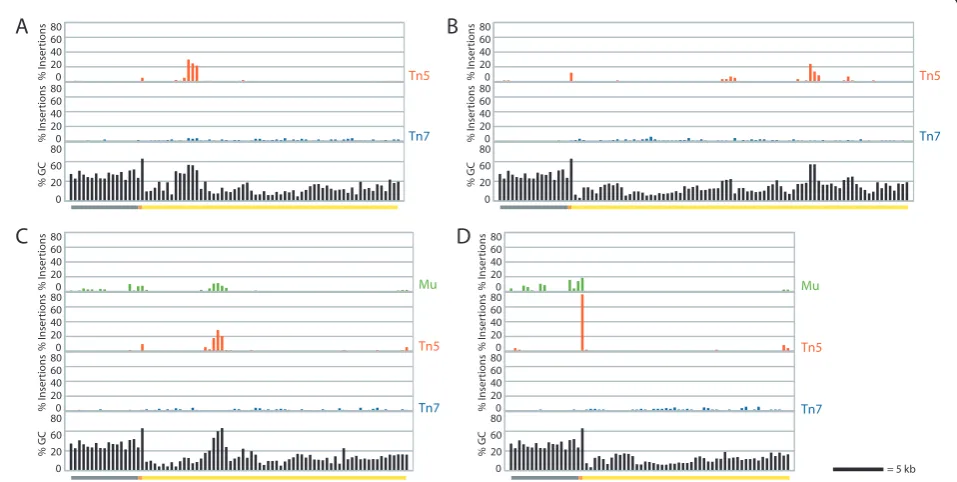
Depending on the nucleotide composition of the tar-get fragment, insertion site bias would be expected to result in non-random spacing of insertions in targets with variable G/C content. Histograms showing the per-cent of insertions in each 400 bp window spanning the fosmid demonstrate that Mu and Tn5 had strongly clus-tered insertions (Figure 2). For Tn5, 10% of the 400 bp windows accounted for 92.4% of the insertions; for Mu, it was 72.6%. In contrast, the spacing of Tn7 insertions is much more uniform (Figure 2), with the top 10% of 400 bp windows containing 32.8% of the insertions. The
sequence motifs for both Mu and Tn5 are G/C rich; analysis of the percent G/C for each 400 bp window shows that the strongest peaks in the frequency of Mu and Tn5 insertions occur in regions of relatively ele-vated G/C content (Figure 2).
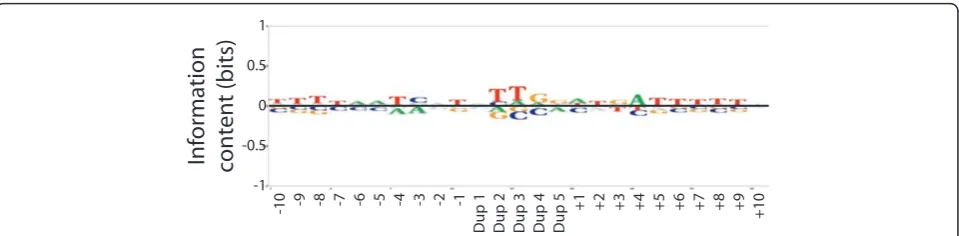
As part of a larger sequencing effort, and due to the minimal sequence bias discussed above, Tn7 was then used to mutagenize 49 fosmids containing C. glabrata subtelomeric genomic DNA. A total of 6,700 insertion events were used to generate a BLogo sequence motif (Figure 3). In contrast to the smaller set of Tn7 inser-tion events discussed above, and due to the larger number of sequences used, the subtle biases exhibited by Tn7 were significant at P < 0.001. Although the relative bias is very weak, Tn7 does exhibit a bias toward a central TTG core. There is also a slight palindromic bias in the flanking regions; positions plus 1 to plus 6 are overrepresented for ATGATT and posi-tions minus 6 to minus 1 for AATCAT. Overall, the slight bias seen for Tn7 is for A/T rich sequences and is markedly less pronounced than the G/C biases of Mu and Tn5.
Conclusions
Uniform distribution of transposon insertion is impor-tant for their use in many molecular biological applica-tions. In the analysis here, Tn7 demonstrates a far more
0 20 40 60 80 % Inser tions 0 20 40 60 80 % Inser tions 0 20 60 80 % GC 0 20 40 60 80 % Inser tions 0 20 40 60 80 % Inser tions 0 20 60 80 % GC 0 20 40 60 80 % Inser tions 0 20 40 60 80 % Inser tions 0 20 40 60 80 % Inser tions 0 20 60 80 % GC 0 20 40 60 80 % Inser tions 0 20 40 60 80 % Inser tions 0 20 40 60 80 % Inser tions 0 20 60 80 % GC
A
C
B
D
Tn5 Tn7 Tn5 Mu Tn7 Tn5 Mu Tn7 Tn5 Tn7= 5 kb
Figure 2Insertion events are not uniformly distributed for Mu and Tn5. Histograms of the percent of insertions contained in each 400
base pair window along the fosmids are shown (green, red, and blue bar graphs) for pB1907(A), pB1908(B), pB1909(C), and pB1910(D). For
random insertion profile than either Mu or Tn5. For Tn5 and Mu, the consensus sequences derived are con-sistent with extensive published analyses [5-10]. Trans-poson insertion site preference is complex. For example, previous studies of Mu insertion have shown that parti-cular dinucleotides, or base steps, contribute to site pre-ference; predicted structural features of DNA also may play a role [6-8]. However, even these comprehensive analyses of insertion site preference derived consensus sites that are both G/C rich and consistent with those we derived here. We suggest that the preference for G/ C rich sequences exhibited by Mu and Tn5 is of parti-cular importance for investigators working with A/T rich genomes such asS. cerevisiae (approximately 62% A/T) and many other fungi, Caenorhabditis elegans (approximately 65% A/T), and human (approximately 60% A/T) [16]. Tn7 has less target bias, with a weak preference for A/T rich sequences. For the large geno-mic inserts analyzed here, this resulted in a broad distri-bution of insertion sites, with a bias away from the plasmid backbone (which is more G/C rich relative to the cloned genomic DNA). The minimal sequence bias exhibited by Tn7 suggests that Tn7 should be consid-ered for generating random insertions in cloned A/T-rich genomes.
Abbreviations
bp: base pair.
Acknowledgements
We thank Julia Koehler for the gift of pCaNAT. This work was supported by grants 1F32AI080094 (BMG), 2RO1AI046223 (BPC), and RO1GM076425 (NLC). NLC is an Investigator of the Howard Hughes Medical Institute.
Author details
1Department of Molecular Biology and Genetics, Johns Hopkins University
School of Medicine, Hunterian 617, 725 North Wolfe Street, Baltimore, MD
21205-2185, USA.2Institut Pasteur, Plate-forme Génomique, Département
Génomes et Génétique, Rue du Dr. Roux, F-75015 Paris, France.3Institut de
Génétique et Microbiologie, Université Paris Sud 11, CNRS UMR8621, 15 rue
Georges Clémenceau, Orsay F-91405, France.4Department of Molecular
Biology and Genetics, The Howard Hughes Medical Institu725 North Wolfe
Street Johns Hopkins University School of Medicine, Baltimore, MD 21205-2185, USA.
Authors’contributions
BG carried out all cloning, Tn7 mutagenesis and all sequence analysis, and wrote the paper. CF and CB carried out the Mu and Tn5 mutagenesis and sequencing. NC and BC conceived of the idea and supervised the project. All authors read and approved the final manuscript.
Competing interests
The authors declare that they have no competing interests.
Received: 5 October 2011 Accepted: 7 February 2012 Published: 7 February 2012
References
1. Craig NL:Mobile DNA IIWashington, DC: ASM Press; 2002.
2. Fransen M, Vastiau I, Brees C, Brys V, Mannaerts GP, Van Veldhoven PP:
Analysis of human Pex19p’s domain structure by pentapeptide scanning mutagenesis.J Mol Biol2005,346:1275-1286.
3. Puttamreddy S, Cornick NA, Minion FC:Genome-wide transposon
mutagenesis reveals a role for pO157 genes in biofilm development in Escherichia coli O157:H7 EDL933.Infect Immun2010,78:2377-2384.
4. Xu T, Bharucha N, Kumar A:Genome-wide transposon mutagenesis in
Saccharomyces cerevisiae and Candida albicans.Methods Mol Biol2011,
765:207-224.
5. Biery MC, Stewart FJ, Stellwagen AE, Raleigh EA, Craig NL:A simple in vitro
Tn7-based transposition system with low target site selectivity for genome and gene analysis.Nucleic Acids Res2000,28:1067-1077.
6. Butterfield YS, Marra MA, Asano JK, Chan SY, Guin R, Krzywinski MI, Lee SS,
MacDonald KW, Mathewson CA, Olson TE, Pandoh PK, Prabhu AL, Schnerch A, Skalska U, Smailus DE, Stott JM, Tsai MI, Yang GS,
Zuyderduyn SD, Schein JE, Jones SJ:An efficient strategy for large-scale
high-throughput transposon-mediated sequencing of cDNA clones.
Nucleic Acids Res2002,30:2460-2468.
7. Haapa-Paananen S, Rita H, Savilahti H:DNA transposition of bacteriophage
Mu. A quantitative analysis of target site selection in vitro.J Biol Chem
2002,277:2843-2851.
8. Manna D, Deng S, Breier AM, Higgins NP:Bacteriophage Mu targets the
trinucleotide sequence CGG.J Bacteriol2005,187:3586-3588.
9. Goryshin IY, Miller JA, Kil YV, Lanzov VA, Reznikoff WS:Tn5/IS50 target
recognition.Proc Nat Acad Sci USA1998,95:10716-10721.
10. Shevchenko Y, Bouffard GG, Butterfield YS, Blakesley RW, Hartley JL,
Young AC, Marra MA, Jones SJ, Touchman JW, Green ED:Systematic
sequencing of cDNA clones using the transposon Tn5.Nucleic Acids Res
2002,30:2469-2477.
11. Seringhaus M, Kumar A, Hartigan J, Snyder M, Gerstein M:Genomic
analysis of insertion behavior and target specificity of mini-Tn7 and Tn3 transposons in Saccharomyces cerevisiae.Nucleic Acids Res2006,34:e57.
12. Dujon B, Sherman D, Fischer G, Durrens P, Casaregola S, Lafontaine I, De
Montigny J, Marck C, Neuveglise C, Talla E, Goffard N, Frangeul L, Aigle M,
1
-1 0.5
-0.5 0
Inf
ormation
co
nt
ent (bits)
-10 -9 -8 -7 -6 -5 -4 -3 -2 -1
Dup 1 Dup 2 Dup 3 Dup 4 Dup 5
+1 +2 +3 +4 +5 +6 +7 +8 +9 +10
Beyne E, Bleykasten C, Boisramé A, Boyer J, Cattolico L, Confanioleri F, De
Daruvar A, Despons L, Fabre E, Fairhead C, Ferry-Dumazet H,et al:Genome
evolution in yeasts.Nature2004,430:35-44.
13. Castano I, Kaur R, Pan S, Cregg R, Penas Ade L, Guo N, Biery MC, Craig NL,
Cormack BP:Tn7-based genome-wide random insertional mutagenesis
of Candida glabrata.Genome Res2003,13:905-915.
14. Cormack BP, Falkow S:Efficient homologous and illegitimate
recombination in the opportunistic yeast pathogen Candida glabrata.
Genetics1999,151:979-987.
15. Li W, Yang B, Liang S, Wang Y, Whiteley C, Cao Y, Wang X:BLogo: a tool
for visualization of bias in biological sequences.Bioinformatics2008,
24:2254-2255.
16. Herold J, Kurtz S, Giegerich R:Efficient computation of absent words in
genomic sequences.BMC Bioinformatics2008,9:167.
doi:10.1186/1759-8753-3-3
Cite this article as:Greenet al.:Insertion site preference of Mu, Tn5, and Tn7 transposons.Mobile DNA20123:3.
Submit your next manuscript to BioMed Central and take full advantage of:
• Convenient online submission
• Thorough peer review
• No space constraints or color figure charges
• Immediate publication on acceptance
• Inclusion in PubMed, CAS, Scopus and Google Scholar
• Research which is freely available for redistribution