Burnout and Extension Educators: Where We Are
and Implications for Future Research
Mia B. Russell Prince Attoh Tyrone Chase
Tao Gong
University of Maryland Eastern Shore
Jinhee Kim
University of Maryland College Park
Girvin L. Liggans
University of Maryland Eastern Shore
Burnout is identified as an individual work-related outcome that plagues educators within Cooperative Extension. Extension educators are particularly susceptible to burnout due to the unique set of demands and stressors they face, including geographic isolation, long work hours, prolonged driving times, and emotionally demanding interactions with clients, peers, local government, and administration. This review examines the literature relevant to Extension and burnout, discusses predictors and outcomes of burnout, and examines theories that have been used to investigate burnout. While studies have shed light on burnout within Extension from discipline and individual state perspectives, this review identifies the need for an updated examination of burnout with a regional or national scope. Additionally, job demands-resources theory is identified as a lens to better understand and explain burnout among Extension educators. As a prevalent issue that requires deeper understanding, the job demands-resources theory comprises principles from work motivation, job design, and job stress literatures and has been used to understand, explain, and make predictions about job burnout. At a time when issues related to Extension are front and center in academe and mainstream media, understanding burnout can help support the continued success of Extension. Other implications are also discussed.
Keywords: job characteristics, job demands, job resources, burnout, engagement, turnover intention, Cooperative Extension, Extension educators
Introduction
For more than a century, Cooperative Extension (Extension) has provided nonformal education and outreach throughout the United States. This long history of service is anchored in the
successful efforts of the Extension educator, who provides the knowledge, resources, and tools to individuals, families, and communities who need them (Seevers, Graham, Gamon, & Conklin, 1997; U.S. Department of Agriculture, 2017). At a time when agricultural, nutritional, financial, and environmental challenges are mounting, Extension is as relevant today as ever. However, organizational changes of recent years present potential barriers to the continued success of Extension. These changes can manifest personnel-related challenges with burnout, employee engagement, and turnover among the Extension workforce.
Americans spend one-third of their waking hours at work (Saks, 2006). As a defining part of life, studying the work environment is important. The Extension literature primarily focuses on program implementation, delivery, and evaluation; however, limited research exists on
personnel- related issues, such as stress (Bartholomew & Smith, 1990; Bradley, Driscoll, & Bardon, 2012; Ezell, 2003; Fetsch & Kennington, 1997), burnout (Ensle, 2005; Igodan & Newcomb, 1986; Place, Jacob, Summerhill, & Arrington, 2000), work-life balance (Boltes, Lippke, & Gregory, 1995; Kutilek, Conklin, & Gunderson, 2002; Rousan & Henderson, 1996), job satisfaction (Nestor & Leary, 2000), and turnover (Ensle, 2005; Kutilek et al., 2002;
Mowbray, 2002; Safrit & Owen, 2010; Strong & Harder, 2009). Among these issues, burnout has been both prevalent and consistent over the last three decades within the Extension literature (Ensle, 2005; Igodan & Newcomb, 1986; Place et al., 2000).
Defined as a persistent, negative, work-related state of mind (Leiter & Maslach, 1999), burnout has reached epidemic proportions within U.S. organizations and is sabotaging workforce retention (Wilkie, 2017). As a helping professional facing unique job characteristics, such as geographic isolation, prolonged driving times, and emotionally demanding interactions with clients, peers, local government, and administration, Extension educators have increased susceptibility to burnout. While nationally aggregated data do not exist, burnout has been identified as a predictor of turnover within Extension (Kutilek, 2000). In fact, Kutilek (2000) suggested the net cost of turnover for Extension was $80,000 per employee. Chandler (2005) purported that the cost to replace an educator, with an annual salary of $30,000, ranged between $7,185 and $30,000. While the research suggests that burnout has an indirect effect on turnover among Extension educators, a research theory identifying or investigating predictors and
consequences of burnout among this population was not identified.
Extension educators. This review offers a theory that may be useful in identifying the predictors and consequences of burnout.
Methods
Literature for this research synthesis was obtained through an extensive search of online databases and other published resources relevant to Extension and burnout using a keyword search of Cooperative Extension, Extension educator, Extension agent, burnout, workplace, job characteristics, job demands, job resources, and turnover. Peer-reviewed journal articles, including Journal of Extension and other Extension-related journals as well as working papers and books published by December 2016 were reviewed. Of the seventy publications that were reviewed, 30 were specific to the Extension context.
Burnout
Studied for more than 40 years, the term “burnout” was first used by Freudenberger (1974) to explain the phenomena of physical, emotional, and mental exhaustion as a consequence of severe and unresolved job stress among helping professionals (Weisberg & Sagie, 1999). Maslach (1976) characterized burnout as often accompanied by distress, reduced effectiveness, decreased motivation, and dysfunctional attitudes and behaviors at work. During the 1980s, there was an increased awareness and greater discussion of stress and burnout at work (Farber, 1983).
Maslach (1982) later defined burnout as a psychological syndrome involving chronic exhaustion, cynicism, and reduced personal efficacy that often occurs among individuals who work with people (Maslach, Jackson, & Leiter, 1986). Burnout is typically measured by the Maslach Burnout Inventory (MBI), which examines burnout in three dimensions: exhaustion, cynicism, and reduced professional efficacy (Maslach et al., 1986). As the most widely used measure of burnout, the MBI has three specific versions (General Survey, Human Services Survey, and Educators Survey) based on more than 25 years of research of various occupations.
Exhaustion, the first and most prevalent dimension of burnout, refers to the draining of emotional resources, feelings of tiredness, and chronic fatigue resulting from work overload. Chronic exhaustion can lead to cynicism, which represents distancing oneself from and developing negative attitudes towards work as well as depersonalization. According to Maslach (1998), distancing is an immediate reaction to exhaustion. When employees face overwhelming
workplace demands and develop cynicism, their professional efficacy can begin to erode. When efficacy is compromised, employees may realize a loss of competence, confidence, and
productivity. More simply put, burnout can be viewed as the depletion of physical and mental resources from excessive and prolonged levels of job stress and strain (Igodan & Newcomb, 1986).
when heavy workload is combined with lack of personal control, insufficient rewards, absence of fairness, lack of community, or conflicting values (Maslach & Leiter, 1997), personality factors such as irrational beliefs or expectations (Pines, 2002), and lack of job significance and
meaningfulness (Azeem & Nazir, 2008).
Predictors and Outcomes of Burnout
Organizational research suggests burnout is a consequence of chronic job demands (Leiter & Maslach, 1999) and can lead to physical and emotional illness, increased job turnover,
absenteeism, and reduced productivity (Boles, Dean, Ricks, Short, & Wang, 2000), increased use of sick leave; mental health problems; low morale; reduced job satisfaction and work
engagement (Rothmann, 2003), and deterioration in the quality of care or service (Maslach & Jackson, 1986).
Extension research identified several factors that may contribute to burnout. Ensle (2005) described burnout as a consequence to managing multiple stakeholders and levels of
accountability. Other factors included increased service demands, funding and grantsmanship requirements (Ensle, 2005), travel demands and long work hours that include nights, weekends, and holidays (Peters, Zvonkovic, & Bowman, 2008), as well as heavy workloads, work unit climate, individual needs and values, and the external environment (Harder, Gouldthorpe, & Goodwin, 2015).
Igodan and Newcomb (1986) concluded that all agents will experience burnout at one time or another. The identified predictors of burnout, in order of strength, were discipline, age, and marital status. Much of the Extension research examined burnout within specific states and disciplines. For example, Fetsch, Flashman, and Jeffiers (1984) examined stress levels across disciplines among Kentucky educators. Findings from this study suggested 4-H educators have higher stress levels than educators in other program areas (Fetsch et al., 1984). This study supported clear discipline delineation as suggested by Manton and Van Es (1985) where agricultural educators experienced the narrowest set of stressors and demands while family and consumer sciences (FCS) and 4-H educators experienced the heaviest and broadest set of demands. In a study of Ohioan educators, Rousan and Henderson (1996) found agents
voluntarily left Extension because of other life priorities, family obligations, and misalignment between the amount of work and levels of compensation. In other words, these findings suggest a misalignment between work and home, which is also related to burnout (Rousan & Henderson, 1996). Based on the Maslach Burnout Inventory (Maslach et al, 1986), Sears, Urizar, and Evans (2000) found a significant proportion of Extension employees faced emotional fatigue,
professional ineffectiveness, and depression.
self-induced stress, lack of support, unequal recognition, insufficient pay raises, reporting difficulties, and excessive committee obligations. Harder et al. (2015) identified high or heavy workload as a predictor of burnout, with two-thirds of the respondents (66.4%, n = 77) reporting that they overextended themselves with their workload. The study also found that only 38% (n = 44) of responding educators indicated they were able to manage a healthy balance between work and their personal lives.
While many organizational outcomes have been associated with burnout, Ensle (2005) and Harder et al. (2015) suggested a pattern of turnover can emerge when burnout is not addressed. Turnover of Extension educators often results in losses of critical knowledge and expertise (Bradley et al., 2012; Ensle, 2005) and may create disruptions and interruptions in programming resulting in jeopardized client service (Fischer, 2009; Strong & Harder, 2009), compromised organizational objectives (Broadbridge, 2002), and substantial financial and time strains (Kutilek, 2000). Additionally, turnover increases resource requirements for new agent
recruitment and training (Arnold & Place, 2010), increases workloads for remaining staff (Borr & Young, 2010; Ensle, 2005; Hendrie, 2004), lowers employee morale or engagement, weakens relationship continuity, and increases problems with quality or productivity (Emberland & Rundmo, 2010; Wright & Bonett, 2007). Employee turnover has been found to have a profound influence upon organizational effectiveness and competitive advantage (Jeswani & Dave, 2012). Costs associated with hiring, orientation, and training range from 90% to 200% of the average annual salary (Cascio, 2006; Mitchell & Lee, 2001; Society for Human Resource Management, 2014). In addition to the costs that plague an already budget-strapped system, turnover may preclude Extension from achieving its mission due to the loss of local programming where vacancies exist (Kutilek, 2000). Turnover often emerges from improperly managed job characteristics, such as poor relationships between peers and managers, lack of opportunity for growth and development, and a lack of challenging and meaningful work (Emberland & Rundmo, 2010; Society for Human Resource Management, 2014; Wright & Bonett, 2007). Failure to address workplace challenges can lead to burnout and other serious outcomes up to and including turnover (Huang, Lawler, & Lei, 2007; Paine, 1984). As a pervasive issue and concern within Extension, there is a need to better understand predictors of as well as burnout related outcomes and to empirically examine the effects of burnout among educators.
Job Characteristics
workload and time pressure (Lee & Ashforth, 1996), and levels of overcommitment (Inocente, 2005). As suggested by Maslach (1998), chronic job demands are potentially serious; these demands lead to burnout by depleting oneself of mental and physical energy.
Job demands require sustained physical and/or psychological effort, whereas, job resources, help manage job demands and are particularly related to motivation and work engagement (Demerouti et al., 2001). Job resources encourage work goal achievement, reduce job demands, and
stimulate personal growth, learning, and development (Bakker & Demerouti, 2007). Job resources include autonomy, performance feedback, wages, career opportunities, job security, coworker and supervisor support, team climate, role clarity, participation in decision making, skill variety, feedback, rewards, job control, task significance, and identity (Bakker &
Demerouti, 2007). Characterized by a motivational process, these resources can actively encourage health-supporting activities and engagement (Hakanen, Schaufeli, & Ahola, 2008). The primary assumptions are “job demands and job resources are evident in any job and are related to burnout and work engagement” (Bakker & Demerouti, 2007, p. 312).
While not explicitly stated within the Extension literature, several job demands and job resources have been identified. This research has uncovered various predictors of burnout including high work pressure and emotionally demanding interactions with clients, peers, and administration (Ensle, 2005), as well as working nights and weekends, meeting tight deadlines, managing multiple reporting structures, and navigating a generally busy work culture (Peters et al., 2008). Specifically, Bradley et al. (2012) suggested physical exhaustion from driving and traveling may lead to burnout. Other identified job characteristics, which can be classified as job resources, include flexibility, autonomy, rewarding projects, meaningful work, and community outreach (Arnold & Place, 2010; Bradley et al., 2012; Ensle, 2005). Harder, Gouldthorpe, and Goodwin (2014) suggest Extension educators enjoy the opportunity to make a difference in people’s lives while having variety in daily activities. Depending upon the extent to which these job
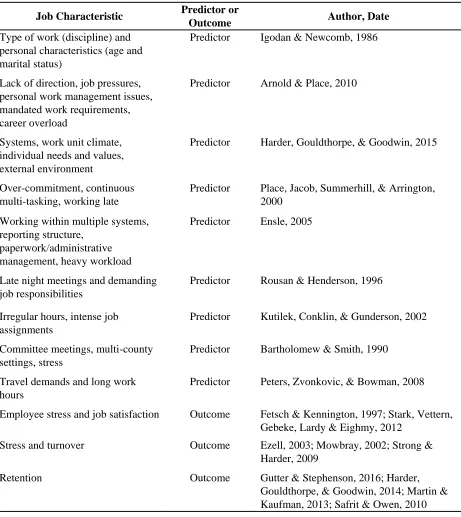
characteristics are realized, burnout can lead to increased stress, reduced job satisfaction, and increased turnover (Ezell, 2003; Fetsch & Kennington, 1997; Gutter & Stephenson, 2016; Harder et al., 2014; Martin & Kaufman, 2013; Mowbray, 2002; Safrit & Owen, 2010; Stark, Vettern, Gebeke, Lardy & Eighmy, 2012; Strong & Harder, 2009). While limited research exists, job characteristics identified in the Extension literature, explicitly or tangentially related to burnout, are included in Table 1. An examination of predictors and outcomes of burnout can help
Table 1. Job Characteristics as Predictors and Outcomes of Burnout within Extension
Job Characteristic Predictor or
Outcome Author, Date
Type of work (discipline) and personal characteristics (age and marital status)
Predictor Igodan & Newcomb, 1986
Lack of direction, job pressures, personal work management issues, mandated work requirements, career overload
Predictor Arnold & Place, 2010
Systems, work unit climate, individual needs and values, external environment
Predictor Harder, Gouldthorpe, & Goodwin, 2015
Over-commitment, continuous multi-tasking, working late
Predictor Place, Jacob, Summerhill, & Arrington, 2000
Working within multiple systems, reporting structure,
paperwork/administrative management, heavy workload
Predictor Ensle, 2005
Late night meetings and demanding job responsibilities
Predictor Rousan & Henderson, 1996
Irregular hours, intense job assignments
Predictor Kutilek, Conklin, & Gunderson, 2002
Committee meetings, multi-county settings, stress
Predictor Bartholomew & Smith, 1990
Travel demands and long work hours
Predictor Peters, Zvonkovic, & Bowman, 2008
Employee stress and job satisfaction Outcome Fetsch & Kennington, 1997; Stark, Vettern, Gebeke, Lardy & Eighmy, 2012
Stress and turnover Outcome Ezell, 2003; Mowbray, 2002; Strong & Harder, 2009
Retention Outcome Gutter & Stephenson, 2016; Harder, Gouldthorpe, & Goodwin, 2014; Martin & Kaufman, 2013; Safrit & Owen, 2010
Theoretical Framework
understanding the predictors and consequences of burnout by incorporating principles from the work motivation, job design, and job stress literatures.
Hackman and Oldham (1980) developed the job characteristics theory as a means to understand how job characteristics and job design affect job outcomes. They suggested five characteristics that represent job outcomes and described psychological states: skill variety, task variety, task significance, autonomy, and feedback. The theory purports direct correlations between characteristics and psychological states such as experienced meaningfulness, experienced
responsibility for outcomes, and knowledge of actual results. Skill variety, task variety, and task significance are direct correlates of experienced meaningfulness. Autonomy is directly
correlated with experienced responsibility for outcomes. Finally, feedback is directly and positively correlated to knowledge of actual results. While this theory posits that autonomy and feedback have multiplicative power, there is a circular argument suggesting that job outcomes influence job design and job design influences job outcomes.
The two-factor theory addresses motivation, or the willingness to exert high levels of effort toward organizational goals, conditioned by the efforts and ability to satisfy individual needs (Herzberg, 1966). The two-factor theory focuses on hygiene, or extrinsic, factors and
motivation, or intrinsic, factors. Herzberg asserted that intrinsic factors are related to satisfaction and affect the quality of work, while extrinsic factors are related to dissatisfaction and effect an individual’s willingness to work. A full supply of hygiene factors, such as supervision, company policies, working conditions, and salary, will not necessarily result in job satisfaction.
Effectively addressing motivation factors, such as achievement, recognition, meaningful work, responsibility, and opportunities for advancement and growth, can improve employee
productivity and performance. Herzberg theorized that both intrinsic and extrinsic factors should be addressed to improve satisfaction (Wan Fauziah & Tan, 2013). This theory has been utilized within the Extension context to evaluate maintenance and motivation factors that influence job satisfaction (Strong & Harder, 2009). The job satisfaction of Extension educators is important but may not be enough to ensure the continued success of Cooperative Extension.
Although similarities exist between these models and theories, several researchers (Bakker & Demerouti, 2007; Demerouti et al., 2001; Schaufeli & Taris, 2014) have used JD-R theory to more comprehensively examine the link between employee well-being and performance in various occupations and organizations. JD-R theory serves as an employee health and well-being theory comprised of principles from the work motivation, job design, and job stress literatures and has been used to understand and explain job burnout (Bakker, Demerouti, & Schaufeli, 2005; Demerouti et al., 2001). Job characteristics, characterized as emotional, cognitive, or physical, constitute an overarching model that may be applied to various
engagement. JD-R theory posits that employee well-being is derived from two relatively independent processes: the health impairment process and the motivational process (Bakker & Demerouti, 2007). The health impairment process may lead to burnout and subsequent health problems. This process is evident when poorly designed jobs and chronic job demands exhaust employees’ mental and physical resources. Alternatively, the motivational process of job
resources leads to a positive affective state, which fosters positive organizational outcomes, such as good quality performance, low sickness absence, and organizational commitment.
Through this theory, burnout is established as an outcome of employee well-being, and job characteristics are evaluated collectively and independently. Accordingly, job resources and job demands are related to both burnout and engagement. Hu, Schaufeli, and Taris (2011) and Schaufeli and Taris (2014) found a positive correlation between job resources and engagement as well as a negative correlation with job demands and burnout. Bakker, Demerouti, and Sanz-Vergel (2014) suggested that job resources have the capacity to reduce the costs of job demands, and therefore, both job demands and job resources have an interactive effect. Bakker, Van Veldhoven, and Xanthopoulou (2010) suggested specific demands (i.e., challenges requiring complex skills and having a high workload) must exist in order for job resources to be
meaningful. Although job demands are not necessarily negative, negative outcomes may occur when employees feel overburdened (Meijman & Mulder, 1998). These job characteristics have the individual and collective power to influence the health impairment process and the
motivational process; both of which are integral to major organizational outcomes, and
subsequently, organizational success. Given the unique characteristics within Extension, JD-R expands the lens of the two-factor theory by examining motivation and health impairment
processes. While the two-factor theory examines intrinsic and extrinsic factors, it is important to consider the ever-changing external environment as well. JD-R also provides a more
comprehensive approach to examine the interactive effects between and among these job characteristics and the extent to which burnout is influenced. Practically, JD-R theory is useful for diagnosing contributing factors of burnout and evaluating multiple consequences.
Implications and Conclusion
significantly and negatively affects employees and organizations, up to and including employee intentions to leave Extension (Kutilek, 2000). The predictors of burnout have been identified as excessive driving and traveling, geographic isolation, fewer resources, reduced access to
technology (Bradley et al., 2012), night and weekend work, tight deadlines, multiple reporting structures, and a generally busy work culture (Peters et al., 2008). Some of these predictors can be classified as job characteristics, which contribute to both burnout and engagement (Bakker & Demerouti, 2007). Consequences of burnout include employee stress, low job satisfaction (Fetsch & Kennington, 1997; Stark et al., 2012), and turnover (Ezell, 2003; Gutter & Stephenson, 2016; Harder et al., 2014; Martin & Kaufman, 2013; Mowbray, 2002; Safrit & Owen, 2010; Strong & Harder, 2009).
Our review of the existing Extension literature surrounding burnout demonstrates the need for a current and more comprehensive empirical examination of burnout and engagement, the need for more supportive workplaces, and offers a theoretical lens in which to examine burnout and related variables. As Extension pursues its mission into the next century, better understanding the relationship between the predictors and consequences of burnout and engagement can help administrators and states design more supportive environments for professionals. Supportive work environments, which offer a deliberate balance of job demands and job resources to
maximize motivation and encourage goal achievement, may include an awareness of geographic responsibilities and program planning time as well as prioritization of employee self-care. From this lens, leadership can create an environment that stimulates growth and development and helps to alleviate burnout. For example, vast geographic responsibilities may require traveling long distances and may foster work pressure by reducing available time for teaching and outreach and administrative office time. While leadership may not be able to reduce geographic
responsibilities, this may be an area where additional administrative support or other types of support would be helpful. Other resources that support flexibility, autonomy, creativity, and innovation should also be considered. These types of resources and support can help educators when developing community-centered programming.
therefore, research undergirded by JD-R theory may lead to a better understanding of how job resources influence the work environment, burnout, and engagement among Extension
educators.
Drawing from JD-R theory, future research should consider an examination of job characteristics that foster engagement – the antithesis of burnout and outcome of the motivational process identified in the theory. Future research should also include an empirical examination of the mediating effects of burnout on the relationship between job characteristics and turnover
intention within Extension. Given the lack of discipline-specific research, an examination of job characteristics and their influence on turnover and engagement, across all disciplines, is
warranted. An examination of the specific job demands and job resources experienced in Extension and by discipline is needed to identify organizational factors associated with both burnout and engagement. Findings from this suggested research could be used to develop an Extension-specific instrument to assess job characteristics. Additionally, this research may contribute to the formation of strategies to reduce burnout within Extension as well as increasing engagement and retention. Due to the very nature of Extension, better understanding predictors and consequences of burnout and engagement are necessary to reach organizational goals (Abbasi & Hollman, 2000; Harter & Blacksmith, 2010). Without this understanding, it is possible to jeopardize the future of Extension.
This article provides a current context in which Extension educators and leadership can glean perspective. Administrators can consider the relevance of burnout in their respective state program areas, while educators can better understand and control for those factors that lead to burnout. Researchers have a basis for investigating the influence of job characteristics on engagement. Policy makers can use the results of JD-R theory-driven research to determine whether, and to what extent, additional policies or programs should be created. Overall, addressing the work environment of Extension educators is integral to improving employee-related outcomes within the Cooperative Extension System.
References
Abbasi, S. M., & Hollman, K. W. (2000). Turnover: The real bottom line. Public Personnel Management, 29(3), 333–342. doi:10.1177/009102600002900303
Arnold, S., & Place, N. (2010). Influences on agricultural agents’ decisions to remain in an Extension career. Journal of Agricultural Education, 51(2), 36–45.
doi:10.5032/jae.2010.02036
Azeem, S. M., & Nazir, N. A. (2008). A study of job burnout among university teachers. Psychology and Developing Societies, 20(1), 51–64. doi:10.1177/097133360702000103 Bakker, A. B., & Demerouti, E. (2007). The job demands-resources model: State of the art.
Bakker, A. B., Demerouti, E., & Sanz-Vergel, A. I. (2014). Burnout and work engagement: The JD-R approach. Annual Review Organizational Psychology and Organizational
Behavior, 1(1), 389–411. doi:10.1146/annurev-orgpsych-031413-091235
Bakker, A. B., Demerouti, E., & Schaufeli, W. B. (2005). The crossover of burnout and work engagement among working couples. Human Relations, 58(5), 661–689.
doi:10.1177/0018726705055967
Bakker, A. B., Van Veldhoven, M., & Xanthopoulou, D. (2010). Beyond the demand-control model: Thriving on high job demands and resources. Journal of Personnel Psychology, 9(1), 3–16. doi:10.1027/1866-5888/a000006
Bartholomew, M., & Smith, K. L. (1990). Stresses of multicounty agent positions. Journal of Extension, 28(4), Article 4FEA2. Retrieved from http://www.joe.org/joe/1990winter/a2 .php
Boles, J. S., Dean, D. H., Ricks, J. M., Short, J. C., & Wang, G. (2000). The dimensionality of the Maslach Burnout Inventory across small business owners and educators. Journal of Vocational Behavior, 56(1), 12–34. doi:10.1006/jvbe.1999.1689
Boltes, B. V., Lippke, L. A., & Gregory, E. (1995). Employee satisfaction in Extension: A Texas study. Journal of Extension, 33(5), Article 5RIB1. Retrieved from http://www.joe.org/joe /1995october/rb1.html
Borr, M. L., & Young, R. B. (2010). Retirement and attrition trends of Extension professionals in North Dakota. Journal of Extension, 48(1), Article 1RIB4. Retrieved from
http://www.joe.org/joe/2010february/rb4.php
Bradley, L. K., Driscoll, E., & Bardon, R. E. (2012). Removing the tension from Extension: Journal of Extension, 50(2), Article 2TOT1. Retrieved from https://www.joe.org/joe /2012april/tt1.php
Broadbridge, A. (2002). Rationalising retail employment: A view from the outside looking in. International Journal of Retail & Distribution Management, 30(11), 536–543.
doi:10.1108/09590550210449395
Cascio, W. F. (2006). The economic impact of employee behaviors on organizational performance. California Management Review, 48(4), 41–59.
Chandler, G. D. (2005). Organizational and individual factors related to retention of county Extension agents employed by Texas Cooperative Extension. Dissertation Abstracts International, 65(12), 4432A. (UMI No. 3157047).
Demerouti, E., Bakker, A. B., Nachreiner, F., & Schaufeli, W. B. (2001). The job demands-resources model of burnout. Journal of Applied Psychology, 86(3), 499–512. doi:10.1037/0021-9010.86.3.499
Emberland, J. S., & Rundmo, T. (2010). Implications of job insecurity perceptions and job insecurity responses for psychological well-being, turnover intentions and reported risk behavior. Safety Science, 48(4), 452–459. doi:10.1016/j.ssci.2009.12.002
Ensle, K. M. (2005). Burnout: How does Extension balance job and family? Journal of
Ezell, P. A. (2003). Job stress and turnover intentions among Tennessee Cooperative Extension System employees. University of Tennessee, Knoxville. (Doctoral dissertation).
Dissertation Abstracts International,64(06), 1920A. (UMI No. 3092816).
Farber, B. A. (1983). Stress and burnout in the human service professions (Vol. 117). New York, NY: Pergamon.
Fetsch, R. J., Flashman, R., & Jeffiers, D. (1984). Up tight ain't right: Easing the pressure on county agents. Journal of Extension. 22(3), Article 3FEA4. Retrieved from
https://www.joe.org/joe/1984may/a4.php
Fetsch, R. J., & Kennington, M. S. (1997). Balancing work and family in Cooperative Extension: History, effective programs, and future directions. Journal of Extension, 35(1), Article 1FEA2. Retrieved from https://www.joe.org/joe/1997february/a2.php
Fischer, K. (2009, December 13). Economy forces land-grant universities to reshape Extension work. The Chronicle of Higher Education. Retrieved from
https://www.chronicle.com/article/Economy-Forces-Land-Grant/49456 Freudenberger, H. J. (1974). Staff burn-out. Journal of Social Issues, 30(1), 159–165.
doi:10.1111/j.1540-4560.1974.tb00706.x
Gutter, M., & Stephenson, L. (2016). Family and Consumer Sciences Extension educator pipeline: Career pathway potential. Journal of Family & Consumer Sciences Education, 33(1), 8–15.
Hackman, J. R., & Oldham, G. R. (1980). Work redesign. Reading, MA: Addison-Wesley. Hakanen, J. J., Schaufeli, W. B., & Ahola, K. (2008). The job demands-resources model: A
three-year cross-lagged study of burnout, depression, commitment, and work engagement. Work & Stress, 22(3), 224–241. doi:10.1080/02678370802379432
Harder, A. Gouldthorpe, J., & Goodwin, J. (2014). Why work for Extension? An examination of job satisfaction and motivation in a statewide employee retention study. Journal of Extension, 52(3), Article 3FEA5. Retrieved from https://www.joe.org/joe/2014june/a5 .php
Harder, A., Gouldthorpe, J., & Goodwin, J. (2015). Exploring organizational factors related to Extension employee burnout. Journal of Extension, 53(2), Article 2FEA2. Retrieved from https://joe.org/joe/2015april/a2.php
Harter, J. K., & Blacksmith, N. (2010). Employee engagement and the psychology of joining, staying in, and leaving organizations. In N. Garcea, S. Harrington, & P. A. Linley (Eds.), Oxford handbook of positive psychology and work. Oxford, UK: Oxford University Press. doi:10.1093/oxfordhb/9780195335446.013.0010
Hendrie, J. (2004). A review of a multiple retailer's labour turnover. International Journal of Retail & Distribution Management, 32(9), 434–441. doi:10.1108/09590550410549310 Herzberg, F. I. (1966). Work and the nature of man. Cleveland, OH: World Publishing
Hu, Q., Schaufeli, W. B., & Taris, T. W. (2011). The job demands-resources model: An analysis of additive and joint effects of demands and resources. Journal of Vocational Behavior, 79(1), 181–190. doi:10.1016/j.jvb.2010.12.009
Huang, T. C., Lawler, J., & Lei, C. Y. (2007). The effects of quality of work life on commitment and turnover intention. Social Behavior and Personality: An International Journal, 35(6), 735–750. doi:10.2224/sbp.2007.35.6.735
Igodan, O. C., & Newcomb, L. H. (1986). Are you experiencing burnout? Journal of Extension, 24(1), Article 1FEA1. Retrieved from https://www.joe.org/joe/1986spring/a1.php Inocente, N. J. (2005). Paraiba Valley university teachers occupational stress: Burnout,
depression and sleep evaluation. Arquivos deneuro-Psiquiatria, 63(2), 367–370. doi:10.1590/S0004-282X2005000200035
Jeswani, S., & Dave, S. (2012). Impact of individual personality on turnover intention: A study on faculty members. Management and Labour Studies, 37(3), 253–265.
doi:10.1177/0258042X13484837
Kutilek, L. M. (2000). Learning from those who leave. Journal of Extension, 38(3), Article 3IAW2. Retrieved from http://www.joe.org/joe/2000june/iw2.php
Kutilek, L. M., Conklin, N. L., & Gunderson, G. (2002). Investing in the future: Addressing work/life issues of employees. Journal of Extension, 40(1), Article 1FEA6. Retrieved from http://www.joe.org/joe/2002february/a6.php
Lee, R. T., & Ashforth, B. E. (1996). A meta-analytic examination of the correlates of the three dimensions of job burnout. Journal of Applied Psychology, 81(2), 123–133.
doi:10.1037/0021-9010.81.2.123
Leiter, M. P., & Maslach, C. (1999). Six areas of worklife: A model of the organizational context of burnout. Journal of Health and Human Services Administration, 21(4), 472–489. Manton, L. N., & Van Es, J. C. (1985). Why do Extension agents resign? Journal of Extension,
23(3), Article 3FEA4. Retrieved from https://www.joe.org/joe/1985fall/a4.php
Martin, M., & Kaufman, E. K. (2013). Do job satisfaction and commitment to the organization matter when it comes to retaining employees? Journal of Extension, 51(4), Article 4RIB1. Retrieved from http://www.joe.org/joe/2013august/rb1.php
Maslach, C. (1976). Burned-out. Human Behavior, 5(9), 16–22.
Maslach, C. (1982). Burnout: The cost of caring. Englewood Cliffs, NJ: Prentice-Hall.
Maslach, C. (1998). A multidimensional theory of burnout. In C. L. Cooper (Ed.), Theories of organizational stress (pp. 68–85). Oxford, UK: Oxford University Press.
Maslach, C., Jackson, S. E., & Leiter, M. P. (1986). Maslach Burnout Inventory (MBI). Palo Alto, CA: Consulting Psychologists Press.
Mitchell, T. R., & Lee, T. W. (2001). 5. The unfolding model of voluntary turnover and job embeddedness: Foundations for a comprehensive theory of attachment. Research in Organizational Behavior, 23, 189–246. doi:10.1016/S0191-3085(01)23006-8
Mowbray, J. M. (2002). Factors affecting turnover of county Extension agents in the University of Kentucky Cooperative Extension Service. Dissertation Abstracts International, 63(02), 465A. (UMI No. 3042470).
Nestor, P. I., & Leary, P. (2000). The relationship between tenure and non-tenure track status of Extension faculty and job satisfaction. Journal of Extension, 38(4), Article 4RIB1. Retrieved from http://www.joe.org/joe/2000august/rb1.php
Paine, W. S. (1984). Professional burnout: Some major costs. Family & Community Health, 6(4), 1–11. doi:10.1097/00003727-198402000-00004
Peters, C. L., Zvonkovic, A. M., & Bowman, S. (2008). Job travel and work experiences of women employed in the Cooperative Extension Service. Journal of Extension, 46(4), Article 4FEA4. Retrieved from http://www.joe.org/joe/2008august/a4.php
Pines, A. M. (2002). Teacher burnout: A psychodynamic existential perspective. Teachers and Teaching: Theory and Practice, 8(2), 121–140. doi:10.1080/13540600220127331 Place, N. T., Jacob, S. G., Summerhill, W. R., & Arrington, L. R. (2000). Balancing work and
family: Professional development needs of Extension faculty. Proceedings of the American Association for Agricultural Education, 27, 180–191.
Prieto, L. L., Soria, M. S., Martínez, I. M., & Schaufeli, W. (2008). Extension of the job demands-resources model in the prediction of burnout and engagement among teachers over time. Psicothema, 20(3), 354–360.
Rothmann, S. (2003). Burnout and engagement: A South African perspective. SA Journal of Industrial Psychology, 29(4). 16–25. doi:10.4102/sajip.v29i4.121
Rousan, L. M., & Henderson, J. L. (1996). Agent turnover in Ohio State University Extension. Journal of Agricultural Education, 37(2), 56–62. doi:10.5032/jae.1996.02056
Russell, M. B., Liggans, G. L., & Attoh, P. A. (2018). Job characteristics and employee engagement: A national study of FCS Extension education. Journal of Family and Consumer Sciences, 110(3), 24–31. doi:10.14307/JFCS110.3.24
Safrit, R. D., & Owen, M. B. (2010). A conceptual model for retaining county Extension program professionals. Journal of Extension, 48(2), Article 2FEA2. Retrieved from http://www.joe.org/joe/2010april/a2.php
Saks, A. M. (2006). Antecedents and consequences of employee engagement. Journal of Managerial Psychology, 21(7), 600–619. doi:10.1108/02683940610690169
Schaufeli, W. B., Enzmann, D., & Girault, N. (1993). Measurement of burnout: A review. In W. B. Schaufeli, C. Maslach, & T. Marek (Eds.), Series in applied psychology: Social issues and questions. Professional burnout: Recent developments in theory and research (pp. 199–215). Philadelphia, PA: Taylor & Francis.
Schaufeli, W. B., & Taris, T. W. (2014). A critical review of the job demands-resources model: Implications for improving work and health. In G. F. Bauer & O. Hämmig (Eds.), Bridging occupational, organizational and public health: A transdisciplinary approach (pp. 43–68). New York, NY: Springer Science and Business Media.
Seevers, B. S., Graham, D., Gamon, J., & Conklin, N. (1997). Education through Cooperative Extension. Clifton Park, NY: Delmar Publishers.
Society for Human Resource Management. (2014). Employee engagement: The newest research and trends. Workplace Visions, 2. Retrieved from https://www.shrm.org/ResourcesAndTo ols/business-solutions/Documents/14-0373%20Workplace%20Visions%20Issue%202%2 02014_FINAL.pdf
Stark, C., Vettern, R., Gebeke, D., Lardy, G., & Eighmy, M. A. (2012). The 4-H youth development professionals workload relationship to job satisfaction. Journal of Youth Development, 7(3), 22–35. doi:10.5195/jyd.2012.126
Strong, R., & Harder, A. (2009). Implications of maintenance and motivation factors on Extension agent turnover. Journal of Extension, 47(1), Article 1FEA2. Retrieved from http://www.joe.org/joe/2009february/a2.php
U.S. Department of Agriculture. (2017). Cooperative Extension System. Retrieved from https://nifa.usda.gov/cooperative-extension-system
Van den Broeck, A., Van Ruysseveldt, J., Smulders, P., & De Witte, H. (2011). Does an intrinsic work value orientation strengthen the impact of job resources? A perspective from the job demands-resources model. European Journal of Work and Organizational Psychology, 20(5), 581–609. doi:10.1080/13594321003669053
Wan Fauziah, W. Y., & Tan, S. K. (2013). Generation differences in work motivation: From developing country perspective. International Journal of Economy, Management and Social Sciences, 2(4), 97–103.
Weisberg, J., & Sagie, A. (1999). Teachers' physical, mental, and emotional burnout: Impact on intention to quit. The Journal of Psychology, 133(3), 333–339.
doi:10.1080/00223989909599746
Wilkie, D. (2017). Workplace burnout at ‘epidemic proportions.’ Retrieved from
https://www.shrm.org/resourcesandtools/hr-topics/employee-relations/pages/employee-burnout.aspx
Wright, T. A., & Bonett, D. G. (2007). Job satisfaction and psychological well-being as
Mia B. Russell, PhD, MBA, AFC, is a former Extension educator and currently serves as a financial education content leader in the private sector. Her research interests include personal finance and its relationship with human resource management and technology as well as both individual and organizational level outcomes of work-related well-being.
Prince A. Attoh, MA, EdD, is currently the Director of the PhD Program in Organizational Leadership and holds the rank of Associate Professor, at University of Maryland Eastern Shore. His research interests include Cross-cultural leadership, Women and leadership and Research methods in Leadership.
Tao Gong, PhD, is currently working as an Associate Professor in the Organizational Leadership Ph.D. program at the University of Maryland Eastern Shore. Dr. Gong’s research interests include human resource management, economics and leadership studies. Dr. Gong has published a number of articles in these fields.
Tyrone Chase, PhD, CRT, joined the University of Maryland Eastern Shore as an Assistant Professor in the Organizational Leadership Program in 2012. He has co-authored book chapters, published articles solo and co-authored and provided workshops, training and consultations for organizations throughout the state of Maryland.
Jinhee Kim, PhD, is a Full Professor and Family Finance Extension Specialist at University of Maryland, College Park. Her research interests include financial strain and food insecurity in relation with family and health outcomes, financial socialization of youth and young adults, intergenerational transfer of time and financial assets, and financial management of immigrants.
Girvin L. Liggans, PhD, REHS, DAAS, has worked for regulatory agencies within local, state, and federal government. His research interests include organizational behavior, legal