The Journal of Science Policy and Governance South Florida Groundwater – Technological and Policy Solutions for an Unsustainable Thirst
The Journal of Science Policy &
Governance
POLICY ANALYSIS:
SOUTH FLORIDA GROUNDWATER – TECHNOLIGICAL
AND POLICY SOLUTIONS FOR AN UNSUSTAINABLE
THIRST
BY
TRISHA K. LOWE, Duke University
[email protected]
MATT WENHAM, Scientists & Engineers for America
The Journal of Science Policy and Governance South Florida Groundwater – Technological and Policy Solutions for an Unsustainable Thirst
2
Executive Summary
Despite relatively abundant water resources, Florida faces the prospect of demand exceeding supply within 40 years. Particularly in the south of the state, heavy reliance on groundwater sources of freshwater presents an unsustainable situation for a region with an increasing population. In this paper, we consider some of the major challenges to water supplies in South Florida and discuss potential technological and policy solutions to these problems.
The South Florida Water Management District is the largest in the state by population and accounts for the majority of the state’s freshwater use. Much of this water comes from groundwater sources, such as the Biscayne Aquifer. As a result of rapid urbanization in the second half of the twentieth century, these groundwater sources are increasingly becoming contaminated by saltwater intrusion and chemical and biological contaminants, and experiencing lower rates of replenishment from rainfall. This has placed further stress on groundwater resources, forming a positive feedback cycle which produces further contamination and rapid depletion.
The Journal of Science Policy and Governance South Florida Groundwater – Technological and Policy Solutions for an Unsustainable Thirst
3
Introduction
On average, enough water falls annually on the state of Florida to fill nearly twelve million
Olympic sized swimming pools, which averages out to over 30,000 swimming pools full each
day1 (Florida Department of Environmental Protection [FDEP], 2009a; “How big is Florida”, 2005; Fédération Internationale de Natation, 2009). Florida has more than 50,000 miles of rivers,
streams and waterways, and nearly 1,200 statute miles of coastline (The Florida Council of 100
[FC100], 2003, p. 7). These vast natural resources provide the basis for agriculture, maritime
industry, tourism, and recreation. Water is the defining economic, social, and cultural factor for
the state. However, Florida’s water resources have drastically changed since humans settled
there. After more than a century of drainage, canal, and other water control projects meant to
make the state more profitable and habitable, only about fifty percent of Florida’s original
wetlands remain. (Ingebritsen, McVoy, Glaz & Park, 1999, p. 96). Engineered changes, such as
large-scale drainage and the construction of levees and canals, allowed for large population
growth. The newly available land and water resources allowed agriculture to thrive, paving the
way for later urbanization. Unfortunately, the acts that allowed for this development in central
and south Florida also led to multiple water quality and environmental problems, which
governments and the local population are now forced to deal with (Light & Dineen, 1994, p.
47-84). Surface waters have been heavily polluted from fertilizers and storm water runoff, and this
can leech into aquifers. Ninety percent of Floridians depend on groundwater for their potable
water, but the aquifers have been overdrawn and overstressed (FC100, 2003, p. 8). The
increasing demand, particularly among South Florida’s 7.5 million or so residents, cannot be met
The Journal of Science Policy and Governance South Florida Groundwater – Technological and Policy Solutions for an Unsustainable Thirst
4
study by Tetra Tech, Florida’s water supply is expected to be at extremely high risk by 2050,
such that demand will exceed supply (Natural Resources Defense Council [NRDC], 2010, p. 1).
This paper looks at the major issues facing South Florida’s water supply, both to surface and
groundwater sources, and the proposed technical and policy solutions currently being deployed
to address these challenges. We also propose additional solutions that should be considered to
ensure sustainable water supply for the region.
Background
Water Management Districts
Florida is divided into five water management districts, with the South Florida Water
Management District (SFWMD) being the largest (Figure 1). SFWMD serves 16 counties in the
southern portion of the state, covering about 7.5 million residents from the Florida Keys, greater
Miami area, West Palm Beach, Orlando, and other well-known regions (South Florida Water
Management District [SFWMD], 2010a). SFWMD withdraws the most freshwater annually, as
can be seen in Figure 2, even though most of the state’s precipitation falls in the northern portion
of the state. The same trend holds for SFWMD’s withdrawals even when considering fresh
The Journal of Science Policy and Governance South Florida Groundwater – Technological and Policy Solutions for an Unsustainable Thirst
5
Figure 1. Florida’s Five Water Management Districts (FC100, 2003, p. 9).
The Journal of Science Policy and Governance South Florida Groundwater – Technological and Policy Solutions for an Unsustainable Thirst
6
Figure 3. Freshwater withdrawal by category and district (FC100, 2003, p. 9).
Aquifers
Florida’s aquifer system includes several aquifers that cover different parts of the state. The
Floridan aquifer lies beneath almost the entire state, and is one of the most productive aquifers in
the world (Cervone, 2003). The Floridan aquifer system is subdivided into the Upper and Lower
Floridan aquifers. The Upper Floridan is more permeable, and is separated from the Lower
Floridan by a middle confining unit of clay, limestone or dolomite. In northern regions of the
state, such as within the Suwannee River Water Management District, the Upper Floridan
provides almost all the water for public, self-supplied domestic, self-supplied
The Journal of Science Policy and Governance South Florida Groundwater – Technological and Policy Solutions for an Unsustainable Thirst
7
not used for water supply (Grubbs, 1998, p. 3). However, in South Florida the Floridan becomes
brackish (a mixture of salt and freshwater instead of pure freshwater) in the Upper level and
saline in the Lower level, and thus is unfit for consumption. Figure 4 is a representation of where
the Floridan aquifer is used for potable (drinking, or other household uses) water. As can be seen
in this figure, South Florida is unable to use the Floridan aquifer for freshwater.
Figure 4. The Floridan Aquifer is brackish in the southern portion of the state (FDEP, 2007).
Instead, the Biscayne Aquifer, which is found along the southern tip of the state, provides
freshwater to the SFWMD. In some of the northern and western areas of the SFWMD the
Surficial Aquifer System provides additional water, but generally only for domestic, commercial,
or small municipal supplies (FDEP, 2007). The Surficial Aquifer System refers to any
“otherwise undefined aquifers that are present at the land surface” (FDEP, 2007). Figure 5 shows
The Journal of Science Policy and Governance South Florida Groundwater – Technological and Policy Solutions for an Unsustainable Thirst
8
Figure 5. The Floridan aquifer covers Florida, with the Biscayne and Surficial aquifers above it in the Southern and Eastern portion of the state (FDEP, 2007).
Surficial aquifers are shallow beds of sand and shells less than 100 feet underground, and in
Florida the surficial aquifer is separated from the Floridan Aquifer by a confining unit consisting
of a bed of less permeable soil (Cervone, 2003). Figure 6, from a USGS report, shows a profile
The Journal of Science Policy and Governance South Florida Groundwater – Technological and Policy Solutions for an Unsustainable Thirst
9
Figure 6. Profile view of aquifer layers (Miller, 1990).
As groundwater is pumped out for human use or flows out into other bodies of water naturally, it
must be replenished. This can either happen by infiltration, surface water-groundwater
interactions, or by humans pumping water back in to depleted aquifers.
Infiltration is the natural process during which rainwater seeps through soil down into the
groundwater. The rate of infiltration, - how fast rainwater can seep down into the aquifer -
depends on many factors, such as the type of soil, the intensity and duration of the rainstorm, the
slope of the land, and the type of land cover. Of these, land cover is the factor most affected by
human influences. For example, land that is covered by woods has a different infiltration rate
than land covered by grass or land covered by pavement. Generally speaking, the more “urban” a
land cover (for example, a parking lot or building), the lower the infiltration rate (or, the lower
the rate at which the soil can absorb rainfall). Infiltration can also be specified using runoff
coefficients, which instead describe the percentage of water that runs off (rather than infiltrates)
given the type of surface. These coefficients vary depending on the method used to calculate
runoff, however, to give an idea of the range of these factors, one technique (the Rational
Method) calculates that the runoff coefficient for a flat lawn is around 0.10 and the coefficient
for a wooded area is 0.15, whereas asphalt or concrete has a coefficient of 0.95 (North Carolina
Department of Environment & Natural Resources, 2007, p. 3-2). This is due to the fact that
“urban” surfaces tend to be less permeable than natural ones, so in urban settings less of the rain
permeates the ground surface and more of the water becomes runoff (Stankowski, 1972, p.
The Journal of Science Policy and Governance South Florida Groundwater – Technological and Policy Solutions for an Unsustainable Thirst
10
Human activity can also modify surface-groundwater interactions. Typically, these interactions
occur where rivers, lakes, or shorelines connect to the water table. When groundwater levels are
higher than surface water levels, the groundwater seeps out into the surface water. When surface
water levels are higher than groundwater levels, the surface water seeps into the groundwater.
This occurs naturally, and can vary by season or location. However, when human activity results
in the lowering of groundwater or surface water levels, this may reverse the direction of the
interaction. Thus, human activity can indirectly influence groundwater replenishment by
changing surface water levels. In addition, groundwater replenishment can be altered by directly
pumping water into aquifers, which is discussed in detail in a later section. The Floridan Aquifer
is mostly recharged by rain in the northern portion of the state, where it is unconfined or only
semi-confined. Though Florida receives close to 50 inches of rain annually, recharge rates are
typically less than half of this (United States Geological Survey [USGS], 2010a). From what is
known about aquifer replenishment, it is possible to conclude that the presence of humans in
these regions is a major cause for these lower recharge rates.
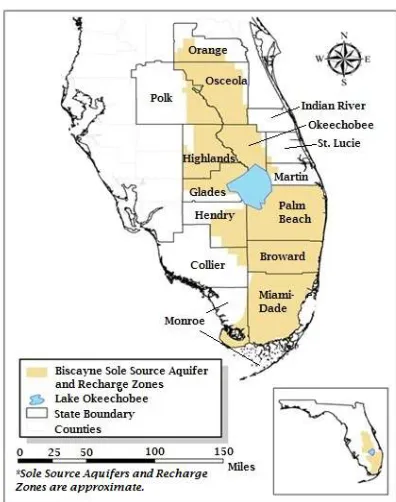
Because the Biscayne Aquifer is porous and close to the surface, it is easily replenished by
The Journal of Science Policy and Governance South Florida Groundwater – Technological and Policy Solutions for an Unsustainable Thirst
11
Figure 7. Biscayne Aquifer Recharge Zones (Environmental Protection Agency [EPA], 2010).
Figure 8 shows the differences in population density in South Florida from 1980 to 2000. By
comparing Figures 7 and 8, it can be seen that much of the recharge area of the Biscayne Aquifer
has experienced increases in population density. Although exact figures are not available, it is
reasonable to assume that this increase in population density has led to an increase in impervious
areas and a subsequent decrease in recharge rates for the Biscayne Aquifer, in a similar
The Journal of Science Policy and Governance South Florida Groundwater – Technological and Policy Solutions for an Unsustainable Thirst
12
Figure 8. Population density in 1980 (left) versus 2000 (right). Darker colors indicate higher densities (9ational Atlas of the United States, 2010).
Threats and risks to groundwater
Contamination
The effect of increased imperviousness as a result of urbanization on aquifer recharge was
outlined above. However, increased imperviousness can decrease the amount of water recharging
the aquifer, but it can also increase the amount of storm water runoff. Urban runoff tends to have
much higher levels of contaminants, so this storm water runoff is more polluted than what the
runoff would have been from a natural surface. In South Florida, this contaminated runoff can
enter the aquifers through streams and canals. Though overall water quality in the Everglades has
not changed substantially due to the natural ability of the ecosystem to “clean” water, areas
where excess water is pumped into the wetlands from flood-prone agricultural and urban areas
has seen drops in water quality (McPherson, Hendrix, Klein & Tyus, 1976, p. 69). During times
of drought, nutrient levels also tend to be above normal, especially in regions linked to
agriculture (Perry, 2008, p. 569). Additionally, during rain events it is common that regulatory
standards for contaminants such as fecal coliform are exceeded on Florida beaches (Brownell et al, 2007, p. 3747). Several bodies of surface water in Florida were placed on the 303(d) List in 1998, indicating that these areas do not meet water quality standards as specified by the Clean
Water Act (FDEP, 2010a). Because of surface-ground water interactions, the presence of
The Journal of Science Policy and Governance South Florida Groundwater – Technological and Policy Solutions for an Unsustainable Thirst
13
Groundwater can also be polluted directly by chemicals. Fertilizers used above ground or leaks
in underground sewage and industrial waste tanks and pipes can leech contaminants into the
groundwater systems (Harvey & McCormick, 2009, p. 185). The Floridan aquifer system is
especially vulnerable to leeching contaminants because of the numerous springs and sinkholes
over it, which provide a direct line into the groundwater system (USGS, 2010a). In the northern
portion of the state, the upper level of the Floridan is also vulnerable due to the lack of a
confining layer above it. The Biscayne Aquifer is especially susceptible to contamination from
leaks and spills because it is highly permeable (USGS, 2009). Pollutants can easily seep through
the ground or enter through the numerous canals that run over the aquifer. Figure 9 shows an
example of instances from private wells where two different contaminants were found in levels
exceeding acceptable concentrations. Instances of both contaminants are clustered around
predominantly agricultural areas above the surficial aquifer. This means a high amount of
contaminants leeching into a highly permeable groundwater source – something that could easily
occur in South Florida over the Biscayne Aquifer.
The Journal of Science Policy and Governance South Florida Groundwater – Technological and Policy Solutions for an Unsustainable Thirst
14
Aquifers can also be contaminated by saltwater. When water levels get low enough near the
coast, saltwater encroaches into the aquifer underground or through canals – a process known as
saltwater intrusion (Miller, 1990). If this occurs, that portion of the aquifer may be unfit for
potable use without costly desalination treatment.
Saltwater intrusion is a very real threat in South Florida due to the Biscayne Aquifer’s highly
permeable edges and proximity to both the coast and miles of human-constructed canals. In early
November 2010, the SFWMD began planning for the possible effects of climate change, with the
main threat to the water supply being seawater leaking into groundwater as the surrounding
ocean level rises (Climate Signals, 2010). This kind of contamination can also be directly linked
to depletion - namely, lowering groundwater levels through pumping or drainage canals creates
an imbalance that causes saltwater to intrude inland (Miller, 1990). Data from a USGS report on
groundwater in Florida (see Figure 10) shows the how the saltwater intrusion phenomenon
works. Because most of the drinking water in South Florida comes from groundwater, and the
groundwater supply is close to the surface below very permeable layers of limestone, the
drinking water supply in the Biscayne Aquifer is particularly susceptible to saltwater
The Journal of Science Policy and Governance South Florida Groundwater – Technological and Policy Solutions for an Unsustainable Thirst
15
Figure 10. Saltwater intrusion mechanisms (Miller, 1990).
Contamination by chemical (such as fertilizer or industrial wastes) or biological (such as sewage)
contaminants is a threat to South Florida’s surface and groundwater supplies. In 2008, testing by
the Florida Department of Environmental Protection (FDEP) found large regions of surface
water were contaminated by sewage, fertilizer or manure pollution (Florida Water Coalition,
2010). Wetland ecosystems, such as the Everglades, traditionally influence groundwater recharge
and discharge, sediment and toxicant retention, and nutrient processing/water quality (Maltby &
Dugan, 1994, p. 33). However, with degradation of the Everglades and increased loadings and
stressors, some parts of the aquifers have already been tainted by these contaminants, as well as
The Journal of Science Policy and Governance South Florida Groundwater – Technological and Policy Solutions for an Unsustainable Thirst
16
areas of South Florida contains nutrients and coliform bacteria from septic tanks and seepage
from polluted canals (McPherson, Hendrix, Klein & Tyus, 1976, p. 72). In the past, programs
have intentionally disposed of treated and semi-treated wastewater in the deeper parts of the
Floridan aquifer (Garcia-Bengochea & Vernon, 1970, p. 1454).
Depletion
As discussed above, depletion of water sources can exacerbate saltwater contamination.
However, depletion also causes other problems. From 1950 to 2000, total withdrawals from the
Floridan Aquifer (including withdrawals by other states) increased by 500 percent (Berndt &
Marella, 2005, p. 14). Figure 11 shows how total groundwater withdrawals in Florida have
increased, in comparison with somewhat steady surface water withdrawals.
Figure 11. Total freshwater withdrawals in Florida (USGS, 2010a).
Figure 12 demonstrates the change in groundwater freshwater and saline withdrawals as well as
The Journal of Science Policy and Governance South Florida Groundwater – Technological and Policy Solutions for an Unsustainable Thirst
17
Figure 12. Comparison of 1985 (left panels) and 2005 (right panels) levels of freshwater groundwater withdrawals (A), saline groundwater withdrawals (B) and public supply freshwater groundwater
withdrawals (C) (9ational Atlas of the United States, 2010).
A
B
The Journal of Science Policy and Governance South Florida Groundwater – Technological and Policy Solutions for an Unsustainable Thirst
18
In the 1980s, the Tampa Bay region experienced the effect of groundwater depletion firsthand
when Pinellas County pumped too much groundwater and was forced to build a $158 million
seawater desalination plant to meet the area’s water needs (Goodnough, 2007).
As mentioned previously, of the five water districts in Florida, the SFWMD withdraws the
largest amount of freshwater (USGS, 2010a). SFWMD has traditionally received all of its
groundwater from the Biscayne Aquifer, but has recently also began to withdraw from the
Floridan Aquifer, as requests for additional permits to withdraw from the Biscayne Aquifer were
denied in 2005. This decision spurred the Miami-Dade Water and Sewer Department to develop
a new plan that includes the (expensive) desalination of brackish water from the Floridan aquifer
in order to meet South Florida water demand (Jackson, 2010), (USGS, 2010b). Excessive
groundwater pumping has lowered water levels in lakes and wetlands and reduced river and
spring flows, harming ecosystems as well as recreation (SFWMD, 2010b). Lowering the
water-table also accelerates sinkhole formation (Cervone, 2003).
Water is essential for human and economic activities and in Florida approximately 60 percent of
the total freshwater supply comes from groundwater (FDEP, 2008). This water is utilized for a
variety of purposes, as can be seen in Figure 13. With aquifers providing 90 percent of the state's
drinking water and more than 60 percent of the state's freshwater usage in agriculture and
industry (a majority of the non-potable demand), depletion or contamination of South Florida’s
fresh groundwater resources is a significant threat to the health and prosperity of the population
The Journal of Science Policy and Governance South Florida Groundwater – Technological and Policy Solutions for an Unsustainable Thirst
19
Figure 13. Uses of freshwater in Florida (USGS, 2010a).
Current Water Supply Mitigation Projects
SFWMD is currently seeking “alternative supply” projects to help reduce demand on South
Florida’s groundwater. In 2005, the state legislature enacted the Water Protection and
Sustainability Program to encourage protection, cooperation and the development of alternate
supply projects (SFWMD, 2010c). This program has funded development projects to increase
saltwater and brackish water supplies, water reuse, storm water usage, and any other source
designated as nontraditional in a regional water supply plan. Additional projects are being
developed in other areas to protect existing aquifer stores. It is estimated that by 2025 Floridians
will use an additional 2.0 billion gallons of water per day, with much of this increased demand
occurring within the SFWMD. Florida’s water management districts identified 327 alternative
water supply projects that hope to receive funding from the Water Protection and Sustainability
Trust Fund. When all the projects are completed, they will provide an additional 761 million
The Journal of Science Policy and Governance South Florida Groundwater – Technological and Policy Solutions for an Unsustainable Thirst
20
canceled due to the current economic climate. Even if all the projects still on the table were
completed, they would be adding less than 40 percent of the expected 2025 demand (FDEP,
2010b, p. 2).
Contamination Prevention
To prevent saltwater encroachment via canals, several large barriers have been constructed at the
coastal ends of the canals. These canal-control structures can be lowered when the water levels
drop low enough to allow saltwater intrusion, preventing saltwater from moving up the canals
(Miller, 1990). The majority of salt-water intrusion actually occurred before 1946, when these
control structures were not in place. However, since 1952, the structures have been used to
stabilize the salt-water intrusion and to manage flooding and groundwater level changes (USGS,
2004).
Desalination
There are currently 30 brackish and two seawater desalination plants in South Florida, with
seven additional brackish plants under construction. Within the next few years, these desalination
plants will have the capacity to produce 250 million gallons of potable water daily (SFWMD,
2010d).
Water Reuse
Water reuse eases demand on traditional sources of water, and is especially popular in South
Florida for irrigating golf courses and other landscaped areas, washing cars, and filling ponds
(SFWMD, 2010e). Despite the SFWMD’s stated intent to increase reuse, a 2004 FDEP report
The Journal of Science Policy and Governance South Florida Groundwater – Technological and Policy Solutions for an Unsustainable Thirst
21
supply demand per capita (FDEP, 2004). In 2009, while some areas of South Florida had 100
percent reuse (Kissimmee), others, such as the Lower East Coast area of the SFWMD (which
includes Miami-Dade, Broward, Monroe, and Palm Beach counties), reused far less than this
(between 4 and 35 percent) (FDEP, 2009b). Overall, the district only reused 29.1 percent of
wastewater, an improvement from 2003, but still below the state overall reuse of 43.3 percent.
Wastewater from Broward and Miami-Dade counties alone counts for 63 percent of wastewater
treated by SFWMD, but only 6 percent of that is reused (SFWMD, 2010e). Thus, this is one
currently operating mitigation strategy that could be drastically improved.
Aquifer Storage and Recovery
Aquifer Storage and Recovery (ASR) entails injecting and storing water in an aquifer during
times of excess so that it can later be recovered during times of drought. ASR has been used in
Florida for decades, and most Florida facilities store water in the upper Floridan Aquifer, where
the aquifer is brackish or saline. SFWMD is working with the U.S. Army Corps of Engineers to
conduct pilot tests on two ASR systems in order to determine how ASR can be used in the
Comprehensive Everglades Restoration Plan (CERP).
Water Reservations
SFWMD is developing water reservations to “secure the long-term availability of water” for
environmental reasons: “when a water reservation rule is in place, volumes and timing of water
at specific locations are protected for the natural system ahead of new consumptive uses such as
The Journal of Science Policy and Governance South Florida Groundwater – Technological and Policy Solutions for an Unsustainable Thirst
22
Everglades Restoration
In 2000, local, state, and federal decision-makers approved a plan to “restore the Everglades”
(Layzer, 2006, p. 404). Florida is now working towards this restoration, with the goals of
improving aquifer levels, biodiversity, and water quality. While the destruction of the Everglades
caused many problems, from increased contaminant loading to altering the natural flow of water,
one of the major changes was altering the use of area that previously was able to allow slow
seepage of rain and marsh water in order to replenish the aquifers. If the Everglades are
successfully restored, this will greatly improve the replenishment of the aquifers in the area.
The Comprehensive Everglades Restoration Plan (CERP) includes expansion of water supplies
to restore the environment and partially meet the needs of a growing population. CERP plans to
build 18 reservoirs along with many innovative alternative water supplies (FC100, 2003, p. 5).
Water Restrictions
SFWMD encourages regulations to restrict water use, especially in times of minimal rainfall.
Currently, there is a Year-Round Conservation Measures Landscape Irrigation rule in place,
which establishes limits on landscape watering; however, county and city ordinances can differ
from what SFWMD suggests (SFWMD, 2010g). Restrictions are fairly short-term solutions for
low supply periods.
Water Conservation
Conservation is one of the easiest ways to reduce demand for groundwater. SFWMD has several
tools available online to help residents conserve, from tips and suggestions to a water use
The Journal of Science Policy and Governance South Florida Groundwater – Technological and Policy Solutions for an Unsustainable Thirst
23
rates in the state, using 179 gallons per day compared to the state average of 158 gallons per day,
so there is large scope for improvement in water conservation (SFWMD, 2008, p. 3). It is
estimated that in South Florida as much as half of this usage goes towards outdoor irrigation, and
that up to 50 percent of that water is lost to evaporation (SFWMD, 2008, p. 3). While several
counties in the SFWMD, such as Miami-Dade and Broward, have year-round twice-a-week
landscaping limits, other counties, such as Palm Beach, and some cities, such as Ft. Lauderdale,
are allowing watering three-times-a-week. The SFWMD has suggested that switching to
twice-a-week landscape irrigation across the entire district could reduce overall demand by up to 10
percent. Given current practices, mandates on irrigation may be one of the best ways to reduce
wasteful watering and conserve water. However, even a 10 percent reduction in demand will not
make up for the anticipated population growth and unsustainable demand. This area is one in
which local authorities and SFWMD can achieve significant results by first establishing
regulations that curb wasteful water practices, and then by targeting resident behavior with
regard to water conservation. More consumer information on xeriscaping, conservative plumbing
fixtures, and water costs (such as installing easy to read meters so residents can monitor their
own usage easily) could all help to conserve water.
Alternative Solutions and Policy Implications
Change Agricultural Practices
Currently, agricultural demands for freshwater are substantial, and they draw extensively from
groundwater sources (Marella, 2010, p. 1). If reused water could be used for irrigation, this
would free up aquifer water for potable uses. While the use of semi-treated wastewater (or
The Journal of Science Policy and Governance South Florida Groundwater – Technological and Policy Solutions for an Unsustainable Thirst
24
the SFWMD, it is not being utilized to the full extent possible. Importantly, developing the reuse
program enough to offset agricultural demand will face several logistical hurdles. Large-scale
greywater distribution systems would need to be installed in order to adequately meet crop
needs. Whether the state or the farmer pays for this distribution system, it will take some time
before the infrastructure is available. The larger this distribution system, and the more farms it
must reach, the longer this lag time will be. Additionally, given current reuse rates, it may not be
possible to distribute reused water to all farms, so a way of fairly determining which farms
receive reused water must be developed.
Agricultural practices in South Florida have the potential to be adjusted to use less water. Some
farmers have been able to use vertical planters to conserve water, and the movement for “vertical
farms” in urban settings is growing (Despommier, 2011, Wagner, 2010). The principle behind
vertical planting is that by growing plants in vertical compartments the farmer is able to achieve
a much greater planting density while using less water than a traditional farm. In 2008, SFWMD
used funds from the WaterSIP program to help fund one such project at Hydro Fresh Farms in
Fort Pierce. The project cost approximately $120,000, but increased the farm’s capacity by
40,000 plants while decreasing the water usage by nearly 40 million gallons a year (SFWMD,
2011). While a complete shift to vertical farms may be unrealistic for immediate implementation,
using hydroponic, hydro-stacking, and other vertical growing mechanisms can drastically reduce
water needs. Vertical planters and other conservation tools can save water, but they also come
with a price to implement. In policy terms, this will likely require incentives for farmers and
agricultural corporations to invest in the upfront cost of these technologies, as the potential cost
savings as a result of the decreased water use may not initially be large (given relatively cheap
The Journal of Science Policy and Governance South Florida Groundwater – Technological and Policy Solutions for an Unsustainable Thirst
25
Water Savings Investment Program (Water SIP) to subsidize the technology shift, which could
potentially be applied to other farms and perhaps supplemented by federal funding. The Natural
Resources Conservation Service will be providing $74 million for fiscal year 2011 and $60
million for fiscal year 2012 on for the Agricultural Water Enhancement Program (AWEP)
(Natural Resources Conservation Service [NRCS], 2011). AWEP is already being used to fund
projects in Florida intended to reduce water use (and specifically groundwater withdrawals) by
changing irrigation methods. Additionally, the Everglades is considered a priority region for
AWEP, and thus may be more likely to receive AWEP funding (NRCS, 2009, p. 1). Further
reliance on AWEP to change agricultural practices is a reasonable goal.
Genetically engineered (also known as genetically modified, or GM) crops also have the
potential to help reduce agricultural water demands. On a global level, such technologies have
been on the UN agenda since the Swedish report “Water – More Nutrition Per Drop” was
released in 2004 (“Study advocates water-conserving GM crops”, 2004). GM crops such as
tropical maize are already widespread across the world, and even rank in the top as far as
demand and importance in international agriculture (Anami, De Block, Machuka & Lijsebettens,
2009, p. 17). The initial development of new GM crops does necessitate capital costs, but these
could be addressed using the same mechanisms discussed above. Genetically engineered crops
must additionally overcome social obstacles, as there is an ongoing debate over the safety and
nutrition of genetically engineered crops (“Are genetically modified crops safe?”, 2006). The
state (or federal) government would have to conduct research and develop stringent regulations
to provide conclusive data on the safety of these products before some American consumers
would be willing to accept the product. An alternative to GMO crops would be to switch to less
The Journal of Science Policy and Governance South Florida Groundwater – Technological and Policy Solutions for an Unsustainable Thirst
26
limited barriers to market entry compared to GMOs, yet use less water than current crops. On a
similar note, the method of irrigation can greatly reduce water use. In the 1990s, citrus crop
irrigation shifted from flooding techniques to a practice known as micro-irrigation. In 2001,
when 80% of citrus crops were watered using micro-irrigation, this resulted in water savings of
90 billion gallons (Hassell, 2004). Yet, only 31 percent of Florida’s crops are watered using
micro-irrigation, and over 50 percent are watered using water-intensive “seepage” methods such
as flood irrigation (York, Parsons & Walker-Coleman, 2000, p. 2).
Managing Population Growth
One of the biggest problems facing South Florida stems from the fact that the population in the
region is booming. Stricter zoning and permitting requirements could slow the growth in South
Florida until more sustainable water sources are found. In the United States two main kinds of
regulations have been used in an attempt to slow population growth/urbanization: locally
imposing urban containment policies to control the amount and type of settlement in a certain
region, and state-mandated growth management requirements for local governments (Wassmer,
2006, p. 25).The State of Florida has a growth management plan that is vertically, horizontally,
and internally consistent, and findings have shown that it may be able to reduce urban area
(Wassmer, 2006, p. 32, 34).The question is whether this reduction in urban area will be (a)
enough to alleviate water issues and (b) uniform across the state. As with many resources,
decreasing use in one place often leads to an increase elsewhere, and if this increase continues to
be in South Florida, the growth management plan will be ineffective at helping conserve South
The Journal of Science Policy and Governance South Florida Groundwater – Technological and Policy Solutions for an Unsustainable Thirst
27
Even if growth is stopped, the question of whether there is a way to shrink our ecological
footprint remains. A government buyback of property, especially given the current housing
market, could remove land from urban use and allow for restoration. Land purchasing programs
could be especially effective around the borders of the Everglades, where restoration projects and
the Everglades Land Acquisition project are already underway (SFWMD, 2009). The
government could also purchase land around hazardous sites, retired landfills, wastewater
treatment plants, and other areas generally perceived to have less market value. These areas are
also where there tends to be social injustice as a result of environmental damage – so-called
‘environmental injustice’ - and providing fair prices to residents could help alleviate some of
these issues (Bullard, Mohai, Saha & Wright, 2007, p. vii).
A policy to slow or even stop and reverse population growth in South Florida will be politically
difficult. In addition to the logistical problems of how to best control growth without harming the economy, there are also social implications, and additionally, the policy must outweigh people’s
desire to live in the ‘Sunshine State’ and along South Florida’s white beaches. History has shown
that Florida’s population growth is surprisingly steadfast – despite a crumbling housing market
and the recession, Florida remained one of the fastest-growing states in the nation (Parker, 2010).
Pipeline construction
A common saying in Florida is “80 percent of the population and public consumption is south of
I-4; 80 percent of the water resources are north of I-4.”(FC100, 2003, p.17) One idea for how to
alleviate water stress in the southern portion of the state is to create a pipeline that would bring
water down from the northern portion of the state. However, this approach faces significant
The Journal of Science Policy and Governance South Florida Groundwater – Technological and Policy Solutions for an Unsustainable Thirst
28
not without their own water struggles. In addition, it is feared that this is not a sustainable
solution and that moving large amounts of water without addressing consumption will simply
expand the area facing water supply shortages in the future 2 (Pittman, 2009), (“Worst fears realized”, 2003).
Cisterns
Up until World War II, a major part of South Florida - the Florida Keys - received water only
from rain. A recent movement in the Keys has led to an increased interest in cisterns, which are
essentially storage tanks that collect rainwater (Conklin, 2008). Cisterns (or other rainwater
harvesting mechanisms) are easy to implement in new construction and renovation projects
(Yudelson, 2010). Marco Island has looked into using grants from the SFWMD Water SIP to
fund cisterns. They note that “… the average number of rain events sufficient to fill a cistern is 7
events during the 8-month dry season, and 14 events during the wet season. The total number of
rain events during the rainy season has averaged over 60 events of various volumes each year for
5 years. This indicates that very limited, if any, supplemental irrigation is needed during this wet
period.” (City of Marco Island, 2010)Cisterns are a very practical solution to offset the public
water supply. An average sized 1,200 square foot roof can harvest as much as 50 thousand
gallons of water per year in South Florida (Boshears, 2010). If hypothetically approximately two
million of SFWMD’s constituents installed cisterns with collection rates on this scale, this would
offset 100 billion gallons of water each year - approximately 10 percent of SFWMD’s current
withdrawal, and almost 14 percent of the entire state’s 2025 increased demand. If all 7.5 million
South Florida residents installed cisterns with collection rates on this scale, the collected
rainwater would meet over 50 percent of Florida’s 2025 increased demand.
The Journal of Science Policy and Governance South Florida Groundwater – Technological and Policy Solutions for an Unsustainable Thirst
29
A study conducted jointly by four of Florida’s five water management districts found that water
use decreases with increases in water price, and that a utility can decrease water use without
decreasing profits by taking advantage of this revised pricing structure (Southwest Florida Water
Management District, 2011). Raising the price of water in Florida is not unreasonable – the state
currently has some of the lowest rates in the nation. Compared to a city like Houston, which is
similar in climate to much of South Florida, Florida’s average water bill is almost a third of that
of Houston (SFWMD, 2008, p. 3).
Conclusions and Relevance
Headlines such as “Drought just tip of water problems” and “Florida Faces Vanishing Water
Supply” are becoming more and more common in South Florida, despite the state’s natural
abundance of rain and pristine groundwater sources (Crabbe, 2008; NPR, 2007). Current
measures, though helpful, have not been able to fully balance the system such that human and
ecosystem demands do not exceed natural supplies. However, many more solutions could be
pursued to help protect and sustain South Florida’s groundwater. In this paper, we have
discussed some of these potential solutions and examined the technical and political factors that
may affect their introduction.
Unfortunately, the problems facing South Florida are not unique. Figure 14 shows a map and
The Journal of Science Policy and Governance South Florida Groundwater – Technological and Policy Solutions for an Unsustainable Thirst
30
Figure 14. This map shows where saltwater is intruding into freshwater wells along the Atlantic coast. Saltwater intrusion is a naturally occurring phenomenon, but over- pumping of groundwater to meet rapid
population growth has aggravated the problem for many Eastern cities (9PR, 2007).
Florida needs to take decisive actions to find alternative water supply sources before it is too late.
Communities along the Colorado River Basin and in parts of the Northeast, among others, are
considering similar questions – what can be done to protect our groundwater, where can we draw
from to meet our public, agricultural, and industrial demands, and ultimately, are we going to run
The Journal of Science Policy and Governance South Florida Groundwater – Technological and Policy Solutions for an Unsustainable Thirst
31
9otes
1 Based on an average annual rainfall of 54 inches,i the area of Florida being 58,560 square miles,ii the size of
an Olympic swimming pool as 2,500 m3,iii and 365 days in a year.
2 See http://www.whoseflorida.com/misc_pages/bad_idea_for_florida_water.htm or
The Journal of Science Policy and Governance South Florida Groundwater – Technological and Policy Solutions for an Unsustainable Thirst
32
References
Anami, S., De Block, M., Machuka, J. & Van Lijsebettens, M. (2009). Molecular improvement of
tropical maize for drought stress tolerance in sub-Saharan Africa. Critical Reviews in Plant Sciences
28: 1/2: p.16-35.
Are genetically modified crops safe? (2006). "PR. Retrieved from <http://www.npr.org/templates/story/
story.php?storyId=5386438>.
Berndt, M.P. & Marella, R.L. (2005). Water withdrawals and trends from the Floridan aquifer system
in the southeastern United States, 1950-2000. US Geological Survey. Retrieved from <http://pubs.usgs.gov/circ/2005/1278/pdf/cir1278.pdf>.
Boshears, A. (2010) Cisterns could help south Florida’s water crisis. Pompano Today. Retrieved from
<http://www.pompanotoday.com/past-issues-of-pompano-toda/2010-10-issue/south-florida-water-management.html>.
Brownell, M.J., Harwood, V.J., Kurz, R.C., McQuaig, S.M., Lukasik, J. and Scott, T.M. (2007) Confirmation of
putative stormwater impact on water quality at a Florida beach by microbial source tracking methods and
structure of indicator organism populations. Water Research. 41(16), P. 3747-3757.
Bullard, R., Mohai, P., Saha, R. & Wright, B. (2007). Toxic wastes and race at twenty: 1987-2007. United
Church of Christ, 2007. Retrieved from <http://www.ucc.org/assets/pdfs/toxic20.pdf>.
Cervone, S. (2003). Aquifers. Center for Aquatic and Invasive Plants, University of Florida and the Bureau of
Invasive Plant Management, Florida Department of Environmental Protection. Retrieved from
<http://plants.ifas.ufl.edu/guide/aquifers.html>.
City of Marco Island. (2010). Retrieved from <http://www.cityofmarcoisland.com/
Public_Documents/MarcoIslandFL_DPW/cistern>
ClimateSignals. (2010). Sea level rise approaching ground water in south Florida. Retrieved from
<http://climatesignals.org/2010/11/sea-level-rise-approaching-ground-water-in-south-florida/>.
Conklin, D. (2008, May) Cisterns making a comeback. Keys Sunday. Retrieved from
<http://www.keysnet.com/2008/05/26/4221/cisterns-making-a-comeback.html>.
Crabbe, N. (2008, February). Drought just tip of water problems. The Gainesville Sun. Retrieved from
<http://www.gainesville.com/article/20080228/NEWS/802280316?p=1&tc=pg&tc=ar>.
Despommier, D. The Vertical Farm. Retrieved from <http://www.verticalfarm.com/> on 19 January 2011.
Environmental Protection Agency (EPA). (2010). Sole source aquifers in the southeast. Retrieved from
<http://www.epa.gov/region4/water/groundwater/r4ssa.html>.
Fédération Internationale de Natation. (2009) FI"A Facilities Rules 2009-2013. Retrieved from
<http://www.fina.org/project/index.php?option=com_content&task=view&id=51&Itemid =119>.
Florida Council of 100 (FC100). (2003). Improving Florida’s water supply management structure. Retrieved from
The Journal of Science Policy and Governance South Florida Groundwater – Technological and Policy Solutions for an Unsustainable Thirst
33
Florida Department of Environmental Protection (FDEP). (2004). Florida Water Plan: 2003 Annual Progress
Report. Retrieved from <http://www.dep.state.fl.us/water/waterpolicy/docs/ FWP_AnnualProgressReport_2003.pdf>.
FDEP. (2007). Aquifers. Retrieved from <http://www.dep.state.fl.us/swapp/aquifer.asp>.
FDEP. (2008). What is ground water? Retreived from <http://www.dep.state.fl.us/water/groundwater/whatis.htm>.
FDEP. (2009a). Florida drought conditions - frequently asked questions. Retrieved from
<http://www.dep.state.fl.us/Drought/faq.htm>.
FDEP. (2009b). 2009 SFWMD reuse by planning region. Retrieved from <http://www.sfwmd.gov/portal/
page/portal/xrepository/sfwmd_repository_pdf/reusebyplanningarea2009.pdf>.
FDEP. (2010a). 309(d) Rule/List – Watershed Assessment Program. Retrieved from
<http://www.dep.state.fl.us/water/watersheds/assessment/303drule.htm>.
FDEP. (2010b). Sustaining our water resources: Annual report on regional water supply planning, March 2010.
Retrieved from <http://www.dep.state.fl.us/water/waterpolicy/docs/sustaining-our-water-resources.pdf>.
Florida Department of Health. Drinking water toxic programs. Retrieved from
<http://www.doh.state.fl.us/environment/water/> on 16 November 2010.
Florida Water Coalition. It’s time to end the slime. Retrieved from <http://floridawatercoalition.org/>. on 16
November 2010.
García-Bengochea, J.I. & Vernon, R.O. (1970). Deep well disposal of waste waters in saline aquifers of south
Florida. Water Resources Research. 6(5), p. 1464-1470.
Goodnough, A. (2007, June 19). Florida is slow to see the need to save water. The "ew York Times.
Grubbs, J.W. (1998). Recharge rates to the upper Floridan Aquifer in the Suwannee River Water Management
District, Florida. USGS & Suwannee River Water Management District, Tallahassee, FL & Denver, CO. Harvey, J.W. & McCormick, P.V. (2009). Groundwater’s significance to changing hydrology, water chemistry and
biological communities of a floodplain ecosystem, Everglades, South Florida, USA. Hydrogeology
Journal. 17, p. 185-201.
Hassell, B. (2004) Plant management in Florida waters – Florida agriculture and water use. Center for Aquatic &
Invasive Plants, University of Florida. Retrieved from <http://plants.ifas.ufl.edu/guide/agricul.html>.
How big is Florida? (2005) Retrieved from <http://myflorida.custhelp.com/>.
Ingebritsen, S.E., McVoy C., Glaz, B. & Park, W. (1999) Florida Everglades. USGS Circular 1182, p. 96. United
States Geological Survey, Reston, VA.
Jackson, N. (2010) I’ll drink to that. American City & Country 125.10.
Layzer, J.A. (2006) The environmental case: translating values into policy. 2nd ed. Washington, D.C.: CQ
Press.
Light, S.S. & Dineen, J.W. (1994) Water control in the Everglades: a historical perspective. In S.M Davis & J.C.
The Journal of Science Policy and Governance South Florida Groundwater – Technological and Policy Solutions for an Unsustainable Thirst
34
Maltby, E. & Dugan, P.J. (1994) Wetland ecosystem protection, management & restoration: an international
perspective. In S.M Davis & J.C. Ogden (Eds.) Everglades: the ecosystem and its restoration. (p. 29-46). St
Lucie Press, Boca Raton, FL.
Marella, R.L. (2010). Water withdrawals, use, and trends in Florida, 2005. USGS and FDEP. Retrieved from
<http://pubs.usgs.gov/sir/2009/5125/>.
McPherson, B.F., Hendrix, C.Y., Klein H. & Tyus, H.M. (1976). The Environment of South Florida, a summary
report. Geological Survey Professional Paper 1011. US Geological Survey. Retrieved from <http://sofia.usgs.gov/publications/papers/pp1011/pp1011.pdf>.
Miller, J.A. (1990) Ground water atlas of the United States: Alabama, Florida, Georgia, South Carolina, HA
730-G. US Geological Survey, Reston, VA. Retrieved from<http://pubs.usgs.gov/ha/ha730/ch_g/ index.html>.
National Atlas of the United States: Map Maker. Retrieved from <http://nationalatlas.gov/mapmaker> on 16
November 2010.
Natural Resources Conservation Service (NRCS). (2009) Approved AWEP priority areas. US Department of
Agriculture. Retrieved from
http://www.nrcs.usda.gov/programs/awep/pdf_files/AWEP-PriorityAreas_4-28-09.pdf>.
NRCS. (2011) Agricultural Water Enhancement Program.US Department of Agriculture. Retrieved from
<http://www.nrcs.usda.gov/programs/awep/index.html>.
Natural Resources Defense Council. (2010). Climate change, water, and risk: current water demands are not
sustainable. Retrieved from<http://www.nrdc.org/globalwarming/watersustainability/files/ WaterRisk.pdf>.
North Carolina Department of Environment & Natural Resources. (2007) "CDE"R Stormwater BMP manual.
Raleigh, NC. Retrieved from
<http://portal.ncdenr.org/c/document_library/get_file?uuid=a85cdd45-7f1f-44d8-9921-babea9478516&groupId=38364>
NPR. (2007). Florida faces vanishing water supply. Retrieved from <http://www.npr.org/templates/
story/story.php?storyId=11097869>.
Parker, L. (2010, December 24) Florida growth not so slow after all. AOL "ews. Retrieved from
<http://www.aolnews.com/2010/12/24/florida-population-growth-not-so-slow-after-all-census-shows/>.
Perry, W.B. (2008) Everglades restoration and water quality challenges in south Florida. Ecotoxicology. 17,
p.569-578.
Pittman, C. (2009). Plan re-emerges to shift water resources across Florida. St. Petersburg Times. Retrieved from
<http://www.tampabay.com/news/environment/water/plan-re-emerges-to-shift-water-resources-across-florida/1048261>.
South Florida Water Management District (SFWMD). (2008) Water conservation – a comprehensive plan for South
Florida. Retrieved from <http://www.sfwmd.gov/portal/page/portal/xrepository/sfwmd_repository_pdf/ waterconservationplan.pdf>
The Journal of Science Policy and Governance South Florida Groundwater – Technological and Policy Solutions for an Unsustainable Thirst
35
<https://my.sfwmd.gov/portal/page/portal/common/newsr/rog_briefing_leg_comm_mtgs_01092009.pdf>.
SFWMD. (2010a). About us. Retrieved from <http://www.sfwmd.gov/portal/page/portal/
xweb%20about%20us/sfwmd%20about%20us>.
SFWMD. (2010b). Water supply. Retrieved from <http://www.swfwmd.state.fl.us/
publications/files/watersupply.pdf>.
SFWMD. (2010c). Alternative water supply. Retrieved from
<http://www.sfwmd.gov/portal/page/portal/xweb%20-%20release%203%20water%20supply/alternative%20water%20supply>.
SFWMD. (2010d) Desalination. Retrieved from
<http://www.sfwmd.gov/portal/page/portal/xweb%20-20release%203%20water%20supply/desalination>.
SFWMD. (2010e). Water reuse. Retrieved from
<http://www.sfwmd.gov/portal/page/portal/xweb%20-%20release%203%20water%20supply/reuse>.
SFWMD. (2010f). Water reservations.Retrieved from <http://www.sfwmd.gov/portal/page/portal/
xweb%20protecting%20and%20restoring/other%20(kissimmee)>.
SFWMD. (2010g). Year-round conservation measures. Retrieved from <http://www.sfwmd.gov/portal/page/
portal/xweb%20-%20release%203%20water%20conservation/year%20round%20irrigation%20rule>.
SFWMD. (2011). Water conservation – WaterSIP. Retrieved from
<http://www.sfwmd.gov/portal/page/portal/levelthree/water%20conservation#sip>.
Southwest Florida Water Management District. (2011). Water rates: conserving water and protecting revenues.
Retrieved from <http://www.swfwmd.state.fl.us/conservation/waterrates/>.
Stankowski, S.J. (1972). Population density as an indirect indicator of urban and suburban land-surface
modifications. In Geological Survey Professional Paper 800-B. US Geological Survey, Washington, D.C.
Study advocates water-conserving GM crops. (2004). Asia Pacific Biotech "ews 8.12: 651.
United States Geological Survey (USGS). (2004) Managing the water system. USGS South Florida Information
Access. Retrieved from <http://sofia.usgs.gov/publications/reports/rali/waterprob.html>.
USGS. (2009). Ground water atlas of the United States – Alabama, Florida, Georgia, South Carolina. Biscayne
Aquifer. HA 730-G. Retrieved from http://pubs.usgs.gov/ha/ha730/ch_g/G-text4.html
USGS. (2010a). Water-use facts for 2005 and trends. USGS Florida Water Science Center. Retrieved from
<http://fl.water.usgs.gov/infodata/wateruse/waterusefacts2005.html>.
USGS. (2010b). Floridan aquifer system groundwater availability. Retrieved from
<http://fl.water.usgs.gov/FASWAM/index.html>.
USGS. (2010c). Regional assessment of groundwater quality in the Floridan, Biscayne, and Surficial aquifer
system. USGS National Water-Quality Assessment Program. Retireved from <http://water.usgs.gov/nawqa/studies/praq/flordn/index.html>.
USGS. (2010d). Floridan aquifer system groundwater availability: problem. Retrieved from
<http://fl.water.usgs.gov/FASWAM/problem.html>.
Wagner, C.G. (2010). Vertical farming: an idea whose time has come back. The Futurist. Retrieved from
The Journal of Science Policy and Governance South Florida Groundwater – Technological and Policy Solutions for an Unsustainable Thirst
36
Wassmer, R.W. (2006). The influence of local urban containment policies and statewide growth management on
the size of United States urban areas. Journal of Regional Science 46.1: 25-65.
Worst fears realized. (2003, October). The Gainseville Sun. Retrieved from <http://www.gainesville.com/
apps/pbcs.dll/article?AID=/20031003/EDITORIALS/210030316>.
York, D.W., Parsons, L.R., Walker-Coleman, L. (2000) Agricultural reuse: using reclaimed water to
irrigate edible crops in Florida. FDEP. Retrieved from <http://www.dep.state.fl.us/water/wqssp/docs/Crops.pdf>.
Yudelson, J. (2010) Opportunities abound for water technologies. Heating/Piping/Air Conditioning HPAC
The Journal of Science Policy and Governance South Florida Groundwater – Technological and Policy Solutions for an Unsustainable Thirst
37
About the Authors
Trisha Lowe will be graduating with her B.S.E. this May from Duke University in Durham, NC. She is majoring in Civil and Environmental Engineering, with a focus on environmental
engineering and water resources, and is part of the Energy and the Environment certificate program. During her senior year Trisha was a virtual intern with the Scientists and Engineers for America water security research group. Originally from the small island of Key West, FL, Trisha loves to travel, and recently spent a summer in Obrajes, Bolivia with Engineers Without Borders constructing a vehicular bridge.
After finishing his DPhil in 2009, Dr Wenham spent 3 months in Malawi, working as a volunteer teacher and teacher trainer in biology. He commenced his current position as a postdoctoral fellow at the US National Institutes of Health in January 2010, working on the interaction between pathogenic bacterial proteins and human cells at the National Institute for Diabetes and Digestive & Kidney Diseases. He has also worked as Science Policy Fellow with Scientists and Engineers for America, a non-profit organisation in Washington, DC that advocates for a greater role for scientists and engineers in the decision making process. He is currently a Fellow with the Institute on Science for Global Policy. Prior to leaving Australia, Dr Wenham was heavily involved in youth affairs, chairing a ministerial advisory council on youth affairs for the South Australian Government and receiving a Centenary Medal for services to the community in 2001. Matt has served in the Australian Army Reserve and is a graduate of the reserve officer