Available Online at www.ijpret.com
269
INTERNATIONAL JOURNAL OF PURE AND
APPLIED RESEARCH IN ENGINEERING AND
TECHNOLOGY
A PATH FOR HORIZING YOUR INNOVATIVE WORK
ANALYSIS OF HEAT TRANSFER THROUGH CIRCULAR DUCT USING INTERNAL
THREADS OF VARYING PITCH
SHUBHAM N DAMBIWAL, SUMEDHBODHI A DAHIWALE, MANGESH M SAWALKAR
Dept of Mech Engg., JDIET, YTL.
Accepted Date: 27/02/2014 ; Published Date: 01/05/2014
\
Abstract: The present paper focuses on Experimental analysis of heat transfer and friction
factor characteristics of horizontal circular duct using internal threads of pitch 10mm, 12mm and 16mm with air as the working fluid. The transitional flow regime is selected for this study with the Reynolds number range 7,000 to 14,000. The horizontal aluminum duct was subjected to constant and uniform heat flux. The experimental data obtained were compared with those obtained from plain Horizontal duct. The effects of internal threads of varying depth on heat transfer and friction factor were presented. Based on the same pumping power consumption, the duct with internal threads possesses the highest performance factors for turbulent flow. The heat transfer coefficient enhancement for internal threads is higher than that for plain duct for a given Reynolds number. The use of internal threads improved the performance of horizontal circular duct.
Keywords: Belt Conveyor, Design Modification, Failures.
Corresponding Author: MR. SHUBHAM N DAMBIWAL
Access Online On:
www.ijpret.com
How to Cite This Article:
Available Online at www.ijpret.com
270 INTRODUCTION
Heat exchangers are used in different processes ranging from conversion, utilization & recovery of thermal energy in various industrial, commercial & domestic applications. Some common examples include steam generation &condensation in power & cogeneration plants; sensible heating & cooling in thermal processing of chemical, pharmaceutical & agricultural products; fluid heating in manufacturing & waste heat recovery etc. Increase in Heat exchanger’s performance can lead to more economical design of heat exchanger which can help to make energy, material & cost savings related to a heat exchange process. The need to increase the thermal performance of heat exchangers, thereby effecting energy, material & cost savings have led to development & use of many techniques termed as Heat transfer Augmentation. These techniques are also referred as Heat transfer Enhancement or Intensification. Augmentation techniques increase convective heat transfer by reducing the thermal resistance in a heat exchanger. Use of Heat transfer enhancement techniques lead to increase in heat transfer coefficient but at the cost of increase in pressure drop. So, while designing a heat exchanger using any of these techniques, analysis of heat transfer rate &pressure drop has to be done. Apart from this, issues like long-term performance & detailed economic analysis of heat exchanger has to be studied. To achieve high heat transfer rate in an existing or new heat exchanger while taking care of the increased pumping power, several techniques have been proposed in recent years.
Available Online at www.ijpret.com
271 conductivity porous material subjected to oscillating flow is a new and effective method of cooling electronic devices. The experimental investigations of Hsieh and Liu reported that Nusselt numbers were between four and two times the bare values at low Re and high Re respectively. Bogdan and Abdulmajeed et al. numerically investigated the effect of metallic porous materials, inserted in a duct, on the rate of heat transfer. The duct was subjected to a constant and uniform heat flux. The effects of porosity, porous material diameter and thermal conductivity as well as Reynolds number on the heat transfer rate and pressure drop were investigated. The results were compared with the clear flow case where no porous material was used. The results obtained lead to the conclusion that higher heat transfer rates can be achieved using porous inserts at the expense of a reasonable pressure drop. Smith et. al. investigated the heat transfer enhancement and pressure loss by insertion of single twisted tape, full length dual and regularly spaced dual twisted tapes as swirl generators in round tube under axially uniform wall heat flux conditions. were included in theiranalysis.Rao and Sastri, while working with a rotating tube with a twisted tape insert, observed that the enhancement of heat transfer offsets the rise in the friction factor owing to rotation.
The present experimental study investigates the increase in the heat transfer rate between a ducts heated with a constant uniform heat flux with air flowing inside it using internal threads of varying pitch. As per the available literature, the enhancement of heat transfer using internal threads in turbulent region is limited. So, the present work has been carried out with turbulent flow (Re number range of 7,000-14,000) as most of the flow problems in industrial heat exchangers involve turbulent flow region.
II. Experimental WORK
Available Online at www.ijpret.com
272 designed for a load voltage of 0-220 V; with a maximum current of 10 A. Difference in the levels of manometer fluid represents the variations in the flow rate of air. The velocity of airflow in the tube is measured with the help of orifice plate and the water manometer fitted on board.
Procedure: Air was made to flow though the test duct by means of blower motor. A heat input
of 60 W was given to the nichrome heating wire wound on the test duct by adjusting the dimmer stat. The test duct was insulated in order to avoid the loss of heat energy to the surrounding. Thermocouples 2 to 4 were fixed on the test surface and thermocouples 1 and 5 were fixed inside the duct. The readings of the thermocouples were observed every 5 minutes until the steady state condition was achieved. Under steady state condition, the readings of all the five thermocouples were recorded. The experiments were repeated for four different test ducts of varying pitch with constant airflow rate. The fluid properties were calculated as the average between the inlet and the outlet bulk temperature. Experiments were carried out at constant heat input and constant mass flow rate, for all the four test ducts with varying pitch.
Fig. Experimental setup layout
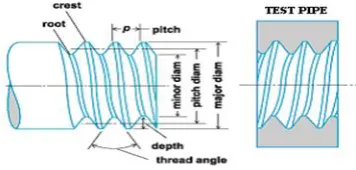
Fig. 2 Test Duct with Internal Threads
Available Online at www.ijpret.com
273 1.1 Sequence of Operations
Experiments were carried out first on plain aluminum horizontal test duct and then on aluminum horizontal duct with internal threads of varying pitch.
1.2Without Internal threads
Initially, the experiment was carried out on plain duct without internal threads. The working fluid air flows through the duct section with least resistance.
1.3 With Internal threads of varying depth
The internal threads were done on duct as shown in Fig. 2. The three different test ducts of varying depth were used for experimentation. The presence of the internal threads in the duct causes resistance to flow and increases turbulence. The mass flow rates of air and the heat input were kept constant as that of plain duct experiment.
1.4Data reduction
The data reduction of the measured results is summarized in the following procedures:
Ts = ( T2 + T3 + T4)/3 - (Equation I )
Tb = ( T1 + T5 )/2 - (Equation II )
Discharge of air,
Q = Cd *A1 *A2 * (2ghair)/ (A12 – A22) - (Equation III )
Equivalent height of air column,
hair = ( w *hw) /w - (Equation IV )
Velocity of air flow,
V = (Q/A) - (Equation V)
Where A =convective heat transfer area (*D*L),
Re = ( * V * D) / - (Equation VI)
Available Online at www.ijpret.com
274 L= Length of duct
Total Heat Transfer
Q = Qc + Qr - (Equation VII)
Q = m Cp (T1 – T5) - (Equation VIII)
Where m= mass flow of air
Qc = Convective Heat Transfer
Qr = Radiation Heat Transfer
Qr = A (Ts4 -Tb4) - (Equation IX)
h= (Q-Qr) / (A (Ts-Tb) - (Equation X)Experimental Nusselt number
Nu = h* (D/ K) - (Equation XI)
Nusselt numbers calculated from the experimental data for plain tube were compared with the correlation recommended by Dittus-Boelter.
Theoretical Nusselt number
Nu = 0.023 Re 0.8Pr0.4 - (Equation XII)
In straight duct lengths, Pressure drop (P) can be calculated using the Darcy Equation
f = Darcy friction factor
RESULTS AND DISCUSSION
Available Online at www.ijpret.com
Available Online at www.ijpret.com
276 CONCLUSION
Experimental investigations on enhancement of turbulent flow heat transfer with internal threads of varying depth in a horizontal duct under forced convection with air flowing inside are carried out. From the experimental results, conclusions can be drawn as follows:
I. The heat transfer enhancement increases with increase in depth of internal threads due to increased turbulence of air. It is due to the swirl flow motion provided by internal threads.
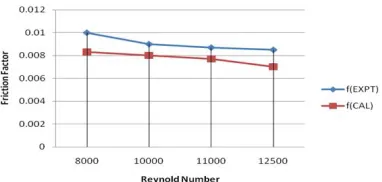
II. The friction factor increases with the increase of depth of internal threads again due to swirl flow exerted by the internal threads.
III. The enhancement of Nusselt number is much higher than that of enhancement in friction factor for the same depth of internal threads that justifies the usage of internal threads in horizontal duct.
Available Online at www.ijpret.com
277 REFERENCES
1. Q. Liao and M.D. Xin (2000), “Augmentation of convective heat transfer inside tubes with three-dimensional internal extended surfaces and twisted-tape inserts”, ChemicalEngineering Journal, Vol. 78, pp. 95-105
2. D. Angirasa (2001), “Experimental investigation of forced convection heat transfer augmentation with metallic porous materials”, International Journal of Heat Mass Transfer, pp. 919-922
3. H.L. Fu, K.C. Leong, X.Y. Huang and C.Y. Liu (2001), “An experimental study of heat transfer of a porous channel subjected to oscillating flow”, ASME Journal of Heat Transfer, Vol. 123, pp.162-170.
4. S.S Hsieh, M.H. Liu, H.H. Tsai (2003), “Turbulent heat transfer and flow characteristic in a horizontal circular tube with strip-type inserts part-II (heat transfer)”, International Journal of Heat and Mass Transfer, Vol. 46, pp.837-849.
5. B.I. Pavel and A.A. Mohamad (2004), “ An experimental and numerical study on heat transfer enhancement for gas heat exchangers fitted with porous media”, International Journal of Heat and Mass Transfer, Vol. 47, pp.4939-4952.
6. Rao, M. M. and Sastri, V. M. K. (1995), “Experimental investigation for fluid flow and heat transfer in a rotating tube twisted tape inserts”, International Journal of Heat and Mass Transfer, Vol.16, pp.19–28.
7. Sivashanmugam, P. and Suresh, S. (2007), “Experimental studies on heat transfer and friction factor characteristics of turbulent flow through a circular tube fitted with regularly spaced helical screw tape inserts”, Experimental Thermal and Fluid Science, Vol. 31, pp. 301-308.