journal homepage: http://farplss.org
Volume 30, Number 6, 2018
68
The evaluation of it specialists’ performance based on the grading
system and it’s forecasting by means of regression models
N. Maksymenko
Odessa I.I. Mechnykov National University, Ukraine
Article info
Received 22.10.2018
Accepted 31.12.2018
Odessa I.I. Mechnikov National University, Ukraine
Maksymenko, N. (2018). The evaluation of it specialists’ performance based on the
grading system and it’s forecasting by means of regression models. Fundamental and
applied researches in practice of leading scientific schools, 30 (6), 68–72.
The article is devoted to the actual problem of the substantiation of the laws and conditions of the relationship between the personal development and human potential of IT specialists and the results of their activities in the organization. The purpose of the article is the analysis and prediction of the performance of IT specialists by the grading system using regression analysis, where the predictors are the individual potentials of IT specialists. This problem is considered on the example of IT-professionals (n = 182) from four countries of Central and Eastern Europe. The author’s grading system was used to determine the level of professional efficiency during the trial period. The models for forecasting the professional performance of IT professionals were created, confirmed by various methods of regression analysis. It is determined that such aspects of personal development and human potential as social intelligence, abstract thinking, decisiveness, dominance, intrinsic motivation, communication, resistance to emotional stress, openness, and susceptibility to any kind of knowledge are predictors of effective performance in the IT industry.
Keywords: IT specialists; personal development and human potential; grading
system; forecasting models; regression analysis.
Introduction
In modern human resource management practice, the so-called grading is widely used, or the grading system, which is also called the “Hay method”, after the author Edward N. Hay, who in 1946 developed a complex system of usefulness positions of employees (1946). This system is widely used to this day, in many sectors of the economy. The "Hay method" is not a pure method of evaluating performance, since it also takes into account market trends. Companies that use this system benefit from an information service regarding market trends for job salaries and instructions on how payment should be tied to the grading allocated for each position (Cowling, 2013).
The job evaluation is carried out by three types of factors that contain certain sub-factors:
Ability (Know-how), that is, knowledge, professional experience and aptitudes necessary to perform the work of the position provided. In order to be able to evaluate various works, three different types of knowledge are identified:
1. Professional / specialized knowledge: theoretical and
practical awareness about executable receptions,
procedures, motions, knowledge of the specialized approaches, theoretical models and professional disciplines, measureable on a depth and breadth.
2. Complexity and diversity: these skills are necessary for successful work in complex and diverse areas of activity. This sub-factor includes the analytical and ideological skills necessary to perform work on planning, organizing, consulting, integrating, coordinating and managing subordinates.
3. Communication skills: these skills are necessary support for effective direct interpersonal interaction with colleagues, groups, clients, and the public. Each workplace should include more or less unique elements of knowledge on different balances between these three factors (Stepanova, Bilokrinitsʹka, 2017).
non-Volume 30, Number 6, 2018
69
standard, progressive thinking, with the help of which a person can generate new results. Creativity / problem solving shows the degree of independence of reasoning, its isolation from established rules and standards. These include the freedom of thought and the complexity of the tasks to be solved.
The area of responsibility (accountability), the criterion reflecting the authority of the position in decision-making, the degree of independence of action, as well as the real influence of the position of the results of the enterprise or unit (labor process). This group of factors included freedom of action and the scale of activity (Stepanova, Bilokrinitsʹka, 2017).
The grading system is characterized by the following - it is a kind of corporate “table of ranks” in which each cluster (grading) of positions has its own salary level. Grading is a method of creating a universal hierarchy of positions (ranks) for all company personnel; assessment system, which allows to determine compensation levels acceptable for all employees based on a comparison of the relative value for the company of different areas of work (positions). The grading procedure should be considered as a practical tool that allows you to better take into account the individual needs of the enterprise in differentiating the permanent part of wages (Shakhno, 2013).
The main advantage of the grading system is the translation of the intangible indicator “employee work value” into a cash equivalent. In general, practice has shown that the grading system has the following advantages and disadvantages, Table 1 (Lozovsʹkyy, Taran, Taran, 2009, p. 762).
Advantage:
- Helps to manage the payroll (PR) and makes the payroll system flexible;
- Increases the efficiency of the wage fund from 10 to 30%;
- Organizes the imbalance of wages in the enterprise; - Allows, if necessary, to quickly carry out an analysis of the structure of both official salaries and the permanent part of salaries, as well as to track their dynamics;
- There is a convenient tool for determining the size of the base salary of a new position;
- Allows you to keep track of the level and units where there are discrepancies in payroll;
- Allows you to compare the levels of payments of your company with the payments of others in one market segment or within the group;
- Allows you to compare the average salary of any position in your company with the average market;
- Allows you to eliminate the significant inefficiency of work, as it reveals duplication of functions, the inept leadership of line managers by their subordinates;
- solves the problem of calculating surcharges for work performed on standards that are lower or higher official;
- facilitates the process of indexing wages;
- Allows you to determine how much an enterprise position at any level costs;
- It is an effective way to integrate different-sized holding units into a single structure;
- Optimizes the allocation of labor resources.
The disadvantages of the grading system are the following:
- Requires high costs for development, implementation, and maintenance in working condition;
- The first initial development of the grading system should involve a large group of experts;
- Keeping the system up to date causes great difficulties, since it is necessary to take into account and track a large number of elements and interdependence definition;
- Development of conditions for moving between grading causes various problems (organizational, financial, psychological, etc.);
- There are difficulties of fair, objective grading of parameters that are difficult to formalize;
- There is a high probability of a subjective approach both in the development and initial assessment of grading (for example, not only posts are often evaluated, but in some individuals who occupy them), and in the process of regular working checks of staff compliance with the level of grading;
- The difficulties of ensuring objectivity and transparency of assessment cause emotional and psychological problems that reduce the motivation of employees.
The study the specifics of the activities IT specialists suggests that it is their psychological characteristics and components of personal potential that can and should ensure successful professional activity. Authors investigating this problem emphasize the importance of creating psychological models of the effectiveness of professional activities in the field IT. However, these models do not associate psychological parameters with estimates obtained by the grading system. So, the grading system is one of the essential tools for assessing the performance of employee’s organizations. But it should be noted, while there are no noticeable scientific developments in the direction of studying the psychological predictors of the success IT specialists when they are evaluated using the grading system.
The goal of article
is the analysis and prediction of the effectiveness IT specialists in the grading system using regression analysis, where the predictors are the individual potentials of IT specialists.
Research results
On the basis of a recruiting company engaged in the professional selection of specialists for Ukrainian and international IT companies, 182 specialists were investigated. The study involved specialists of both sexes (men - 79.7%, women - 20.3%) aged from 29 to 54 years. 84 people represent Ukraine (46.2%), 11 people - Poland (46.2%), 27 people - Romania (14.8%) and 60 people - Russia (33.0%). All of them have higher technical education. The subjects were motivated to participate in the study by receiving feedback in the form of providing the results to each subject and the necessary clarifications. The level of concentration of the subjects can be described as sufficient, since the study took place within two hours during working hours.
Volume 30, Number 6, 2018
70
intellectual and creative potential (the breadth of thinking, the ability for integrated vision, the ability to predict, common sense, practical thinking, the ability to set priorities, innovations) were determined using objective tests organized as a solution to specific situations, the parameters of the leadership potential (focus on people, task orientation, external orientation, internal orientation) were determined using a semantic differential; parameters of the block of activity potential (striving for success, striving for quality, striving for learning; uncertainty in their actions, search for challenge, decisiveness, purposefulness, striving for risk) were determined using a semantic differential; parameters of the block of social and communicative potential (ability to influence, directness in communication, assertiveness, forethought), which were determined using the semantic differential, as well as parameters (the ability to present results, ability to take into account the interests of others, responsibility), which were determined using objective tests, organized as a solution to specific situations. To determine the level of professional efficiency during the trial period, the grading system proposed by the author of the publication was used. A candidate for an IT specialist position should prepare an examination project for certification - experts to be evaluated (IT-company personnel managers, mentor, supervisor, IT-company managers, and IT-company owner). Projects must meet the following criteria:
- only practical projects based on real corporate calls; - availability of analytics, purposeful action plan and budget;
- the best candidates to implement their projects in IT companies;
- the best three projects are selected to participate in field gathering of the company's management.
The project format is as follows:
- work in teams;
- internal presentation of the theme, the project plan; - regular meetings with supervisors;
- protection of the project (exam) with the participation of the mentor, supervisor and corporate owner of the practice.
According to the results of certification, the corresponding grading value (0, 1, 2 or 3) was assigned, which had a definite definition.
0. The employee does not meet the specified requirements for the position of IT-specialist and is released after the certification and the end of the probationary period.
1. The employee continues to work on improving his skills and competence according to the individual development plan for 1-1.5 years. After a successful assessment of changes, it can be moved to the management reserve. It remains in the role / in the project for up to 2 years. Has priority for the passage of the LDC master program.
2. The employee is transferred to the so-called "Reserve Management". He continues to work on improving his skills and competence according to the individual development plan for 0.5-1 year. After a successful assessment of changes can be moved to a strategic reserve remains in the role of 1-1.5 years has priority for the passage of the MNRS (Master in High Performance Computing - Master of High Performance Computing) or the MBA (Eng. Master in Business Administration - Master of Business Administration).
3. The employee is transferred to the so-called "Strategic Reserve". Starts a promotion plan for 6 months. Remains in the current role up to a year. The first priority is for MNRS (Master in High Performance Computing) or MBA (Master in Business Administration) programs.
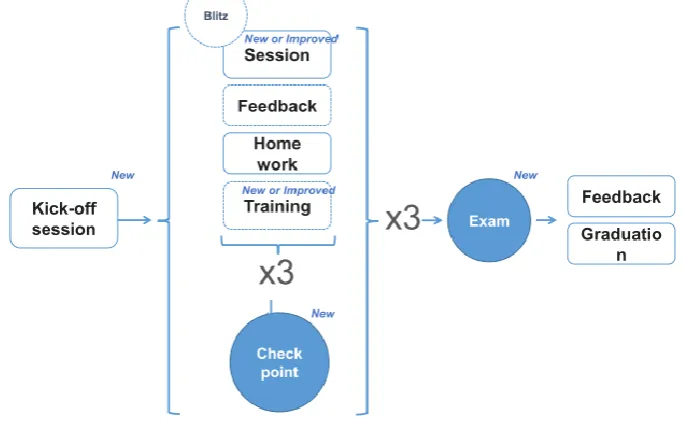
Fig. 1. Grading of IT specialists
The grading process itself took place as follows (fig. 1). At first, a constituent session was held with the employees at whom they were informed about the purpose and purpose of the grading process. Then they began work on projects,
Volume 30, Number 6, 2018
71
assignment of the corresponding grading to the employee. To assess the performance of IT specialists on the basis
of the grading system, analysis of descriptive statistics was used.
Fig. 2. Histogram of the distribution of values of the resulting grading specialists of an IT company
As the frequency analysis shows, grading “0” was assigned to 26 employees, 14.3% of the entire sample. According to grading "1", 93 people were estimated, which is 51.1% of the entire sample. Grading "2" received 50 employees (27.5%) and grading "3" - 13 employees (7.1%). The histogram of grading distribution in a sample of IT professionals is shown in Figure 2.The figure above shows that more than half of the subjects received grading "1". The average value for this variable is 1.275 points. It should be noted that the assessment obtained by the grading system did not reveal a link with sex. Among men, grading “0” was assigned to 23 employees, accounting for 15.9% of the entire sample. According to grading “1”, 72 people were estimated, which is 49.7% of the entire sample. Grading "2" received 38 employees (26.2%) and grading "3" - 12 employees (8.3%). In the subsample of women, grading “0” was assigned to 3 employees, which is 14.3% of the entire sample. According to grading "1", 21 people were estimated, which is 56.8% of the entire sample. Grading "2" received 12 people (32.4%) and, finally, grading "3" - one employee (7.1%). As the value of the Somers d test shows, these differences were not statistically significant (d = 0.037; p = 0.682). To predict the success of our activity, we chose regression models, where the independent variables (predictors) were indicators of psychological methods, and the dependent variable (external criterion) was the specialist's estimate obtained by the grading system.
The main method of mathematical analysis was the multiple linear regressions (Keith, 2015). To identify the most significant predictors that determine the level of the components of the activity potential, we used the regression analysis procedure with simultaneous inclusion of all the predictors, which allowed using each other predictor as a control variable. Step-by-step multiple regression is used to create reliable predictive models of the level of performance. Step-by-step multiple regressions (exclusion and inclusion methods) are used to minimize the number of variables studied in the model under study.
It is determined that statistically significant predictors of professional efficiency are straightforward communication (β = -0.247; p = 0.011), task orientation (β = -0.379; p = 0.001). The coefficient of determination for the entire model was R2 = 0.236. Negative standardized regressions coefficients indicate that direct communication, task orientation are factors that prevent effectiveness in IT organizations. Low scores of the first indicator indicate tactlessness, straightforwardness, lack of insight and social agility. People are characterized by a lack of understanding of the motives of the behavior of others, reduced criticality, and a certain naïveté, a tendency to shared hobbies, sentimentality, and sensitivity. Practical tasks are well solved, but in unexpected situations they often lack the imagination and ingenuity necessary for imagination. Low values of the second indicator indicate that these people are guided by specific instructions in their behavior, need constant support, support from others, advice and approval. They prefer to be subservient not because they are very dependent on authorities, but rather because they lack initiative and courage in choosing their own line of conduct.
Step-by-step regression procedure allowed us to obtain prognostic regression models at the level of statistical significance of the regression coefficients (p <0.05). The models included the following indicators: striving for success (β = 0.182; p = 0.013), internal orientation (β = 0.204; p = 0.017), direct communication (β = -0.216; p = 0.003), task orientation (β = -0.311; p <0.001), breadth of thinking (β = 0.258; p = 0.006). Positive factors allowed revealing factors which positively influence efficiency of activity of IT specialists. After all, they indicate
determination, dominance, inner motivation, and
communication, resistance to emotional stress, openness, and susceptibility to any kind of knowledge.
Volume 30, Number 6, 2018
72
Y = 0,711 + 0,159* X1 + 0,390* X2 - 0,162* X3 - 0,503* X4 + +0,423* X5,
where:
X1 - striving for success, X2 - interior orientation, X3 - direct communication, X4 - task orientation, X5 - the breadth of thinking.
An alternative method of mathematical analysis was the multiple ordinal regressions. In statistics, ordinal regression (also called “ordinal classification”) is a type of regression analysis used to predict the ordinal variable, i.e. a variable whose value exists on an arbitrary scale, where only relative
ordering between different categories is significant. This can be considered an intermediate method between regression and classification (Gutiérrez, Pérez-Ortiz, Sánchez-Monedero, Fernández-Navarro, Hervás-Martínez, 2016). The variants of the ordinal regression depend on the link function, it is used: logit model (which was used as a communication option in this study) is probit model', ordinal regression. In machine learning, the ordinal regression can be called the learning ranking (Shashua, Levin, 2002).
The ordinal regression model revealed additional statistically significant predictors that determine the participation of control group representatives in non-state public associations (see table 1).
Tab.1
Significant order regression coefficients determining professional performance
Index Assessment of Wald Criterion
W р
Pr
ov
is
io
ns direct communication striving for success -0,500 0,442 7,154 3,704 0,007 0,005
task orientation -1,818 14,061 <0,001
interior orientation 1,156 4,266 0,039
This table shows that striving for success and internal orientation are positive predictors, and straightforward communication and task orientation confirming linear regression modeling data are negative predictors.
So, models of forecasting the professional efficiency of IT specialists have been created, confirmed by various methods of regression analysis. It is determined that such aspects of personal potentials as social intelligence, abstract thinking,
decisiveness, dominance, intrinsic motivation,
communication, resistance to emotional stress, openness, susceptibility to any kind of knowledge are predictors of effective activity in the IT industry.
Conclusions
The author's grading system was used, which is designed to determine the level of professional efficiency during the probationary period, according to its conditions, the candidates for the IT specialist position were to prepare for the certification examinations of the project - experts to be assessed. According to the results of certification, the corresponding grading value was assigned, which served as an objective assessment of professional efficiency. Proposed models for forecasting the professional performance of IT professionals, confirmed by various methods of regression analysis. Creation of special software products based on the data we received will significantly intensify the selection of IT specialists, as well as improve the quality of their selection, which will reduce the time and cost of their professional training, increase its efficiency, reduce staff
turnover, and increase the efficiency of personnel. For further empirical verification, we plan to expand the sample under study both quantitatively and qualitatively, which will improve the accuracy of predictive models for IT professionals and calculate such models for specific professional categories of IT professionals.
References
Lozovsʹkyy, O.M., Taran, O.A., Taran, V.S. (2009). Vprovadzhennya systemy greydinhu na vitchiznyanikh pidpriyemstvakh. Vinnytsʹkyy torhovelʹno-ekonomichnyy instytut KNTEU. Stepanova, A. A., Bilokrinitsʹka, K. V. (2017). Greyduvannya yak
suchasna systema oplaty pratsi na Ukrayinsʹkykh pidpriyemstvakh na prikladi PAT "KYYIVENERHO", 1, 40-43. Shakhno, A. Yu. (2013). Systema greyduvannya yak suchasna forma
oplaty pratsi na pidpryyemstvi/ Innovatsiyna ekonomika. - 2013. - № 6. - S. 187-194.
Cowling, A. (2013). Managing Human Resources. Abingdon-on-Thames: Routledge.
Gutiérrez, P.A., Pérez-Ortiz, M., Sánchez-Monedero, J., Fernández-Navarro, F., Hervás-Martínez, C. (2016). Ordinal Regression Methods: Survey and Experimental Study. IEEE Transactions on Knowledge and Data Engineering, 28 (1), 127–146.
Hay, E.N. (1946). The Characteristics of Salary Grades. Personnel, 23, 3, 14.
Keith, T. Z. (2015). Multiple Regression and Beyond: An Introduction to Multiple Regression and Structural Equation Modeling. New York, NY: Taylor & Francis.
Shashua, А., Levin, A. (2002). Ranking with Large Margin Principle: Two Approaches. Advances in Neural Information Processing Systems, 15, 937-944.