Available Online At www.ijpret.com
INTERNATIONAL JOURNAL OF PURE AND
APPLIED RESEARCH IN ENGINEERING AND
SECURITY POLICY AND INFORMATION AVAILABILITY
1. Asst. Prof., Dept. of MBA India.
2. Asst. Prof., Dept of ECE India.
3. Principal, RVR Institute of
Accepted Date:
27/12/2012
Publish Date:
01/01/2013
Keywords
Information Availability,
Confidentiality,
Integrity,
Security Policy
Corresponding Author Mr. N.B.C. Sidhu
IJPRET-QR CODE
Available Online At www.ijpret.com
INTERNATIONAL JOURNAL OF PURE AND
APPLIED RESEARCH IN ENGINEERING AND
TECHNOLOGY
A PATH FOR HORIZING YOUR INNOVATIVE WORK
SECURITY POLICY AND INFORMATION AVAILABILITY
NBC SIDHU1, KUMAR KESHAMONI2,Dr. VVRLS GANGADHAR3
of MBA, RVR Institute of Engineering and Technology, Hyderabad,
Dept of ECE, RVR Institute of Engineering and Technology, Hyderabad,
RVR Institute of Engineering and Technology, Hyderabad, India
Abstract
Information availability is a key element of information
security. However, information availability has not been
addressed with the same enthusiasm as confidentiality and
integrity because availability is impacted by many variables
which cannot easily be controlled. The principal goal of this
research is to characterize information availability in detail and
investigate how effective enterprise security policy can ensure
availability.
INTERNATIONAL JOURNAL OF PURE AND
APPLIED RESEARCH IN ENGINEERING AND
A PATH FOR HORIZING YOUR INNOVATIVE WORK
SECURITY POLICY AND INFORMATION AVAILABILITY
Technology, Hyderabad,
Technology, Hyderabad,
, Hyderabad, India.
Information availability is a key element of information
security. However, information availability has not been
addressed with the same enthusiasm as confidentiality and
availability is impacted by many variables
which cannot easily be controlled. The principal goal of this
research is to characterize information availability in detail and
Available Online At www.ijpret.com
INTRODUCTION
Today’s businesses are highly dependent
upon the availability of information
resources. While information availability
(IAV) is well established as an attribute
required for information security (INFOSEC),
researchers and practitioners were, and
remain, most concerned with maintaining
confidentiality and integrity of the
information. IAV remains less understood in
Practice and ignored in research because of
the seemingly endless number of potential
factors that can impact the availability of
information (Hosmer 1996; Parker, 1992).
Brinkley & Schell (1995) argue that there
exists an “unbounded ness of possible
causes of a loss of availability.” Tryfonas,
Gritzalis & Kouklakis (2000) call for
availability to be revisited at the
macroscopic Level because of our
ever-growing dependence upon online
information. Lipson & Fisher (1999) believe
that “the problems of greatest concern
today relate to the availability of
information and continuity of services. “The
simultaneous increase in dependency upon
information resources and attacks against
those same resources gives credence to the
need, now more than ever, for better
understanding of the factors that determine
IAV. The astounding cost of Unavailability
ranges from $1 to 3 million per hour
depending upon the industry sector (ODI,
2006). Enterprises require that availability
be provided with the same certainty
associated with confidentiality and
integrity. Therefore, this paper has three
main objectives: (1) Explain the notion of
IAV and its attributes; (2) Identify key
determinants of IAV; and (3) Evaluate the
Impact of one of these determinants
(security policy) on IAV using the example
of three firms (cases).
INFORMATION AVAILABILITY
Confidentiality is defined as the “assurance
that information is not disclosed to
unauthorized entities or processes” (Schou,
1996). By controlling access to information
and preventing unauthorized disclosure, a
system can achieve confidentiality (Brinkley
& Schell, 1995). Integrity is defined as the
“condition that exists when data is
unchanged from its source and has not
been accidentally or maliciously modified,
altered, or destroyed” (Schou, 1996).
Available Online At www.ijpret.com
unauthorized modification of information
(Brinkley & Schell, 1995). In contrast to
confidentiality and integrity, availabilities
the “timely, reliable access to data and
information services for authorized users”
(Schou, 1996). More broadly, availability’s
about information being accessible as
needed, when needed, where needed. The
objective of availability is to enable access
to authorized information or resources
(CEC, 1991). According to Viles & French
(1995), most users expect a “100-100Web:
100 percent availability for all servers and
100 millisecond latency to every server.”
This expectation is nearly impossible to
sustain, given the many threats to
availability.
Components of Information Availability (IAV)
It is reasonably well established that
availability has three components:
Reliability, Accessibility, and Timeliness.
Reliability’s “the probability of a system
performing its purpose adequately for the
period of time intended under the
operating conditions encountered”
(Reibman & Veeraraghavan, 1991). Users
do not want to depend upon a system that
cannot be trusted to consistently execute
their requests. Broadly speaking,
accessibility is “the degree to which a
system is usable by as many people as
possible without modification”
(http://www.wikepedia.org). There are
several access control policies, such as
Mandatory Access Control (MAC) and
Discretionary Access Control (DAC) which
are supported with access control Services
such as Role Based Access Control (RBAC)
(Sandu, 1996). Timeliness is the
responsiveness of a system or resource to a
user request. Traditionally IAV has mostly
been measured by the amount of time an
information resource is either processing or
not (uptime and downtime) (Wood, 1995).
DETERMINANTS OF INFORMATION AVAILABILITY (IAV)
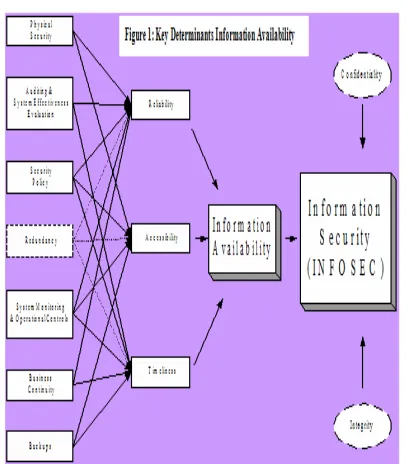
In Figure 1, each block on the far left
represents an IAV factor that impacts the
availability of an information resource or
the data stored within an information
resource. Each factor influences one or
more of the attributes of availability,
thereby contributing to the overall
Available Online At www.ijpret.com
discussion of each factor and its impact to
the enterprise follows.
Security Policy
An enterprise-wide security policy is the
foundation for INFOSEC activities and
establishes the framework for information
processing and use of IT devices within an
enterprise. “A policy is a documented
high-level plan for organization-wide computer
and information security. It provides a
framework for making specific decisions,
such as which defense mechanisms to use
and how to configure services, and is the
basis for developing secure programming
guidelines and procedures for users and
system administrators to follow” (Dekker,
1997). Most security policies do not address
IAV (NRC, 1991; Hosmer, 1996). In fact
authors of policies generally concentrate on
confidentiality concerns. A system security
policy should address who is using the
system and the enterprise’s expectations of
users. Access control mechanisms can be
defined and user privileges established. A
security policy impacts the reliability of an
IS by establishing the thresholds within
which the system operates. Current and
future architecture and design decisions
should be based upon the organization’s
strategic plan and the enterprise security
policy. Furthermore, the level of reliability
that the organization also desires may
impact the amount of preventative
maintenance that occurs, the level of
system monitoring and auditing, and
evaluation of system effectiveness.
Operational Controls and System Monitoring
By implementing operational controls
within the system, security professionals
can set limits that protect the organization’s
information. Operational controls “are
those system rules and guidelines that are
necessary to manage the day-to-day
activities that occur within an enterprise’s
information resources” (Weber, 1999, p.
291). Operational controls are created to
implement security policy, thereby
providing a mechanism for enforcing the
security policy. Monitoring system
performance provides the stakeholders of
the enterprise with measurements of how
the information resources are operating
(Weber, 1999). Real-time monitoring can be
used to identify unauthorized activity and
Available Online At www.ijpret.com
system. According to Hawkins, Yen, & Chou
(2000), the best intrusion protection is
constant monitoring for intrusions by
utilizing the best protection the
organization can afford. Operational
controls and system monitoring can work
together to enforce security policy and
provide security professionals the capability
of defending the system at the desired
level. Operational controls affect reliability,
accessibility, and timeliness by placing
appropriate limits, as deemed necessary
within the security policy, on users,
applications, hardware, data storage,
And support functions.
Auditing and System Effectiveness
Evaluation
According to Weber (1999, p. 10), auditing
IT resources is a “process of collecting and
evaluating evidence to determine whether
a computer system safeguards assets,
maintains data integrity, allows
organizational goals to be achieved
effectively, and uses resources efficiently.”
Auditing is used to verify that the
operational controls within the system are
successfully implemented and to analyze
system behavior to detect misuse or abuse
within the system (NRC, 1991). Auditing
differs from monitoring in that auditors
analyze historical data, whereas monitors
trigger alarms based upon real-time activity.
A system effectiveness evaluation is a
specific type of audit that not only analyzes
the reports and logs, but takes a macro
view of the system, the organization, and its
personnel to determine how well the
system meets the needs of the organization
(Weber, 1999). This type of evaluation is
especially important for availability, in that
the availability is a significant dynamic of
several factors that a system effectiveness
evaluation measures (ibid). Auditing and
system effectiveness evaluations provide
independent assessment of reliability and
timeliness factors within the system. These
evaluations may show trends of
inappropriate or unauthorized behavior on
the system that is not being caught through
real-time monitoring.
Physical Security
Physical security is a critical prerequisite of
IAV. If an organization does not provide
physical security to its systems, then
unauthorized personnel would have
Available Online At www.ijpret.com
systems. The traditional point of view looks
at protecting building sites and equipment
from theft, vandalism, natural disaster,
manmade catastrophes, and accidental
damage (NCES, 1998). While information is
not directly protected through physical
security, the Information resides on
hardware that computer security experts
are charged to protect, therefore
warranting the attention of both
information and security professionals.
Securing the physical hardware and the
communications pathways within the
enterprise is an important step in assuring
the availability of the system. If the device
containing the data a user is requesting is
unavailable because the device has been
stolen, the power to that device has been
cut, or the cable connecting the device is
disconnected, the impact to the user or
process making the request is the same as if
the requestor was not authorized to access
that data. Bois (2002) aptly asserts“… it is
vital that we acknowledge that people
seeking to do harm to our information
infrastructure will not stop if they cannot
get to us via the Internet.”
Figure 1 Key Determinants Information Availability
Backups
Backups provide a copy of the data,
applications, and O/S settings that are
stored within a computer. By having
backups, an enterprise can minimize the
downtime an enterprise experiences
following an event that may leave a storage
device damaged or erased (Murphy, 1996).
Additionally, backups have become
necessary because the data stored within
the enterprise is valuable (Parrish, 2001). If
the situation arises where information is
lost, then a set of backups will greatly
Available Online At www.ijpret.com
felt by the organization. Backups for both
the system and user are required to provide
maximum restorable capability to the
enterprise. Physical security of the backup
media is crucial, requiring the same level of
security for the backup capability as other
critical applications (Parrish, 2001). Backups
address timeliness and accessibility by
providing the enterprise the capability to
restore lost files in a timely manner.
Without backups, the system would need to
be recovered by starting with blank storage.
Business Continuity
Business continuity is a key component of
any enterprise’s plan to maintain
operations in the event of a catastrophic
event such as a natural disaster or a
network attack. Yet, only 20% of existing
continuity plans are workable when tested
(Brunetto& Harris, 2001; Kelly, 2000).
Business continuity impacts the timeliness
and accessibility of a system by providing
systematic and known process for restoring
operations in the least time possible.
Without a tested continuity plan, the
organization has no “insurance” that
operations will ever be restored to their
pre-event state (Facer, 1999; Wilson, 1997).
SECURITY POLICY AND IAV
The six factors identified earlier can
influence IAV by impacting how a request
made to an information resource is
successfully executed. Each factor plays a
role in the success of this complex process,
but the enterprise’s security policy provides
direction for how each segment of the IT
infrastructure will be implemented,
operated, maintained, and when necessary
terminated. In order to address the
question of how (and if) security policies of
organizations address IAV and how this
impacts IAV, we conducted three case
studies using Yin’s (1994) process. The three
firms represented in study were as follows:
Company 1: A regional grocery store chain located in the southern United States and
Mexico that employs over55, 000 people in
over 300 locations and has annual sales in
excess of $10 billion. This company is
committed to its customers by ensuring
that zero outages occur as a result of a
security breaches. The firm has an
informational website but does not engage
in consumer e-commerce. The company’s
focus is retail sales of groceries,
Available Online At www.ijpret.com
products, and a limited selection of house
wares, paper goods and chemicals,
Newspapers and magazines, flowers, and
outdoor cooking products. This firm also
produces a line of food products
Company 2: A large member-owned Fortune 500 company that owns and
manages more than $65 billion in assets
and offices throughout the United States
and Europe. It offers members banking,
investment, personal property and casualty,
and life insurance services. In 2001, this
firm posted revenue of $9 billion.
Approximately 15% of that revenue is
attributed to the company’s Internet
presence. The firm also maintains a
Corporate Intranet which is available to
employees and contains several online
documents and tools that employees use
on a daily basis. This firm employs over
20,000 employees worldwide, with 2,600
personnel in the IT department, and 45
specifically assigned to system security, but
holds every employee responsible for
security.
Company 3: A national telecommunications provider, offering local and long distance
telephone service; dial, dedicated, switched
and digital subscriber line (DSL) services;
and managed services to customers. The
company employs approximately 180,000
employees across the United States and
reported $43 Billion in revenue in 2002. It
maintains an extensive Internet presence,
which includes both informational sites and
e-commerce applications. Customers have a
variety of options when viewing the
company’s main webpage, including
viewing bills, news releases, or the
company’s earnings report, as well as
requesting new service, troubleshooting
telephone problems, or querying the
company’s online telephone directory, and
customers can register to receive e-mails
(e.g., new service information, bill-pay
reminder, or a reply to a question). In
addition to its public presence, employees
have access to a myriad of information and
services via a corporate Intranet.
Case Study Approach
Following Yin (1994), first, the enterprise
security policy or policies of each firm were
examined to assess whether the security
policy addressed IAV and its enablers using
a “document review agenda” set forth in
Available Online At www.ijpret.com
interviews were conducted with security
personnel from each organization using an
a priori list of thirty-five questions as a
starting point for the discussion. Data
collected from the interviews has been
combined with the analysis of each
organization’s documents to develop a
Narrative case history for each organization
studied. How each firm addresses IAV is
examined in terms of the accessibility,
Reliability and timeliness and the six factors
that influence them.
Case Narratives Company 1
This company’s corporate security policy
does not mention availability at all, nor
does the policy provide specific direction or
guidance to the reader as to how
availability should be provided. Reliability,
however, is included as a function that must
be assured. As seen in Figure 2, Company 1
hierarchically organizes its 22 information
security policy documents, where Specific
guidelines and directions are documented
in operating procedures that address
specific pieces of hardware or Software
systems.
Reliability
Company 1 ensures reliability by
architecting an infrastructure that includes
frame relay (FR) and satellite connectivity to
all facilities. The entire infrastructure from
circuits to printers is redundant. Stores have
dual servers, and servers and cash registers
are connected to uninterruptible power
supplies (UPS). Company 1 has a primary
and backup data Center, each has generator
backup and the two facilities are connected
via a SONET backbone. All critical
applications have redundant backup with
automatic failover. Servers are
load-balanced and redundant for each of the
application platforms within the enterprise.
Not only is Company 1 committed to
assuring reliability in its current
infrastructure, their strategy plans to
double the current infrastructure capacity
within 3 or 4 years. Furthermore, any new
piece of hardware or software must go
through a certification process to ensure
that corporate standards are met.
Accessibility
Company 1 grants access to information
based upon the role (RBAC) the employee is
Available Online At www.ijpret.com
of least privilege, only information that an
employee may need to perform the duties
the employee is assigned are made
available. It should be noted that any
employee movement is not automatically
updated within the IS. Due to the manual
request that must be made to the
Information Security Office, there is a
strong possibility that an Employee’s role
may not be updated when the employee
changes jobs. Company 1 also recognizes
that information may be released to outside
parties who must request access to
information through the Public Affairs
Department
Timeliness
Timeliness is not addressed in Company 1’s
security policy. By architecting the
infrastructure with redundant Components
and connectivity, reduced latency is
achieved as a byproduct of reliability.
Metrics of system “uptime” are taken
Mostly of the enterprise servers which are
concentrated at the data center.
Company 2
Company 2 has high uptime requirements
of its IT resources. This company’s Internet
presence, and the applications made
available to users, requires 100% uptime to
deliver on the company’s promise to its
users. This company has built an INFOSEC
policy pyramid, as seen in Figure 3, to link
the corporate security policy with technical
procedures for specific systems. The top
layer of the pyramid is the corporate
security policy with the corporation’s key
security metrics filling the Next layer. These
two documents address INFOSEC from a
business perspective. The third layer, the
corporation’s security guidelines, begins to
discuss security in technical detail, but also
include business requirements. The final
layer of the pyramid is individual
procedures, which apply to specific
information resources. The company’s data
center and alternate facility are located
within 200 miles of each other. Both are
unmarked buildings, with on-site security
Personnel.
Reliability
Company 2 addresses reliability through a
combination of network planning,
information security, and disaster recovery
actions. The company’s guidelines state
Available Online At www.ijpret.com
paths within the city where the data center
is located and separate upstream providers
for both voice and data traffic. The same
requirement exists for the alternate data
center. Furthermore, its two data centers
are connected via an OC-12 connection and
the backup data center can automatically
assume the workload in the event that an
outage occurs at the primary data center.
Both data centers are hardened, stand
alone facilities with the capability to feed
and lodge personnel for an extended period
of time. To further enhance the enterprise’s
reliability, Company 2 has developed
extensive business continuity plans, which
would be executed during an event (e.g.,
natural disaster; physical or cyber attack; or
power outage). These continuity plans are
reviewed every 60 days to ensure that
modifications to the physical and logical
network have been recorded in the
continuity plans. Scenario-based exercises
are regularly executed at 6-8 week
intervals. Auditing agencies regularly
inspect the performance and operation of
Company 2’s IT resources. The company’s
Internal Audit Division, which is separate
from the IT Company, analyzes how the
system the performance level, run security
scans, check data integrity, and review
system logs. External agencies (e.g.,
Securities and Exchange Commission (SEC)
and the Federal Deposit Insurance Company
(FDIC)) also audit Company 2.
Accessibility
Company 2 currently addresses accessibility
through role-based access control (RBAC)
and an industry leading Information
Management System (IMS). Employees are
granted access based upon the principle of
least access, which is based upon the
employee’s position. If an employee moves
from one job to another, then the losing
manager triggers a manual process to
revoke current privileges and the gaining
manager requests new access privileges
required to Work in the new position.
Members are required to log-on to the
Internet site, which initiates the member’s
session. Once logged-on, the traffic from
the company’s Internet site pass through
the IMS, a transaction monitor which makes
a member’s information accessible.
Members who use the company’s Internet
site may access account information,
Available Online At www.ijpret.com
business transactions without visiting a
physical office or speaking to a company
representative. Company 2 has a robust
backup capability. Backups are written at
the Backup Data Center and stored off-site.
Backups are handled by a leading industry
backup application, which controls the
backup process. Company 2 does not take a
single-minded attitude toward backups.
Each system has specific backup
requirements that are defined when the
system is brought online. Those
requirements are programmed into the
backup system, thereby providing
consistent control of the backup process. In
addition to data files, the company’s
Database (DB) and system logs are also
backed-up. By including logs in the backup
schema, Company 2 can recreate the stored
data and any transactions that occurred
since the last backup and the loss Of data.
Figure 2 Company 1 Security Policy Hierarchy
Figure 3 Company 2 Security Policy Pyramid
Timeliness
Company 2 addresses timeliness by
monitoring, in real-time, certain aspects of
circuits, hardware, and software. Each IS
has system-level response time objectives
(e.g., end-to-end or application to
application). Several IT resources are
designed using an N-tiered model. By
architecting systems in this way, Company 2
has enhanced the capabilities of its
information resources, but has increased
the complexity of the applications operating
within the enterprise. To effectively
measure timeliness, the components of
each IS are measured separately. These
separate response times are then summed
to provide a high-level response time.
Available Online At www.ijpret.com
performance at a more granular level and
make the correct adjustment to keep the
response times below the maximum
response time stated in each system’s
system-level objective. Company 2 balances
real-time monitoring with after-the-fact
auditing of system and event logs. The
business decides how to strike this balance
by analyzing the business requirements and
associated risks. The greater the risk
assessed, the more real-time monitoring is
used. Alarms are based upon a
programmed threshold for each IS.
Company 2 also audits system and event
logs to analyze user behavior and for the
purpose of post-event analysis. By
employing real-time monitoring, Company 2
can address timeliness and defend the
enterprise. This coupled with auditing can
address system faults to prevent future
problems.
Company 3
IT services in Company 3 have been
consolidated into a separate business unit.
Day-to-day security is maintained by system
administrators and operations personnel
who monitor the public and private
networks that Company 3 operates. At
Company 3, INFOSEC is a part of the
company’s “Code of Business Conduct”
(hereinafter referred to as “the Code”). This
document states the boundaries within
which employees of Company 3 must act.
Included in the Code are clauses about the
corporate expectation of privacy, use of
company property (including information),
ethics, and equal employment opportunity.
As seen in Figure 4, Company 3 has written
Executive support for CIS and these
executive documents state that INFOSEC is
critical to the success of the business. It is
worth noting that the policy provides the
company’s confidentiality, integrity, and
availability definitions. Additionally, this
policy explicitly states that non-availability
could be a characteristic of company
information if the company’s information is
not protected. While availability is defined
in Company 3’s security policy, the policy is
written at an executive-level. The
technology used to accomplish the goals
stated in the policy is documented in the
company’s INFOSEC standards. INFOSEC
guidelines address how to use the
Available Online At www.ijpret.com
Reliability
Company 3 addresses reliability by
clustering and consolidating data storage
and processing and by employing
redundant circuitry throughout its logical
and physical network. The company has
strategically located regional data centers
which are controlled by an on-site security
detail, with access card and biometric
access devices installed at points of entry to
computer rooms. Additionally, Company 3
has identified a comprehensive list of
hardware and software documentation (i.e.
business benefits, technologies used,
backup and application recovery contacts
and requirements, and field support
impact) which IT personnel use to maintain
each IT resource? Company 3 employs
multiple firewalls throughout the
enterprise, each of which is dedicated to a
certain class of user (e.g., affiliates, business
partners, employees). Company 3 conducts
systematic backups at all its data centers. In
addition to backups at the data center level,
Company 3 has implemented an application
which enables employees to backup critical
files residing on a desktop PC. In the event
that a Data center experiences an event
resulting in do anytime, each data center is
linked to another data center, which acts as
its backup. Additionally, each data center
maintains offline backup storage for itself
and the data center to which it is linked. As
a national telecommunications provider,
Company 3 is very concerned about disaster
recovery and business continuity. As a
result, Company 3 has a workgroup within
the company’s Asset Protection Division
dedicated to planning the response to an
unforeseen event. Before any IT resource is
added to the enterprise, a continuity plan is
developed and tested. Enterprise-wide tests
of the company’s continuity plans are
conducted annually
Accessibility
Company 3 addresses accessibility through
RBAC and the rule of least privilege.
Employees are granted access based upon
the needs of their position and
requirements of Federal Regulations.
Company 3 has a standardized User ID and
utilizes an industry standard directory
service. This enables developers to verify
the identity of the user. This does not,
Available Online At www.ijpret.com
resources. For some IT resources, ITO grants
access; for others the administrator
Or owner of the IT resource grants access.
Company 3 tracks access controls manually.
If an employee changes positions, the
employee will request access to any new IT
resources that are required to complete
work in the new position. For auditing
purposes, all access requests are
documented and the accountability trail
maintained. Additionally, Company 3
maintains several classifications of
information, which define the level at which
that information can be released.
Figure 4 Company 4 Security Policy Diagram
Timeliness
Timeliness is addressed through the
Systems Operations Center (SOC), where
monitoring throughout the logical and
physical network is conducted. Company 3
employs a number of alarms which are
activated based upon the rules applied to
each alarm. Periodically, the need for each
alarm is reviewed to ensure that the cost of
alarming the network is commensurate
with the risk of loss. Company 3 applies
specific standards to its various IT
resources. How each standard is applied is
dependent upon the criticality of the
resource and the risk to the business. These
factors are determined as part of the design
process, and timeliness metrics are made
available to the IT staff through the
Availability Management group. Company 3
has an active Auditing group. This group not
only audits IT systems, but the entire
business. Audits are conducted when
irregularities within the business arise.
During these audits, the supporting IT
resources are analyzed. Any identified IT or
INFOSEC findings are included in the report
which is provided to the President of the
business unit, and applicable sections are
sent to the personnel responsible for that
function (e.g., INFOSEC findings are sent to
Available Online At www.ijpret.com
SUMMARY OF FINDINGS
Based on our understanding of factors that
influence IAV and the related analysis of the
data collected from three firms, we can
draw the following conclusions.
Whether an organization’s security policy
addresses IAV or not, business requirements
are driving IT professionals to Provide IAV.
IAV was absent from Company 1’s security
policy; the word ‘availability’ was included
in Company 2’s security policy; and defined
in Company 3’s security policy. Regardless
of how IAV was addressed in the company’s
security policy, the business requirements
of all three companies had identified IAV.
Furthermore, information is being used by
each company to bring the business closer
to both customer and other businesses. By
using IT to connect geographically dispersed
locations, the companies into reviewed
have leveraged consolidated storage plans
to decrease operating costs and enhance
the services that each company can
provide. These applications are not driven
by INFOSEC considerations, but by business
Requirements. The INFOSEC literature
reviewed for this paper indicates that IAV is
not being addressed because unavailability
has infinite causes. Conversely, businesses
have embraced the possibilities (and the
enhanced revenues) which effective IAV
brings.
Security policies provide broad INFOSEC
goals, which may include IAV, but do not
provide sufficient detail to address IAV in a
day-to-day context.
After reviewing each company’s security
policy and interviewing the company’s
INFOSEC professional(s), it is clear that each
company did not desire to have detailed
security policies. Applying a hierarchical
approach to the policies, which all three
companies did, allowed each company to
secure executive support for INFOSEC goals
and develop more granular Documentation
(i.e., standards, guidelines or procedures)
for use by personnel charged with
day-to-day control of the information enterprise.
The degree to which IAV is addressed in the
security policy does not necessarily
correspond with the level of IAV that is
demonstrated by each company.
Of the three components of IAV, reliability is
Available Online At www.ijpret.com Timeliness and accessibility, however, do
not receive the same attention.
The companies participating in this research
had all architected highly redundant
infrastructures. Each company had done
this to remove as many single points of
failure as possible. Furthermore, Companies
1 and 3 addressed IAV through redundancy,
but neither addressed timeliness. Company
2 also addressed IAV through redundancy
and had detailed timeliness metrics which
provided additional granularity to Company
2. None of the companies addressed IAV
through the context of accessibility. In
general, timeliness seems to be addressed
through system performance parameters
rather than through security policy. For
example, Company 2 recorded response
times to provide metrics which could be
analyzed to address timeliness.
Given the large showing of redundant IT
components in the participating companies,
there may be cause to add ‘Redundancy’ as
a determinant of IAV.
Each of the participating companies had
redundant hardware and software,
communications pathways, and data
centers. Each company also placed a great
deal of confidence in having redundancy to
provide IAV in the event of an outage (e.g.,
natural disaster, manmade catastrophe,
accidental or malicious action, or hardware
or software failure). Therefore, after
reviewing the data collected for this paper,
we believe that ‘Redundancy’ should be
included as the seventh determinant of IAV
in our model displayed in Figure 1. Past
research in this area has shown that
redundancy provides an organization the
Ability to reconstruct information elements
that may be corrupted or damaged and
minimize unavailability by utilizing
Redundant capabilities or restoring the
capabilities of the IS (Jajodia et al., 1999).
Additionally, having redundant Connectivity
that has adequate capacity for the traffic
load of the organization is an imperative for
many organizations today.
The ability to provide adequate IAV is
impeded by resource constraints and the
need to balance IAV with the other Security
attributes (i.e., confidentiality and integrity),
Available Online At www.ijpret.com
Past research shows that there is greater
importance attached to confidentiality and
integrity as compared with IAV. Our study
provides some support for the notion that
there is a division between INFOSEC
requirements and business requirements.
Furthermore, we find that IAV is addressed
from a business perspective and not from a
security perspective. It is apparent that the
ability to deliver adequate IAV has to be
balanced with other security attributes and
business Requirements. Also, IAV may need
to be considered separately from
confidentiality and integrity and potentially
a separate IAV policy may be needed within
organizations to overcome the potential
threats to availability.
CONCLUDING REMRKS
In this paper we have developed a detailed
understanding of information availability
(IAV) an important attribute of modern
information security. Based on past
literature, we provide a detailed list of
factors or determinants of information
availability and its attributes (reliability,
accessibility and timeliness). We evaluate
the impact of a firm’s security policy on IAV
and Discuss some key findings. It is
important to note that we intentionally
focused our attention in this research on
how one determinant of IAV, security
policy, impacts IAV. This is because we felt
that without a well-developed security
policy, an enterprise is ill-prepared to
ensure that information resources with be
available and that the data is correct.
However, we believe that further research
needs to be conducted on how the other
determinants influence IAV and in what way
the interactions between the various
determinants impacts IAV and INFOSEC.
REFERENCES
1. Bois J, Protect you. Retrieved from
ttp://rr.sans.org/physical/protect.php.
SANS Institute (http://www.SANS.org).
2002
2. Brinkley DL and Schell RR, Concepts and
terminology for computer security. In. M. D.
Abrams, S. Jajodia & H. J. Podell (Eds.),
Information security: An integrated
collection of essays, 11-39. Los Alamitos,
Available Online At www.ijpret.com
3. Brunetto G and Harris NL (2001)
Disaster recovery: How will your company
survive? [Electronic version]. Strategic
Finance, 2001; 82(9): 57-61.
4. CEC -- Commission of the European
Communities, Information Technology
Security Evaluation Criteria (ITSEC),
Provisional Harmonized Criteria: Version 1.2
[Electronic version]. Luxembourg: Office for
Official Publications of the European
Communities. 1991.
5. Dekker M, Security of the Internet. The
Froehlich/Kent Encyclopedia of
Telecommunications, Vol. 15, 231- 255.
Retrieved May 21, 2002 from
http://www.cert.org/encyc_article/tocency
c.html. 1997.
6. Facer D, Rethinking: Business continuity
[Electronic version]. Risk Management,
1999; 46(10): 17-18.
7. Hawkins S, Yen DC, and Chou DC,
Awareness and challenges of Internet
security. Information Management &
Computer Security, 2000; 8(3): 131-143.
8. Hosmer HH, Availability policies in an
adversarial environment. Proceedings of
the 1996 Workshop on New Security
Paradigms, USA, 105-117. Retrieved April
10, 2002 from
http://doi.acm.org/10.1145/304851.304876
. 1996.
9. Hutt AE, Bosworth S and Hoyt DB,
Computer security handbook (3rd edition).
New York, NY: John Wiley & Sons, Inc. 1995.
10.Jajodia S, McCollum CD and Amman P,
Trusted recovery [Electronic version].
Communications of the ACM, 1999; 42 (7):
71-75.
11.Kelley J, Business continuity: Battling
high-tech exposures [Electronic version].
Risk Management, 2000; 47(5): 31-33.
12.Lipson HF and Fisher DA, Survivability--A
new technical and business perspective on
security [Electronic Version]. Proceedings of
the 1999 workshop on new security
paradigm, Canada, 1999: 33-39.
13.Martin A, Key determinants of
information availability: a multiple case
study. Unpublished MS in MIS Thesis,
Available Online At www.ijpret.com
14.Millen JK, Resource allocation model for
denial of service. Proceedings of the
Symposium on Research insecurity and
Privacy. USA, 137-147. 1992.
15.Murphy, M. (1996, February 1) Backup
strategy. Retrieved May 14, 2002 from
http://www.linuxjournal.com/article.php?si
d=1208.
16.NCES -- National Center for Education
Statistics. (1998, September 22)
Safeguarding your technology: Practical
Guidelines for electronic education
information security [Electronic version]
[Handbook]. In: Szuba, T. and the
Technology and Security Task Force of the
National Forum on Education Statistics.
Retrieved June 20, 2002, from
http://nces.ed.gov/pubsearch/pubsinfo.asp
?pubid=98297
17.NRC -- National Research Council
Computers at risk: Safe computing in the
information age. Washington, D.C.: National
Academy Press. 1991.
18.ODI -- On track Data International Cost
of Data Loss. Retrieved January 12, 2006
from
http://www.ontrack.com/understandingdat
aloss/. 2006.
19.Parker DB, Restating the foundation of
information security. Proceedings of the
Eighth International Conference on
Information Security, Netherlands, 1992:
139-151.
20.Parrish S, Security considerations for
enterprise level backups. Retrieved June 7,
2002 from
http://rr.sans.org/backup/enterprise_level.
php. 2001.
21.Reibman AL and Veeraraghavan M,
Reliability modeling: An overview for
system designers [Electronic Version].
Computer, 1991; 24(4): 49-57.
22.Sandu R, Access control: The neglected
frontier [Electronic version]. Proceedings of
the First Australasian Conference on
Information Security and Privacy, Australia,
1996: 219-227.
23.Schneier B, Secrets and lies: Digital
security in a networked world. New York,
Available Online At www.ijpret.com
24.Schou C, Editor Information Systems
Security Organization (ISSO) Glossary of
INFOSEC and INFOSEC Related terms, Vols. I
& II. Idaho: Idaho State University. 1996.
25.Tryfonas T, Gritzalis D. and Kokolakis S,
A qualitative approach to information
availability. Proceedings of Information
Security for Global Information
Infrastructures (IFIP TC11). Sixteenth
Annual Working. 2000.
26.Conference on Information Security,
USA, 37-47. 26. Yin, R. K. (1994) Case study
research: Design and methods. (2nd Ed.).
Thousand Oaks, CA: SAGE Publications, Inc.
27.Viles CL and French JC, Availability and
latency of World Wide Web information
servers. Computing Systems, 1995; 8 (1):
61-91.
28.Weber R, Information systems control
and audit. Upper Saddle Creek, New Jersey:
Prentice-Hall, Inc. 29. Wilson, K. (1997,
September 2) Contingency and recovery
planning: Checklist for information systems.
Retrieved on June 6, 2002 from
http://socrates.berkeley.edu:2001/em/chec
klist.html. 1999.
29.Wood A, Predicting client/server
availability [Electronic version]. Computer,