Available Online at www.ijpret.com
21
INTERNATIONAL JOURNAL OF PURE AND
APPLIED RESEARCH IN ENGINEERING AND
TECHNOLOGY
A PATH FOR HORIZING YOUR INNOVATIVE WORKSOME ASPECT OF RELIABILITY EVALUATION OF COMPOSITE POWER SYSTEM
ANKUR MALHOTRA1 , RAHUL AGRAWAL2, REENA JHARANIYA3
1. M. Tech Scholar, Department of Electrical Engineering, Vindhya Institute of Technology and
Science (VITS) Indore (M.P.), India.
2. Asst. Prof., Department of Electrical Engineering, Vindhya Institute of Technology and
Science Indore (M.P.), India.
3. Asst. Prof., Department of Electrical Engineering , Vindhya Institute of Technology and
Science Indore (M.P.), India.
Accepted Date: /0/2013 ; Published Date: 01/01/2014
Abstract: Reliability evaluation has been broadly used for power system planning and operations [1], since they are capable of incorporating various system uncertainties such as equipment failures as well as random variations in generation capacity or load demand. Meanwhile, power systems are becoming more complicated, which leads to highly nonlinear problems in their reliability evaluation. The purpose of assigning the reliability of a composite power system is to estimate the ability of the system to perform its function of transporting the energy provided to the bulk supply points. This paper gives an introduction to reliability evaluation of composite power system. The paper also includes a description of reliability evaluation parameters at different levels and different methods for reliability evaluation of a power system.
Keywords: Reliability, Power System, Monto Carlo Simulation
Corresponding Author: MR. ANKUR MALHOTRA
Access Online On:
www.ijpret.com
How to Cite This Article:
Available Online at www.ijpret.com
22
INTRODUCTION
For system analyzers, system planners and designers the system reliability is a very crucial key point for analysis. It is significant to evaluate reliability because of increasing complexity of systems, cost competitiveness, to have alternate designs of the system, cost benefit. As in today’s scenario the power system is getting more complex either due to grid connections or because of smart grids for improved systems, but it is more complex to evaluate reliability. The level of satisfactory reliability or unsatisfactory reliability of the system is may be due to the effect of individual component or it may be the contribution of the whole system. The function or performance of individual component and of the whole system and its failure frequency decides the reliability of the system. The basic definition of reliability also says that “Reliability is the characteristic of any device which shows its capability to
perform its adequate function under given conditions”. From the definition again it is clear
that reliability is a function of performance characteristic of a device. The failure of even a single device may affect the reliability. So, there are two main factors which affect the reliability as shown in fig.1.
Figure1 Factor of reliability
System capability is about to satisfy the load demand and to do this it is required to have presence of sufficient resource at generating stations. For this the generating capacity of the station is always maintained above peak load demand and is done by forecasting the load by system designers. The system adequacy also must include the planned or unplanned outages of generating units or other equipments which form the system.
The system security is also a function of system reliability. Here the security term stands for the capability to survive under any condition. The variation in normal operating condition may be there because of variation in loading conditions, either it may be due to overloading or under loading. There may be other parameters which can affect the reliability of system viz. Current variation, frequency variation etc.. In a secure system all these parameters must remain within permissible limits.
System Reliability
System Capability Or
Available Online at www.ijpret.com
23
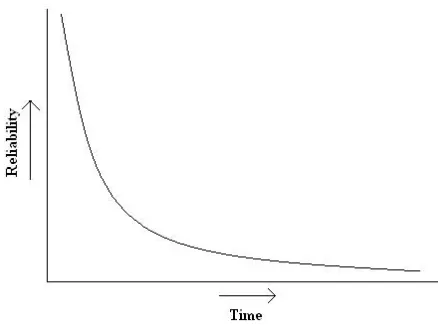
The time period is also one of the criteria to measure the reliability. Reliability decreases as time move towards t = ∞ i.e. reliability is a decreasing function of time as shown in fig.2. It is because after a time period the aging effect after dominating over the performance of the device.
Figure 2 Reliability Vs Time characteristic
As we all know that the complete power system consist of three main divisions i.e. generation, transmission and distribution. For reliability evaluation of system it’s quite difficult to evaluate reliability of each and every device (as reliability is related to adequate performance of the device) individually. To avoid this complication, reliability evaluation is done for complete system by several methods. Now days the reliability evaluation is started on large scale i.e. for composite power system. In this method the reliability evaluation of each division i.e. generation transmission, and distribution is performed commonly in complete system.
Reliability Evaluation of Generating Stations
Available Online at www.ijpret.com
24
reliability is system economics. The less reliable system affects more on the economics of the system as well as on the consumer also. R. Billinton, W. Zhang [40] discussed about reliability indices which was having relation to cost so as to improve the economics of the system with maximum optimized reliability results. As discussed earlier that aging effect is also one of the major reason which is involved in varying the reliability of the system. Wenyuan Li [19] and Hagkwen Kim, Chanan Singh [20] has discussed the effect of aging criteria of reliability. In this paper later there are few more reliability evaluation indices are enlisted. One of which is the probability of failure and in this reliability index the participation of the failure protective devices are considered. The same was done by Xingbin Yu [22]. In this the system reliability was evaluated by considering the failure of the protection system which is considered to be one of the biggest reasons for failure of the system.
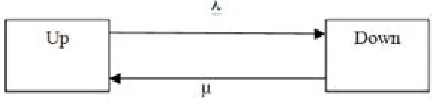
A proper executing system may get deviates and losses reliability even because of the failure of a single device. A component or device is considered to be an outage when it is unavailable to perform its proposed function. A component outage, however, may or may not cause load interruption. Independent outage events including the outage of two or more components are referred to as overlapping outages. The basic component model used in these applications is the two-state representation shown in Figure 3, in which the component is assumed to be either up or down. The rate of departure from the component
up state to its down state is the component failure rate λ. The restoration of the component
to its operational state is denoted by another transition rate, termed as the component
repair rate μ.. The two parameters, λ and μ can be expressed in terms of Mean Time To
Failure (MTTF) and Mean Time To Repair (MTTR) respectively, where, MTTF is the reciprocal
of λ and MTTR is the reciprocal of μ.
Figure 3 Two State Model for a single component
Reliability Evaluation of Transmission System
Available Online at www.ijpret.com
25
There are different criteria which decides maximum permissible loading of line. This criterion varies according to the type of transmission line. For short transmission line thermal limit or temperature rise is in consideration for line loading. In medium transmission line voltage drop is the criteria for deciding the line loading and for long transmission this criteria are changed to angle stability. Tarek A. M. sharaf and Gunnar J berg [41] took this parameter for reliability evaluation they determine loadability using AC load flow model and optimization procedure but instead of linear optimization procedure they use non linear optimization procedure. X Yu and C Singh [42] also consider the same parameter that is loadability to evaluate reliability but they used Monte Carlo simulation to evaluate loadability as reliability evaluating parameter.
As very commonly multiple circuit transmission lines are used over worldwide for transmission of electrical energy. Lie et al. [38] evaluated reliability for same structure using analytical method followed by MCS. Choudhary et al. [39] has done a quantitative reliability assessment of the transmission system. It's a necessary pre step of system planning. Another technique to determine reliability is deterministic criteria but it lacks behind quantitative criteria in terms of accuracy. Apart from this, sometimes reliability also effect on the reactive power . The reactive power is also necessary in power system. Failure or mis-operation of reactive power source may lead to either excess or shortage of reactive power which directly affects the reliability of the power system. The result variation in reliability may not be in the form of a power outage but may be in the form of excess losses or poor power factor or poor power rating. Peng Wang and et al [21] discussed about new reliability indices which are used to calculate reactive power shortage.
So, in a nut shell manner we can say that in today’s time lots of steps are taken to make the system capable with an increased rate of the security. One of the methods to improve reliability is grid connection and as a advancement in this the latest technique is smart grid. Other than this although there are many techniques to evaluate the reliability (few of them are discussed soon after this) but in all the methods on the basic side we need to calculate the reliability indices. There are many reliability indices which can be evaluated for reliability evaluation. For example these are like loss of load probability i.e. [LOLP] loss of load expectation (LOLE) & expected energy not supplied (EENS) etc.
II. RELIABILITY INDICES
Under broad segment the reliability indices can be classified under two categories: [24]
i) Deterministic indices
Available Online at www.ijpret.com
26
Deterministic indices show the postulated conditions. They do not show the system reliability and are also not responsible for system reliability. Hence for planning these systems are having a very limited use.
Different deterministic reliability indices are:
i. Percent reserve margin: This shows the excess of installed generating capacity over annual peak load.
ii. Reserve margin in terms of the larger unit.
These parameters do not reflect the data like unit size and outage rate etc.
Probabilistic indices show the reliability of the system and are necessary part of reliability evaluation. These parameters can also impact the system reliability.
Different probabilistic indices are:
i. Loss of load probability (LOLP) : This LOLP may be defined as probability of loss of load exceeding the available generation capacity.
For LOLP = P [L>C].
Where
L = Load
C = Available capacity of generation.
ii. Loss of load expectation (LOLE): This reliability index shows the time when insufficient generating capacity is there to serve peak load.
iii. Expected unserved energy or Expected energy not supplied (EENS): This index measures the expected amount of energy which is failed to serve or supply to consumer because of shortage in basic energy supply.
Available Online at www.ijpret.com
27
The system based reliability indices are:
i) Bulk power interruption index
ii) Average number of load curtailment
iii) Average energy curtailment
iv) Average number of voltage violation
v) Maximum system load curtailed under contingency condition
vi) Maximum energy not supplied under contingency condition.
The load point indices include the evaluation of:
i) Probability of failure
ii) Failure frequency
iii) Average of voltage violation
iv) Average load curtailed
v) Expected energy not supplied
vi) Average duration of load curtailment
With the help of above available reliability indices the reliability of the composite power system is calculated, this calculation will be done with the help of any one of the methods of reliability evaluation. To evaluate reliability there are few more reliability indices that are used to weigh up reliability. These reliability indices are:
(i) SAIFI (System Average Interruption Frequency Index): This particular index informs
about the typical average frequency of interruptions per customer by having a ratio of total interruptions to customer to the number of customers in the system.
(ii) SAIDI (System Average Interruption Duration Index) : This index informs about the
average time that all customers are interrupted by having a ratio of customer interruption total period to the total number of customers in systems.
(iii) CAIDI (Customer Average Interruption Duration Index) : This index conveys the
Available Online at www.ijpret.com
28
(iv)CAIFI (Customer Average Interruption Frequency Index): It is the average number of
interruptions considered to have a duration, experienced by customers who had at least one interruption during the period.
(v) MAIFI (Momentary Average Interruption Frequency Index): This particular index gives
out the data about the average frequency of momentary interruptions, typically defined as less than five minutes.
The above discussed last five indices give information about the duration and frequency of the system.
III. RELIABILITY EVALUATION OF COMPOSITE POWER SYSTEM
As the topic of the paper suggests we are focusing on the reliability evaluation of composite power system So a composite power system can be divided into many operating states in terms of the capacity available to fulfil demand subject to the satisfaction of security limits (line flows and voltage limit). Hence, the evaluation of a reliability index for a composite system is very much computationally demanding. The three basic functional zones are those of generation, transmission and distribution as shown in figure-4.
Figure 4 Three Zones of power system
Available Online at www.ijpret.com
29
IV. COMPOSITE SYSTEM RELIABILITY EVALUATION METHODOLOGY
There are two main methods which are widely used for reliability evaluation i.e.
1. Analytical Methods
2. Computational or Simulation Methods
Both approaches are able to calculate reliability indices. Both methods use the adequacy & security of a system state using a power flow method for calculating reliability. AC load flow or DC load flow [8-9] may be used depending upon the needs of the study.
1. Analytical Methods can be divided into Contingency Enumeration Methods (CEM), State
Enumeration Methods (SEM) and Markov Cut Set method. Few more fault analysis method is fault tree analysis method and minimal cut set method. The minimal cut sure method is one of the steps of fault tree analysis or we can say it's the first step of the fault tree analysis method to evaluate reliability. Based on the mathematical analysis in all analytical methods a mathematical model is prepared and generally all models are based on Markov models. Yong Liu & Singh [23] proposed a method to evaluate reliability of composite power system. In that they used Markov cut set method which was based on DC optimal power flow. The minimal cut set is analyzed using this DC optimal power flow which was limited up to a particular order and then they used Markov cut set method to calculate reliability indices. Yong Liu & Singh [26] again use minimal cut set method approach as the analytical methodology to evaluate reliability of composite power system but for a short duration of time. Cost outage is also one of effect of reliability. Choi, J.S. et al [32] use an analytical approach to determine the outage cost in a composite power system as an effect of reliability. To evaluate this cost outage they use the analytical method using effective load duration curve.
2. Computational Methods This method can be divided into
Monte Carlo Simulation (MCS) & Artificial Intelligence (AI) based on the iteration technique. The Monte Carlo method can be applied on time varying load to evaluate reliability. For showing the time varying load load duration curve can be used. Monte Carlo itself consist of sequential technique and non sequential methods such as state sampling and state transition sampling.
Available Online at www.ijpret.com
30
Available Online at www.ijpret.com
31
system which is known as RBTS i.e. Roy Billinton test system. This test system is also used in many research works to evaluate the reliability of the system.
V. CONCLUSION
This paper summarizes the various aspects for the reliability evaluation of composite power system. This introduces the various reliability indices used to evaluate reliability of composite power system. The methods for reliability evaluation are Simulation and analytical methods and out of these two methods Simulation method is considered to be superior because it reduces the computational time as compared to analytical methods as well as it gives more accurate and real results.
VI. ACKNOWLEDGEMENT
The authors would like to thank Department of Electrical and Electronics Engineering, Vindhya Institute of Technology and Science, Indore (M.P.) India for providing the necessary help and support for preparing this paper.
REFERENCES
1. IEEE Committee Report, Bibliography on the Application of Reliability Methods in Power System Reliability Evaluation, IEEE Transactions on Power Systems, Vol. 3, No. 4, Nov. 1988, pp 1555-1564.
2. R.N. Allan, R. Billinton, A.M. Breipothi, and C.H. Grigg, Bibliography on the Application of Probability Methods in Power System Reliability Evaluation, IEEE Transactions on Power Systems, Vol. 9, No. 1, Feb. 1994, pp 41-48.
3. R.C. Bansal, T.S. Bhatti and D.P. Kothari, Discussion of Bibliography on the Application of Probability Methods in Power System Reliability Evaluation, IEEE Transactions on Power Systems, Vol. 17, No. 3, Aug. 2002, pp 924-924. J. Electrical Systems 3-2 (2007): PP 48-60
4. R. Billinton, M. F. Firuzabod and L. Berting, Bibliography on the Application of Probability Methods in Power System Reliability Evaluation 1996-1999, IEEE Transactions on Power Systems, Vol. 16, No. 4, Nov. 2001, pp 595-602.
5. R. Billinton and E. Khan, A Security Based Approach to Composite Power System Reliability Evaluation, IEEE Transactions on Power Systems, Vol. 7, No. 1, Feb. 1992, pp 65-70.
Available Online at www.ijpret.com
32
7. Z. Deng and C. Singh, A New Approach to Reliability Evaluation of Interconnected Power Systems Including Planned Outages and Frequency Calculation, IEEE Transactions on Power Systems, Vol. 7, No. 2, May 1992, pp 734-743.
8. R. Billinton and W. Li, A System State Transition Sampling Method for Composite System Reliability Evaluation, IEEE Transactions on Power Systems, Vol. 8, No. 3, Aug. 1993, pp 761-766.
9. A.C.G. Meio, J.C.O. Mello, and S. Granville, The Effects of Voltage Collapse Problems in the Reliability Evaluation of Composite Systems, IEEE Transactions on Power Systems, Vol. 12, No. 1, Feb. 1997, pp 480-487.
10.J. Mitra and C. Singh, Incorporating the D.C. Load Flow Model in the Decomposition- Simulation Method of Multi Area Reliability Evaluation, IEEE Transactions on Power Systems, Vol. 11, No. 3, Aug. 1996, pp 1245-1252.
11.S. Jonnavithula and R. Billinton, Topological Analysis in Bulk Power System Reliability Evaluation, IEEE Transactions on Power Syst., Vol. 12, No. 1, Feb. 1997, pp 456-461.
12.C. Singh and J. Mitra, Composite System Reliability Evaluation Using State Space Pruning, IEEE Transactions on Power Systems, Vol. 12, No. 1, Feb. 1997, pp 471-479.
13.M.E. Khan, Bulk load point’s reliability evaluation using a security based model, IEEE Transactions on Power Systems, Vol. 13, No. 2, May 1998, pp 456-463.
14.R. Billinton and P. Wang, Deregulated Power System Planning Using a Reliability Network Equivalent Technique, Proc. IEE- Generation Transmission and Distribution, Vol. 146, No. 1, 1999, pp 25-30.
15.S. M. Rios, P.V. Vidal, and D.L. Kiguel, Bus Based Reliability Indices and Associated Costs in the Bulk Power System, IEEE Trans. Power Systems, Vol. 13, No. 3, Aug. 1998, pp 719-724.
16.R. Billinton and P. Wang, Distribution System Reliability Cost/Worth Analysis Using Analytical and Sequential Simulation Techniques, IEEE Transactions on Power Systems, Vol. 13, No. 4, Nov. 1998, pp 1245-1250.
17.R. Bilinton and S. Aboreshaid, Voltage Stability Consideration in Composite Power System Reliability Evaluation, IEEE Transactions on Power Syst., Vol. 13, No. 2, May 1998, pp 655-660.
Available Online at www.ijpret.com
33
19.Wenyuan Li, Incorporating aging failures in power system reliability evaluation IEEE Transactions on Power Systems, Vol. 17 issue 3, pp 918-923
20.Hagkwen Kim, Chanan Singh Composite power system reliability modeling and evaluation considering aging components ELECO 2009. International Conference, 5-8 Nov 2009, pp I-14 - I-18
21.Peng Wang and et al Reliability assessment of power systems considering reactive power sources, Power & Energy Society General Meeting, 2009. PES '09. IEEE, 26-30 July 2009, pp 1-7
22.Xingbin Yu Power system reliability analysis considering protection failures, Power Engineering Society Summer Meeting, IEEE, vol.2, 25-25 July 2002, pp 963 - 968
23.Yong Liu, C. Singh, Reliability Evaluation of Composite Power Systems Using Markov Cut-Set Method IEEE Transactions on Power Systems, IEEE, Volume: 25 , Issue: 2, pp 777- 785
24.Y.V. Makarov, N.S. Moharari, A generalized power system reliability and security index , Electric Power Engineering, 1999. PowerTech Budapest 99. International Conference on Aug. 29 1999-Sept. 2 1999, 1999.
25. http://infohost.nmt.edu/~olegm/484/Chap3.pdf, ( accessed on 25/12/2012 )
26.Yong Liu, C. Singh, An analytical methodology for operational reliability evaluation of composite power system 17th Power Systems Computation Conference, August 22-26, 2011
27.Jaeseok Choi, Seungpil Moon, Hongsik Kim, Byongjun Lee, R. Billinton, Development of the ELDC and reliability evaluation of composite power system using Monte Carlo method Power Engineering Society Summer Meeting, 2000. IEEE, vol. 4 Page(s): 2063- 2068
28.J. Tome Saraiva, V. Miranda, L. M. V. G. Pinto , Generation/Transmission Power System reliability evaluation by Monte-Carlo Simulation assuming a fuzzy Load Description,, IEEE Transactions on Power Systems, Vol. 11, 2, May 1996, pp. 690–695
29.R. S. Chanda, P. K. Bhattacharjee A Reliability Approach to Transmission Expansion planning Using Fuzzy Fault-Tree Model,, Electric Power Systems Research, Vol. 45, no. 2, 1998, pp. 101–108.
Available Online at www.ijpret.com
34
31.A. R. Abdelaziz A Fuzzy-Based Power System Reliability Evaluation,, Electric Machines and Power Systems, Vol. 27, no. 3, 1999 , pp. 271–278.
32.Choi, J.S, Moon, S.P., Kim, H.S., Kang, J.J. , Kim H.Y., Billinton, R. Development of an analytical method for outage cost assessment in a composite power system, Power System Technology, PowerCon 2000, vol.3, pp 1527- 1532.
33.N. Samaan, , Chanan Singh Genetic algorithms approach for the evaluation of composite generation-transmission systems reliability worth, Transmission and Distribution Conference and Exposition, IEEE PES, Vol.1, 2003, pp 113- 119,
34.Lingfeng Wang, C. Singh, Multi-deme parallel genetic algorithm inreliability analysis of composite power systems, PowerTech, 2009 IEEE Bucharest, pp 1-6.
35.Grigg, C.et al, The IEEE Reliability Test System-1996. A report prepared by the Reliability Test System Task Force of the Application of Probability Methods Subcommittee, IEEE Transactions on power system, Issue: 3, Volume: 14 , 1999, pp 1010- 1020.
36.Mohammoud M. Hadow, Ahmed N. Abd Allah, and Sazali P. Abdul karim, Reliability Evaluation of Distribution Power Systems Based on Artificial Neural Network Techniques Hindawi Publishing Corporation Journal of Electrical and Computer engineering Volume 2012, Article ID 560541, 10.1155 /2012/560541.
37.Lingfeng Wang, Chanan Singh, Genetic Algorithm Based Adequacy Evaluation of Hybrid Power Generation System Including Wind Turbine Generators, International Conference on Intelligent Systems Applications to Power Systems, 2007 pp 1 - 5.
38.Junzhe Lei, , Xi-Fan Wang, Transmission System Reliability Assessment Considering Multiple Circuits Transmission Lines Which Have Common Right-of-Way APPEEC, pp 1 – 4, 2011.
39.Ali Asraf Chowdhury, D O Koval, Quantitative transmission system reliability assessmentIndustrial & Commercial Power Systems Technical Conference 2009 pp 1 - 9.
40.R. Billinton, W. Zhang, Cost related reliability evaluation of bulk power systems International Journal of Electrical Power & Energy Systems, Volume 23, Issue 2, 1 February 2001, Pages 99-112.
Available Online at www.ijpret.com
35