Available Online at www.ijpret.com 54
INTERNATIONAL JOURNAL OF PURE AND
APPLIED RESEARCH IN ENGINEERING AND
TECHNOLOGY
A PATH FOR HORIZING YOUR INNOVATIVE WORK
IDENTIFICATION AND CLASSIFICATION OF TEXTILE DEFECTS USING
WAVELET FRAMES AND NEURAL NETWORKS
MAHAJAN ARCHANA B., PROF. K. S. BHAGAT Accepted Date: 27/01/2016; Published Date: 01/02/2016
\
Abstract: - In textile industries the texture defect identification and classification is very necessary to maintain good quality of the product. Sometimes, it is very difficult to identify and classify the small fabric defects by human eye and this affects the production tremendously. To address this difficulty a method is proposed for textile defect identification and classification based on computer vision. In this work there are two modiles; feature extraction module and classification module. In feature extraction module wavelet frames, gabor filter, PCA are used. Gabor filter is used to create feature vector. PCA is used for dimension reduction. In classification module the defects are identified and classified by using neural networks. In particular, the proposed system is carried out using wavelet frames, gabor filter, PCA and neural network classifier.
Keywords:Wavelet Frames, gabor filter, PCA, neural network classifier.
Corresponding Author: MS. MAHAJAN ARCHANA B
Access Online On:
www.ijpret.com
How to Cite This Article:
Available Online at www.ijpret.com 55 INTRODUCTION
Textile defect identification and classification plays an important role in automated inspection of fabric products. The end product in textile industry is severely affected by weaving defects which in turn reduces the price of fabrics by 45%-65% due to the presence of defects [1]. Most of the textile industries rely on the human visual system for the fabric defect detection task. According to [2] the human visual system can catch only 60% to 70% of the significant fabric defects. Hence, defects detection is a necessary step for quality assurance in fabric production that helps lowering costs and improving the end product's quality. Computer-vision based system [3] plays an important role to reduce the inspection time and to address the human monitoring errors. Computer-vision based inspection systems have been increasingly applied to replace the human-based systems. In this system the human inspector is replaced by a camera that is directly mounted on the weaving machine. The camera is used for real time detection of fabric defects. Moreover, classification of fabric defects to their original categories is highly desired. The motivations behind the classification of fabric defect lie in the facts that the cause and effect of fabric defects are different from class to class. Based on fabric defect classification, the statistics of the occurrence of each type of defects can be obtained. In this work, a method based on texture analysis approach is proposed to identify and classify the fabric defects into their original categories. The fabric defect detection mainly requires the identification of regions with uniform and non-uniform pattern, for which the proper modeling of the fabric is required. Thus it becomes a key issue to extract the features for the proper representation of the fabric. Wavelet frame decomposition [4] is employed to characterize the texture property of a fabric image. Wavelet frame is a feature extractor. A feature extractor is designed in conjunction with the design of a neural network classifier in a consistent way for minimizing the error rate in defect classification. Principal Component analysis is used for the extraction features, representing the fabric. For the determination of the Principal components the Principal component analysis of the fabric image is done. But as the Principal component analysis gives the global information of an image, so it cannot be applied directly for the detection of fabric defects. Thus the fabric images are divided into a number of very small sub images and the PCA method is applied on each of these for the extraction of feature from sub images. This technique is known as the sub image based PCA method.
Available Online at www.ijpret.com 56 II RELATED WORKS AND BACKGROUND
Venkatesan et al. [5] proposed a PC-based inspection system with benefits of low cost and high detection rate. Both normal and faulty images are processed and features are extracted by using Gray Level Co-occurrence Matrix (GLCM) and classification is done using Adaptive Neuro Fuzzy Inference System (ANFIS). They proved that their proposed scheme performs 36.66% better than the existing microcontroller based classification system. Xuezhi Yang [6] proposed a method for fabric defect classification by incorporating the design of a wavelet frames based feature extractor with the design of Euclidean distance classifier. Channel variances at the outputs of the wavelet frame decomposition are used to characterize each non-overlapping window of the fabric image. By using MCE training method, features suitable for the classification are extracted and appropriate interactions between the feature extractor and the classifier are achieved. The proposed method has been evaluated on the classification of 329 defect samples containing nine classes of fabric defects, and 328 non-defect samples, where 93.1% classification accuracy has been achieved.
Rudra Pratap Singh Chauhan et al. [7] used dual-tree complex-valued DWT for image quality improvement and de-noising which will overcome the limitations of standard DWT. He put forward the simple non Gaussian bivariate probability distribution function to model statistics of wavelet coefficients of images. The model captures the dependence between a wavelet coefficient and its parent. Also gives significant improvement in the value of PSNR over RMSE. Castilho et al. [46] presents a real-time fabric defect detection based intelligent techniques. Neural networks (NN),fuzzy modeling (FM) based on product – space fuzzy clustering and adaptive network based fuzzy inference system (ANFIS) were used to obtain a clearly classification for defect detection. Experimental results for real fabric defect detection, shows the usefulness of the three intelligent techniques and they further stated that NN has a faster performance. Online implementation of the algorithms showed they can be easily implemented and may be adapted to industrial applications without great efforts.
III PROPOSED METHOD
Available Online at www.ijpret.com 57 Above figure shows block diagram of proposed method. Here there are two modules; feature extraction module and classification module. Feature extraction module contains wavelet frames, gabor filter, PCA and classification module contains neural network classifier. Before applying wavelet frames on fabric image the image must be pre-processed.
Wavelet Frames
Here we are using real oriented two dimensional dual tree double density discrete wavelet transform to create wavelet frames. The real oriented dual-tree transform consists of two separable (row and column filtering) wavelet filter banks operating in parallel. It is a type of oversampled filter bank. Wavelet filter banks are special cases of multirate filter banks called tree-structured filter banks. In a filter bank, two or more filters are applied to an input signal and the filter outputs are typically downsampled. An analysis filter bank where the number of channels is greater than the downsampling factor is an oversampled filter bank.
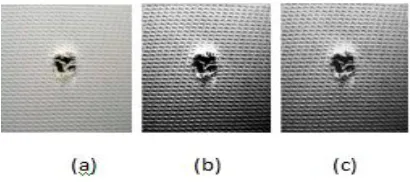
Dual-tree discrete wavelet transform (DWT) provides advantages over the critically sampled DWT for signal and image processing. The dual-tree DWT is implemented as two separate two-channel filter banks. The double-density and dual-tree transforms achieve directional selectivity and approximate shift invariance. Following figure 2 shows the result of preprocessing and 2D dual tree double density DWT.
Figure 2. Hole type defect (a) Input, (b) Histogram equalizes image, (c) 2D dual tree double density DWT.
Available Online at www.ijpret.com 58
Feature Extractor
Here we are using gabor filter for feature extraction. Gabor filters are bandpass filters which are used in image processing for feature extraction, texture analysis, and stereo disparity estimation. A set of Gabor filters with different frequencies and orientations may be helpful for extracting useful features from an image. The features extracted using Gabor filters represent the local information in the image. We can take features from the amplitude or phase after convolving the complex Gabor filters with the image. Gabor filter extracts the Gabor features of an input image. It creates a column vector, consisting of the Gabor features of the input image. The feature vectors are normalized to zero mean and unit variance.
The complex gabor function of spatial 2D Gabor Filter is used here which is given by equation
g(x, y) = K exp (-π (α2 (x -x
0)r2 + β2 (y-y0)r2))
exp (j (2πF0 (x cos 𝑤0 + y sin 𝑤0) + P))
Where,
K : Scales the magnitude of the Gaussian envelope.
(α, β) : Scale the two axis of the Gaussian envelope.
𝜃 : Rotation angle of the Gaussian envelope.
(x0, y0) : Location of the peak of the Gaussian envelope.
(F0, 𝑤0): Spatial frequencies of the sinusoid carrier in in polar coordinates.
P : Phase of the sinusoid carrier.
PCA dimension reduction
Available Online at www.ijpret.com 59
Neural network classifier
For defect identification and classification we are using adaptive neuro-fuzzy inference system (ANFIS) which is a part of artificial neural networks. Neuro-adaptive learning techniques provide a method for the fuzzy modeling procedure to learn information about a data set. Using a given input/output data set, ANFIS constructs a fuzzy inference system (FIS) whose membership function parameters are tuned (adjusted) using either a back-propagation algorithm alone or in combination with a least squares type of method. Here back-propagation algorithm is used.
IV ALGORITHM AND CLARIFICATION IN BRIEF
Algorithm
Stage 1- Pre-processing:
1. First the image is resized.
2. Conversion of RGB image into gray image.
3. Histogram Equalization.
Stage 2- Wavelet frames:
1. Create the first-stage analysis and synthesis filters for the two trees.
2. Create the analysis and synthesis filters for subsequent stages.
3. Apply forward real 2D dual-tree double-density four levels DWT.
4. Apply inverse real 2-D dual-tree double-density DWT.
Stage 3- Gabor feature extraction
1. Create Gabor filters:
Inputs: No. of scales, No. of orientations, No. of rows in a 2-D Gabor filter, No. of columns in a 2-D Gabor filter usually set to 5,8,39,39 respectively.
Output: A u by v array, element of which are m by n matrices; each matrix being a 2-D Gabor filter.
Available Online at www.ijpret.com 60
Filter input image by each Gabor filter
Extract feature vector from input image.
A column vector is created. This vector is the Gabor feature vector of an m by n image.
Stage 4- PCA
Dimension reduction can be done by using principal component analysis.
Calculating the mean; returns a row vector containing the mean of the elements in each column.
Compute covariance matrix
Perform eigen decomposition of covariance matrix.
Sort eigenvectors in descending order.
Stage 5- Neural networks
At this stage defects in textile fabric can be identified and if there is any defect then it is classified using back propagation algorithm of adaptive neuro fuzzy inference system.
Clarification in brief
First in pre-processing stage the RGB image is resized and converted into grayscale image. Then contrast enhancement is done on the grayscale image. It gives histogram equalized image. Histogram equalization is a method in image processing of contrast adjustment using the image's histogram. This method usually increases the global contrast of many images, especially when the usable data of the image is represented by close contrast values. Through this adjustment, the intensities can be better distributed on the histogram. This allows for areas of lower local contrast to gain a higher contrast. Histogram equalization accomplishes this by effectively spreading out the most frequent intensity values. The histogram equalized image is given to next stage that is wavelet frames.
Available Online at www.ijpret.com 61 which gives an output array. 2D analysis filter bank gives low-pass and high-pass subbands while 2D synthesis filter bank gives an output array.
Output of the stage wavelet frames given to the feature extractor. Gabor filter is used for feature extraction. At this stage first the gabor filter bank is created. A set of Gabor filters with different frequencies and orientations may be helpful for extracting useful features from an image. That’s why gabor filter bank generated. For this number of scales, number of orientations, number of rows in a 2D Gabor filter, number of columns in a 2D Gabor filters are usually set to 5, 8, 39, 39 respectively which gives an output array. Then to extracts gabor feature vector the input image can be filtered by each Gabor filter and ct feature vector extracted from input image which is normalized to zero mean and unit variance. And a column vector is created. This vector is the Gabor feature vector of an m by n image. The value of feature vector is 655360×1 of the class double. The gabor array is of 5×8 cell and each cell contains matrix of 39×39. This output is given to principal component analysis which reduces dimension of the data by means of data compression basics. As in PCA a row vector is created, each row vector is of 1×655360 of the class double. At last defects in textile fabric can be identified and if there is any defect then it is classified using back propagation algorithm of adaptive neuro fuzzy inference system.
V. EXPERMENTAL RESULTS
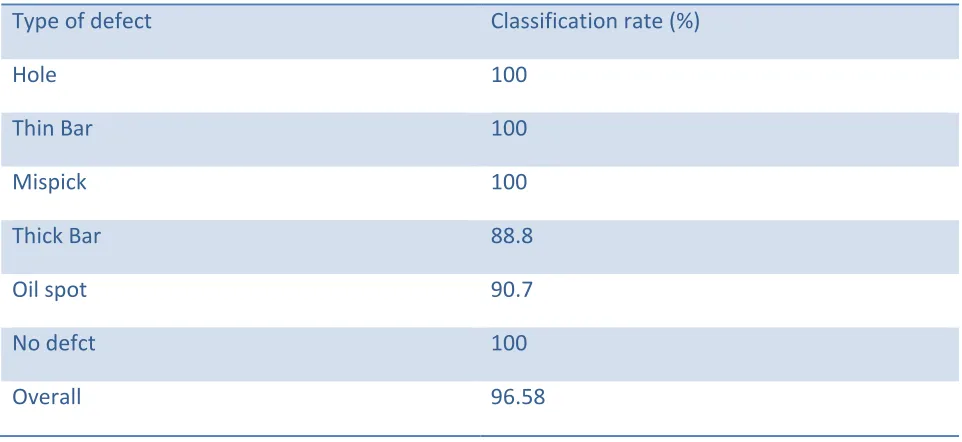
Table 1. Classification performance of variety of defects.
Type of defect Classification rate (%)
Hole 100
Thin Bar 100
Mispick 100
Thick Bar 88.8
Oil spot 90.7
No defct 100
Available Online at www.ijpret.com 62 (a) (b) (c)
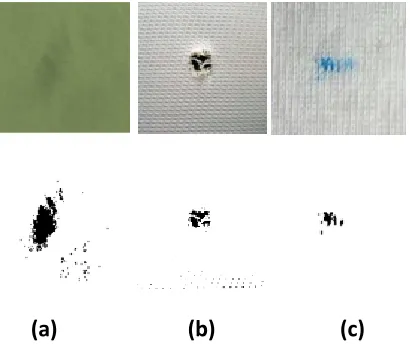
Figure 4.1: Results of sample images with Various Defects (a) Oil Spot (b) Hole (c) Dirty Yarn
VI. CONCLUSION
In this paper textile fabric defect identification and classification is executed. Wavelet frames are applied then the features are extracted by gabor filter and dimension reduction can be done by means of PCA. At last to improve fault classification ANFIS is applied. Experimental results show that proposed method is efficient and provides 96.58% overall classification.
REFERENCES
1. K Srinivasan, P.R. Dastoor, P. Radhakrishnaiah and S. Jayaraman, "FDAS: A knowledge based Framework for Analysis of Defects in Woven Textile Structures", J. Text. Inst., vol. 83, Part 1, no. 3, pp 431-448, 1992.
2. K. Schicktanz, "Automatic fault detection possibilities on nonwoven fabrics", MelliandTextiberichte, pp 294-295, 1993.
3. A. Kumar, "Computer-Vis ion-Based Fabric Defect Detection: A Survey," IEEE Transactions on Industrial Electronics, vol. 55, no. 1, pp.348 - 363, 2008.
4. M. Unser, “Texture classification and segmentation using wavelet frames”, IEEE Trans. on Image Processing, vol. 4, no. 11, pp. 1549-1560, Nov. 1995.
Available Online at www.ijpret.com 63 6. Xuezhi Yang, Grantham Pang and Nelson Yung, “Fabric Defect Classification Using Wavelet Frames and Minimum Classification Error Training”, pp. 290-296, 2002.
7. Rudra Pratap Singh Chauhan, Sanjay Singh and Sanjeev Kumar Shah, “A Practical Approach of Complex Dual Tree DWT for Image Quality Improvement and De-noising”, International Journal of Modern Engineering Research (IJMER), Vol. 1, Issue. 2, pp. 632-636.