
Available Online at www.ijpret.com
56
INTERNATIONAL JOURNAL OF PURE AND
APPLIED RESEARCH IN ENGINEERING AND
TECHNOLOGY
A PATH FOR HORIZING YOUR INNOVATIVE WORK
AN EVALUATION OF CYCLOTRON EFFECTIVE MASS AND ELECTRON G-FACTOR IN
SEMICONDUCTOR QUANTUM WELL
RAJKISHORE PRASAD1, L. K. MISHRA2
1. Department of Physics, Magadh University, Bodh-Gaya (Bihar).
2. Department of Physics, R. L. S.Y. College, Anisabad-Patna (Bihar).
Accepted Date: 29/03/2014 ; Published Date: 01/06/2014
\
Abstract: Using the theoretical formalism of M. De Dios-Leyva etal (2006), we have evaluated the cyclotron effective mass, 2D cyclotron effective mass and g11-factor for
GaAs-Ga0.65Al0.35As quantum well both as a function of magnetic field B (T) and also as a function
of well width. Our theoretically evaluated results are in good agreement with the experimental data and also with other theoretical workers.
Keywords: Cyclotron effective mass g -factor, Semiconductor quantum well, effective mass approximation, Landau states, quantum well wires (QWWs), quantum Dots (QDs), super lattices (SLs)
Corresponding Author: MR. RAJKISHORE PRASAD
Access Online On:
www.ijpret.com
How to Cite This Article:
Available Online at www.ijpret.com
57
INTRODUCTION
The understanding of the physics of wells (QWs), and quantum well wires (QWWs), Quantum dots (QDs) and superlattices (SLs) has been a great interest to solid state physics, several studies have been performed to evaluate the physical properties of these systems1-6. The possible use of electron spins in the architecture of solid state based quantum computer has raised special attention in the study of the behaviour of the electron spin coupled with the external magnetic field. In such type of studies the fundamental importance has been given that no loss can occur when the spins transport information. This goal may be achieved by manipulating the electron g-factor in semiconductor hetrostructure and designing appropriate external gate control devices. The cyclotron effective mass and electronic g-factor have possible application and also in the interpretation of experimental date in this research. These factors play an important role in the magneto-optical and magneto-transport studies optically detected nuclear response experiments, spin electronic and quantum beats measurements. These are also applied the integer quantum Hall Effect.
For the calculation of electron g-factor and cyclotron effective mass one needs the detailed understanding of the interaction between the external applied magnetic field and the electronic state of semiconductor hetrostructure. One new technique like electron spin resonance, spin quantum beats, spin Raman scattering experiments and capacitance and energy spectroscopic. Lattice effects on the orbital contribution, quantum confinement and applications of hydrostatic pressure and external electric/magnetic field may considerably modify conduction electron g-factor both in magnitude and sign in different semiconductor hetrostructure. Theoretical point of view both electron g-factor and cyclotron effective mass provide an excellent tool for testing the band structure electronic calculation in the dimensional semiconductor hetrostructure.
In this paper, we have evaluated cyclotron effective mass (Mc/Mo) and 2D cyclotron effective mass (M2D/Mo) as a function of magnetic field B (T). We have also evaluated (mc/mo) and g11
factor as a function of well width (A0) for GaAs and Ga0.65Al0.35As QW keeping (L=50A0). Our
theoretical evaluated results are in good agreement with the experimental data.
MATERIALS AND METHODS
One uses Ogg-McCombe Hamiltonian 11-18 within the effective mass approximation and in the
Available Online at www.ijpret.com
58
degenerate conduction band of the bulk materials of the GaAs-Ga1-xAl As quantum well under
an applied magnetic field parallel in the growth z-direction. This is written as
2 4 1 * 1 .
2 2 B z
H K I g B a K I
m
+ (1)
2 2 2 2
2
3 4
4 [{ x, y } { y, z}] z
B a
I a k k k k I a B
l
+
2
5{ . , z } 6 z z ( ) a K k BI a B k V z I
Where is the 2x2 unit matrix ̅
ˆ ˆ ˆ
/
K keA c
ˆ
K i
Landau gauge is used for the vector potential
ˆ ˆ
A yBx
ai = 1-6 are constants taken from ref. 14 for equal values for the well and barrier materials.
V(z) is square well confining potential taken from Ga1-x AlxAs and GaAs band gap offset.19
m* and g are the z-growth direction position dependent conduction electron effective mass and Landu g-factor.
Γ is constant associated with spin orbit term (due to the fact that GaAs has no. inversion
symmetry), B
c l
eB
is the Landau length, μβ is the Bohr magnetronˆ ( ˆx, ˆy, ˆz)is the Pauli
matrices and ˆis a vector operator with components such as ˆx k k kˆ ˆ ˆy x yk k kˆ ˆ ˆz x z and corresponding cyclic permutation. The above Hamiltonian is a 2 x 2 conduction band effective Hamiltonian.13-15 This Hamiltonian includes effects of non-parabolicity by taking into account
the coupling between the lowest Г6cconduction band, Г7νand Г8νvalance bands and the Г7c and
Г8c p - anti bonding conduction bands.
The 2nd.term in RHS of eqn. (1) is the Zeeman contribution, the second order in k
spin dependent term (with the factor a4, a5, and a6) together with the third one is spin orbit
Available Online at www.ijpret.com
59
The terms in a1 and a3 govern the energy dependence of the Cyclotron effective mass where as
term with a2 gives the diamagnetic shift of the Landau electronic length.
Let the Eigen function of H be
( ) ( , )
ikx
x e
r y z
L
(2)
Here kx is good quantum number as Hˆdoes not depend on x explicitly. Lx is QW length along x
direction. ( )x
and ( , )y z are two component wave function.
Now we write the Hamiltonian20,21
0
ˆ ˆ ˆ
H H W (3)
whereWˆis the perturbed Hamiltonian and may be neglected. This only contributes small
correction to the energy levels.22 The Eigen function of H orHˆ( ˆ0)may be written as
,
1
( ) iK xx ( ) ( )
n n m
x
r e y f z
L (4) and 0 1 ( ) ( ) , ( ) x iK x n n x r e
y f m z L
(5)
Where the symbols ± corresponds to (↑) spin up and (↓) spin down states respec vely. Eigen
functions n( )y is 1D harmonic oscillator is given by
2
0 0
1 1 2
2 2
( )
1
( ) ( )
2 [ !2 ]
n n
n B B
B
y y y y
y e H
l l n l (6)
Where Hn are the Hermite polynomials, yo=Kxl is the orbit centre position and En=ћ c(n+1/2)
Available Online at www.ijpret.com
60
fn,m± (z) and is associated with the electronic levels En m,
. This indicates En m,
m-th QW confined energy and n=0, 1, 2, ... for given m represents the corresponding sub bands energy level.24
The Cyclotron effective mass is given by
, , 1 / [ ( ) ( )] c n n eB c m
E B E B
(7)
The two-dimensional (2D) Cyclotron effective mass is given as
2 , ,
( / )( 1/ 2)
[ ( ) ( 0)]
D
n n
eB c n m
E B E B
(8)
The parallel g-factor is
[ n( ) n( )]
B
E B E B
g B (9)
RESULTS AND DISCUSSIONS
In this paper, using the theoretical formalism developed by M. De. Dios-Leyva etal, 25 we have theoretically evaluated electronic Landau level energy, Cyclotron effective mass (Mc/mo), 2D
Cyclotron effective mass (m2D/mo) and g11-factor for L=50Ao GaAs-Ga0.65Al0.35As QW as a
function of as a function of the growth direction applied magnetic field. The results are shown in table T1, T2, T3 and T4 respectively. We have also evaluated cyclotron effective mass (mc/mo)
for GaAs-Ga0.65Al0.35As QW as a function of well width. The theoretical results were compared
with experimental data I25 and II26. The results are shown in table T5. In another evaluation, we
have obtained the theoretical result of g11-factor for GaAs-Ga0.65Al0.35As QW as a function of
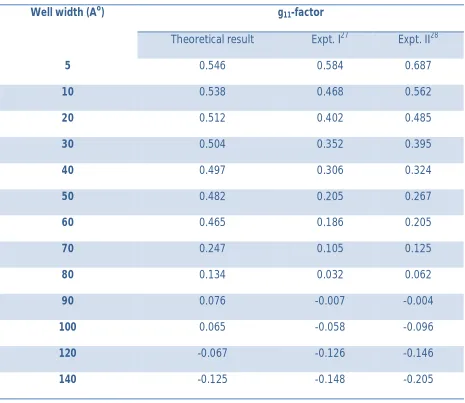
well width (A˚). The results are compared with another two experimental data I27 and II which is shown in table T628.
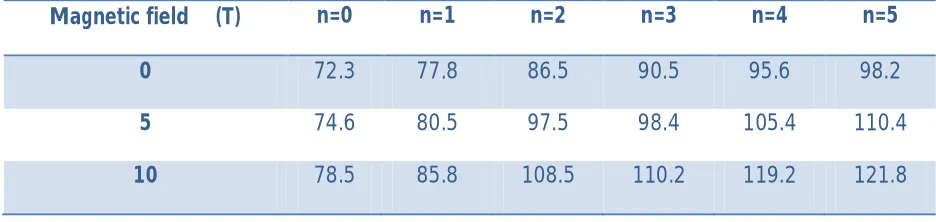
In table T1, we have shown the electronic levels of the first m=1 sub bands of Landau levels. The
non-linear behaviour of the E n m,
Available Online at www.ijpret.com
61
and T3. We have evaluated Cyclotron mass (mc/mo) for GaAs-Ga0.65Al0.35As QW (L=50Ao) for n=0,
1, 2, 3 and 4 keeping m=1. Our evaluated results of (mc/mo) increases as a function of (T) for
all n. The increase is linear for two values of n and nonlinear for large value of n. Similar behaviour is also observed for 2D cyclotron mass as a function of (T) shown in table T3. The first dependent g11-factor is shown in table T4. In this case also our evaluated results increases
as a function of (T) for all values of n. It appears that field depends on g11 factor is due to the magnetic field effect on the electronic Landau states as well as to the confinement or barrier penetration of the electron wave function due to the presence of Ga0.65Al0.35As barrier. We
have also calculated Cyclotron effective mass (mc/mo) and g11 factor both as a function of well
width (Ao) for GaAs-Ga0.65Al0.35As QW. The calculated result were compared with the
experimental data I26 and II27 for (mc/mo) shown in table T5 and another experimental data I28
and II29 for g factor shown in table T6. Our evaluate results of (mc/mo) is larger in magnitude
for experimental data I and small for experimental data II as a function of well width. The evaluated results of (mc/mo) decrease as a function of well width as per experimental
observation. Similar trend is also obtained for g factor. There is some recent results30-36 which also reveal the similar behaviour.
CONCLUSION:
In this paper, we have evaluated cyclotron effective mass (mC/m0) and g11 factor both as a
function of well width for GaAs-Ga0.65Al0.35As QW. We observe that both (mC/m0) and g11
decreases as a function of well width. Our evaluated results are larger in magnitude with experimental results but trends are same with expt.
Table T1
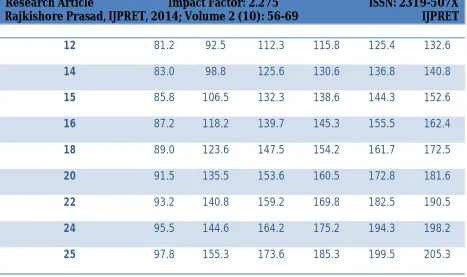
An evaluated results of electronic Landau levels as a function of the growth direction applied magnetic field for L=50Ao, GaAs-Ga0.65Al0.35As Quantum Well for m=1 sub-bands of Landau
states.
Magnetic field (T) n=0 n=1 n=2 n=3 n=4 n=5
0 72.3 77.8 86.5 90.5 95.6 98.2
5 74.6 80.5 97.5 98.4 105.4 110.4
Available Online at www.ijpret.com
62
12 81.2 92.5 112.3 115.8 125.4 132.6
14 83.0 98.8 125.6 130.6 136.8 140.8
15 85.8 106.5 132.3 138.6 144.3 152.6
16 87.2 118.2 139.7 145.3 155.5 162.4
18 89.0 123.6 147.5 154.2 161.7 172.5
20 91.5 135.5 153.6 160.5 172.8 181.6
22 93.2 140.8 159.2 169.8 182.5 190.5
24 95.5 144.6 164.2 175.2 194.3 198.2
25 97.8 155.3 173.6 185.3 199.5 205.3
Table T2
An evaluated results of Cyclotron effective mass (mc/mo) for GaAs-Ga0.65Al0.35As QW as a
function of growth direction magnetic field (m=1), L=50Ao.
(T) ---(mc/mo)--- (m=1)
n=0 n=1 n=2 n=3 n=4
0 0.082 0.084 0.092 0.096 0.104
5 0.084 0.088 0.098 0.102 0.108
10 0.086 0.090 0.104 0.108 0.112
15 0.089 0.094 0.105 0.114 0.115
18 0.090 0.098 0.110 0.118 0.120
20 0.092 0.102 0.114 0.122 0.125
Available Online at www.ijpret.com
63
24 0.096 0.109 0.122 0.130 0.132
25 0.098 0.112 0.126 0.134 0.136
28 0.102 0.114 0.129 0.138 0.140
30 0.104 0.118 0.130 0.142 0.145
Table T3
An evaluated results of 2D Cyclotron effective mass (m2D/mo) for GaAs-Ga0.65Al0.35As QW for
L=50Ao as a function of growth direction magnetic field (T).
(T) ---(m2D/mo)--- (m=1)
n=0 n=1 n=2 n=3 n=4
0 0.080 0.082 0.084 0.089 0.092
5 0.081 0.086 0.088 0.092 0.099
7 0.083 0.089 0.090 0.096 0.106
9 0.085 0.092 0.096 0.099 0.112
10 0.088 0.095 0.099 0.103 0.118
12 0.091 0.099 0.102 0.109 0.122
14 0.094 0.105 0.107 0.112 0.125
15 0.097 0.108 0.115 0.118 0.129
18 0.099 0.112 0.120 0.125 0.135
20 0.102 0.115 0.126 0.130 0.138
22 0.106 0.118 0.129 0.135 0.142
Available Online at www.ijpret.com
64
25 0.112 0.124 0.136 0.142 0.146
28 0.115 0.128 0.139 0.144 0.150
30 0.118 0.130 0.142 0.147 0.152
Table T4
An evaluated results of g11 factor for L=50Ao GaAs-Ga0.65Al0.35 QW as a function of the growth
dimension applied magnetic field.
(T) ---(g11-factor)--- (m=1)
n=0 n=1 n=2 n=3 n=4
0 0.122 0.124 0.132 0.204 0.217
5 0.124 0.128 0.206 0.247 0.268
7 0.126 0.132 0.258 0.268 0.305
9 0.128 0.136 0.297 0.358 0.362
10 0.130 0.139 0.325 0.392 0.428
12 0.134 0.143 0.367 0.435 0.495
14 0.136 0.146 0.405 0.495 0.573
15 0.138 0.149 0.435 0.558 0.645
17 0.140 0.156 0.468 0.592 0.708
19 0.144 0.159 0.506 0.675 0.786
20 0.148 0.163 0.558 0.706 0.825
22 0.152 0.168 0.605 0.768 0.889
Available Online at www.ijpret.com
65
26 0.159 0.178 0.703 0.855 0.962
28 0.163 0.184 0.768 0.903 1.032
30 0.165 0.190 0.804 0.947 1.057
TableT5
An evaluated result of Cyclotron effective mass for GaAs-Ga0.65Al0.35 QW as a function of well
width (Ao) Theoretical results were compared with expt. I and expt. II
Well width (Ao) Cyclotron Effective Mass (mc/mo)
Theoretical Expt. I25 Expt. II26
5 0.115 0.109 0.118
10 0.108 0.104 0.114
15 0.102 0.100 0.109
20 0.097 0.093 0.107
30 0.092 0.089 0.103
40 0.086 0.085 0.092
50 0.084 0.080 0.087
60 0.080 0.076 0.083
70 0.076 0.072 0.080
80 0.073 0.069 0.076
90 0.070 0.066 0.072
100 0.069 0.062 0.069
Available Online at www.ijpret.com
66
120 0.065 0.058 0.062
130 0.062 0.056 0.060
150 0.060 0.054 0.058
Table T6
An evaluated result of g11-factor for GaAs-Ga0.65Al0.35As QW as a function of well width The
theoretical results were compared with the experimental result I and II.
Well width (Ao) g11-factor
Theoretical result Expt. I27 Expt. II28
5 0.546 0.584 0.687
10 0.538 0.468 0.562
20 0.512 0.402 0.485
30 0.504 0.352 0.395
40 0.497 0.306 0.324
50 0.482 0.205 0.267
60 0.465 0.186 0.205
70 0.247 0.105 0.125
80 0.134 0.032 0.062
90 0.076 -0.007 -0.004
100 0.065 -0.058 -0.096
120 -0.067 -0.126 -0.146
Available Online at www.ijpret.com
67
150 -0.246 -0.257 -0.269
160 -0.324 -0.305 -0.325
180 -0.364 -0.348 -0.355
200 -0.405 -0.386 -0.402
REFERENCES:
1. R. Kohler, A. Tredicueci, F. Beltron, D.A. Ritchie, R. C. Iotti and F. Rosei, Nature 417, 156 (2002)
2. R. C. Iotti and R. Rossi, Phys. Rev. Lett. (PRL) 80, 1864, (2001)
3. O. S. Andreu, W. Schrenk, E. Gornik and G. Strasser, Appl. Phys. Lett. 83, 4693 (2003)
4. R. Kohler, A Tredicucci, F. Beltron, D. A. Ritchie and A. G. Davies, Appl. Phys. Lett. 80, 1867, (2002)
5. I. Zutic, J. Fabiaz and S. Das Sarna Rev. Met. Phys. 76, 323, (2004)
6. Y. K. Kato, R. C. Myers, A. C. Gossard and D. D. Awschalom, Scence 306, 1910 (2004)
7. M. Dobers, K. Von Klitzing and G. Weimann, Phys Rev. B38, 5453 (1988)
8. V. F. Sapeya, T. Tef., M. Cardona, K. Ploog, E. L. Ivchenko and D. N. Mirlin, Phys, Rev. B50, 2510 (1994)
9. G. Medeiros – Ribeiro, M. V. B. Pinbeiro, V. L. Pimentel and E. Mareya, Appl. Phys. Lett., 80, 4229 (2002)
10.A. S. Bracker, E. A. Stinaff, D. Gammor, M. E. Ware, J. G. Tischler, A. Shabaev, D. Park, D. Gershoni, V. L. Korener and I. A. MErkuler, Phys. Rev. Lett. (PM) 94, 047 402 (2005)
11.N. R. Ogg, Proc. Phys. Soc. 89, 43, (1966)
12.B. O. Mc Combe, Phys. Rev. 181, 1206 (1969)
Available Online at www.ijpret.com
68
14.V. G. Golaber,V. I. Ivaner-omski, I. G. Minervin, A. V. Osatin and D. G. Polyaker, Sov. Phys. JETP 61, 12 14 (1985)
15.G. Lommer, F. Malcher and U. Rossler, Supper Lattice and Microstrant, 2, 273 (1986)
16.M. De Dios-Leyva, J. Lopez-Gondar and J. Sabin del Valle, Phys. Stat. Sol. (b) 148, K113 (1988)
17.J. Sabin del Valle, J. Lopez-Gondar and M. De-Dios-Legva, Phys. Stat Sol, K, 151, 127, (1989)
18.E. L. Fvchenko and A. A. Kiselor, Sov. Phys. Semicond. 26, 827 (1992)
19.A. Bruno-Altonso, L. Diago-Cisneros and M. De Dios-Leyva, J. Appl. Phys. 77, 2387 (1995)
20.E. H. Li, Physica E5, 215 (2000)
21.G. Dresselhavs, Phys Rev., 100, 580, (1955)
22.T. Kuhn and F. Rossi, Phys. Rev. B46, 7496 (1992)
23.C. Jaeoboni and L. Reggiani, Rev. Med. Phys., 55, 645 (1983)
24.S. Kumar, B. S. Williams, Q. Hu and J. L. Rend, Appl. Phys. Lett., 88, 121123 (2006)
25.M. De. Dios-Leyva, N. P. Montenegro, H. S. Brandi and L. E. Oliveira Brazillian J. Of Phys. 36, 854, (2006)
26.J. Singleton, R. J. Micholas and D. C. Rogers, Surf. Sci. 196, 729, (1988)
27.J. G. Michels, R. J. Warbuton, R. J. Micholas, J. J. Harsi and C. T. Foxon, Physica B184, 159 (1993)
28.P. Le. Jeune, D. Robert, X. Marie, T. Amand, M. Brossech and D. Radicher, Sem. Sc. Tech. 12, 380 (1997)
29.A. Malinowski and R. T. Harley, Phys. Rev. B62, 2051 (2000)
30.M. C. Bafino, P. Sen and P. K. Sen, Ind. J. Pure & Appl. Phys. 42, 949 (2007)
31.A. G. Silva, C. A. Para- Murillo, P. T. Moraus and M. Hopkinsen, Opt. Express, 16, 19201 (2008)
Available Online at www.ijpret.com
69
33.X. G. Peralta, I Brener, W. J. Padila, E. W. Young and J. Reneo, Matamaterials (Amsterdam) 4, 83 (2010)
34.A. Gabbay, J. Reneo, J. R. Wendl, A. Gin, M. C. Wanka and I Brener, Appl. Phys. Lett.(APL) 98, 203103 (2011)
35.Y. Todorov and C. Sirtori, Phys. Rev B85, 045304 (2012)


![Chlorido{N [(E) 2 (diphenylphosphanyl)benzylidene] 2 (thiophen 2 yl)ethanamine κP}gold(I)](data:image/gif;base64,R0lGODlhAQABAIAAAP///wAAACH5BAEAAAAALAAAAAABAAEAAAICRAEAOw==)